Sample Category Title
EUR/USD Bracing For Next Upside Break?
Key Highlights
- The Euro traded higher recently, but it struggled to break the 1.1490 resistance against the US Dollar.
- There is a major contracting triangle in place with resistance at 1.1465 on the 4-hours chart of EUR/USD.
- The US Pending Home Sales in Nov 2018 declined 0.7% (MoM), less than the last -2.6%.
- Today in the US, the Dallas Fed Manufacturing Business Index for Dec 2018 will be released, which is forecasted to rise to 18.5.
EURUSD Technical Analysis
The Euro made a nice upward move this past week and broke the 1.1400 and 1.1450 resistance levels against the US Dollar. However, the EUR/USD pair struggled once again to clear the 1.1480-1.1500 resistance zone.
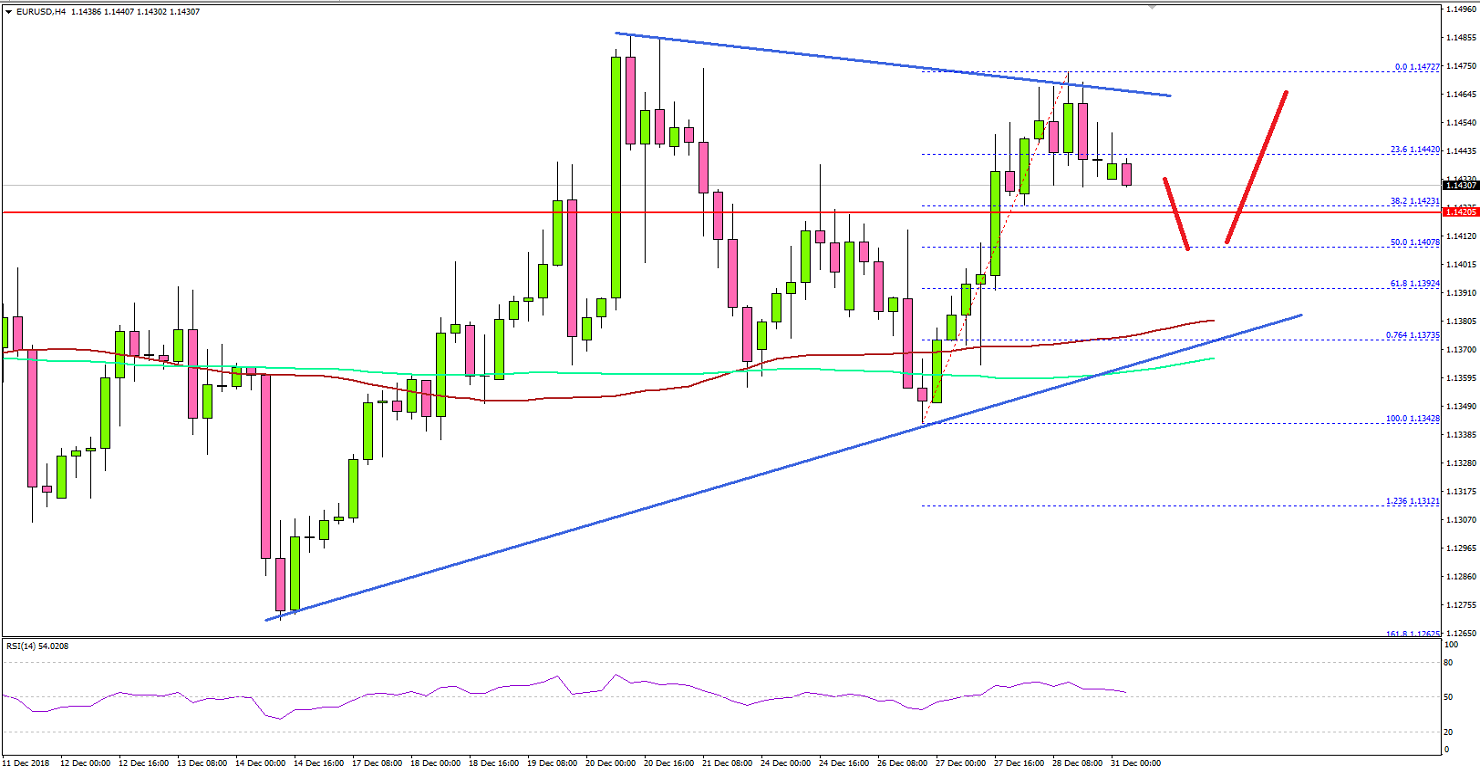
Looking at the 4-hours chart, the pair made many attempts to break the 1.1480-1.1500 resistance zone, but buyers struggled to gain momentum. The recent high was formed at 1.1472 and later the pair started consolidating gains.
It broke the 1.1440 support and the 23.6% Fib retracement level of the last wave from the 1.1342 low to 1.1472 high. It seems like the pair may continue to move down and it could test the 1.1420 support.
The next main support is at 1.1405 and the 50% Fib retracement level of the last wave from the 1.1342 low to 1.1472 high. On the upside, the pair needs to break the 1.1470 and 1.1480 resistance levels to gain momentum.
Moreover, there is a major contracting triangle in place with resistance at 1.1465 on the same chart. Therefore, the pair seems to be preparing for the next move either above 1.1480 or towards 1.1400.
As long as the pair is above the 1.1400 support and the 100 simple moving average (red, 4-hours), buyers remain in control for a fresh upward move above the 1.1480 resistance.
Recently in the US, the Pending Home Sales report for Nov 2018 was released. The market was looking for a 0.7% decline in sales compared with the previous month.
The result was similar, but it was better than the last decline of -2.6%. However, the yearly change was disappointing since there was a decline of 0.7%, more than the last -6.7%.
Overall, EUR/USD is placed nicely above the 1.1400 support and it could make another attempt to clear the 1.1480 resistance area.
Economic Releases to Watch Today
- Dallas Fed Manufacturing Business Index for Dec 2018 – Forecast 18.5, versus 17.6 previous.
Asia Market Update: Trump and Xi Speak Over the Weekend on Trade
Asia Market Update: China Manufacturing PMI contracts for first time since 2016, muted impact seen amid multiple market closures; Trump and Xi speak over the weekend on trade
General Trend:
- Market closures for today's session include China, Japan and South Korea; Hong Kong and Australia have shortened sessions
- US equity futures gain: Trump said trade deal with China is 'moving along very well' without being too specific
- Crude Oil and Copper Futures gain in Asian trading; Natural gas declines
- USD trades mixed across regional currencies
- Financials support markets in Hong Kong and Australia
- Hong Kong Hang Seng ends 2018 with its largest loss since 2011
- Partial US government shutdown continues, to enter 10th day as of Monday
- Some investors pare back Fed rate hike expectations (US financial press)
- Note all markets closed tomorrow for New Year's Day, coverage to resume January 2nd
Headlines/Economic Data
Japan
- Nikkei 225 closed
- (JP) Japan cosmetic exports set to gain for the 6th consecutive year, driven by tourists continuing to buy products they get on vacation – Nikkei
- (JP) Japan said to consider tax breaks related to cars with automatic breaks - Japanese Press
Korea
- - Kospi closed
- (KR) SOUTH KOREA DEC CPI M/M: -0.3% V 0.1%E; Y/Y: 1.3% V 1.7%E, Core CPI y/y: 1.3% v 1.3% prior
- (KR) South Korea Nov Department Store Sales y/y: -3.9% v +1.2% prior; Discount Store Sales y/y: -2.8% v -14.3% prior
- (KR) South Korean commercial banks expected to record a decline of KRW2.0T in net earnings in 2019 – Yonhap
- (KR) North Korea leader Kim sends letter to South Korea President Moon calling for continued efforts to build peace and prosperity on the Korean Peninsula next yea – Yonhap
- 017670.KR Taxi hailing app, T Map Taxi, reports 13-fold increase in users to 1.21M in Dec from 93K in Oct – Yonhap
- (KR) South Korea Finance Min Hong: Reiterates 2019 economic conditions could be difficult, to focus on revitalizing the economy
- (KR) Bank of Korea (BOK) Gov Lee: See need to maintain accommodative stance in 2019 - New Years message
China/Hong Kong
- Hang Seng opened +0.9%, Shanghai Composite closed
- (CN) CHINA DEC OFFICIAL MANUFACTURING PMI: 49.4 V 50.0E; Non-Manufacturing PMI: 53.8 v 53.2e; Composite PMI: 52.6 v 52.8 prior (1st time below 50 since July 2016, lowest since Feb 2016)
- (US) Pres Trump says China trade deal is "moving along very well", spoke to Pres Xi this morning; Xi hopes to reach mutually beneficial agreement (Saturday)
- (HK) According to analysts home prices in Hong Kong could fall 10-25% in 2019, with biggest fall expected in H2 - SCMP
- (US) US grants ~1.0K exceptions to tariffs on goods from China, including industrial machinery and electronics parts
- (CN) China Foreign Ministry spokesperson Lu Kang: China stands ready to work with the United States to move forward the China-U.S. ties which are underpinned by coordination, cooperation and stability – Xinhua
- (CN) China legislature approves plans to speed up local government bond issuance before the approval of the annual fiscal budget; for 2019 State Council can assign CNY1.39T in bonds to local govts - China Daily
- (CN) China Supreme Court plans to begin to hear cases related to intellectual property rights from Jan 2019 - financial press
- 272.HK Unit to acquire all remaining interests held by BSREP CXTD Holding (affiliate of Brookfield Asset Management) in China Xintiandi Holding for ~HK$4.1B, China Xintiandi to become wholly-owned unit following the transaction
- (CN) China has restarted approvals of video games with 80 online video games – press
- (CN) China customs bureau to allow imports of U.S. rice, effective Dec 27th - press
- (CN) China PBoC Dir of Monetary Policy Sun Guofeng: China's position on monetary policy had not changed; PBoC will not flood the market with liquidity - press
- (HK) Overnight HK$ HIBOR reaches 4.6% (highest level since Oct 2007)
Australia/New Zealand
- ASX 200 opened +0.1%
- GXY.AU Received several offers from possible partners on Sal de Vida project, evaluating offers
- WGX.AU Accepts offer to sell non-core Mt. Marion and Buldania lithium royalties to Cobalt 27 for A$250k and 200 metric tonnes of physical cobalt metal
North America
- (US) US Senator Shelby (R) said the talks related to government funding were at an impasse, shutdown could last a 'long,long time' - US media
- (US) US Senator Graham (R) said President Trump is 'receptive' to idea related to deal for government shutdown, deal could provide work permits for 'Dreamers' in exchange for funds related to border barriers - financial press
- (US) Texas judge rules Affordable Care Act ('Obamacare') to remain in place during appeal - US Press
- (US) US Fed Fund Futures are pricing in 11% probability of Fed rate cut in 2019 v 2.4% earlier in Dec; Probability of at least 1 Fed rate hike in 2019 has declined to 15% vs 50% previously – US financial press
- (US) Goldman Sachs said to have reduced forecast for US Fed rate hikes, cited growth and financial conditions - US financial press
Europe
- (UK) Trade Secretary Fox says there is a 50/50 chance that the Brexit may be stopped if Parliament votes against the deal proposed by the govt - Sunday Times
- (UK) Fin Min Philip Hammond being accused by Cabinet of failing to provide money needed to prepare UK for no-deal Brexit – Telgraph
- (UK) EU Juncker said not trying to keep the UK in the EU - financial press
- (IT) On Saturday, Italy parliament passed the 2019 budget (as expected), the vote was 327 to 228 - financial press
- DBK.DE Chairman Achleitner said the firm is 'strong', has no need for state aid or merger - financial press
Levels as of 11:50ET
- Hang Seng +1.3%; Shanghai Composite closed; Kospi closed; Nikkei225 closed; ASX 200 -0.1%
- Equity Futures: S&P500 +0.7%; Nasdaq100 +0.9%, Dax closed; FTSE100 +0.4%
- EUR 1.1425-1.1450; JPY 110.28-110.47 ; AUD 0.7043-0.7067; NZD 0.6705-0.6721
- Feb Gold -0.2% at $1,280/oz; Feb Crude Oil +1.0% at $45.81/brl; Mar Copper +0.8% at $2.70/lb
China PMI manufacturing dropped to first contraction reading since 2016
The official China PMI manufacturing dropped to 49.4 in December, down from 50.0 and missed expectation of 50.0. It's also the first contractionary reading since July 2016, and the lowest since February 2016.
In the release, CLFP noted that China-US trade frictions are starting to direct and indirect impacts on the economy. Both domestic and external demand weakened. In particular, new orders dropped -0.7 to 49.7. New export orders dipped deeper into contraction by -0.4% to 46.6, lowest since 2016. Also, downward pressure on the economy increased in the second half as seen by the persistent decline in the PMI reading.
Also from China, PMI services rose to 53.8, up from 53.4, and beat expectation of 53.2.
Asian markets higher, yen low as Trump boasts big progress in US-China trade talks
Asian stocks are apparently lifted by Trump's tweet on the "big progress" in trade talks with China. Hong Kong HSI is up 1.27% at the time of writing. Singapore Strait Times is up 0.44%. Japan and China are on holiday though. But at the time time, gain is limited partly due to holiday, and partly on mixed China PMI data. In the currency markets, Yen is the weakest one for today so far while commodity currencies trade higher. but most are trading within Friday's range.
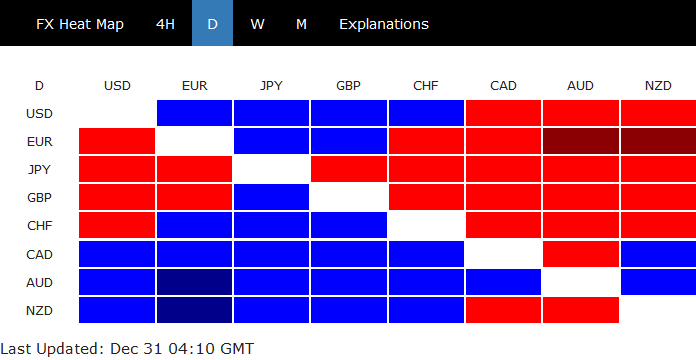
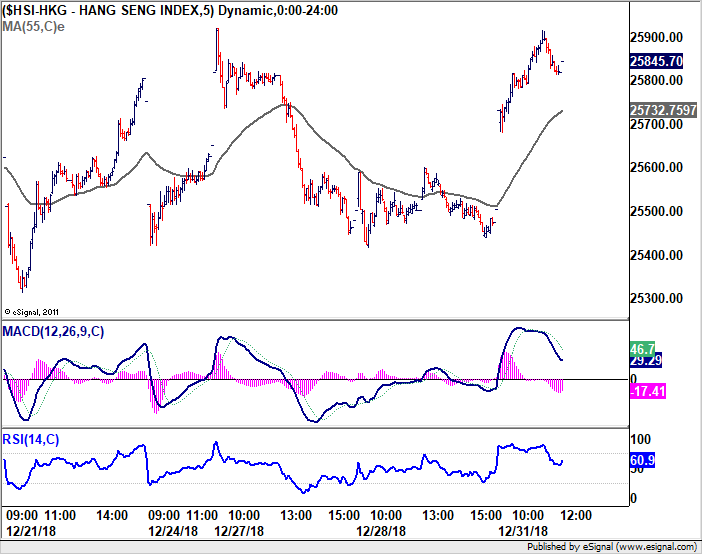
Trump tweeted over the weekend that "Just had a long and very good call with President Xi of China. Deal is moving along very well. If made, it will be very comprehensive, covering all subjects, areas and points of dispute. Big progress being made!". China's state media also said Xi believed both sides wanted "stable progress", and China-US ties had reached a "vital stage" on its 40th anniversary.
https://twitter.com/realDonaldTrump/status/1079045134061371392
It's reported that US delegation, led by Deputy U.S. Trade Representative Jeffrey Gerrish with Treasury Under Secretary for International Affairs David Malpass, will travel to China in the week of January 7 for face-to-face meeting.
2018 Financial Results and 2019 Forex Forecast
What Happened: Year 2018
As usual, Deutsche Bank experts summed up the year at the end of December. And the results were just fantastic, with a negative connotation. 93% of all assets fell in comparison with January 2018, and this figure was the worst in the last 118 years, surpassing even 1920 with its 84%.
Experts say that the main reason for the recession was “extremely soft monetary policy,” which grew into a monetary tightening. Four US interest rate increases by the US Federal Reserve were enough to send most of the markets to a nose dove, which can turn into a prolonged recession. US President Donald Trump openly called Fed Chairman Jerome Powell and his colleagues insane, calling for an end to the rate hike. But, as it turned out, the President could not decree bankers, and on December 19, the Federal Open Market Committee (FOMC) raised the rate by another 0.25%. Moreover, it turned out that in 2019 only two members of this Committee see a rate of 2.5%, six see it at 2.75%, four at 3.25%, three at 3.30%, and two FOMC members would like it to be 3.6%!
The result is obvious: at the end of the year, everything that could fall, was falling on the market. The Dow Jones Industrial Average had the worst December since the Great Depression of the 1930s. As Bloomberg calculated, the collapse made 500 world richest people poorer by $ 511 billion, and Facebook founder Zuckerberg suffered the most, his fortune lost $23 billion.
As for the foreign exchange market, the beginning of 2018 was marked by a serious strengthening of the euro against the US dollar. At the peak, on February 16, the EUR/USD pair reached 1.2555. But then the difference in the monetary policy of the Fed and the ECB, the difficulties with the Brexit agreement, the Italian problems and the slowdown in the Eurozone economy as a whole, played into the dollar, and the pair went down, reaching the bottom at 1.1215 in mid-November.
GBP/USD experienced similar fluctuations. It reached the maximum value of 1.4375 on April 17, and the minimum was recorded on December 12, when the pair fell to 1.2475, losing 1,900 points in eight months.
As for the Japanese yen, investors viewed it mainly as a safe haven in case of acceleration of trade wars between the USA and China. However, since no special changes were observed on this front, the USD/JPY pair met the end of the year near the Pivot Point of the last two years in the 111.00 zone. Thus, compared to the beginning of 2018. the pair lost only about 200 points.
What will Happen: Year 2019
According to a number of analysts, everything that happened in the outgoing year is only the beginning of a common prolonged depression. First of all, the forecast concerns the United States, where the yield on two-year Treasury bonds has already decreased, and the yield on similar ten-year securities has fallen to a seven-month low, which is considered a sign of recession.
The situation in the Eurozone looks somewhat better, despite the fact that the ECB has revised its forecasts for inflation and economic growth downward. The past year has shown that the trade wars unleashed by Trump are not so terrible for the Old World as was previously assumed. However, both the European currency and the British pound continue to be influenced by the problems associated with Brexit.
On the other hand, the end of the 90-day truce between the United States and China will soon come up, which introduces additional uncertainty about the dollar exchange rate.
In the meantime, the forecasts given by strategists from leading world banks and agencies, for the most part, look quite similar.
Blomberg bases its forecast on the positive dynamics of European exports, improved situation in the German automotive industry and accelerated growth of average wages. All this may lead to the normalization of the monetary policy of the Eurozone and the growth of the euro to the level of $1.20 by the end of the year.
Morgan Stanley also expects the year 2019 to be difficult for the dollar and recommends its sale against the euro amid the forecast for inflation in the Eurozone. The immediate target for the EUR/USD pair is in the $1.18 zone.
It should be noted that, for the most part, analysts make very optimistic forecasts for the euro for the next 3-month period. Societe Generale and CIBC Capital Markets point out at the level $1.17, TD Securities forecast is at $1.18, Unicredit at $1.19, and finally, Lloyds Bank has set a record bar of $1.24.
However, there are more cautious views. Thus, Citi experts believe that the European currency has not yet reached its bottom, and by the end of the I quarter of 2019. it may drop to $1.13, and only then it will go up, reaching the mark at $1.18 in the second half of the year. The Barclays Capital expect a fall to $1.12 by March 31, and for ING Group forecasts, the bottom may be at the level of $1.11.
JPMorgan Chase analysts also believe that the US economy will experience a recession in 2019, as Trump's fiscal stimulus will run out, and the Fed’s monetary policy will no longer provide cheap money. Thus, the growth rate of the Eurozone economy will come out ahead, and the euro will start to grow on expectations of higher interest rates from the ECB, but this will happen only in the second half of 2019.
In numbers, the forecast looks like this: falling to $1.11 in the first quarter and rising to $1.18 by the end of the fourth quarter of 2019.
As for the GBP/USD, the JPMorgan Chase forecast assumes the growth of the British currency to $1.30 in the first quarter and to $1.37 by the end of the year, provided that Brexit is quiet (40% probability). In the absence of an Agreement on the terms of leaving the EU, the pound sterling will fall by 10%, and in the case of Brexit cancellation, on the contrary, it will grow by 10%.
Concerning the future, the yen forecast is negative. So, the pair JPY/USD in the first half of 2019. expects growth first to the level of 112 yen per dollar, and then to the values of 2016. at 118.00. Experts explain the possible weakening of the Japanese currency by an increase in foreign investment by Japanese companies and a worsening trade balance. Spreads are also expected to increase on the rates, which will adversely affect the yen rate.
Similar trends are predicted by Citi strategists. In their opinion, the GBP/USD is expected to grow to 1.26-1.30, and JPY/USD - to 113.00-115.00.
Eco Data 12/31/18
[php_everywhere instance="1"]
Less- than- Expected Decline in US Crude Oil Inventory Failed to Rescue Price
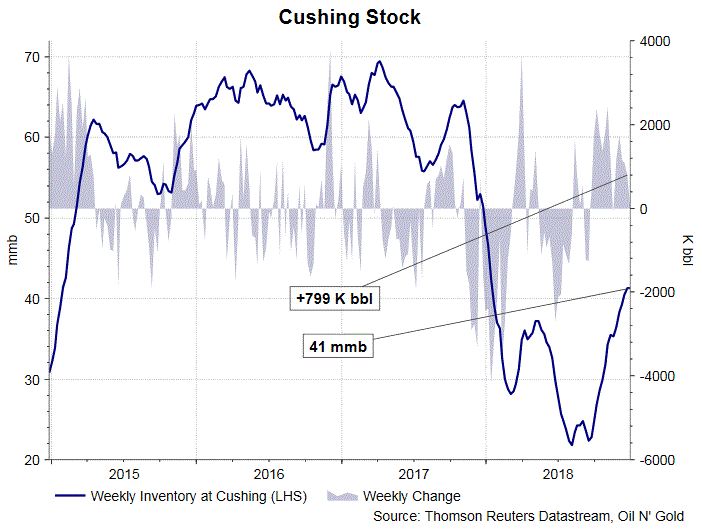
The report from the US Energy Information Administration (EIA) shows that total crude oil and petroleum products stocks dropped -2.05 mmb to 1227.54 mmb in the week ended December 21. Crude oil inventory slipped -0.05 mmb (consensus: -2.87 mmb) to 441.41 mmb. Inventories increased in ALL 5 PADDs. Meanwhile, Cushing stock added +0.8 mmb to 41.29 mmb. Utilization rate climbed higher, by -0.3% to 95.1% and crude production added +0.1 M bpd to 11.7M bpd for the week.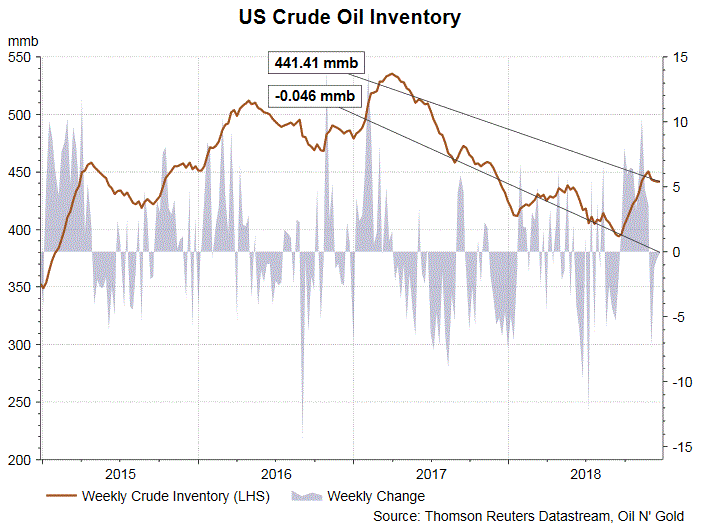
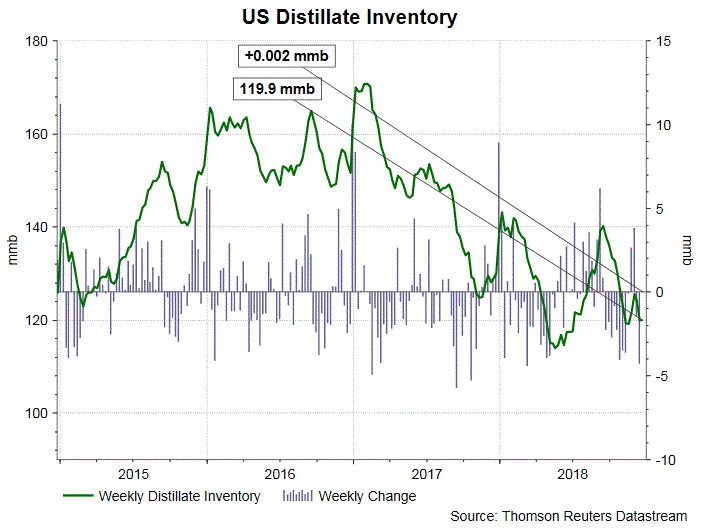
Concerning refined oil product inventories, gasoline inventory added +3 mmb to 233.11 mmb although demand gained +1.14% to 9.35M bpd. The market had anticipated a +0.03 mmb increase in stockpile. Production slipped -1.84% to 10.14M bpd while imports fell -14.45% to 0.51M bpd during the week. Distillate inventory steadied at 119.9 mmb. Demand declined -13.18% to 4.24M bpd. The market had anticipated a -0.53 mmb drop in inventory. Production climbed +0.95% higher 5.44M bpd while imports soared +46.76% to 0.2M bpd during the week.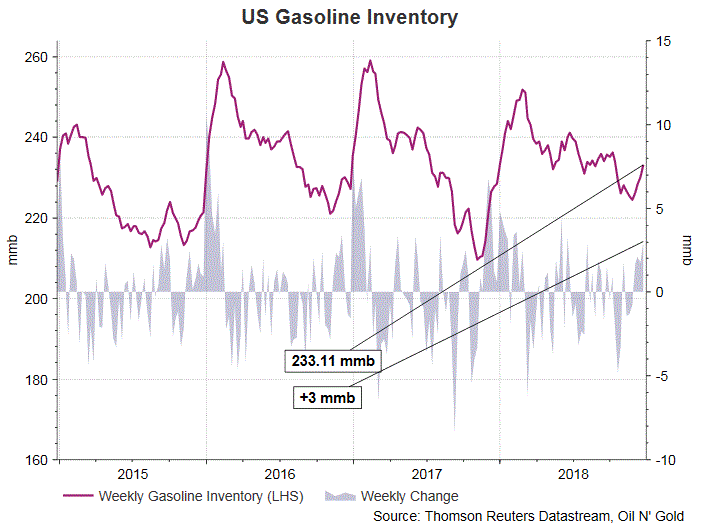
 Released after market close on Wednesday, the industry- sponsored API estimated that crude oil inventory soared +6.9 mmb during the week. For refined oil products, gasoline stockpile gained +3.7 mmb while distillate was down -0.6 mmb.
Summary 12/31 – 1/4
Monday, Dec 31, 2018
[php_everywhere instance="1"]
Tuesday, Jan 1, 2019
[php_everywhere instance="2"]
Wednesday, Jan 2 2019
[php_everywhere instance="3"]
Thursday, Jan 3, 2019
[php_everywhere instance="4"]
Friday, Jan 4, 2019
[php_everywhere instance="5"]
Dollar Might Face Hard Times in 2019
Dollar bulls have wined and dined like kings and queens in 2018. The greenback appreciated the most against the emerging market currencies. The earlier part of the year saw the focus on rising US interest rates and political stories lead the way lower for EM. Trade wars also contributed to the risk-off narrative and will likely be a key area of focus in Q1.
- Emerging Market Currencies will try to outperform early in H1
- Stocks ready to rally once trade spat resolved
- Brexit clarity needed before cable traders return
Volatility was the story for Q4 as some of the major indexes fell over 20%. The panic that hit the markets saw safe-haven currencies surge on market uncertainty regarding trade wars, Fed quantitative tightening (QT), a partial government shutdown in the US, and Brexit worries. While the data in the US has been softer, many parts of the economy are still strong, such as record-low unemployment and near 3.0% GDP growth. With many risk events in play for the first quarter, we could see Fed policy remain on hold until the latter part of the year. If the Fed pauses interest rate increases and signals a goal on when QT will stabilize, we could see some headwinds for the US dollar in the first half of the year.
Will the Oil bottom hold?
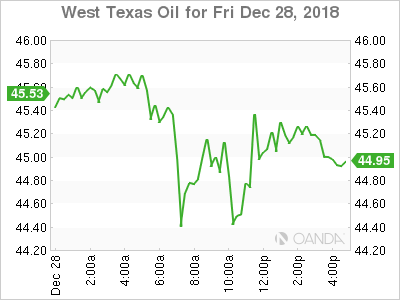
Thin volumes supported the Christmas Eve oil collapse to $42.36 and everyone will closely watch to see if that level holds. While most analysts expect oil to be higher by the end of 2019, the fundamental concerns on both the supply and demand side could see the meltdown continue. In January, we may hear more talks of extending cuts from OPEC+, US offshore drilling companies may need to scale back operations if oil stays near current levels, and if we see a framework agreement on the trade spat between the US and China, we could see positive sentiment return to the battered commodity.
Brexit outcome nearing
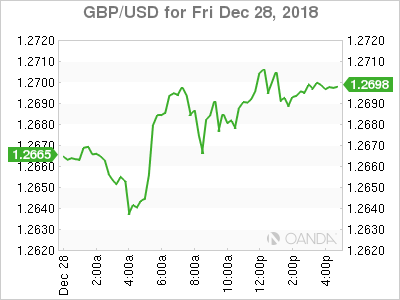
We are well under 90 days until the Brexit deadline and no one wants to trade sterling because no one has a clue how Brexit will play out. The expectations are still slightly for a soft Brexit, but money managers are not ready just yet to place their bets. A hard exit is still a possibility and that is preventing most long-term bullish bets from just being placed. PM May appears poised to lose the vote in Parliament on the week of January 14th. After the vote, we could see Jeremy Corbyn deliver on his threat of a no confidence motion on the government, which could lead to a general election. The House of Commons recess ends on January 7th, but we could see the MPs called back earlier. The smart money remains on the sidelines as the scenarios on how this will evolve remain plentiful. We should start to see some positioning after the Parliament vote.
Treasuries continue to advance
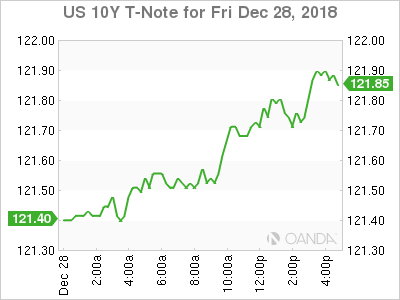
US Treasury yields continue to slide as the 10-year yield fell to the lowest level since February. The 10-year and 2-year gap widened to 19.85 basis points alleviating concerns that the Fed’s tightening process would invert the yield curve. All eyes will be on Fed Chair Powell’s January 4th interview at the annual meeting of the American Economic Association in Atlanta. The market does not agree with the Fed’s dot plot and seeks clarity on quantitative tightening, so every event Powell attends will be closely watched for further dovish commitments.
Market events to watch this week:
Monday, December 31
- Year End
- 10:30am USD Dallas Fed Manufacturing Activity
- 7:00pm KRW Trade Balance
Tuesday, January 1
- Bank Holiday
- Brazil’s new President is sworn in
- 8:45pm CNY Caixin Manufacturing PMI
Wednesday, January 2nd
- 9:45am USD Markit Manufacturing PMI (final reading)
Thursday, January 3
- 2:00am TRY Turkey Consumer Price Inflation (CPI)
- 8:15am USD ADP Employment Change
- 8:30am USD Jobless Claims
- 10:00am USD ISM Manufacturing
- 8:45pm CNY Caixin Services PMI
Friday, January 4
- 4:30am GBP UK Services PMI
- 5:00am EUR Euro Zone CPI Flash Estimate
- 8:30am USD Non-Farm Payrolls & Unemployment Rate
- 8:30am CAD Employment Change & Unemployment Rate
- 11:00am USD Crude Oil Inventories
*All times EDT
Oil Remains Bid after Inventories Post Small Decline
Oil prices climbed higher after the weekly DOE crude inventories fell by 46,000 barrels last week, the market consensus was for a decline of 2.5 million barrels. The reason oil prices edged higher on a smaller draw, was because yesterday, the weekly API oil inventories rose by 6.9 million barrels, up from a build of 3.5 million in the prior month.
The weekly Baker Hughes US rig count rose from 1,080 to 1,083. The US oil rig count also increased from 883 to 885. The gas rig count also ticked higher from 197 to 198.
The Canadian dollar still remains near its 19-month lows against the greenback and has yet to show a significant recovery along with oil prices.
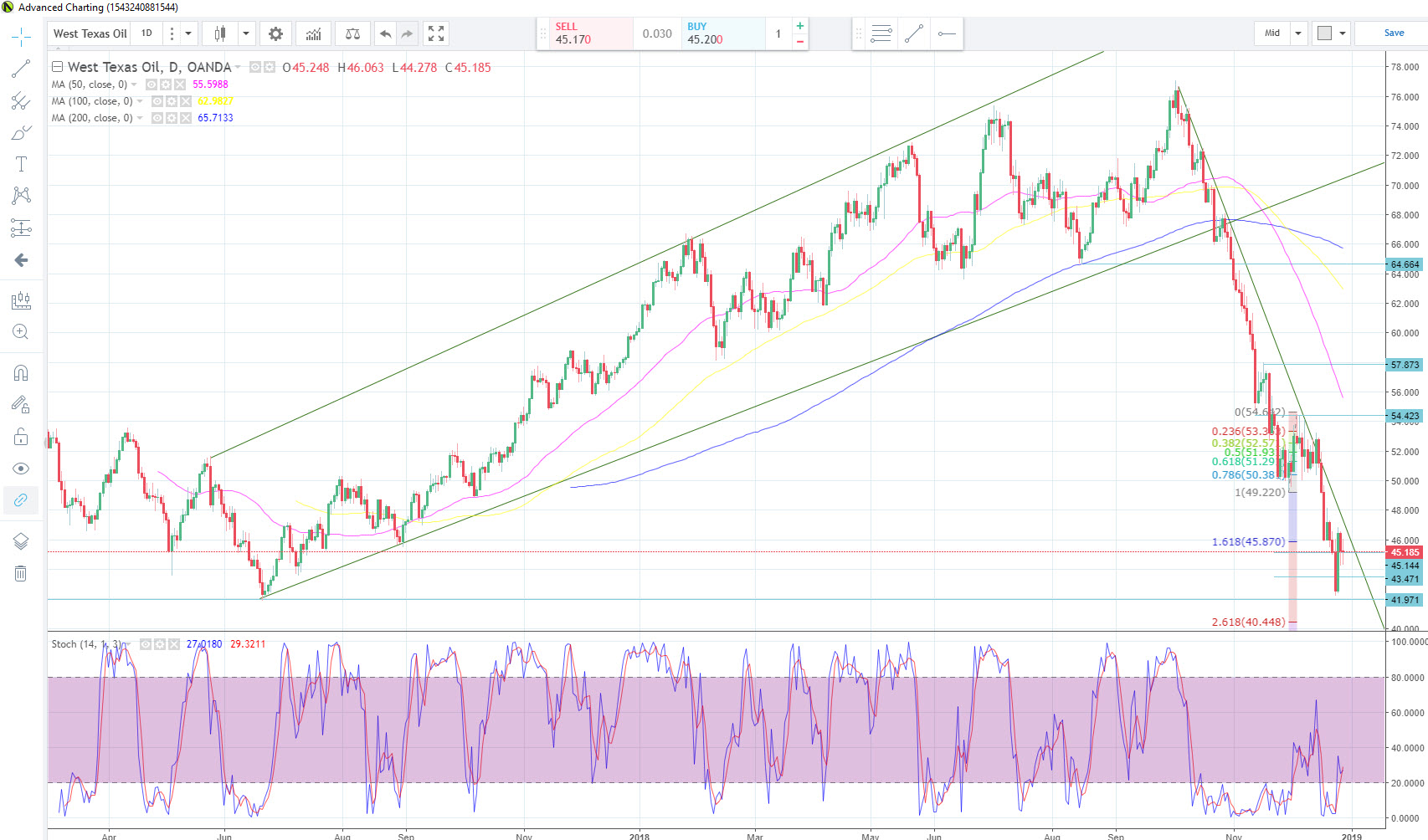
Price action on the West Texas Intermediate (WTI) crude daily chart shows key low of $42.36 is still holding and price is in the middle of this week’s trading range. Volumes remain light and it is become less likely a major move will occur until the New Year. The $40 level remains critical support for WTI and it could happen if we see another major wave of risk aversion. To the upside, $48.00 could provide initial resistance.