Sample Category Title
Chinese Manufacturing PMIs to Spread More Gloom at Year-End
PMI gauges out of China will be one of the few highlights in a light economic calendar next week. The NBS manufacturing PMI is released first on Monday at 01:00 GMT, with the Caixin/IHS Markit manufacturing PMI following on Wednesday at 01:45 GMT. Expectations aren’t high for either indicators of factory activity as China’s economy continues to lose steam from structural reforms such as deleveraging as well as of course the trade war with the United States.
The official NBS manufacturing PMI, which mostly covers large and state-owned enterprises, is anticipated to slip below the 50 level that separates expansion from contraction for the first time since July 2016. It is expected to fall from 50.0 to 49.9 in December. The NBS non-manufacturing PMI is also due on Monday, though this tends to attract less attention.
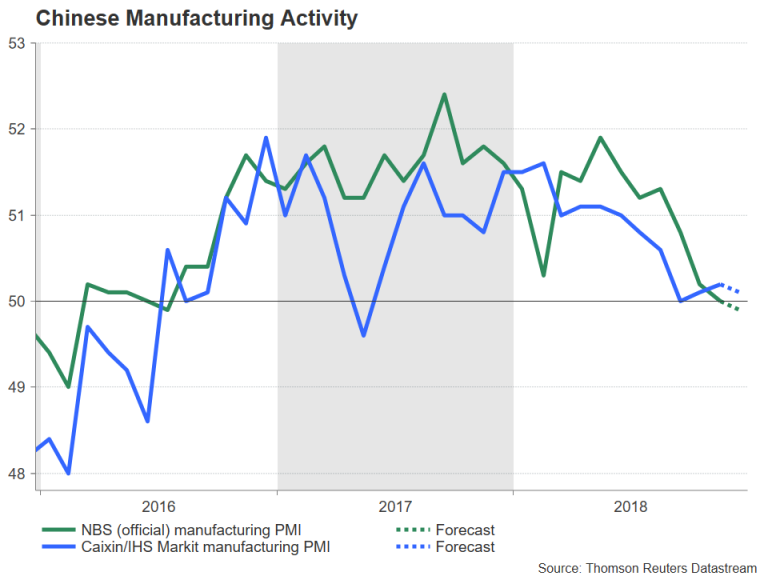
Turning to the Caixin/IHS Markit manufacturing PMI, the index is forecast to decline from 50.2 to 50.1 in December, eking out meagre growth at the end of 2018. If confirmed, this would suggest the private small- and medium-sized companies, which make up the Caixin/IHS Markit survey, are faring somewhat better than their larger counterparts, but only marginally.
Worse-than-expected figures in the manufacturing PMIs could deepen the risk-off sentiment currently prevailing over the markets as they would fuel concerns about a sharp slowdown in the world’s second largest economy. On the bright side though, disappointing PMI numbers would likely prompt Chinese authorities to announce further stimulus measures over the coming months to boost growth and avoid a deep downturn. Policymakers have in recent months stepped up measures to support the economy in a bid to counter the negative impact from tougher US trade restrictions.
In forex markets, the Australian dollar is likely to see the biggest response to the data, as it often serves as a liquid proxy for the Chinese yuan. The aussie could breach its immediate support in the $0.7015-0.7020 region from any misses in the PMIs, as well as from any fresh market turbulence. If this happens, the next support could come around $0.7030 – the 123.6% Fibonacci extension of the upleg from $0.7018 to $0.7393. Lower down, the aussie could stall at the 138.2% Fibonacci at $0.6875.
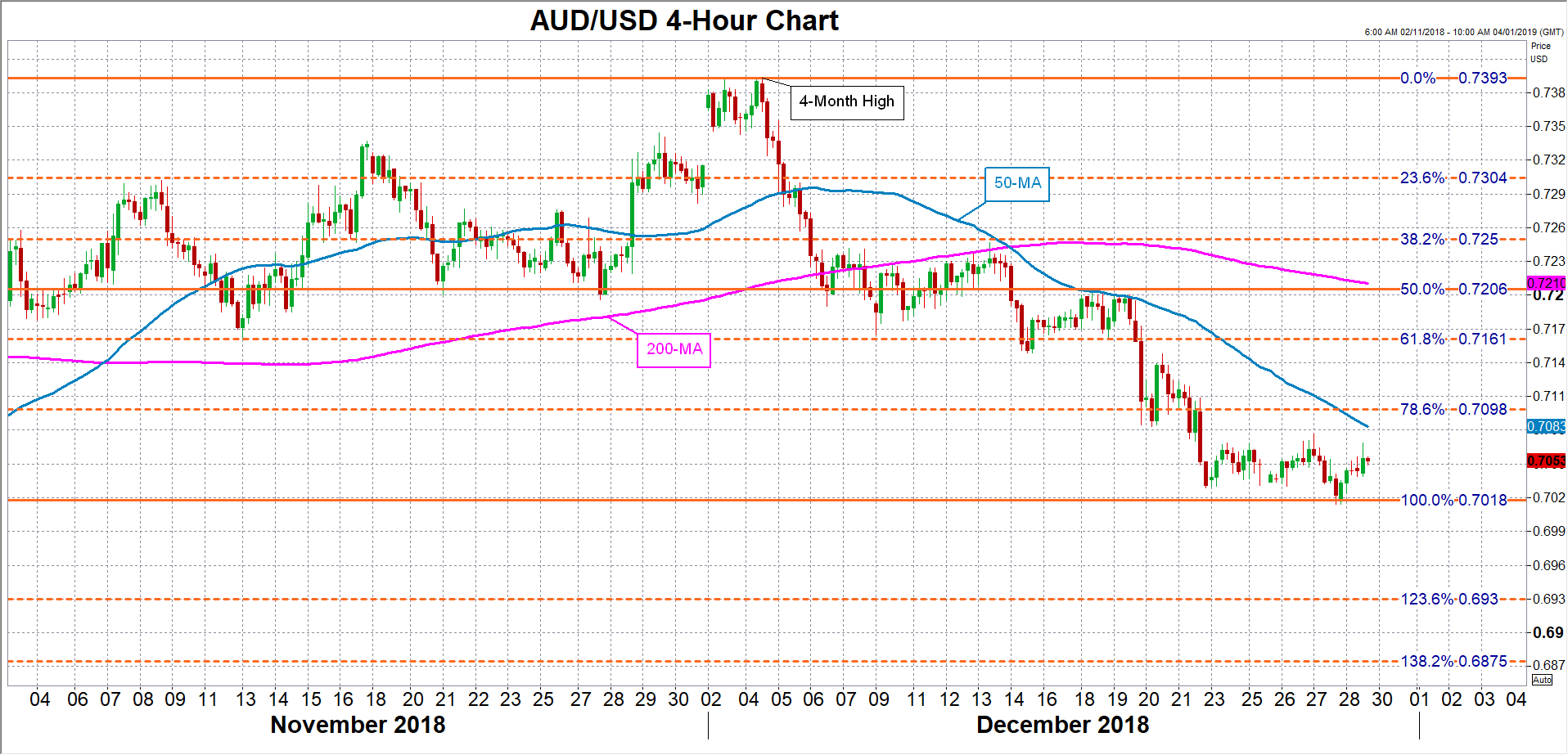
On the other hand, a stronger set of PMIs than what is being projected by analysts could provide the aussie with a bit of a lift, especially if this week’s rebound in global equities broadens to positive risk sentiment in the wider markets in the coming days. The aussie could initially target the 50-period moving average in the 4-hour chart around $0.7080 before aiming for the $0.71 handle, which is just above the 78.6% Fibonacci retracement level. Higher up, the focus would turn to the 61.8% Fibonacci retracement at $0.7161.
Week ahead – US Employment Report to Kick off the New Year
After a particularly turbulent week that lacked fresh catalysts but not wild price swings, traders will now turn their sights back to more familiar themes, such as economic data releases, and most notably the US jobs report for December. That doesn’t mean everything is back to normal though, as liquidity will likely remain thin, which implies that any piece of news could have a disproportionally large market impact.
Further deterioration in China’s manufacturing PMI expected
The week will commence with China’s official manufacturing and non-manufacturing PMIs for December, which are due during the Asian session on Monday. The manufacturing index is projected to drop to 49.9 from 50.0 previously, which would officially bring it into contractionary territory. The Caixin/IHS Markit will follow on Wednesday and is also forecast to have weakened in December.
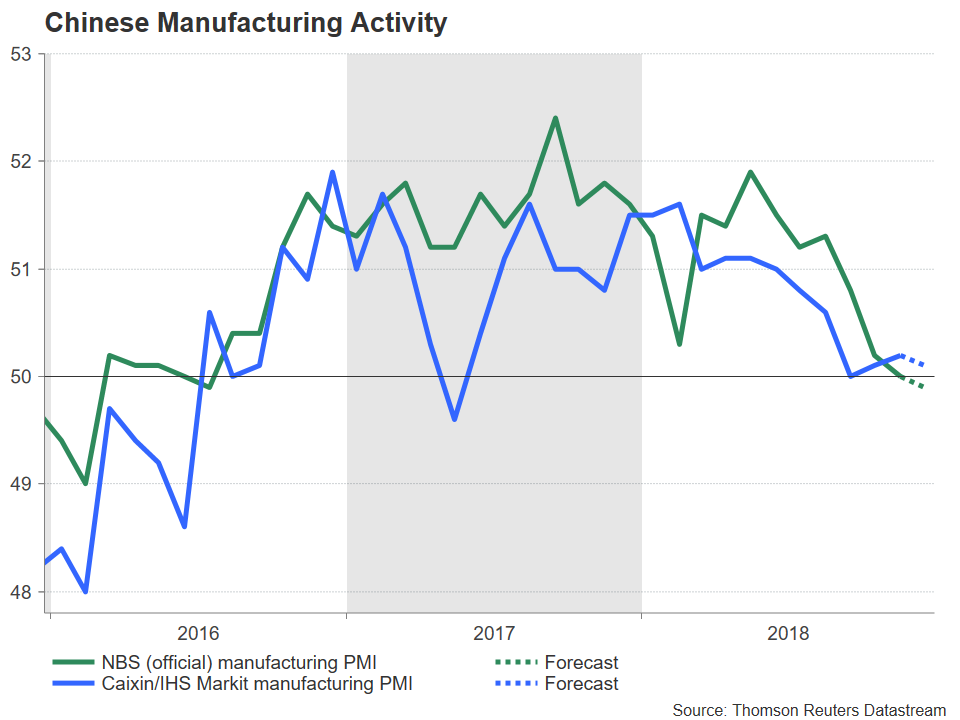
Such prints could add further fuel to the narrative that global growth is set to slow down in 2019 and thus, besides impacting the yuan and the China-sensitive Australian dollar, may also amplify the broader risk aversion seen in markets lately.
US employment data and Powell’s speech on the dollar’s sleigh
The highlight on the US economic calendar will most probably be the employment report for December, due out on Friday. Nonfarm payrolls are forecast to have risen by 178k, a print consistent with further tightening in the labor market, while the unemployment rate is projected to have held steady at 3.7%, its lowest level since the early 1970’s. As per usual though, the lion’s share of attention may fall on wage growth, which is expected to cool to a 3.0% yearly rate after accelerating to a decade-high of 3.1% in the previous month.
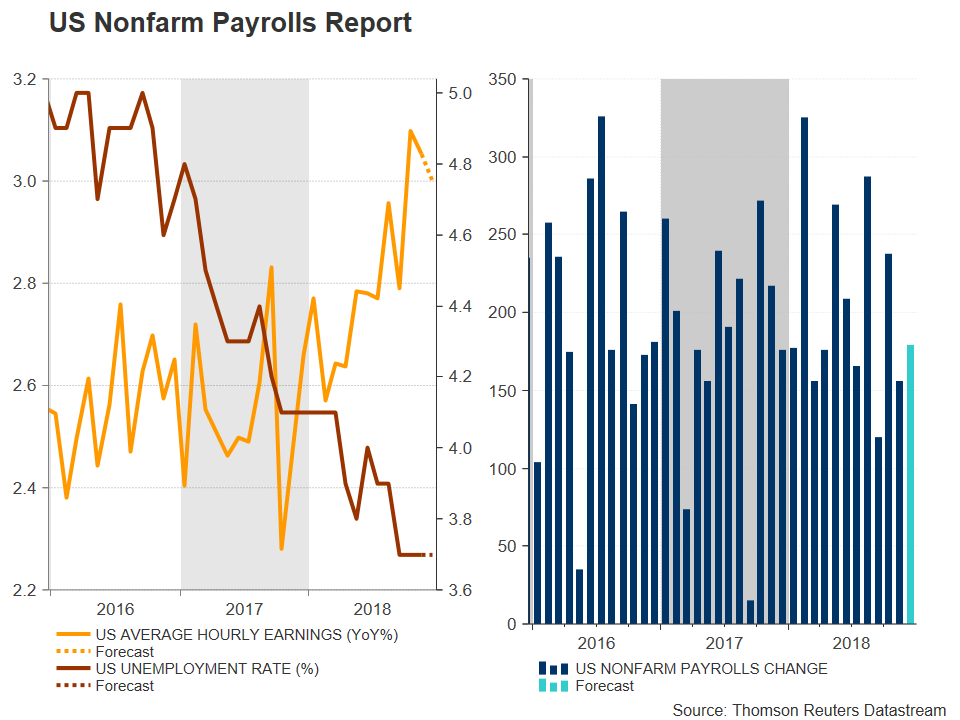
The question is whether such figures will be enough to alter the dovish expectations around the Fed, which according to market pricing, is not expected to touch the hiking button at all next year. Investors seem confident that the latest housing market slowdown will spill over into slower growth in the broader economy soon, keeping the Fed away from hiking. In this sense, it will be interesting to hear what Fed Chair Powell has to say when he participates in a panel discussion in Atlanta on Friday, and whether he will acknowledge the massive divergence between what his central bank signaled recently (two hikes in 2019), and what markets expect. Finally, the ISM manufacturing PMI for December is also due a day earlier, on Thursday.
Staying in North America, Canada will see the release of its own jobs data for December on Friday. Forecasts point to a somewhat soft report, though that may not be particularly alarming considering how strong November’s figures were.
UK PMIs and Eurozone inflation figures on tap
Across the Atlantic Ocean, the UK will be on the receiving end of its Markit PMIs for December. The manufacturing index is due out on Wednesday, the construction one on Thursday, and the all-important services print on Friday. Although these are typically tier-one releases, do note that economic data in general may not have much of an impact on the pound amid heightened Brexit uncertainties. The rationale is that even if the economy is robust, the BoE probably won’t hike rates and may in fact cut them under a no-deal Brexit. Hence, politics will probably continue to overshadow economics in driving sterling, with market attention likely to shift back to “all things Brexit” when the UK Parliament returns from holidays, on January 7.
Meanwhile, the Eurozone’s preliminary inflation data for December will be made public on Friday. Expectations are for the headline rate to tick down to 1.8% in yearly terms from 1.9% previously, but for the core rate that excludes fresh food and energy to inch up to 1.2%, from 1.1% in November.
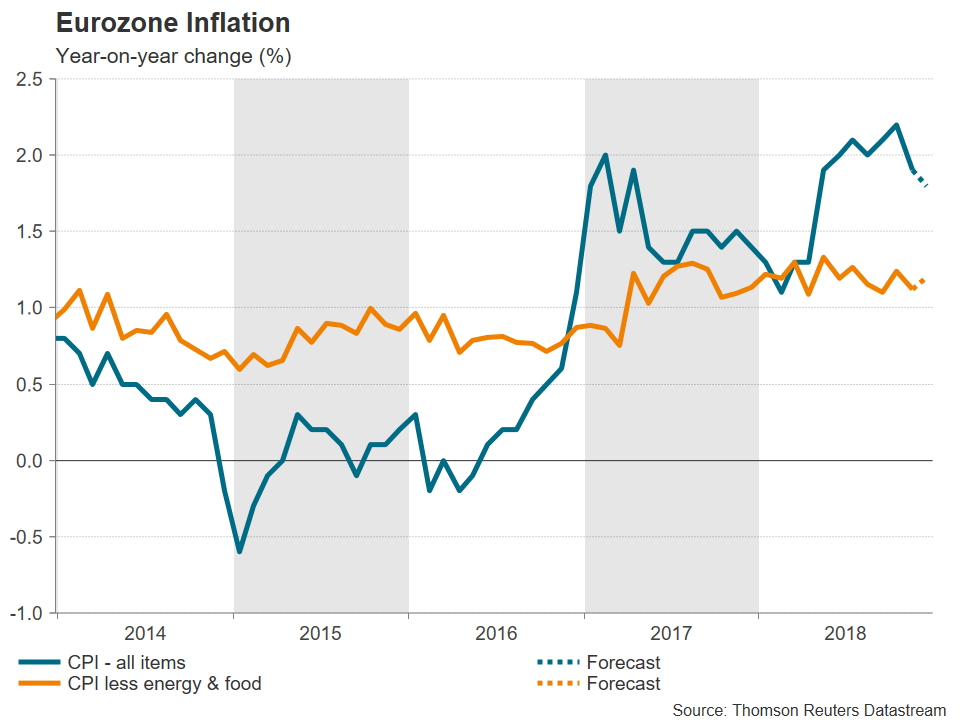
If so, these would be good news overall for the ECB, which usually pays more attention to metrics of underlying inflation. The bloc’s economy has been losing momentum in recent months, and a pickup in core inflation could go a long way in making policymakers more confident to continue their normalization efforts.
Safe-Haven Assets Gain as 10-Year JGB Yield Declines to Negative Territory
Global equities for the most part are rallying and so are safe-haven currencies. While the European bourses are up between 1.4% and 2.5%, the Nikkei fell 0.3% to 20,0014, its first annual loss since 2012.
Negative data in Japan dampened the mood for the Nikkei. The industrial production readings for November came in better than expected but lower than the prior readings. The month on month reading declined 1.1%, down from 2.9% and better than the -1.5% analysts’ consensus. The annual reading was 1.4%, better than the 0.6% eyed, but lower than the 4.2% prior reading. The retails sales data disappointed across the board and saw the prior months revised lower.
The 10-year yield for Japanese government bonds fell to 2 basis points to -0.012%, the first time since Sept 2017. The last time this key yield fell into negative territory, Japanese stock weakness persisted. The demand for safe-haven assets has been strong going into year-end and the drop in Japanese yields should come to no surprise. Recent Japanese government data show that foreign investors are buying record amounts of Japanese bonds. If the recent low in stocks hold, we could see this negative slide for Japan yields be temporary.
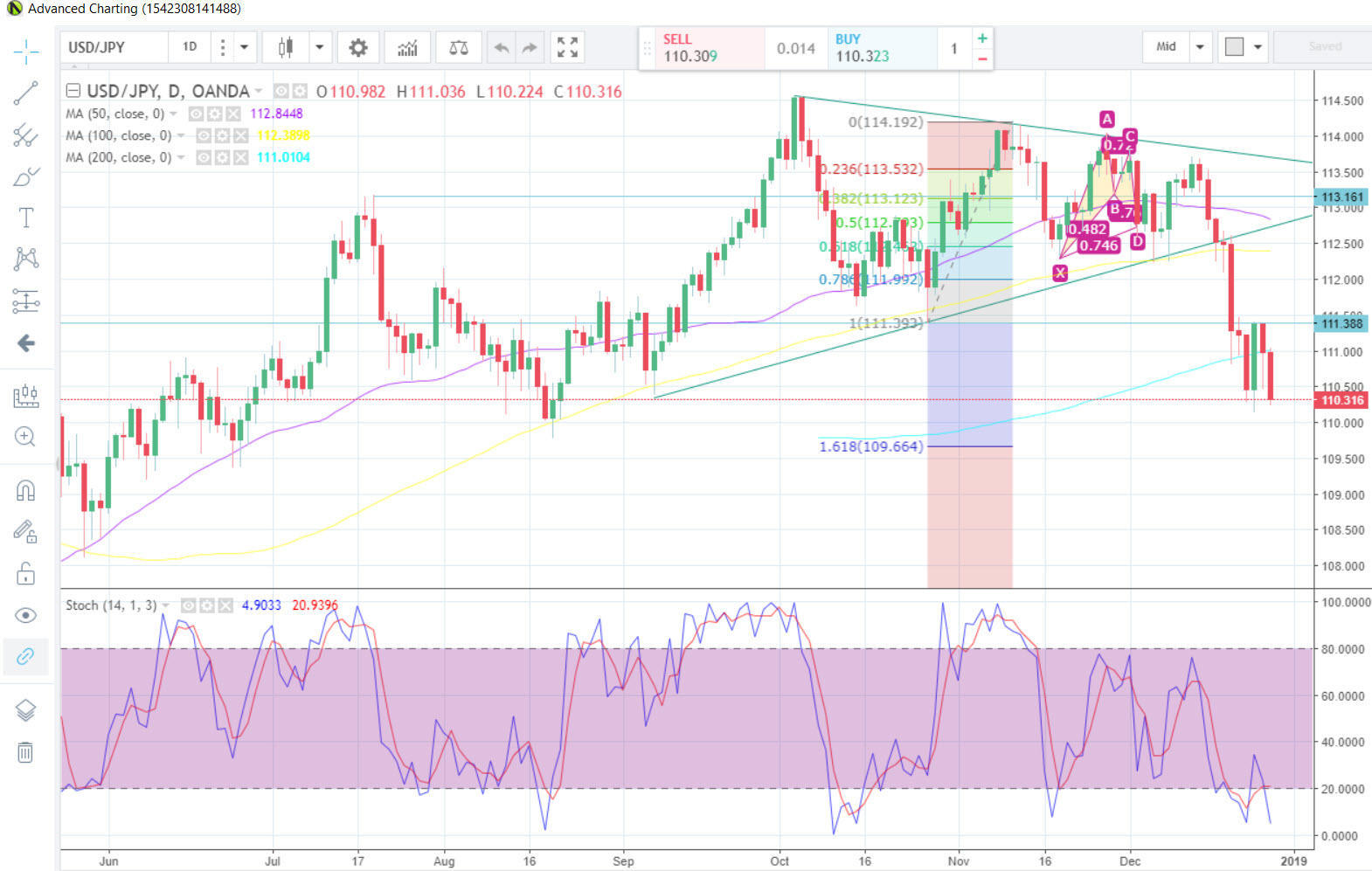
USD/JPY continues to give back its Christmas gains and is once again approaching the psychological 110 handle. If global sentiment becomes negative again, we will see the yen appreciate again alongside US Treasury bonds will rise as yields continue to slide. The data is softening and the US/China trade war continues to weigh on Japan. For now, 110 may provide a bounce, but if a sustained rally does develop, we could see 108.50 targeted.
USD/JPY Mid-Day Outlook
Daily Pivots: (S1) 110.50; (P) 110.94; (R1) 111.43; More..
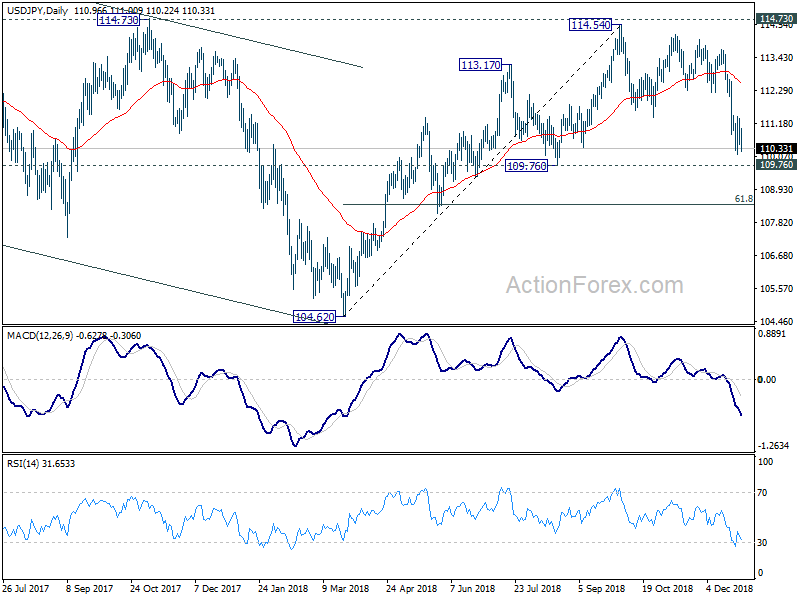
Despite today's decline, USD/JPY is staying above 110.13 temporary low and intraday bias remains neutral. On the downside, break of 110.13 will extend the whole decline from 114.54 and target 109.76 key support level. Break there will carry larger bearish implications. On the upside, break of 111.46, with 109.76 key support defended, will revive near term bullishness. In this case, intraday bias is turned back to the upside for 55 day EMA (now at 112.67) first.
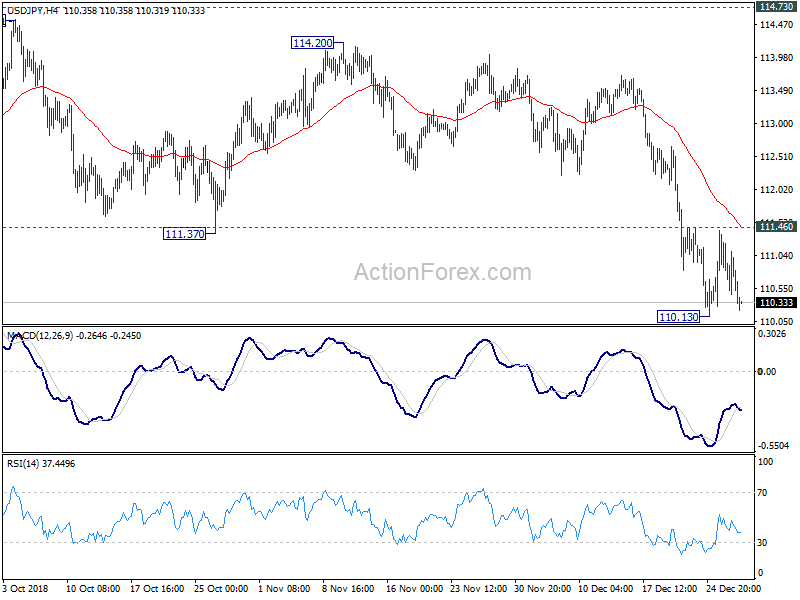
In the bigger picture, price actions from 125.85 (2015 high) are seen as a long term corrective pattern, no change in this view. Apparently, such corrective pattern is not completed yet. Break of 109.76 support will start another medium term down leg to 98.97/104.62 support zone. On the upside, break of 114.73 resistance will likely extend the rise from 98.97 through 118.65 resistance.
EUR/USD Mid-Day Outlook
Daily Pivots: (S1) 1.1372; (P) 1.1413; (R1) 1.1475; More.....
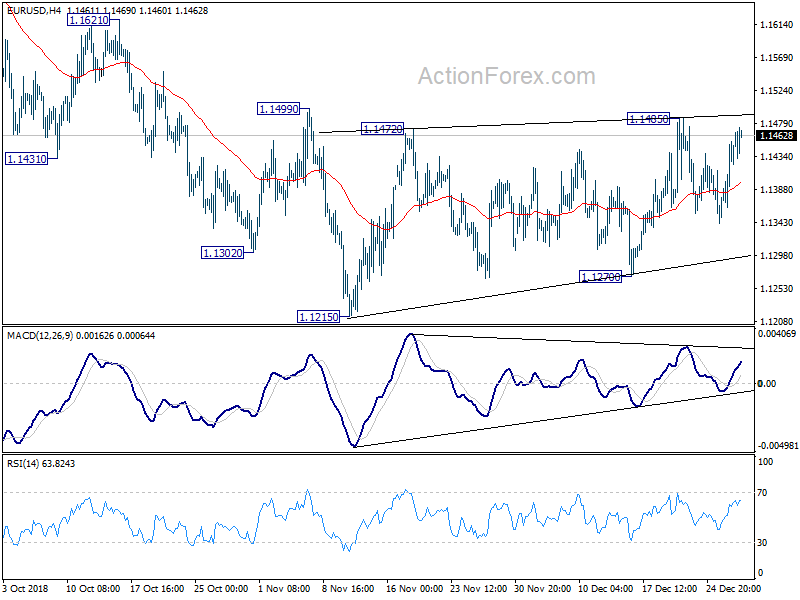
Despite today's rebound, EUR/USD is staying below 1.1485 resistance. Intraday bias remains neutral first. On the upside, break of 1.1485 resistance will revive the case of near term reversal, on bullish convergence condition in daily MACD. Bias will be turned back to the upside for 1.1621 resistance first. Break will target 1.1814 key resistance next. On the downside, break of 1.1270 will, instead, revive the bearish case that down trend from 1.2555 is still in progress. Bias will be turned back to the downside for 1.1186 key fibonacci level.
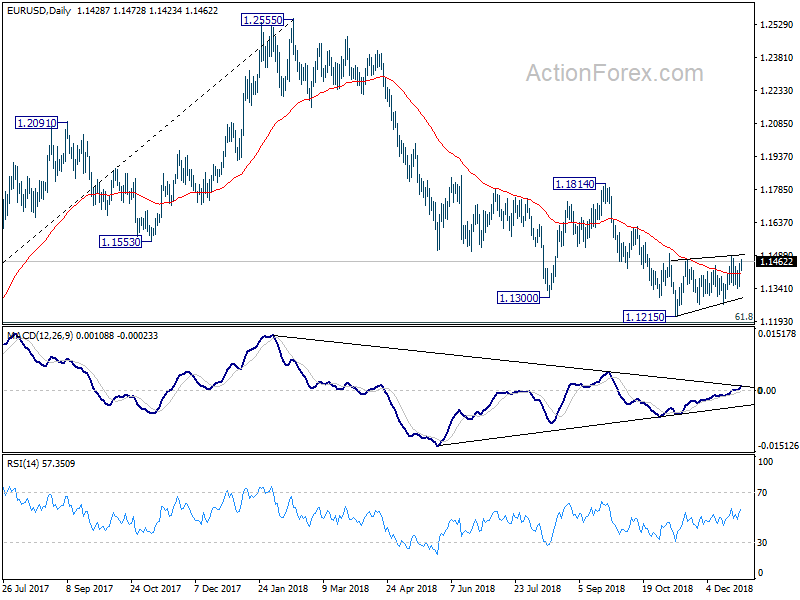
In the bigger picture, as long as 1.1814 resistance holds, down trend down trend from 1.2555 medium term top is still in progress and should target 61.8% retracement of 1.0339 (2017 low) to 1.2555 at 1.1186 next. Sustained break there will pave the way to retest 1.0339. However, break of 1.1814 will confirm completion of such down trend and turn medium term outlook bullish.
GBP/USD Mid-Day Outlook
Daily Pivots: (S1) 1.2616; (P) 1.2646; (R1) 1.2675; More....
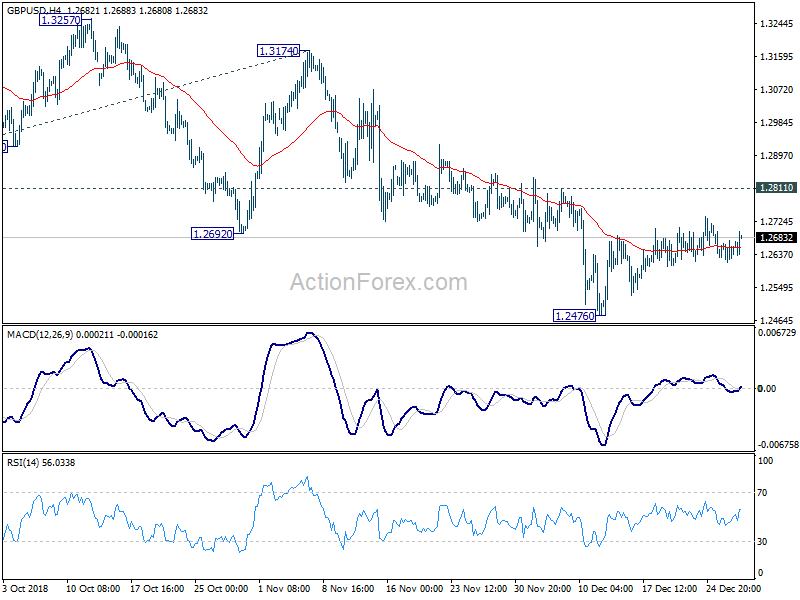
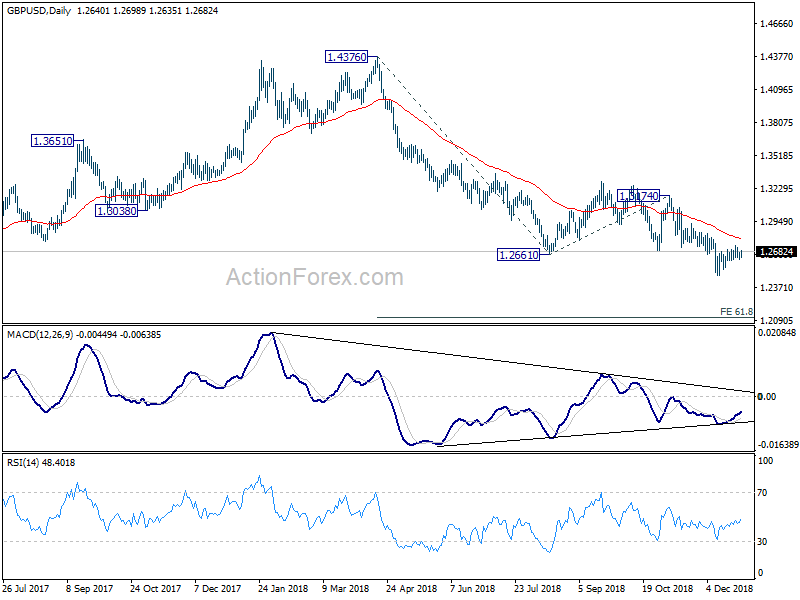
GBP/USD is still bounded in consolidation from 1.2476 and intraday bias remains neutral. Stronger recovery might be seen. But upside should be limited by 1.2811 resistance to bring decline resumption. On the downside, break of 1.2476 will extend larger down trend from 1.4376 to 61.8% projection of 1.4376 to 1.2661 from 1.3174 at 1.2114. However, firm break of 1.2811 will be an early signal of trend reversal and turn focus back to 1.3174 resistance.
In the bigger picture, whole medium term rebound from 1.1946 (2016 low) should have completed at 1.4376 already, after rejection from 55 month EMA. The structure and momentum of the fall from 1.4376 argues that it's resuming long term down trend from 2.1161 (2007 high). And this will now remain the preferred case as long as 1.3174 structural resistance holds. GBP/USD should now target a test on 1.1946 first. Decisive break there will confirm our bearish view.
USD/CHF Mid-Day Outlook
Daily Pivots: (S1) 0.9825; (P) 0.9892; (R1) 0.9945; More...
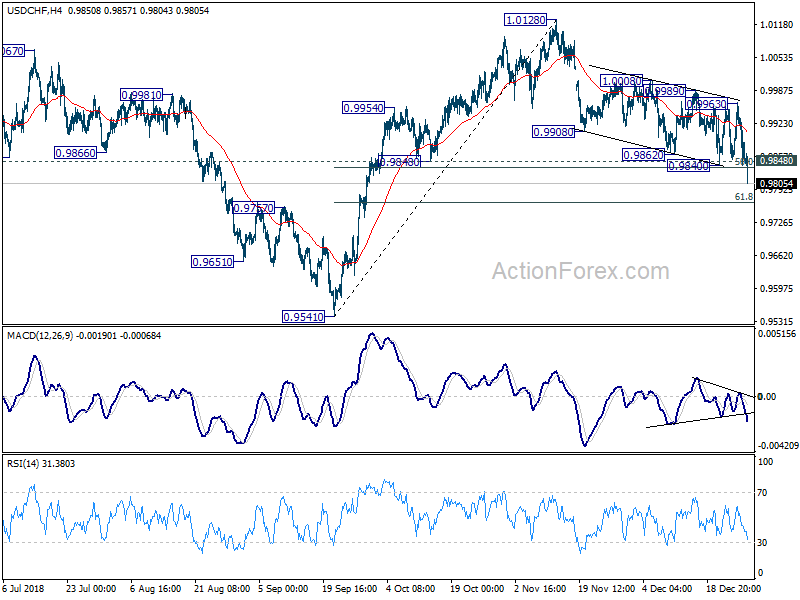
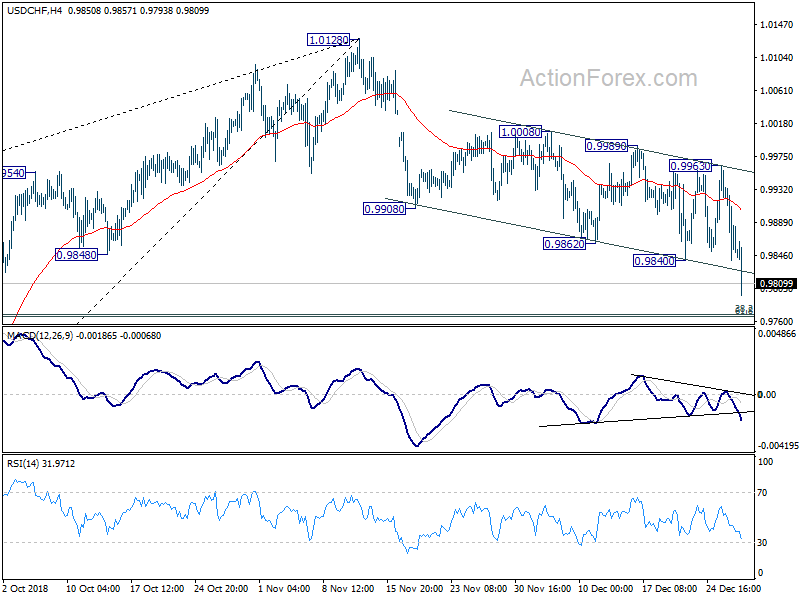
USD/CHF's decline extends to as low as 0.9793 so far today. The strong break of 0.9848 support and downside acceleration is taken as an early sign trend reversal. Intraday bias is now on the downside for cluster support at 0.9765/8 (61.8% retracement of 0.9541 to 1.0128 at 0.9765, 38.2% retracement of 0.9186 to 1.0128 at 0.9768). We'll look for bottoming signal again there but decisive break will pave the way back to 0.9541 support.
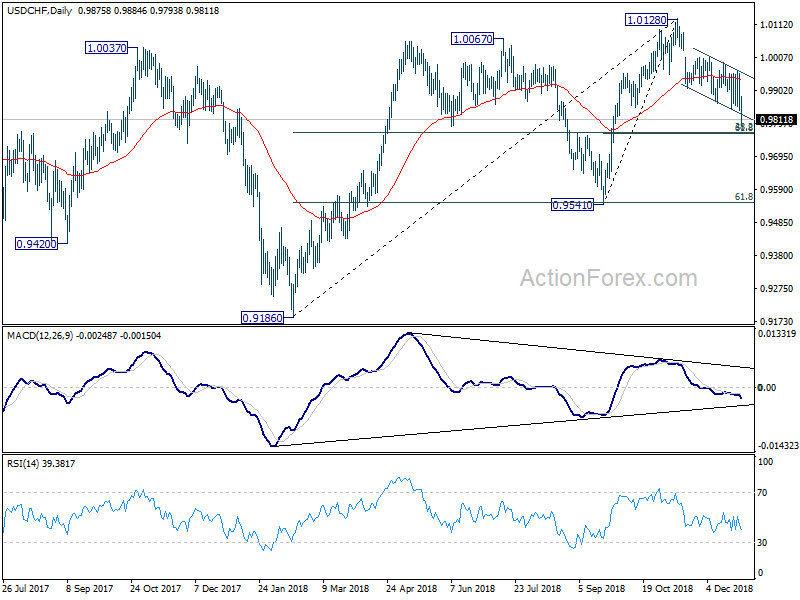
In the bigger picture, the deeper then expected fall form 1.0128 argues that medium term rally from 0.9186 might have completed at 1.0128 already, on bearish divergence condition in daily and weekly MACD. Break of 0.9541 key support will confirm this bearish case. More importantly, the corrective three wave structure will in turn argue that long term decline from 1.0342 (2016 high) is resuming. In that case, 0.9186 will be the next target.
Swiss Franc Shows Power ahead of Weekend, Stocks Rebound in Progress
Just ahead of the weekend, Swiss Franc shows broad based power today as it surges across the board. Yen is trading as the second strongest one, but with much weaker momentum. For now, we're unsure of the exact reason for the rally. European stocks are enjoying a solid rebound. There is no notable selloff in emerging market currencies neither. WTI crude oil is steady in range around 45. Gold does extend recent rally but only with relatively weak momentum. We'd tend to suspect it's geopolitics related and could be related to US withdrawal from Syria. But we can't find the exact linkage yet.
Meanwhile Dollar and Canadian remain the two weakest for today and the week. Euro tried to strengthen against both Dollar and Sterling today. But it lacks follow through buying through 1.1485 and 0.9086 resistance respectively. Instead, Euro is starting to be weighed down by selloff in EUR/CHF as well ass much weaker than expected Germany inflation reading.
In other markets, at the time of writing, US futures point to higher open. FTSE is up 2.05%, DAX is up 1.171%, CAC is up 1.85%. German 10 year yield is up 0.0023 at 0.235. Italian 10 year yield is down -0.0195 at 2.728. German-Italian spread is at 249, below 250 handle. Earlier in Asia, Nikkei dropped -0.31% to 20014.77. Hong Kong HSI rose 0.10% and China Shanghai SSE rose 0.44%. Singapore Strait Times rose 0.29%. Japan 10 year JGB year dropped -0.0232 to 0.001, now very very close to 0%.
Happy new year and all the best in 2019! We'll be back on January 2.
UK Hunt: We can absolutely get Brexit deal through parliament
UK Foreign Minister Jeremy Hunt is confidence that Prime Minister Theresa May's Brexit deal could get through the parliament if EU would clarify that the Irish backstop solution is temporary. He told BBC radio that "If it is temporary, then parliament can live with that," and, "we can get this through, absolutely can."
UK MPs are due to return in the week of January 7 and the debate on Brexit agreement will resume. For now, the rescheduled vote on the agreement will planned to be held in the week of January 14.
Swiss KOF dropped to 96.4 on manufacturing and construction
Swiss KOF Economic Barometer dropped to 96.3 in December, down from 98.9 and missed expectation of 98.8. KOF said in the release "The main drivers of this development stem from indicators belonging to the producing sector (manufacturing and construction). In addition, a weakly negative signal is sent by the financial sector and private consumption. Favorable export prospects, on the other hand, cushion this downward tendency."
Released from Germany, headline CPI slowed to 1.7% yoy in December, down from 2.3% and missed expectation of 2.0% yoy.
BoJ: Global risks tiled to the downside, uncertainties heightened
As shown in the Summary of Opinions at the December 19/20 meeting, BoJ board members sounded more concerned with global developments. The summary noted that "regarding the outlook for the global economy, risks have been tilted to the downside on the whole amid heightening uncertainties and a prevailing view that such situation will be protracted."
Specially, it said "looking at the latest data on trade activities in China, both exports and imports marked negative growth on a month-on-month basis, which possibly indicates a deceleration in the Chinese economy". For Japan, " it cannot be said that the actual condition of restoration-related demand and production stemming from natural disasters has been strong". Also, "recovery in exports to China has been weak, and exports as a whole also have shown weak developments."
BoJ also maintained that "it is necessary to persistently continue with the current powerful monetary easing as the momentum toward 2 percent inflation is maintained." And it warned that "trying to normalize monetary policy prematurely before achieving the price stability target could adversely strengthen the side effects." The summary also noted that long-term yield should be allowed to "temporarily turn negative" and "move upward and downward more or less symmetrically from around zero percent".
USD/CHF Mid-Day Outlook
Daily Pivots: (S1) 0.9825; (P) 0.9892; (R1) 0.9945; More...
USD/CHF's decline extends to as low as 0.9793 so far today. The strong break of 0.9848 support and downside acceleration is taken as an early sign trend reversal. Intraday bias is now on the downside for cluster support at 0.9765/8 (61.8% retracement of 0.9541 to 1.0128 at 0.9765, 38.2% retracement of 0.9186 to 1.0128 at 0.9768). We'll look for bottoming signal again there but decisive break will pave the way back to 0.9541 support.
In the bigger picture, the deeper then expected fall form 1.0128 argues that medium term rally from 0.9186 might have completed at 1.0128 already, on bearish divergence condition in daily and weekly MACD. Break of 0.9541 key support will confirm this bearish case. More importantly, the corrective three wave structure will in turn argue that long term decline from 1.0342 (2016 high) is resuming. In that case, 0.9186 will be the next target.
Economic Indicators Update
| GMT | Ccy | Events | Actual | Forecast | Previous | Revised |
|---|---|---|---|---|---|---|
| 23:30 | JPY | Jobless Rate Nov | 2.50% | 2.40% | 2.40% | |
| 23:30 | JPY | Tokyo CPI Core Y/Y Dec | 0.90% | 0.90% | 1.00% | |
| 23:50 | JPY | BOJ Summary of Opinions | ||||
| 23:50 | JPY | Industrial Production M/M Nov P | -1.10% | -1.60% | 2.90% | |
| 23:50 | JPY | Retail Trade Y/Y Nov | 1.40% | 2.10% | 3.50% | 3.60% |
| 08:00 | CHF | KOF Leading Indicator Dec | 96.3 | 98.8 | 99.1 | 98.9 |
| 09:30 | GBP | BBA Mortgage Approvals Nov | 39.4K | 38.9K | 39.7K | 39.6K |
| 13:00 | EUR | German CPI M/M Dec P | 0.10% | 0.30% | 0.10% | |
| 13:00 | EUR | German CPI Y/Y Dec P | 1.70% | 2.00% | 2.30% | |
| 14:45 | USD | Chicago PMI Dec | 61.2 | 66.4 | ||
| 15:00 | USD | Pending Home Sales M/M Nov | 1.10% | -2.60% | ||
| 15:30 | USD | Natural Gas Storage | -50B | -141B | ||
| 16:00 | USD | Crude Oil Inventories | -2.9M | -0.5M |
Canadian Dollar Quiet on Lack of Key Releases
USD/CAD has posted small losses in the Friday session, after jumping some 1.6% on Thursday. Currently, the pair is trading at 1.3605, up 0.01% on the day. On the release front, there are no Canadian releases. In the U.S., today’s key event is Chicago PMI, which is expected to slip to 61.4 in December, down from 66.4 a month ago.
The struggling Canadian dollar managed to hold onto its own this week, as the Christmas break gave the currency a badly-needed respite. USD/CAD has jumped a staggering 7.8% since mid-November, as turmoil in the equity markets has soured risk appetite and steamrolled risk currencies like the Canadian dollar. The volatility in U.S. markets has been especially pronounced this week, as stocks plunged on Monday, only to rebound with a 2-day rally late in the week. Another factor hurting the Canadian dollar, which is sensitive to commodity prices, is the sharp drop in oil prices. WTI crude, which is currently selling at $44 a barrel, has plunged 39% in just three months. The Canadian dollar has posted six straight weekly losses until Christmas week, and there’s a strong likelihood that the downward spiral will continue into January.
There was a positive development in the U.S- China trade war, following reports on Wednesday that a U.S. delegation would travel to China to hold talks in the first week of January. The ongoing trade dispute between the world’s two largest economies has caused havoc in the equity markets and hurt commodity currencies like the Canadian dollar. President Trump has agreed to suspend further tariffs on China while the sides are talking, but has promised more tariffs on March 1 if the sides are unable to reach a deal. A breakthrough might be too tall an order to expect, but the fact that the sides are meeting face-to-face for the first time in months will likely improve the mood of jittery investors.
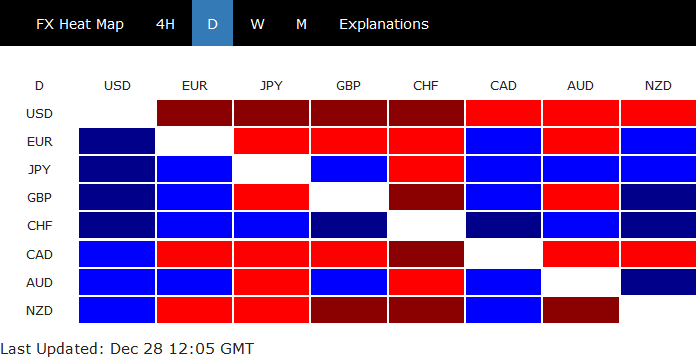
Into US session: Dollar weakest, Swiss Franc strongest, USD/CHF accelerates downwards
Entering into US session, Dollar and Canadian are the weakest one for today and the week. In particular, USD/CHF suffered renewed selling with a key support level at 0.9848 taken out firmly. That's also thanks to broad based strengthen in Swiss Franc, which is the strongest one for today and the week. Yen is the second strongest for today but trails behind Euro as the third strongest for the week.
European markets are generally higher today. At the time of writing:
- FTSE is up 1.77%
- DAX is up 1.78%
- CAC is up 1.83%
- German 10 year yield is up 0.0023 at 0.235
- Italian 10 year yield is down -0.0242 at 2.723.
- German-Italian spread is below 250.
Earlier in Asia
- Nikkei closed down -0.31% to 20014.77, still holding above 20000 handle
- Hong Kong HSI rose 0.1% to 25504.20
- China Shanghai SSE rose 0.44% to 2493.90
- Singapore Strait Times rose 0.29% to 3053.43
- Japan 10 year JGB yield dropped -0.0232 to 0.001, very close to 0%.
With today's downside acceleration, USD/CHF should have a take on 61.8% retracement of 0.9541 to 1.0128 at 0.9765 first. Firm break there will pave the way back to 0.9541 key support level.