Sample Category Title
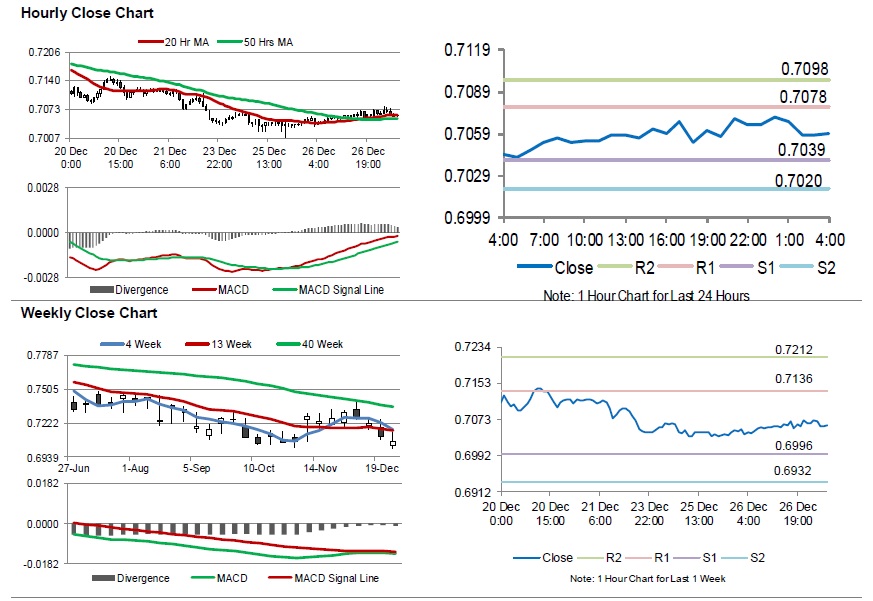
Gold Spot Bullish Bias Above 1262.00
Pivot (invalidation): 1262.00
Our preference Long positions above 1262.00 with targets at 1274.00 & 1279.00 in extension.
Alternative scenario Below 1262.00 look for further downside with 1256.50 & 1253.50 as targets.
Comment The RSI is mixed with a bullish bias.
Equities Roar Back: Fresh Rally, Or Dead-Cat Bounce?
- US stock markets rebound by 5% as mood turns risk-on, and amid thin liquidity
- Dollar climbs while the defensive yen crumbles, but sentiment reversing again today
US stock indices surge by 5%, but is the broader sell-off over?
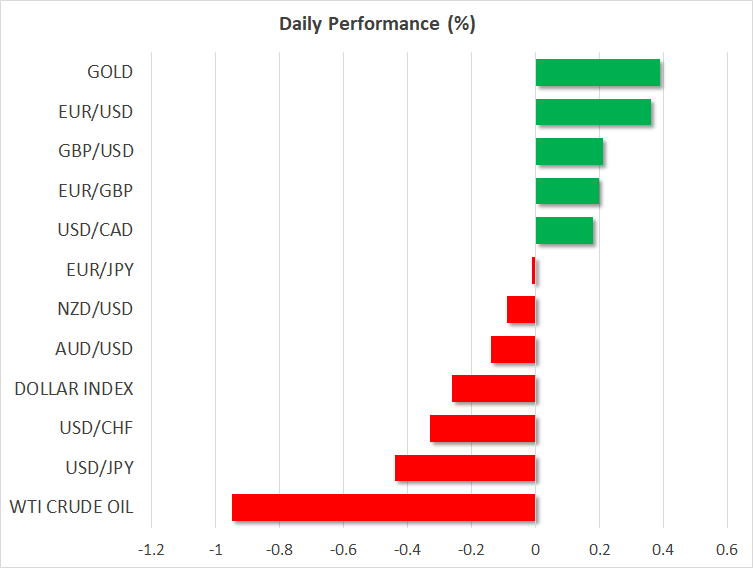
The latest bout of stock market volatility remained in full force on Wednesday. The major US indices posted outsized gains, with the likes of the S&P 500 and the Dow Jones both jumping by almost 5.0% to recover some of their latest losses. Asian markets followed suit. There was little in terms of fresh catalysts behind this astounding rebound, other than news that US and Chinese officials will meet soon for talks. Instead, it may have been owed mainly to the recent sell-off being a little overdone, coupled with end-of-year portfolio rebalancing by major funds, and likely exacerbated by thin liquidity conditions as well as several speculators having to cover their prior short positions.
The question on everyone’s mind is whether this is the beginning of a sustained recovery for these battered indices, or whether it’s merely a one-off bounce in the context of a broader bear market. On balance, this looks more like the latter, considering that the broader narrative – of a looming slowdown in economic growth and corporate profits – has not changed one iota. Rather, the real question may be at what levels do valuations reach attractive enough levels to lure “bargain” investors back in, and thereby halt the broader rout.
Dollar rallies alongside equities as yen gets crushed
In the FX market, the remarkable recovery in risk appetite translated into weakness for the Japanese yen and Swiss franc, given their status as safe-haven assets. Meanwhile, the US dollar was the biggest beneficiary, advancing against almost all of its counterparts as the yields on longer-dated US bonds climbed higher, enhancing’s the reserve currency’s carry appeal. Specifically, dollar/yen climbed by roughly 100 pips, though it’s giving up some of those gains early on Thursday.
In commodity markets, oil prices rallied by roughly 8%, with both WTI and Brent establishing some distance from their recent lows. Meanwhile, gold retreated after touching its highest level since June – of $1278 per ounce – as a resurgent greenback rendered the dollar-denominated metal less attractive for investors using foreign currencies.
Day ahead: US and Japanese data to highlight a rather quiet session
The economic calendar remains relatively light on Thursday. In the US, new home sales for November and the CB consumer confidence index are due for release. Note that while neither of these is usually a major market mover, they could attract extra attention for any clues as to whether the US economy continues to slow, and any market reaction may be amplified by thin liquidity.
In Japan, the Tokyo CPIs for December are due out at 2330 GMT, alongside the nation’s employment data for November. Preliminary industrial production and retail sales figures for the same month are also due twenty minutes later, at 2350 GMT. The BoJ summary of opinions from the latest policy gathering, where the Bank kept its policy unchanged, will also be made public.

China accelerating laws on IP protection, face-to-face meeting with US in Jan
China is accelerating legislation to protect intellectual property rights of foreign investments. Draft laws has been submitted to the Standing Committee of the National People's Congress for first review. Strong wordings were used in the draft like "official authorities and their staff shall not use administrative means to force the transfer of technology." The Committee will being a session on Sunday and then hold "public" consultations until February 24.
China's Ministry of Commerce spokesman Gao Feng said today that there are plans for face-to-face meeting with the US over trade in January. In the mean time, "intensive" phone calls are on-going despite the Christmas break. Separately, Bloomberg reported that a US delegation will travel to Beijing in the week of January 7. Deputy U.S. Trade Representative Jeffrey Gerrish will lead the Trump administration's team, including Treasury Undersecretary for International Affairs David Malpass.
Trump considering executive order to ban US purchase of China’s Huawei and ZTE products
Reuters reported, citing three unnamed sources, that Trump is considering to sign an executive order as early as in January to indirectly limit US companies purchases of equipment from China's tech giants Huawei and ZTE. The executive order could invoke the so called International Emergency Economic Powers Act that gives the president authority to regulate companies on national securities ground. It's believed that, though, Huawei or ZTE wouldn't be directly named.
China's Foreign Ministry spokesperson Hua Chunying declined to comment on the order. But she said "it's best to let facts speak for themselves when it comes to security problems." She added, "some countries have, without any evidence, and making use of national security, tacitly assumed crimes to politicize, and even obstruct and restrict, normal technology exchange activities." And, "this in reality is undoubtedly shutting oneself off, rather than being the door to openness, progress and fairness."
Euro Reverses Its Losses In The Asian Session
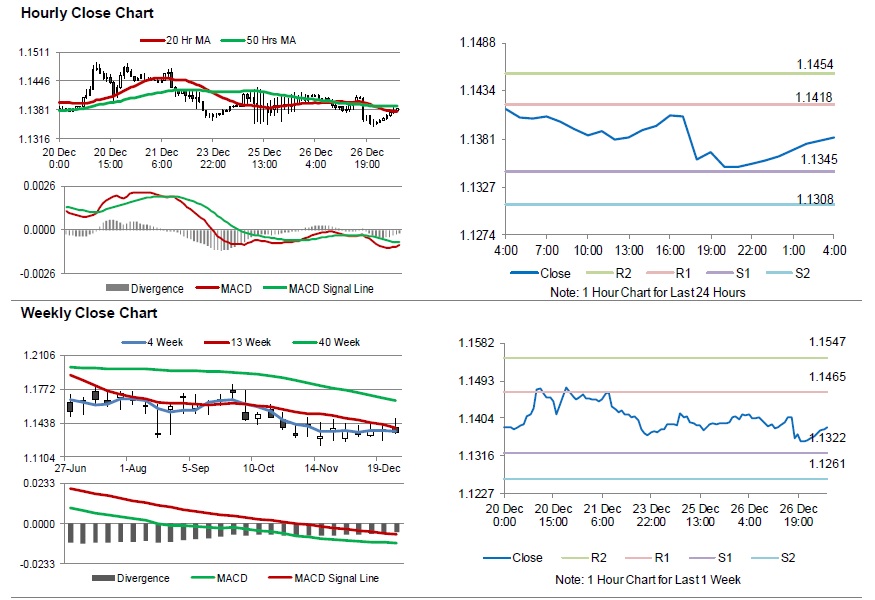
For the 24 hours to 23:00 GMT, the EUR declined 0.48% against the USD and closed at 1.1357.
In the US, data indicated that the Richmond Fed manufacturing index unexpectedly declined to a level of -8.0 in December, defying market expectations for an advance to a level of 15.0. In the previous month, the index had registered a reading of 14.0.
In the Asian session, at GMT0400, the pair is trading at 1.1383, with the EUR trading 0.23% higher against the USD from yesterday’s close.
The pair is expected to find support at 1.1345, and a fall through could take it to the next support level of 1.1308. The pair is expected to find its first resistance at 1.1418, and a rise through could take it to the next resistance level of 1.1454.
Amid lack of macroeconomic releases in the Euro-zone today, investors would keep an eye on the US house price index for October, new home sales for November and consumer confidence index for December along with initial jobless claims, all slated to release later in the day.
The currency pair is showing convergence with its 20 Hr moving average and trading below its 50 Hr moving average.
Sterling Reverses Its Losses In The Morning Session
For the 24 hours to 23:00 GMT, the GBP declined 0.52% against the USD and closed at 1.2641.
In the Asian session, at GMT0400, the pair is trading at 1.2658, with the GBP trading 0.13% higher against the USD from yesterday’s close.
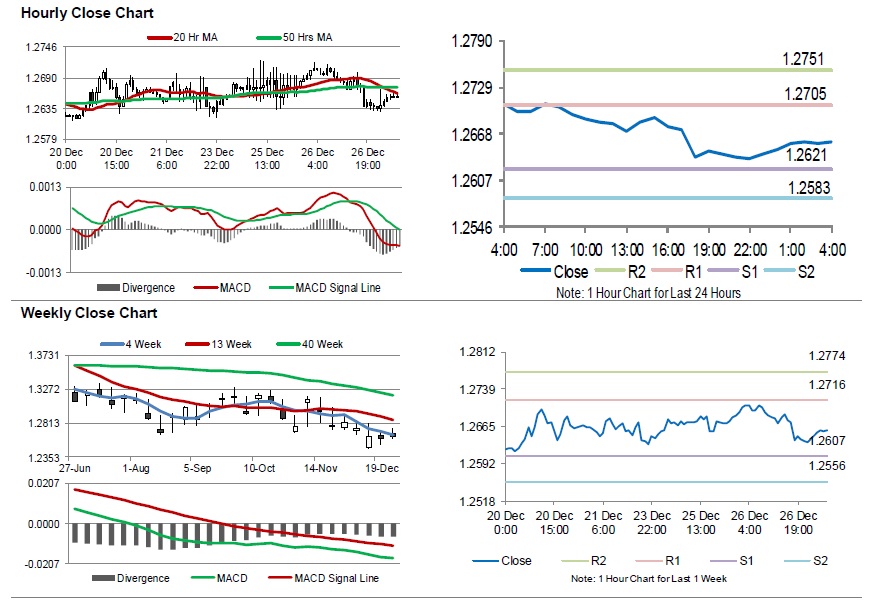
The pair is expected to find support at 1.2621, and a fall through could take it to the next support level of 1.2583. The pair is expected to find its first resistance at 1.2705, and a rise through could take it to the next resistance level of 1.2751.
Amid no major economic releases in the UK today, investor would focus on global macroeconomic news for further cues.
The currency pair is showing convergence with its 20 Hr moving average and trading below its 50 Hr moving average.
Japanese Yen Trading Higher This Morning
For the 24 hours to 23:00 GMT, the USD rose 0.71% against the JPY and closed at 111.26.
On Tuesday, the minutes of the Bank of Japan’s (BoJ) October monetary policy meeting showed that policy makers sounded pessimistic over the decision of allowing bond yields to move more flexibly around the central bank’s zero percent target, highlighting division within the board. However, the board members agreed on the need to maintain monetary policy ultra-loose for the time being.
Data showed that Japan’s final leading economic index eased to a level 99.6 in October, following a level of 104.3 in the prior month. The preliminary figures had indicated a fall to a level of 100.5.
In the Asian session, at GMT0400, the pair is trading at 110.96, with the USD trading 0.27% lower against the JPY from yesterday’s close.
Earlier today, data showed that Japan’s housing starts retreated 0.6% on an annual basis in November, compared to a rise of 0.3% in the previous month. Also, the nation’s construction orders tumbled 10.7% on an annual basis in November, following a decline of 16.5% in the preceding month.
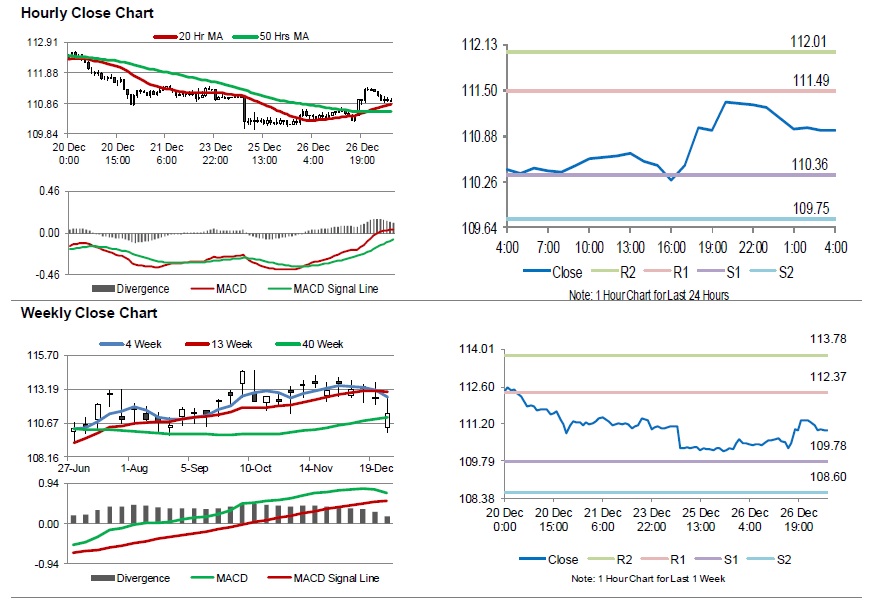
The pair is expected to find support at 110.36, and a fall through could take it to the next support level of 109.75. The pair is expected to find its first resistance at 111.49, and a rise through could take it to the next resistance level of 112.01.
Going ahead, investors would closely watch Japan’s unemployment rate, industrial production and retail trade data, all for November, set to release overnight.
The currency pair is trading above its 20 Hr and 50 Hr moving average.
Swiss Franc Trading On A Stronger Footing In The Asian Session
For the 24 hours to 23:00 GMT, the USD rose 0.93% against the CHF and closed at 0.9954.
In the Asian session, at GMT0400, the pair is trading at 0.9925, with the USD trading 0.29% lower against the CHF from yesterday’s close.
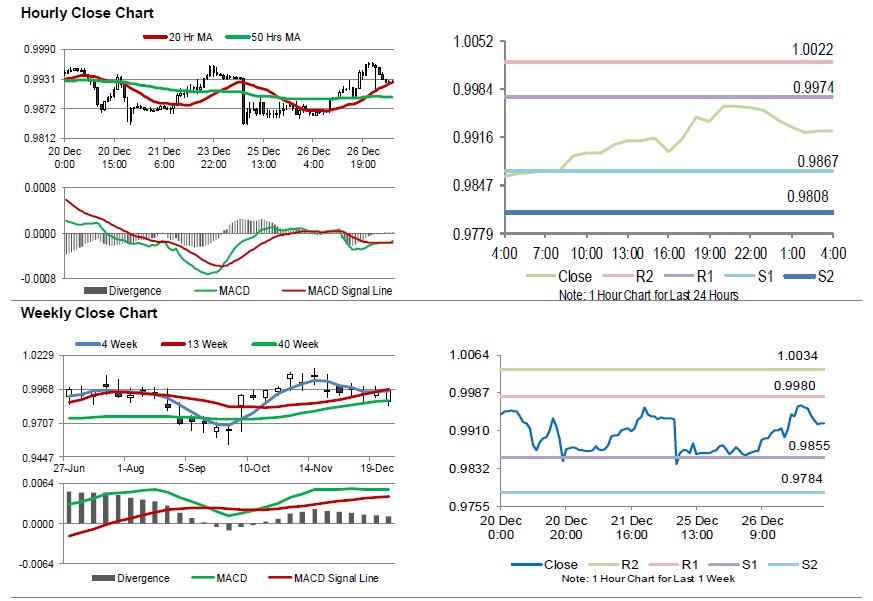
The pair is expected to find support at 0.9867, and a fall through could take it to the next support level of 0.9808. The pair is expected to find its first resistance at 0.9974, and a rise through could take it to the next resistance level of 1.0022.
Trading trend in the Swiss Franc today, is expected to be determined by Switzerland’s Credit Suisse survey expectations for December, due to release in a few hours.
The currency pair is showing convergence with its 20 Hr moving average and trading above its 50 Hr moving average.
Loonie Trading On A Negative Footing This Morning
For the 24 hours to 23:00 GMT, the USD declined 0.26% against the CAD and closed at 1.3574.
In the Asian session, at GMT0400, the pair is trading at 1.3590, with the USD trading 0.12% higher against the CAD from yesterday’s close.
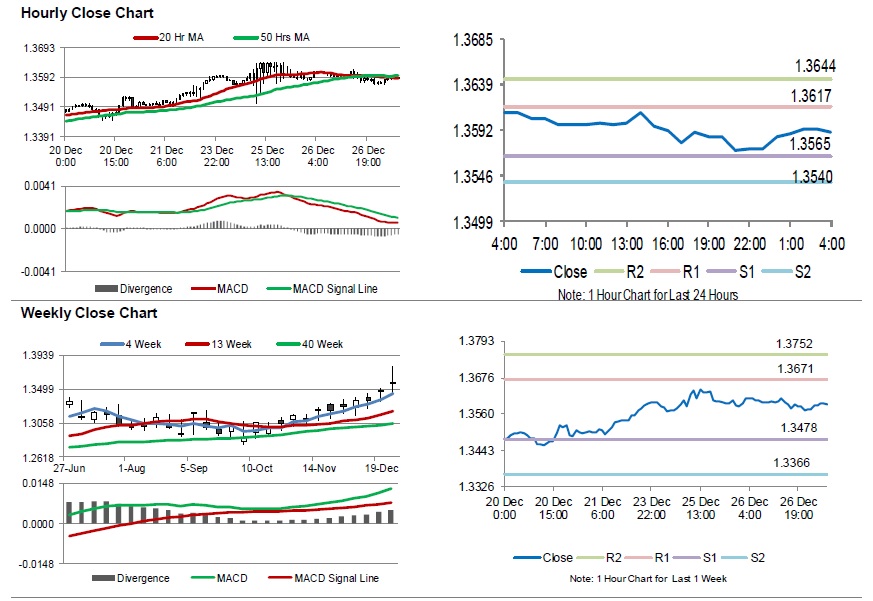
The pair is expected to find support at 1.3565, and a fall through could take it to the next support level of 1.3540. The pair is expected to find its first resistance at 1.3617, and a rise through could take it to the next resistance level of 1.3644.
Moving ahead, investor would await Canada’s business barometer data for December, for further direction.
The currency pair is showing convergence with its 20 Hr and 50 Hr moving averages.
AUD/USD: Aussie Trading Lower In The Morning Session
For the 24 hours to 23:00 GMT, the AUD rose 0.37% against the USD and closed at 0.7065.
LME Copper prices declined 0.9% or $55.5/MT to $5931.5/MT. Aluminium prices declined 1.1% or $21.5/MT to $1898.5/MT.
In the Asian session, at GMT0400, the pair is trading at 0.7059, with the AUD trading 0.08% lower against the USD from yesterday’s close.
Elsewhere in China, Australia’s largest trading partner, industrial profits slid 1.8% on a yearly basis in November, compared to a gain of 3.6% in the preceding month.
The pair is expected to find support at 0.7039, and a fall through could take it to the next support level of 0.7020. The pair is expected to find its first resistance at 0.7078, and a rise through could take it to the next resistance level of 0.7098.
The currency pair is showing convergence with its 20 Hr moving average and trading above its 50 Hr moving average.