Sample Category Title
No Follow Through in Risk Appetite after US Stocks Rebound
US equities staged a impressive rebound overnight and that's actually the strongest since 2009. DOW closed up 4.98% or 1086.25 pts at 22878.45. S&P 500 rose 4.96% to 2467.70. NASDAQ jumped even more by 5.84% to 6554.36. Reactions in Asia were mixed though. Nikkei closed up 3.88% to 20077.62, reclaimed 20000 handle. Singapore Strait Times is trading up 1.71% at the time of writing. But Hong Kong HSI and China Shanghai SSE are down -0.39% and -0.2% respectively.
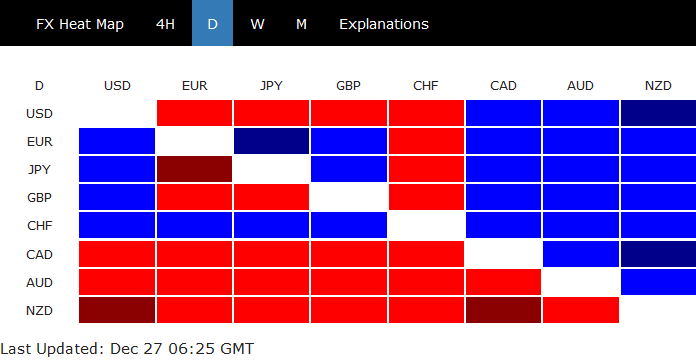
The currency markets also show little confidence on return of risk appetite. Commodity currencies were originally higher earlier today. But they're now the weakest ones at the time of writing, led by New Zealand Dollar. Swiss Franc is the strongest for today for now, followed by Euro and then Yen. The forex markets are somewhat back to "normal".
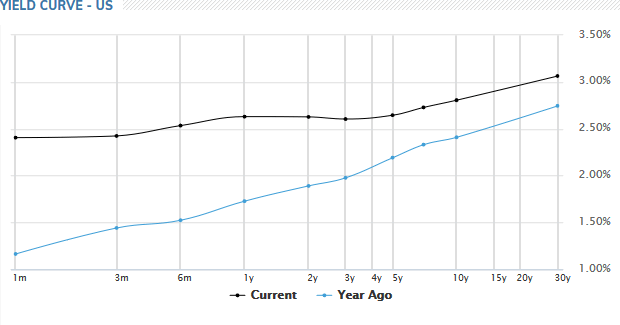
One more thing to note is that Japan 10 year JGB yield is currently down -0.001 at 0.026%. It hit as high as 0.039 earlier today but reversed. It's certain not the kind of relief signal. Also, in the US, yield curve remains inverted from 1-year (2.631) to 2-year (2.628) and 3-year (2.606).
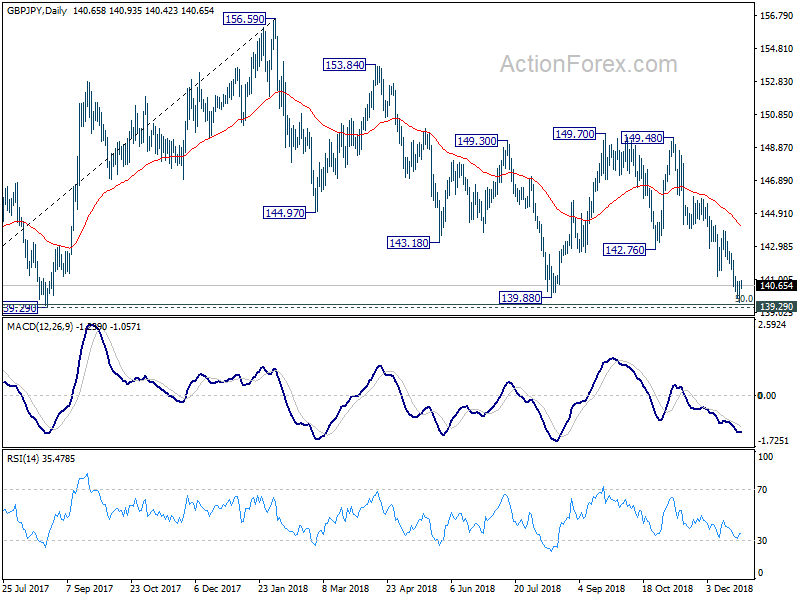
Technically, EUR/JPY and GBP/JPY has likely formed temporary bottoms ahead of 124.89 and 139.29 support respectively. Some consolidations would be seen first but there is no sign of bullish reversal yet. AUD/USD and USD/CAD's corrective recover and retreat were rather shallow. But currencies could try to extend recent decline against Dollar today. EUR/USD, USD/CHF and GBP/USD remain range bound, breakout awaited.
White House adviser Hassett: Powell's 100% safe, Trump very happy with Mnuchin
Kevin Hassett, chairman of the Council of Economic Advisers of the US, said in an interview yesterday that Fed Chair Jerome Powell's job is 100% safe. He told the WSJ that "The president has voiced policy differences with Jay Powell, but Jay Powell's job is 100% safe. The president has no intention of firing Jay Powell".
In addition to Trump's dissatisfaction on Powell, there were also reports that he has turned his anger to Treasury Secretary Steven Mnuchin. Mnuchin is the one whose's meeting Powell once a week regularly. And it's said that Trump is considering to add one of his advisers to the regular meetings. But Hassett said "I am highly confident that the president is very happy with Secretary Mnuchin."
EU Oettinger: Will tolerate France deficit as one-time exception, but urged Macron to continue fiscal reforms
EU Budget Commissioner Guether Oettinger said that French President Emmanuel Macron has "lost authority" by having a budget that exceed EU's 3% limit. He referred to France announcement last week that the budget deficit could rise to 3.2% in 2019, instead of 2.8% as originally planned.
Though, Oettinger expressed his empathy that Macron was under political pressure from violent protests to ease the impact of fiscal reforms. He said an interview that "under this condition, we will tolerate a national budget deficit higher than three percent as a one-time exception." However, he also emphasized "it must not continue beyond 2019."
Oettinger said Macron "remains a strong supporter of the European Union". And, "It crucial now that Macron continues his reform agenda, especially in the labor market, and that France remains on its growth track."
On the data front
Japan housing starts dropped -0.6% yoy in November, below expectation of -0.1% yoy. ECB will release monthly bulletin in European session.
The US Department of Commerce said they will not publish economic data during the partial government shut down. On the other hand, Labor Department will release the data it complies. So, jobless claims, house price index and Conference Board consumer confidence will be featured in US session.
GBP/JPY Daily Outlook
Daily Pivots: (S1) 139.96; (P) 140.41; (R1) 141.18; More...
A temporary low should be in place at 139.59 with the current recovery, ahead of 139.29/47 key support zone. Intraday bias in GBP/JPY is turned neutral for consolidation first. Stronger recovery could be seen through 4 hour 55 EMA (now at 141.46). But near term outlook will stay bearish as long as 143.93 resistance holds. On the downside, decisive break of 139.29/47 will carry larger bearish implications.
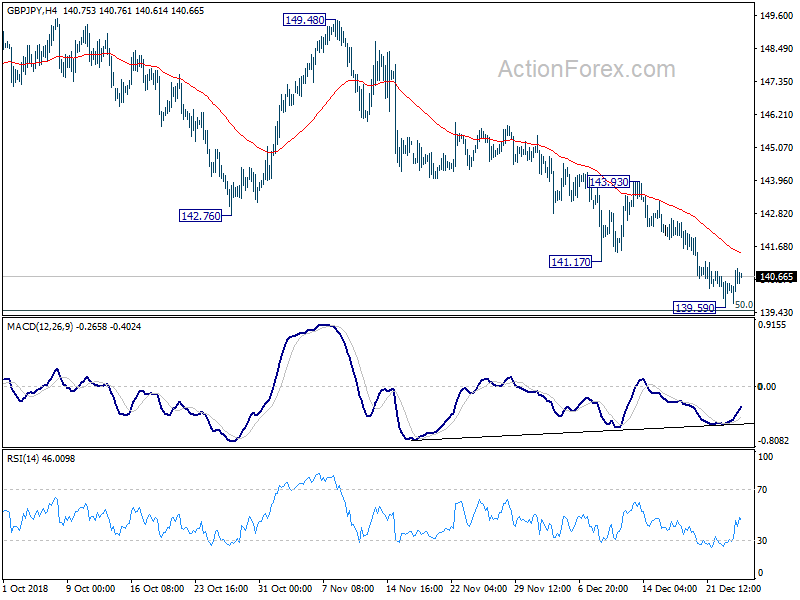
In the bigger picture, as long as 139.29 cluster support (50% retracement of 122.36 to 156.59 at 139.47) holds, up trend from 122.36 (2016 low) could still extend beyond 156.69 high. However, decisive break of 139.29/47 will suggest that such up trend is completed and turn outlook bearish. In that case, next target is 61.8% retracement at 135.43.
Economic Indicators Update
| GMT | Ccy | Events | Actual | Forecast | Previous | Revised |
|---|---|---|---|---|---|---|
| 5:00 | JPY | Housing Starts Y/Y Nov | -0.60% | -0.10% | 0.30% | |
| 9:00 | EUR | ECB Monthly Bulletin | ||||
| 13:30 | USD | Initial Jobless Claims (DEC 22) | 220K | 214K | ||
| 14:00 | USD | House Price Index M/M Oct | 0.30% | 0.20% | ||
| 15:00 | USD | New Home Sales Nov | 569K | 544K | ||
| 15:00 | USD | Consumer Confidence Index Dec | 133 | 135.7 |
Bear Market Maths
If the major US indices drop another 6% will, they will get us to the 200-week moving average, i.e. 2348 on SPX, 20687 on DOW30, or -20% from the top. It appears as though the next stop in S&P500 and DOW30 is 20670 Even on Christmas Eve when US markets are meant to close early, equity markets continue to wilt and risk trades soure, while talk of Trump firing Fed chair Powell didn't help. Neither did the "do not panic" letter sent by US Treasury secretary Mnuchin to the nation's top banks helped as US indices fall 14% in December, the biggest monthly decline since the fateful October 2008. US indices are also posting their 10th consecutive losing day, a streak never seen this millenium according to Ashraf. CFTC positioning data showed fresh GBP selling and EUR stabilisation. The Premium short in USDJPY hit its final target for 200-pip gain. The last two trades in the DOW were stopped out.
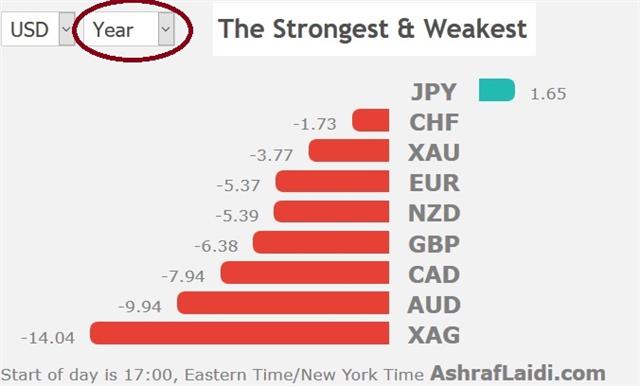
From the sunny market days of September, oil and some equity markets have fallen into a bear market in short order. Last week was the worst for US equity indexes since 2011 as the S&P 500 fell 7%. Month-to-date, S&P500 & DOW30 are down 14%.
The worries are familiar, primarily tariffs, interest rates and Chinese growth. At the same time, there are plenty of indications that the US economy is strong and few signs of a sharp slowdown, let alone a recession. One exception is business investment, something we highlighted last week. Core durable goods orders fell 0.6% in the November report and that marks a contraction in three of the past four months.
At the same time, the calendar provides some clues. The rout in the past week had the distinct flavor of a market being driven by forced selling, flows and fears. Year-end tax loss selling is undoubtedly part of the equation and hedge fund underperformance may have finally triggered waves of redemptions.
Perhaps the selling isn't justified but consider this: Sometimes that market can create its own narrative. Selling can stifle the mood in the economy; banks slow lending and consumers tighten up. It can become a self-fulfilling prophesy. The turmoil can also lead politicians to make some grave errors. The White House was in damage control on the weekend after reports said Trump had frequently mulled firing Fed Chair Powell in the past week.
Ironically, the biggest problem for the markets may well be the various positives of the US economy, which currently act as an excuse for the Fed to commit its obligatory cyclical policy mistake.
CFTC Commitments of Traders
Speculative net futures trader positions as of the close on Tuesday. Net short denoted by - long by +. This week's report was delayed because of the US holiday.
EUR -53K vs -56K prior GBP -61K vs -42K prior JPY -103K vs -98K prior CHF -23K vs -18K prior CAD -7K vs -12K prior AUD -35K vs -46K prior NZD -3K vs -15K prior
Specs picked a bad week to lighten up on AUD and NZD shorts as both paid of late in the week as risk aversion escalated. Meanwhile cable slumped on Dec 9-10 but rebounded afterwards and has chopped sideways. Still, it's never more than one Brexit headline away from another rout.
Yen Far From Overbought
And just like that, US stock indices reach new superlatives –this time on the positive side. The Dow Jones Industrials Index closed up 1084 points to post its highest point gain in history. It was a 5% gain, the highest percentage daily gain since March 23, 2009, which coincided with the start of global QE policies and the beginning of the 10-year bull market. Today's rally coincided with the S&P500 bottoming right at the 200-WMA as well its trendline support from the March 2009 generational low. The Premium long trade in the DOW30, released earlier this morning hit its final target for 600-pt gain. Interestingly, another 9% or 1200 pts in the DOW30 and the index becomes unchanged on the year.
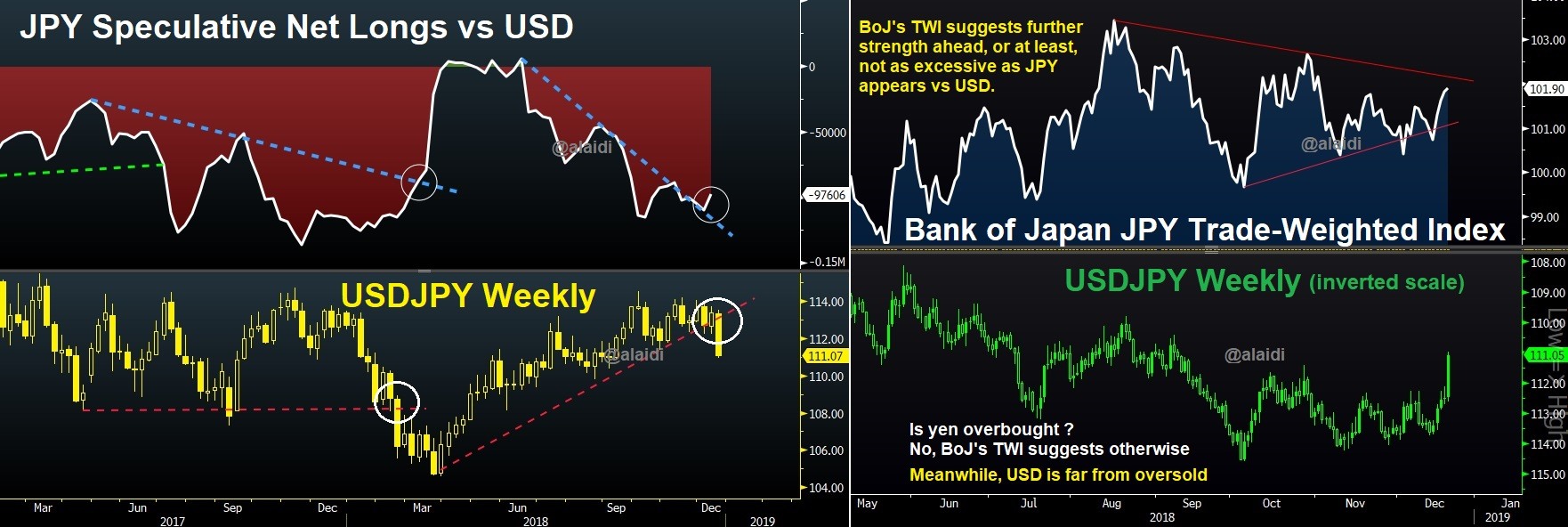
Perhaps the lack of fundamental explanations for this monstrous rally is similar to the lack of fundamental explanations for the 10-consecutive daily declines in indices, which had never been seen in this millennium. After Monday's slide, US Finance Minister Mnuchin announced he would convene a meeting of the Working Group on Financial Markets (also known as plunge protection team) to help stabilise markets. Combining the plunge-protection team with the arrival of 20% decline is a decent explanation for massive bids of the lows. Other news such as US and China announcing trade talks will resume next month. There will be further gains from here on, but I do not see indices hitting new highs. A recession by Q4 remains my base case scenario.
Stocks Rocket 5% Up
And just like that, US stock indices reach new superlatives –this time on the positive side. The Dow Jones Industrials Index closed up 1084 points to post its highest point gain in history. It was a 5% gain, the highest percentage daily gain since March 23, 2009, which coincided with the start of global QE policies and the beginning of the 10-year bull market. Today's rally coincided with the S&P500 bottoming right at the 200-WMA as well its trendline support from the March 2009 generational low. The Premium long trade in the DOW30, released earlier this morning hit its final target for 600-pt gain. Interestingly, another 9% or 1200 pts in the DOW30 and the index becomes unchanged on the year.
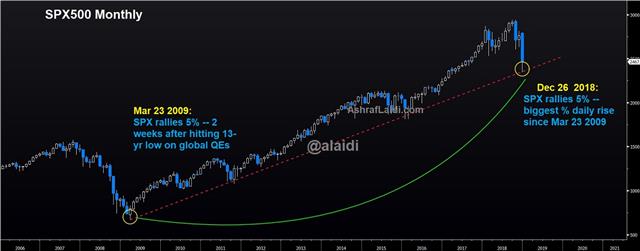
Perhaps the lack of fundamental explanations for this monstrous rally is similar to the lack of fundamental explanations for the 10-consecutive daily declines in indices, which had never been seen in this millennium. After Monday's slide, US Finance Minister Mnuchin announced he would convene a meeting of the Working Group on Financial Markets (also known as plunge protection team) to help stabilise markets. Combining the plunge-protection team with the arrival of 20% decline is a decent explanation for massive bids of the lows. Other news such as US and China announcing trade talks will resume next month. There will be further gains from here on, but I do not see indices hitting new highs. A recession by Q4 remains my base case scenario.
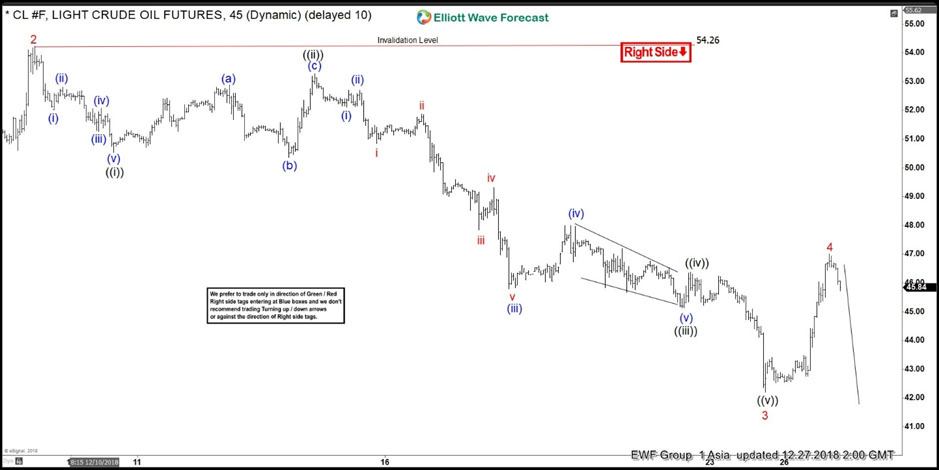
Oil: Impulsive Elliott Wave Structure In Play
Elliott Wave outlook in Oil (CL_F) suggests that the move lower from 10/3 high ($76.9) remains in progress as a 5 waves impulsive Elliott Wave structure. Down from $76.9, Primary wave ((1)) ended at $65.74, Primary wave ((2)) ended at $67.95, and Primary wave ((3)) remains in play. Internal of Primary wave ((3)) also unfolded as 5 waves impulsive Elliott Wave structure of lesser degree where Intermediate wave (4) of ((3)) ended at $54.55.
Oil is currently in the final Intermediate wave (5) of ((3)) move lower which should also complete Primary wave ((3)). Internal of Intermediate wave (5) subdivides as another impulse Elliott Wave structure of lesser degree (Minor). Minor wave 1 of (5) ended at $50.08, Minor wave 2 of (5) ended at $54.26, Minor wave 3 of (5) ended at $42.36, and Minor wave 4 of (5) is proposed complete at $47. Near term, while Oil stays below $47, but more importantly below $54.26, expect for more downside in Oil.
Oil 1 Hour Elliott Wave Chart
EU Oettinger: Will tolerate France deficit as one-time exception, but urged Macron to continue fiscal reforms
EU Budget Commissioner Guether Oettinger said that French President Emmanuel Macron has "lost authority" by having a budget that exceed EU's 3% limit. He referred to France announcement last week that the budget deficit could rise to 3.2% in 2019, instead of 2.8% as originally planned.
Though, Oettinger expressed his empathy that Macron was under political pressure from violent protests to ease the impact of fiscal reforms. He said an interview that "under this condition, we will tolerate a national budget deficit higher than three percent as a one-time exception." However, he also emphasized "it must not continue beyond 2019."
Oettinger said Macron "remains a strong supporter of the European Union". And, "It crucial now that Macron continues his reform agenda, especially in the labor market, and that France remains on its growth track."
White House adviser Hassett: Powell’s 100% safe, Trump very happy with Mnuchin
Kevin Hassett, chairman of the Council of Economic Advisers of the US, said in an interview yesterday that Fed Chair Jerome Powell's job is 100% safe. He told the WSJ that "The president has voiced policy differences with Jay Powell, but Jay Powell's job is 100% safe. The president has no intention of firing Jay Powell".
In addition to Trump's dissatisfaction on Powell, there were also reports that he has turned his anger to Treasury Secretary Steven Mnuchin. Mnuchin is the one whose's meeting Powell once a week regularly. And it's said that Trump is considering to add one of his advisers to the regular meetings. But Hassett said "I am highly confident that the president is very happy with Secretary Mnuchin."
US stocks staged strongest come back since 2009, but currency markets shrug
US stocks staged the strongest come back since 2009 overnight. DOW closed up 4.98% or 1086.25 pts at 22878.45. S&P 500 rose 4.96% to 2467.70. NASDAQ jumped even more by 5.84% to 6554.36. Positive sentiments somewhat carry forward to Asia. Nikkei is currently trading up 4.15% or 802 pts at 20129.59, back above 20000 handle. Singapore Strait Times is also up 1.95%. But Hong Kong HSI is only up 0.62% while China Shanghai SSE is up 0.56%. Not all Asian markets are convinced.
Movements in the currency markets are also relatively muted. For the week, Dollar is the weakest one so far, not Yen. And Canadian is the second weakest. Australian Dollar, Swiss Franc and New Zealand Dollar are indeed the strongest ones but all are held below last week's highs. It seems forex traders are not buying too much into the return of risk appetite yet.
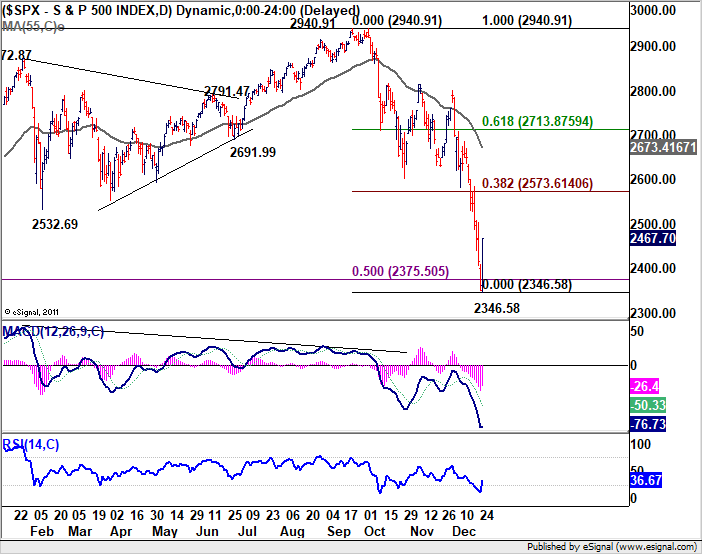
There are two things to note. Firstly, in S&P 500, price action from 2940.91 is seen as a long term correction, no chance in that view despite yesterday's rebound. The question for all correction is the form, in particular whether it's a deep pattern or a sideway pattern. The test for SPX is on 38.2% retracement of 2940.91 to 2346.58 at 2573.61. As long as this fibonacci resistance holds, fall fro 2940.91 is still expected to develope into a deep correction, targeting 2000 handle at least. Though, break of 2573.61 will open up the chances for sideway consolidation instead.
Secondly, US treasury yields staged strong rebound overnight. 5-year yield rose 0.056 to 2.637. 10-year yield rose 0.048 to 2.797. 30-year yield rose 0.045 to 3.048. The rebound was slightly weaker towards the long end. Also the yield curve remains inverted from 1-year (2.631) to 2-year (2.628) and 3-year (2.606).
China’s Monetary Policy Outlook in 2019 – Easing While Refusing to Admit So
Ongoing trade war with the US is accelerating the slowdown in growth in China. As such, the monetary policy adopted by PBOC would continue to be accommodative. Echoing the rhetoric of the annual Central Economic Work Conference, PBOC affirmed that its policy for the coming year would remain “prudent and neutral”. The term “prudent” has been used to describe its monetary policy since 2013, while “neutral” has been used since 2016. China’s monetary policy has undergone tightening and easing over the past few years. Simply repeating it as “prudent” and “neutral” is irresponsible and shows no intention to improve communication with the public.
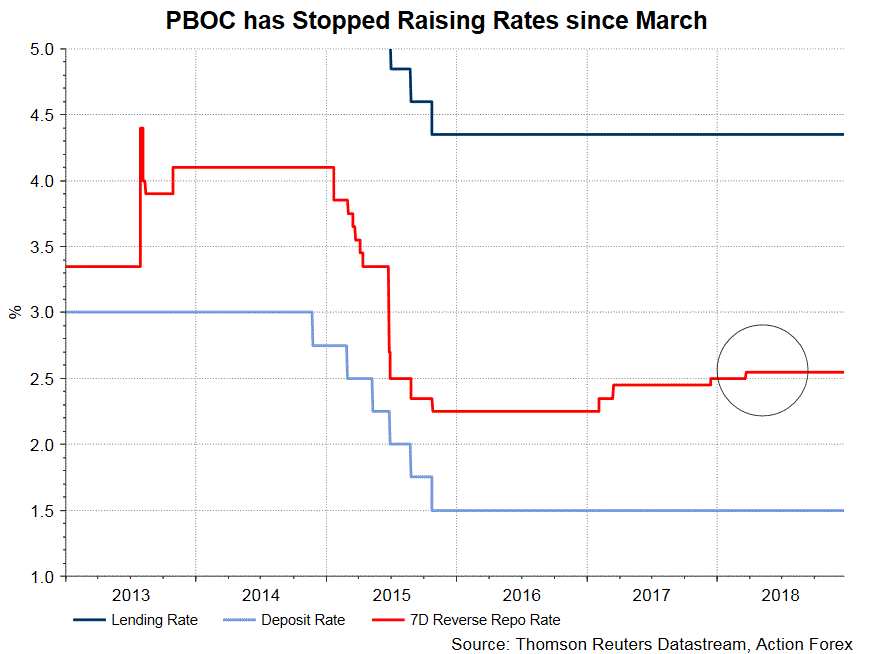
Targeted Medium- Term Lending Facility (TMLF)
Judging from PBOC’s action, we understand that its policy has been increasingly accommodative. The central bank announced last week that it would launch a targeted medium-term lending facility (TMLF), in order to encourage banks to provide more loans to “small and micro enterprises and private businesses”. The TMLF funds will be available for 3 years with an operational interest rate of 3.15%, -15 bps lower than that of medium-term lending facility (MLF). Moreover, it would mature in a year, but could be rolled over twice, making the actual maturity as long as three years. This operation is applicable to “large commercial banks, joint-stock commercial banks and large city commercial banks” which comply with macro-prudential requirements. For small and medium-sized financial institutions, PBOC would increase quotas of its lending and the discount by another RMB 100B.
We expect the operation to offer limited help to the credit market. Apart from its temporary nature, the real reason for banks' reluctance to lend to small and micro firms is "default risk". The lack of confidence is a derivative of the growth slowdown of the broader economy. Injecting more liquidity to banks does not necessarily restore the confidence. PBOC has not disclose detailed operation of the TMLF. It might be of more help of the banks are allowed to use the fund to invest in corporate bonds issued by the small and micro firms
More Cuts in Reserve Requirement Ratio (RRR)
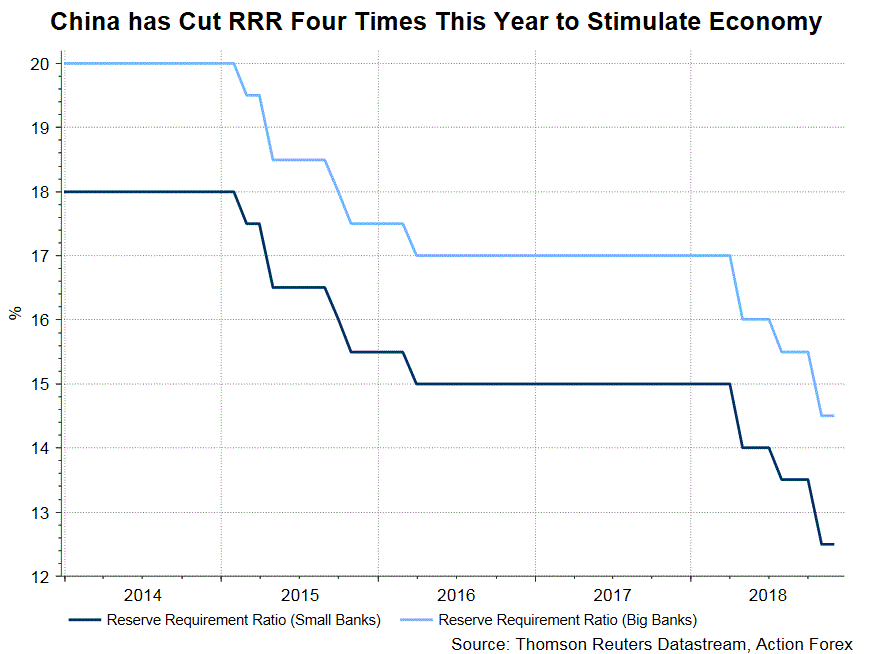
The last reduction, adopted in October, took the RRR for large and small banks to 14.5% to12.5%, respectively. For 2018, PBOC has cut the RRR by four times by a total of -250 bps. We expect more cuts in 2019 with the first move (by -100 bps) coming in as soon as January, ahead of Lunar New Year in early February so as to stimulate consumption.
Renminibi - Managed Depreciation
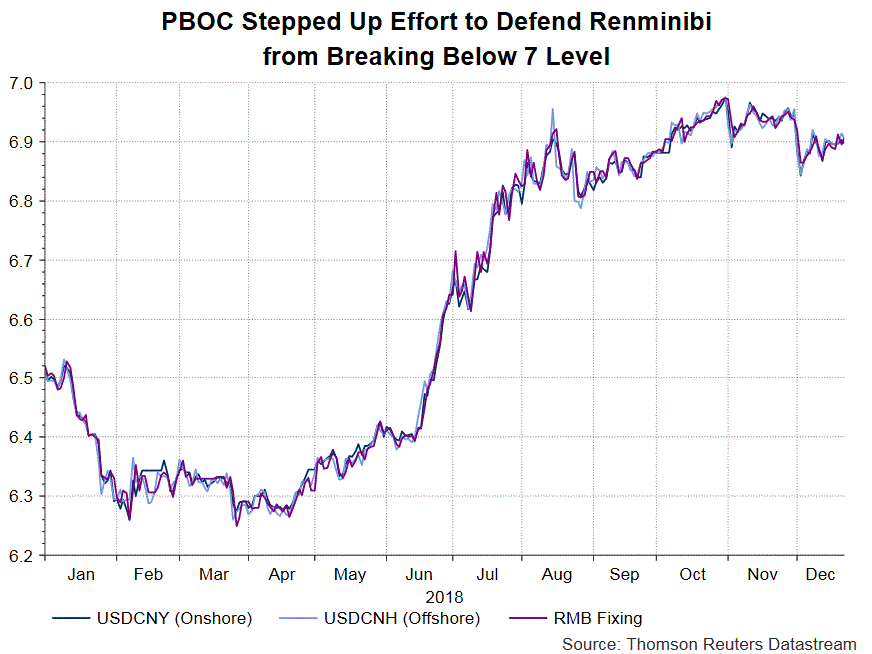
PBOC also noted that it would “enhance counter-cyclical adjustments, maintain reasonably adequate market liquidity and execute targeted adjustments in a more precise and effective way”. Unlike major central banks in advanced economies, the objective of PBOC is not to accomplish target inflation. Rather, it aims a stabilizing the exchange rate. When first introduced in mid 2017, the counter-cyclical factor is just another non-transparent tool adopted by the central bank to intervene the renminbi. The “factor” was suspended in January 2018 and then resumed use in August. Unlike what Trump believes, China does not only manipulate its currency so that it depreciates. Notwithstanding it mysterious nature, the counter-cyclical factor is believed to support the renminbi at times of weakness. Excessive depreciation of a currency would trigger a downward spiral of capital outflow.
PBOC’s indication that it would “enhance counter-cyclical adjustments” suggests that it sees further downside risks to the outlook of renminibi. We view this as a pledge to intervene the market so that the renminbi would not fall below a certain range. Back in October and November, USDCNY almost breached 7 for several times. A break above this psychological level in 2019 appears likely. In our opinion, PBOC’s intervention approach does not aim at a certain price level, but to ensure renminibi’s decline is gradual and within control.
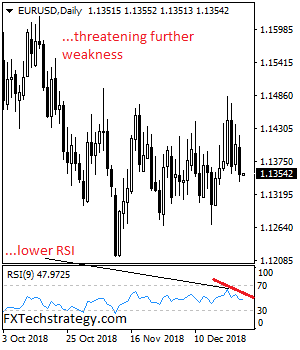
EURUSD Looks To Weaken Further With Eyes On 1.1269 Level
EURUSD looks to weaken further with eyes on 1.1269 level. This is coming on the back of its weakness on Wednesday. Support lies at the 1.1300 level where a violation will aim at the 1.1250 level. A break below here will aim at the 1.1200 level. Further down, support lies at the 1.1150. Its daily RSI is bullish and pointing higher suggesting more strength. On the upside, resistance resides at 1.1400 level with a break through there opening the door for further upside towards the 1.1450 level. Further up, resistance comes in at the 1.1500 level where a violation will expose the 1.1550 level. All in all, EURUSD continues to threaten further weaken towards key support.