Sample Category Title
Japan cabinet approved record fiscal 2019 budget
Japan Prime Minister Shinzo Abe's Cabinet approved budget for fiscal 2019. The general account budget would rise for the seventh straight years, to JPY 101.5T, comparing to current fiscal year's initial estimate of JPY 97.7T.
Of the JPY 101.5T, around JPY 2T will be spent specifically to ease the impact from the planned sales tax hike in October 2019, from 8% to 10%. Measures will include shopping vouchers to help low income households.
However, stimulus measures will altogether hit JPY 6.5T, far exceeding the estimated increase in sale tax revenue. Some economists noted that Abe has now set the precedence that rise in tax would actually be delaying fiscal reform.
Nevertheless, Finance Minister Taro Aso emphasized that "we were able to manage both needs of economic revival and fiscal consolidation with this budget."
Forex Technical Analysis: EUR/USD, USD/JPY, GBP/USD
EUR/USD
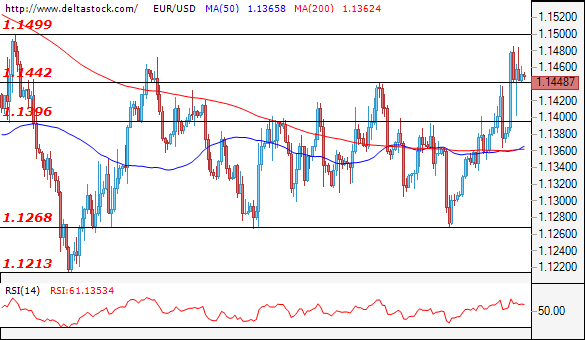
Current level - 1.1448
After the successful break at the 1.1440 level, the expectations are for a test at 1.1533. Key support for the possible rise is 1.1360.
| Resistance | Support | ||
| intraday | intraweek | intraday | intraweek |
| 1.1400 | 1.1450 | 1.1310 | 1.1210 |
| 1.1440 | 1.1500 | 1.1270 | 1.0850 |
USD/JPY
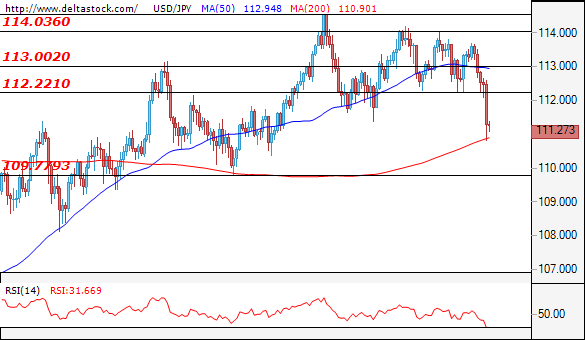
Current level - 112.27
Yesterday's move was strongly to the downside, driven by the sharp decline in indices. Consecutively, the levels at 112.20, 111.60 and 111.37 were broken, with the price dropping to 200MA on the daily chart. Another test is possible at 110.80 and eventually the psychological level 110.00, from where we expect a rebound towards 111.60 and 112.20. The critical level is 109.77.
| Resistance | Support | ||
| intraday | intraweek | intraday | intraweek |
| 112.65 | 114.50 | 112.00 | 112.20 |
| 113.00 | 116.20 | 112.00 | 111.60 |
GBP/USD
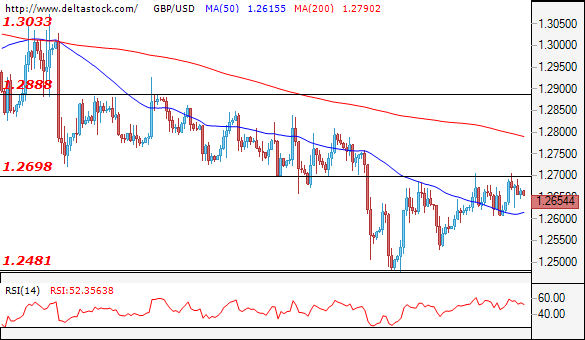
Current level - 1.2654
The trend remains negative and for the bulls to take over they'll need a successful break of 1.2700 level. On the other hand, this could bring back the pair to the levels around 1.2500.
| Resistance | Support | ||
| intraday | intraweek | intraday | intraweek |
| 1.2650 | 1.2880 | 1.2500 | 1.2360 |
| 1.2700 | 1.3030 | 1.2460 | 1.2140 |
Asian update: Nikkei dropped to lowest since Sep 2017, Yen stays strongest for the week
Risk aversion once again spread from US to Asian session. Nikkei closed down -1.11%, or 226.39 pts to 20166.19. That's the lowest level since September 2017 and 20000 handle is now vulnerable. At the time of writing, China Shanghai SSE is down -1.3% at 2504. However, losses in Singapore Strait Times (-0.27%) and Hong Kong HSI (-0.03%) are relatively limited.
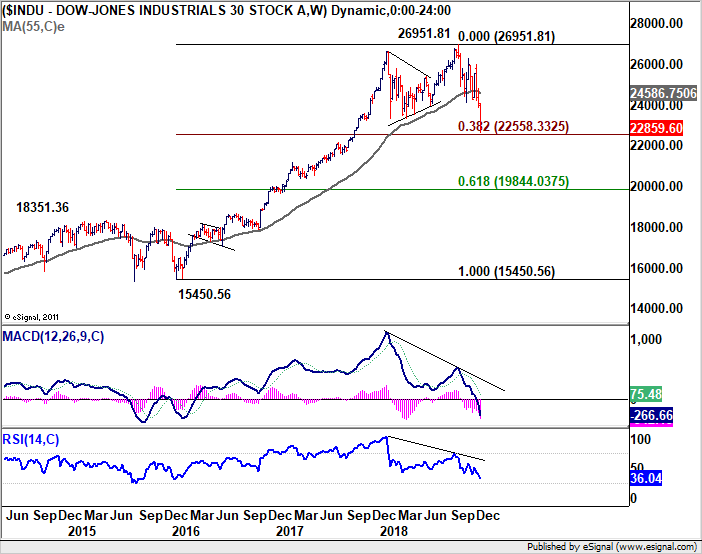
Overnight, DOW lost -1.99% or -464.06pts to 22859.60. S&P 500% dropped -1.58% and NASDAQ dropped -1.63%. DOW is now pressing key support level at 38.2% retracement of 15450.56 to 26951.81 at 22558.33. There is prospect of some recovery before yearly close. But it has to overcome near term resistance at around 23500 before declaring bottoming.
.
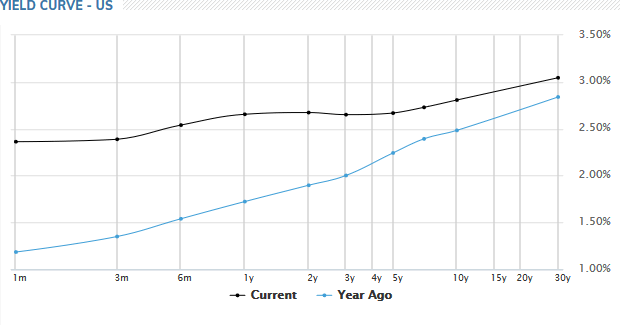
On important development to note is that acceleration in flattening of US yield curve. Overnight, 5-year yield closed up 0.026 to 2.653. 10-year yield rose 0.011 to 2.789. More importantly, 30-year yield breached 3% handle to 2.957, then closed at 3.012, down -0.003. Meanwhile, yield curve remains inverted between 2-year (2.675) and 3-year (2.652).
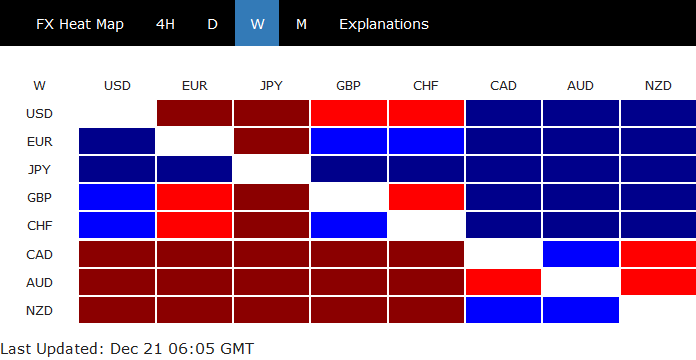
The currency markets are generally in range today. For the week, Yen remains the strongest one on risk aversion, followed by Euro. Commodity currencies are all in deep red.
Can Aggressive Elliott Wave View In Nikkei Will Play Out?
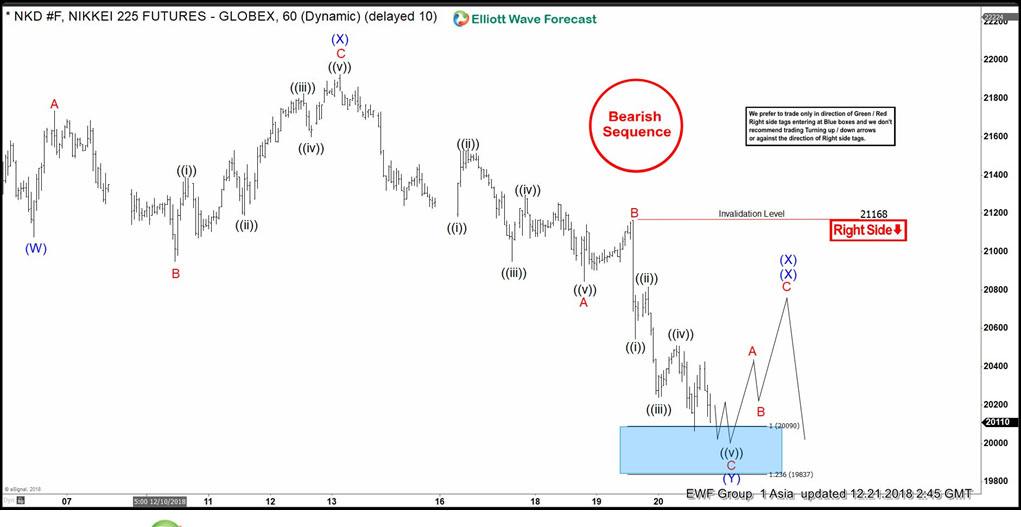
Nikkei short-term Elliott wave view suggests that the cycle from 10/01/2018 peak is showing 5 swings bearish sequence. This favor more downside to 19073-16773 100%-123.6% Fibonacci extension area to be reached in 7 swings before support for bigger 3 wave bounce is seen at least. The decline from 10/01 peak is showing overlapping price action thus suggests that decline is unfolding in a corrective sequence i.e could be unfolding as double three structure.
Currently, the decline to 21075 low intermediate wave (W) lower. Above from there, a bounce in intermediate wave (X) took place as a Flat correction where Minor wave A ended at 21735 high. Minor wave B ended at 20950low and Minor wave C ended at 21890 high which also completed intermediate wave (X). Down from there, intermediate wave (Y) remains in progress in a lesser degree zigzag structure where Minor wave A ended in 5 waves at 20845 low. Then a 3 wave bounce to 21168 high ended Minor wave B.
Below from there, Minor wave C remains in progress in another lesser degree 5 waves structure & reached the 100%-123.6% Fibonacci extension area of Minor wave A-B to complete intermediate wave (Y) soon. Afterward, the index is expected to do a bounce in 3, 7 or 11 swings within intermediate (X)(X) of a possible triple correction lower as per aggressive view against 21168 high pivot firstly & against 21890 high in the second degree. We expect short-term sellers to appear in 3, 7 or 11 swings on a bounce in intermediate wave (X)(X).
Nikkei 1 Hour Elliott Wave Chart
Euro-Zone’s Current Account Surplus Expanded In October
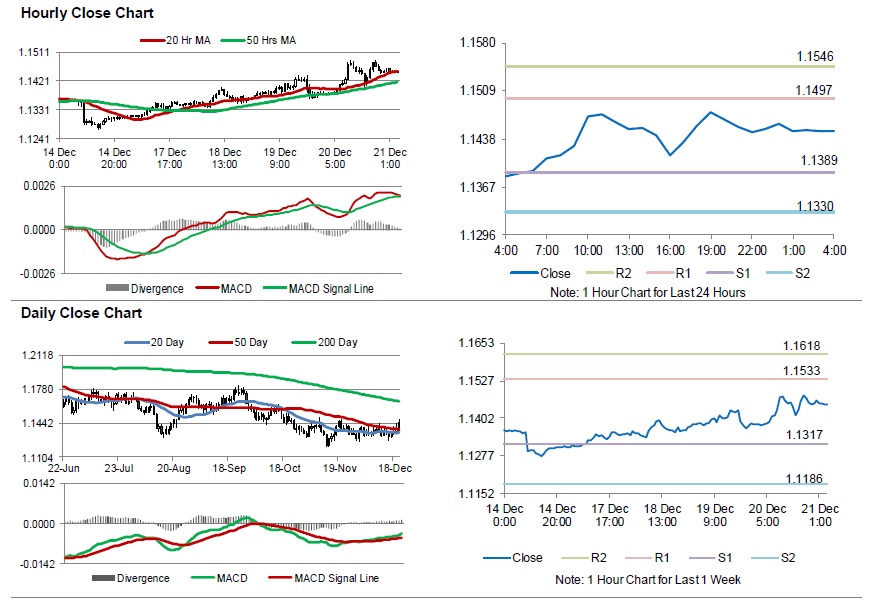
For the 24 hours to 23:00 GMT, the EUR rose 0.61% against the USD and closed at 1.1453.
On the data front, the Euro-zone's seasonally adjusted current account surplus widened to €23.0 billion in October, following a revised surplus of €17.6 billion in the prior month.
In the US, data showed that the US Philadelphia Fed manufacturing index unexpectedly declined to a level of 9.4 in December, defying market consensus for a rise to a level of 15.0. The index had recorded a reading of 12.9 in the previous month.
On the contrary, the nation's leading indicator surprisingly rebounded 0.2% on a monthly basis in November, cofounding market expectations for a flat reading. In the preceding month, the leading indicator had recorded a revised fall of 0.3%. Moreover, the number of Americans filling for fresh unemployment benefits rose to a level of 214.0K in the week ended 15 December 2018, compared to a reading of 206.0K in the previous week. Market participants had anticipated initial jobless claims to climb to a level of 215.0K.
In the Asian session, at GMT0400, the pair is trading at 1.1449, with the EUR trading a tad lower against the USD from yesterday's close.
The pair is expected to find support at 1.1389, and a fall through could take it to the next support level of 1.1330. The pair is expected to find its first resistance at 1.1497, and a rise through could take it to the next resistance level of 1.1546.
Moving ahead, investors would keep an eye on the Germany's GFK consumer confidence for January, slated to release in a while. Later in the day, the US 3Q annualised gross domestic product along with the Michigan consumer sentiment index for December and durable goods orders for November, will keep investors on their toes. Also, the US personal spending and personal income data for November, will pique significant amount of traders attention.
The currency pair is showing convergence with its 20 Hr moving average and trading above its 50 Hr moving average.
BoE Kept Its Benchmark Interest Rate Unchanged, As Widely Expected
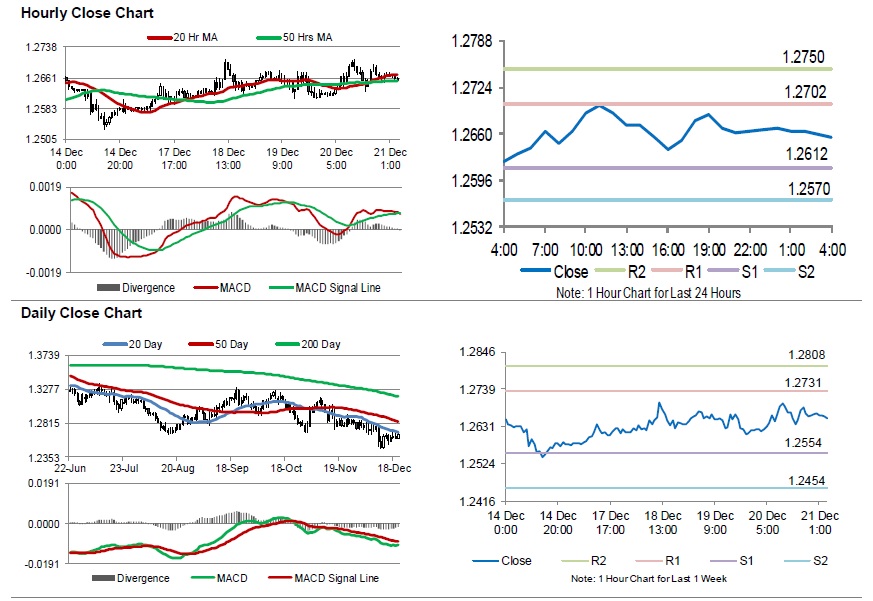
For the 24 hours to 23:00 GMT, the GBP rose 0.35% against the USD and closed at 1.2665.
Data indicated that UK’s retail sales advanced 3.6% on an annual basis in November, buoyed by Black Friday promotions & record online spending and surpassing market expectations for a rise of 2.0%. In the previous month, retail sales had registered a revised gain of 2.4%.
The Bank of England (BoE), in its latest policy meeting, voted unanimously to leave its key interest rates unchanged at 0.75%, as widely. Further, the central bank lowered its growth forecast for Q4 2018 to 0.2% from 0.3%. Additionally, the bank expects inflation to fall below 2.0% in coming months due to lower oil prices. Moreover, policymakers warned that uncertainties surrounding Brexit are posing risks to the country’s growth outlook.
In the Asian session, at GMT0400, the pair is trading at 1.2655, with the GBP trading 0.08% lower against the USD from yesterday’s close.
Overnight data showed that UK’s Gfk consumer confidence fell to a 5.5-year low level of -14.0 in December, at par with market expectations and following a reading of -13.0 in the previous month. Additionally, the Lloyds business barometer eased to a level of 17.0% in December, compared to a level of 24.0 % in the preceding month.
The pair is expected to find support at 1.2612, and a fall through could take it to the next support level of 1.2570. The pair is expected to find its first resistance at 1.2702, and a rise through could take it to the next resistance level of 1.2750.
Looking forward, traders would await UK’s 3Q gross domestic product figures and public sector net borrowing for November, set to release in a few hours.
The currency pair is trading below its 20 Hr moving average and showing convergence with its 50 Hr moving average.
Japanese Yen Trading A Tad Lower In The Asian Session
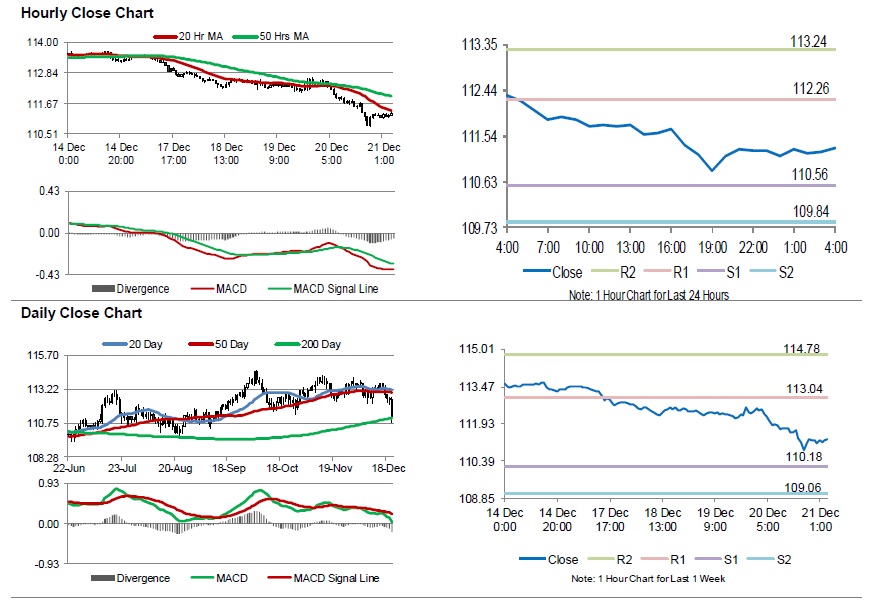
For the 24 hours to 23:00 GMT, the USD declined 1.01% against the JPY and closed at 111.24.
In economic news, Japan’s final machine tool orders declined 17.0% on an annual basis in November, compared to a drop 0.7% in the prior month. The preliminary figures had recorded a fall of 16.8%.
In the Asian session, at GMT0400, the pair is trading at 111.29, with the USD trading slightly higher against the JPY from yesterday’s close.
Overnight data revealed that the nation’s national consumer price index (CPI) climbed 0.8% on a yearly basis in November, at par with market expectations. The CPI had recorded a rise of 1.4% in the previous month.
The pair is expected to find support at 110.56, and a fall through could take it to the next support level of 109.84. The pair is expected to find its first resistance at 112.26, and a rise through could take it to the next resistance level of 113.24.
Going forward, investors would closely monitor the Bank of Japan’s meeting minutes followed by Japan’s housing starts, construction orders, jobless rate, retail trade and industrial production, set to release next week
The currency pair is showing convergence with its 20 Hr moving average and trading below its 50 Hr moving average.
Switzerland’s Trade Surplus Widened In November
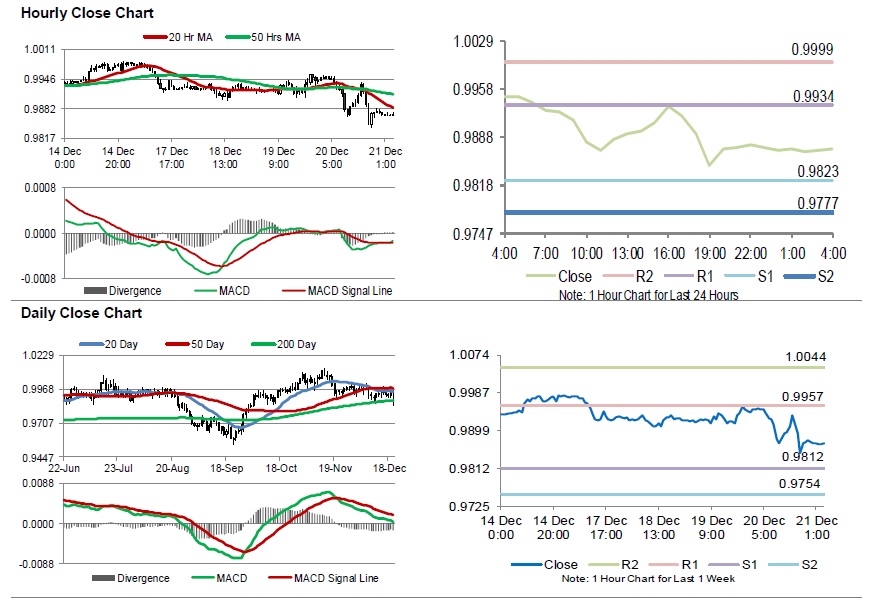
For the 24 hours to 23:00 GMT, the USD declined 0.70% against the CHF and closed at 0.9873.
On the macro front, Switzerland's trade surplus widened to a level of CHF4.74 billion in November, compared to a revised surplus of CHF3.52 billion in the previous month.
In the Asian session, at GMT0400, the pair is trading at 0.9870, with the USD trading marginally lower against the CHF from yesterday's close.
The pair is expected to find support at 0.9823, and a fall through could take it to the next support level of 0.9777. The pair is expected to find its first resistance at 0.9934, and a rise through could take it to the next resistance level of 0.9999.
Trading trend in the Swiss Franc today is expected to be determined by Switzerland's M3 money supply for November, scheduled to release in a while.
The currency pair is trading below with its 20 Hr and 50 Hr moving averages.
Loonie Trading A Tad Higher In The Asian Session
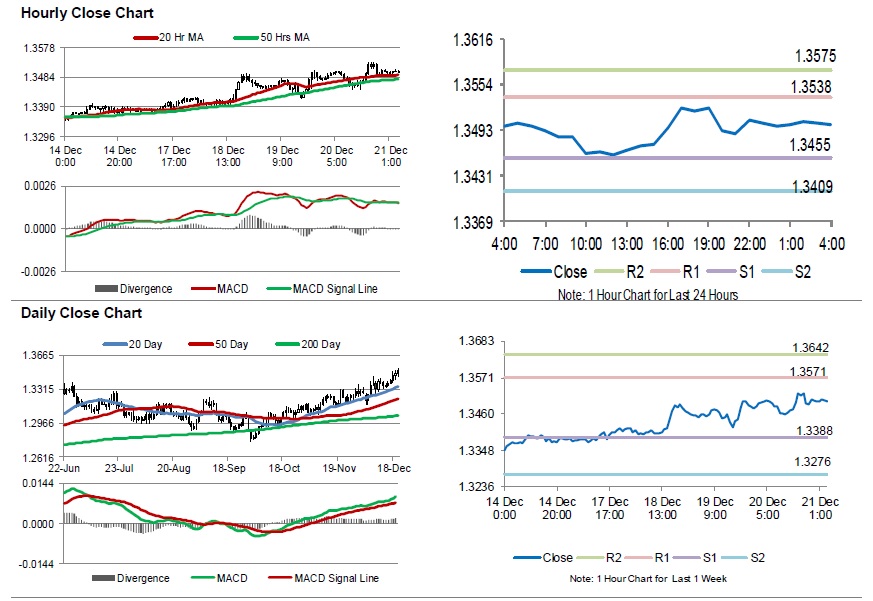
For the 24 hours to 23:00 GMT, the USD rose 0.14% against the CAD and closed at 1.3502.
In the Asian session, at GMT0400, the pair is trading at 1.3500, with the USD trading slightly lower against the CAD from yesterday’s close.
The pair is expected to find support at 1.3455, and a fall through could take it to the next support level of 1.3409. The pair is expected to find its first resistance at 1.3538, and a rise through could take it to the next resistance level of 1.3575.
Moving ahead, investors would await Canada’s gross domestic product and retail sales, both for October, set to release later in the day.
The currency pair is trading above its 20 Hr and 50 Hr moving averages.
Aussie Trading Slightly Lower In The Morning Session
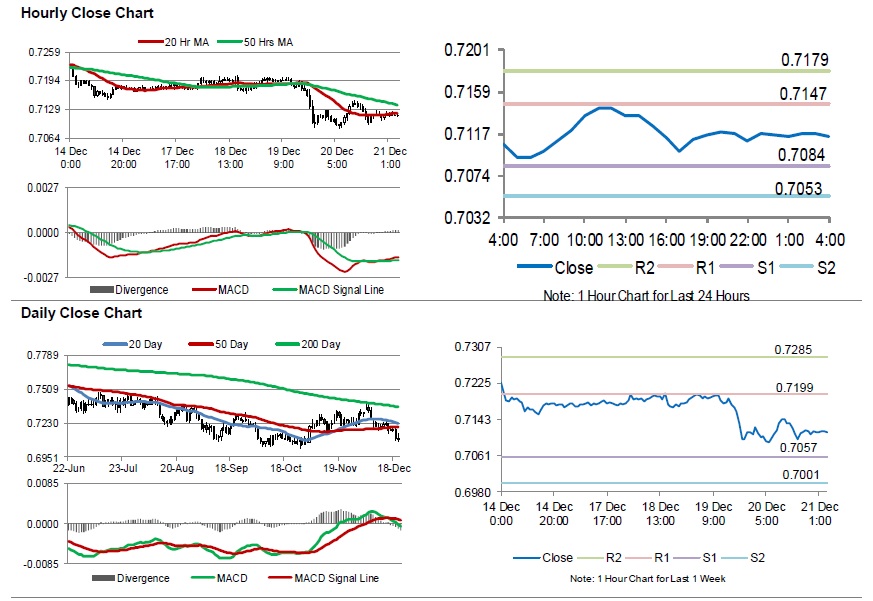
For the 24 hours to 23:00 GMT, the AUD rose 0.06% against the USD and closed at 0.7117.
LME Copper prices rose 1.1% or $64.0/MT to $6051.0/MT. Aluminium prices declined 0.2% or $4.5/MT to $1932.5/MT.
In the Asian session, at GMT0400, the pair is trading at 0.7114, with the AUD trading marginally lower against the USD from yesterday’s close.
The pair is expected to find support at 0.7084, and a fall through could take it to the next support level of 0.7053. The pair is expected to find its first resistance at 0.7147, and a rise through could take it to the next resistance level of 0.7179.
The currency pair is showing convergence with its 20 Hr moving average and trading below its 50 Hr moving average.