

Sample Category Title
Gold Climbs as Dovish Fed Spooks Investors
Gold prices have risen sharply in the Thursday session. In the North American session, the spot price for one ounce of gold is $1260.68, up 1.40% on the day. On the release front, U.S. unemployment claims rose to 214 thousand, just under the forecast of 216 thousand. The Philly Fed Manufacturing Index dropped sharply to 9.4 in November, down from 12.9 a month earlier. This was the lowest level since November 2016. Friday will be busy, with the release of Final GDP, durable goods orders and consumer confidence.
The U.S dollar is in full retreat on Thursday, and gold has taken advantage, posting sharp gains. Gold has punched past the $1260 line for the first time since early July. The catalyst for the strong gains was investor disappointment over the Federal Reserve rate statement. A rate hike had been expected, and the Fed delivered with a quarter-point hike, the fourth of the year. Investors were also looking for a Christmas gift from the Fed, in the form of a dovish rate statement. There was speculation that the Fed would “compensate” investors, given that the markets have been in turmoil for weeks and the U.S. economy appears to be cooling down.
However, the Fed was not in a giving mood, signaling that it plans to continue raising rates in 2019. Policymakers did not remove the phrase “further gradual increases” from their statement, and Fed Chair Jerome Powell added that the “lower end” of the neutral rate range has been achieved. Investors had counted on a more dovish stance from the Fed and responded with a thumbs-down. Equity markets are down sharply on Thursday and investors have snapped up safe-haven assets like gold.
Sunset Market Commentary
Markets
Global core bonds were mixed today. European markets followed the US example of yesterday after the Fed’s policy meeting. Equities edged lower and core bonds opened higher. Investors were not satisfied by the Fed’s ‘dovish hike’, a 25 bps rate hike but a lower 2019 rate forecast (2 hikes instead of 3), and had hoped for a much softer tone. European equities fell at opening, pushing German Bunds higher. The move came to a halt as the reaction to the Fed faded a little, with German bunds pair their gains completely during a volatile trading session. US Treasuries were steady today with some appetite to move lower. The Philadelphia Fed Business Outlook fell from 12.9 in November to 9.4 in December, the lowest level since the end of 2016, with a lot of the weakness driven by a drop in inventories and shipments. The disappointing gauge adds up to worries of a fading economic momentum. It pushed risk sentiment back south and UST’s back up. The Jobless Claims remained stable and didn’t surprise. US equities opened in red as well. The US yield curve was mixed, with changes ranging between -1.2 bps (30-yr) to +1.5 bps (5-yr). The German yield curve flattened with changes varying between -3.2 bps to +0.4 bps (2-yr).
EUR/USD explored higher grounds despite today’s outright risk-off climate. Dollar gains in the wake of yesterday’s dovish hike evaporated as markets try to assess the Fed’s policy implications going forward. The Philly Fed business outlook disappointed (9.4 vs. 15.0 expected) but had little impact on trading. EUR/USD headed north swiftly during early European dealings but lost momentum around noon. The pair is trading around 1.1444 at the time of writing. The 1.12/15-range remains intact for now. Markets will scrutinize tomorrow’s US data batch (CPI, durable goods) but it remains to be seen whether this can alter the technical picture if even the Fed couldn’t. USD/JPY extends its move south at sessions lows close to 111.5.
EUR/GBP followed its American counterpart in lockstep, defying stronger than expected UK retail sales. Headline sales rose 1.4% MoM (3.6% YoY) vs. 0.3% MoM (2.0% YoY) expected. Core measures showed a 1.2% monthly increase (3.8% YoY) whereas markets expected a mere 0.2% (2.3%) increase. Attention then shifted to the BoE policy meeting, which – as expected – left interest rates unchanged at 0.75%. But the BoE warned that brexit uncertainties have “intensified considerably” and have weighed on the near-term outlook for UK growth. It expects 2018Q4 en 2019Q1 growth to land at a modest 0.2% with risks tilted to the downside. Inflation is expected to slow below the 2% target in January (oil price related) but improved labour market conditions are likely to exert sustainable upward pressure on prices eventually. To keep contain future inflation, the BoE still assumes a quarter point rate hike once a year under the condition of a smooth Brexit. In any case, the bank reiterated, the policy response to Brexit could be in both directions, “whatever form it takes”. Sterling was little changed following the decision/assessment and is trading near session highs. EUR/GBP is changing hands close to 0.904. Cable is filling bids around 1.267.
News Headlines
The Swedish Riksbank raised its policy rate for the first time in 8 years, from -0.5% to -0.25% while simultaneously downgrading growth/inflation/rate forecasts. A classic “dovish hike” in which the central bank plots 1 more interest rate increase next year, followed by 2 hikes/year pace afterwards. EUR/SEK nevertheless lost some ground as the market was split on this month’s vote. EUR/SEK fell to the 10.25 area
Bloomberg reports that OPEC and its allies will give greater clarity on their strategy to stabilize oil markets tomorrow by publishing a list of production cuts agreed by each country. It couldn’t stem the rod on oil markets with Brent crude dipping temporarily below $55/barrel for the first time since September last year.
GBPAUD Hits 1-Month High; Remains Bullish in Long Term
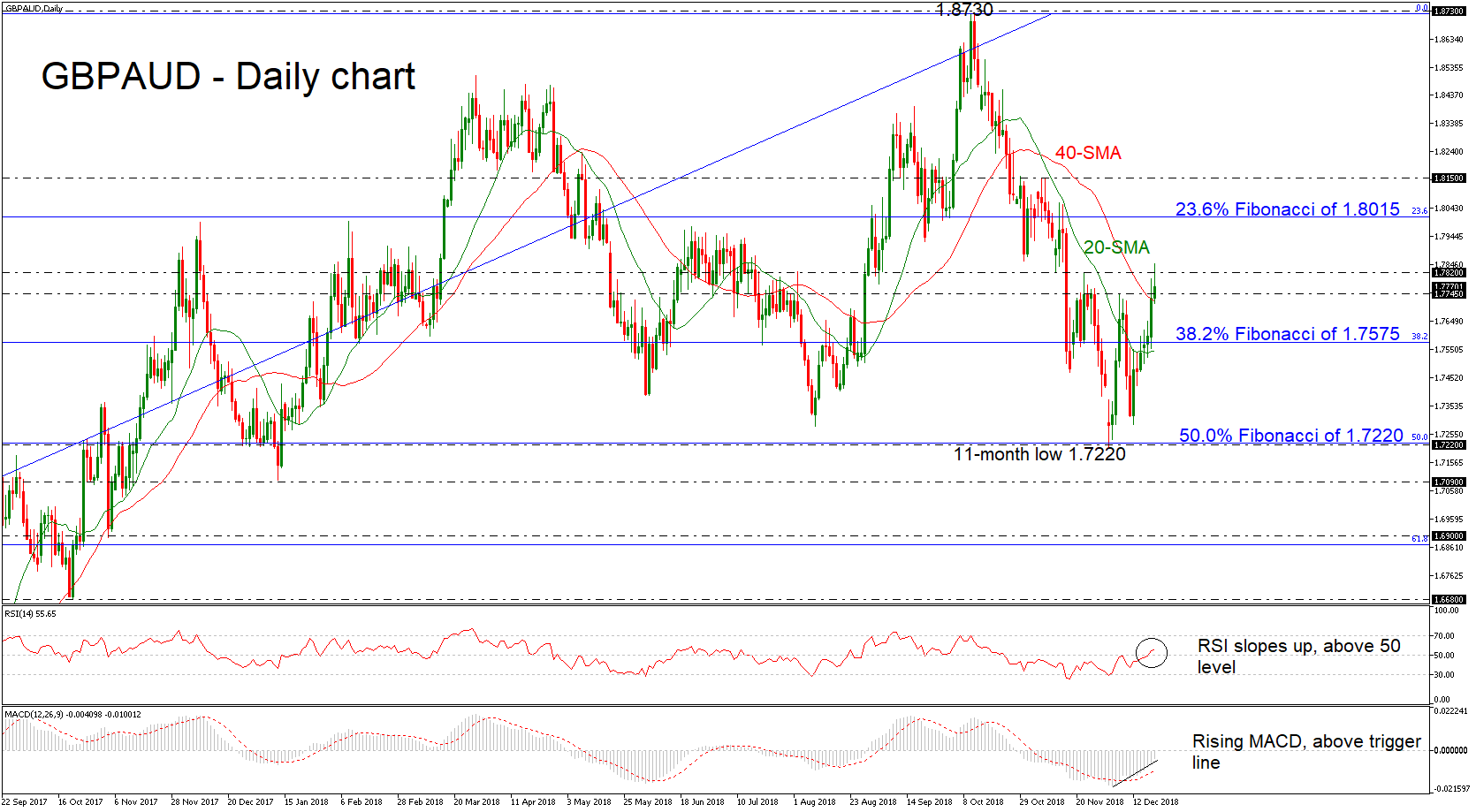
GBPAUD moved higher to a one-month high of 1.7850 after finding support at the 11-month lows at 1.7220, near the 50% Fibonacci retracement level of the upleg from 1.5725 to 1.8730 on December 3. The price extended its gains above the 38.2% Fibonacci mark of 1.7575 and the 20- and 40-simple moving averages (SMAs) in the daily chart. The RSI indicator is advancing above the 50 level, while the MACD oscillator climbed above the trigger line in the negative zone.
If the price manages to edge higher and rise above today’s intraday’s high, it could challenge the 23.6% Fibonacci mark of 1.8015. An upside penetration of this barrier could drive the market until the 1.8150 resistance, registered on November 6.
Alternatively, in case of a downward movement, the market could stop near the 38.2% Fibonacci of 1.7575. Even lower, support could be found at the eleven-month low of 1.7220, which overlaps with the 50.0% Fibonacci region.
To sum up, GBPAUD is in progress to create the fifth straight bullish day, confirming the upside tendency after the selling interest from the 1.8730 barrier. The strong rebound has also ensured the longer term bullish outlook remains intact.
USD/CHF Mid-Day Outlook
Daily Pivots: (S1) 0.9916; (P) 0.9936; (R1) 0.9966; More...
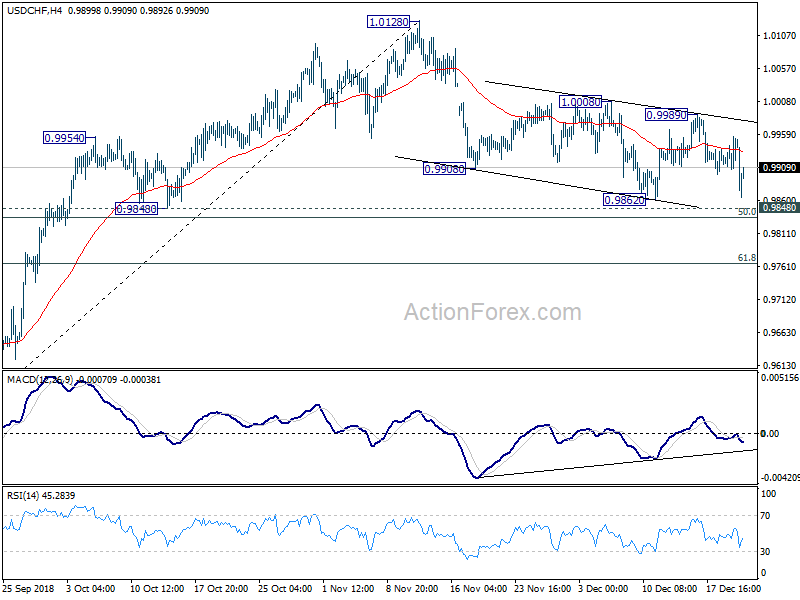
USD/CHF drops sharply today as low as 0.9864 but recovered ahead of 0.9862 low. Outlook is unchanged at price actions from 1.0128 are forming a corrective pattern. Downside should be contained by 0.9848 support to bring rebound. On the upside, above 0.9989 will turn bias back to the upside for retesting 1.0128 high.
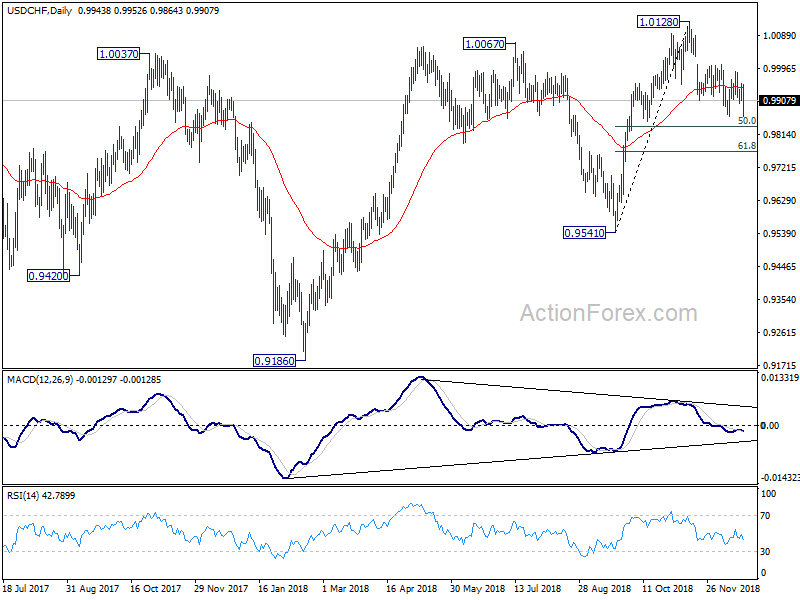
In the bigger picture, current development suggests that the medium term rally from 0.9186 hasn't completed yet. Break of 1.0128 will target 1.0342 key resistance next (2016 high). On the downside, break of 0.9848 support will dampen this bullish view and turn focus back to 0.9541 key support instead.
USD/JPY Mid-Day Outlook
Daily Pivots: (S1) 112.16; (P) 112.41; (R1) 112.73; More..
USD/JPY's decline continues today and reaches as low as 111.47 so far. Intraday bias remains on the downside for 111.37 support and below. Nevertheless, USD/JPY is seen in consolidation pattern from 114.54. Thus, downside should be contained by 38.2% retracement of 104.62 to 114.54 at 110.75 to bring rebound. Larger rise from 104.62 is expected to resume later. On the upside, above 111.96 minor resistance will turn intraday bias neutral first.
In the bigger picture, corrective fall from 118.65 (2016 high) should have completed with three waves down to 104.62. Decisive break of 114.73 resistance will likely resume whole rally from 98.97 (2016 low) to 100% projection of 98.97 to 118.65 from 104.62 at 124.30, which is reasonably close to 125.85 (2015 high). This will stay as the preferred case as long as 109.76 support holds. However, decisive break of 109.76 will dampen this bullish view and turns outlook mixed again.
GBP/USD Mid-Day Outlook
Daily Pivots: (S1) 1.2586; (P) 1.2633; (R1) 1.2657; More....
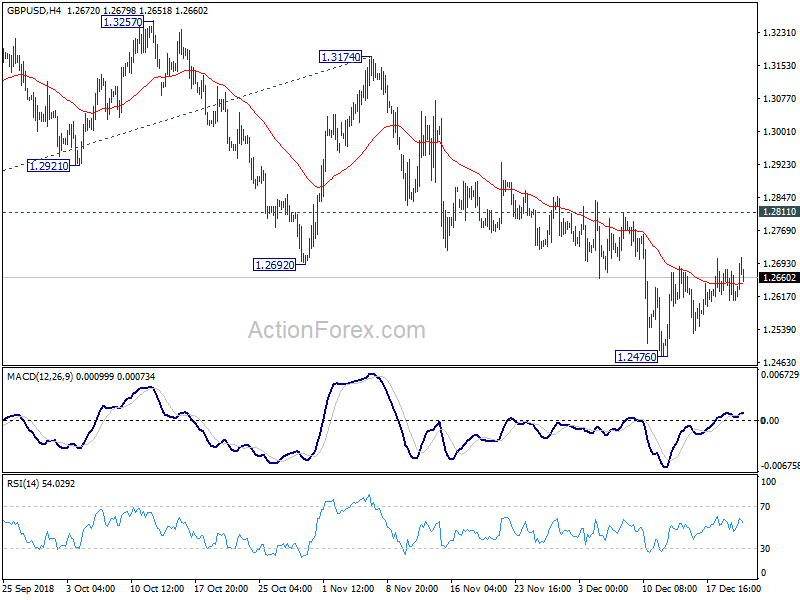
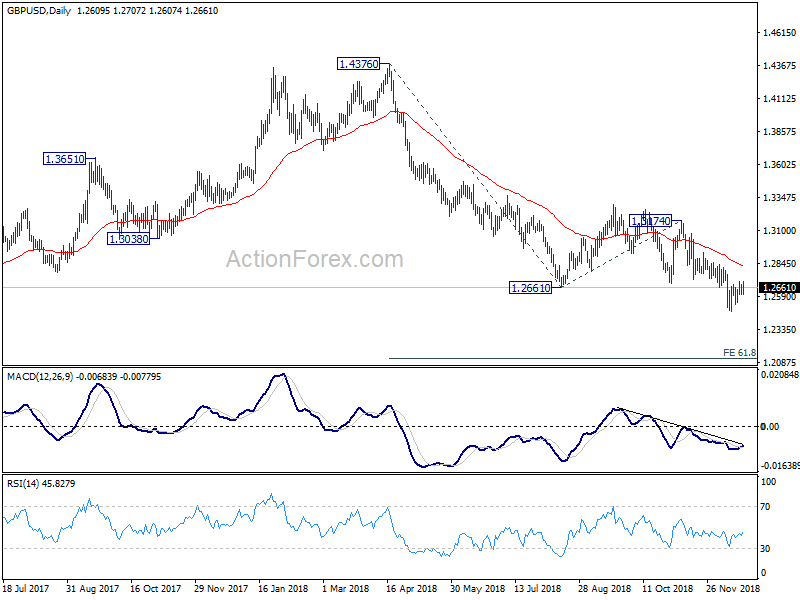
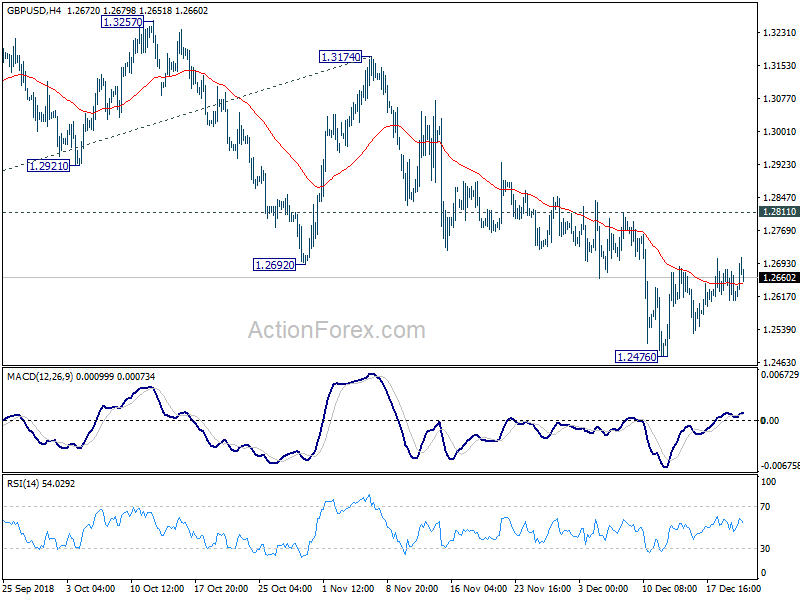
GBP/USD's corrective recovery from 1.2476 is still in progress. Intraday bias remains neutral first. Upside should be limited by 1.2811 resistance to bring fall resumption. On the downside, break of 1.2476 will extend larger down trend from 1.4376 to 61.8% projection of 1.4376 to 1.2661 from 1.3174 at 1.2114. However, firm break of 1.2811 will be an early signal of trend reversal and turn focus back to 1.3174 resistance.
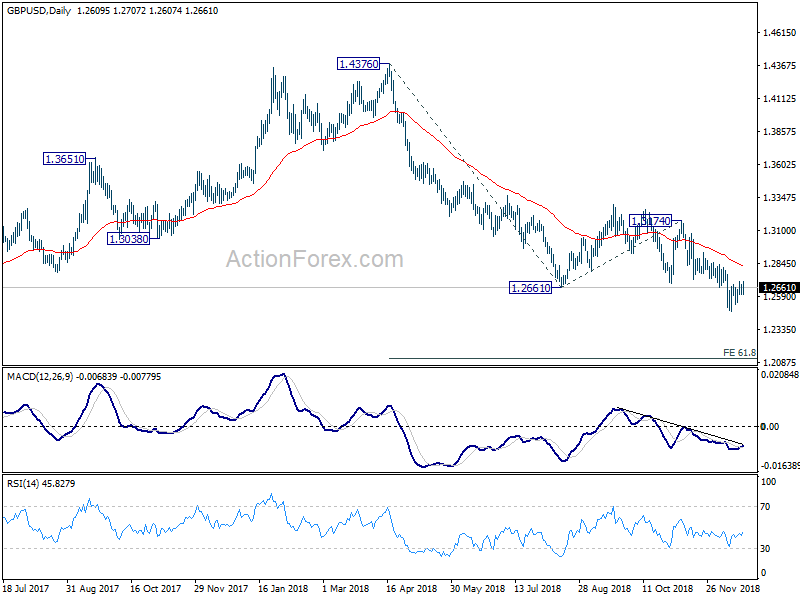
In the bigger picture, whole medium term rebound from 1.1946 (2016 low) should have completed at 1.4376 already, after rejection from 55 month EMA. The structure and momentum of the fall from 1.4376 argues that it's resuming long term down trend from 2.1161 (2007 high). And this will now remain the preferred case as long as 1.3174 structural resistance holds. GBP/USD should now target a test on 1.1946 first. Decisive break there will confirm our bearish view.
Yen Jumps as Dollar Retreats after Dovish Fed Statement
The Japanese yen continues to surge higher this week. In Thursday’s North American session, USD/JPY is trading at 111.65, down 0.75% on the day. The yen has broken below the 112 line for the first time since late October, as the U.S. continues to suffer broad losses this week. In economic news, the BoJ maintained interest rates at -0.10%. In the U.S., unemployment claims rose to 214 thousand, just under the forecast of 216 thousand. The Philly Fed Manufacturing Index dropped sharply to 9.4 in November, down from 12.9 a month earlier. This was the lowest level since November 2016.
The markets were prepared for another rate hike at the Federal Reserve meeting, and policymakers pressed the rate trigger for the fourth time in 2018. Investors were also looking for Christmas goodies from the Fed, in the form of a dovish rate statement. There was speculation that the Fed would “compensate” investors, given that the markets have been in turmoil for weeks and the U.S. economy appears to be cooling down.
However, the Fed seems bent on continuing to raise rates in 2019 – most significantly, policymakers did not remove the critical phrase “further gradual increases” from their statement. At the same time, the dot plot forecast was lowered for 2019, from three rate rises to two. This marks a U-turn for the Fed, as back in October, Fed Chair Jerome Powell talked about continuing to raise rates until the “neutral rate” range was met. This range has been somewhat unclear, allowing Powell to say on Thursday that the “lower end” of the range has been achieved. Investors had counted on a more dovish stance from the Fed and responded with a thumbs-down, sending USD/JPY sharply lower.
The Bank of Japan made no change to its stimulus program and remained cautious. Policymakers said that the Japanese economy will show moderate expansion, but noted continuing risks to the economy due to the U.S-China trade spat and turmoil in the financial markets. BoJ Governor Kuroda hinted that due to the uncertain economic conditions, the bank could increase stimulus in order to reach the bank’s 2 percent inflation target.
EUR/USD Mid-Day Outlook
Daily Pivots: (S1) 1.1344; (P) 1.1393; (R1) 1.1424; More.....
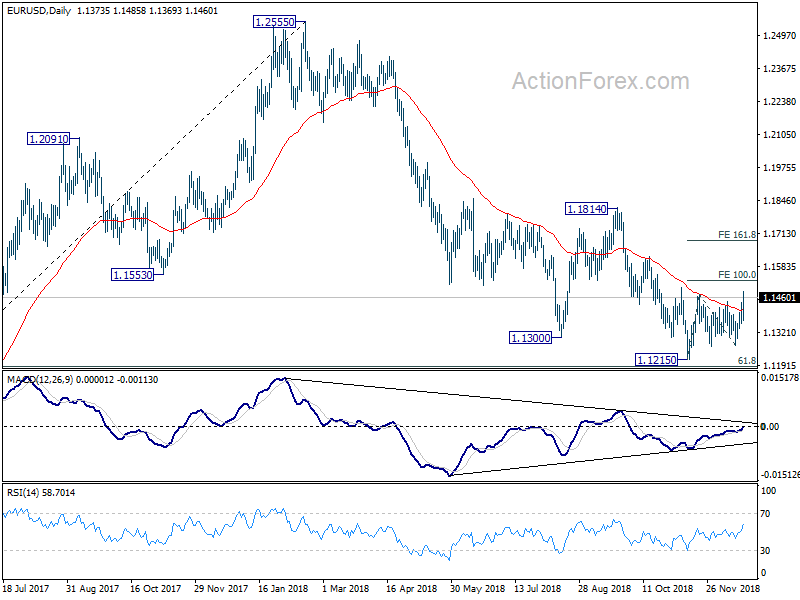
EUR/USD's strong rise and break of 1.1443 resistance indicates resumption of rebound from 1.1215. Also, considering bullish convergence condition in daily MACD, it's taken as an early sign of bullish reversal. Intraday bias is now on the upside for 100% projection of 1.1215 to 1.1472 from 1.1270 at 1.1527 first. Break will target 161.8% projection at 1.1686 next. On the downside, however, break of 1.1364 will suggest that the rebound is completed and turn bias back to the downside for 1.1215 low.
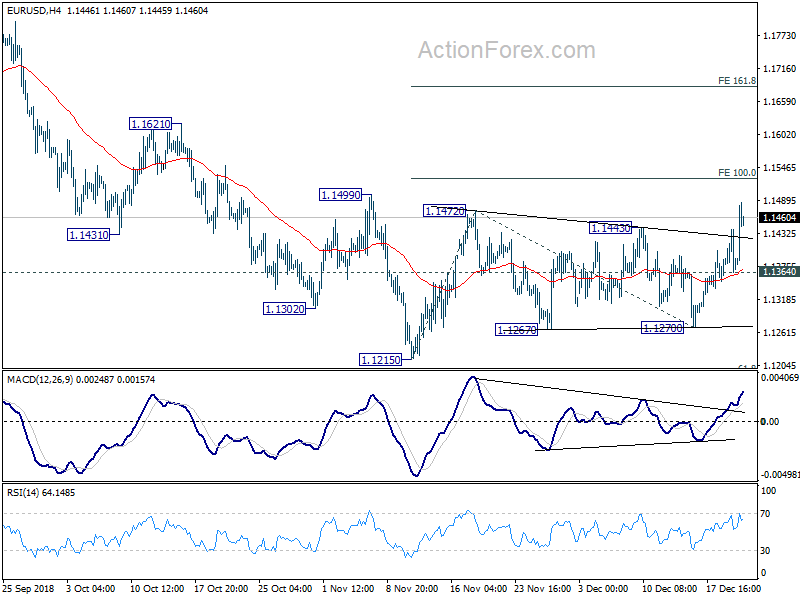
In the bigger picture, as long as 1.1814 resistance holds, down trend down trend from 1.2555 medium term top is still in progress and should target 61.8% retracement of 1.0339 (2017 low) to 1.2555 at 1.1186 next. Sustained break there will pave the way to retest 1.0339. However, break of 1.1814 will confirm completion of such down trend and turn medium term outlook bullish.
Dollar Under Pressure But Loss Limited, BoE Dovish Shift Ignored
Dollar remains in the spotlight today as it suffers renewed selling in European session. It could be part of delayed reaction to the dovish FOMC rate hike yesterday. But then, while the greenback is the worst performing one today, loss greenback is limited so far except versus the Japanese Yen. Commodity currencies remain generally weakest ones for today and the week. Yen is currently trading as the strongest for today as risk aversion continues. Euro followed as second strongest. BoE and BoJ rate decisions today triggered little reactions.
Technically, most important development today is the break of 1.1443 resistance in EUR/USD. It firstly suggests resumption of rebound from 1.1215 low. Also, it's an early signal of bullish reversal As long as 1.1364 minor support holds, further rally is now in favor back to 1.1814 key resistance. However, Dollar is only more bearish against Euro and Yen. Even USD/CHF recovers well ahead of 0.9848 key support. GBP/USD is held in tight range. AUD/USD stays near term bearish and USD/CAD remains near term bullish. More is needed to confirm underlying weakness of Dollar.
In other markets, major European indices are generally lower at the time of writing. FTSE is down -0.23%, DAX is down -1.14%, CAC is down -1.62%. German 10 year yield is down -0.0128 at 0.229. Italian 10 year yield is down -0.0327 at 2.738. Earlier today, Nikkei dropped -2.84%, Hong Kong HSI dropped -0.94%, China Shanghai SSE dropped -0.52%, Singapore Strait Times dropped -0.26%. Japan 10 year JGB yield dropped -0.0032 to 0.031.
BoE stands pat with dovish shift, UK retail sales shone
BOE voted 9-0 to leave the Bank rate unchanged at 0.75% in December. The committee also voted unanimously to leave the asset purchase program at 435B pound .It has turned more cautious than November, warning that Brexit uncertainty has "intensified considerably" since November. Thanks to lower oil prices, policymakers expect inflation to fall below +2% in as soon as January 2019. This should give more room for BOE in keeping interest rates on hold. More in BOE Turns Dovish as Brexit Deadline Nears, Yet No Deal is Secured
UK retail sales came in stronger than expected in November. Retail sales including auto and fuel rose 1.4% mom, 3.6% yoy versus expectation of 0.3% mom, 1.9% yoy. Retail sales excluding auto and fuel rose 1.2% mom, 3.8% yoy versus expectation of 0.2% mom, 2.3% yoy. ONS noted that "retailers reported strong growth on the month due to Black Friday promotions in November, which continues the shifting pattern in consumer spending to sales occurring earlier in the year".
US jobless claims rose to 214k, Philly Fed business outlook dropped to 9.4
US initial jobless claims rose 8k to 214k in the week ended December 15, below expectation of 219k. Four-week moving average of initial claims dropped -2.75k to 222k. Continuing claims rose 27k to 1.688M in the week ended December 8. Four-week moving average of continuing claims rose 6.75k to 1.6725M. Also released Philly Fed business outlook dropped sharply to 9.4 in December, down from 12.9 and missed expectation of 15.6. That's also the lowest level since August 2016.
Yesterday, Fed raised federal funds rate by 25bps to 2.25-2.50% as widely expected. The decision was made by unanimous vote. The latest economic projections were rather dovish. 2019 growth and inflation forecast was revised down. Fed also projected few rate hikes ahead. More in:
- FOMC Review – Fed Not As Dovish As Expected
- FOMC to Continue With Hikes, but Mindful of Risks
- Where The Fed May Be Wrong
- The Fed Hikes Rates, But Acknowledges Risks
- Fed Delivers Dovish Hike But Tightening Isn't Done Yet
- Fed Raises Rates, and Expects "Some" Further Gradual Hikes Will be Required
- FOMC Review Fed To Markets: 'Just A Couple Of More Hikes'
- Fed Recap: 'Some' What Dovish Hike Not Enough For Stocks
MOFCOM: Both US and China took proactive measures on to resolve trade frictions, more talks in Jan
Chinese Commerce Ministry spokesman Gao Feng confirmed in a regular press briefing there were talks between China and US on trade yesterday. Both sides exchanged opinions on topics including balancing trade and intellectual property protection. Further than that, there are plans for more US-China trade talks in January. He said that both sides had maintained very close communications after Xi-Trump meeting earlier this month.
Also Gao hails that both sides took "proactive" measures on resolving trade conflicts and released "positive signals". And he emphasized this is " an important condition for the smooth progress of the consultations" on trade and economic frictions. Gao pointed to US formally suspended additional tariffs on Chinese imports till March 2. Also, China suspended additional tariffs on US autos still March 31.
BoJ stands pat as widely expected, with 7-2 vote
BoJ left monetary policy unchanged today as widely expected. Short term policy rate is held negative at -0.1%. The central bank will continue with asset purchase at around JPY 80T a year to keep 10 year JGB yield at around 0%. The decision was again made by 7-2 vote. Y. Harada against said allowing long-term yields to move to some extent was too ambiguous. G. Kataoka continued to push for strengthen easing.
On economic outlook, BoJ said the economy is "likely to continue its moderate expansion". Domestic demand is likely to follow an uptrend, "with a virtuous cycle from income to spending being maintained in both the corporate and household sectors". CPI is "likely to increase gradually toward 2 percent, mainly on the back of the output gap remaining positive and medium- to long-term inflation expectations rising".
BoJ also maintained the risks include US macroeconomic policies, protectionist moves, emerging markets, Brexit and geopolitical risks.
BoJ Kuroda laid out options for additional easing if necessary
In the post meeting press conference, BoJ Governor Haruhiko Kuroda warned of downside risks to the economy "particularly via overseas economic developments". He added, "if trade frictions persist, that could have a broad impact on Japanese and overseas economies." Nevertheless, he also pointed to tankan survey and BoJ's internal hearings, and noted "trade frictions on Japan's economy is limited for now". There is so far no change in the view that the economy is "expanding moderately". Also, " momentum for achieving our price target is sustained."
Kuroda also sounded open to more easing and noted "If we think doing so would be necessary to sustain the momentum for achieving our price target, we will ease monetary policy further as appropriate." The options for additional easing include cutting the short-term interest rate target, lowering the long-term yield target, ramping up asset buying and accelerating the pace of increase in base money.
Australia employment grew 37k, but full time jobs dropped -6.4k
Australian employment market grew 37.0k, seasonally adjusted, in November, much better than expectation of 20.0k. However, the growth was mainly driven by part-time jobs, which rose 43.4k. Full-time employment has indeed dropped -6.4k. Unemployment rate also rose 0.1% to 5.1%, above expectation of 5.0%. Participation rate rose 0.2% to 65.7%.
New Zealand GDP grew only 0.3%, sharp contraction in construction and manufacturing
New Zealand Dollar drops sharply today after big miss in GDP data. GDP grew 0.3% qoq in Q3, sharp slow down from Q2's 1.0% qoq and missed expectation of 0.6% qoq. Deep contraction is seen in both construction and manufacturing. Construction fell -0.8%, driven by a decrease in heavy and civil construction. Manufacturing dropped -0.8% "with 6 of 9 manufacturing industries declining." Services growth also eased to 0.5%, slowest rate of growth in six years. Also from New Zealand, trade deficit shrank to NZD -861M in November.
EUR/USD Mid-Day Outlook
Daily Pivots: (S1) 1.1344; (P) 1.1393; (R1) 1.1424; More.....
EUR/USD's strong rise and break of 1.1443 resistance indicates resumption of rebound from 1.1215. Also, considering bullish convergence condition in daily MACD, it's taken as an early sign of bullish reversal. Intraday bias is now on the upside for 100% projection of 1.1215 to 1.1472 from 1.1270 at 1.1527 first. Break will target 161.8% projection at 1.1686 next. On the downside, however, break of 1.1364 will suggest that the rebound is completed and turn bias back to the downside for 1.1215 low.
In the bigger picture, as long as 1.1814 resistance holds, down trend down trend from 1.2555 medium term top is still in progress and should target 61.8% retracement of 1.0339 (2017 low) to 1.2555 at 1.1186 next. Sustained break there will pave the way to retest 1.0339. However, break of 1.1814 will confirm completion of such down trend and turn medium term outlook bullish.
Economic Indicators Update
| GMT | Ccy | Events | Actual | Forecast | Previous | Revised |
|---|---|---|---|---|---|---|
| 21:45 | NZD | Trade Balance (NZD) Nov | -861M | -880M | -1295M | -1317M |
| 21:45 | NZD | GDP Q/Q Q3 | 0.30% | 0.60% | 1.00% | |
| 00:30 | AUD | Employment Change Nov | 37.0K | 20.0K | 32.8K | |
| 00:30 | AUD | Unemployment Rate Nov | 5.10% | 5.00% | 5.00% | |
| 02:00 | JPY | BOJ Rate Decision | -0.10% | -0.10% | -0.10% | |
| 04:30 | JPY | All Industry Activity Index M/M Oct | 1.90% | 2.00% | -0.90% | -1.00% |
| 09:00 | EUR | Eurozone Current Account (EUR) Oct | 23.0B | 18.4B | 17.0B | 17.6B |
| 09:30 | GBP | Retail Sales Inc Auto Fuel M/M Nov | 1.40% | 0.30% | -0.50% | -0.40% |
| 09:30 | GBP | Retail Sales Inc Auto Fuel Y/Y Nov | 3.60% | 1.90% | 2.20% | 2.40% |
| 09:30 | GBP | Retail Sales Ex Auto Fuel M/M Nov | 1.20% | 0.20% | -0.40% | |
| 09:30 | GBP | Retail Sales Ex Auto Fuel Y/Y Nov | 3.80% | 2.30% | 2.70% | 2.80% |
| 12:00 | GBP | BoE Bank Rate | 0.75% | 0.75% | 0.75% | |
| 12:00 | GBP | BoE Asset Purchase Target Dec | 435B | 435B | 435B | |
| 12:00 | GBP | MPC Official Bank Rate Votes | 0--0--9 | 0--0--9 | 0--0--9 | |
| 12:00 | GBP | MPC Asset Purchase Facility Votes | 0--0--9 | 0--0--9 | 0--0--9 | |
| 13:30 | CAD | Wholesale Trade Sales M/M Oct | 1.00% | 0.20% | -0.50% | -0.70% |
| 13:30 | USD | Philadelphia Fed Business Outlook Dec | 9.4 | 15.6 | 12.9 | |
| 13:30 | USD | Initial Jobless Claims (DEC 15) | 214K | 219K | 206K | |
| 15:00 | USD | Leading Index Nov | 0.00% | 0.10% | ||
| 15:30 | USD | Natural Gas Storage | -136B | -77B |
BOE Turns Dovish as Brexit Deadline Nears, Yet No Deal is Secured
BOE voted 9-0 to leave the Bank rate unchanged at 0.75% in December. The committee also voted unanimously to leave the asset purchase program at 435B pound .It has turned more cautious than November, warning that Brexit uncertainty has “intensified considerably” since November. Thanks to lower oil prices, policymakers expect inflation to fall below +2% in as soon as January 2019. This should give more room for BOE in keeping interest rates on hold.
Brexit Uncertainty
The members have turned more cautious over Brexit. As noted in the minutes, Brexit uncertainties are “weighing on UK financial markets”, sending higher funding costs and non-financial high-yield corporate bond spreads in the UK than in other countries. It added that the country’s “equity prices have fallen materially”, sterling has “depreciated further, and its volatility has risen substantially”. According the BOE, the “further intensification of Brexit uncertainties, coupled with the slowing global economy, has also weighed on the near- term outlook for UK growth”. Business investment has “fallen for each of the past three quarters and is likely to remain weak in the near- term”, while the “housing market has remained subdued”.
Economic Outlook
On economic developments, BOE noted that “near-term outlook for global growth has softened and downside risks to growth have increased”. Selloff of sterling after Brexit referendum has boost inflation. Headline inflation has been above BOE’s +2% target. The overshoot to +3% in 2H17 had triggered BOE to hike the policy rate although confidence remained weak and growth was fragile. Inflation has eased over the past few months. BOE expect to soften further. As noted in the accompanying statement, the significant decline in oil prices should lead UK’s inflation “to fall below +2% in coming months”.
Forward Guidance
BOE swapped the order of the forward guidance – the last two paragraphs of the statement. It cited the November reference that, under the scenario of a smooth Brexit, an “ongoing tightening of monetary policy over the forecast period, at a gradual pace and to a limited extent, would be appropriate”. It then reaffirmed that “the monetary policy response to Brexit, whatever form it takes, will not be automatic and could be in either direction”. Although BOE retained the view of a smooth Brexit which would be followed rate hikes, the concluding statement this month is that the next interest rate move can be up or down.