

Sample Category Title
Sunset Market Commentary
Markets
Global core bonds reap substantial gains today. US Treasuries still faced low volumes today as many US investors take a long weekend after Thanksgiving. Risk sentiment initially improved on European equity markets, with all major indices opening in green. The German Bund mirrored the move and opened lower. That didn’t last very long as German/EMU PMI’s came out disappointing. The Composite PMI for the EMU decreased from 53.1 to 52.4 in November. Consensus pinned a modest decrease to 53.0. The German Bund contract reversed its initial losses and jumped higher. European equity markets took a step back as well and are currently trading with losses. US Treasuries moved higher as well throughout the day, though at a slower pace. Oil prices stabilized over the previous days around $63 but nosedived again today to edge below $60/barrel for the first time since January 2017. Donald “I want to see oil prices even more down” Trump seems to be getting what he asked for. The falling oil prices make investors adjust inflation expectations downwardly, putting even more pressure on core yields. Both the German and US yield curve bull flatten with yields declining up to -3.5 bps (30-yr) for Germany and-3.6 bps (30-yr) in the US. The US 10-yr yield is currently testing the 3.05% low of October and is testing the technical 3.0%-3.05% area support. A relative quiet day concerning the Italian budget keeps the Italian 10-yr yield spread over Germany stable at 308 bp.
US markets reopened after Thanksgiving today but there were few eco data to guide USD trading. In Europe, the first estimate of the EMU November PMI’s were scheduled for release. The report has often only a limited impact on markets and on EUR/USD trading in particular. However, this time was different. EMU and especially German PMI’s (again) missed the consensus by a significant margin, suggesting a further loss of momentum in the EMU economy. The outcome also contradicted the recent assessment of the ECB that part of the slowdown in Q3 was due to temporary factors. European yields and the euro declined. EUR/USD dropped from the 1.14 area to fill bids in the 1.1340 area. Sentiment on risk remained fragile and even worsened as US traders joined the action. However, this time the dollar continued to outperform the euro in the wake of the poor EMU PMI’s, despite US equity underperformance. EUR/USD is trading in the mid 1.13 area. Changes in USD/JPY were again very modest (Japanese markets were closed today). The pair lost a few ticks but continues trading tight ranges (currently 112.75 area).
Sterling showed a mixed picture and mainly followed the broader trends in the euro and the dollar. Cable reversed part of yesterday’s gain. At the same time, EUR/GBP also lost some ground, mainly due to the overall decline of the euro after disappointing EMU PMI’s. There was still some political noise ahead of this Sunday’s EU summit to approve the EU-UK Brexit deal. Spain disagreed on the approach with respect to Gibraltar. However, investors basically held the view that the Withdrawal agreement and the political text on the future relationship will be approved. If the process turns out as expected, the focus will shift to the approval in UK parliament. EUR/GBP is trading in the mid 0.88 area. Cable is trading in the 1.2825 area.
News Headlines
Rating agency Moody’s warned that a “significant escalation” of the conflict between Italy and the EC would be negative for Italy’s recently downgraded credit rating. A potential escalation of the standoff could increase funding costs to “unsustainable levels” and threaten growth. Moody’s already sees downside risks to the economic outlook.
Canadian headline inflation increased by 2.4% YoY (0.3% MoM) in October vs. 2.2% (0.1%) expected. Core measures (2.0% YoY) matched expectations but September data was revised downwards (1.9%). September retail sales grew 0.2% MoM after a weak August.
US PMIs dropped slightly, enjoying sustained robust economic growth in Q4
US PMI manufacturing dropped to 55.4 in November, down fro 55.7, missed expectation of 55.8. PMI services dropped to 54.4, down from 54.8, missed expectation of 55.0. PMI composite dropped to 54.4, down from 54.9.
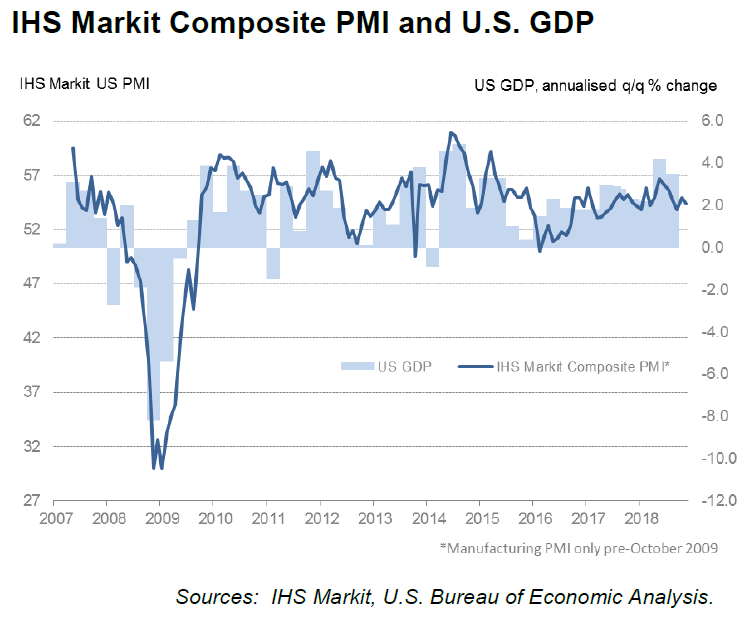
Commenting on the flash PMI data, Chris Williamson, Chief Business Economist at IHS Markit said:
"Solid flash PMI numbers for November add to evidence that the US is enjoying sustained robust economic growth in the fourth quarter. The surveys are broadly consistent with the economy growing at an annualized rate of 2.5%, building further on the country's best growth spell since 2014 seen in the second and third quarters.
"The November survey does raise some warning flags to suggest growth could slow in coming months. In particular, growth of hiring has waned as companies grew somewhat less optimistic about the outlook. Goods exports also appear to also be coming under increasing pressure, often linked to trade wars having dampened demand. However, it should also be remembered that some pull back in growth was to be expected after October's numbers were boosted by a post-hurricane rebound, especially given the historically high levels of production, order books and employment.
"With growth remaining reassuringly robust and price pressures elevated, policymakers will be encouraged that the economy has so far withstood both the headwinds of trade war worries and the steady progress made to date towards normalising interest rates."
USD/JPY Mid-Day Outlook
Daily Pivots: (S1) 112.82; (P) 113.01; (R1) 113.14; More...
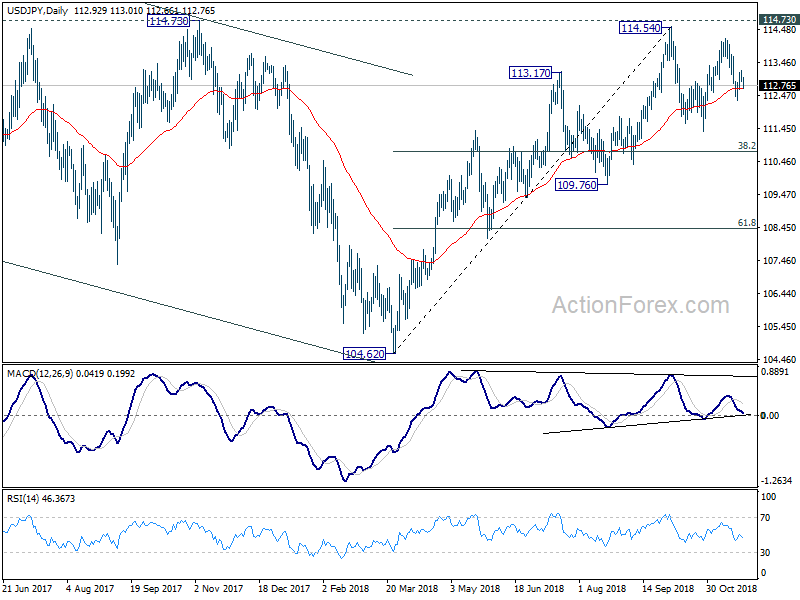
No change in USD/JPY's outlook. Intraday bias stays neutral first. . On the downside, break of 112.30 will extend the fall from 114.20 and target 111.37 support. Such decline is seen as the third leg of the consolidation pattern from 114.54. Downside should be contained by 38.2% retracement of 104.62 to 114.54 at 110.75 to bring rebound. On the upside, break of 113.21 will indicate that fall from 114.20 has completed. And, intraday bias will be turned back to the upside for 114.54/73 key resistance zone.
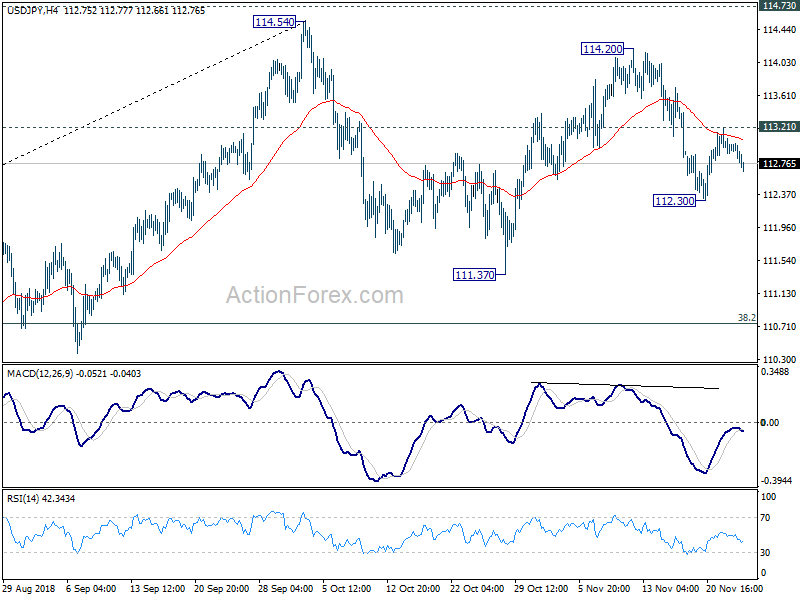
In the bigger picture, corrective fall from 118.65 (2016 high) should have completed with three waves down to 104.62. Decisive break of 114.73 resistance will likely resume whole rally from 98.97 (2016 low) to 100% projection of 98.97 to 118.65 from 104.62 at 124.30, which is reasonably close to 125.85 (2015 high). This will stay as the preferred case as long as 109.76 support holds. However, decisive break of 109.76 will dampen this bullish view and turns outlook mixed again.
USD/CHF Mid-Day Outlook
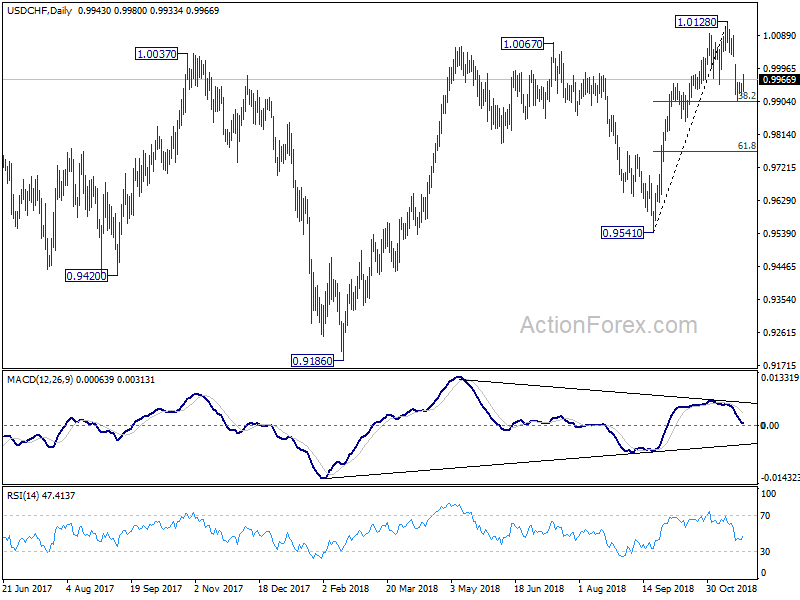
Daily Pivots: (S1) 0.9929; (P) 0.9943; (R1) 0.9943; More...
USD/CHF's recovery from 0.9908 temporary low extends higher today. But it's limited below 1.0006 minor resistance. Intraday bias remains neutral and another fall could still be seen. On the downside, break of 38.2% retracement of 0.9541 to 1.0128 at 0.9904 will target 0.9848 key support level. On the upside, above 1.0006 minor resistance will indicate that the pull back has completed. Intraday bias will be turned back to the upside for retesting 1.0128 high.
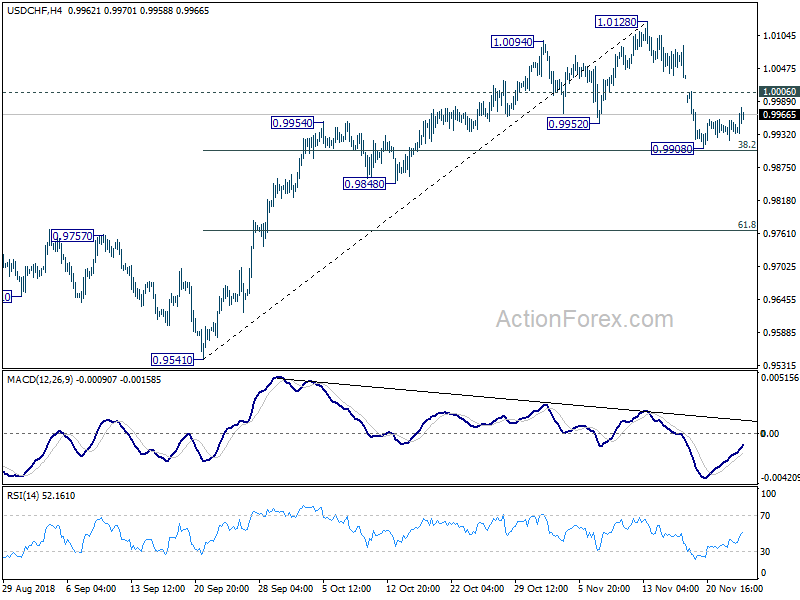
In the bigger picture, the pullback from 1.0067 has completed at 0.9541 already. And rise from 0.9186 is likely resuming. Firm break of 1.0067 will pave the way to retest 1.0342 key resistance. We'd be cautious on strong resistance from there to limit upside to bring another medium term fall to extend long term range trading. However, break of 0.9848 near term support will dampen this view and bring deeper decline back to 0.9541 support and possibly below.
GBP/USD Mid-Day Outlook
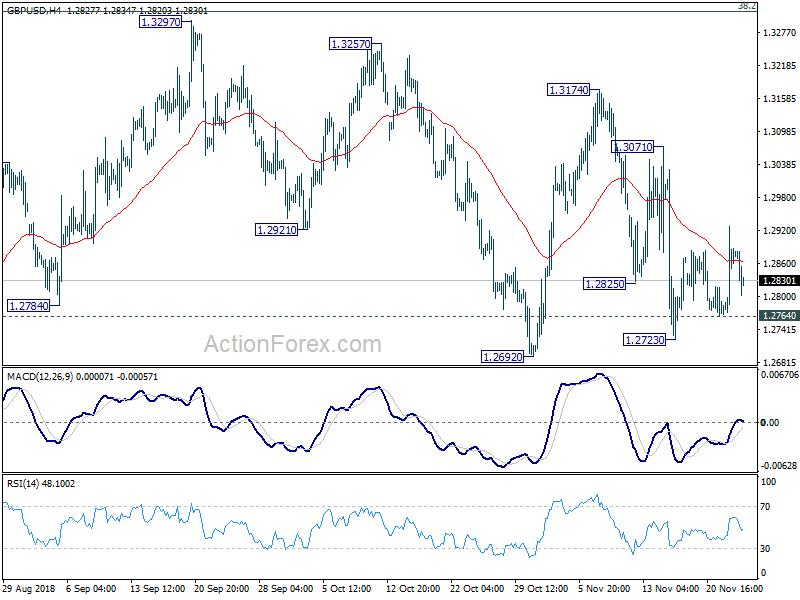
Daily Pivots: (S1) 1.2785; (P) 1.2857; (R1) 1.2950; More...
At this point, with 1.2764 minor support intact, further rise is mildly in favor in GBP/USD to 1.3071 resistance. But after all, price actions from 1.2661 are forming a consolidation pattern. Hence even in case of strong rebound, upside should be limited by 1.3316 fibonacci level to bring down trend resumption eventually. On the downside, below 1.2764 minor support will turn bias back to the downside for 1.2661. Firm break there will resume the larger down trend from 1.4376.
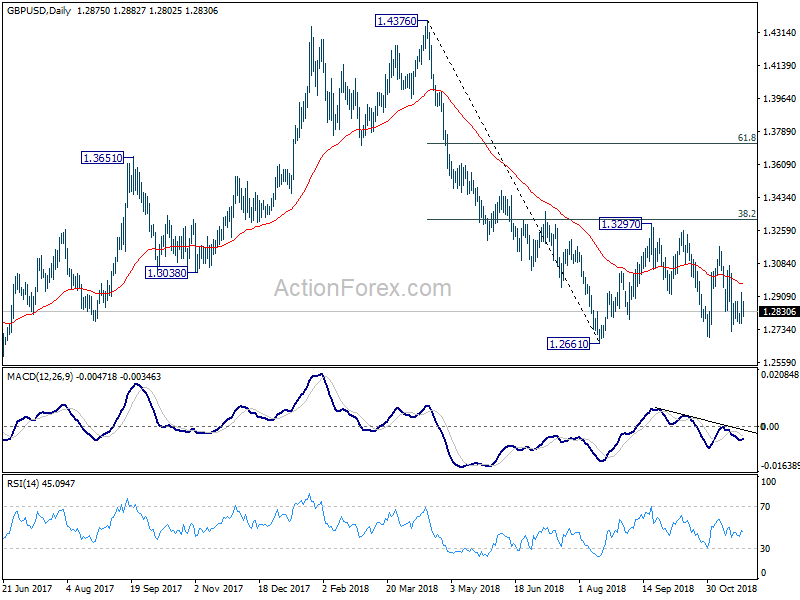
In the bigger picture, whole medium term rebound from 1.1946 (2016 low) should have completed at 1.4376 already, after rejection from 55 month EMA. The structure and momentum of the fall from 1.4376 argues that it's resuming long term down trend. And this will be the preferred case as long as 38.2% retracement of 1.4376 to 1.2661 at 1.3316 holds. However, firm break of 1.3316 would bring stronger rebound to 61.8% retracement at 1.3721. And, the eventual depth of the fall from 1.4376, and the chance of hitting 1.1946 low, will depend on the strength of the interim corrective rebound from 1.2661.
Canadian Consumer Spending Up a Tick in September
Canadian retail sales rose a modest 0.2% month-on-month in September, a tick ahead of market expectations. Looking through price changes, it was a more encouraging story as the volume of goods sold rose 0.5%.
The two largest sales categories led the way: motor vehicle and parts dealers saw sales grow 0.5% month-on-month (volumes: +1%), while food and beverage stores reported a 0.9% gain (0.8% in volume terms). Softness was observed in gasoline stations (-1.1%) but this was due largely to price effects as sales volumes were down a modest 0.2%. Notable for its housing activity implications, building material/garden equipment stores reported declines again in September (-1.9% in both dollar and volume terms).
Looking across the provinces, it was a generally positive month. The three largest provinces (Ontario, Quebec, British Columbia) reported more or less flat sales, while solid growth was recorded in Alberta (+0.5%), Saskatchewan (+1.7%), and Manitoba (+1.5%). Sales activity was mixed across the Atlantic provinces.
Key Implications
Decent. September's data paints a picture of a still-resilient consumer, particularly once the impact of falling gas prices are removed from the picture. Canadians showed a bit of confidence heading into the fall, still willing to commit to auto purchases even as borrowing costs have marched upward. If there is a fly in the ointment, it is in the housing related sectors, such as furniture/home furnishings, and building material stores, which have displayed persistent weakness since mid-year.
This is the last major piece of data before next Friday's quarterly GDP figures. Our final read is that the Canadian economy likely turned in a not-too-hot, not-too-cold 1.8% annualized pace of growth. This aligns with the Bank of Canada's expectations, and together with the current challenges facing the oil patch, rules out another hike in December. Instead, all eyes are likely to be closely trained to how the Bank is viewing the impacts of energy price moves and the implication for the pace of hikes thereafter when it releases its decision on December 5th.
Canada: Consumer Price Inflation Edges Higher in October
Canadian consumer price inflation picked up to 2.4% in October (from 2.2% in September), ahead of the consensus forecast for an unchanged reading. Adjusted for seasonal patterns, prices rose 0.3% month-on-month.
The acceleration in price growth was broad based with five of eight major categories moving higher year-on-year and shelter prices remaining unchanged at 2.5%. Transportation costs were up 4.3% year-on-year, from 3.9% previously with prices for airfares, passenger vehicles and travel tours accelerating notably.
Two of three of the Bank of Canada's core measures edged higher on the month, with CPI-median to 2.0% (from a downwardly revised 1.9%), and CPI-trim rising to 2.1% (from a downwardly revised 2.0%). CPI-common was unchanged at 2.0%
Key Implications
A bit of a surprise on the headline, but some volatility is to be expected. The acceleration is likely to be reversed in the months ahead on the back of declining oil prices.
Underneath the surface, price growth looks pretty stable and right on the Bank of Canada's target. There is little in this report that should sway interest rate policy one way or the other.
More important for the Bank is the economic impact of falling oil prices, which in combination with a widening spread on western Canadian oil benchmarks, is likely to lead to a decline in oil production and notable loss of income in energy-producing provinces. The impact is not negligible and will slow the pace of Canadian economic growth over the next two quarters.
EUR/USD Mid-Day Outlook
Daily Pivots: (S1) 1.1378; (P) 1.1407; (R1) 1.1432; More.....
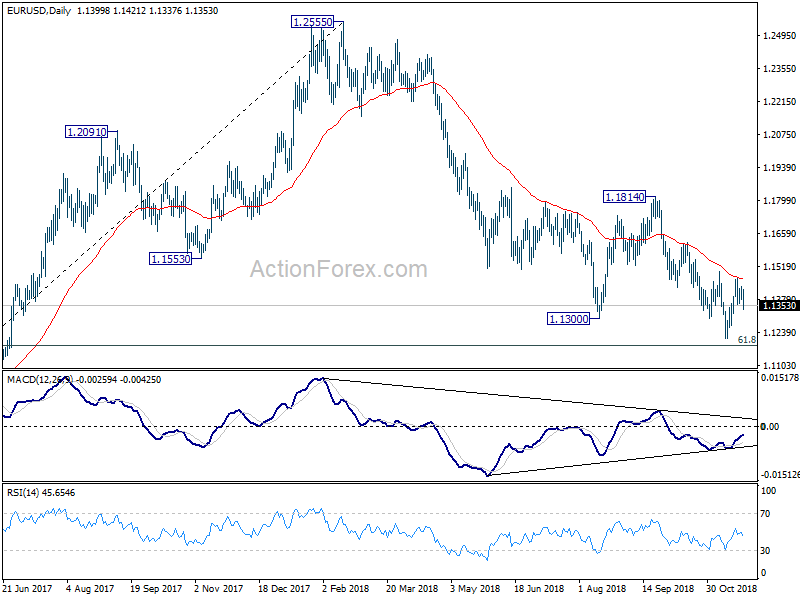
EUR/USD's break of 1.1358 suggests that fall from 1.1472 has resumed. Intraday bias is turned back to the downside for 1.1215 low first. Decisive break there will resume medium term down trend. On the upside, above 1.1421 will turn intraday bias neutral again. Overall, near term outlook stays bearish as long as 1.1499 resistance holds and further decline is expected.
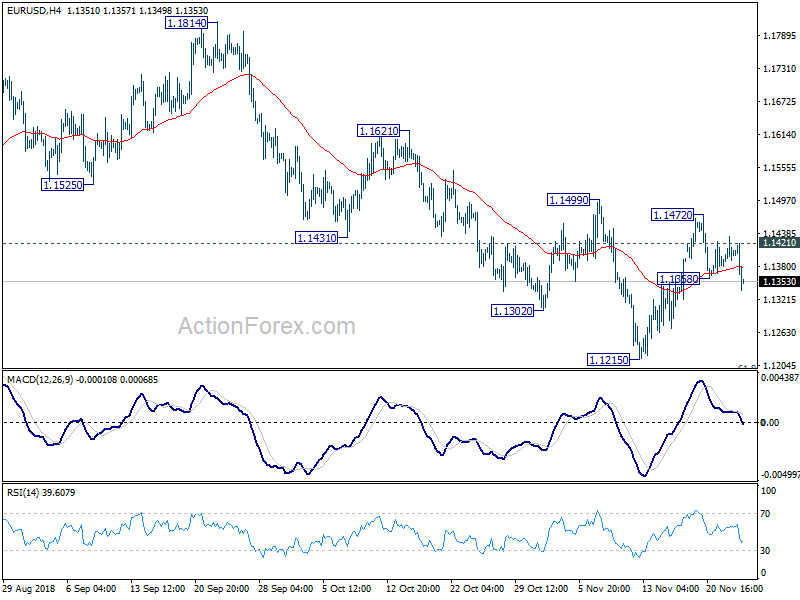
In the bigger picture, down trend from 1.2555 medium term top has just resumed and should target 61.8% retracement of 1.0339 (2017 low) to 1.2555 at 1.1186 next. Sustained break there will pave the way to retest 1.0339. On the upside, break of 1.1814 resistance is now needed to confirm medium term bottoming. Otherwise, outlook will stay bearish in case of strong rebound.
Euro Down on Growth Worry, Canadian Follow Oil Lower
Yen rises broadly today as risk aversion is back. Chinese stocks dived sharply in otherwise quiet Asian session. The Shanghai SSE closed down -2.49% at 2579.48 has likely completed recent corrective rebound. European indices also reversed initial gain and are trading broadly lower at the time of writing. Weak Eurozone PMI data is a factor weighing down sentiments. In the background, WTI crude oil is extending recent free fall and hits as low as 50.60. 50 psychological level is now in touching distance.
Back to the currency markets, Dollar and Swiss Franc are following as the second and third strongest for now. New Zealand Dollar is the weakest one for today, followed by Euro and the Sterling. The lift by UK-EU political declaration was rather brief. Focuses will turn to whether EU27 leaders, including Spain, would approve the Brexit withdrawal agreement this Sunday. For the week, Swiss Franc remains the strongest one, followed by Yen and then Sterling. Australian, New Zealand and Canadian Dollar are the weakest.
In other markets, FTSE is now down -1.1%, DAX is down -0.73%, CAC is down -0.63%. German 10 year yield is down -0.0303 at 0.343. Italian 10 year yield is down -0.004 at 3.437. Earlier today, Nikkei rose 0.65%, Hong Kong HSI rose 0.18%, Singapore Strait Times rose 0.09%. But China Shanghai SSE dropped -0.23%.
Eurozone PMI composite dropped to 47-month low, Q3 weakness not just a blip
Eurozone PMI manufacturing dropped to 51.5 in November, down from 52.0, missed expectation of 52.0. That's the lowest reading in 30 months. PMI services dropped to 53.1, down from 53.7 and missed expectation of 53.6. That's the lowest reading in 25 months. PMI composite dropped to 52.4, down from 53.1, lowest in 47 months.
Chris Williamson, Chief Business Economist at IHS Markit said November's reading "brought further signs that the manufacturing-led slowdown is spilling over to services". And, the data suggest that "weakness of GDP in the third quarter may not have been a blip, and that the underlying trend is one of slower economic growth". The reading indicates 0.3% GDP growth in Q4, but "forward-looking indicators such as new orders and future expectations remaining worryingly subdued."
Also release, Germany PMI manufacturing dropped to 51.6 in November, down from 52.2 and missed expectation of 52.2. That's the lowest level in 32 months. PMI services dropped to 53.3, down from 54.7 and missed expectation of 54.5. PMI composite dropped to 52.2, down from 53.4, hit a 47-month low. Germany Q3 GDP was finalized at -0.2% qoq.
France PMI manufacturing dropped to 50.7 in November down from 51.2 and missed expectation of 51.3. That's the lowest in 26 months. PMI services dropped to 55.0, down from 55.3 and matched expectations. PMI composite dropped to 54.0, down from 54.1.
Canadian Dollar ignores CPI and retail sales, tumbles as WTI crude oil diving to 50
Canada headline CPI accelerated to 2.4% yoy in October, up from 2.2% yoy and beat expectations of 2.2% yoy. CPI core was unchanged at 1.9% yoy. CPI core median was unchanged at 2.0% yoy. CPI core trim was also unchanged at 2.1% yoy. Looking at the details, prices rose in all major components. Headline retail sales rose 0.2% mom in September, above expectation of 0.0% mom. But ex-auto sales rose 0.1% mom only, below expectation of 0.30%.
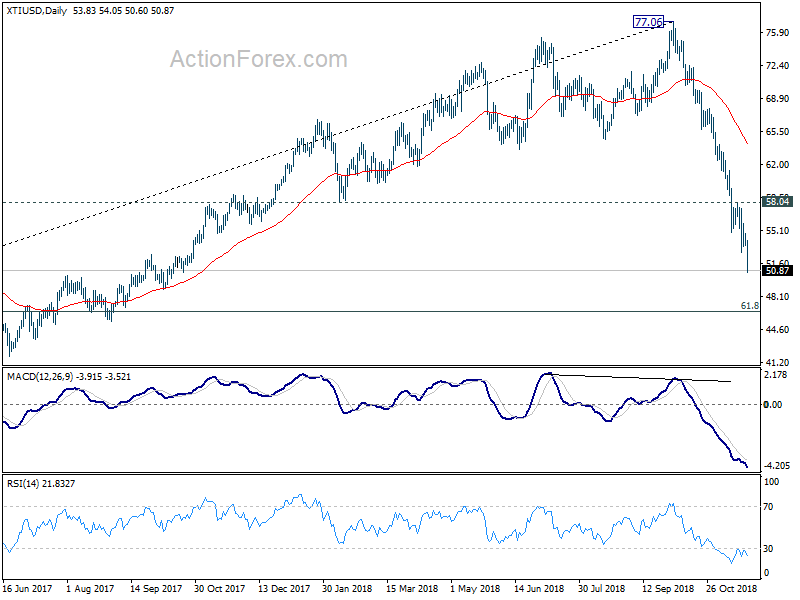
Canadian Dollar drops sharply after the release, mainly as delayed reaction to the free fall in oil prices. WTI crude oil is now heading to 50 psychological level. And overall, we maintain the view that WTI's fall from 77.06 is a medium term decline. Further fall would likely be seen to 61.8% retracement of 27.69 to 77.06 at 46.54 before bottoming.
EUR/USD Mid-Day Outlook
Daily Pivots: (S1) 1.1378; (P) 1.1407; (R1) 1.1432; More.....
EUR/USD's break of 1.1358 suggests that fall from 1.1472 has resumed. Intraday bias is turned back to the downside for 1.1215 low first. Decisive break there will resume medium term down trend. On the upside, above 1.1421 will turn intraday bias neutral again. Overall, near term outlook stays bearish as long as 1.1499 resistance holds and further decline is expected.
In the bigger picture, down trend from 1.2555 medium term top has just resumed and should target 61.8% retracement of 1.0339 (2017 low) to 1.2555 at 1.1186 next. Sustained break there will pave the way to retest 1.0339. On the upside, break of 1.1814 resistance is now needed to confirm medium term bottoming. Otherwise, outlook will stay bearish in case of strong rebound.
Economic Indicators Update
| GMT | Ccy | Events | Actual | Forecast | Previous | Revised |
|---|---|---|---|---|---|---|
| 07:00 | EUR | German GDP Q/Q Q3 F | -0.20% | -0.20% | -0.20% | |
| 08:15 | EUR | France Manufacturing PMI Nov P | 50.7 | 51.3 | 51.2 | |
| 08:15 | EUR | France Services PMI Nov P | 55 | 55 | 55.3 | |
| 08:30 | EUR | Germany Manufacturing PMI Nov P | 51.6 | 52.2 | 52.2 | |
| 08:30 | EUR | Germany Services PMI Nov P | 53.3 | 54.5 | 54.7 | |
| 09:00 | EUR | Eurozone Manufacturing PMI Nov P | 51.5 | 52 | 52 | |
| 09:00 | EUR | Eurozone Services PMI Nov P | 53.1 | 53.6 | 53.7 | |
| 13:30 | CAD | Retail Sales M/M Sep | 0.20% | 0.00% | -0.10% | 0.00% |
| 13:30 | CAD | Retail Sales Ex Auto M/M Sep | 0.10% | 0.30% | -0.40% | |
| 13:30 | CAD | CPI M/M Oct | 0.30% | 0.10% | -0.40% | |
| 13:30 | CAD | CPI Y/Y Oct | 2.40% | 2.20% | 2.20% | |
| 13:30 | CAD | CPI Core Y/Y Oct | 1.90% | 1.90% | 1.90% | |
| 13:30 | CAD | CPI Core - Median Y/Y Oct | 2.00% | 2.00% | 2.00% | |
| 13:30 | CAD | CPI Core - Trim Y/Y Oct | 2.10% | 2.10% | 2.10% | |
| 14:45 | USD | US Manufacturing PMI Nov P | 55.8 | 55.7 | ||
| 14:45 | USD | US Services PMI Nov P | 55 | 54.8 |
Canadian Dollar ignores CPI and retail sales, tumbles as WTI crude oil diving to 50
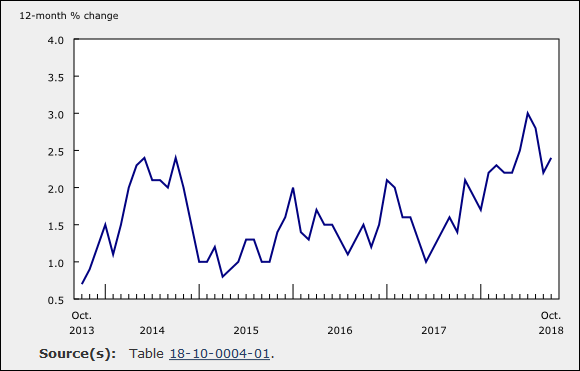
Canada headline CPI accelerated to 2.4% yoy in October, up from 2.2% yoy and beat expectations of 2.2% yoy. CPI core was unchanged at 1.9% yoy. CPI core median was unchanged at 2.0% yoy. CPI core trim was also unchanged at 2.1% yoy. Looking at the details, prices rose in all major components.
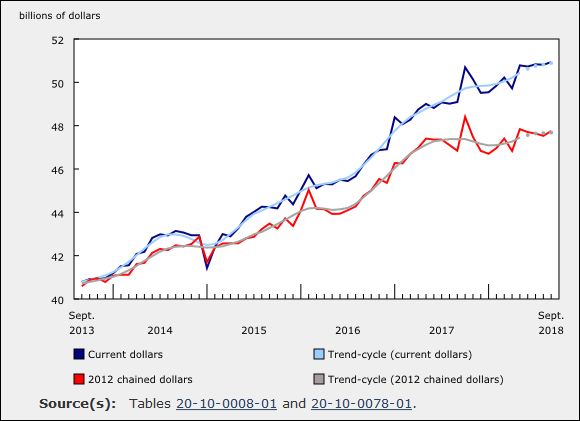
Headline retail sales rose 0.2% mom in September, above expectation of 0.0% mom. But ex-auto sales rose 0.1% mom only, below expectation of 0.30%.
Canadian Dollar drops sharply after the release, mainly as delayed reaction to the free fall in oil prices. WTI is now heading to 50 psychological level.