

Sample Category Title
Dollar Higher but Trump-Xi Meeting is a Wild Card
It's another week with multiple theme happening at the same time. Swiss Franc ended as the strongest on risk aversion. Oil's free fall could be that extra lift the the Franc. Dollar ended as the second strongest, but that's mainly due to relatively smaller problems in the US. Sterling was the third strongest after UK and EU agreed on the political declaration on future relationship. On the hand, Australian and Zealand Dollar were the weakest ones on risk aversion. Aussie was additionally pressured by the decline in iron ore prices. Euro was the third weakest one on deteriorating growth outlook. Canadian Dollar follow oil prices lower.
Dollar high but got its own problems too
Dollar ended the week as the second strongest. But that's mainly due to more serious problems of the others. The US got its own too. For the week, all three major US indices -- DOW, S&P 500 and NASDAQ dropped more than -3%. Stocks suffered the worst Thanksgiving week since 2011 as led by tech stocks and oil.
Trump's administration is now pushing for more stringent export-control rules of a list of 14 categories of new technologies that have national security applications. A request for public comment was published last Monday in the Federal Register. Broadly speaking, the categories include biotechnology, artificial intelligence and machine learning, position and navigation, microprocessor, advanced computing, data analytic, quantum information and sensing, logistics, additive manufacturing, robotics, brain-computer interfaces, hypersonics, advanced materials, advanced surveillance.
Whether the move is another step in Trump's trade war with China is another question. The implications of the move on technology products are huge. And, companies selling everyday products from Apple to Amazon to even Tesla would be heavily affected. The impact would start from their sourcing of some components, to manufacturing them in some countries, to eventually selling the finished products internationally.
Talking about trade war, just ahead of the Trump-Xi meeting on Nov 30/Dec 1 as sideline of G20 summit in Argentina, the US Trade Representative released an update on the Section 301 IP investigation, which shouldn't help the negotiation. In short, the report complained that "China has not fundamentally altered its unfair, unreasonable, and market-distorting practices that were the subject of the March 2018 report on our Section 301 investigation." Habitually, China denied the accusations as groundless.
The outcome of the Trump-Xi meeting is a big wild card for the markets. The WTO released a report last week noting that from May-Oct period, the new trade-restrictive measures covered over USD 480B worth of trade, hitting highest since record began in 2012. And it warned that further escalation remains a "real threat". It seems that investors were at least not too optimistic on the meeting yet.
NASDAQ still medium term correction
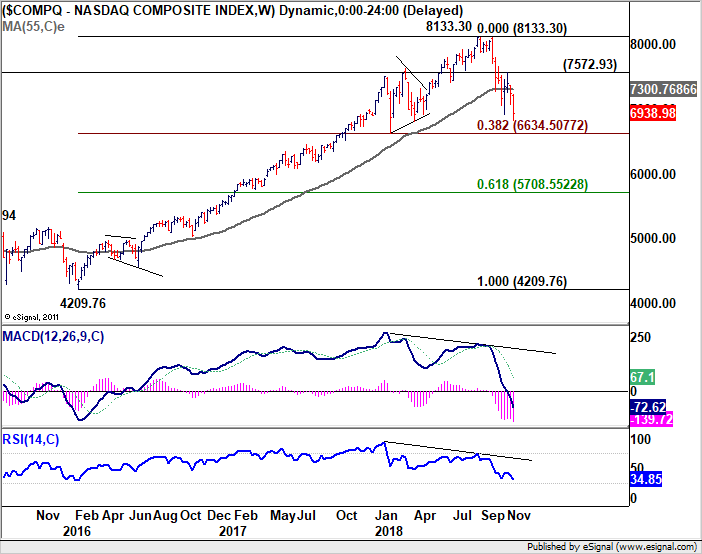
NASDAQ dropped -4.26% or-308.9 pts to 6938.98 last week. Breach of 6922.83 support, suggests resumption of corrective down trend from 8133.30. DOW and S&P 500 are holding above equivalent support for now. We'd maintain in a less bearish case, fall from 8133.30 is only correcting the up trend from 2016 low at 4209.76. And NASDAQ should at least target 38.2% retracement of 4209.76 to 8133.30 at 6634.50 before completing the correction.
Mixed outlook in Dollar index
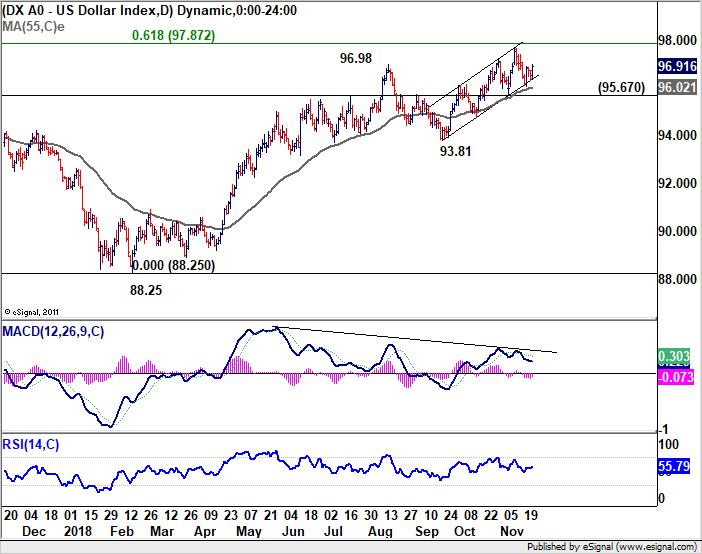
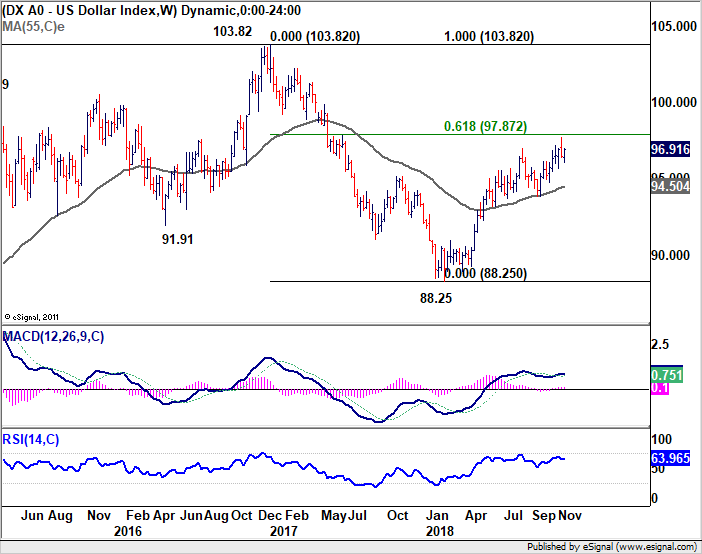
Outlook is rather mixed in the Dollar index. It's staying inside near term rising channel and is held well above 95.67 support. It's also staying above slightly rising 55 week EMA. However, upside momentum is diminishing as seen in daily MACD. At the same time, it's facing key fibonacci level at 61.8% retracement of 103.82 to 88.25 at 97.87. For now, we won't turn bearish as long as 95.67 support holds. But we'd prefer to see 97.87 firmly taken out before committing to bullish view in the index.
Euro weighed down by deteriorating growth outlook
Euro was weighed down by deteriorating growth outlook of the Eurozone. In the monetary policy meeting accounts, ECB has twisted its tones to the dovish side a bit. In particular, it noted that "weaker growth pattern in H2 "would have a mechanical impact, via the carry-over effect, on the estimate for annual growth in 2019". The central bank is still expected to end the asset purchase program after December. But, it could hold interest rates unchanged longer than "at least through summer of 2019:"
Also from Eurozone, PMI manufacturing dropped to 51.5 in November, down from 52.0, missed expectation of 52.0. That's the lowest reading in 30 months. PMI services dropped to 53.1, down from 53.7 and missed expectation of 53.6. That's the lowest reading in 25 months. PMI composite dropped to 52.4, down from 53.1, lowest in 47 months. Markit also warned that "the survey data suggest that the weakness of GDP in the third quarter may not have been a blip, and that the underlying trend is one of slower economic growth."
DAX to extend medium term correction
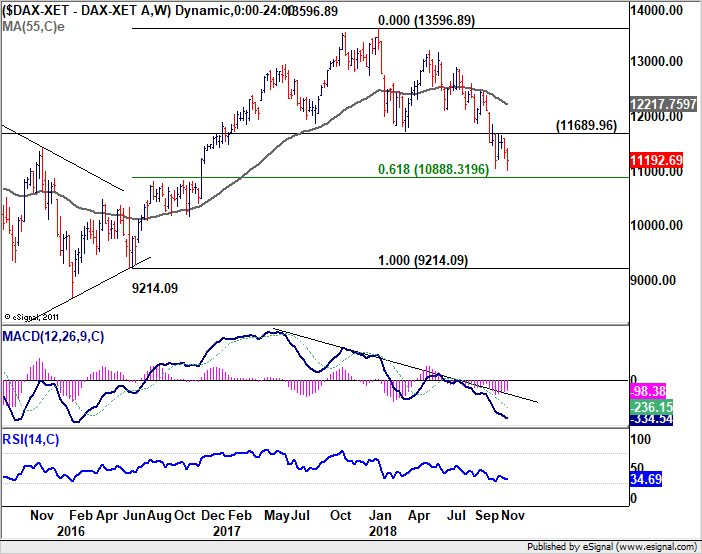
Development in European stocks didn't help sentiments neither. DAX has been trying to rebound from 61.8% retracement of 9214.09 to 13596.89 at 10888.32. But the strength of recovery has been very week. And 10888.32 looks rather vulnerable. Near term outlook will stay bearish as long as 11689.96 resistance holds. Firm break of 10888.32 could pave the way to next key support level at 9214.09.
Aussie lower on iron ore and Chinese stocks
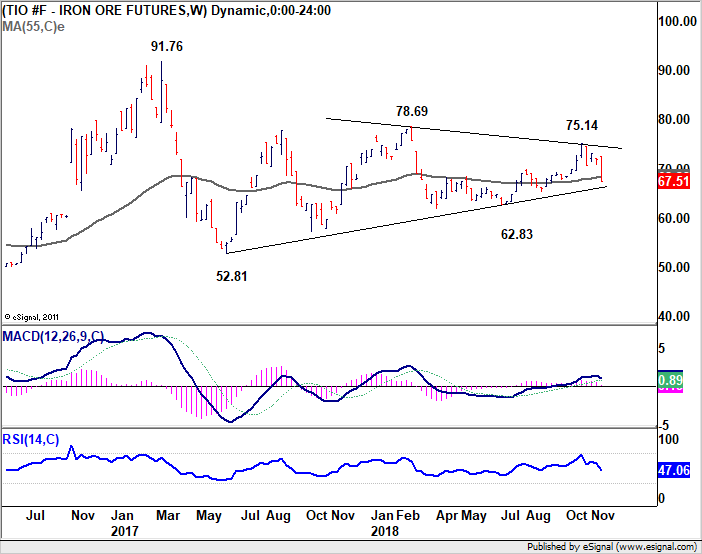
Australian Dollar ended as the weakest one last week as pressured on two fronts. On the one hand, iron ore price suffered steep decline, with TIO down -6.2% to 67.51. More importantly, current development suggests cyclical rebound from July's low at 62.83 has already completed at 75.14. A test on 62.83 will likely be seen ahead, with prospect of having a test on 52.81 in medium term.
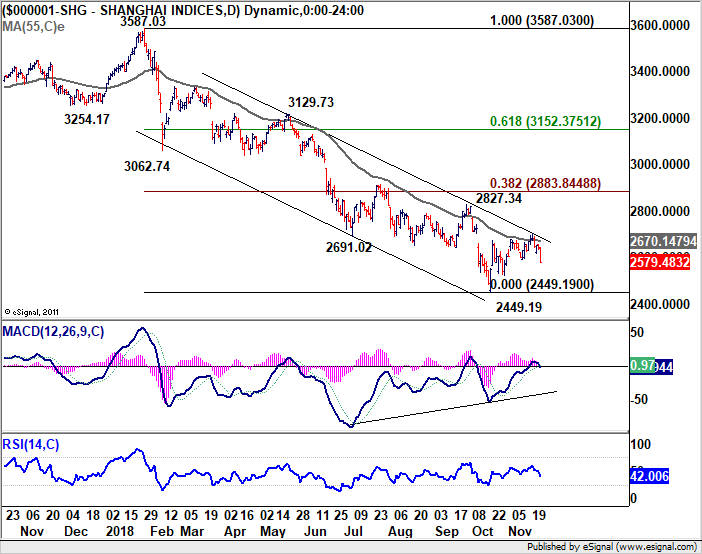
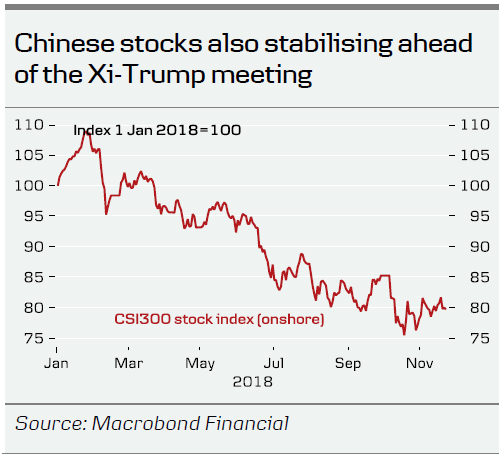
On the other hand, Chinese stocks rally attempt faltered again. Shanghai SSE's sharp fall on Friday suggests that corrective rebound from 2449.19 might have completed already. Medium term outlook is kept bearish with the index held inside falling channel. Rejection by 55 day EMA is another bearish sign. We could see a retest and even break of 2449.19 low rather soon. Bother developments could weigh on the Aussie.
Oil price free fall to continue in near term
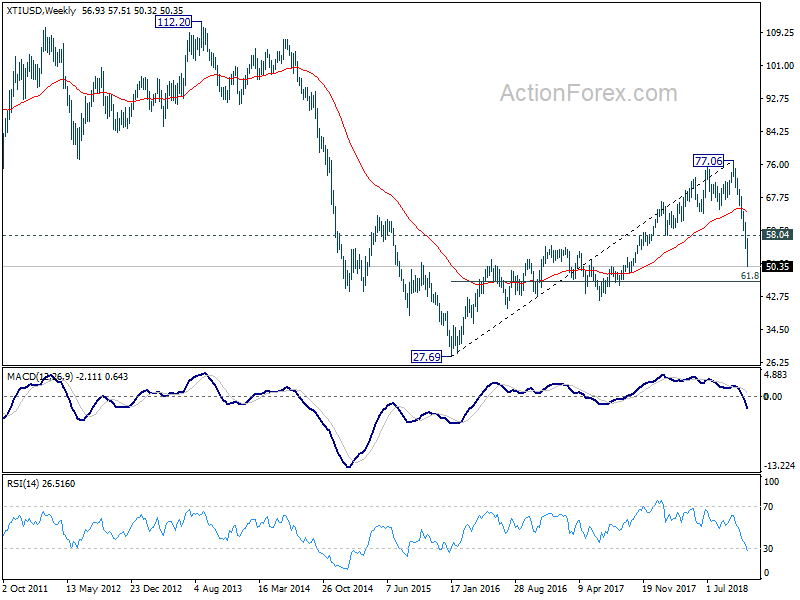
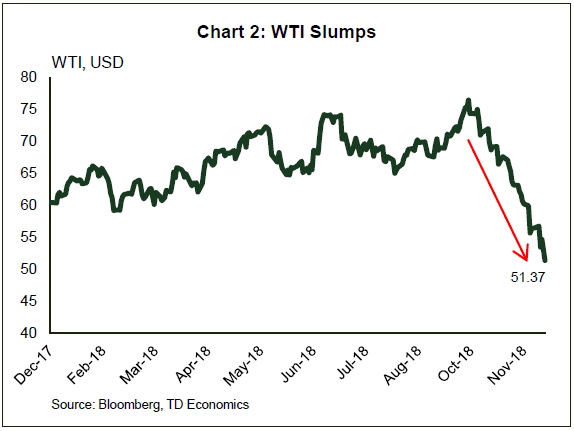
Canadian data released last week were not bad. But the Loonie was clearly dragged down by the free fall in oil prices. WTI crude oil closed at 50.35 and that's -35% off October's high at 77.06. Near term outlook will stay bearish as long as 58.04 resistance holds. WTI should now target 61.8% retracement of 27.69 to 77.06 at 46.54. We'd probably only see buying comes in again, gradually, below this 46.54 fibonacci level.
Position trading
In our view, Aussie and Euro are two candidates to short based on the above bearish development. Aussie is actually a one but there is a wild card of Trump-Xi meeting. So, we'd better give in a pass. For Euro, at this point, we can't really think of any special development that can give it a pop. A trade deal with the US could be but there is little chance of having some tangible progress for the near term. Negative Brexit development will shoot up EUR/GBP for sure, but that should be confined to EUR/GBP only. And, we are not expecting upcoming data to show any turn around. For we're slightly favoring more decline in USD/JPY in the near term, we'll choose to sell EUR/JPY.
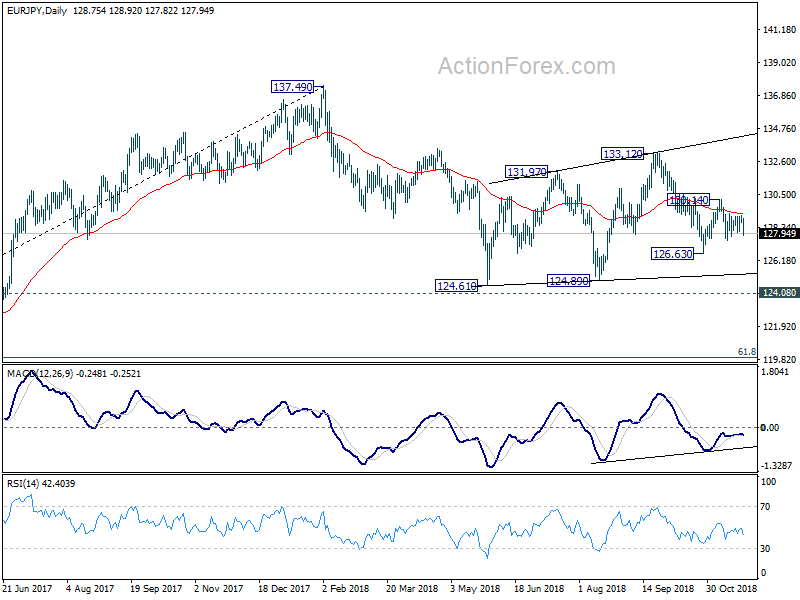
In our view, the corrective rise from 126.63 should have completed at 130.14. And staying below 55 day EMA is a bearish sign too. We'd expect the fall from 133.12 to resume eventually for a test on 124.61/89 support zone. But we'd actually expecting the fall from 137.49 to resume and extend to 61.8% retracement of 109.03 to 137.49 at 119.90.
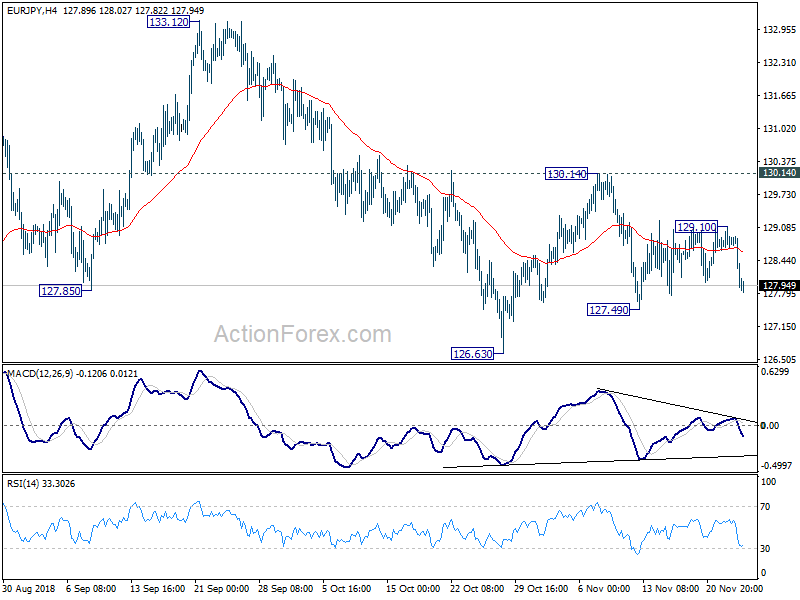
So, we'll sell EUR/JPY on break of 127.49, with stop at 129.00, slightly below 129.10 resistance. We'll put 120.00 as target first, with risk reward at around 1:4.9. But we'd be cautious on the reaction fro 124.08 key support and might exit earlier.
USD/CHF Weekly Outlook
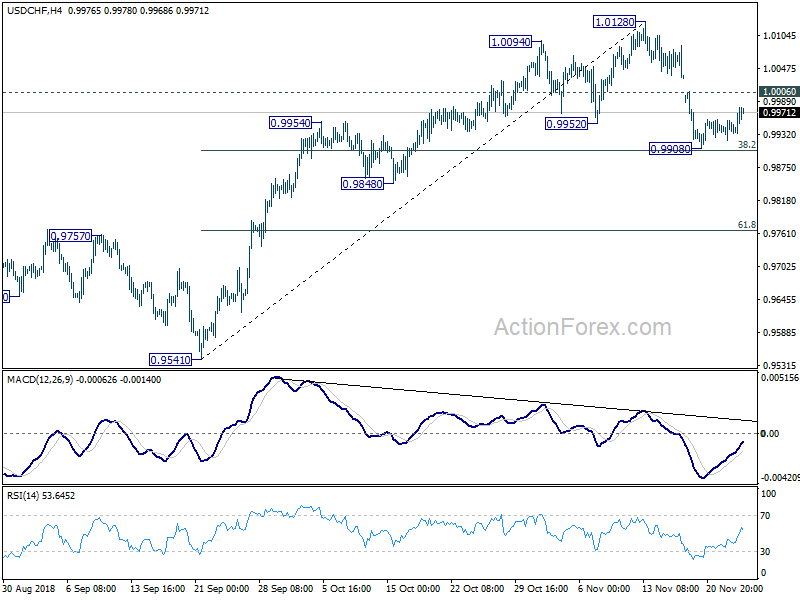
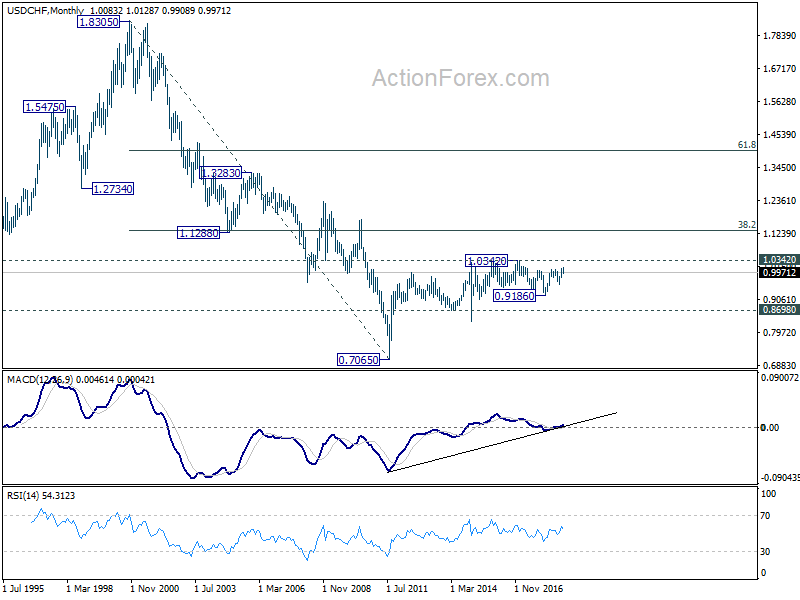
USD/CHF dropped to as low as 0.9908 last week but drew support from 38.2% retracement of 0.9541 to 1.0128 at 0.9904 and recovered. Initial bias is neutral this week first. On the upside, break of 1.0006 minor support will argue that the pull back from 1.0128 has completed. Intraday bias will be turned back to the upside for retesting 1.1028. However, on the downside, break of 0.9904 will target 0.9848 key support level.
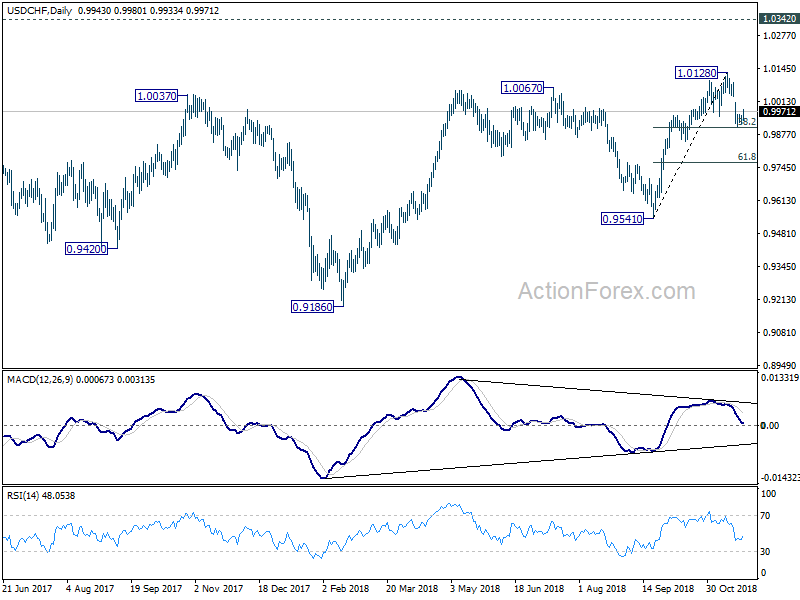
In the bigger picture, the pullback from 1.0067 has completed at 0.9541 already. And rise from 0.9186 is likely resuming. Firm break of 1.0067 will pave the way to retest 1.0342 key resistance. We'd be cautious on strong resistance from there to limit upside to bring another medium term fall to extend long term range trading. However, break of 0.9848 near term support will dampen this view and bring deeper decline back to 0.9541 support and possibly below.
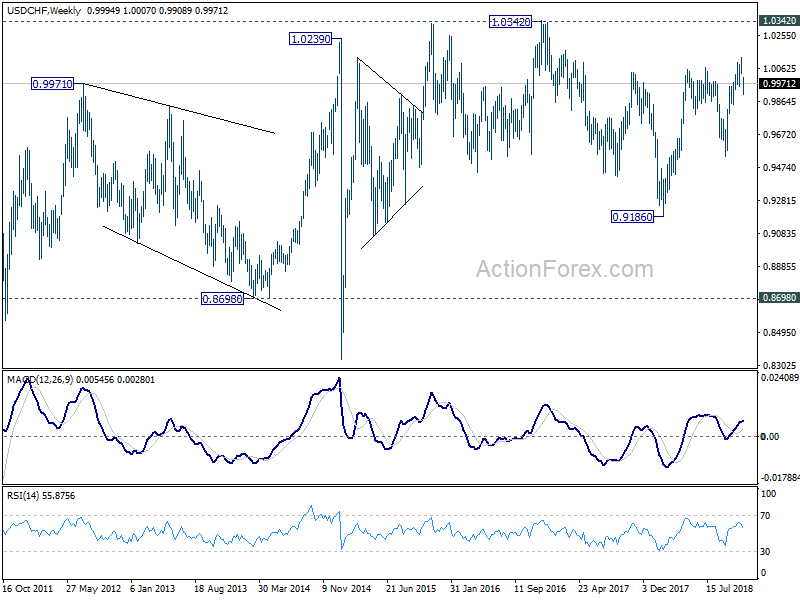
In the long term picture, price actions from 0.7065 (2011 low) are not clearly impulsive yet. Thus, we'll treat it as developing into a corrective pattern, at least, until a firm break of 1.0342 resistance.
Summary 11/26 – 11/30
Monday, Nov 26, 2018
[php_everywhere instance="1"]
Tuesday, Nov 27, 2018
[php_everywhere instance="2"]
Wednesday, Nov 28 2018
[php_everywhere instance="3"]
Thursday, Nov 29, 2018
[php_everywhere instance="4"]
Friday, Nov 30, 2018
[php_everywhere instance="5"]
The Weekly Bottom Line: Oil Continues its Slump
U.S. Highlights
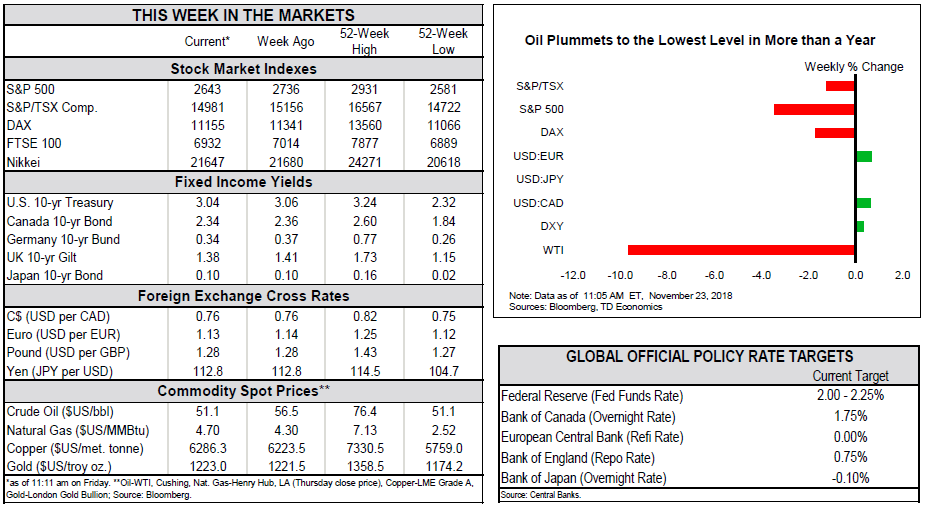
- Equity market volatility persisted this week as the main indexes were dragged down by tech and energy stocks. The latter resumed their slide as oil prices fell to their lowest levels in more than a year.
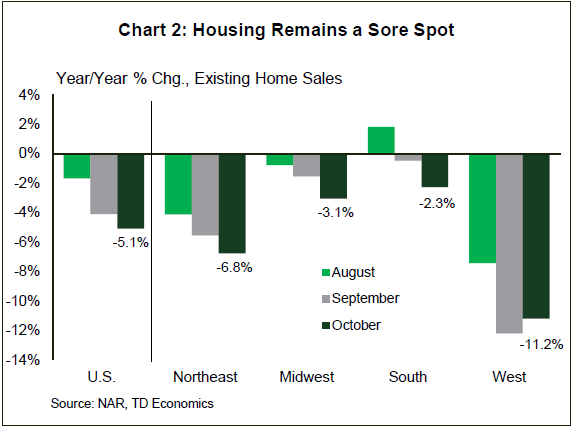
- Housing data was mildly positive, but continued to drive in the point that the sector remains a sore spot. Both existing home sales and housing starts rose around 1.5% month on month in October. But, sales are still down some 5% year on year, weighing on builder confidence.
- Presidents Trump and Xi will meet at the G20 summit next week in Buenos Aires. Any conciliation would be a plus for financial markets. Here's hoping that the atmosphere and outcome are as pleasant as the host city's name.
Canadian Highlights
- This was a week heavy on data, with wholesale trade coming in below expectations, retail sales surprising to the upside, and headline inflation posting a broad-based pickup.
- The main event, however, was in Ottawa, with the release of the federal government's fall fiscal update, which focused on measures to address Canadian business competitiveness.
- Oil hit a 1-year low as of writing, fueling worries about price levels going forward and the expected impacts on the Canadian economy.
U.S. - Despite Sour Week, There Is Still Plenty to Be Thankful For
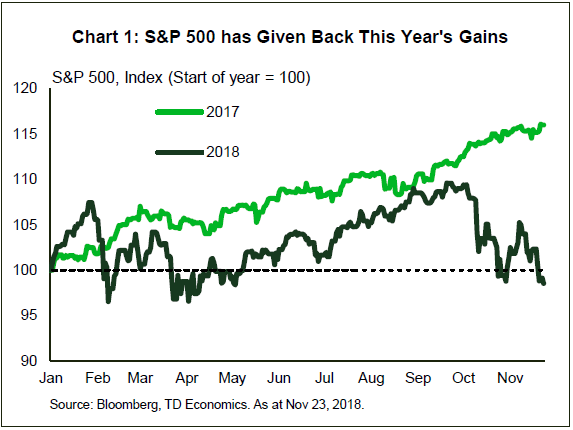
What a difference a year makes. Investors had much to be thankful for at last year's Thanksgiving, with equity indexes experiencing double-digit gains from the start of the year. This year, the atmosphere is a lot less bubbly. The S&P has given back all of this year's gains and some (Chart 1). Volatility persisted this week as the main indices were dragged down by tech and energy stocks. The latter resumed their slide as oil prices fell to their lowest levels in more than a year. Shifting headlines on Brexit and a softening of manufacturing PMIs in Europe did little to help broad market sentiment. Investors tilted funds toward safer assets such as Treasuries, contributing to a slight pullback in yields.
Despite the carnage in equity markets, there is still plenty to be thankful for. The U.S. economy remains the growth-leader among the G7 and appears likely to retain its lead over the next year. Its labor market echoes this strength, with more job openings than there are unemployed Americans. This backdrop has allowed the Fed to raise interest rates at a faster pace than its peers and also gives it the flexibility to respond to any future hiccups in growth.
The rise in rates, however, has had an impact on typically interest-rate sensitive sectors of the economy, most notably housing. Despite some improvement in housing data this week, the sector remains a sore spot. Both existing home sales and housing starts rose around 1.5% month on month in October, propped up by the volatile multifamily segment. The uptick in resales was encouraging, since it marked the first gain in six months. But, sales are still down some 5% from a year ago (Chart 2). Current conditions are providing little comfort for builders, whose confidence took a plunge this month.
With interest rates rising, resale activity is likely to remain soft. Still, a strong labor market and a more gradual increase in mortgage rates going forward should limit the downside. Median home price growth has moderated to 3.8% year on year, which alongside rising wage growth, will limit the hit to affordability as mortgage rates rise. An improvement in the number of homes for sale in recent months also marks a positive step. Still, inventory levels are historically low and this imbalance should ultimately help housing starts retain their mild upward trajectory over the medium term.
Aside from the housing market, developments on the trade front bear close watching. Next week's G20 summit appears an ideal setting for President Trump to announce a deal with his Chinese counterpart. Without progress, tariff rates are likely to increase in January, which could further undermine market confidence. As Trump and Xi tango in Buenos Aires next week, here's hoping that the atmosphere and outcome are as pleasant as the host city's name. Should trade tensions continue to fester, and confidence take a further hit, the Fed's preferred path of rate hikes will come into question.
Canada - Oil Continues its Slump
This was a packed week for Canada, with high-profile data releases and a federal fiscal statement. Adding to this were speeches by Bank of Canada Senior Deputy Governor Wilkins and oil market developments that have added to the worries faced by Canadian producers.
Stealing the show was the federal government's fiscal update (see commentary). In the statement, Minister Morneau emphasized measures to address competitiveness issues that were front and centre, especially after the United States' Tax Cuts and Jobs Act. While short of explicit tax cuts, the measures included full expensing of equipment and machinery that are estimated to reduce the marginal tax rate on new business investment to 14% from 17%. Of course, the good news comes at a cost, with approximately $16 billion in net new spending. A better than expected economic profile will offset some of this, with the 2017-2018 deficit forecasted lower, and only modestly wider deficits than previously expected going forward. Together with the USMCA, this should further boost confidence and reinforce the shift to investment and exports as contributors to real GDP growth going forward.
Meanwhile, in a speech this week, Senior Deputy Governor Carolyn Wilkins discussed potential changes to the central bank's framework ahead of its inflation-control agreement in 2021. At the centre of this are the bank's lower estimates of the neutral interest rate, which are raising concerns about the flexibility of policy in implementing stimulus when needed, and the increased incentives to pile on household debt. While still in the early stages of discussion, measures such as a dual mandate and/or a change to the inflation target are currently on the table. Both would mark a significant departure from the system of the last 20+ years.
On the data front, wholesale trade disappointed expectations, coming in at -0.5%. Countering this was a solid retail sales release at 0.2%, with a 0.5% move in volumes signaling still-healthy consumer spending. Finally, consumer price inflation picked up in October, with a broad-based increase moving the headline number to 2.4%. The Bank of Canada's core measures, however, averaged 2%. This week's data picture likely won't add up to much when it comes to interest rate expectations – with the inflation uptick and the retail volumes likely reinforcing the rate normalization narrative. We remain of the opinion that the Bank of Canada will likely hike in January, but developments in the oil sector clearly bias the risk around this view towards a longer pause in rate hikes.
One emerging concern is the current oil price environment and its impact on the Canadian economy. West Texas Intermediate (WTI) oil slumped to one-year lows this morning, reaching US$51. While the Canadian benchmark discounts to WTI have recently started to narrow, they still remain at elevated levels, and have recently resulted in some oil production shut-ins. Any persistence of this current environment will likely catch the Bank of Canada's attention (see recent report).
U.S.: Upcoming Key Economic Releases
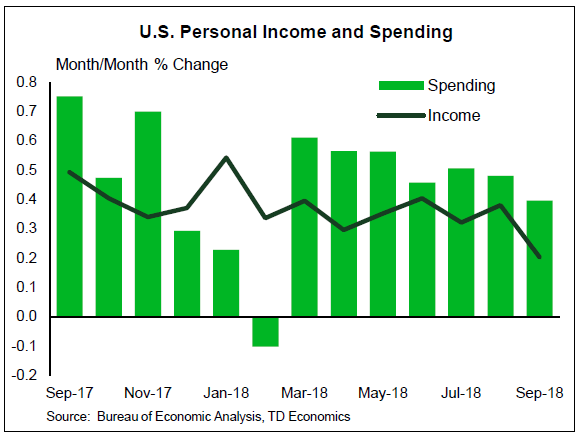
U.S. Personal Income & Spending - October
Release Date: November 29, 2018
Previous: Income: 0.2%, Spending: 0.4%
TD Forecast: Income: 0.4%, Spending
Consensus: Income: 0.4%, Spending
We see downside risks for PCE inflation for October, with core PCE printing at 0.1% vs the 0.2% rise in core CPI. Different weightings and muted healthcare services are likely to blame for the underperformance. That should allow core inflation to soften to 1.8% y/y, an 8-month low, and leave tracking at 1.9% for Q4. On the flip side, spending should hold strong at 0.4%, supportive of Q4 real PCE in the 2.5-3.0% range.
Canada: Upcoming Key Economic Releases
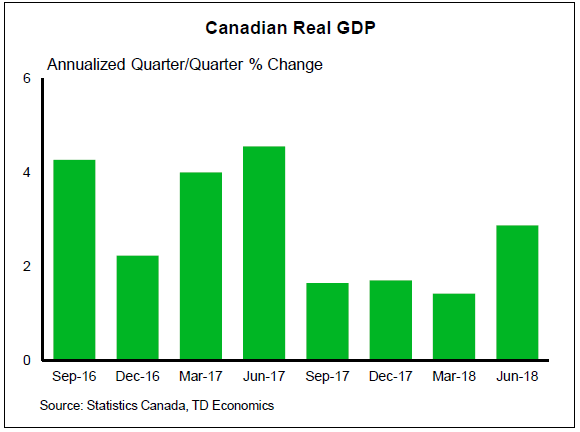
Canadian Real GDP - Q3 & September
Release Date: November 30, 2018
Previous: 2.9% q/q, 0.1% m/m
TD Forecast: 1.8 q/q, 0.1% m/m
Consensus: N/A
Economic activity moderated somewhat in the third quarter, with slowing consumer spending the main driver of an expected deceleration to 1.8% (q/q, annualized). Consumer spending growth of 1.4% is a step down from the prior quarter's 2.6% pace. Helping offset this is a pickup in non-residential business investment, expected to increase by 3.1% (from 1.7% previously). Soft indicators of construction activity suggest that residential investment will come in negative (tracking: -1.5%) despite positive developments in the resale market. Rounding out the report is net trade, expected to contribute positively to real GDP growth as imports (-5.1%) contracted more than exports (-0.4%). A positive terms-of-trade shock should help send nominal GDP to a 4.8% pace.
Industry-level growth for September should reveal waning momentum into Q4, with GDP projected to post a modest 0.1% increase due to a drag from the goods sector. Energy will weigh on monthly growth due to weaker output from the oil sands, which will intensify in coming months as producers shut in projects amid a blowout in WCS spreads. Utilities will provide a small offset due to unseasonably warm weather, although manufacturing will also weight modestly on growth due to weaker factory output. This will leave services to drive growth for the fourth consecutive month.
Dollar Higher as Trade War Concerns Fuel Risk Aversion
The dollar is higher on Friday against most major pairs. The greenback gained the most against the EUR as disappointing PMI surveys and the uncertain future of the Brexit deal ahead of the weekend took its toll on the single currency. Oil prices tumbled as fears of oversupply put losses at more than 11 percent despite the best efforts of the Organization of the Petroleum Exporting Countries (OPEC) to once again stop the decline with a probable production cut agreement. Global growth concerns are reducing expectations of energy demand with the trade war between the US and China a growing concern ahead of the G20 meeting in Argentina later this month.
- ECB President Mario Draghi to speak Monday
- US second GDP estimate to show 3.6% annual growth
- FOMC minutes to be published on Friday
Pound Lower as Brexit Deal Facing Obstacles in Parliament
The GBP/USD fell 0.55 percent on Friday. The currency pair is trading at 1.2804 against the US dollar as the Brexit deal is facing pressure from both sides. British PM Theresa May still has to push through the agreement in parliament, with shrinking possibilities of success. On the other hand Spanish negotiators left the Gibraltar issue until last minute and is another obstacle that could derail a deal being reached between the EU and the UK.
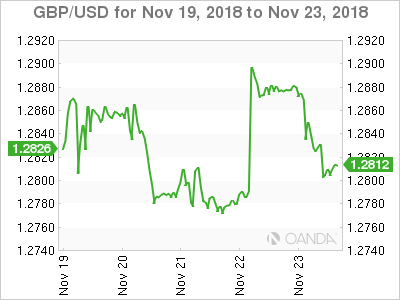
European Leaders remain optimistic about reaching an agreement over the weekend, but things look harder in the UK parliament. The March 29 deadline approaches, and if an agreement is not reached the no-deal exit will be a reality. Theresa May is saying that holding out for a better deal is not ideal, as she continues to endorse the current deal on the table.
Brexit headlines will guide the pair as investors try to quantify the most likely outcome and its impact on the final exit from the European Union. If a deal is rejected by UK parliament at this stage, it won’t be the end but it will mean an amendment if possible would have to be presented in February.
Canadian Dollar Lower Despite Strong Inflation
The Canadian dollar is lower against the US dollar on Friday. The fall of oil prices and the tepid growth of retail sales combined with the safe haven appeal of the big dollar ahead of the weekend put the loonie in a tough spot.
Canada’s CPI showed an unexpected 0.3 percent gain, keeping the inflation rate above the 2 percent target of the Bank of Canada (BoC). Markets forecast a 23 percent probability of a rate hike, as other factors will keep the central bank from pulling the trigger on higher interest rates.
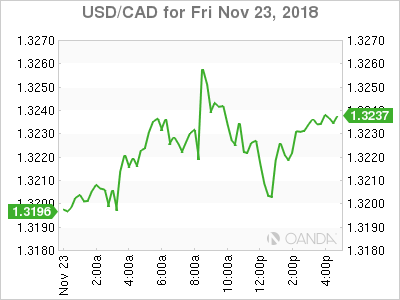
The USMCA agreement shields Canada from trade uncertainty, but does not make the loonie immune to the greenback rising on risk aversion flows.
Oil Lower as Trade and Oversupply Concerns Rise
Oil continues to drop on Friday. West Texas Intermediate is down 6.59 percent and Brent 5.75 percent and both clocking in loses near or above 10 percent on a weekly basis. Investors were anticipating a bigger disruption from US sanctions against Iranian exports, but as waivers appeared and at the same time the Trump administration pressured the OPEC to keep prices low, oversupply fears have risen.
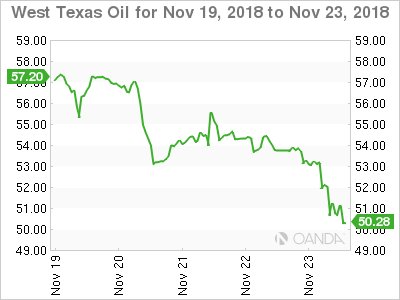
The leaders of the US and China will meet ahead of the overarching G20 meeting in Argentina. There have been some optimistic comments last week, but the latest official statements signal the two sides are still far apart.
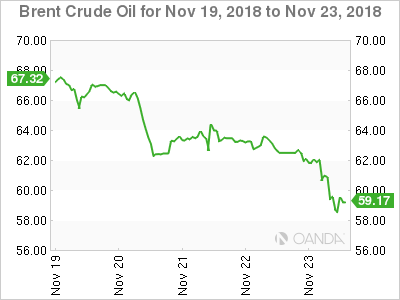
The OPEC is expected to once again agree to limit production to add stability to falling oil prices. This time around the other major producers are not as onside as they were in the past with Russia not ready to commit until more data is available. WTI is slightly above the $50 price and will test it to the downside if trade and oversupply concerns continue.
Gold Falls as Fundamentals Favor Stronger Dollar
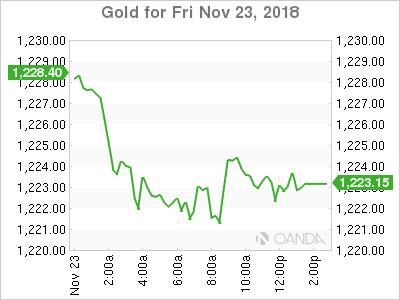
Gold is lower on Friday as the US dollar is back from the Thanksgiving holiday gaining against most major pairs. Trade concerns have increased as the APEC summit once again highlighted how far apart the US and China are on trade. Oil prices suffered the most form the strength of the dollar, in comparison the yellow metal will remain attractive due to geopolitical risk ahead of a busy week.
British PM Theresa May is trying to push through parliament a Brexit deal as she faces mounting obstacles. Trade disputes are on the rise as the end of the APEC highlighted that protectionist measures are here to stay.
The December FOMC meeting is expected to conclude with a 25 basis rate hike, Fed funds futures point to a 74.1 percent probability, but some dovish comments from Fed members have raised questions on how much more interest lifts are needed to reach a neutral rate.
Gold remains a safe haven destination, but for the time being market conditions favor the US dollar due to trade concerns and central bank expectations.
Market events to watch this week:
Sunday, November 25
- All Day EUR EU Economic Summit
- 5:45pm NZD Retail Sales q/q
- 6:15pm AUD RBA Gov Lowe Speaks
Monday, November 26
- 10:00am EUR ECB President Draghi Speaks
- 2:30pm GBP BOE Gov Carney Speaks
Tuesday, November 27
- 11:00am USD CB Consumer Confidence
- 4:00pm NZD RBNZ Financial Stability Report
- 6:00pm NZD RBNZ Gov Orr Speaks
- 8:00pm NZD RBNZ Gov Orr Speaks
Wednesday, November 28
- Tentative GBP Bank Stress Test Results
- 9:30am USD Prelim GDP q/q
- 8:00pm NZD ANZ Business Confidence
- 8:30pm AUD Private Capital Expenditure q/q
Thursday, November 29
- 4:00am EUR ECB President Draghi Speaks
- 3:00pm USD FOMC Meeting Minutes
Friday, November 30
- 9:30am CAD GDP m/m
*All times EDT
China Weekly Letter: All Eyes on the Xi-Trump Meeting
- Cautious optimism ahead of the Xi-Trump meeting
- APEC meeting underlines long-term US-China rivalry
- Chinese economy gets worse before it gets better
Cautious optimism ahead of the Xi-Trump meeting
All eyes are on the Xi-Trump meeting at the G20 and the tone is more positive on the US side than we have seen for some time. At a press conference on Thursday Donald Trump stated that 'I have been preparing for it all my life… I know every ingredient, every stat. I know it better than anyone knows it… My gut is always right'. He also again hailed his great relationship with Xi Jinping, see Channel Newsasia.
During the week Trump's economic adviser Larry Kudlow added to the positive sentiment saying that 'As we move toward the G20 meeting, communications, very detailed communications are occurring at all levels of government…I think that's a much better place than where we were two, three, four weeks ago', see Politico.
It is not all hunky-dory, though. A new report by US Trade Representative Robert Lighthizer provides an update on China's theft of Intellectual Property Rights (IPR). The conclusion is very clear: 'This update shows that China has not fundamentally altered its unfair, unreasonable, and market-distorting practices that were the subject of the March 2018 report on our Section 301 investigation'. China has denied the accusations, calling them 'groundless' and 'unacceptable', see People's Daily.
Other news on the meeting: SCMP reported this week that the ultra-hawk on China, Peter Navarro (author of 'Death by China'), will not attend the dinner. Navarro has previously been in open quarrel with US Treasury Secretary Stephen Mnuchin and last week Larry Kudlow said Navarro had been 'way off base' referring to comments by Navarro who referred to global billionaires as 'unregistered foreign agents' because they tried to pressure Trump into making a deal.
Comment. While there are clearly still big outstanding issues between the US and China, we still see a 60% chance of a ceasefire at the meeting, even if it may not go as smoothly as Trump seems to expect. Both Xi and Trump are taking a risk by going into direct talks for the first time and neither of them can afford a failure. Trump has taken the initiative and branded himself as the guy who could fix the problems with China. Hence a failure would damage this image. Similarly, Xi Jinping could lose face domestically if the meeting ends with no result and China ends up facing more tariffs next year. We will publish a preview of the meeting early next week with more details on why we look for a ceasefire.
US-China clash at APEC meeting – is Mike Pence the 'bad cop'?
The rising rivalry between the US and China became evident again at the annual APEC meeting last weekend, see SCMP. The meeting ended without a joint communiqué for the first time in its 29-year history and China's President Xi Jinping and US Vice President Mike Pence targeted each other with very tough words in their respective speeches.
Xi stated that 'history has shown that confrontation, whether in the form of a cold war, a hot war or a trade war, produces no winners' and that 'Unilateralism and protectionism will not solve problems but add uncertainty to the world economy'.
Pence, in turn, said that 'We have great respect for President Xi and China, but as we all know, China has taken advantage of the United States for many, many years and those days are over'. He also blasted China for the Belt and Road Initiative and stated 'know that the US offers a better option…We don't drown our partners in a sea of debt, we don't coerce, or compromise your independence … We don't offer a constricting belt or a one way road.'
Comment. Mike Pence's speech follows a similar very tough speech in early October at which he aimed numerous verbal shots at China – a speech that some commentators have seen as marking the beginning of a cold war between the US and China. It contrasts with the more positive tone by Trump recently, which gives the impression of a 'good cop – bad cop' division between Trump and Pence currently. Either way, we believe the rivalry is here to stay. And although we expect a trade deal in 2019, the outlook of China surpassing the US economically by 2030 – and likely becoming twice as big by 2050 – sets the stage for more tensions and strategic competition for many years to come.
Economic outlook – it gets worse before it gets better
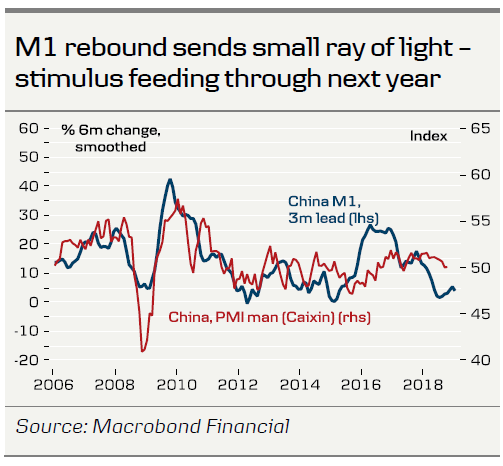
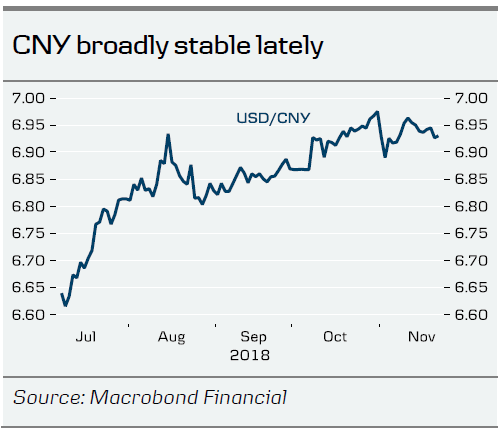
There were no Chinese key figures released this week, but we used the pause to update our China Leading Indicators chart pack. It's a mixed picture but overall the indicators suggest more weakness short term, but recovery from Q2 as stimulus kicks in, see China Leading Indicators – It gets worse before it gets better, 21 November 2018. In financial markets this week, the CNY and Chinese equities were again trading broadly sideways as market participants await the Xi-Trump meeting next week.
Other China news this week:
EU agrees on investment screening while China calls it 'self-harm'. To end what a negotiator called 'European naivety', the EU on Tuesday agreed on far reaching rules to screen foreign investments, see Reuters. The deal aims to protect strategic investments in the area of infrastructure and technology. A China Daily Editorial calls the restrictions 'self-harming' and states that it 'will put a brake on the momentum of Chinese investment in the EU, which does not bode well for their strategic partnership'.
China and Russia look to ditch USD with new payments system. They are drafting a pact to increase the use of their own currencies in bilateral and international trade, see SCMP.
Dolce & Gabbana has felt the wrath of Chinese consumers. In a video, the two founders of the Italian fashion company asked for forgiveness after Chinese consumers launched a boycott of their products. A commercial seen as racist against Chinese people, which was then followed by Gabbana describing China as a 'country of s***' triggered the anger, see Reuters.
Box: The APEC cooperation
What is APEC?
The Asia-Pacific Economic Cooperation (APEC) is a regional economic forum established in 1989 to leverage the growing interdependence of the Asia-Pacific. The leaders of the APEC countries meet annually in one of the APEC countries. This year Papua New Guinea hosted the meeting.
APEC's 21 members aim to create greater prosperity for the people of the region by promoting balanced, inclusive, sustainable, innovative and secure growth and by accelerating regional economic integration.
Its members are countries along the pacific rim and include China, the US, Russia, Japan, Canada, Australia, Indonesia, Malaysia, Vietnam, Mexico and Peru.
What does APEC do?
APEC ensures that goods, services, investment and people move easily across borders.
Members facilitate this trade through faster customs procedures at borders; more favourable business climates behind the border; and aligning regulations and standards across the region"
Source: APEC web page
Australia & New Zealand Weekly: RBA’s Forecast for Wages Casts Doubt on Their Confidence of a Hike by End...
Week beginning 26 November 2018
- RBA's forecast for wages casts doubt on their confidence of a hike by end 2020.
- RBA: Governor Lowe and Assistant Governor Kent speak.
- Australia: capex survey, construction work done, private credit.
- NZ: RBNZ Financial Stability Report, retail sales, business confidence, residential building consents.
- China: NBS PMI's.
- Europe: CPI, unemployment, ECB President Draghi speaks.
- US: Fed Chair Powell speaks, FOMC minutes, GDP 2nd estimate.
- Key economic & financial forecasts.
Information contained in this report current as at 23 November 2018.
RBA's Forecast for Wages Casts Doubt on Their Confidence of a Hike by End 2020
The minutes of the November monetary policy meeting of the Reserve Bank Board confirm the confident approach we have seen in the recent Statement on Monetary Policy.
While consumption growth is still identified as a source of uncertainty, the Board expects it to remain around the 3% level over the next few years that we have seen recently. Household disposable income growth is also forecast to increase at that rate.
GDP growth and labour market conditions have been stronger than the RBA had expected over the last twelve months. Accordingly, the forecast for the unemployment rate has been lowered to 4 ¾ per cent from 5 per cent by mid-2020, with an implied downside risk to that forecast. With the improved labour market outlook, there has been a modest upward revision to the outlook for wages growth. This is a particularly encouraging development for the RBA as they see wages growth as the key uncertainty for future consumption growth and inflation.
In that regard, the forecast for inflation has been lifted modestly, reflecting the brighter outlook for economic activity, the labour market and wages.
Non-mining business investment was expected to continue to make a significant contribution to output growth supported by above average business conditions and the significant pipeline of non-residential construction work.
Their discussion around the housing market is less confident. Residential building approvals are recognised to have fallen in the September quarter and liaison with builders describes a difficult picture. Furthermore, it is noted that housing prices have fallen further in Sydney and Melbourne, although are stable in most other cities. With the RBA's core forecast that consumption and income growth will be aligned, there is no allowance for any negative wealth effects from these housing developments.
The minutes discuss the various policy stances of other central banks noting that "market pricing was consistent with policy rates remaining steady over the following year in Australia and New Zealand, where policy rates had not been lowered to the extent they had in some other economies".
The Board also discussed the RBA's forecasting performance over the previous year, noting that forecast errors were smaller than historical averages with GDP growth and business investment surprising to the upside, the terms of trade average being higher than expected, and the marked depreciation in the Australian Dollar. Labour market outcomes were also stronger than expected, although wages growth and inflation had evolved largely as expected.
Consequently their success in the forecasting of inflation and wages despite underestimating employment and growth forecasts is a result that would have puzzled the forecasters.
The conclusion has been that the lags between growth; unemployment; and wages/inflation are larger than had been expected.
The question is just how long are these lags?
Westpac is expecting growth to slow down in 2019 and the unemployment rate to move back to 5.3% through mid- 2019. That development would interrupt the steady gradual improvement the RBA is expecting.
This expected gradual lift in wages growth represents the key to the RBA's expectation for higher rates. The importance of wages in boosting incomes and inflation is paramount in the RBA's thinking so it is instrumental to get an insight into just how quickly the RBA expects wages growth to lift. Note the comments in the minutes that Australia requires "a gradual increase in wages growth for inflation to be sustainably within the target range".
That outlook was provided in a graph (reproduced from the November Statement on Monetary Policy) where the RBA's own forecasts for annual growth in the Wage Price Index are presented for the first time.
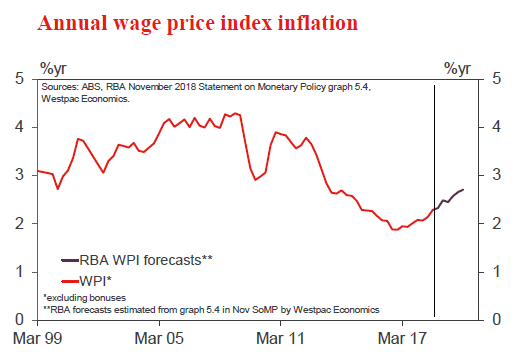
We are not given the point estimate by end 2020 but it certainly "eyeballs" at comfortably below 3%. (arguably around 2.75%).
Consider the growth rate of the WPI at the point of the beginning of the previous five rate hike cycles.
The start dates of the five previous rate hike cycles were May 2002; November 2003; May 2006; August 2007; and October 2009.
The latest WPI prints at the time of those meetings were an annual pace of 3.5% in December 2001; 3.2% in June 2002; 4.1% in December 2005; 4.0% in March 2007 and 3.7% in June 2009.
These are much faster growth rates than the RBA is expecting by end 2020 raising the question as to whether despite the confident assertion that the next move in rates is likely to be up, the RBA is anticipating such long lags between growth and wages/inflation that it will be surprised if the case to raise rates will even be clear by end 2020.
The RBA itself might be expecting to continue with "there was no strong case for a near-term adjustment in monetary policy" for a lot longer than is commonly assumed.
There may be other surprise developments such as a rapid fall in the Australian dollar which would trigger a response from the RBA. However, its forecast of a gradual build up of wage pressures indicates that they expect to be patient for a lot longer than generally believed.
The week that was
The RBA's minutes from their November meeting and a subsequent speech by Governor Lowe carried a confident but unhurried tone. Meanwhile the US economy showed early signs of the slowdown in activity that we anticipate will take growth back to trend over the coming year.
Beginning with the RBA, though the consumer is still seen as a 'source of uncertainty', the Board is more confident in the sector's outlook.
In the RBA's view, on the back of strong gains for employment and a nascent acceleration in wages growth, consumption is set to support above-trend growth through 2019 and 2020, along with strength in infrastructure investment and non-residential construction. With the savings rate near historic lows, this requires an acceleration in income growth to the 3.0% annual pace currently being seen for consumption.
We remain unconvinced on growth, instead anticipating that it will slow back to trend in 2019. Housing and the consumer are critical to this view. On housing, in contrast to the RBA, Westpac anticipates that GDP will be materially affected by declining residential investment – a trend increasingly evident in dwelling approvals.
On top of this investment effect, further declines in house prices will reduce household wealth and, we believe, impede consumers' willingness to spend. Consumers' spending capacity also continues to be restricted by a very modest wage uptrend, with full employment remaining elusive. The above outturn would clearly warrant the RBA remaining on hold not only through 2019, but also 2020.
Confidence in the real economy is also critical for the US. There the market has taken recent communications by FOMC officials as dovish overall, resulting in a paring back of nearterm expectations for policy. For us, the 'dovish' remarks of the Committee are merely recognition that neutral is nearing and the growth cycle maturing, not that policy will shift abruptly.
Westpac remains of the view that, following a rate hike at their December meeting, the FOMC will increase the federal funds rate a further three times in 2019 to a September peak of 3.125%. At this level, the stance of policy will be mildly contractionary, but still accommodative enough to allow growth to persist at trend given the underlying strength of the US labour market.
October's weak durable goods orders and shipments update was in line with our view that growth in business investment will weaken over the coming year.
However, as long as the consumer remains robust, which labour market strength and household wealth currently point to, the FOMC is unlikely to waver. Global risks are being watched, but will only affect policy if/ when they threaten domestic momentum.
Across the Atlantic, Brexit remains the focus. Negotiations achieved enough this week to allow the EU Summit on the matter to go ahead this weekend, but the key event to watch out for remains the UK parliament's vote to pass or reject the current draft deal. On that matter there remains considerable uncertainty.
For Europe more broadly, there was a subtle change in the ECB's November meeting minutes. Risks continue to be considered broadly balanced with the broad-based expansion still intact, but a remark was made by a member "that a number of arguments pointed towards risks to the growth outlook tilting to the downside".
The 'balance of risks' will gain greater prominence in 2019 as the first rate hike of the cycle (potentially) comes into view.
Before closing out for the week, our New Zealand economics team has just released their latest quarterly update. Notable in this edition is the unusual pairing of stronger NZ GDP and inflation forecasts with softer RBNZ cash rate and currency profiles. Reconciling this divergence, it is increasingly evident that the RBNZ's behaviour has changed, with the cash rate kept lower for longer than the RBNZ of old would have. See the following NZ page for further detail.
Chart of the week: draft Brexit proposal
PM May is currently seeking approval for a draft exit agreement. The proposal detail implies a 'soft' Brexit that would keep the UK closely linked to the EU – at least temporarily. Key aspects of the draft proposal include:
- A transition period through to December 2020 where the UK will remain within the EU customs union.
- The transition period avoids the need for a hard border between Ireland and Northern Ireland, but it also means that the UK will be required to adhere to EU regulations without a capacity to influence them.
- Financial service providers based in the UK are likely to have reduced ability to operate within the EU.
- The existing rights of EU citizens in the UK and UK citizens residing in the EU have been maintained, allowing freedom of movement while new arrangements are agreed.
New Zealand: week ahead & data wrap
Stranger things
This week we released our latest Economic Overview. In it we highlight what may at first sound like an unusual set of changes in our forecasts. We're now expecting stronger economic growth and a faster pick-up in inflation than we previously forecast. But despite the firming on both of these fronts, we actually expect that the Reserve Bank is going to remain on hold for longer than we previously assumed, and have pushed out our forecast for Official Cash Rate hikes to November 2020 (back from May 2020 as we previously expected). So what's behind this change in the outlook?
Looking first at real economic activity, recent months have seen the New Zealand economy catching a second wind, with GDP growth set to rise to rates a little over 3% through 2019. This pick-up is something we had long been forecasting, despite the pessimistic tone of some business surveys. It was pretty much inevitable, given the large increases in Government spending being rolled out, and it has been reinforced by a lift in construction activity. Demand is also being buoyed by the recent drop in fixed mortgage rates, which has boosted the housing market and household spending.
We still expect that the current firmness in activity will give way to a period of slower growth as we head into the early-2020s. Previous drivers of demand, like population growth and the construction cycle, have now moved into new phases, and going forward they won't provide the same boost they once did. In addition, house price growth is set to slow again over the coming years, with a battery of demand-dampening policy changes already in place or on the horizon.
On the prices front, headline inflation is now set to rise to 2.2% in early-2019. However, much of that rise is due to earlier increases in petrol prices, which are only providing a temporary lift in inflation. In fact, we've already seen some sizeable falls in fuel prices in recent weeks, which will dampen headline inflation going forward.
Looking through the short-term volatility in fuel prices, we are seeing signs that inflation pressures more generally are building in the economy. Most notably, a growing number of businesses have highlighted increased cost pressures, particularly with regards to wages. Combined with a lower NZ dollar and firmness in demand, we expect that this will push inflation higher over the coming year.
But even accounting for those factors, inflation is only set to rise slowly, with underlying inflation expected to rise from around 1.7% now to a little over 2% in 2020. That's because there are still some big factors limiting the rise in overall inflation. The most important is the continuing strong competitive pressures in the retail sector. We're also seeing more moderate increases in some Government charges (such as tertiary education) than we did in the previous decade, and that pattern is likely to continue for some time.
The above factors mean that we expect inflation will remain well contained within the RBNZ's 1 to 3% target band over the next few years, albeit at rates that are a little above 2%. We certainly don't think that inflation will rise to levels that would spook the RBNZ into hiking rates any time soon. In fact, the RBNZ's recent communications have highlighted that, since the adoption of its new duel mandate, it is now more willing to tolerate some rise in inflation above the target mid-point in order to shore up growth. That dovish lurch was evident in the RBNZ's recent policy statement, which both showed higher growth and inflation settling a little above 2%, but absolutely no change in the accompanying interest rate projection. With this in mind, we are now forecasting later and more gradual OCR hikes than we previously expected.
With inflation currently well contained, this approach will work fine for the RBNZ over the next few years. But over time, we could see inflation expectations creeping higher. That would then mean the Reserve Bank has to maintain higher nominal interest rates to achieve the same real interest rate and keep inflation steady.
The price of milk
The other key development this week was yet another drop in global dairy prices. Prices fell 3.5% in the latest auction and have now fallen 20% since their May peak.
While concerns about the strength of global demand are swirling at the moment, the big factor weighing on prices is the strong growth in domestic milk production. Milk collections were up 6.5% in October compared to last year, and season to date production is up 6%. That's well ahead of what we or Fonterra expected. In addition, pasture conditions are looking good as we head into the summer months.
Increases in production and the related drop in prices have added to the downside risk for this season's farmgate payout. We have long forecast a $6.25/kgMS farmgate milk price for the 2018/19 season. However, that forecast was contingent on some rise in milk auction prices over the coming months. And with production so strong, there is clearly downside risk to our forecasts. Certainly, Fonterra's forecast $6.25 to $6.50 is looking increasingly unrealistic.
While prices may be softening, we wouldn't describe this as a negative for New Zealand farmers. Despite lower prices, higher volumes will support farmgate returns. And importantly, prices remain well above breakeven levels for most farmers.
Data Previews
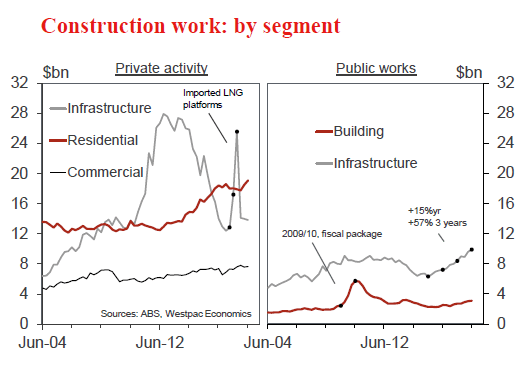
Aus Q3 construction work
- Nov 28, Last: 1.6%, WBC f/c: 0.6%
- Mkt f/c: 0.9%, Range: -2.5% to 2.0%
Construction work grew by a robust 1.6% in Q2. Gains were evident across public works, new home building and commercial building. There was a modest decline in private engineering activity, as well as a dip in home renovations.
For the September quarter, we anticipate a more modest lift in construction work, up a forecast 0.6%.
Notably, new home building activity is expected to consolidate after a brisk 4.1% rise in Q2. Approvals have retreated although a sizeable work pipeline remains.
Public works is a source of growth, +2.5% in Q2 and up a forecast 3% in Q3, with a focus on transport infrastructure.
Elsewhere conditions are likely to be mixed, with the risk of a small decline in private engineering and a modest gain in commercial building work.
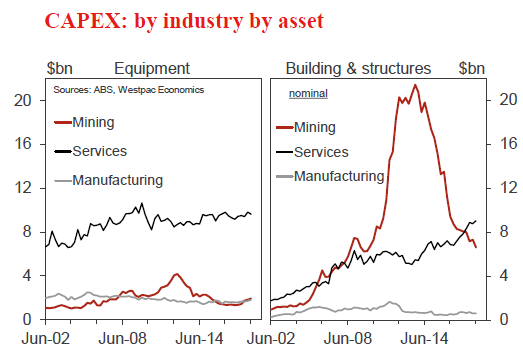
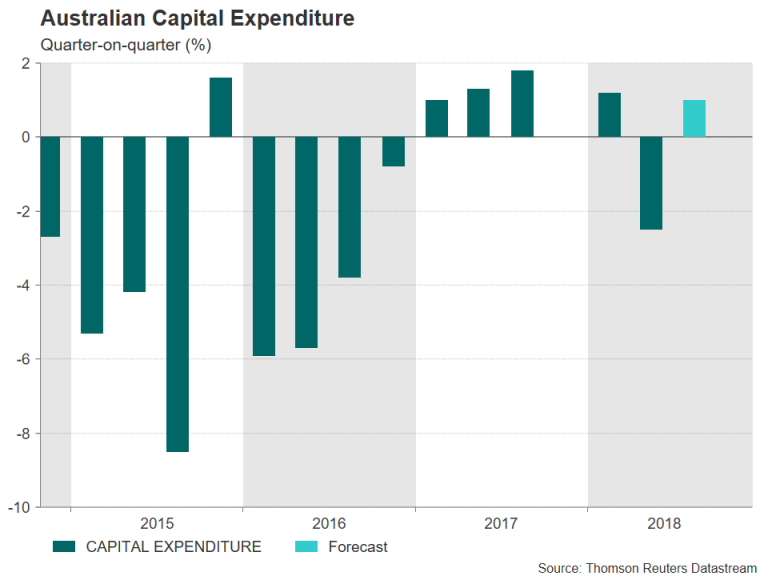
Aus Q3 private business capex
- Nov 29, Last: -2.5%, WBC f/c: 0.4%
- Mkt f/c: 1.0%, Range: -0.5% to 3.0%
Private business capex spending was mixed over the first half of 2018, down 2.5% in Q2 after a 1.2% rise in Q1.
This followed a 4.2% rise in capex in 2017, after four years of decline, on a diminished drag from the mining investment wind-down and with non-mining investment trending higher.
For Q3, we expect a soft result, up only 0.4%.
Building & structures is expected to be broadly flat. Commercial building up a little, supported by a sizeable work pipeline but with approvals off their highs. Infrastructure down a little with gas projects completed but other projects (roads and iron ore) getting underway.
Equipment spending is forecast to rise by 0.8%, reversing a 0.9% fall in Q2, to be 5% above the level of a year ago - supported by rising profits and higher capacity utilisation levels. Service sectors are lifting spending but growth is choppy and the underlying pace is modest of late.
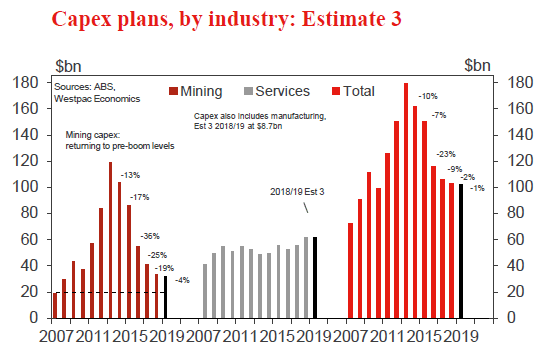
Aus 2018/19 capex plans
- Nov 29, Last (Est 3 for 2018/19): $102bn, -1%
This survey, conducted in October and November, includes the 4th estimate of capex spending plans for 2018/19.
In the previous survey, Est 3 for 2018/19 was $102bn, some 1% below Est 3 a year ago. By industry, Est 3 on Est 3 points to mining capex in 2018/19 being lower than in 2017/18 (with the completion of the gas projects) and broadly flat capex across the non-mining economy.
For Est 4 on Est 4 to be at -1% (matching the Est 3 outcome) would require an upgrade of 6% to $108bn - an upgrade which is in line recent historical experience, including last year. Accordingly, an Est 4 of $108bn is plausible, with risks potentially tilted to the upside.
Our central case forecast is for business investment to edge higher in 2018/19, up 1%. This is supported by sectors (education and health) and assets (computer software) excluded from the capex survey. That is, the capex survey understates the outlook for business investment.
Aus Oct private credit
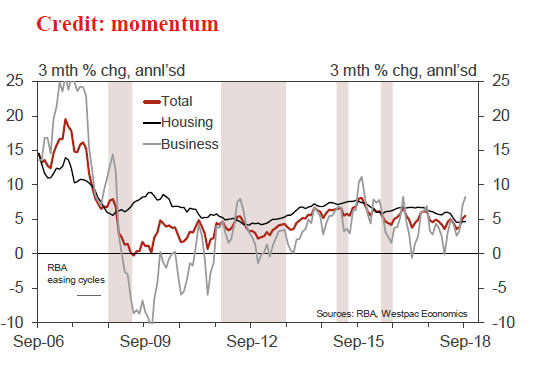
- Nov 30, Last: 0.5%, WBC f/c: 0.4%
- Mkt f/c: 0.4%, Range: 0.3% to 0.5%
Private sector credit growth has been relatively modest over the past year at 4.6%, moderating from 5.3% a year earlier as the housing sector cools.
However, in the September quarter, growth lifted to a 5.5% annualised pace centred on a burst of business lending, running at 8.3% annualised for the period. For October, we expect a 0.4% gain, matching the September outcome.
Housing credit, at this late stage of the cycle, is slowing as tighter lending conditions see new lending decline, particularly for investors. In September, housing credit grew by 0.4%, 5.2%yr (including investors, at 0.1%mth, 1.4%yr).
Business credit, 4.4% above the level of a year ago, is volatile around a modest uptrend as businesses increase investment in the real economy. Commercial finance strength of late points to a robust outcome for October.
NZ Q3 real retail sales
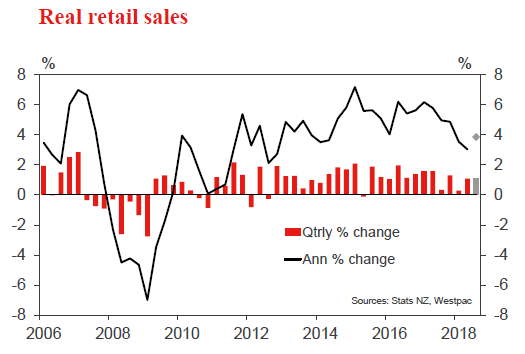
- Nov 26, Last: +1.1%, Westpac f/c: +1.0%, Mkt f/c: +1.1%
Adjusted for price changes, retail spending rose by 1.1% in the June quarter. Strength was seen in several areas, with spending in core categories (which excludes the volatile vehicle and fuel components) up a strong 1.4%.
We expect to see another solid increase in retail volumes of 1.1% in the September quarter, including a 2% increase in the core categories.
Monthly nominal spending figures posted solid gains over the September quarter, buoyed by increases in government transfer payments to households. However, recent months also saw strong increases in fuel prices, which squeezed households' disposable incomes and limited the rise in overall spending.
NZ RBNZ Financial Stability Report
- Nov 28
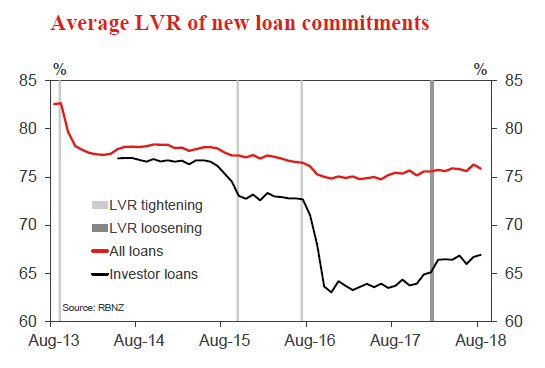
The RBNZ's six-monthly review of the financial system will include a review of the loan-to-value (LVR) restrictions on mortgage lending. Last November the RBNZ eased the restrictions slightly, and indicated that further easing was possible if house prices and credit growth remained in check.
We have long been of the view that these criteria would be met. Government policies (such as extending the 'bright line' test and restricting foreign buyers) and changes in lending practices are now doing some of the prudential work that the LVR restrictions once did on their own.
We would expect any changes to be incremental. The RBNZ has said that it will look to reduce the LVR limits to 'neutral' levels, rather than remove them altogether.
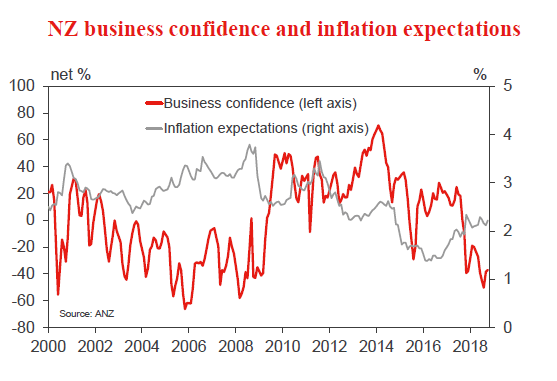
NZ Nov business confidence
- Nov 29, Last: -37.1
Business sentiment has improved marginally in the last two months, but it remains at very low levels.
Prospects for the November survey look mixed. Fuel prices have fallen sharply in the last month, providing some relief in terms of both business costs and consumers' spending power. However, confidence in the agricultural sector may worsen further, given to the deteriorating outlook for farmgate milk prices.
While we expect some drag on business investment in the short term, our view remains that overall activity is much more robust than the confidence surveys would imply. The 1% rise in June quarter GDP was boosted by some temporary factors, but we expect solid gains of 0.7-0.8% in the next two quarters.
NZ Oct residential building consents
- Nov 30, Last: -1.5%, WBC f/c: -5%
Residential dwelling consent issuance fell by 1.5% in September. However, that only partially offset earlier increases, and still left consent issuance at elevated levels.
We expect to see a further 5% decline in residential consent numbers in October. That decline is expected to be centred on Canterbury, and follows an unexpected lift in September. Building activity in Canterbury is continuing to gradually ease back following a period of very strong activity in the wake of 2010 and 2011's massive earthquakes.
Consent numbers in other regions are expected to remain firm. In Auckland, where most of the increase over the past year has been centred, issuance levels are expected to remain very strong (around 13,000 on an annual basis).
Week Ahead – Brexit and G20 Summits to Take Centre Stage; Fed also Under the Limelight
European and world leaders’ summits preceding and concluding the upcoming week will be the most closely watched events as the market tone will be tied to how much progress is made with Brexit arrangements and in easing Sino-US trade tensions. The Federal Reserve will also be attracting plenty of attention as several policymakers, including Chairman Powell, are scheduled to speak. In terms of economic indicators, Australian quarterly business expenditure, Canadian Q3 GDP and US PCE inflation will be the highlights.
Hopes high for Brexit deal at Brexit summit
European Union leaders will meet on Sunday, November 25 for a special summit to sign-off the Withdrawal Agreement between Britain and the EU as well as on the declaration on the framework for the future relationship. Sterling jumped above the $1.29 on Thursday after the UK and EU negotiators managed to reach an agreement on the text outlining the future relationship. Excluding last-minute hiccups such as Spain objecting on the terms for Gibraltar, the withdrawal deal and future declaration are set to get the seal of approval by EU member states.
However, pound bulls are unlikely to return to the market in droves just yet, as, even if a deal is finalized, all eyes will be on the UK Parliament, which many expect will vote down the agreements when MPs get to have their say sometime in December.
Aussie eyes Q3 capex for GDP clues
The Australian dollar is on track to end three straight weeks of gains as it pulls back from 2½-week highs on receding risk appetite in the markets. The focus next week though will return to the domestic economy as third quarter figures on business spending are out on Thursday, followed by private sector lending for October on Friday. Capital expenditure is forecast to have increased by 1.0% quarter-on-quarter in Q3, rebounding from the prior quarter’s 2.5% decline. A strong reading would be positive for the aussie as it would point to encouraging GDP numbers due the following week.
In addition to Australian data, aussie traders will be looking at Chinese PMI figures on Friday. China’s official manufacturing PMI slowed to just above the 50-expansion level in October as local exporters came under pressure from the higher tariffs imposed by the United States. Further deterioration in the manufacturing activity gauge would fuel concerns of a slowdown in China and hurt the aussie, which is often traded as a liquid proxy for the Chinese economy.
Battered loonie seeks Canadian GDP boost
Like their Australian counterpart, the kiwi and the loonie – the other major commodity-linked currencies – came under pressure versus the greenback during the past week as the risk-off sentiment weighed on commodity prices. While the New Zealand dollar’s decline was more attributed to profit-taking, having rallied 6% between the October trough and the November top, the Canadian dollar’s losses were driven by the oil sell-off. Both currencies are set for further volatility next week as key indicators are released in New Zealand and Canada.
Retail sales numbers from New Zealand for the June-September period are up first on Monday. They will be followed by October trade figures on Tuesday and the ANZ business outlook index on Thursday. The ANZ’s confidence gauge had slumped to a 10-year low in August before recovering to -37.1 in October. A further improvement in November could help the kiwi resume its rebound.
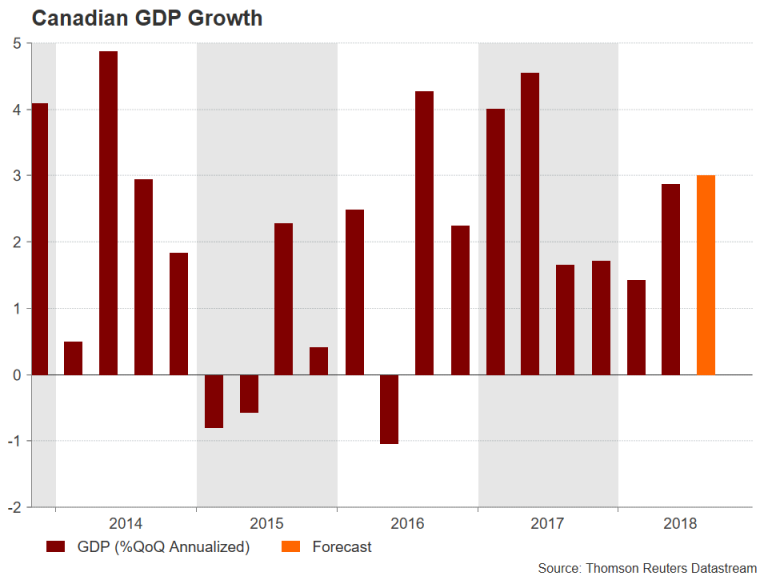
The loonie also stands to gain from next week’s data if they strengthen expectations of another rate rise by the Bank of Canada in early 2019 following October’s quarter-point hike to 1.75%. The biggest clue will likely come from third quarter GDP estimates due on Friday. Canada’s economy is projected to have expanded by an annualized rate of 3.0% during the third quarter, which would be a slight improvement on the prior 2.9%.
Yen likely to be unfazed by slew of Japanese data
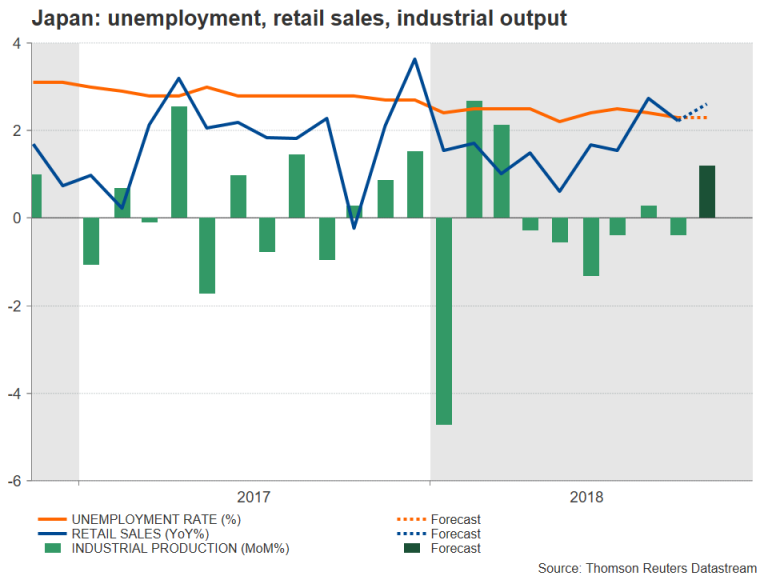
The Japanese economic calendar will be a busy one in the upcoming week but safe-haven flows relating to global trade tensions and political uncertainty in Europe will probably remain the yen’s biggest drivers. Attention at the start of the week will fall on the Nikkei/Markit flash manufacturing PMI for November on Monday. Retail sales for October will follow on Thursday. Lastly on Friday, data on the labour market and industrial production will be watched. Japan’s jobless rate is forecast to stay unchanged at 2.3% in October, near multi-decade lows, while the preliminary reading on industrial output for October is forecast to show a 1.2% month-on-month bounce from September’s 0.4% dip.
Draghi’s parliamentary hearing and Eurozone inflation eyed
ECB President Mario Draghi will testify before the European Parliament’s Economic and Monetary Affairs Committee on Monday, which comes hot on the heels of the ECB’s meeting minutes published this week. Draghi is unlikely to provide any new views on the monetary policy outlook. However, any repetition of earlier remarks that the projected rate path could be adjusted if the growth and inflation outlook worsen could still drag on the euro.
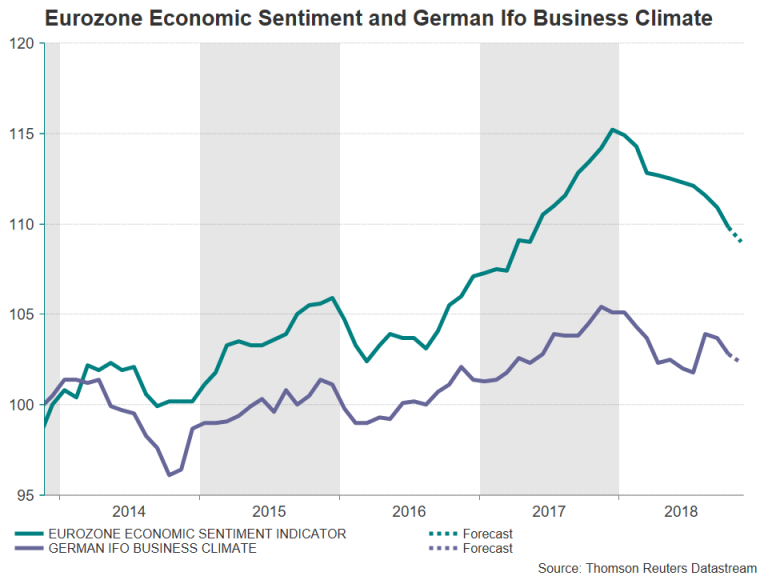
In terms of data, Germany’s Ifo survey will provide a glimpse at German business sentiment. But those hoping for a turnaround will probably be disappointed as the Ifo’s business climate index is expected to drop from 102.8 to 102.3 in November. On Thursday, traders will get the chance to assess business confidence in the wider euro area. The economic sentiment indicator is forecast to fall from 109.8 to 109.0 in November. The flash PMIs published this week also showed a deceleration in German and Eurozone manufacturing and services activity during the month.
Finally, on Friday, the flash inflation numbers for November are due, along with the bloc’s unemployment rate for October. The Eurozone’s headline CPI rate is expected to decrease by 0.1 percentage points to 2.1% year-on-year in November, while the core rate that excludes all volatile items is anticipated to stay unchanged at 1.1%.
PCE inflation, Fed and Trump-Xi meeting to be dollar’s focal points
There will be no shortage of sources of direction for the US dollar next week, with traders at risk of being overwhelmed by important data releases, Fed speakers, the FOMC meeting minutes and highly anticipated trade talks between Chinese and US leaders.
Starting with US economic pointers, the housing sector, which is under scrutiny lately due to signs of a slowdown, will move to the fore early in the week with the S&P CoreLogic Case-Shiller 20-City Composite Home Price index out on Tuesday. Other housing data during the week will include new home sales (Wednesday) and pending home sales (Thursday), both for October. Also scheduled for Tuesday is the Conference Board’s consumer confidence index, which is predicted to ease in November from October’s 18-year high. On Wednesday, the second estimate of GDP growth in the third quarter is due. Economic growth is expected to be unrevised from the initial reading of 3.5%.
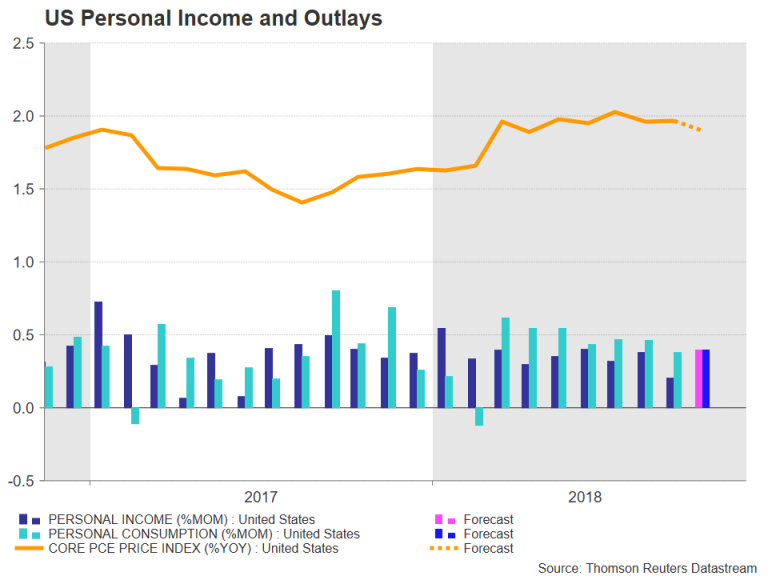
More key releases will follow on Thursday with the personal income and outlays report. Both personal income and consumption are forecast to have risen by 0.4% m/m in October, maintaining the steady and solid growth enjoyed throughout the year. Meanwhile, the Fed’s favourite price barometer, the core personal consumption expenditures (PCE) price index, is expected to have moderated a little to 1.9% y/y in October.
The GDP and PCE prints may fail to see the usual reaction in the markets as the focus is increasingly turning on 2019 in relation to Fed policy. The Fed itself will have the opportunity to message to the markets its latest assessment of the US economy through its meeting minutes and via public appearances. The minutes of the October/November policy meeting will be published on Thursday and will probably hint at a rate hike in December. But potentially of more significance to traders will be what FOMC members comment on regarding the pace of rate hikes in 2019, and more specifically, whether Fed Chairman, Jerome Powell will signal a rethink of the central bank’s gradual tightening approach when he speaks on Wednesday.
Drawing the week to a close will be the meeting between President Trump and President Xi at the sidelines of the G20 summit on November 30 – December 1. Sentiment towards the two sides reaching an eventual deal on better trade relations has improved substantially lately amid renewed efforts by the two countries to bridge their differences over trade policy. However, it’s unclear how many concessions the Chinese are willing to make at this point and how concerned Trump is with the sell-off on Wall Street to push the two leaders to strike some sort of a truce.
Any progress at the G20 summit would be positive for risk appetite but possibly negative for the dollar, which has benefited the most from the heightened trade risks.
Oil Selling Resumes, WTI Falls to a 13-Month Low and Brent Breaks Below $60
Oil headlines have been sparse over the past 24-hours, but the broad selloff resumed as markets remain focused on rising production levels globally and fears of a slowdown in global economic growth. The US benchmark, West Texas Intermediate crude is poised for its 7th consecutive weekly loss. Brent futures also took out the key psychological $60.00 handle and is tentatively finding support at the $58.75 level. Oil is one of Canada’s largest exports and the recent slide continues to drive the Canadian dollar lower against the greenback.
Yesterday, Saudi Arabian Energy Minister Khalid al-Falih noted that he sees weak oil demand in January and that the kingdom would respond accordingly to cool the global market’s anxiety. Oil did react to his comment that November’s oil output is now above 10.7 million barrels per day, this followed the surge markets saw in October. The Saudi oil minister said that demand for Saudi crude may be lower in January compared with December.
The countdown continues to the 175th OPEC meeting on December 6th, but expectations of any cut having a major turnaround for oil are dwindling as the larger oil producers are near record levels and weakening demand concerns are growing. Earlier in Europe, both Germany and the Euro Zone saw the preliminary manufacturing PMI readings for November both come in softer than expected and the lowest level since March 2016.
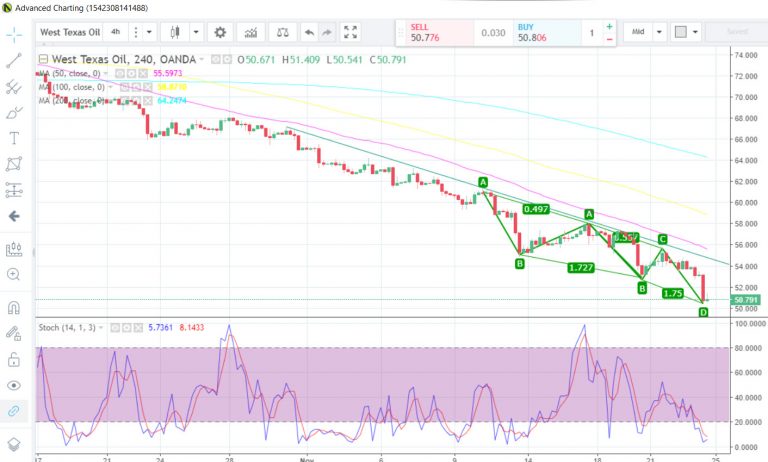
Price action on the 4-hour oil chart shows that bullish bounce that was identified earlier in the week has ended and that next leg lower may have formed a new bullish ABCD pattern. If valid we could see price a technical bounce here. The overall bearish trend remains intact with key resistance potentially coming from the $66 .00 to $66.75 region. Major support lies at $45.00 level for WTI.
Weekly Focus – One Step Closer to a US-China Trade Agreement?
Market movers ahead
- In the US, PCE core inflation is set to come in just below the Fed's 2% target
- In the euro area, falling energy prices will drag headline inflation lower
- Brexit negotiations will continue to be high on the agenda with an EU summit on Sunday and uncertainty about political backing in the UK
- Newsflows around the upcoming meeting between Chinese President Xi Jinping and US president Trump, likely to occur on 1 December, will be a key market theme
- Chinese PMI manufacturing reading for November may drop below the 50 benchmark
Weekly wrap-up
- Politics (Brexit, US-China trade talks and Italy) in focus rather than economic data this week
- Brexit one step closer to a deal, but uncertainty prevails, while Italy is one step closer to an EDP
- Conciliatory tones from Trump in a potential Xi-Trump ceasefire in the trade war between China and the US.
Canadian CPI up to 2.4% in October
Highlights:
- CPI inflation ticked up to 2.4% in October from 2.2% in September.
- A 4.6% m/m increases in airfares — likely reflecting more methodology/sample changes earlier this year more than underlying price trends — accounted for part of the headline gain
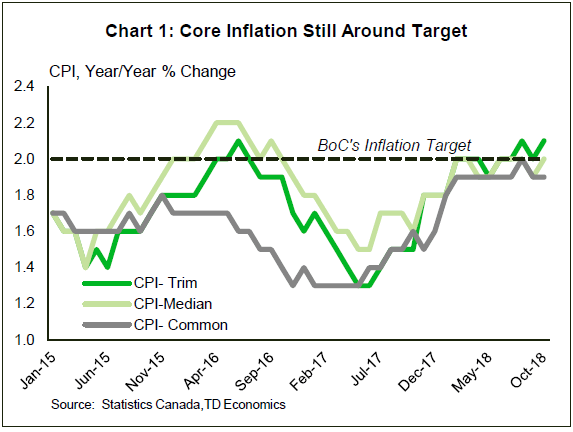
- The Bank of Canada’s three preferred ‘core’ measures (the trim, median, and common CPI) ticked up on average to 2.0% from 1.9% in September. They have been close to 2% for most of the year.
Our Take:
Volatility in the airfares component was part of the story once again in October with a 4.6% month-over-month increase. That followed a 16.6% drop the prior month that in turn retraced a similar-sized jump in July. We continue to suspect that those unusual swings can be traced back to new methodology/sample implemented for the component earlier this year more than any fundamental change in underlying price growth. Energy prices were still up 7.9% from a year ago despite a monthly decline in gasoline prices, food price growth ticked up to 2.0% from 1.8% in September, and higher interest rates pushed mortgage interest costs up 7.0% from a year ago.
Looking through monthly volatility, there was little to point to in terms of changes in underlying inflation trends. The Bank of Canada’s three preferred ‘core’ measures (the trim, median, and common CPI) ticked up on average to 2.0% from 1.9% in September.
Year-over-year energy price growth is clearly likely to soften going forward given the pullback in oil prices in recent weeks — and that pullback has in turn generated concern about another round of retrenchment in the oil sector. Household spending has also shown clear signs of slowing — even with a decent 0.5% increase in retail spending volumes in September also reported this morning. Slower growth is also to be expected with the economy bumping up against capacity limits, though. Barring an unexpected shock — and at this point we expect the pull-back in oil prices to-date will ultimately have a negative but manageable impact — there is still room for the Bank of Canada to follow through with further gradual interest rate hikes next year.