Sample Category Title
EUR/AUD Daily Outlook
Daily Pivots: (S1) 1.5646; (P) 1.5673; (R1) 1.5711; More....
Outlook in EUR/AUD remains unchanged. Further decline is expected with 1.5853 resistance intact, for 1.5601 support next. Decisive break there will target 1.5271/5313 cluster support zone next. On the upside, break of 1.5853 minor resistance is needed to indicate short term bottoming. Otherwise, outlook will stay bearish in case of recovery.
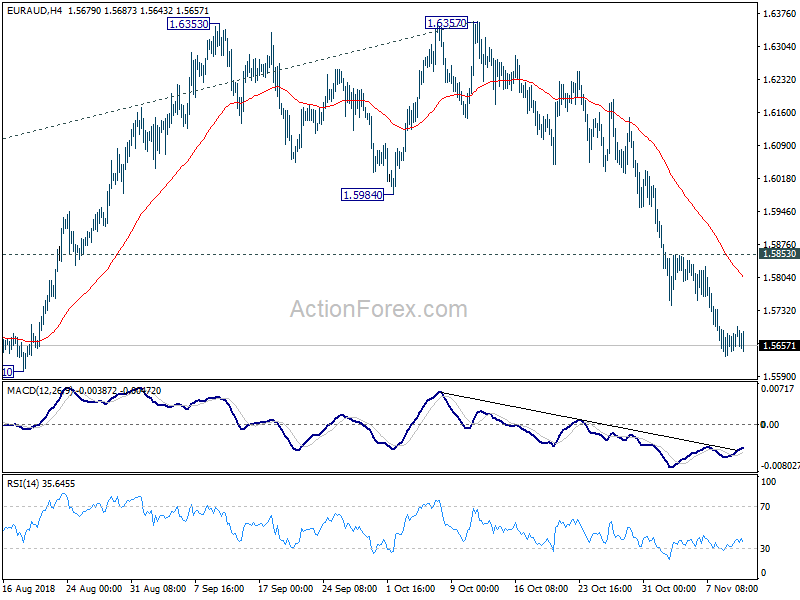
In the bigger picture, current development argues that up trend from 1.3624 (2017 low) is possibly completed at 1.6357, ahead of 1.6587 (2015 high). This is supported by bearish divergence condition in weekly MACD. Deeper decline is now in favor to 1.5271 cluster support (38.2% retracement of 1.3624 to 1.6357 at 1.5313). Break will target 61.8% retracement at 1.4668. On the upside, break of 1.6357 is needed to confirm up trend resumption. Otherwise, risk will now stay on the downside even in case of strong rebound.
EUR/CHF Daily Outlook
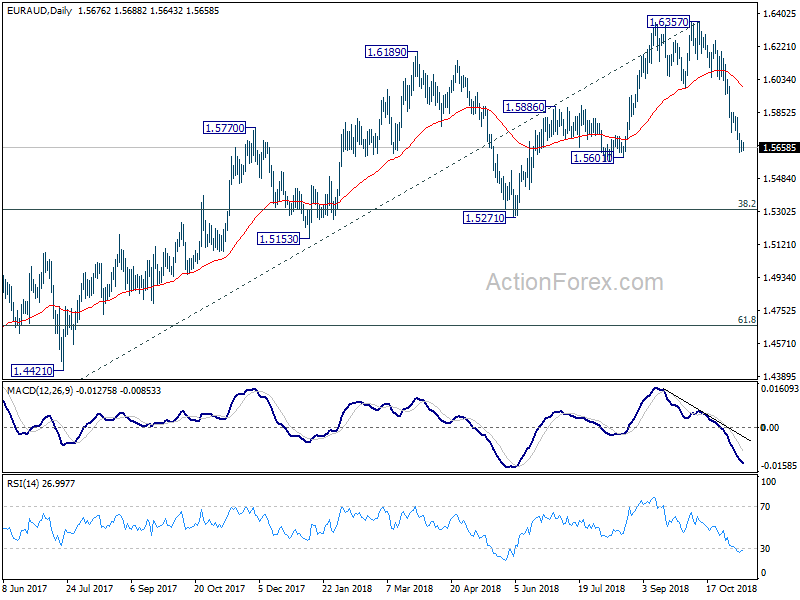
Daily Pivots: (S1) 1.1372; (P) 1.1408; (R1) 1.1434; More...
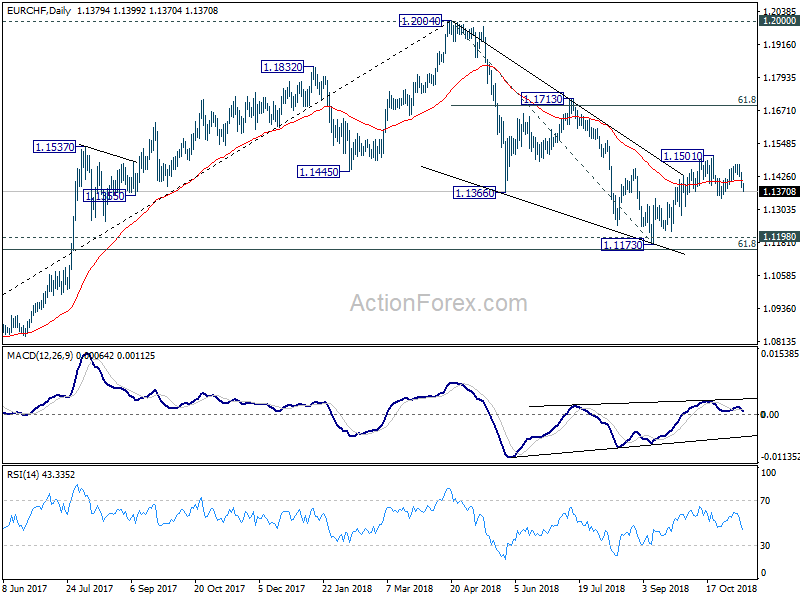
Intraday bias in EUR/CHF remains on the downside for 1.1343 support. Firm break there will extend the decline from 1.1501. In that case, further fall would be seen back to 1.1154/98 key support zone again. On the upside, break of 1.1470 will turn focus back to 1.1501. Decisive break of 1.1501 will revive the case of bullish reversal.
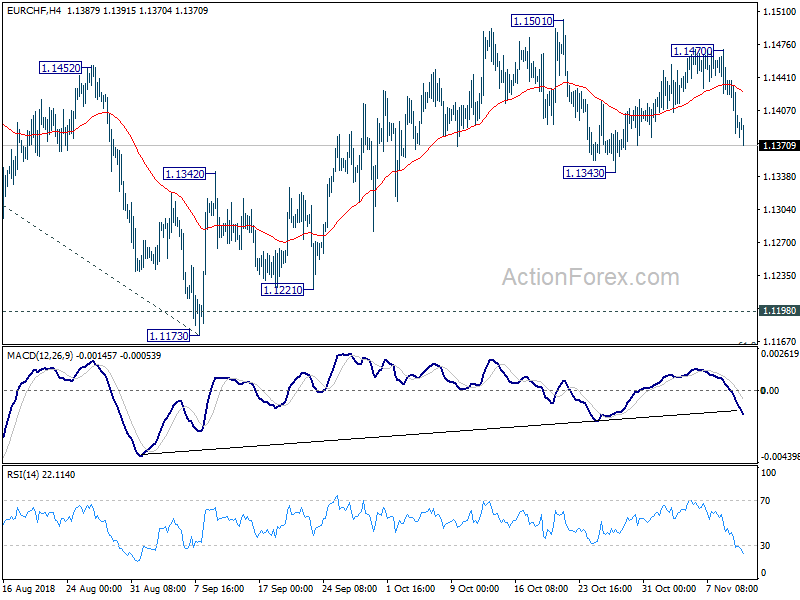
In the bigger picture, price actions from 1.2004 medium term top is seen as a correction only. Downside should be contained by support zone of 1.1198 (2016 high) and 61.8% retracement of 1.0629 to 1.2004 at 1.1154 to complete it and bring rebound. This cluster level is in proximity to long term channel support (now at 1.1243) too. A break of 1.2 key resistance is still expected in the medium term long term. However, sustained break of the mentioned support zone will mark reversal of the long term trend. In that case, 1.0629 key support will be back into focus.
EUR/USD breaks 1.13 as dollar buying jumps in, 1.1186 next
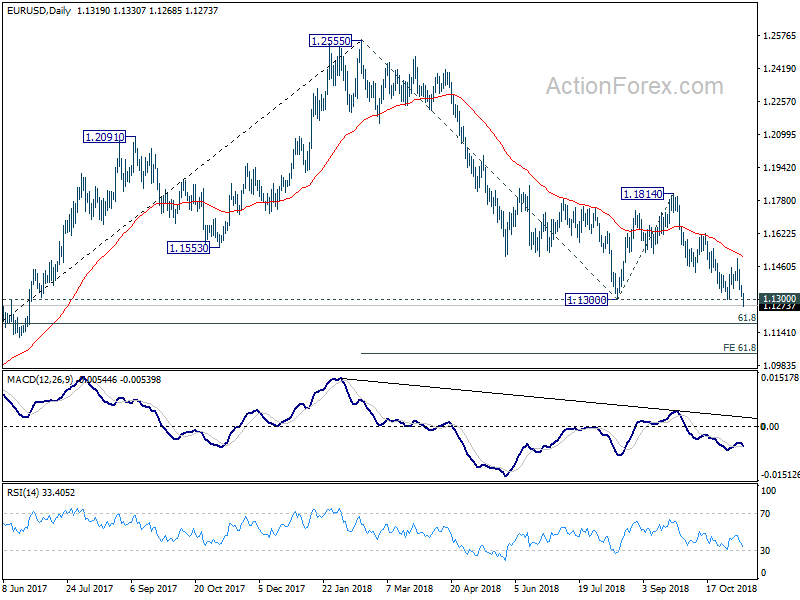
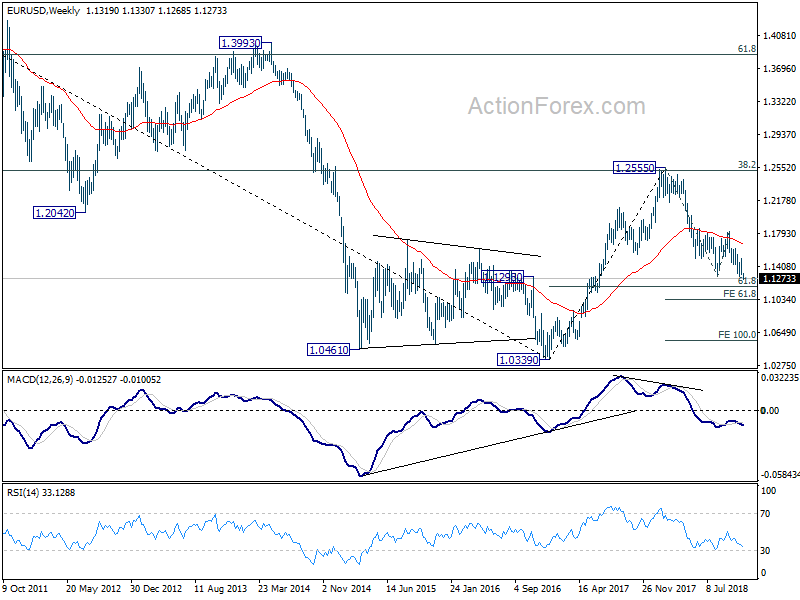
EUR/USD finally broke 1.1300 key support level as a wave of Dollar buying jumps in. The down trend from 1.2555 should have resumed. Next downside target is 61.8% retracement of 1.0339 (2017 low) to 1.2555 at 1.1186 next. Based on current momentum, it should be too difficult to get through this level. The real test will lie in 61.8% projection of 1.2555 to 1.1300 from 1.1814 at 1.1038. Reaction from there will show if there is downside acceleration.
Brexit And Italy Create Major Risks This Week
May suffers setback as negotiations hit another apparent impasse
European markets are set to get the week off to a positive start despite Brexit and Italy risks seemingly rising as both enter into a crucial period.
Theresa May looks to have suffered numerous setbacks over the weekend that has reportedly forced her to abandon plans for an emergency Brexit cabinet meeting on Monday. May was hoping to get approval of a Brexit deal with the aim of securing an agreement with EU leaders this month but that now looks in serious jeopardy after the EU rejected her compromise for an independent mechanism that would enable the UK to exit the backstop customs arrangement.
The EU has insisted on ECJ oversight, which the UK can never agree to as it could leave it trapped in the backstop arrangement indefinitely which completely negates the point of the decision to leave in the first place. To make matters worse for May, four remain-backing ministers are apparently on the verge of quitting which would be yet another blow, albeit one she has survived in the past in more threatening circumstances.
None of this makes traders feel any more confident that we're going to avoid a painful no deal scenario and we're seeing that reflected in the currency at the start of the week. The pound is off against the euro, dollar and yen and looking quite vulnerable. Brexit headlines are going to feed the volatility in sterling over the coming days and weeks as we get a better idea if the last 18 months of negotiations have been nothing more than a frustrating and tedious waste of time, or whether a fudge can be found for those last few – albeit major - remaining issues.
Italy draft budget expected Tuesday but government unwavering on deficit
It's been a little quiet on Italy the last week or so but that will change at the start of the week as the government prepares to resubmit its draft budget. Ministers have been resolute about the need for an increased budget deficit of 2.4% for next year, insisting that this is not something it is willing to back down on. Recent reports though suggest that the Finance Minister will instead try to win over the European Commission by offering more realistic growth forecasts, while maintaining the deficit number, which you would imagine must therefore mean concessions somewhere on spending or taxes.
This will all come to a head on Tuesday and we may not have to wait long to know whether Italy is heading towards an Excessive Deficit Procedure which could ultimately lead to fines of up to 0.2% of GDP against the country. This may continue to weigh on the euro in the near-term as Italian yields remain elevated, lifting others with them and weighing on Italian stocks, and the spread over German Bunds sits at 2013 levels.
Oil rallies on JMMC report and Saudi December cut
Oil prices are up more than 1% at the start of the week following the meeting of the JMMC of OPEC+ nations over the weekend, at which the committee concluded that oversupply next year will warrant output cuts. The analysis doesn't come as much of a surprise given the recent inventory data and the US decision to offer waivers to eight importers of Iranian oil, despite Saudi Arabia, Russia and itself pumping record levels of oil.
It also doesn't bind the countries to committing to such a move and there is likely to be some debate on the need for such a move in Vienna next month, with Russia expressing doubt. Saudi oil minister Khalid al-Falih confirmed that its output will fall by half a million barrels a day in December, regardless of an agreement, which is offering some support for oil prices today. More will need to be done though to persuade traders that the recent bear-market in WTI isn't justified.
EURUSD Heavy Losses Expected Below 1.1300
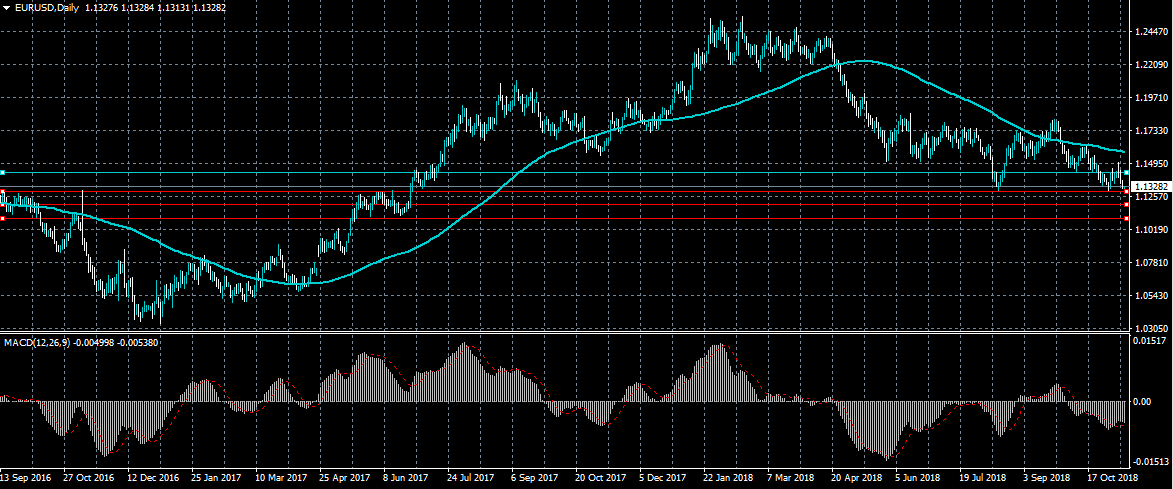
The euro has opened the new trading week under downside pressure against the US dollar, with price edging closer to the current yearly trading low. The EURUSD pair risks heavy technical selling below the 1.1300 support level, as a number of large stop-losses orders are likely to be triggered. Only a strong move back above the 1.1400 resistance level can negate intraday bear pressures.
The EURUSD pair is strongly bearish while trading below the 1.1300 level, key technical support is found at the 1.1225 and 1.1130 levels.
If the EURUSD pair moves above the 1.1400 level, buyers may test the 1.1431 and 1.1500 resistance levels.
GBPUSD Under Technical Pressure
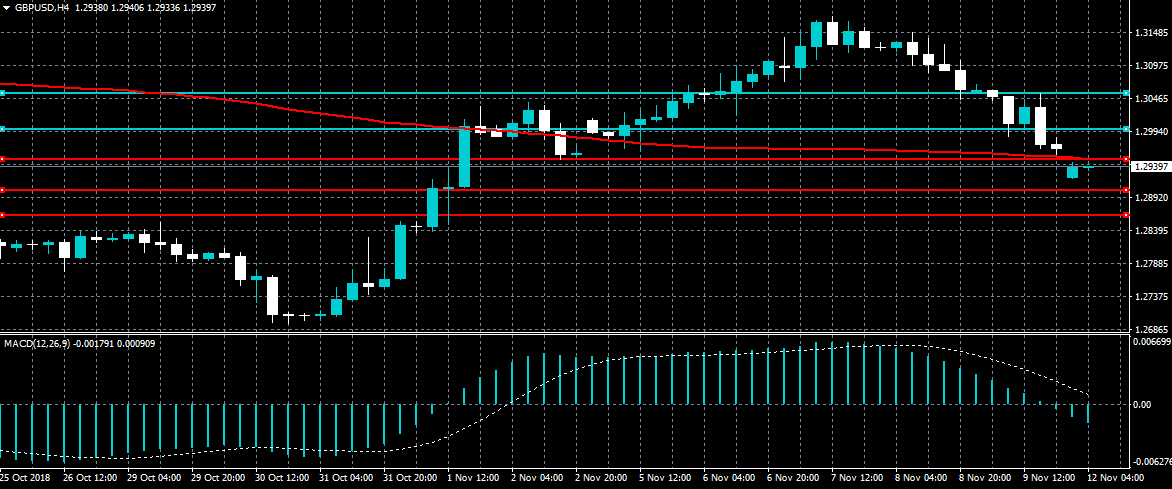
The British pound has continued to slide lower against the US dollar in early Monday trade, with price fast approaching the 1.2900 support level. The GBPUSD pair will likely remain under heavy intraday selling technical pressure while trading below the 1.2955 level. The Moving Average Convergence Divergence indicator across the four-hour time frame is trending lower, pointing to further losses.
The GBPUSD pair is strongly bearish while trading below the 1.2955 level, key technical support is now found at the 1.2900 and 1.2866 levels.
If the GBPUSD pair trades above the 1.2955 level, buyers may target the 1.3000 and 1.3055 resistance levels.
Crude Oil Rises As Saudi Signals Supply Cuts
The price of crude oil jumped in the Asian session after Saudi Arabia announced measures to reduce supply. The Saudi Arabian Minister of Energy – Khalid al-Falih – said that the country will slash oil output by 500K barrels a day. He attributed this to lower demand. This was against the agreement within OPEC and Russia which called for an increased supply. The news was a relatively good one for the oil market, which saw the price of Brent jump from $61.95 to $71.05.
The Japanese yen fell against the USD today even after the better-than-expected producer price index (PPI). The PPI measures the change in selling price of goods purchased by companies and is a good measure of inflation. The data showed that the PPI rose by an annualized rate of 2.9%. This was higher than the estimated increase of 2.8%. It was, however, lower than September’s increase of 3.0%. On a monthly basis, the PPI rose by 0.3%, which was higher than the consensus estimates of 0.1%. Later today, the country will release the preliminary numbers of machine tools.
Gold received some support in the Asian session after the slide that happened on Friday. Last week, it had the worst week in more than three months after the Federal Reserve eyed more rate increases. In the monetary policy decision last week, the Fed said that the economy was strong and was capable of accommodating multiple rate hikes. Rate hike expectations often lead to a stronger dollar and weaker gold because the latter offers no yield.
XAU/USD
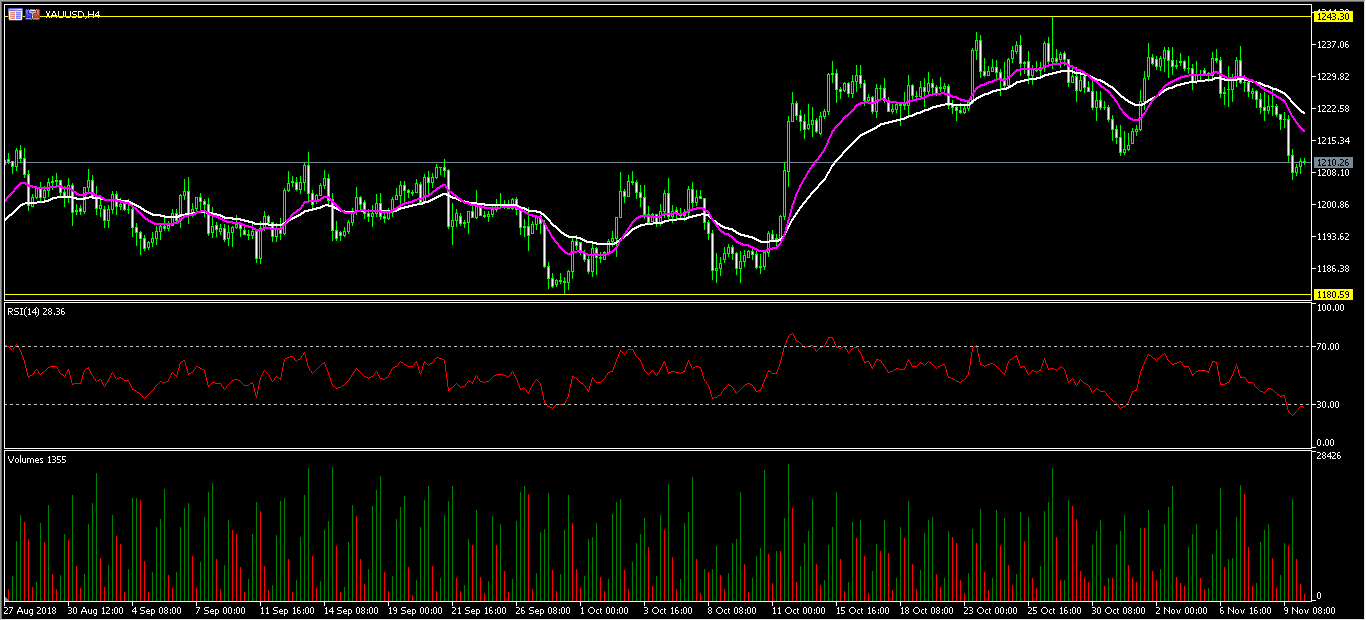
Gold rose slightly today after the sharp decline last week. Starting from last month, its price has gained from $1180 to a high of $1243. The XAU/USD pair is now trading at 1210, which is slightly higher than Friday’s close of 1206. This price is below the 30 and 15-day EMA. The RSI has fallen to 28, which is considered an oversold position. However, this has happened with the volumes being low, which means that the pair will likely continue with the decline. If it does, it could test the important 1200 level.
EUR/USD
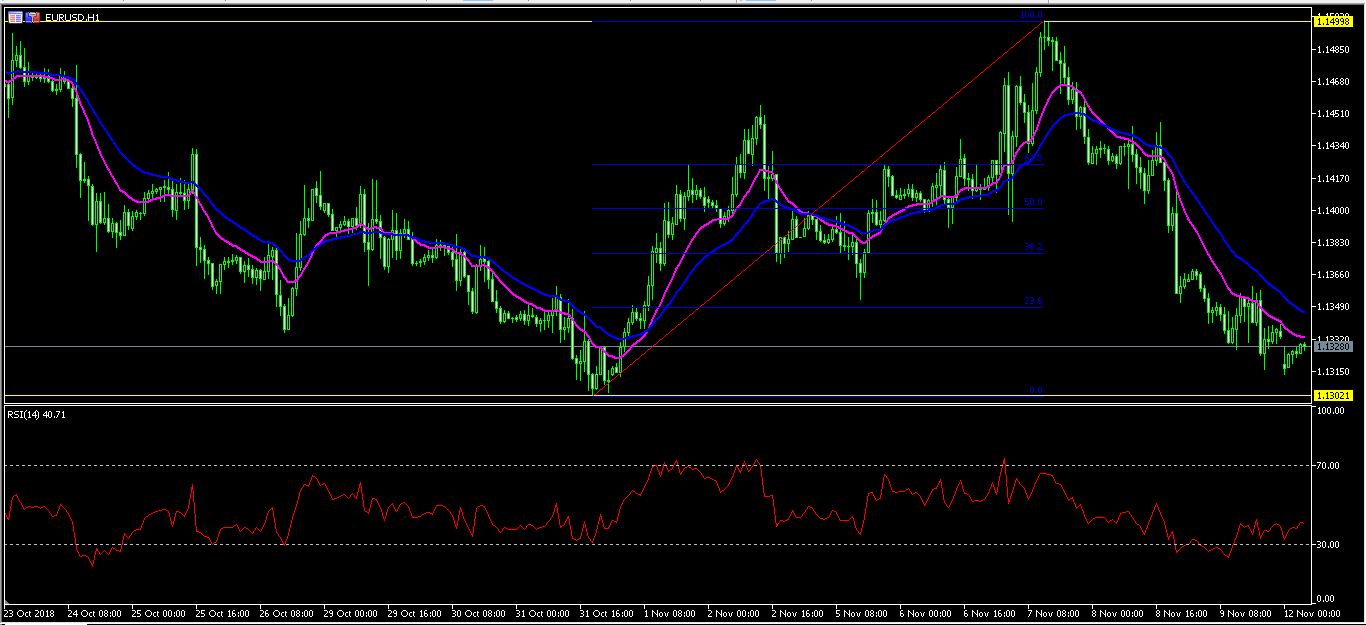
The EUR/USD fell slightly during the Asian session. It reached an intraday low of 1.1312. It then recovered slightly, reaching an intraday high of 1.1330. Last week, the pair declined sharply from a high of 1.1500 to a weekly low of 1.1315. The decline accelerated after the indications by the Fed that it will continue to hike rates. On the hourly chart, the double EMA appear to be changing direction, which will be an indication that a crossover could happen. The RSI has risen to the current level of 40. At this level, it is likely that the pair will start moving up. If it does, it could test the 1.1350 resistance level, which is also the 23.6% Fibonacci Retracement level.
USD/JPY
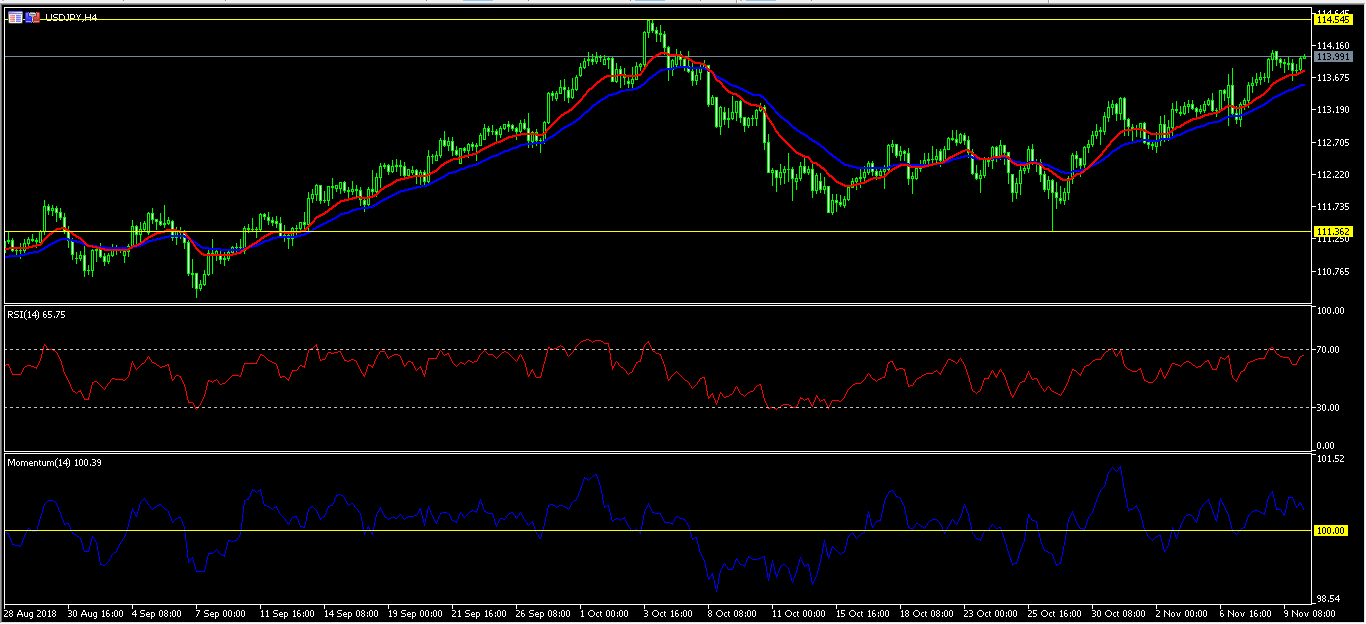
In the final week of October, the USD/JPY pair reached a low of 111.36. It then started rising and reached a high of 114.01 today as it tries to reach the important resistance level of 114.54. The RSI on the four-hour chart rose to 65 while the double EMA showed that the pair could continue moving higher. The momentum indicator is currently above 100, which means that the pair will likely move higher. If it does, it will test the previous high of 114.54.
Brexit Monitor: No UK Compromise On Backstop Proposal Just Yet
UK politics remain poisoned, as PM Theresa May tries to find a final compromise in her Cabinet to unlock the negotiations with the EU. The ambition was to have a full draft withdrawal text ready early this week but the decision may be postponed further, as May's proposal is under fire. As the withdrawal text is 95% done, there is still no agreement on the backstop solution to the Irish border (i.e. how does one avoid a hard border between Ireland and Northern Ireland if the UK and the EU fail to reach an agreement on the permanent future relationship during the transition, which removes the need for a hard border). PM Theresa May is trying to downplay the importance of the backstop, as she says it would never come into force anyway. She argues the deal on the future relationship will remove the need of a border but it is still causing a lot of trouble politically.
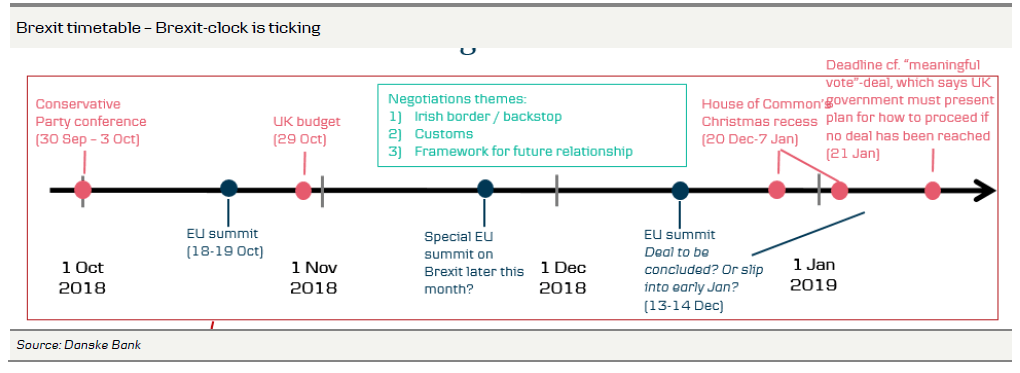
As the UK has rejected the idea to let Northern Ireland stay in the customs union (CU) and EU single market, May's proposal is to keep the whole UK in the CU. Apart from the fact that the UK cannot make new trade deals with other countries while staying in the CU, the EU has also said it demands the UK to stay closely aligned with EU regulation (and maintaining fishing rights in British waters) and that the UK cannot unilaterally leave the CU. It seems like May has accepted there must be a joint UK-EU exit mechanism, which has infuriated both remainers and Brexiteers, see The Guardian. The EU also demands there is a ‘backstop to the backstop', if there is to be an exit mechanism, which May also seems to have accepted. This ‘backstop to the backstop' is just the original idea of keeping Northern Ireland inside the CU and single market. This has upset the Democratic Unionist Party (DUP) in Northern Ireland, who says it cannot vote for anything that may lead to a border between Great Britain and Northern Ireland. According to BBC's Laura Kuenssberg, sources say May is likely to dismiss the DUP eventually by accepting the EU's ‘backstop to the backstop'. This is also the impression one gets from May's leaked letter to DUP's Foster. While some media have reported that the UK Cabinet is close to reaching a compromise on the backstop proposal, we warn against being too optimistic. First of all, we have been disappointed before. Politicians usually do not give in until they really feel the pressure and while the pressure is increasing, it may not be heavy enough just yet. Secondly, PM Theresa May's supportive party DUP in Northern Ireland is very upset and has threatened to vote against the deal. She is also under pressure, not only from hardliners but also increasingly from moderate, pro-EU Conservatives. Thirdly, even if the UK Cabinet finds common ground, we still do not know whether the EU can accept it. The EU has made it very clear it still wants a ‘backstop to the backstop' if the UK backstop is only temporary in nature. The EU says the UK must come back no later than early this week, otherwise there will be no special Brexit summit later this month (rumours say 25 November). Our base case is still that the EU and the UK will reach an agreement in December but that negotiations may slip into early January. We still expect a decent Brexit (75% probability) but think one should not rule out a ‘no deal' Brexit (15% probability), see Brexit Monitor: Final deal unlikely before December, 18 October.
In our view, the real test is not whether PM Theresa May can sign a deal with the EU, but whether it can pass the UK House of Commons. Brexit hardliners have said they will vote again any deal that in their view is too soft. This number is probably not below 25 but could easily be higher. In addition, the DUP now threatens to vote it down as well (10 seats). Remainers are also smelling blood after the resignation from pro- EU Jo Johnson (brother of ex-foreign secretary Boris Johnson, one of the leading Brexiteers).
PM Theresa May will need support from Labour MPs to pass the deal. The question is whether she can persuade enough? Around 30 Labour MPs are currently expected to vote against the party line, but lately there have been indications that this number may be lower. Bloomberg has a very good overview of the mathematics and party views here. Our case is that the Labour MPs will fear a ‘no deal Brexit' forcing them to vote in favour of whatever May is putting to the floor. This may change if Labour sees its chance to overthrow the government.
UK Politics Remain Poisoned
Market movers today
With no big market movers on the agenda today, focus will be on Brexit negotiations, where things soured over the weekend (see below).
Tomorrow, Italy returns to the limelight as it is the deadline to send a revised budget to the EU Commission.
On the data front, the week brings US inflation, German ZEW and Chinese data on money, credit and industrial production. Focus in the Scandies will be on Norwegian GDP for Q3 and Swedish inflation. See also Weekly Focus, 9 November 2018.
In Denmark , we estimate CPI inflation rose to 0.7% y/y in October. See the Scandi section on page 2.
Selected market news
UK politics remain poisoned, as PM Theresa May tries to find a final compromise in her cabinet to unlock the negotiations with the EU. The ambition was to have a full draft withdrawal text ready early this week but the decision may be postponed further, as May's proposal is under fire. While the withdrawal text is 95% complete, there is still no agreement on the backstop solution to the Irish border (i.e. how does one avoid a hard border between Ireland and Northern Ireland if the UK and the EU fail to reach an agreement on the permanent future relationship during the transition, which removes the need for a hard border). The development during the past week supports our view that the real test is probably not reaching an agreement with the EU, but to get the deal through the House of Commons. Brexit hardliners, the DUP, moderate pro-EU Conservatives and Labour are all threatening to vote it down. Our base case is still that the EU and the UK will reach an agreement in December but that negotiations may slip into early January . We still expect a decent Brexit (75% probability) but think one should not rule out a 'no deal' Brexit (15% probability). For more details, see our Brexit Monitor: No UK compromise on backstop proposal just yet, 12 November. Last week, EUR/GBP was below 0.87 but now it is moving back towards 0.88.
OPEC+ oil ministers held preparatory talks before next month's OPEC meeting on Sunday. They indicated that oil production cuts in 2019 are on the table as a glut in the oil market remains. Saudi Arabia has hinted it will reduce oil exports by as much as 0.5million a day in December. Russia seems more reluctant to cut output, as the Russian energy Minister Alexander Novak has said it is hard to say whether supply will be too high next year. The oil price is currently slightly above USD71 per barrel, which is 15 dollars weaker than its peak in early October.
Euro Extends Its Losses In The Asian Session
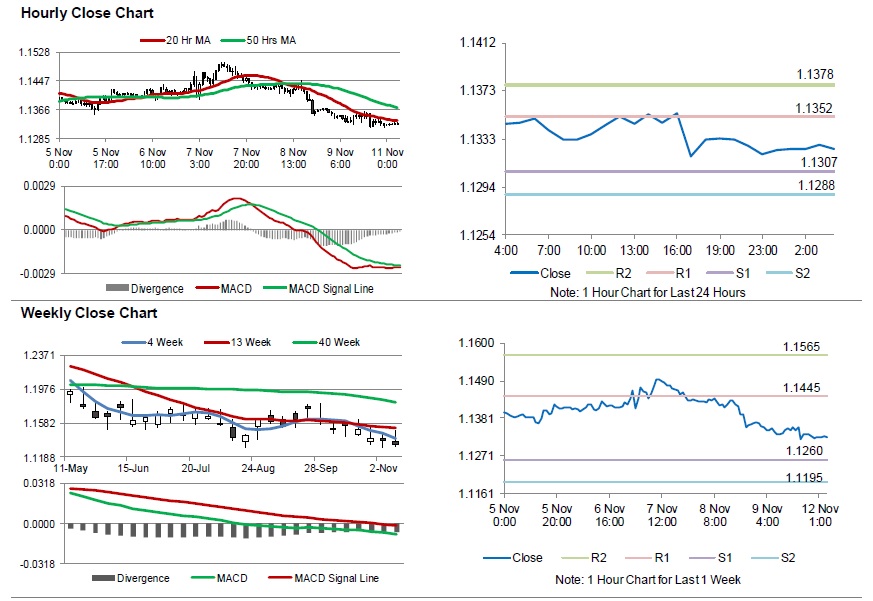
For the 24 hours to 23:00 GMT, the EUR declined 0.30% against the USD and closed at 1.1333 on Friday.
In the US, data showed that US producer price rose 2.9% on an annual basis in October, rising by the most in six-years and surpassing market expectations for an advance of 2.5%. In the previous month, the producer price had registered a rise of 2.6%. On the contrary, the nation’s preliminary Reuters/Michigan consumer sentiment index eased to a level of 98.3 in November, less than market expectations for a fall to a level of 98.0. The index had recorded a reading of 98.6 in the preceding month.
In the Asian session, at GMT0400, the pair is trading at 1.1325, with the EUR trading 0.07% lower against the USD from Friday’s close.
The pair is expected to find support at 1.1307, and a fall through could take it to the next support level of 1.1288. The pair is expected to find its first resistance at 1.1352, and a rise through could take it to the next resistance level of 1.1378.
Amid no major economic releases in the US and Euro-zone today, investors would focus on global macroeconomic factors for further direction.
The currency pair is trading below its 20 Hr and 50 Hr moving averages.