

Sample Category Title
Swiss Franc Trading A Tad Lower In The Morning Session
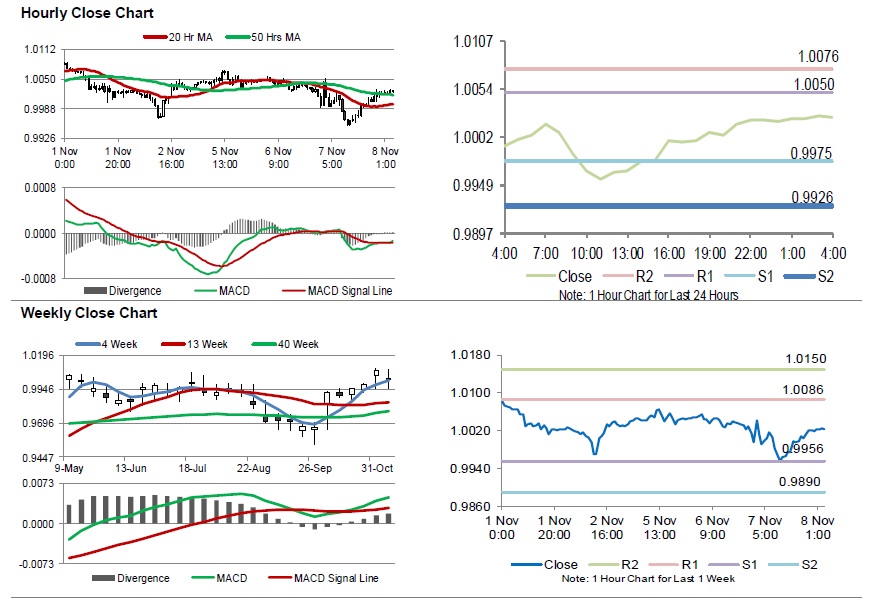
For the 24 hours to 23:00 GMT, the USD declined 0.09% against the CHF and closed at 1.0020.
In the Asian session, at GMT0400, the pair is trading at 1.0023, with the USD trading marginally higher against the CHF from yesterday’s close.
The pair is expected to find support at 0.9975, and a fall through could take it to the next support level of 0.9926. The pair is expected to find its first resistance at 1.00500, and a rise through could take it to the next resistance level of 1.0076.
Going forward, traders would await Switzerland’s unemployment rate for October, scheduled to release in a while.
The currency pair is trading above its 20 Hr and 50 Hr moving averages.
Canada’s Ivey Purchasing Manager’s Index Climbed In October
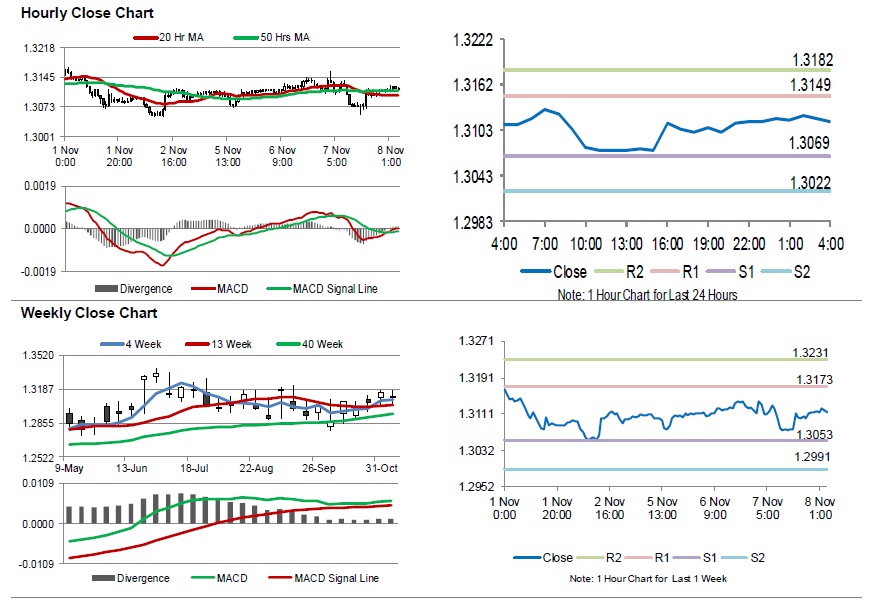
For the 24 hours to 23:00 GMT, the USD declined 0.08% against the CAD and closed at 1.3115.
On the macro front, Canada's seasonally adjusted Ivey PMI jumped to a level of 61.8 in October, following a reading of 50.4 in the previous month.
In the Asian session, at GMT0400, the pair is trading at 1.3115, with the USD trading flat against the CAD from yesterday's close.
The pair is expected to find support at 1.3069, and a fall through could take it to the next support level of 1.3022. The pair is expected to find its first resistance at 1.3149, and a rise through could take it to the next resistance level of 1.3182.
Going forward, investors would keep an eye on Canada's housing starts for October and new housing price index for September, slated to release later in the day.
The currency pair is trading above its 20 Hr moving average and showing convergence with its 50 Hr moving average.
Aussie Extends It Gains In The Asian Session
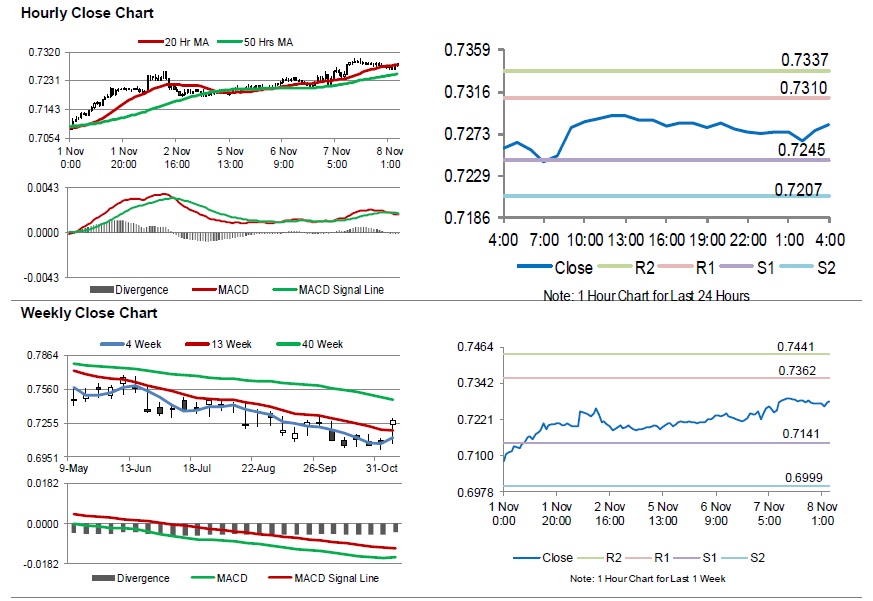
For the 24 hours to 23:00 GMT, the AUD rose 0.51% against the USD and closed at 0.7273.
LME Copper prices rose 0.1% or $5.0/MT to $6210.0/MT. Aluminium prices rose 0.1% or $1.5/MT to $1951.5/MT.
In the Asian session, at GMT0400, the pair is trading at 0.7282, with the AUD trading 0.12% higher against the USD from yesterday’s close.
Elsewhere, in China, Australia’s largest trading partner, trade surplus widened less than expected to $34.01 billion, compared to a revised surplus of $31.70 billion in the previous month.
The pair is expected to find support at 0.7245, and a fall through could take it to the next support level of 0.7207. The pair is expected to find its first resistance at 0.7310, and a rise through could take it to the next resistance level of 0.7337.
Trading trend in the Aussie today is expected to be determined by the release of Reserve Bank of Australia’s monetary policy statement, set to release overnight.
The currency pair is showing convergence with its 20 Hr moving average and trading above its 50 Hr moving average.
Gold: Yellow Metal Extends Its Losses In The Asian Session
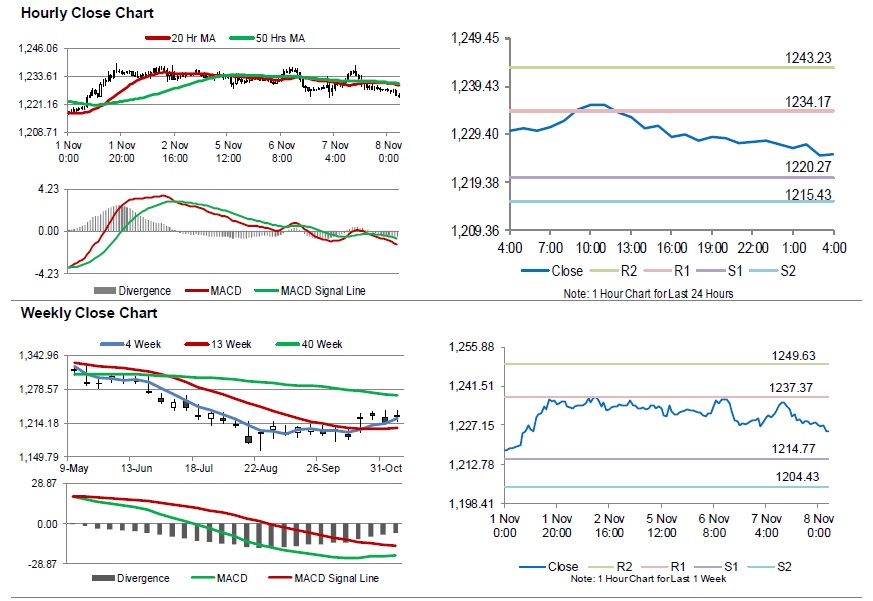
For the 24 hours to 23:00 GMT, Gold declined 0.09% against the USD and closed at USD1227.80 per ounce.
In the Asian session, at GMT0400, the pair is trading at 1225.10, with gold trading 0.22% lower against the USD from yesterday’s close.
The pair is expected to find support at 1220.27, and a fall through could take it to the next support level of 1215.43. The pair is expected to find its first resistance at 1234.17, and a rise through could take it to the next resistance level of 1243.23.
The yellow metal is trading below its 20 Hr and 50 Hr moving averages.
Silver: White Metal Trading On A Weaker Footing This Morning
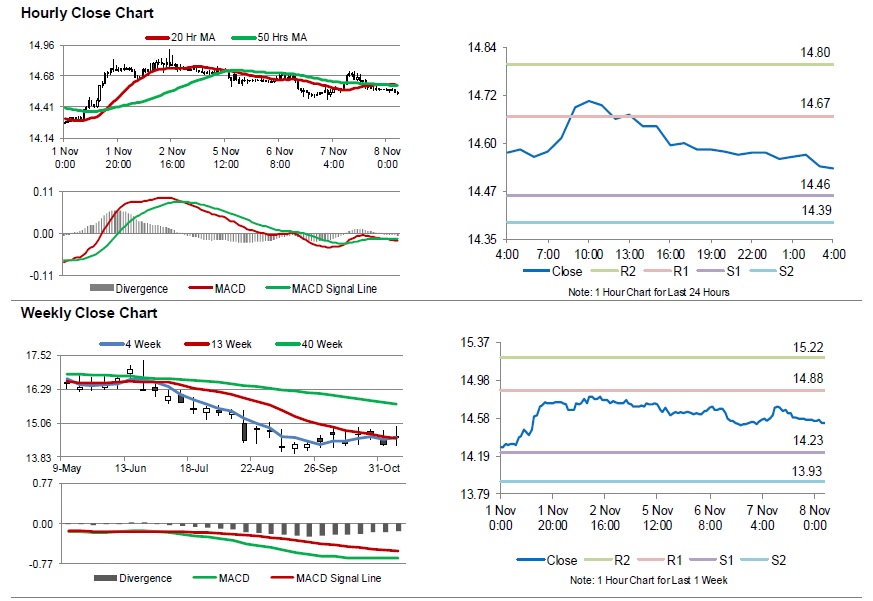
For the 24 hours to 23:00 GMT, Silver rose 0.24% against the USD and closed at USD14.57 per ounce.
In the Asian session, at GMT0400, the pair is trading at 14.53, with silver trading 0.27% lower against the USD from yesterday’s close.
The pair is expected to find support at 14.46, and a fall through could take it to the next support level of 14.39. The pair is expected to find its first resistance at 14.66, and a rise through could take it to the next resistance level of 14.80.
The white metal is trading below its 20 Hr and 50 Hr moving averages.
Crude Oil: Oil Trading Lower In The Morning Session
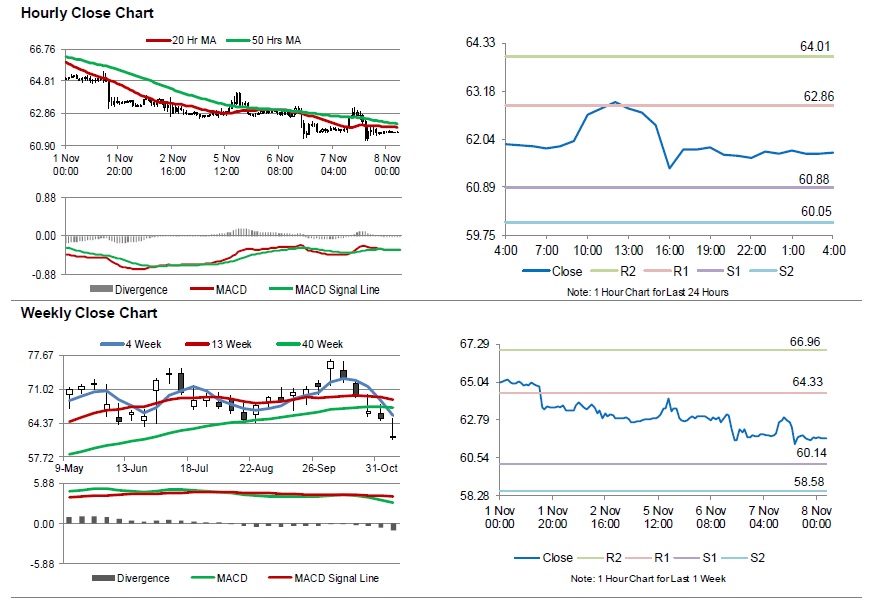
For the 24 hours to 23:00 GMT, Crude Oil slightly declined against the USD and closed at USD61.74 per barrel, after the Energy Information Administration (EIA) report indicated that US crude oil stockpiles rose 5.8 million barrels to 431.8 million in the week ended 02 November 2018, marking its seventh consecutive rise.
In the Asian session, at GMT0400, the pair is trading at 61.71, with oil trading 0.05% lower against the USD from yesterday’s close, as increase in the US crude output raised concerns of a return of global oversupply.
The pair is expected to find support at 60.88, and a fall through could take it to the next support level of 60.05. The pair is expected to find its first resistance at 62.86, and a rise through could take it to the next resistance level of 64.01.
Crude oil is trading below its 20 Hr and 50 Hr moving averages.
China trade surplus widened to USD 34B in October, both import and export rose
From China, exports rose 15.6% yoy in October to USD 217.3B. Imports rose 21.4% yoy to USD 183.2B. Trade surplus widened to USD 34.0B, below expectation of USD 36.3B.
In CNY terms, exports rose 20.1% to CNY 1490B. Imports rose 26.3% to 1257B. Trade surplus widened to CNY 234B, above expectation of CNY 209B.
RBNZ Affirmed the Next Move Can be Up Or Down, Despite Upbeat Data
RBNZ left the OCR unchanged at 1.75% in November. The move had been widely anticipated. Despite recent strong dataflow, the central bank downplayed the improvements and Governor Adrian Orr affirmed that the next rate change can be up or down. Kiwi, which has jumped to the highest level in 3 months against US dollar after the upbeat employment report, remains firm after the announcement.
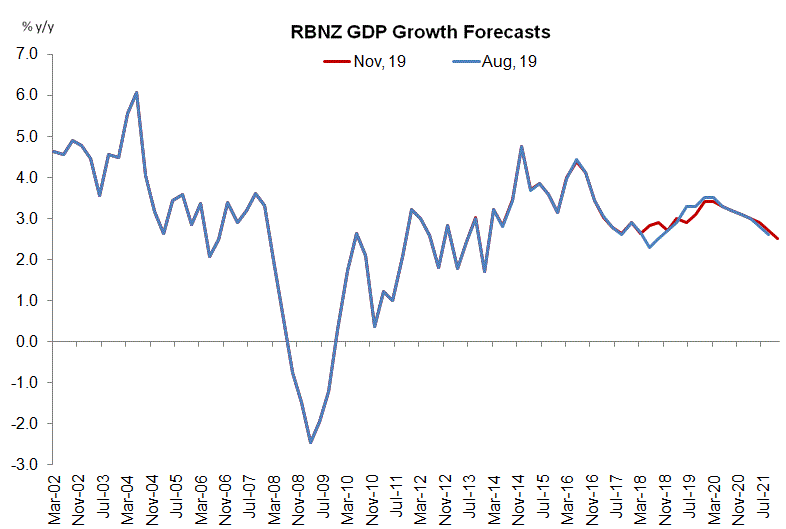
Recent macroeconomic developments have been robust. GDP growth picked up to +1% in 2Q18, up from +0.5% a quarter ago. On year-over-year basis, GDP expanded +2.7%. Growth was broadly based, with 15 out of the 16 industries contributing to the largest quarter-on-quarter increase in two years. Unemployment rate fell to 3.9%, the lowest since June 2008, in 3Q18, from a revised 4.4% in the prior quarter. This also beat consensus of an uptick to 4.5%. Meanwhile, the participation rate rose to a record 71.1%, suggesting higher confidence in the employment market. Headline CPI accelerated to 0.9% q/q in 2Q18, compared with consensus of +0.75 and 2Q18’s 0.4%. From a year ago, inflation accelerated to +1.9%, up from +1.5% in 2Q18. However, the headline reading was mainly lifted by the strong increase in petrol price. According to NZ Stat. petrol price contributed about 30% to the quarterly CPI movement for September, and about 40% to the annual movement."
RBNZ downplayed these developments. In the accompanying statement, it removed the reference that interest “rates could move up or down” in the next monetary policy decision. While this sounds hawkish in first sight, the governor affirmed that he is “not taking rate cut off the table” and the policy rate would stay at an expansionary level for some time. The central bank attributed the strong growth in the second quarter to “temporary factors” and cited business surveys’ expectations of softer growth ahead in the near term. It expects growth to pick up next year, with the help of monetary stimulus and government spending. It also noted that a weaker NZD would help support export earnings.
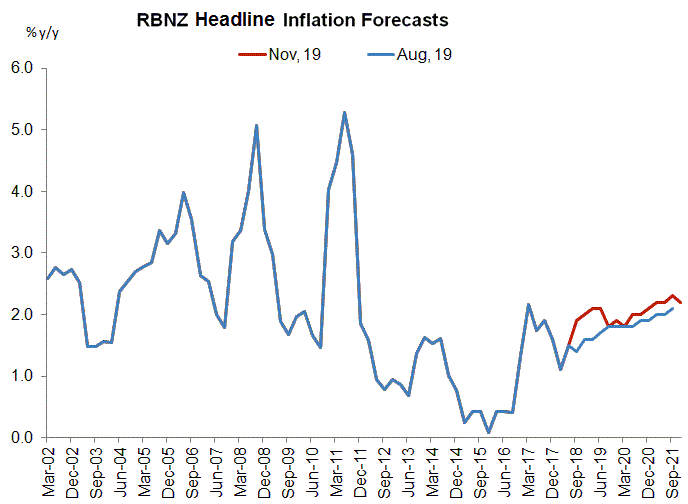
RBNZ acknowledged the strong employment situation. Yet, it is more concerned about core inflation, which has remained below the 2% target mid-point. It signaled the need of “continued supportive monetary policy”. As suggested in the accompanying statement, higher fuel prices would remain an upside risk to near-term headline inflation. As such it has revised the headline inflation estimates over the forecast horizon. Looking through this effect, RBA expected “limited pass through of higher costs into generalised consumer prices, and that longer-term inflation expectations remain anchored at our target”.
In short, RBNZ judged that it is appropriate to stay cautious amidst the upside risk to temporary inflation and downside risk to growth have affirmed. It is likely that it would not adjust the policy rate until late 2020.
UK RICS house price balance dropped to six year low, never-ending Brexit negotiation a key drag
UK RICS house price balance dropped to -10 in October, down from -2. That's also the weakest reading since September 2012. RICS noted that "The weaker trend in prices is being driven by the lack of demand from new buyers, which is in part a result of heightened political uncertainty, ongoing affordability pressures, a modest upward move in interest rates and a lack of fresh stock coming onto the market."
RICS Chief Economist Simon Rubinsohn also noted that "uncertainty about the economic outlook on the back of the never-ending Brexit negotiations appears a key drag on sentiment according to respondents to the survey."
US Midterm Election Results as Expected – Limited Impact on Canadian Outlook
Our Take:
A mostly as-expected outcome from the U.S. midterms — the Democrats retaking the House but Republicans adding modestly to their majority in the Senate — does not have a significant impact on our outlook for the U.S. or Canada. The main risks in terms of the Canadian economic outlook are what happens to U.S. trade policy — particularly the prospects for the passage of the USMCA and the end of existing ‘Section 232’ steel and aluminum tariffs — and any changes to the U.S. fiscal policy stance.
USMCA probably still on track: The new NAFTA replacement, the ‘USMCA’, is still likely to be approved by Congress. The Democrats will want to avoid handing the Trump administration political “wins” but will also probably find it difficult to oppose some of the changes in the deal versus NAFTA, including the high-wage requirements in the auto sector. Of course, the agreement will ultimately also need to be ratified by Canada and Mexico but we continue to think the most likely outcome is the deal will move forward. None of the three trade partners will want to reopen an acrimonious debate that contributed to increased uncertainty for businesses and less investment in all three countries. NAFTA remains in effect in the mean-time.
Pushback on presidential ‘Section 232’ powers? The president has used dubious national defense (section 232) arguments to justify imposing tariffs on steel and aluminum products primarily on close allies including Canada. Canada already obtained some protection from future measures in the new USMCA. Traditionally more protectionist democrats perhaps won’t see reducing trade barriers as a key top priority but could presumably kick up more resistance to what is arguably a misuse of Presidential authority. Tariffs used in the escalating trade spat with China have for the most part not made use of section 232 measures.
How long can fiscal tailwinds blow? The combination of US tax cuts and spending saw the U.S. government budget deficit balloon to $800 billion in 2018 (about 4% of GDP) under the current administration. That is providing a significant tailwind to economic growth, some of which — stronger growth in the industrial sector — is spilling over into Canada. With the split Congress, political gridlock is a risk and additional tax cuts are much less likely. There may yet be room for a compromise on spending plans, though.