Sample Category Title
BoJ: Recent fall in stocks reflects effect of US-China trade frictions
BoJ released the summary of opinions at October 30/31 monetary policy meeting today. There the central reiterated that the economy is "likely to continue expanding". It noted "positive momentum in domestic demand". The September Tankan survey also "reconfirmed enterprises' strong fixed investment stance".
However, momentum of the expansion "weakened somewhat" recently due to natural disaster and US-China trade conflicts. BoJ also pointed out that recent stock prices fall "large for external demand-oriented firms" and "small for domestic demand-oriented firms". Therefore, "the fall in stock prices certainly seems to reflect the effects of the trade friction to some extent."
On inflation, BoJ maintained that CPI is "likely to continue accelerating moderately" but the developments have been "weak and unstable". And, "rise in inflation has been delayed with a positive output gap" as inflation mechanism is becoming "complex".
On monetary policy, BoJ noted "t is important to consider in a flexible manner such factors as the range of yield movement and the target maturity of JGBs in conducting yield curve control, while maintaining the framework of monetary easing." This suggested policymakers are considering further tweak to the current framework.
RBNZ Orr refuses to rule out rate cut, but NZD stays firm
New Zealand Dollar stays firm after RBNZ left OCR unchanged at 1.75% as widely expected. In the accompanying statement, RBNZ maintained the intention to keep OCR unchanged "through 2019 and into 2020".
The language that the "the direction of our next OCR move could be up or down" was removed. Instead, RBNZ said "there are both upside and downside risks to our growth and inflation projections. As always, the timing and direction of any future OCR move remains data dependent.". That at first glance looked like the central bank is moving away from the possibility of a cut. However, Governor Adrian Orr made it clear in the press conference that "it would be pointless to remove that option", regarding a cut.
Orr also talked down the pick-up in GDP growth in the June quarter as "partly due to temporary factors". Instead, he pointed to businesses surveys which "suggest growth will be soft in the near term". While employment is "around its "maximum sustainable level", core inflation remains below 2% target mid-point, "necessitating continued supportive monetary policy".
Below are the press conference video and full statement.
https://www.youtube.com/watch?v=GqqHa5iqTtM
Official Cash Rate Unchanged at 1.75 Percent
Tena koutou katoa, welcome all.
The Official Cash Rate (OCR) remains at 1.75 percent. We expect to keep the OCR at this level through 2019 and into 2020.
There are both upside and downside risks to our growth and inflation projections. As always, the timing and direction of any future OCR move remains data dependent.
The pick-up in GDP growth in the June quarter was partly due to temporary factors, and business surveys continue to suggest growth will be soft in the near term. Employment is around its maximum sustainable level. However, core consumer price inflation remains below our 2 percent target mid-point, necessitating continued supportive monetary policy.
GDP growth is expected to pick up over 2019. Monetary stimulus and population growth underpin household spending and business investment. Government spending on infrastructure and housing also supports domestic demand. The level of the New Zealand dollar exchange rate will support export earnings.
As capacity pressures build, core consumer price inflation is expected to rise to around the mid-point of our target range at 2 percent.
Downside risks to the growth outlook remain. Weak business sentiment could weigh on growth for longer. Trade tensions remain in some major economies, raising the risk that trade barriers increase and undermine global growth.
Upside risks to the inflation outlook also exist. Higher fuel prices are boosting near-term headline inflation. We will look through this volatility as appropriate. Our projection assumes firms have limited pass through of higher costs into generalised consumer prices, and that longer-term inflation expectations remain anchored at our target.
We will keep the OCR at an expansionary level for a considerable period to contribute to maximising sustainable employment, and maintaining low and stable inflation.
Meitaki, thanks.
Democrats Take the US House – Market Implications
US midterm elections were broadly in line with expectations: the Democrats captured the House but Republicans retained control of the Senate. While markets were volatile as the votes were counted, the lack of a major surprise limits the net market response. The outlook for trade policy and the Fed will be unchanged. Major spending cuts and further tax cuts are both unlikely, while there could be some talk of an infrastructure package.
Who won?
The Democratic Party recaptured control of the House of Representatives for the first time since losing it in the 2010 “Tea Party” wave but the Republican Party easily kept control of the Senate. So from 3 January 2019, Congress will revert to the historically common situation of being split between the two parties.
This outcome was our base case, with an 85% probability, given consistent polling favouring Democrats nationally and the fact that the mixture of Senate seats being contested (just 35 of 100) tilted very heavily in the Republicans’ favour (2020 is a different story).
The Democratic party gained at least 26 seats in the House, with an additional 15 seats yet to be called while Republicans strengthened their slim Senate majority by 2 seats.
What comes next?
Retaking the House allows the Democrats to set the legislative agenda. But deep partisan divide seems likely to ensure many proposals passed by a Democrat-controlled House are blocked by a Republican-controlled Senate before ever reaching the president’s desk. Signature legislation thus faces a tough uphill battle. Trump's agenda is not necessarily crippled but it will certainly face headwinds.
Extending last year's tax cuts (Tax Cuts 2.0), a key priority for Republicans is very unlikely with Democrats running the House.
Further deregulation in various sectors such as energy and banking will likely rely exclusively on executive order and is likely to be smaller in scale.
Infrastructure is likely to be revived, long favoured by Democrats and Trump, though they remain very far apart on key details. Democrats prefer federal spending to drive capital works while the administration has pushed for private sector participation. Any infrastructure push needs to overcome a Republican-led Senate too. Fiscal deficits approaching $1trn will arguably check any meaningful infrastructure spend as well.
It is an open question how key fiscal deadlines will be dealt with going forward. Congress averted a government shutdown before the midterms by passing a short term funding bill that expires 8 December 2018, raising yet again the prospect of a partial shutdown then. The debt limit is currently suspended, but due to be reinstated on 1 March 2019 at the prevailing stock of public debt, probably around $22 trillion, up more than $1 trillion since the suspension on 9 February 2018. Funding the government and raising the debt ceiling to avoid default has been typically less fraught when Democrats have been in charge of the House, but they may be less willing to compromise after their midterm victory.
Aside from economic issues, House Democrats are sure to launch multiple select committees to investigate Trump’s finances and Russian collusion even more aggressively.
President Trump will still have great leeway to pursue his trade policies, with little need to consult Congress on e.g. China tariffs. Over decades, Congress has delegated substantial powers over trade to the president. This year’s tariffs on both metals and a wide range of goods imports from China did not require Congressional approval. Trump's protectionist agenda enjoys a sympathetic ear with Democrats too and is unlikely to meet any meaningful resistance from a Democrat led House. The outcome of the Trump-Xi summit at the Buenos Aires G20 at the end of November will be much more significant. Trump has tasked US officials with drafting terms of a potential deal and officials in both China and the US have sounded hopeful albeit cautious.
Congress is likely to vote on ratification of the revised NAFTA deal early next year and will need to win some Democrat support if it is to pass the House; that is no sure thing with Democrats reportedly seeking even stronger provisions to protect US labour interests.
The Fed will brush aside any questions of politics and will proceed with a December rate hike. Trump will likely continue to periodically criticise the Fed for raising interest rates and cast doubt about Chair Powell.
The US economy is in good shape; the labour market is close to full employment and inflation is near the Fed’s 2% target. The outcome of the midterm elections does not materially impact the US growth outlook either way and thus shouldn't alter the USD's medium term trend. Fed tightening will remain a key pillar of support for the USD going forward.
Daily Markets Broadcast
Wall Street advances after midterm elections concluded
US indices rose Wednesday after the Democrats gained control of the House and the Republicans increased their majority in the Senate. US treasuries rose while the US dollar retreated. Today we see China’s trade data for October, while the FOMC meets later, with no change in rates expected.
US30USD Daily Chart
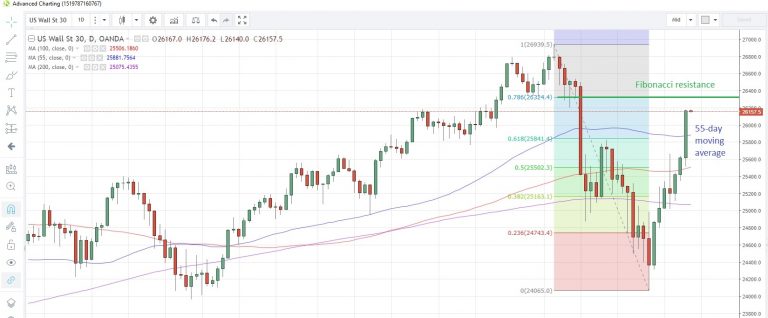
The US30 index gained the most in three weeks yesterday, touching the highest since the large sell-off on October 10
The index climbed and closed above the 55-day moving average for the first time since October 9. 78.6% Fibonacci retracement of the October drop is at 26,324
Fed holds its FOMC meeting later today, though no change in rates is expected this time. Watch for any comments on the state of the economy or trade war impact.
DE30EUR Daily Chart
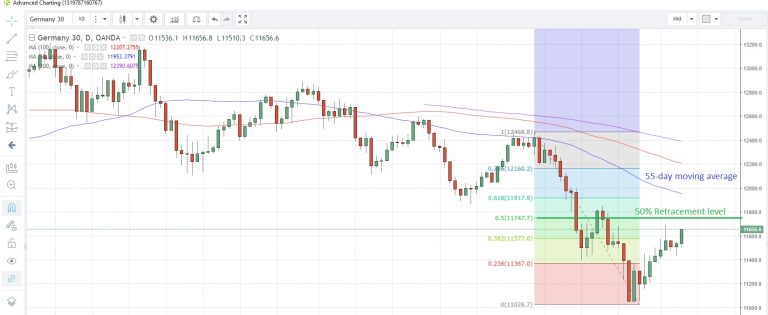
The Germany30 index rose for a second day, buoyed by hopes that a solution to the Irish border issue for Brexit may be imminent
The index is once again rising toward the 50% retracement of the September 27 to October 26 drop at 11,748
Germany’s trade surplus probably narrowed to EUR18 billion in September from EUR18.3 billion the previous month, the latest survey of economists shows.
CN50USD Daily Chart
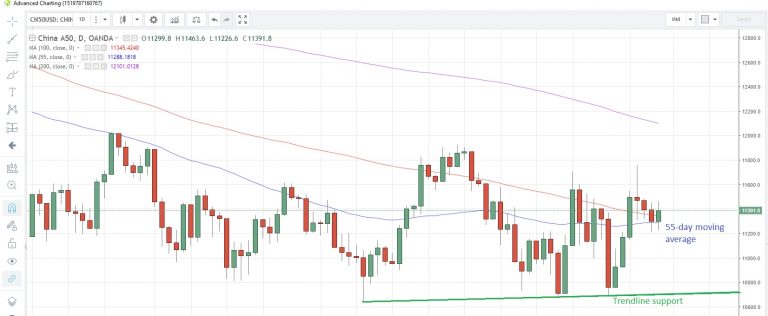
China shares rose for the first time in four days yesterday as the PBoC Governor Yi Gang affirmed its prudent, neutral monetary policy
The index is sitting just above the 55-day moving average at 11,288, while the 100-week moving average at 11,795 may act as near-term resistance
China’s October trade data is due today. Imports are seen rising 14.0% y/y, just below September’s +14.3%, and do not appear yet to be showing any strains from the US-China tariff war. The surplus with the US, which hit a record high last month, will see extra scrutiny to gauge the impact of recent tariffs.
(RBNZ) Official Cash Rate Unchanged at 1.75 Percent
Tena koutou katoa, welcome all.
The Official Cash Rate (OCR) remains at 1.75 percent. We expect to keep the OCR at this level through 2019 and into 2020.
There are both upside and downside risks to our growth and inflation projections. As always, the timing and direction of any future OCR move remains data dependent.
The pick-up in GDP growth in the June quarter was partly due to temporary factors, and business surveys continue to suggest growth will be soft in the near term. Employment is around its maximum sustainable level. However, core consumer price inflation remains below our 2 percent target mid-point, necessitating continued supportive monetary policy.
GDP growth is expected to pick up over 2019. Monetary stimulus and population growth underpin household spending and business investment. Government spending on infrastructure and housing also supports domestic demand. The level of the New Zealand dollar exchange rate will support export earnings.
As capacity pressures build, core consumer price inflation is expected to rise to around the mid-point of our target range at 2 percent.
Downside risks to the growth outlook remain. Weak business sentiment could weigh on growth for longer. Trade tensions remain in some major economies, raising the risk that trade barriers increase and undermine global growth.
Upside risks to the inflation outlook also exist. Higher fuel prices are boosting near-term headline inflation. We will look through this volatility as appropriate. Our projection assumes firms have limited pass through of higher costs into generalised consumer prices, and that longer-term inflation expectations remain anchored at our target.
We will keep the OCR at an expansionary level for a considerable period to contribute to maximising sustainable employment, and maintaining low and stable inflation.
Meitaki, thanks.
First Impressions of the RBNZ’s Monetary Policy Statement
The Reserve Bank left the OCR at 1.75%, as expected.
In the press release, the crucial phrase that the next move could be "up or down" was removed. This implies that the Reserve Bank has moved away from the possibility of reducing the OCR.
However, they have not moved any closer to hiking. The numerical OCR forecast was identical to the August forecast, and implies hikes from around mid-2020. The language in the press release was just as adamantly on hold: "We expect to keep the OCR at this level [1.75%] through 2019 and into 2020".
The details reveal that the RBNZ recognises that inflation pressures have built. The inflation forecast was lifted, upside risks to inflation were emphasised more heavily, and rising inflation was discussed up front in the document. Intriguingly, the forecast was for inflation to rise above 2% in the medium term.
The really interesting thing is that, despite this forecast of rising inflation, the RBNZ has declined to alter its OCR forecast. In other words, the RBNZ has chosen to take the run of recent strong data in the form of higher inflation, not a higher OCR forecast. The RBNZ is choosing higher inflation, rather than a higher OCR.
This draws attention to the difference between the new RBNZ operating regime and Governor and the old. Evidently, the RBNZ now feels less bound to the 2% midpoint of the inflation target band. The RBNZ is saying it knows that inflation is rising, and it is comfortable with that. This could be because the RBNZ has been burned by inflation undershooting for years. Or it could be the influence of the new dual mandate.
Similar to previous statements, the RBNZ believes there are downside risks to growth and upside risks to inflation. However, they believe the upside risks to inflation have intensified. This has altered the balance. The RBNZ's alternative scenarios were evenly balanced between upside and downside, whereas previously they were tilted towards downside risks.
As The Election Dust Settles
Markets
US markets had a tremendous post-election session as the great divide offers investors with some sense of relief that there are more checks and balances on President Trump freewheeling style of politics but has left analyst debating what this will mean for policy going forward. One positive take away from the Republican side, President Trump does have solid support from the Republican base.
While the likelihood of Tax reform 2.0 has lessened, I still believe that the there will be bipartisan support for the Trump administration key infrastructure initiative as the Democrats don’t want to be perceived as wet blankets and try to suppress any action which is supportive for the economy as the Democrats begin their run-up to election 2020.
However, on foreign policy, the Democratic takeover of the House of Representatives has “no influence whatsoever” on the Trump administration’s hawkish view but this does offer the Trump administration some bargaining opportunities with Congress, that is if both sides can ever put partisan politics on the backburner.
Currencies
On the currency front, I should be happy that things worked out pretty much as scripted. The US dollar initially drowned in a wavelet of blue but later gained momentum as risk sentiment remained supportive. The problem is; however, I hate when things work out too scripted especially since we are still dealing with election haze and moves that came on the back of little to no data – the main question now is where we go from here.
Not expecting much from tonight’s FOMC but eventually, I suspect the diverging global growth narrative will come into focus as election risk passes and this should favour the USD at least over the short term. Old dollar bulls die hard I guess.
Oil Markets
Oil had another eventful session as OPEC and its partners were reportedly planning discussions about possibly reinstating production limit’s next year, likely in response to surging U.S. supply. As US crude oil production rose to a new record high, and the largest in the world ahead of Russia.
But I’m not sure how this added up to be a U-turn storyline that was getting spun in cyberspace. I don’t think OPEC and their allies’ intention is to drive prices higher especially when the global economy is slowing is on the cusp of a more profound fall. But instead to achieve a more consistent goal of price stability which plays into the long-held assumption that dynamic adjustment from time to time would be necessary to hold the delicate price equilibrium in check.
Of course, OPEC producers are concerned about the potential oversupply that was again highlighted by the larger-than-expected 7.8 million barrels jump in API reports and then supported after EIA reported that crude inventories rose by 5.8 million barrels almost double analysts estimate.
Looking at Cushing, inventories rose 2.4 million barrels from the prior week 1.9 million barrels and is pointing to a jump to 3 million barrels next week Plains Sunrise pipeline is starting up this month and should add about .2 billion barrels of net inflow per day according to industry sources.
But as an aside, this has got to be the most tumultuous head of heels oil markets I can remember in some time. But looking over the near term, I would suspect the old $ 65-75 Brent Crude range would likely keep suppliers and their customers happy.
Gold Market
Investors took no joy in the very supportive risk markets and even more so with the dollar picking up steam which added up to an election event disappointment for Gold bulls and with Spot falling to break out on the topside, trader took profit at the first glint of the US dollars strength.
I suspect gold will ping pong along with the US dollar as traders begin to re-evaluate the current state of the USD
Malaysian Ringgit
The Ringgit got a bit of a reprieve overnight on the back of the markets overexuberance to chase down everything and anything with a yield attached to it. In other words, EM assets were getting snapped up on the assumption the Feds would slow the pace of rate hikes post-election
But back to reality, post -budget, its expected Malaysia, will receive a negative outlook if not a complete rating downgrade. While credit rating downgrades are not the death knell for a currency, but it will have significant short-term impacts, and that threat alone will keep the MYR trading defensively in the weeks ahead.
But with the deficit target at the higher end of market expectations, the MYR could weaken at a faster pace than expected and we could see 4.20 + by year-end.
4.20 the main resistance with Key support at 4.15
Yesterday the US dollar sold off influenced by US political risk, but the USDMYR market remains bid on the dip.
AS for today’s policy review, regardless of the BNM tone, the market is pricing in a dovish outlook based on moderate inflation slowing economy and the general fiscal malaise. But I would be surprised if BNM cam across overtly dovish as that would trigger unwanted and unnecessary weakness in the MYR, so I believe they will hold a neutral tone.
Markets Cheer Expected Elections Outcome
Risk trades are higher after Democrats regained control of the House in a vote that tracked close to what polls were expecting. Kiwi is the highest performer after a solid jobs reports ahead of the RBNZ decision. EURUSD is attempting to close the day above 1.1440 to make it above the Sep 24 trendline resistance. The DOW30 was stopped out and the EURUSD long was closed for 145 pip-gain.
There was no major surprise in the US midterms. Democrats won a dozen-seat majority in the House which is slightly less than forecast. Republicans did better in the Senate, expanding their majority and winning a pair of very tight races. Overall, Republicans did a bit better than expected but there were no surprises and the balance of power has tilted back towards gridlock.
So what's behind the surge in indices? As we wrote before the vote, elections are by definition uncertain events and increasingly emotional events. Almost any result would have led to a sigh of relief to some extent. This means that further tax cuts are less likely in the US but it's also a check on the President's trade war and some of his darker impulses. The S&P 500 opened 21 points higher and is now up 42 pts. DOW30 is up 358 pts, above its 55-DMA for the 1st time since Oct 10.
Looking ahead the RBNZ is largely expected to leave rates at 1.75% .The currency jumped after the unemployment rate dropped to 3.9% from 4.5% earlier today. That's the lowest in 10 years and could be a game changer for the central bank. The drop in unemployment came despite a 0.2 pp rise in participation. Wages also jumped 1.4% q/q compared to 0.8% expected.
Before the report, the RBNZ was expected to remain on the sidelines for at least a year with the chance of a cut but these numbers mean a hike is now more likely. NZD/USD has rebounded nicely from a test of the 2015/16 lows in the past six weeks but is still 500 pips below April levels. A shift from the RBNZ and continued USD selling could help to close that gap.
Eco Data 11/8/18
[php_everywhere instance="1"]
Today’s top mover: NZD/USD at key resistance zone just ahead of RBNZ statement
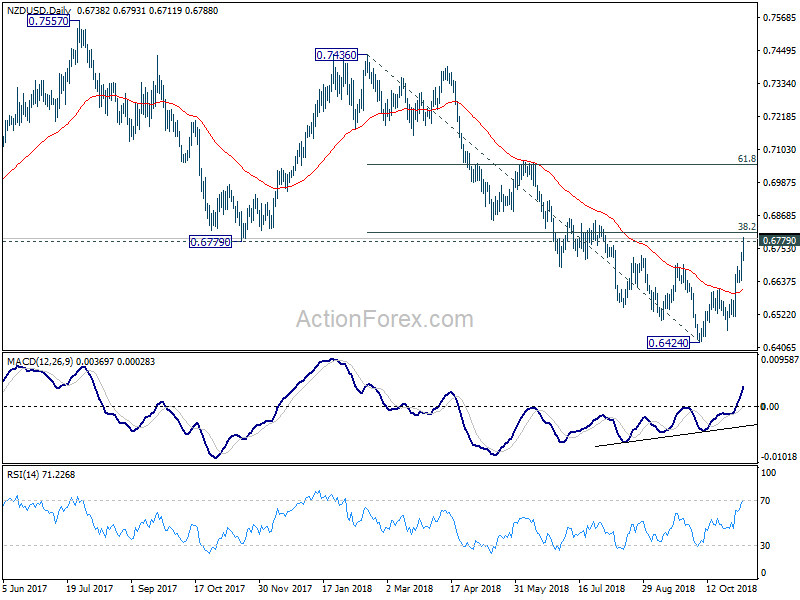
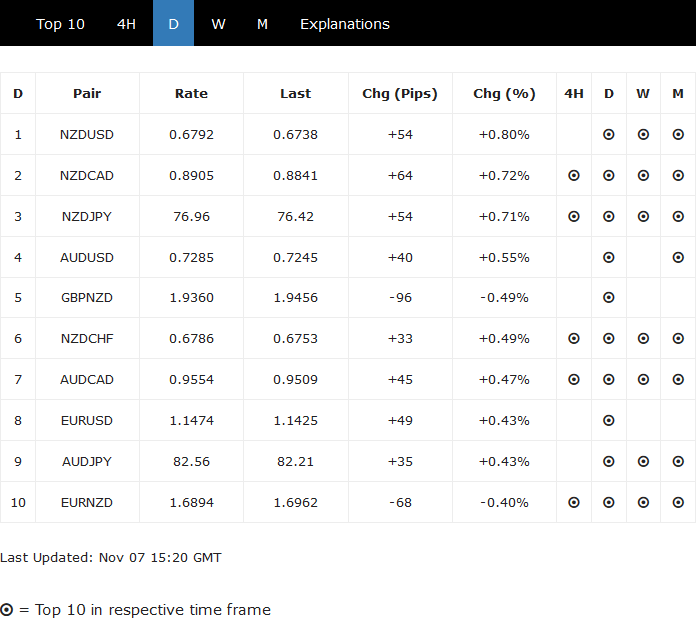
NZD/USD is the top mover for today so far, up 0.80% at the time of writing. On the one hand, Dollar is broadly sold off after US mid-term elections. On the other hand, strong employment data came in at an ideal time, just before RBNZ rate decision in the upcoming Asian session.
RBNZ is widely expected to keep the Official Cash Rate unchanged at 1.75%. And, the central was very clear in its last statement that it intend to keep OCR at this level "through 2019 and into 2020". More importantly, RBNZ said "the direction of our next OCR move could be up or down.". There has been some bets that the next move is a cut. The question is, with unemployment rate hitting decade low at 3.9%, and employment rate jumped to record at 68.3%, would RBNZ turn less dovish? We'll see within a couple of hours.
Technically, NZD/USD is now at a very important resistance zone. That is, 38.2% retracement of 0.7436 to 0.6424 at 0.6811, which is close to 0.6779 support turned resistance. Decisive break there will solidify the case of bullish medium term reversal. And further rally should at least be seen to 61.8% retracement at 0.7049 and above. This is our preferred case for now as long as 0.6689 minor support holds.
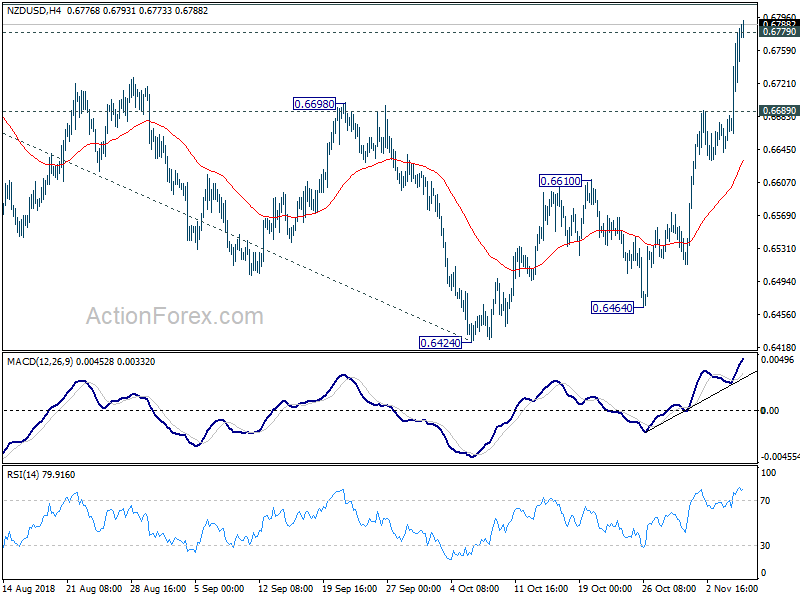
However, break of 0.6689 will indicate rejection by this key 0.6779/6811 resistance zone. That will revive medium term bearishness and could bring retest of 0.6424 low as next step.