Sample Category Title
Gold Ticks Higher as Markets Digest US Midterm Vote
Gold has posted small gains in the Wednesday session. In North American trade, the spot price for one ounce of gold is $1227.90, up 0.07% on the day. On the release front, there are no major indicators in the United States. On Thursday, the Federal Reserve will set the benchmark rate and release a rate statement. As well, the U.S. releases unemployment claims.
The U.S mid-term election is over, with a new political landscape in Congress. The Democrats regained control of the House of Representatives for the first time since 2010, but the Republicans increased their slim majority in the Senate. The results are a setback for President Trump, as the Democrats will be in a stronger position to derail Trump’s plans to boost fiscal stimulus and lower taxes. This could dampen enthusiasm for the U.S dollar, and investors have reacted on Wednesday by sending the greenback broadly lower against other currencies, although gold has failed to jump on the bandwagon. Investors will be shifting focus to the Federal Reserve, which releases its monthly rate statement on Thursday. The Fed is expected to maintain the benchmark rate at a range of between 2.0% and 2.25%.
Another key event this week which could affect gold prices is the Federal Reserve policy meeting on Thursday. The Fed is expected to maintain interest rate levels, with a 93% likelihood that the Fed will stay on the sidelines. However, the rate statement will be scrutinized, with investors looking for clues regarding future monetary policy, as well as the Fed’s view of the economy. If the Fed sounds optimistic about the economy, risk appetite could rise and send gold prices lower.
British Pound Hits 3-Week High as US Election Weighs on Greenback
GBP/USD has moved higher for a third straight session. In Wednesday’s North American session, the pair is trading at 1.3148, up 0.38% on the day. There are no key releases out of the U.S or the U.K, as the markets continue to digest the results of the U.S. midterm elections on Tuesday. On Thursday, the Federal Reserve will set the benchmark rate and release a rate statement. As well, the U.S. releases unemployment claims.
It’s been a quiet week for British releases, but that will change on Friday, when the U.K publishes Preliminary GDP and manufacturing production. This first GDP report for Q3 is expected to improve with a strong gain of 0.6%, after a 0.4% gain in Final GDP in the second quarter. A strong GDP release would likely boost the pound, which has enjoyed a strong November with gains of 1.43 percent. Traders should be prepared for some volatility from the pound in the Friday session.
All eyes were on the U.S mid-term elections, and when the dust settled, both parties could claim a victory of sorts. The Democrats regained control of the House of Representatives for the first time since 2010, but the Republicans increased their slim majority in the Senate. The results are a setback for President Trump, as the Democrats will be in a stronger position to derail Trump’s plans to boost fiscal stimulus and lower taxes. This could dampen enthusiasm for the U.S dollar, and investors have reacted on Wednesday by sending the greenback broadly lower. Investors will be shifting focus to the Federal Reserve, which releases its monthly rate statement on Thursday. The Fed is expected to maintain the benchmark rate at a range of between 2.0% and 2.25%. A hawkish rate statement could boost global equity markets.
Rand Rallies on Improved Risk Appetite; USD Softens Further after Mid-Terms
Financial markets are continuing their forward drive on the realization that investors were rightly positioned for the outcome of the mid-term elections in the United States. A number of stock markets are trending higher on improved risk appetite, while the South African Rand has been a noticeable mover following gains above 1% at time of writing. The Rand is generally used as a proxy for evaluating investor appetite towards risk.
One of the more interesting trends to have monitored in the aftermath of the mid-term results is the acceleration in near-term Dollar weakness. This suggests that investors are descaling away from heavy USD buying positions and have potentially been put off holding onto their positions because of the consensus that the Liberal Democrats taking control of the House provides a potential roadblock to President Trump introducing further fiscal stimulus.
Softness in the Greenback is something that will be warmly welcomed from different currencies across the globe. The Indonesian Rupiah, which has been crushed to its weakest levels since the 1997 Asian Financial Crisis due to the emerging market rout in recent months has rallied over 1.4% in the past day, and has gained as much as 2.65% this week. At time of writing, only the Offshore Chinese Renminbi and Japanese Yen are marginally lower against the USD this week, with this generally suggesting that investors are gradually dipping back into buying emerging market currencies at weak valuations.
This trend of Dollar softness has also been noted across the EMEA this week with only the Turkish Lira showing weakness against the Greenback at 0.66% since Monday. It should be taken into account that the weakness in the Turkish Lira could also be a reflection of profit-taking on the Lira after the currency benefited from a rally by as much as 13% quarter-to-date. The Turkish Lira is actually trading reasonably close to its pre-historic crisis levels seen in early August, which means the Lira has rallied nearly 20% since August 10, and I think it is fair to say that this would have been unheard of given how seriously worried investors were about the events around Turkey back in the summer.
The British Pound has advanced to its highest level in approximately three weeks as the Sterling benefits from weakness in the Dollar and hopes of a Brexit agreement being close at last.
As we wrap into the final half of trading for the week the mid-term election outcome should fade away from investors’ radar, with financial markets instead reverting attention to the guidance provided from the Federal Reserve after their latest policy meeting and any upcoming announcements on the direction of trade talks between the United States and China.
The upcoming OPEC meeting in Abu Dhabi this coming weekend is another event that investors should be preparing for, especially given the headlines that have circulated over the past few hours that OPEC and its allies are discussing possible oil output cuts in 2019.
Fed to Hold Rates; Unlikely to Signal Slower Tightening after Stocks Sell-Off, Trump Attack
The US Federal Reserve will announce its latest monetary policy decision on Thursday at 19:00 GMT after concluding a two-day meeting. While the Federal Open Market Committee (FOMC) is almost certain to keep its benchmark rate unchanged this month, investors will be watching for any tweaks to the statement language for clues about the future pace of rate hikes. In the absence of any unease by FOMC members about the recent volatility in stock markets, the US dollar could head back towards last week’s 16-month highs as this would signal that the Fed does not intend to pause raising interest rates.
There can be no refuting that the US economy is at its strongest in years, with the unemployment rate at a 49-year low, wages rising at the fastest pace in nearly 10 years and GDP growth of above 3% in the past two quarters. This leaves policymakers in little doubt that interest rates need to continue to rise gradually, which translates to about one hike a quarter. As the Fed last raised rates at its September meeting, it is widely anticipated to keep the target range for the federal funds rate at between 2.00% and 2.25% on Thursday, with expectations high for another hike in December.
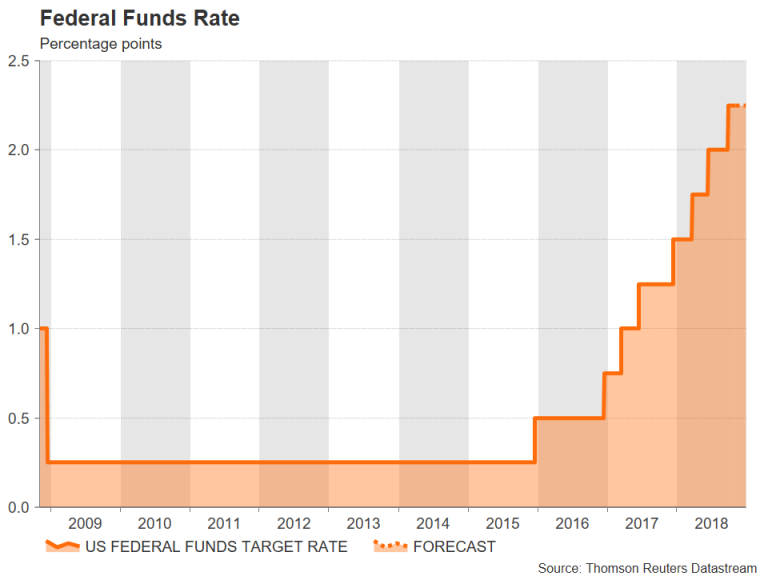
With no press conference scheduled for the November meeting, and no new dot plot chart either for investors to dissect, all the attention will be on the wording of the Fed’s statement. FOMC members will likely deviate slightly from the previous statement to note the slower growth in the third quarter. They may also point to some increased downside risks from the ongoing trade tensions and some tightening in financial conditions following the sharp losses in US stocks during October. However, given that the US economy continues to produce strong jobs growth and the core PCE price index (the Fed’s preferred inflation gauge) has stood at 2% for the past five months, the Fed is not expected to put too much weight on the negative developments since the last meeting.
Should FOMC members tread carefully with their words and the meeting proves to be a non-event, the dollar will likely drift sideways until the next risk event. But if the Fed plays down the recent equity rout and sets a more optimistic tone about the outlook, ignoring President Trump’s criticism that rates are rising too fast, the dollar could receive fresh impetus to advance higher.
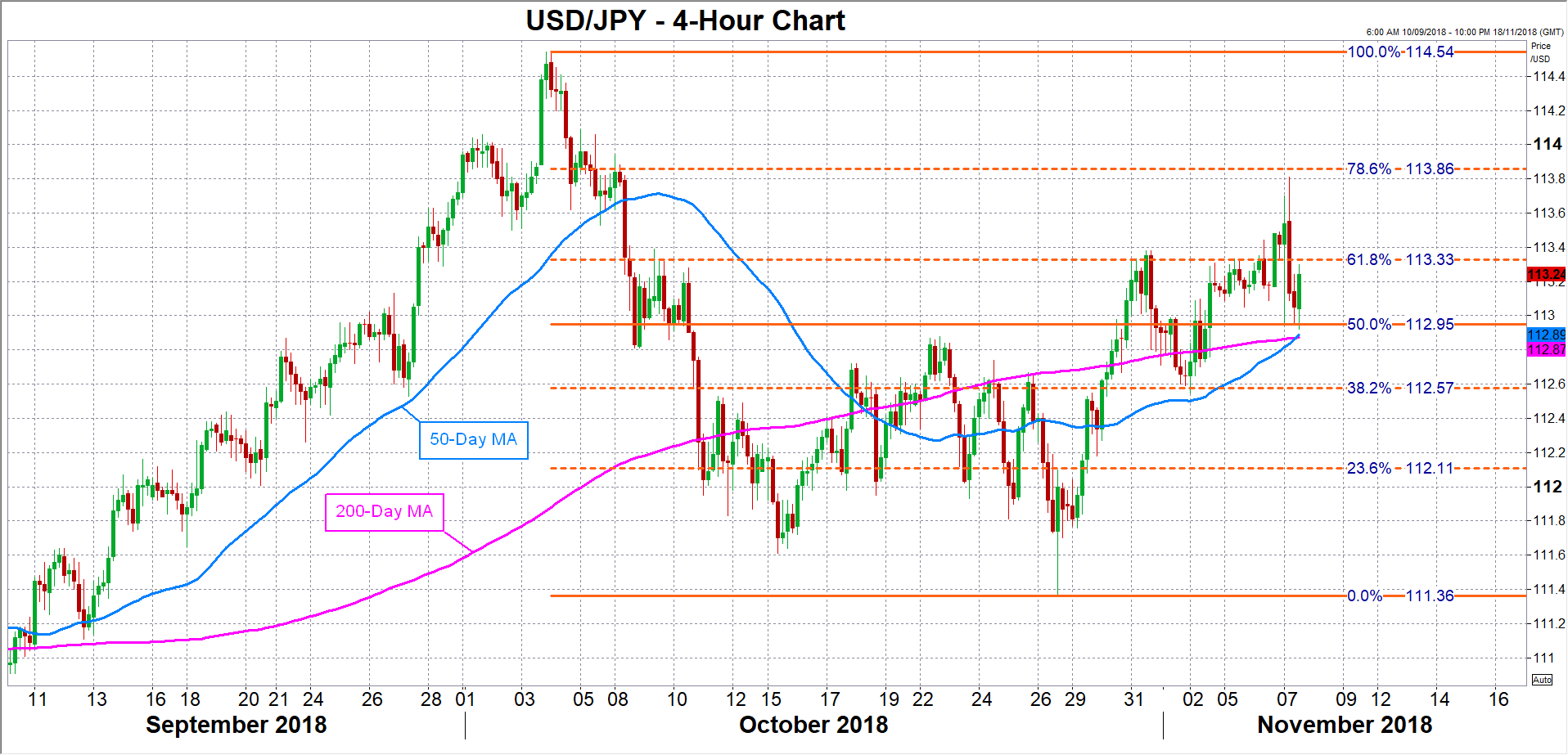
Dollar/yen is facing immediate resistance at around 113.35, which is just above the 61.8% Fibonacci retracement of the downleg from 114.54 to 111.36. A hawkish statement would help the pair break above that level, with the next resistance coming from 113.86 – the 78.6% Fibonacci level. A climb above that barrier and the 114 handle would bring into focus the October top of 114.54.
In the event, however, that the Fed unexpectedly sounds a slightly downbeat note due to the recent meltdown on Wall Street and the weakening global growth outlook, the dollar could come under sudden selling pressure. Such a shift would raise the possibility of the Fed slowing or even pausing its planned rate increases.
A downside move could see dollar/yen finding immediate support at the 50% Fibonacci at 112.95. Further south, the 38.2% Fibonacci is the next key support to watch at 112.57. Steeper losses could pull the pair towards the 23.6% Fibonacci at 112.11, putting the 112 handle at risk.
Whatever the tone of the statement, however, the odds of a December rate hike will remain high and the focus will increasingly become what happens after that. Looking into 2019, how the economy performs will depend on how far Trump will push his trade fight with China, as well as on how well he cooperates with a Democratic-controlled House, following Republican losses in the midterm elections.
USDCHF Hits 2-Week Low; Remains Bullish in Medium Term
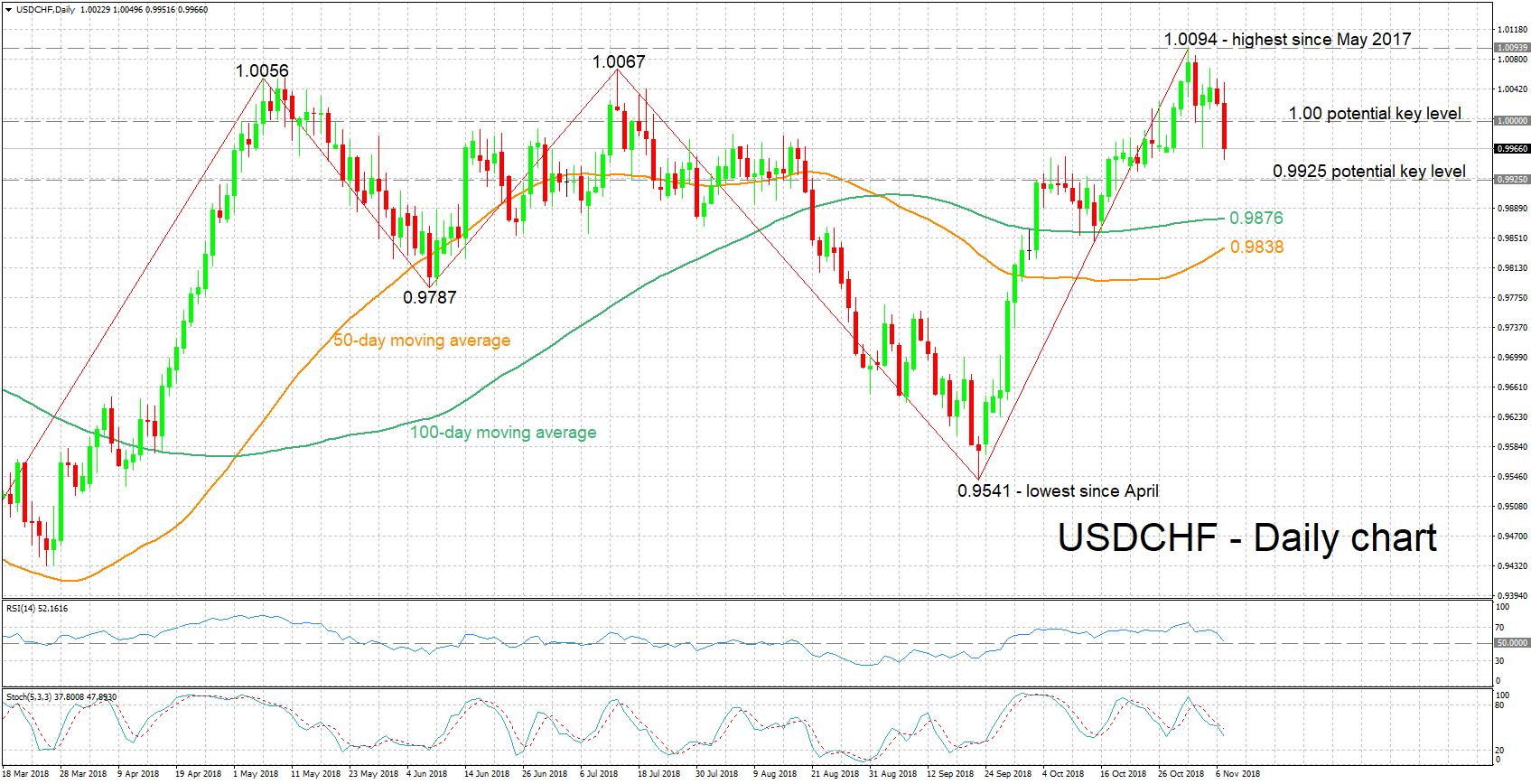
USDCHF extended Tuesday’s losses and is currently trading not far above a two-week low of 0.9952 hit earlier on Wednesday.
The RSI turned lower after entering overbought territory above 70. At the moment, it continues to head lower in support of a negative short-term picture. The bias in the very-short-term also looks bearish as indicated by the stochastics: the %K and %D lines are negatively aligned and are both moving further down.
Further declines may meet support around 0.9925, this being a congested area between mid-April to late August that also halted advances in the beginning of October. Not far below, support could occur around the current levels of the 100- and 50-day moving average lines at 0.9876 and 0.9838 respectively. Even lower, early June’s bottom of 0.9787 would be eyed.
On the upside, resistance could occur around the parity level (1.00) that that may be of psychological significance. Higher still, the one-and-a-half-year zenith of 1.0094 would increasingly come into scope; not far below this point lie a couple of other peaks from previous months as well.
The medium-term picture continues to look predominantly bullish, with trading activity taking place above both the 50- and 100-day MAs.
Overall, the short-term outlook appears mostly bearish, and the medium-term one remains bullish for the most part.
Gold Looks Neutral in Near-Term; Develops in Sideways Channel
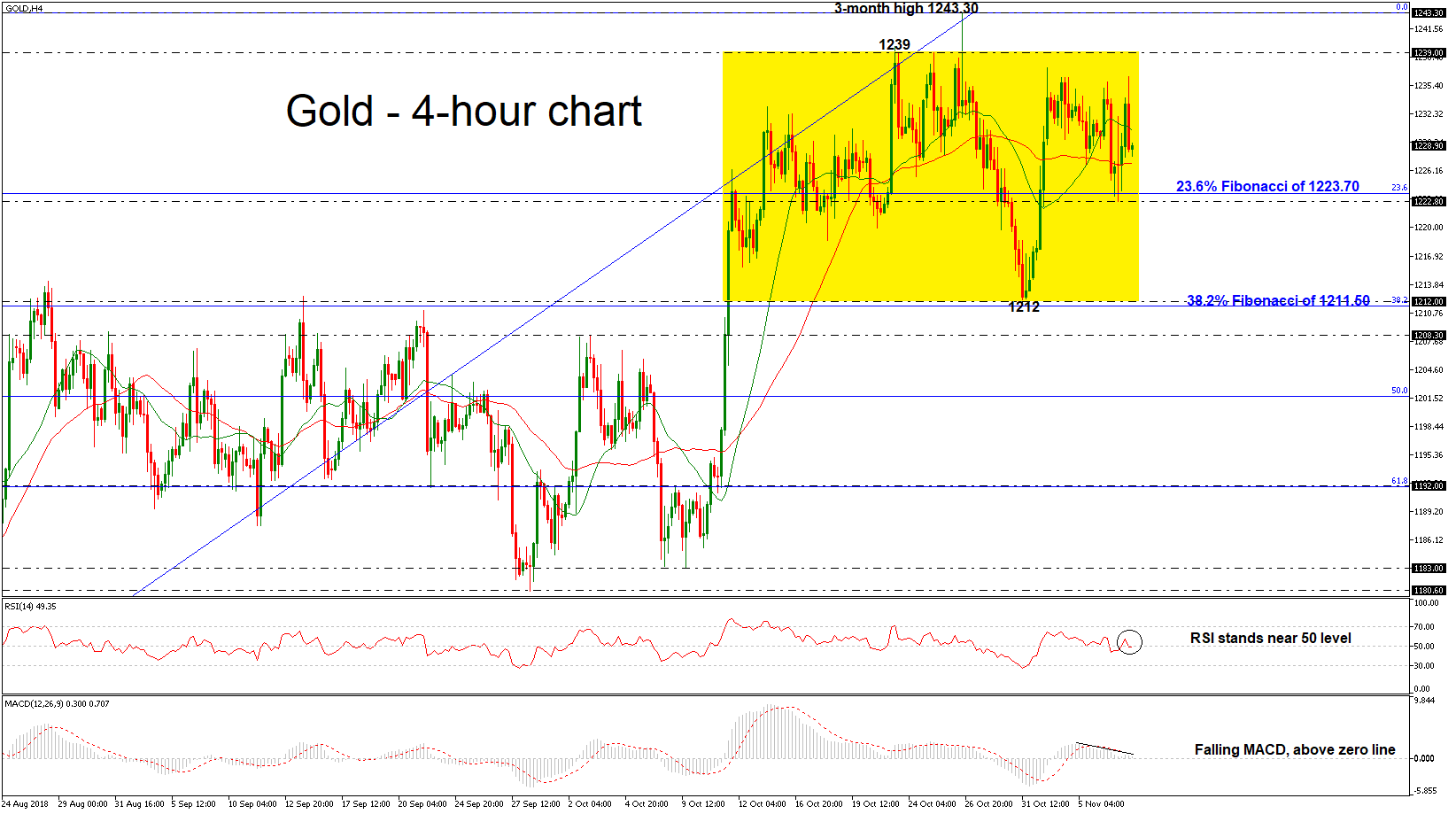
Gold is currently trading within a consolidation area over the last month, with upper boundary the 1239 resistance level and lower boundary the 1212 support barrier. At the end of the previous month, the price reached a new three-month peak of 1243.30, endorsing the scenario for bullish tendency, however, it returned back to neutral mode.
In the short-term chart, the RSI indicator is sloping down and is ready to enter into the negative territory, while the MACD oscillator dropped below the trigger line and is hovering slightly above the zero line.
A fall below the 40-simple moving average (SMA) would probably stop around the 23.6% Fibonacci retracement level of the upleg from 1160 to 1243.30, around 1223.70, which stands near the 1222.80 support. The next level is coming from the 38.2% Fibonacci mark, which hovers around the 1212 key level.
On the other side, a move higher and above today’s peak of 1236.38 would likely retest the upper boundary of the trading range at 1239. Should bulls overcome that region, the focus would probably turn to three-month high of 1243.30.
Overall, the yellow metal looks neutral as it develops in a sideways channel in the near-term, while in the bigger picture remains in a bullish retracement following the rebound at 1160.
Sunset Market Commentary
Markets
Global core bonds are mixed today. German Bunds lose ground while US Treasuries trade near yesterday’s closing levels. US midterm election results came in broadly as anticipated: the Democratic Party re-gains power in the House of Representatives. Republicans strengthen their majority in the Senate. This means President Trump has to govern his next two years in a split Congress, probably causing less wiggle room to execute policy measures. Investors quickly returned to the order of the day after a volatile opening this morning. European equities opened higher though, preluding a day of improved risk sentiment causing German Bunds to gradually slip lower. Mixed EMU retail sales had little impact on trading. The US yield curve edges lower at the long end of the curve with changes ranging from -4.5 bps (30-yr) and +1.3 bps (2-yr). The German yield curve bear flattens with yield changes varying between +1.1 bps (30-yr) and +2.0 bps (2-yr). Spreads over Germany tighten with Greece (-6 bps) and Italy outperforming (-6 bps).
Global (FX) markets tried to assess the consequences of the US elections for US growth and for markets today. A divided Congress with the Democrats securing a decent majority (about 10 seats) is seen hampering the fiscal-driven outperformance of the US economy that dominated markets’/FX thinking this year. This potential reduction of fiscal stimulus weighs on US yields and on the dollar. The US currency is losing interest rate support and is declining against most majors. EUR/USD extends recent uptrend in the 1.1301/1.1615 trading range. The pair tested the 1.15 big figure but trades currently again slightly lower near 1.1470. After jumping higher this morning, USD/JPY drifted to an intraday low just below 113 but regained some ground as the positive risk sentiment prevents further yen gains. USD/JPY trades currently in the 113.25 area. Today’s USD correction is logic given the election outcome, even as it was more or less in line with expectations. Tomorrow’s Fed statement is the next point of reference for USD trading. We are keen to see the USD reaction, especially if the communiqué doesn’t give too much weight to recent market volatility and keep a hawkish tone on recent strong data. Will it bring the USD back in pole position?
Trading in EUR/GBP (currently 0.8735 area) and in cable (1.3135 area) was mainly driven by the global USD trends. The USD decline after the US election also propelled cable. At the same time, there was slight euro outperformance. of an imminent Brexit deal, from now, hard good news (from Brexit or from the UK economy) is probably needed to inspire further sustained sterling gains.
News Headlines
Brent crude rose from $72/barrel to $73.5/barrel today on rumours that Saudi Arabia and Russia are plotting oil production cuts in 2019 as a fresh surge of American shale risks outweighing a sanctions-related decline in Iranian output. The gossip comes in the run-up to this weekend’s OPEC+ meeting in Abu Dhabi.
The German Council of Economic Experts (GCEE) presented its annual report today. They expect the German growth rate to gradually cool down to potential growth in coming years. The GCEE made a stark warning to the ECB which risk being too late with the turnaround in monetary policy.
The Polish central bank kept its policy rate unchanged at 1.5% as widely expected. NBP governor Glapinski holds a press conference later today. Most Polish central bank members want to delay a first rate hike until at least the end of 2019 and preferably even into 2020.
Spanish PM Sanchez said he will change the mortgage law in order to overrule yesterday’s court ruling that Spanish lenders aren’t liable for mortgage stamp duty payments. Spanish financial stocks managed to cling on to opening gains despite Sanchez’s proposed U-turn.
AUD/USD Mid-Day Outlook
Daily Pivots: (S1) 0.7217; (P) 0.7232; (R1) 0.7260; More...
AUD/USD's rally extends to as high as 0.7299 so far. Intraday bias stays on the upside for 0.7314 resistance. As noted before, a medium term bottom might be in place at 0.7020 already. Decisive break of 0.7314 should confirm this bullish case. Next target will be 38.2% retracement of 0.8135 to 0.7020 at 0.7446 next. However, on the downside, break of 0.7182 minor support will turn focus back to 0.7020 low instead.
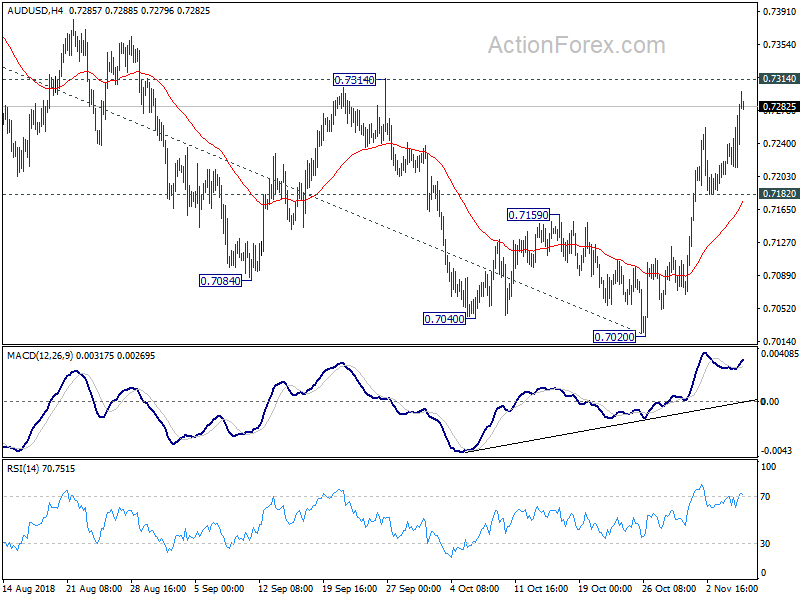
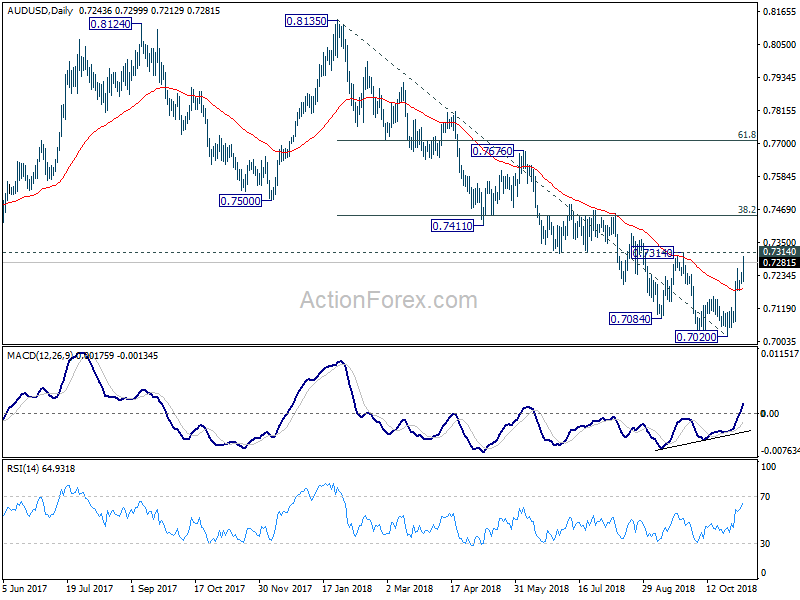
In the bigger picture, as long as 0.7314 resistance holds, fall from 0.8135 is tentatively treated as resuming long term down trend from 1.1079 (2011 high). Decisive break of 0.6826 will target 0.6008 key support next (2008 low). However, firm break of 0.7314 will suggest that whole decline from 0.8135 has completed. And, the corrective pattern from 0.6826 (2016 low) is extending with another rising leg towards 0.8135 before completion.
EUR/USD Mid-Day Outlook
Daily Pivots: (S1) 1.1398; (P) 1.1419; (R1) 1.1446; More....
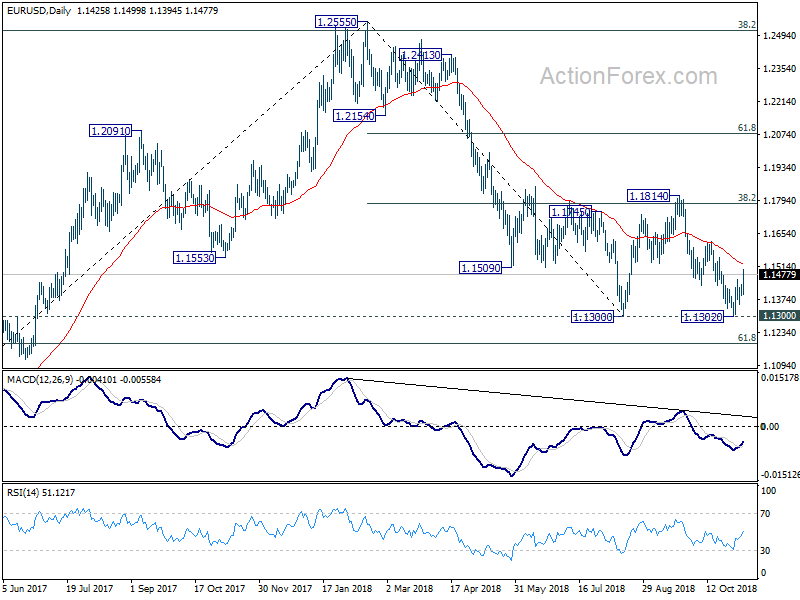
Intraday bias in EUR/USD remains on the upside as rebound from 1.1302 is in progress. Further rally would be seen to 1.1621 resistance and above. As noted before, such rise is seen as the third leg of the consolidation pattern form 1.1300. Hence, upside is expected to be limited by 1.1814 to bring down trend resumption eventually. On the downside, break of 1.1353 minor support will suggests that rise from 1.1302 has completed. In that case, retest of 1.1300 key support should be seen next.
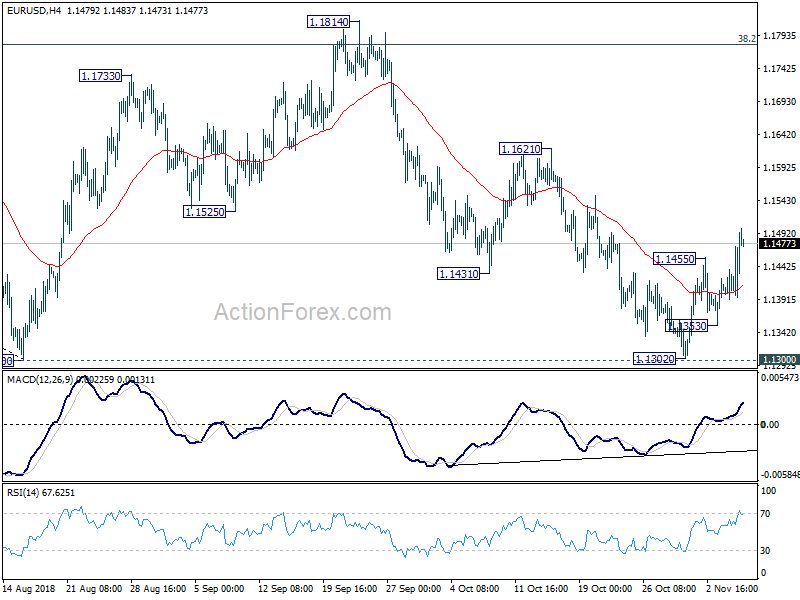
In the bigger picture, price actions from 1.1300 is seen as a corrective pattern. Decisive break of 1.1300 will resume the down trend from 1.2555 to 61.8% retracement of 1.0339 (2017 low) to 1.2555 at 1.1186 next. Sustained break there will pave the way to retest 1.0339. In case the consolidation from 1.1300 extends, upside should be limited by 1.1814 and 38.2% retracement of 1.2555 to 1.1300 at 1.1779. to bring down trend resumption eventually.
GBP/USD Mid-Day Outlook
Daily Pivots: (S1) 1.3049; (P) 1.3078; (R1) 1.3135; More...
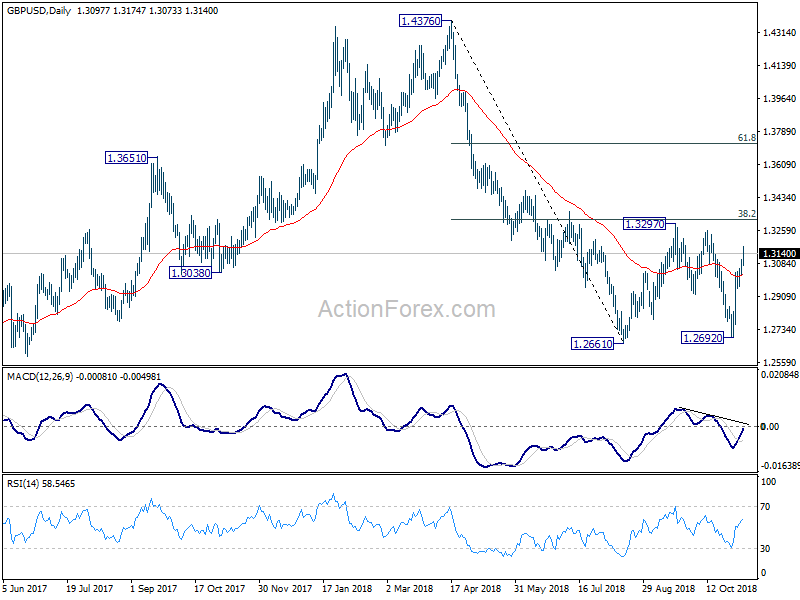
GBP/USD's rebound form 1.2692 is still in progress and intraday bias stays on the upside for 1.3257/3297 resistance zone. As this rise is seen as the third leg of consolidation pattern from 1.2661, we'd expect strong resistance from 1.3316 fibonacci level to limit upside to bring down trend resumption eventually. On the downside, below 1.2951 minor support will turn bias back to the downside for 1.2692 instead.
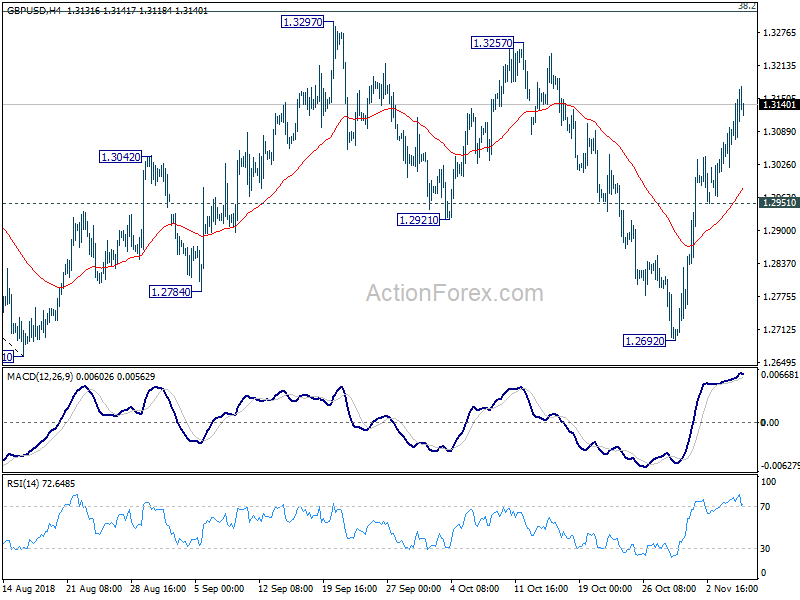
In the bigger picture, whole medium term rebound from 1.1946 (2016 low) should have completed at 1.4376 already, after rejection from 55 month EMA. The structure and momentum of the fall from 1.4376 argues that it's resuming long term down trend. And this will be the preferred case as long as 38.2% retracement of 1.4376 to 1.2661 at 1.3316 holds. However, firm break of 1.3316 would bring stronger rebound to 61.8% retracement at 1.3721. And, the eventual depth of the fall from 1.4376, and the chance of hitting 1.1946 low, will depend on the strength of the interim corrective rebound from 1.2661.