

Sample Category Title
USD/CHF Mid-Day Outlook
Daily Pivots: (S1) 1.0012; (P) 1.0034; (R1) 1.0048; More...
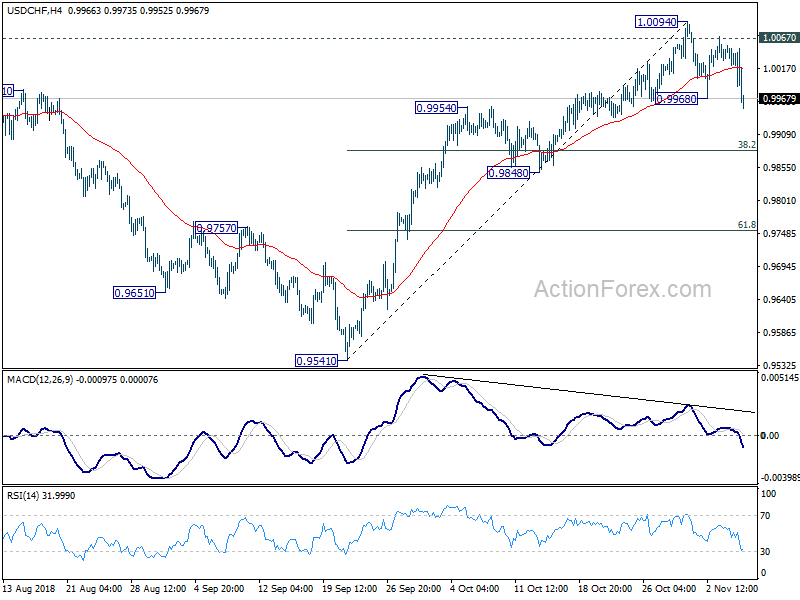
USD/CHF's break of 0.9968 suggests that correction from 1.0094 short term top has resumed. Intraday bias is turned back to the downside for 38.2% retracement of 0.9541 to 1.0094 at 0.9883. For now, we'd expect strong support from there to contain downside to bring rebound. Rise from 0.9541 is still in favor to resume. Break of 1.0094 will target 1.0342 key resistance next. However, decisive break of 0.9848 support will indicate reversal and turn outlook bearish.
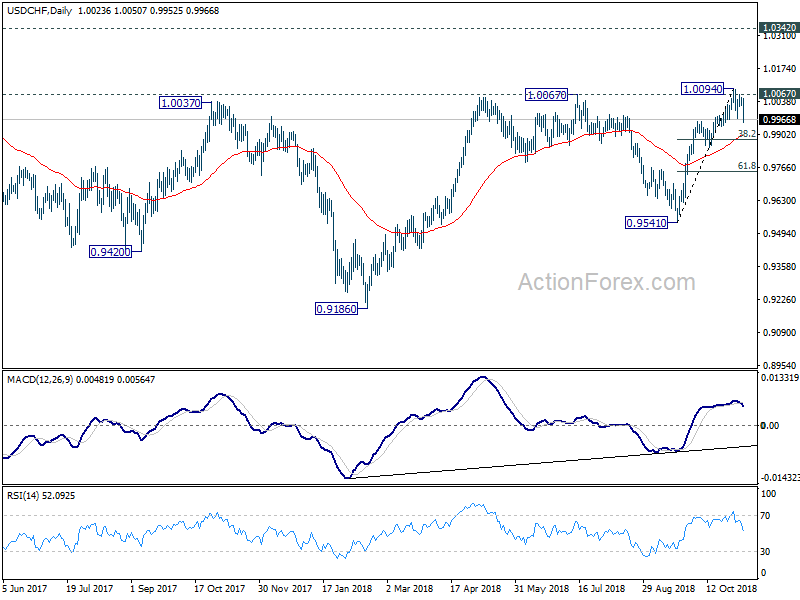
In the bigger picture, the pullback from 1.0067 has completed at 0.9541 already. And rise from 0.9186 is likely resuming. Firm break of 1.0067 will pave the way to retest 1.0342 key resistance. We'd be cautious on strong resistance from there to limit upside to bring another medium term fall to extend long term range trading. However, firm break of 0.9848 near term support will dampen this view and bring deeper decline back to 0.9541 support and possibly below.
US Mid-Term Results Cheered by Stocks, But Dollar and Yields Pressured
Dollar's selloff continues as markets enter into US session. It's clear that Democrats have regained control of the House while Republicans retained control of Senate. The reactions in the financial markets are not too straightforward. Stocks are cheering the results as futures point to triple digit gain in DOW at open. Yet Dollar is under broad based selling pressure even though weakness is relatively limited so far. We'd view the slight decline is US treasury yields as the link between them. 10-year yield is currently down -0.12 at 3.203. One explanation is that it's hard for Trump's administration to push through aggressive fiscal stimulus, thus reduce the risks of worsening debt. Hence, lower yields are welcomed by stocks but pressure the greenback. Nevertheless, for such a big event, it takes a bit more time to see which sides the investors would take.
Staying in the currency markets, Yen is the second weakest ones on return of risk appetite. Sterling is the third weakest as this week's rally lost momentum, on lack of progress of any kind in Brexit negotiation. Australian Dollar is the strongest one, followed by New Zealand Dollar. The latter was boosted by strong job data which raise the chance of RBNZ turning less dovish in the upcoming rate decision. Swiss Franc is the third strongest.
In other markets, FTSE is currently up 1.29%, DAX up 0.86%, CAC up 1.25%. German 10 year yield rises notably by 0.0161 to 0.453. Italian 10 year yield drops -0.0575 to 3.355. Asian stocks were mixed with Nikkei closed down -0.28% at 22085.80. China Shanghai SSE dropped -0.68% to 2641.34. But Hong Kong HSI and Singapore Strait Times rose 0.10% and 0.15% respectively. Gold edged higher to 1236.60 earlier today but it's now back pressing 1230 handle.
Technically, there are a couple of developments to watch in US session. Firstly, break of 0.7314 key resistance in AUD/USD will be would confirm medium term bullish reversal. EUR/AUD is pressing 1.5742 support now and firm break will resume recent decline from 1.6357. EUR/JPY will likely have a take on 130.20 resistance and break there will indicate near term reversal too.
Some EU officials welcomed US mid-term results
Here are some comments from EU officials on US mid-term elections. European Commissioner for Economic and Financial Affairs Pierre Moscovici, "The Democrats won the House of Representatives for the first time in eight years, despite a mighty Republican Gerrymandering. Donald Trump is right: "Tremendous success Tonight"
European Commission First Vice President Frans Timmermans, "Inspired by voters in the US who chose hope over fear, civility over rudeness, inclusion over racism, equality over discrimination. They stood up for their values. And so will we."
German Foreign Minister Heiko Maas tweeted, "It would be a misconception to now bet on course corrections from Donald #Trump. It remains the case: The US remains our most important partner outside Europe. To maintain this partnership, we need to re-measure and realign our relationship with the US." Also, "More diverse, younger, more feminine-these are the winners #Midterms2018 of the, especially among the democrats. A good part of the electorate has thus confirmed the pioneering role that the country still plays, and hopefully in the future, in favour of diversity and freedoms."
Irish PM Varadkar hints at no Brexit deal within November
Irish Prime Minister Leo Varadkar said today that "with every day that passes, the possibility of having a special summit in November becomes less likely." He referred to the extra EU summit for Brexit and hinted that it's unlikely to reach a deal that soon. Though, Varadkar also noted "we do have one scheduled for the 13th, 14th of December, so not getting it done in November doesn't mean we can't get it done in the first two weeks of December. But I think beyond that you're into the New Year, which I think wouldn't be a good thing."
Separately, it's reported that unnamed EU officials said breakthrough is needed within days if there would be another EU summit on November 17-18. For now, there is no decisive progress yet. European Council President Donald Tusk said he talked to UK Prime Minister Theresa May this morning on Brexit talks. But then? Nothing new, nothing more.
SNB Zurbruegg: Exchange rate situation still very fragile, current monetary policy has to continue
SNB Vice Chairman Fritz Zurbruegg said in a Schaffhauser Nachrichten newspaper interview that when EUR/CHF was at 1.2, there came the " the impression that everything is solved and the pressure is gone – the franc is no longer a safe haven". However, then, "you can see that the franc reacts very quickly as long as there are uncertainties." That showed the "exchange rate situation is still very fragile". Therefore, SNB policymakers are "convinced we have to continue with our current monetary policy."
Also, he noted the central bank is not considering to reduce its balance sheet yet. He said "there are risks that we have accepted to fight against the over-valuation of the franc, and we can live with that. And, "the size of our balance sheet doesn't limit our ability to act and we have shown that we are still ready to intervene in the currency markets if necessary." He added "that's why there is no talk at present about reducing this portfolio."
NZD surges after surprisingly strong New Zealand job data
New Zealand Dollar surges broadly after surprisingly strong employment data. Unemployment rate dropped -0.5% to 3.9% in Q3 versus expectation of 4.4%. That's the lowest level in a decade since June 2008. Employment rate rose 0.5% to 68.3%, highest since the series began 30 years ago. Participation rate also rose 0.2% during the quarter to 71.1%. Employment grew 1.1% qoq versus expectation of 0.5% qoq.
The set of strong data came in just a day ahead of RBNZ rate decision. RBNZ is widely expected to keep OCR unchanged at 1.75%, without a doubt. The tone of the accompanying statement is the key. RBNZ Governor Adrian Orr has sounded rather dovish in his recent comments, even being open for a cut as next move. The upbeat data will likely be reflected in the communications and thus, at least, remove some bets on RBNZ cut.
Other data released
Eurozone retail sales rose 0.0% mom in September versus expectation of 0.1% mom. German industrial production rose 0.2% mom in September versus expectation of -0.1% mom. Swiss foreign currency reserves rose to CHF 753B in October. UK Halifax house prices rose 0.7% mom in October. Japan leading indicator dropped to 103.9 in September, labor cash earnings rose 1.1% yoy.
USD/CHF Mid-Day Outlook
Daily Pivots: (S1) 1.0012; (P) 1.0034; (R1) 1.0048; More...
USD/CHF's break of 0.9968 suggests that correction from 1.0094 short term top has resumed. Intraday bias is turned back to the downside for 38.2% retracement of 0.9541 to 1.0094 at 0.9883. For now, we'd expect strong support from there to contain downside to bring rebound. Rise from 0.9541 is still in favor to resume. Break of 1.0094 will target 1.0342 key resistance next. However, decisive break of 0.9848 support will indicate reversal and turn outlook bearish.
In the bigger picture, the pullback from 1.0067 has completed at 0.9541 already. And rise from 0.9186 is likely resuming. Firm break of 1.0067 will pave the way to retest 1.0342 key resistance. We'd be cautious on strong resistance from there to limit upside to bring another medium term fall to extend long term range trading. However, firm break of 0.9848 near term support will dampen this view and bring deeper decline back to 0.9541 support and possibly below.
Economic Indicators Update
| GMT | Ccy | Events | Actual | Forecast | Previous | Revised |
|---|---|---|---|---|---|---|
| 21:45 | NZD | Unemployment Rate Q3 | 3.90% | 4.40% | 4.50% | 4.40% |
| 21:45 | NZD | Employment Change Q/Q Q3 | 1.10% | 0.50% | 0.50% | 0.60% |
| 21:45 | NZD | Labor Cost Private Sector Q/Q Q3 | 0.50% | 0.50% | 0.60% | |
| 0:00 | JPY | Labor Cash Earnings Y/Y Sep | 1.10% | 1.20% | 0.90% | 0.80% |
| 2:00 | NZD | RBNZ 2-Year Inflation Expectation Q4 | 2.00% | 2.00% | ||
| 5:00 | JPY | Leading Index CI Sep P | 103.9 | 103.9 | 104.5 | |
| 7:00 | EUR | German Industrial Production M/M Sep | 0.20% | -0.10% | -0.30% | 0.10% |
| 8:00 | CHF | Foreign Currency Reserves (CHF) Oct | 753B | 740B | ||
| 8:30 | GBP | Halifax House Prices M/M Oct | 0.70% | 0.90% | -1.40% | -1.30% |
| 10:00 | EUR | Eurozone Retail Sales M/M Sep | 0.00% | 0.10% | -0.20% | 0.30% |
| 15:00 | CAD | Ivey PMI Oct | 50.9 | 50.4 | ||
| 15:30 | USD | Crude Oil Inventories | 3.2M | |||
| 20:00 | NZD | RBNZ Official Cash Rate | 1.75% | 1.75% |
EURUSD Sees Strong Rally With Eyes On 1.1549 Zone
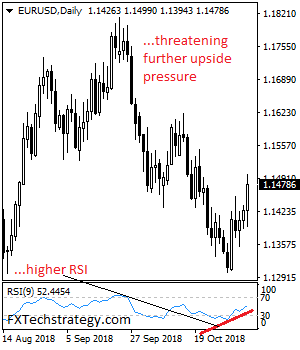
EURUSD sees strong rally with eyes on the 1.1549 zone. This is a build up on its recent bullish recovery. Support lies at the 1.1450 level. A violation will aim at the 1.1400 level. A turn below here will target the 1.1350 level. Further down, support lies at the 1.1300. On the upside, resistance resides at 1.1550 level with a break through there opening the door for further upside towards the 1.1600 level. Further up, resistance comes in at the 1.1650 level where a violation will expose the 1.1700 level. All in all, EURUSD continues to face further upside pressure.
Dollar’s Rivals Gain as US Congress Split Flags Political Noise; RBNZ Rate Decision Awaited
Here are the latest developments in global markets:
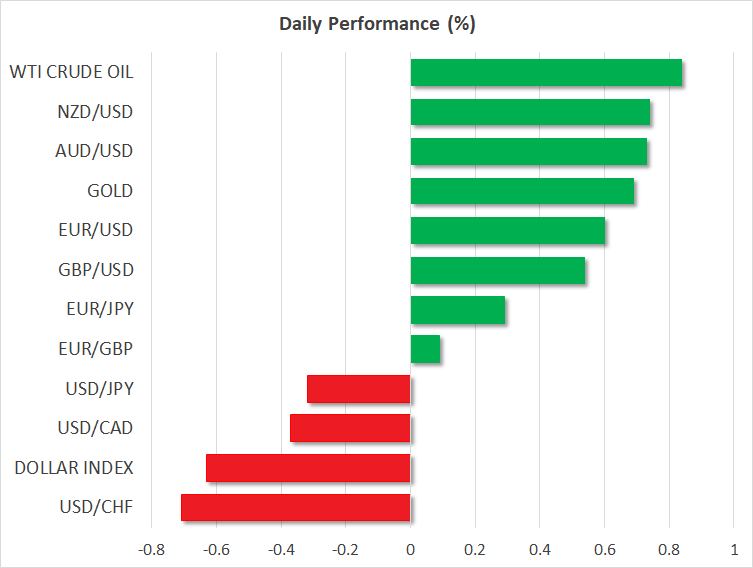
- FOREX: As was widely anticipated, Democrats took control of the House and Republicans retained the majority in the Senate in the mid-term US elections. The dollar index opened with a gap down on Wednesday, slipping to a 2-month trough of 95.67 before inching up to 95.81 (-0.52%). Dollar/yen edged lower by 0.20% to 113.19 along with US Treasury yields after hitting a fresh 1-month high at 113.81 earlier in the day. The 10-year government notes jumped to 3.25%, the highest since October 9 but they soon returned to 3.18%. The British pound continued to benefit on growing hopes that a Brexit agreement could be reached at the end of this month. Pound/dollar rallied by 0.50%, euro/pound added 0.09% to its performance and pound/yen improved by 0.15%. Slightly better-than-expected retail sales growth out of the Eurozone helped euro/dollar to continue its recovery, while a weaker dollar was also supportive. In Italy, the government avoided a political headache after the Parliament approved as expected the security bill which had brought conflicts between the rulling partners. Euro/dollar advanced by 0.60% towards the 1.1500 level. The kiwi surged on New Zealand’s robust employment data, with traders now fixing their gaze to the RBNZ policy decision tonight. Kiwi/dollar jumped by 0.67% to a 3-month peak of 0.6788 and is set to complete the fifth consecutive green day. Aussie/dollar moved higher by an equivalent percentage to touch six-week highs just shy of 0.7300. Dollar/loonie retreated by 0.37% to 1.3074. Emerging currencies were also overperforming the US dollar.
- STOCKS: Global stocks edged sharply higher after the US Congress became split; a theme already seen in previous elections. European equities extended higher on Wednesday at 1100 GMT. The pan-European STOXX 600 and the blue-chip Euro STOXX 50 surged by 1.17% and 1.27% respectively, with all sectors being in the green. The British FTSE 100 was strongly up by 1.29%. The German DAX 30 climbed by 1.08%, the French CAC 40 increased by 1.45%, while the Italian FTSE MIB inched up by 0.52%. The Spanish IBEX 35 was the best performer jumping by 1.80%, with banks leading gains after the Spanish Supreme Court said that banks were not required to pay stamp taxes on mortgages. In Asia, most stocks closed positive, while futures tracking US indices such the S&P 500, Dow Jones and Nasdaq 100 were substantially up, pointing to a significant positive open.
- COMMODITIES: Oil prices rebounded on Wednesday from multi-month lows after a report that Russia and Saudi Arabia are discussing oil output cuts during next year. WTI crude bounced off eight-month troughs, gaining 1.32%, while the London-based Brent added 1.73% to its performance. In precious metals, silver jumped by 1.07% and gold advanced by 0.61% to $1,233.68/ounce.
Day ahead: Political concerns rise in the US; RBNZ to stand pat on monetary policy
The dollar will be closely watched during the rest of the day as the outcome of the US midterm elections signalled a fresh wave of political uncertainty, sending the dollar lower. Although the Democrats’ victory in the House of Representatives was widely expected, investors focused on the negative implications the results might have as the opposition party is obviously not in favour of the US’s President’s fiscal agenda. Specifically, given that Republicans have now lost full control of Congress, Democrats could easily oppose Trump’s plans for further tax cuts and stricter migration controls in coming months, potentially bringing further selling to the greenback. Controversies around trade could also arise, turning the cloud around the US-Sino standoff even darker. Yet potential improvements in economic data and hence the Fed’s increasing willingness to deliver additional rate hikes in the future, might prevent investors from shifting funds away from the US.
Meanwhile in the UK, the sentiment around Brexit is not so negative following several positive headlines supporting that a Brexit deal could be possible . On Tuesday, the Cabinet meeting broke up without any agreement, though a “thumbs up” hand sign from the British Brexit Secretary boosted optimism that efforts to arrange an agreement were constructive. Moreover, Bloomberg’s analysts supported that a second meeting could be called within days to achieve an approval of the draft Brexit deal.
On the monetary front, the Reserve Bank of New Zealand is overwhelmingly projected to keep interest rates steady at a record low of 1.75% today at 2000 GMT. An upbeat employment report in combination with stronger inflation and GDP growth figures could turn policymakers less dovish, with investors waiting eagerly to see whether the RBNZ could play down chances for a rate cut. Note that in previous gatherings the Bank argued that interest rates could move either up or down. A press conference will follow the rate statement at 2100 GMT. Should policymakers appear more optimistic on the economy and hence on the rate path, the kiwi could experience stronger buying interest.
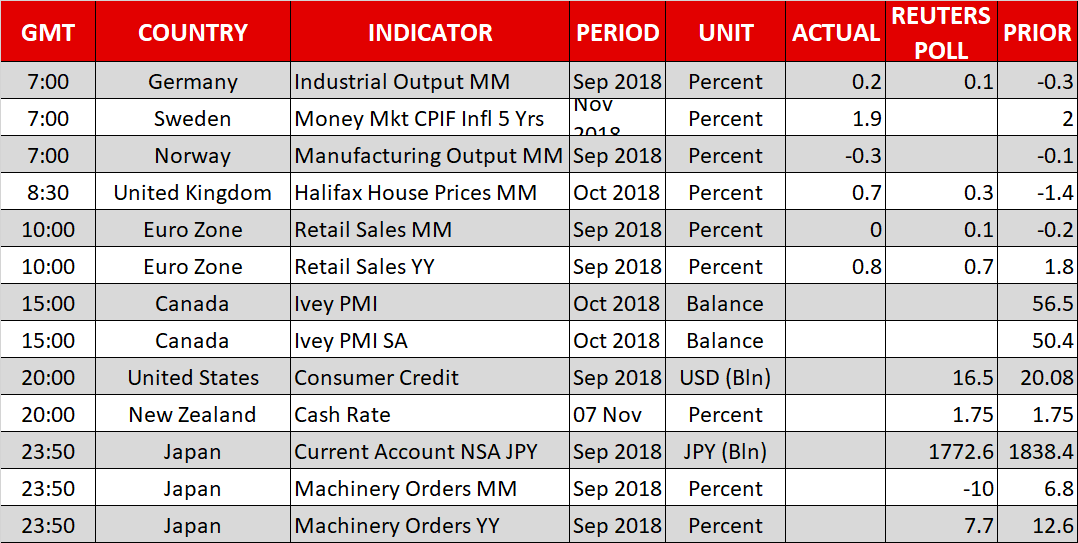
In Canada, Ivey PMIs will come out at 1500 GMT, though as usual, the loonie might shrug off the data.
At 2350 GMT, Japan will release core machinery orders for the month of September, while at the same time the Bank of Japan will be issuing its summary of opinions, giving some insight on what was discussed at the last week’s policy meeting when policymakers kept rates steady without surprise. The latter could move the safe-haven yen.
In energy markets, the Energy Information Administration is scheduled to report on US oil inventories for the week ending November 3 at 1530 GMT. Projections are for a smaller build-up in crude stocks, while the decline in distillate and gasoline stocks is expected to slow down. Crude prices could extend losses if the numbers prove that stockpiles are continuing to build up.
Canadian Dollar Higher as Risk Appetite Returns after US Election
The Canadian dollar has posted gains in the Wednesday session, USD/CAD is trading at 1.3080, down 0.33% on the day. On the release front, Canada releases Ivey PMI, which is expected to improve to 50.9 points. There are no major U.S releases on the schedule. On Thursday, Canada releases Housing Starts. In the U.S, the Federal Reserve will set the benchmark rate and release a rate statement. We’ll also get a look at unemployment claims.
Investors expressed relief that the uncertainty over the U.S mid-term elections is over, with both the Republicans and Democrats able to point to a victory of sorts. The markets were pleased that President Trump did not suffer a stinging defeat. Had the Democrats taken back both houses of Congress, Trump would have been a lame duck for the next two years, and he would have had great difficulty passing any further market-friendly reforms. The mixed results have improved risk appetite, and the Canadian dollar has responded with gains on Wednesday.
Participation was high in the mid-term elections on Tuesday, and voters rendered a split-decision. The Democrats regained control of the House of Representatives for the first time since 2010, but the Republicans maintained control of the Senate, and have increased their majority. The results are a setback for President Trump, as the Democrats will be in a stronger position to derail Trump’s plans to boost fiscal stimulus and lower taxes.
DAX Climbs Sharply After U.S Election
The DAX index has jumped in the Wednesday session. Currently, the DAX is trading at 11,606, up 1.07% on the day. On the release front, German industrial production posted a gain of 0.2%, above the estimate of 0.0%. Eurozone retail sales improved to 0.0%, shy of the estimate of 0.1%. On Thursday, Germany releases trade balance and the eurozone publishes its economic forecasts.
European markets have posted gains on Wednesday, as investors expressed relief that the mid-term election uncertainty is over and the slugfest ended up as a split-decision. Had the Democrats taken back both houses of Congress, Trump would have been a lame duck for the next two years, and he would have had great difficulty passing any further market-friendly reforms. After a rough October for the DAX, investors are hoping that the positive start to November continues.
All eyes were on the U.S mid-term elections, and when the dust settled, both parties could claim a victory of sorts. The Democrats regained control of the House of Representatives for the first time since 2010, but the Republicans maintained control of the Senate, and have increased their majority. The results are a setback for President Trump, as the Democrats will be in a stronger position to derail Trump’s plans to boost fiscal stimulus and lower taxes. Investors have reacted on Wednesday by sending the dollar lower. Investors will be shifting focus to the Federal Reserve, which releases its monthly rate statement on Thursday. The Fed is expected to maintain the benchmark rate at a range of between 2.0% and 2.25%. A hawkish rate statement could boost global equity markets.
The Midterm Elections and Our Economic Outlook: An Update
In a previous report, we outlined our thinking on policy and the economic outlook headed into the midterm elections. In this report, we provide a brief update based off of last night's election results.
Another Fiscal Inflection Point? Probably not.
On October 22, we put out a report titled "The Midterm Elections and Our Economic Outlook" that took a deep dive into how we were thinking about potential policy outcomes heading into the midterm elections. Broadly speaking, the results from last night do not materially change our views.
The 2016 election was a watershed election, resulting in the first Republican unified government since 2005-2006 and producing a clear inflection point in the nation's fiscal policy (top chart). Divided government, under which the U.S. will operate come 2019, has been more common and generally less conducive to sweeping legislative changes. More specifically as it relates to our outlook, it seems unlikely that Republicans in the Senate and White House will agree to any major changes to the 2017 tax reform bill proposed by Democrats in the House. Conversely, Democrats in the House are unlikely to agree to tax cuts anywhere near the magnitude that occurred in 2017.
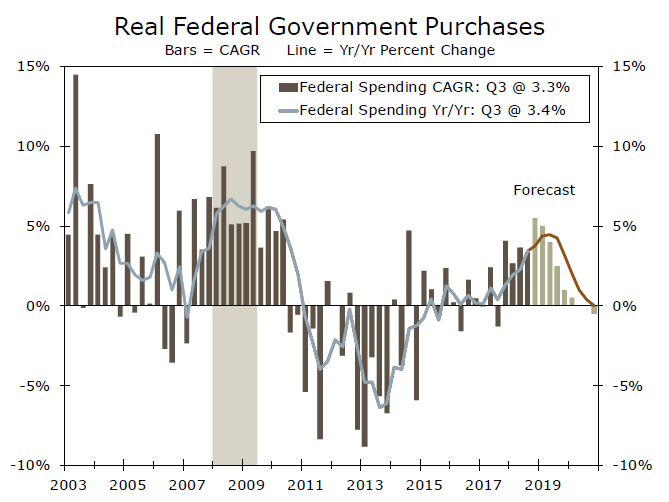
The spending side of the ledger has a murkier outlook. At present, the United States is operating under a two-year budget deal that expires on September 30, 2019. Under current law, inflation-adjusted discretionary spending would outright decline in FY 2020, leading the federal component of GDP to be a drag on economic growth, as it was from roughly 2011-2014. This period, which saw a significant contraction in discretionary spending, eventually gave way to divided government legislation that led federal government consumption and investment to have a much more neutral impact on economic growth. Our forecast assumes something similar; a bipartisan effort succeeds in staving off another fiscal contraction, but the significant boost that occurred in 2018 is not repeated (middle chart).
While this is our base case, we believe a plausible case could be made for swings in either direction. President Trump has appeared sympathetic to policy stimulus of all kinds, and a slowdown in growth headed into the 2020 election might lead policymakers to boost spending more meaningfully than we currently have forecasted. Alternatively, it is easy to imagine a scenario where a divided Congress and the president engage in a prolonged budget standoff next year that results in a debt ceiling debacle and a sharper deceleration in federal government spending than we currently envision.
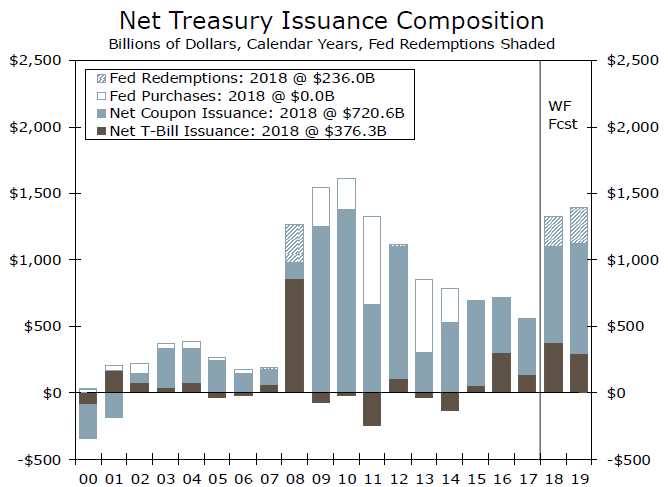
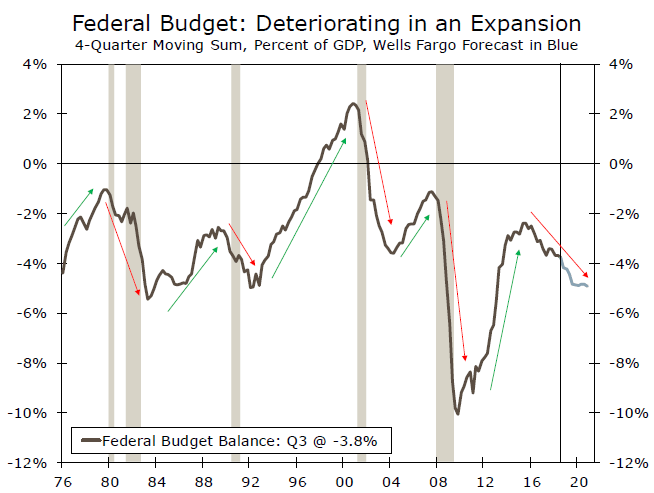
Given this baseline, what do the elections mean for our interest rate outlook? Unlike 2016, we do not currently believe the 2018 midterms will spark policy outcomes that provide a significant boost to growth and a subsequently more hawkish Fed. For Treasury supply, our base case is for the deficit to continue widening over the next few quarters, but for the pace of widening to slow by H2-2019. More specifically, we look for a budget deficit of $1.05 trillion in FY 2019 and $1.1 trillion in FY 2020. As a result, though the level of net Treasury issuance will remain high, the pace of growth is also likely to slow, (bottom chart).
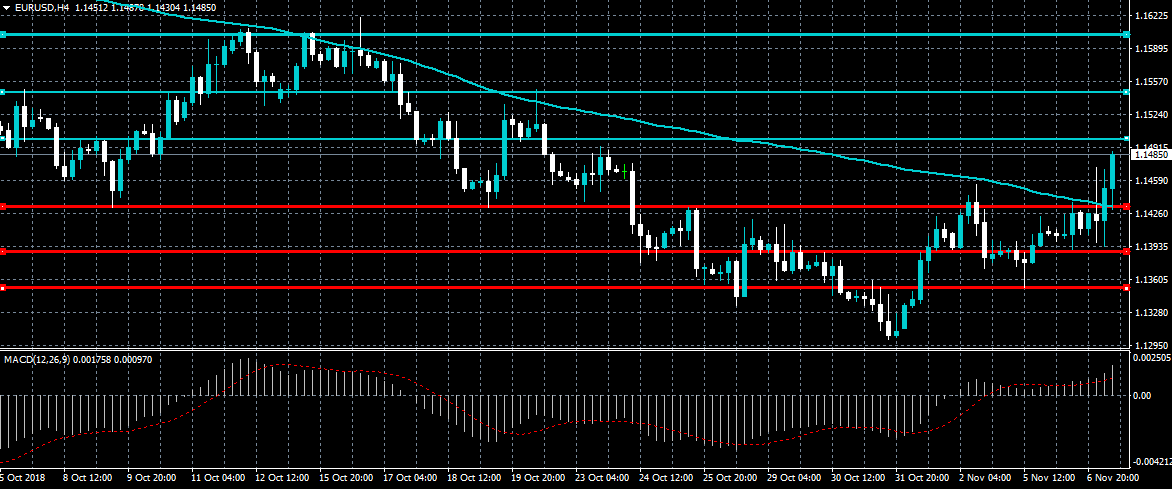
EURUSD Bulls Targeting 1.1500 Level
The euro has moved to a fresh monthly trading high against the greenback during the European trading session, as the US dollar index tumbles below the 96.00 level. EURUSD bulls are now targeting towards the 1.1500 level after a strong technical break above the 1.1470 resistance level. The MACD indicator continues to rise across the four-hour time frame, with buyers increasingly likely aim for 1.1553 level in the medium-term.
The EURUSD pair is strongly bullish while trading above the 1.1470 level, key technical resistance is now found at the 1.1500 and 1.1553 levels.
If the EURUSD pair declines below the 1.1470 level, sellers may target the 1.1452 and 1.1431 support levels.
USDJPY Reverses From Bullish Target
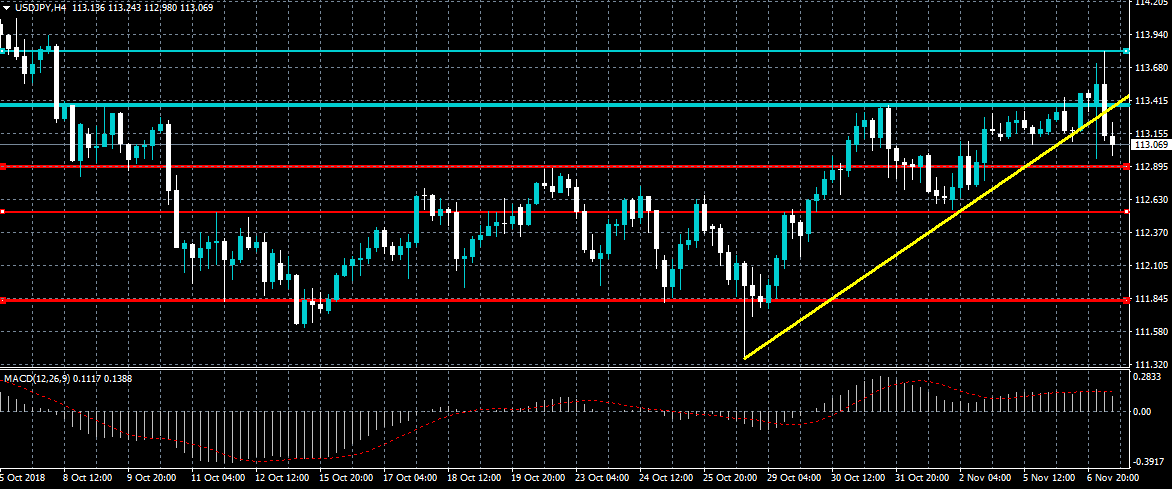
The US dollar is trading lower against the Japanese yen currency, after finding strong technical resistance from the 113.80 level. The USDJPY pair has a bearish intraday bias while trading below key trendline support and may have reached its medium-term upside target, at 113.80. Sellers need to break the 112.89 level, while buyers need to move the price back above the 113.40 level.
The USDJPY pair is bearish while trading below the 113.40 level, key support is now found at the 112.90 and 112.54 levels.
If the USDJPY pair trades above the 113.40 level, buyers are likely to test the 113.80 and 114.20 resistance levels.
European update: Dollar overwhelmingly weak on elections, Australian Dollar strongest
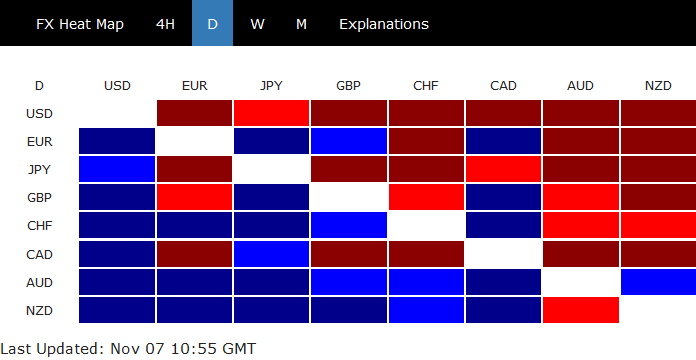
Dollar is overwhelmingly the weakest one today. Democrats have already won over 218 seats in House in the mid-term election to regain majority after eight years. Republicans, on the other hand, retained majority in Senate. There are talks that the gridlock in the Congress would limit Trump's ability to push through more fiscal stimulus. Yet, there is another theory that the stocks markets were usually bullish with a split Congress. DOW futures are now pointing to higher open with triple digit gains. Major European indices are generally higher. So it seems that the latter is more true. And thus, a split Congress is unlikely the reason for Dollar's weakness. Staying in the currency markets, Canadian Dollar is now the second weakest, followed by Japanese Yen. On the other hand, Australian Dollar is the strongest one, followed by New Zealand Dollar and then Swiss Franc.
In Europe, at the time of writing:
- FTSE is up 1.17%
- DAX is up 1.03%
- CAC is up 1.36%
- German 10 year yield is up 0.015 at 0.452
- Italian 10 year yield is down -0.076 at 3.330
Earlier in Asia
- Nikkei dropped -0.28% to close at 22085.80
- Hong Kong HSI rose 0.1% to 26147.69
- China Shanghai SSE dropped -0.68% to 2641.34
- Singapore Strait Times rose 0.1% to 3065.36