

Sample Category Title
Chinese Exports To Start Reflecting Effect Of Tariffs? Aussie Eyed Too
Chinese trade data for October are due on Thursday. The ongoing Sino-US trade dispute has rendered such releases somewhat more important, with the numbers likely to be scrutinized for any negative effects stemming from US tariffs. As is usually the case, the Aussie will also be attracting attention after the figures are made public due to the Australian economy’s heavy reliance on China; the currency is viewed as a liquid proxy for China-related “plays”.
Analysts’ projections call for Chinese exports and imports to have risen by 11.0% and 14.0% annually in October respectively, below September’s corresponding figures of 14.5% and 14.3%, but still at robust levels. Consequently, the nation’s trade surplus (measured in USD) is anticipated to widen to $35.0 billion from September’s $31.7bn, something which would put it at its highest since June.
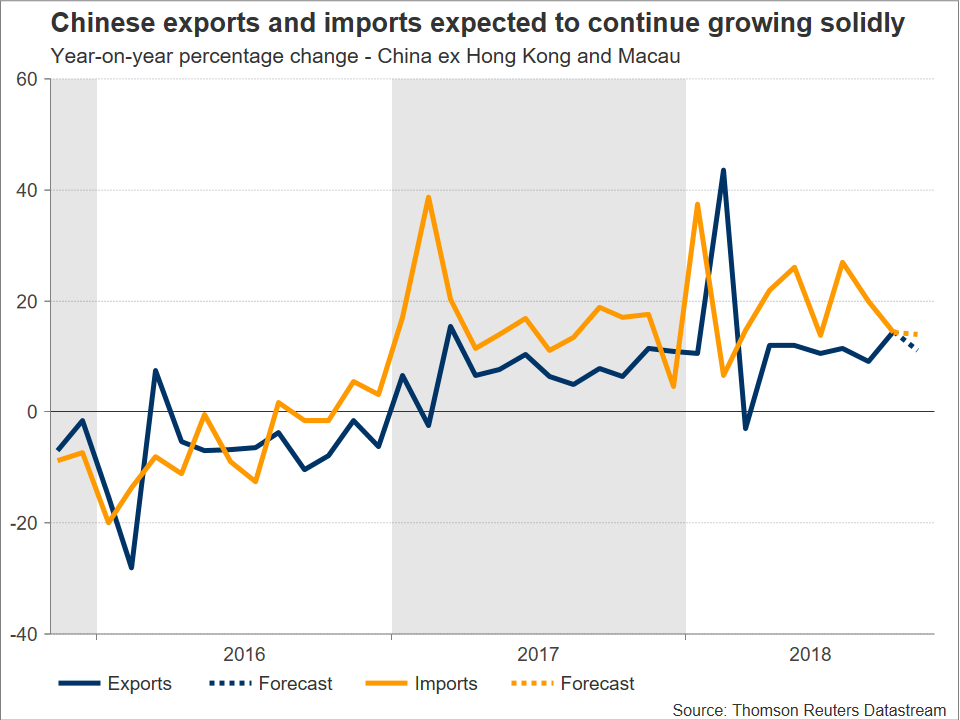
Posing risks to export growth are the Trump administration’s levies on billions of dollars of shipments to the US. Additionally, it should be kept in mind that Washington could well ratchet up its tariff game to effectively cover all Chinese imported goods to the US, or at least such a move was recently signaled in case Presidents Trump and Xi fail to reach a breakthrough on trade when they meet at the G20 summit at the end of November. Having said that, it is worthy of mention that a less confrontational tone has prevailed as of late which has generated excitement for an agreement on trade. In the words of White House economic advisor Kudlow though, “We (the US) are not on the cusp of a deal.”
It may be puzzling to some that exports continue to hold nicely despite the imposed tariffs. In fact, China’s September trade surplus with the US rose to a record high of $34.13bn; in other words and taking into account that the total surplus stood at $31.7bn during the month (mentioned previously), China runs a surplus with the US and is roughly in balance with the rest of the world.
However, the strong readings on exports are likely owed to so-called front-loading of orders by businesses to avoid higher prices when the tariffs officially kicked in. In other words, US actions could have provided a short-term boost to Chinese shipments, with the data to possibly start reflecting a slowdown soon. It would be interesting to see whether Thursday’s release starts supporting this. Elsewhere, beyond Trump’s levies, cooling global growth is another factor that may weigh on Chinese exports moving forward.
On the FX front, the Aussie will be eyed as the figures hit the markets but also in the event of trade headlines. China-positive developments typically lift the Aussie
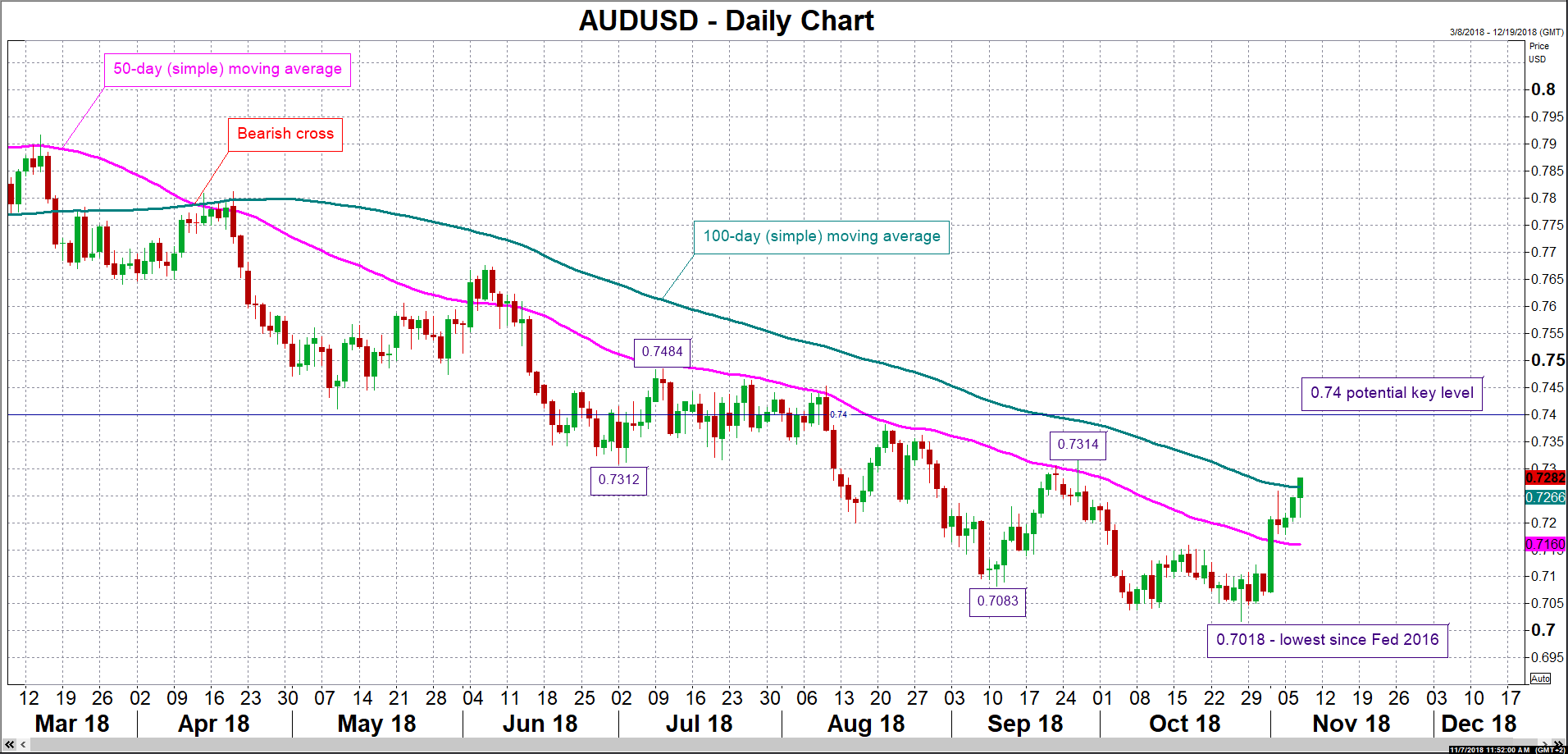
Upbeat Chinese prints or more importantly de-escalating trade tensions between the US and China may spur long positions on AUDUSD. A first line of resistance to a rising pair could occur around a previous high at 0.7314. Further above, a barrier could come around the 0.74 handle, this being a congested zone between late June to early August. Even higher, the focus would turn to the 0.7484 peak. On the downside and in the event of disappointing readings or an intensifying Sino-US trade dispute, immediate support could be met around the current level of the 100-day moving average line at 0.7266. Sharper declines could meet support around the 50-day MA at 0.7160. Lower, a previous bottom at 0.7083 would increasingly come into view, with steeper losses bringing the two-and-a-half-year nadir of 0.7018 into scope.
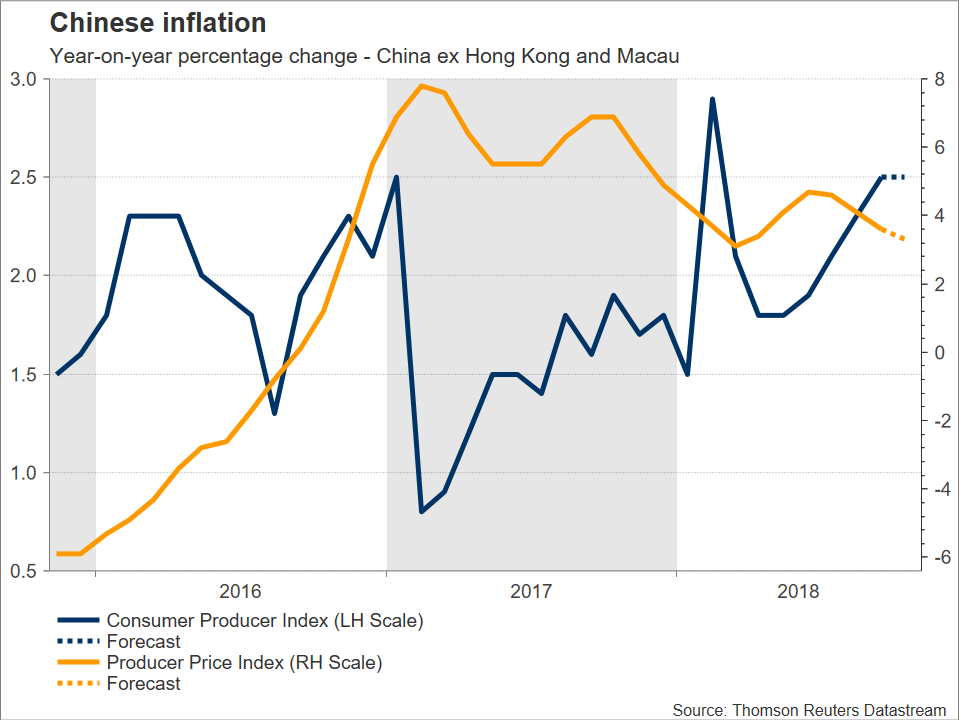
Also out of the world’s second largest economy this week will be the gauges of factory and consumer inflation. Specifically, the producer price index (PPI) and consumer price index (CPI) for October will be hitting the markets on Friday at 0130 GMT. The two are projected to expand by 3.3% (vs 3.6% in September) and 2.5% (the same rate as in September) on an annual basis correspondingly. If the numbers come in line with forecasts, the year-on-year growth in factory prices would stand at its lowest since March, while consumer inflation would remain at its highest since February. It bears mention that inflation considerations, if any, would likely take the back seat as Chinese authorities seem much more interested in reviving softening growth at the moment.
EURJPY On The Up After Rebound On 126.60
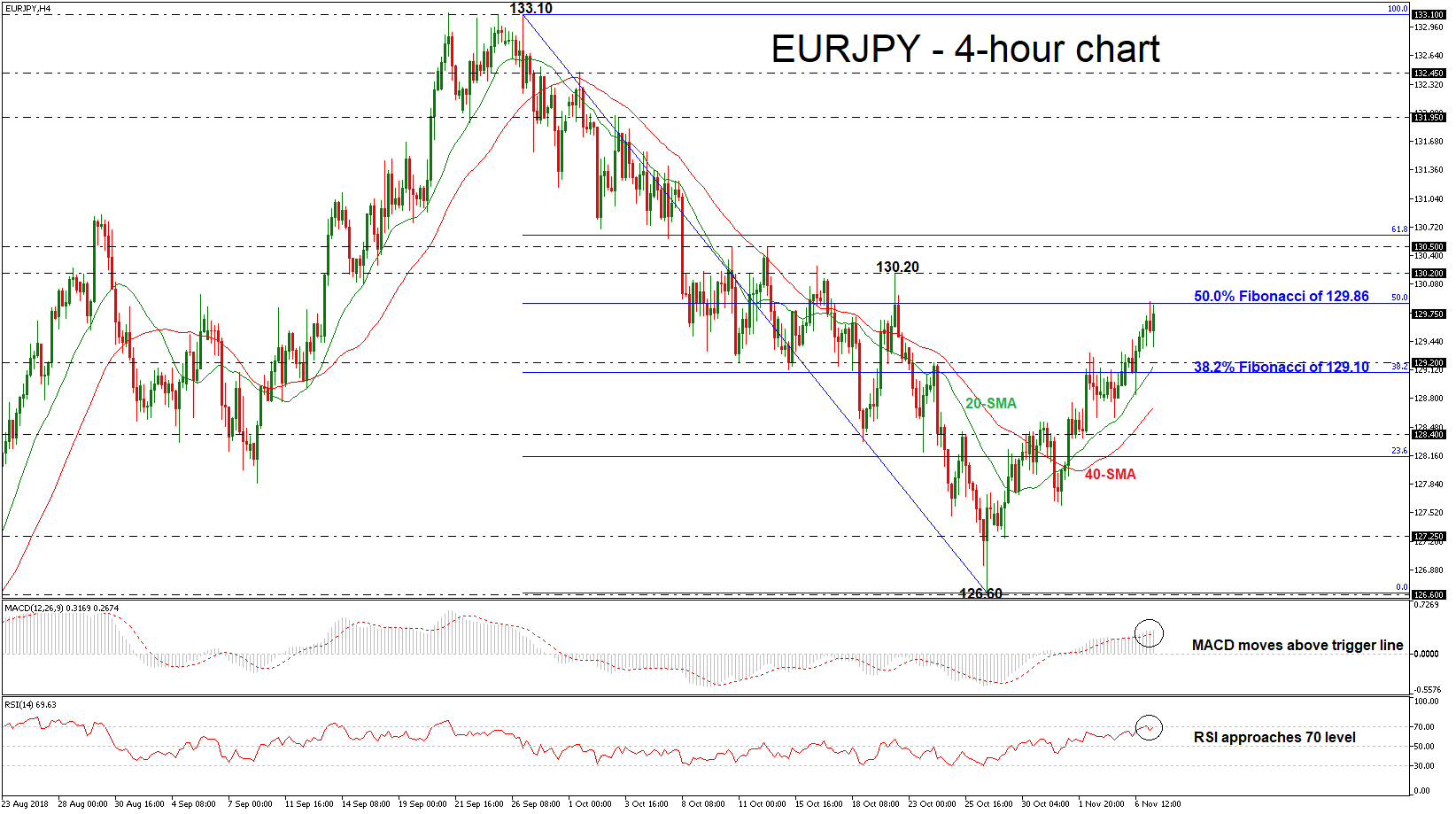
EURJPY has jumped considerably following the rebound on the two-month low of 126.60, hitting a new two-week high of 129.88 earlier today. The technical indicators are confirming the recent upside movement. The RSI is ready to jump into the overbought zone, while the MACD surpassed the trigger line in the bullish zone.
If prices are able to continue to move higher and overcomes 50.0% Fibonacci retracement level of the downleg from 133.10 to 126.60, around 129.86, the next resistance for traders to watch is the 130.20 barrier, identified by October 22. Even higher, the price could meet the 130.50 hurdle, before being able to hit the 61.8% Fibonacci of 130.63.
Alternatively, if the market manages to turn to the downside again, this could open the way towards the 129.20 support level, which holds slightly above the 38.2% Fibonacci of 129.10. Moving lower, the market could decline further until the 40-simple moving average (SMA) of 128.68 in the 4-hour chart.
Zooming into the near-term picture, in the 4-hour chart, EURJPY has been trading within a short-term uptrend over the last couple of weeks, creating higher lows and higher highs.
The US Dollar Declined Slightly
The US currency weakened slightly against a basket of major currencies. Yesterday, a report on the JOLTS jobs openings was published, the figure counted to 7.009M and was worse than the expected value of 7.100M. The dollar index (#DX) closed in the negative zone (-0.05%). Investors took a wait-and-see attitude before the Fed meeting, which will begin today and last two days. Tomorrow, the regulator will have to decide on a key interest rate. Experts expect that the regulator will leave the figure at the same level of 2.00%-2.25%.
Yesterday, reports on the labor market of New Zealand were also published. Thus, the 'employment change' figure increased by 1.1% in the third quarter, while investors expected +0.5%. The unemployment rate declined to 3.9% in the third quarter instead of 4.4%. Today, the Reserve Bank of New Zealand will decide on the interest rate. Experts forecast that the interest rate will remain unchanged at 1.75%. The pound shows positive dynamics against optimistic news about Brexit.
The "black gold" prices have declined significantly. At the moment, futures for the WTI crude oil are testing a mark of $61.80 per barrel. At 17:30, a report on the US crude oil inventories will be published.
Market Indicators
Yesterday, the main US stock indices showed positive dynamics: #SPY (+0.63%), #DIA (+0.69%), #QQQ (+0.67%).
At the moment, the 10-year US government bonds yield is at the level of 3.19-3.20%.
The news feed on 07.11.2018:
Ivey PMI in Canada at 17:00 (GMT+2:00);
RBNZ interest rate decision at 22:00 (GMT+2:00).
Investors Digest Midterm Elections | Bitcoin Crossed a Critical Level
Donald Trump is still popular with his polices over in the United States as Republicans kept the control of the Senate
European and U.S. futures are struggling to make up their mind as investors digest the implication of the midterm election. The exit polls are showing that we have a split in Congress. As a result of this the dollar index has retreated and the gold price has moved higher.
Most importantly, we have the price of Bitcoin touching the critical level of $6,500, which is going to boost the confidence among the Bitcoin bulls. The 10-day historical volatility for bitcoin has dropped below the 10-day historical volatility of S&P500 and Nasdaq. This confirmed that the capitulation is on the horizon because bitcoin isn’t the kind of animal which can be put under control easily. But let’s get back to U.S. mid term elections.
One thing is for certain, the midterm election was mainly about Trump. President’s policies have divided the country and this was the first major political test of his presidency. Donald Trump is still popular with his polices over in the United States as Republicans kept the control of the Senate. The Democrats are on track to reclaim the House, and a victory would make things a little arduous for the president for his remaining time in the office.
This is because president Trump would be left without congressional support and he would struggle to move his agenda towards the finish line. The Midterm elections have provided the Democrats with clues and a blue print for their next battle which is going to take place in 2020. Although, president Trump thinks that the Midterm elections have been tremendous success for him. The president’s controversial immigration policy has backfired for the Republicans candidates and this worked in favour of Democrats.
Nonetheless, traders are going to shift their focus from the Mid-term election and focus on things which actually matters around the globe. So far, the U.S. economic health remain robust and despite the trade war, there hasn’t been any surprises in the trade numbers although the earning season has told us that the trade war is taking the toll.
For now , the order of the day is the Trump trade which means equities and the dollar are likely to move higher especially given that one of the major risk event is behind us. It will not be a smooth sailing as before and that is purely because of the bipartisan results of the midterm elections.
The volatility index would remain elevated because the US debt problem is real and it is growing. In the light of Midterm elections, the fiscal policy is likely going to change and the monetary policy would remain on It’s path under which the Fed would continue to increase the interest rates. This would increase the annualised cost of servicing the U.S. debt .
EU Moscovici: Trump is right, tremendous success tonight
Here are some comments from two EU officials on US mid-term elections.
European Commission First Vice President Frans Timmermans, "Inspired by voters in the US who chose hope over fear, civility over rudeness, inclusion over racism, equality over discrimination. They stood up for their values. And so will we."
https://twitter.com/TimmermansEU/status/1060082832054382592
European Commissioner for Economic and Financial Affairs Pierre Moscovici, "The Democrats won the House of Representatives for the first time in eight years, despite a mighty Republican Gerrymandering. Donald Trump is right: "Tremendous success Tonight"
https://twitter.com/pierremoscovici/status/1060057113261682689
Bitcoin Market Share Falls To Monthly Low As Ripple And Bitcoin Cash Rally
Bitcoin market dominance has fallen to a monthly low of just over 51% of the overall market capitalization while Ripple and Bitcoin Cash have both rallied multiple percentage points over the past week. Bitcoin's overall value in the cryptocurrency market is an important barometer in the progress of the space as a whole. If Bitcoin were still at 100% value, then price shifts in its markets would impact the overall capitalization a lot more than they do now.
Ripple's market performance is the most notable as of late, pushing to be almost equal with Ethereum. Ethereum's demand comes from many dozens of sources on a regular basis as token platforms require it to operate and process transactions and ICOs launch. Ripple's demand is a bit more tricky and reliant on the needs of large institutions which have in the past few years integrated the platform as a means of moving money cheaply across borders.
Ripple continues to impress, having weathered a long winter of low valuations and pushing ever further toward realistic dollar parity. By this, we mean parity which is not wholly reliant on the astronomical price of Bitcoin – that someone is actually willing to take a single dollar and exchange it for a single Ripple, which might be different than prices reflected on BTC/XRP charts on a given day. Nevertheless, at present, they stand at more than 50 cents a token.
Many factors go into the recent rise both in price and volume on Bitcoin Cash, but likely the most important is the upcoming hard fork in which there will again be two major camps around the currency. The same people who forked Bitcoin into Bitcoin Cash are now actively working to fork Bitcoin Cash into something else.
The prospects of a viable tertiary fork growing out of Bitcoin Cash are an arbitrage opportunity that many veteran crypto traders recognize – when the Bitcoin Cash fork happened, anyone who'd bought Bitcoin prior to the fork and was holding it then immediately also held Bitcoin Cash, which started out trading rather high.
It is likely that this is the primary motivating factor to the increased demand and volume surrounding Bitcoin Cash, but certainly, other factors are at play such as the budding ecosystem and economy around the crypto.
Elliott Wave Analysis: USDCHF Preparing For A Temporary Pullback
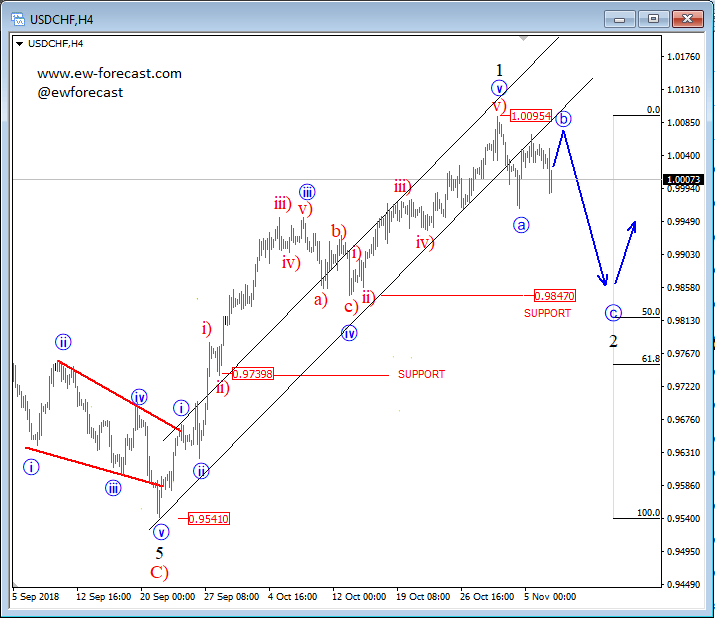
A five-wave recovery on USDCHF from 0.9541 lows suggests that wave 1 of a higher degree is ending, and that a new temporary, three-wave correction can cause a pullback. We are talking about wave 2, which can unfold a temporary a-b-c setback and can later look for support and a bounce around 0.985 region, or deeper near the 0.974 level.
A correction represents a pause within a trend. In Elliott wave theory we know wave 2, 4 and B corrections, the most common ones. They can consist of three minor legs, or they can unfold a more complex combination(more then three legs).
USDCHF, 4h
The Mid-Term Dilemma
Americans head to the polls late on Tuesday in a vote that could lead to another deadlock in Congress but how the market will react isn't entirely clear. The British pound is the top performer for the 2nd consecutive day, while the loonie is the only loser against the greenback. The video for Premium subscribers previewing the various elections scenarios is posted below.
Rules of Thumb?
There are generally two rules of thumb for traders during elections: i) the stakes are overstated generally and in the aftermath of most votes the anxiety recedes and depressed assets tend to recover; ii) the immediate reaction rarely lasts (remember what happened immediately after Trump's victory was announced). Traders aiming to capitalize on volatility emerging on what are believed to be the exit polls or first round of official results will need to be swift in squaring/closing positions. Most importantly, remember to stay relatively small
The US midterm elections are primarily about the House of Representatives, with polls giving Democrats around a 70% chance of taking it back; which would give them an effective veto over major US legislation. That would result in a deadlock and a series of investigations that would undoubtedly infuriate Trump and further divide the US. Still, every election seems like a potential disaster in the leadup and businesses tend to get along just fine anyway, so risk assets and US stocks in particular are expected to rebound in time regardless of the result.
Yet rules of thumb don't always work. Italy earlier this year is a good example. The MIB index initially climbed 9% in the eight weeks after the election but has fallen 20% since.
Beware of November 2016 Moment
What's especially top-of-mind on the US vote is the results of the 2016 presidential election. US futures initially crumbled on the shock of Trump's win only to begin a turn the next day and an epic run for months ahead. Some said the reason to the subsequent rebound was the Trump's acceptance speech, which was surprisingly more concilatory and less divisive. By the same token, traders must watch not only the results, which will trickle from 5 am til 8 am GMT/London, but also the response (speeches) from the new majority/minority leaders in both chambers of Congress.
Could market participants anticipate a similar playbook? If that is so, then a Republicans win would trigger an immediate rally in stocks and selloff in the yen, and potential disappointment if they don't. Fundamentally, Trump is promising another tax cut so there's some underpinning, even if that promise rings hollow given the deficit concerns.
On the other hand, Democrats holding the House are much more likely to curb a trade war, which could also be good for markets. As for the US dollar, a Democrat win in the House would certainly curb Trump's ability to goose growth and that uncertainty is likely to weigh on the US dollar, especially if it means more aggressive trade policies since these are not the subject of Congressional approval.
While it's tempting to project certainty, the trade may be to chase the momentum once the dust settles. We will also be listening carefully to the responses from Trump, Democrats and Republicans to see if there's an indication of a willingness to work together
AUDUSD Outlook: Fresh Bullish Signal On Extension Above Daily Cloud
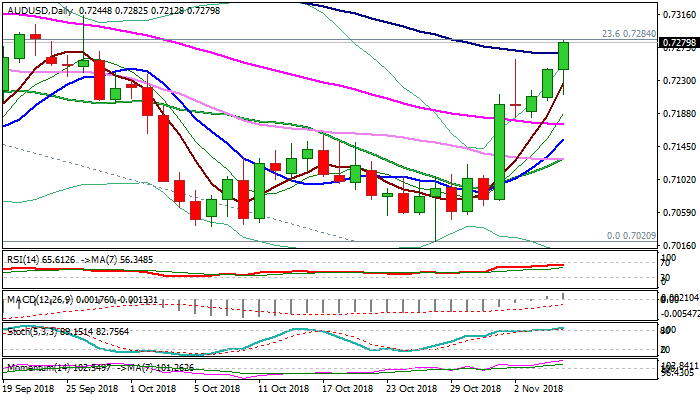
The Australian dollar advance further on Wednesday, extending steep recovery rally from 0.7020 (26 Oct spike low) and generates bullish signal on break above pivots at 0.7265/74 (100SMA / daily cloud top).
Bulls were additionally boosted by of US election results and attack resistance at 0.7284 (bear-trendline drawn off 0.7988, 11 Feb high / Fibo 23.6% of 0.8135/0.7020).
Daily MA’s returned to full bullish setup and support the advance along with strengthening bullish momentum, with close above daily cloud to add to bullish signals.
Bulls eye target at 0.7314 (26 Sep spike high), violation of which would open way for further recovery and expose targets at 0.7381 (21 Aug lower top) and 0.7446 (Fibo 38.2% of 0.8135/0.7020).
Overbought studies suggest bulls may take a breather and position for fresh advance.
Res: 0.7284, 0.7314, 0.7381, 0.7446
Sup: 0.7274, 0.7245, 0.7212, 0.7173
Split Congress Keeps Dollar Bulls Sidelined, RBNZ Decision Looms
Here are the latest developments in global markets:
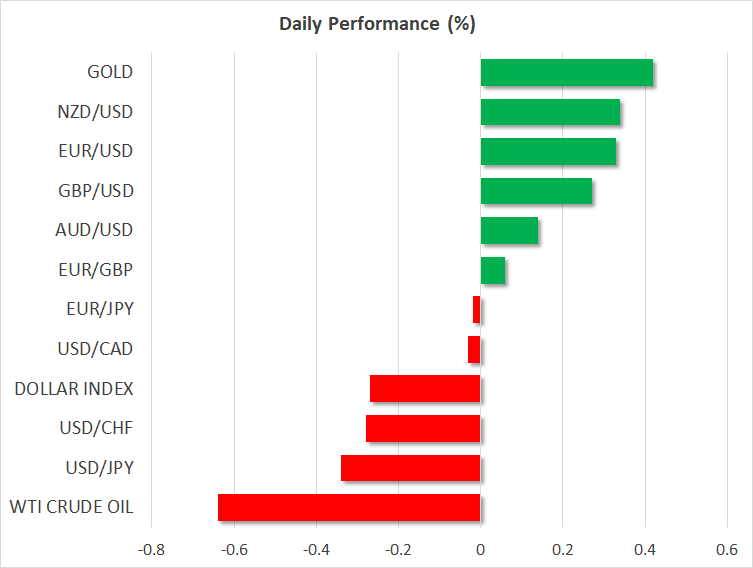
FOREX: The dollar is lower by 0.28% against a basket of six major currencies on Wednesday, weighed down by the results of the US midterm elections, which produced a split Congress – dampening the prospect for any further tax cuts. Meanwhile, the pound continued its Brexit-induced march higher, while the kiwi dollar soared overnight, after a surprisingly strong employment report out of New Zealand.
STOCKS: Wall Street closed in the green on Tuesday as US citizens went to the polls to elect their 116th Congress, with the Dow Jones (+0.68%), S&P 500 (+0.63%), and Nasdaq Composite (+0.64%) all posting decent gains. Even though the outcome was a divided Congress, equity investors seemingly focused more on uncertainty fading rather than the incoming political gridlock, evident by futures tracking the Dow, S&P, and Nasdaq 100 all pointing to a higher open today. Meanwhile, Asia was mostly in the red on Wednesday, with Japan’s Nikkei 225 (-0.28%) and Topix (-0.42%) ticking lower, alongside the Hang Seng in Hong Kong (-0.16%). In Europe, all the major indices were set to open much higher today, according to futures.
COMMODITIES: Oil continued its downtrend, with WTI touching an eight-month low and Brent its own three-month trough, pressured by worrisome signs on the supply front, in light of the US granting sanctions waivers to some of Iran’s biggest clients. Oversupply is slowly returning as a market theme, and it will be crucial to see if the weekly EIA data confirm as much today. In precious metals, gold is up by 0.41% at $1,232 per ounce, hovering near its recent highs. The near-term outlook seems to have shifted back to neutral, with prices now fluctuating between $1,212 and $1,238.
Major movers: Dollar softens on divided Congress; kiwi soars after jobs data
As was widely telegraphed by opinion polls, the US midterm elections produced a split Congress, with the Democratic party taking back control of the House of Representatives, and the Republicans keeping control of the Senate. The result sets the stage for gridlock in Washington DC, rendering President Trump unable to implement most of his domestic agenda – such as tax cuts 2.0 – as the Democrats would likely veto any relevant legislation. Outside of the economic arena, while the Democrats could start an impeachment process, for a US President to actually be impeached it requires a 67/100 supermajority in the Senate, implying Trump is not going anywhere for now.
The market reaction was mostly subdued, possibly due to how widely this outcome was anticipated. The US dollar is modestly lower, as Democrats taking the House likely put to bed any surviving speculation for more deficit-funded tax cuts – evident by a pullback in US Treasury yields. That said, the fact that the Democrats can’t roll back any of Trump’s already-enacted policies probably limited the downside. Meanwhile, stocks appear to have escaped unscathed, as futures tracking the US indices are pointing to a green open today, amplifying the narrative that US equities tend to outperform after the midterms as uncertainty fades, irrespective of which party won.
Elsewhere, the British pound continued its climb higher, touching a five-month high against the euro as optimism surrounding an imminent resolution to the Brexit talks continued to ride high. The latest headlines suggest the UK is drawing up another proposal, which may be presented to Brussels later this month, adding credence to speculation the Brexit “endgame” is gradually drawing closer.
In New Zealand, the local dollar soared after the nation’s employment report for Q3 blew past forecasts, with the unemployment rate unexpectedly slipping to a 10-year low even as the labor force participation rate rose. The strong prints likely enhanced speculation for a more optimistic tone by the RBNZ tonight, which will announce its policy decision at 2000 GMT.
Day ahead: RBNZ rate decision due
On Wednesday, investors will likely assess the economic implications of a split Congress in the US and position themselves accordingly. Beyond that, the Reserve Bank of New Zealand’s (RBNZ) policy decision is an event that has potential to prove market-moving for FX markets, particularly for kiwi pairs.
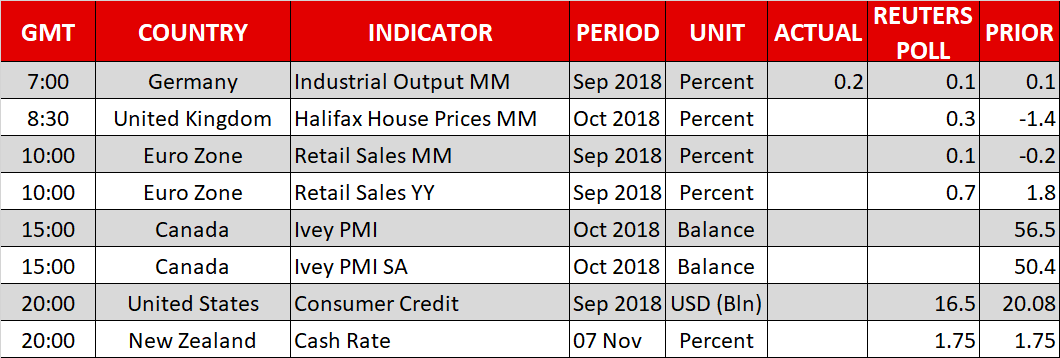
October data on housing prices due out of the UK at 0830 GMT are unlikely to prove market-sensitive, at least not for FX markets where all eyes for positioning on sterling remain on Brexit developments.
Eurozone retail sales for September will be hitting the markets at 1000 GMT. Month-on-month, sales are anticipated to grow by 0.1%, after contracting by 0.2% in August. This would put the annual pace of growth at 0.7% (vs 1.8% previously). Also of interest for euro pairs are any updates having to do with Italy’s budget.
Out of North America, Canada’s Ivey PMI for October will be made public at 1500 GMT, while September consumer credit data out of the US are due at 2000 GMT.
In focus will be the RBNZ’s rate decision at 2000 GMT. The Bank is widely expected to maintain its benchmark rate at the historic low of 1.75%. In light of no change in rates being expected, the RBNZ’s communication – how optimistic it is on the economy’s prospects – will likely act as the driving force for movements in the kiwi.
Earlier in the year, the central bank adopted a dovish stance by not ruling out a rate cut. Jobs data released during today’s Asian session which showed the unemployment rate falling to a decade low, in combination with the recent upside surprise in Q3 GDP growth, may tilt the Bank towards adopting a more upbeat tone, diminishing the chances for a rate cut and thus helping the local dollar. The press conference by the Bank’s Governor at 2100 GMT will also be eyed; his commentary has the capacity to move the kiwi.
In energy markets, EIA numbers on US crude stocks due at 1530 GMT are projected to show an inventory buildup of around 2.4 million barrels during the week ending November 2, following a rise by roughly 3.2m in the previously tracked week.
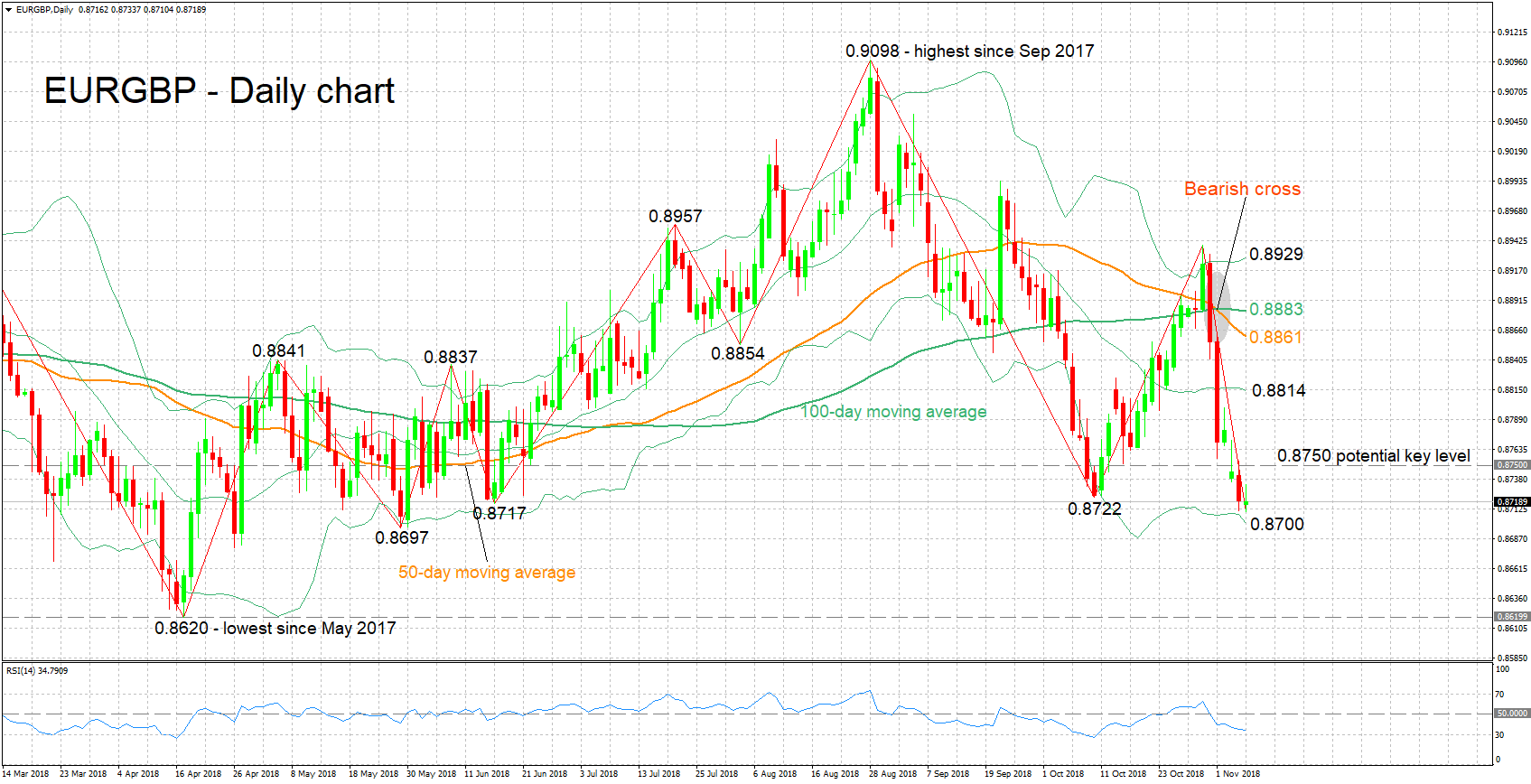
Technical Analysis: EURGBP short-term bearish at 5-month low
EURGBP extended its losses to touch a five-month low of 0.8710 earlier on Wednesday. The RSI is declining in support of a bearish picture in the short-term; notice that at 35, the indicator is relatively close to the 30 oversold level.
Concrete signs that Britain and the EU are edging closer to a Brexit deal are likely to push the pair lower. Immediate support to losses may come around the lower Bollinger band at 0.87; the area around this captures the earlier hit low of 0.8710, as well as numerous other bottoms from previous months. A downside violation would bring 0.8620, the pair’s lowest since May 2017, within scope.
On the upside and in the event of a no-deal Brexit scenario again coming to the fore, support could come around 0.8750; the zone around this was congested between late April to late June. Further above, the region around the middle Bollinger band – a 20-day moving average line – at 0.8814 would be eyed. Higher still, the attention would turn to the current levels of the 50- and 100-day MAs at 0.8861 and 0.8883 respectively.
Italian budget updates can also move the pair.