Sample Category Title
U.S. Stock Demand Recovers After Elections
Preliminary estimates of the U.S. election results support a positive mood on the world markets, reducing the demand for protective assets and causing some dollar weakening.
It should be noted that market movements are very moderate. The dollar index sank by 0.2%. Futures for S&P500 has added about the same amount.
The Democrats got control over the House of Representatives, but the Senate remained under control of the Republicans. This is the most expected result, and it is welcomed by markets, as the control of the Senate eliminates the risk that rigid regulation of the financial sector can be restored. After many surprises during the Votes in recent years, the most probable outcome looks somewhat unusual.
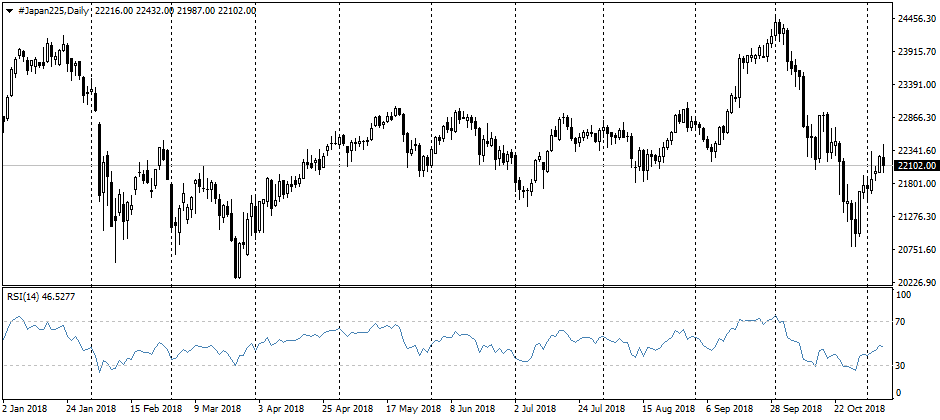
Often after the elections, even if their results meet expectations, there is some upswing in the markets, following the reduction of the uncertainty. Now the focus of the market returns to other macrotrends. At the time of writing, Chinese indices and Japanese Nikkei225 have returned the increase since the beginning of the day and have entered the red zone to preserve fears before the trade wars.
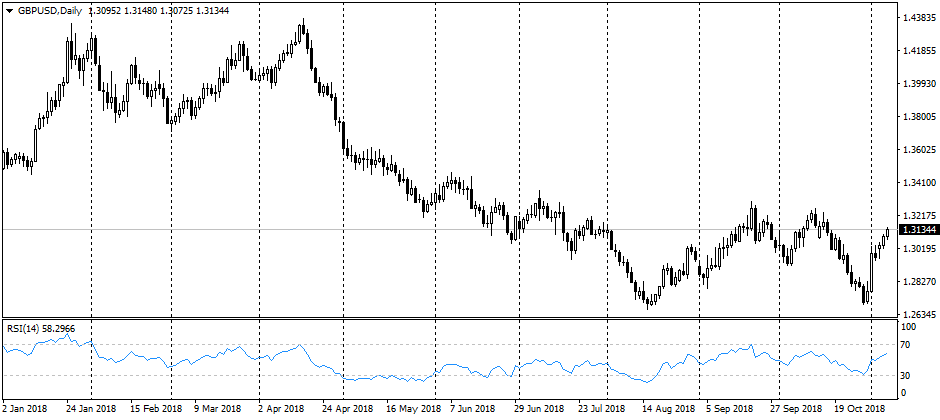
The dollar has been losing ground since the beginning of the month, following the recovery of the demand on the U.S. stock markets and the return of demand for the pound and the euro. The British currency is adding on the progress around the Brexit negotiations. Expectations of a breakthrough allowed GBPUSD to add more than 3% from the end of October and return above 1.31. At the same time, one should stay very cautious about such expectations, as there have been many unfulfilled hopes for a breakthrough in recent months on this topic.
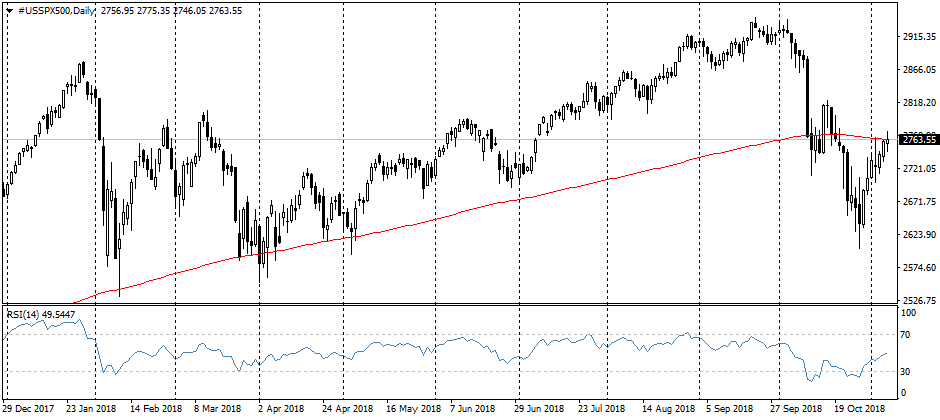
At the same time, the recovery from the October dip continues in the American markets. Futures on S&P500 Returned to the mark of 200-day average. Further growth above this line can be a positive signal, additionally supporting the demand for shares.
SNB Zurbruegg: Exchange rate situation still very fragile, current monetary policy has to continue
SNB Vice Chairman Fritz Zurbruegg said in a Schaffhauser Nachrichten newspaper interview that when EUR/CHF was at 1.2, there came the " the impression that everything is solved and the pressure is gone - the franc is no longer a safe haven". However, then, "you can see that the franc reacts very quickly as long as there are uncertainties." That showed the "exchange rate situation is still very fragile". Therefore, SNB policymakers are "convinced we have to continue with our current monetary policy."
Also, he noted the central bank is not considering to reduce its balance sheet yet. He said "there are risks that we have accepted to fight against the over-valuation of the franc, and we can live with that. And, "the size of our balance sheet doesn't limit our ability to act and we have shown that we are still ready to intervene in the currency markets if necessary." He added "that's why there is no talk at present about reducing this portfolio."
EURUSD Intraday Bullish Above 1.1431
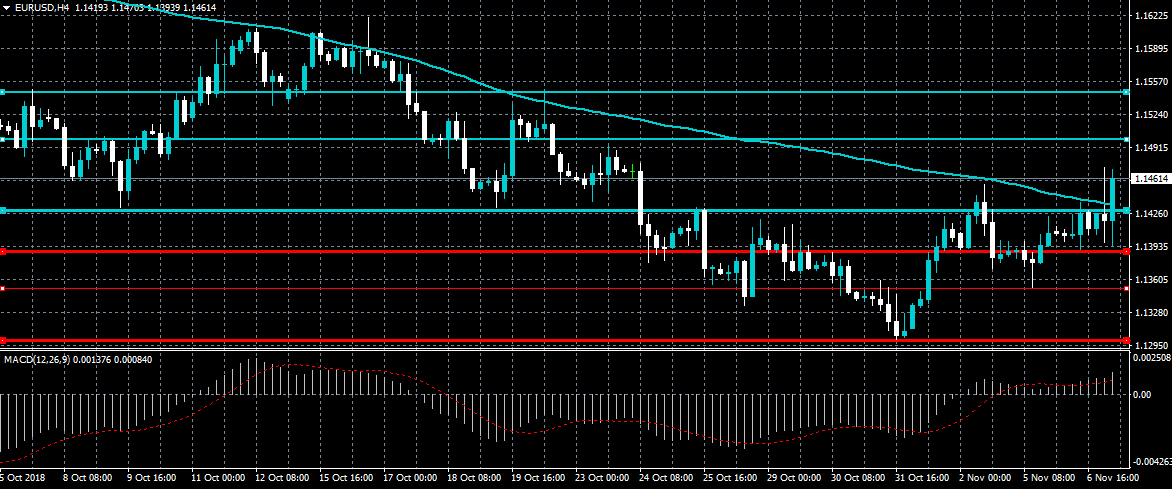
The euro currency is trading sharply higher against the US dollar in early Wednesday trade, following the results of the US mid-term elections. The EURUSD pair is strongly bullish while trading above the 1.1431 level, with traders now watching the inverted head and shoulders pattern across the four-hour time frame. Despite the bullish break higher, the EURUSD pair still faces key risk-events from EU Retail Sales and the FOMC policy meeting later this week.
The EURUSD pair is bullish while trading above the 1.1431 level, key support is found at the 1.1410 and 1.1387 levels.
If the EURUSD pair moves above the 1.1470 level, buyers are likely to test towards the 1.1500 and 1.1553 resistance levels.
GBPUSD Watching MACD Divergence
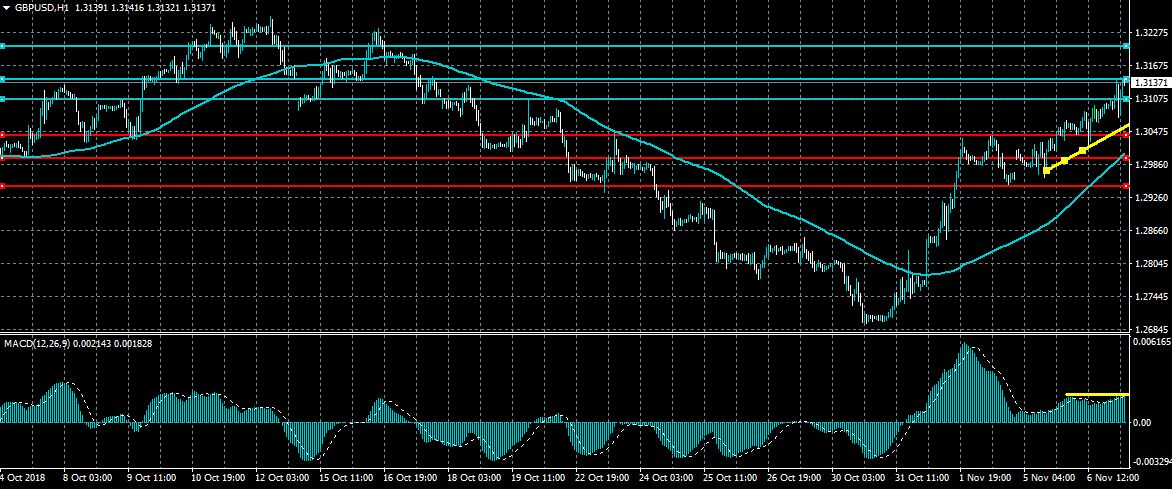
The British pound has surged above the 1.3100 level against the US dollar after the US mid-term elections results caused the greenback to sell-off across the board. The GBPUSD pair is strongly bullish while trading above the 1.3100 level, with the 1.3200 level the next large resistance barrier ahead. Caution is advised, as the GBPUSD pair is showing negative MACD price divergence on the one-hour time frame.
The GBPUSD pair is strongly bullish while trading above the 1.3100 level, key resistance is now found at the 1.3145 and 1.3200 levels.
If the GBPUSD pair moves below the 1.3100 level, sellers may test towards the 1.3060 and 1.3040 support levels.
Bullish Momentum Continues For Bitcoin
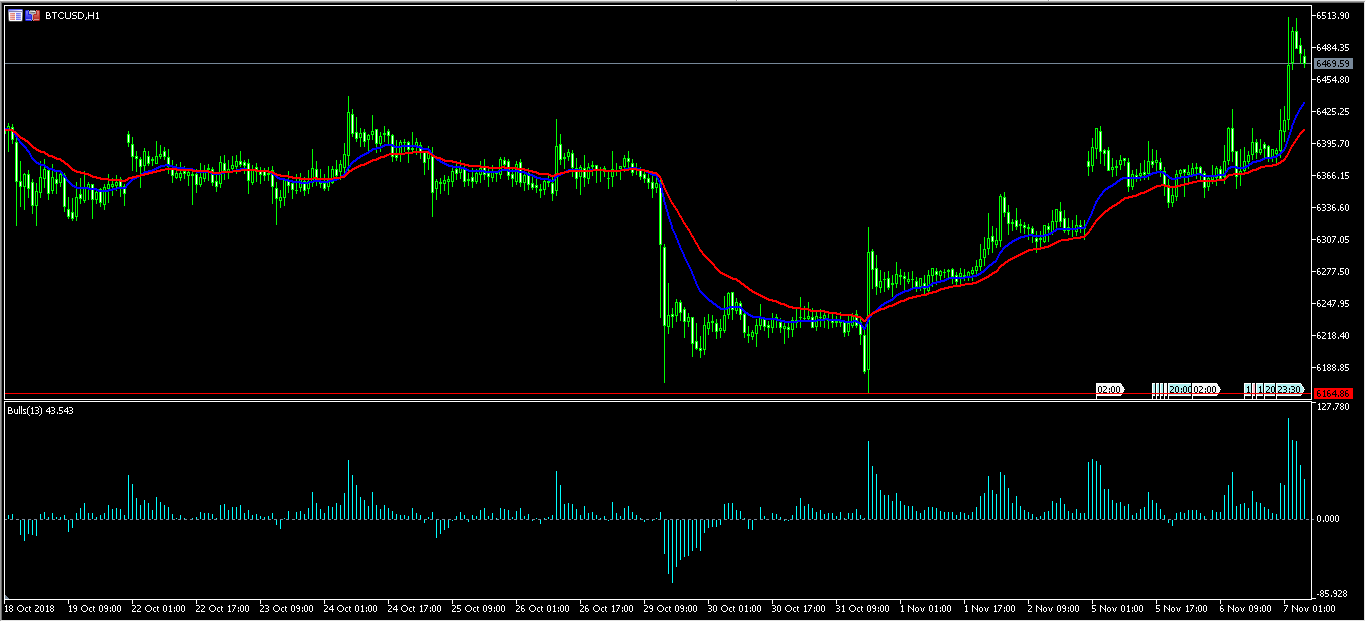
November is turning out to be a good month for Bitcoin. It started the month trading at $6160 and reached a monthly high of $6515 yesterday. Overnight, the BTC/USD pair remained near this high.
There are two major reasons for the new upward surge of the currency. First, after last month’s consultative meeting between the SEC, CBOE, and VanEck, traders believe that there is a likelihood that a Bitcoin ETF will be approved. This is mostly because the proposed ETF will be priced at $200,000, in a bid to focus on institutional rather than retail investors.
The second reason is a technical one. In October, Bitcoin had a relatively dull month with the price little changed. In fact, it was the least volatile month in years. In technical analysis, traders view a prolonged period of low volatility as the ‘calm before the storm’. This is usually an indication that the security’s price will rally in either direction. If the rally continues, it will likely test the important resistance of $7000.
This week, Hublot announced a new watch product in partnership with Hong Kong’s Octagon Strategy. The firm announced a new Bitcoin-themed watch as the world celebrates the currency’s ten years. The watch will retail at $25000 which will only be accepted in the form of Bitcoin. As a sign of success, all the watches that were manufactured have already been pre-ordered.
The BTC/USD pair is trading at 6470. This is lower than the previous high of 6515. It is also above the 15 and 30-day Exponential Moving Average. The drop has led to the fall of the Bulls Power. Going forward, there is a likelihood that the pair will attempt to continue with the upward trend. If it falls, however, the pair will test the important level of 6400.
Markets Wobble As US Election Results Stream In
Markets were volatile during the Asian session as results from the US Midterm elections streamed in. As it stands, Republicans hold the Senate majority while the Democrats have redeemed control of the House of Representatives. The outcome is likely to challenge the Trump administration in many areas including military spending and foreign business dealings.
The price of crude oil was little changed after API released its weekly data of inventories. The data showed that the inventories rose to 7.83 million barrels. This was higher than last week’s numbers that showed the inventories at more than 5.7 million barrels. In the previous week, the organization data showed a sharp drawdown in the stocks. The EIA is expected to release the official inventories today. Traders expect the data to show the inventories at 2.43 million barrels, which will be lower than the previously released 3.2 million barrels.
The New Zealand dollar rose sharply against the USD after positive employment numbers from New Zealand. In the third quarter, the unemployment rate declined to 3.9%. This was a sharp decrease from the previous 4.5% and the expected 4.4%. In the quarter, the participation rate jumped to 71.1%, which was higher than the consensus estimate of 70.9% while the employment change in the quarter rose by 1.1%. These numbers are positive for the New Zealand economy and an indicator that the RBNZ will likely start thinking about tightening. Later today, traders will get a reaction from the bank when it releases its monetary policy statement.
EUR/USD
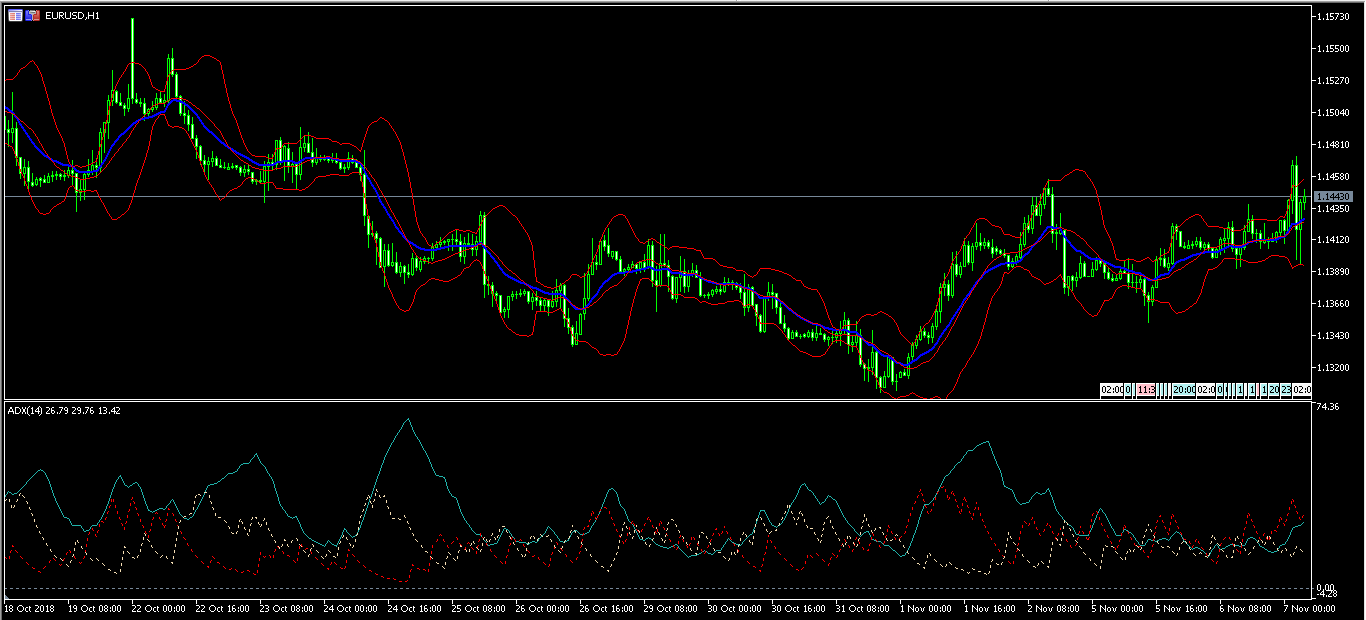
The EUR/USD had a volatile Asian session with the pair fluctuating between the 1.1472 and 1.1395 level. This is as the results from the US elections started to stream in. With no major economic data expected today from Europe and the US, the pair’s movements will be dictated by reactions to the Midterms. The pair is now trading at 1.1445, which is slightly higher than today’s low. The ADX indicator is currently at 26, an indicator that the current upward movement will not last.
NZD/USD
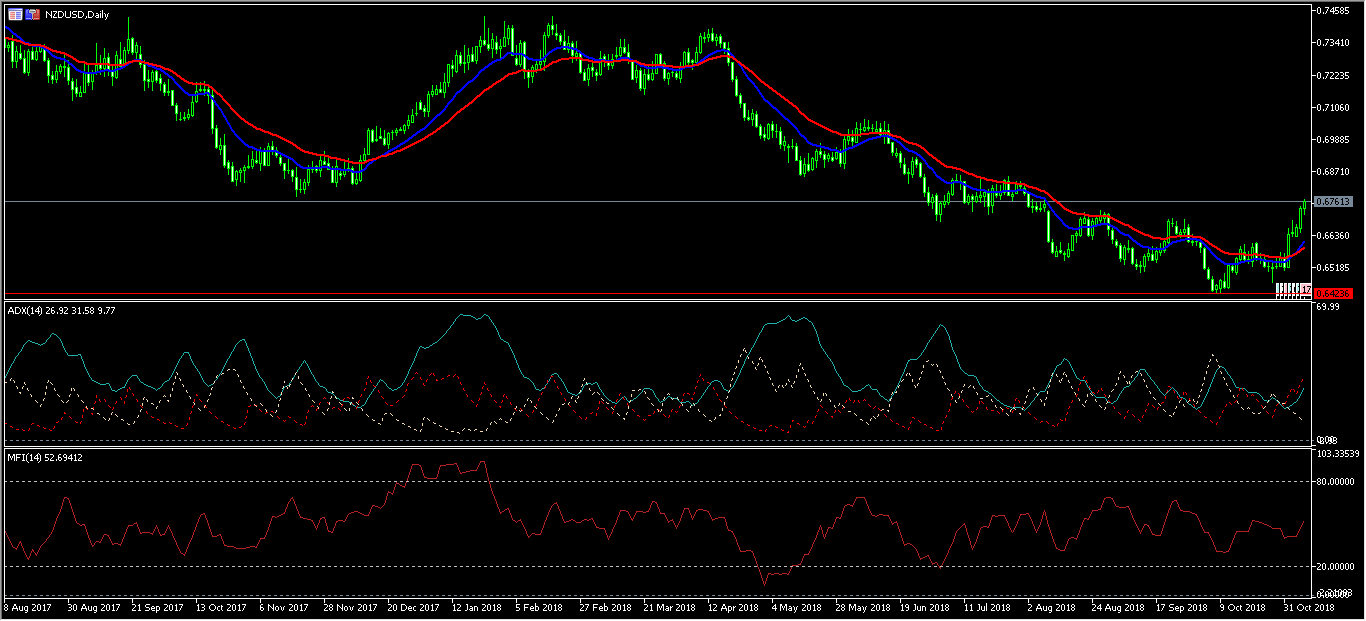
The Kiwi rose sharply against the USD after the impressive quarterly jobs numbers. The NZD/USD pair reached an intraday high of 0.6768, which was the highest level since early August. Today’s upward movement continued a momentum started in October when the pair reached a low of 0.6423. The double EMA of 15 and 30 days made a crossover on the daily chart indicating that the upward trend will continue. This is confirmed by the ADX indicator and the Money Flow Index. Further upward trends will see the pair test the important resistance of 0.6800.
XTI/USD
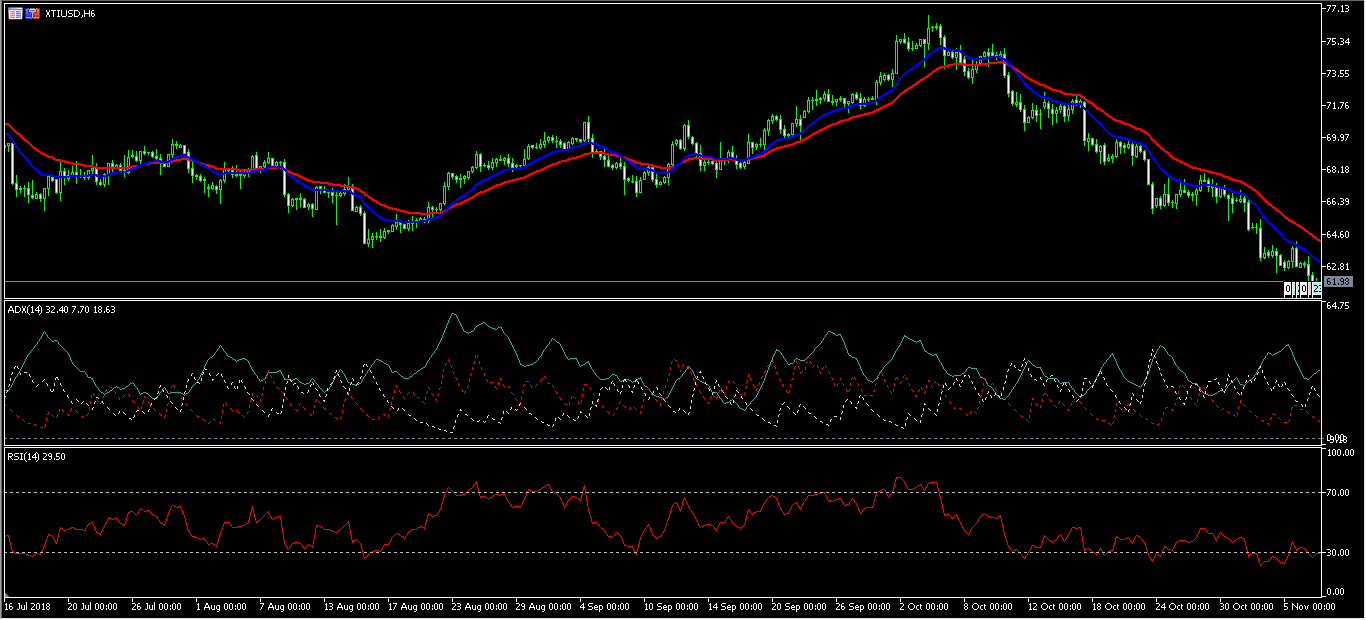
The price of WTI crude oil remained at extremely low levels after the API released the inventories numbers. The XTI/USD pair is trading at 61.98, which is near the lowest level since March this year. The pair’s moving averages show that it will likely continue moving lower. The ADX is at 31, a signal that it will continue the trend. However, with the RSI trading at the oversold level, there is a likelihood that the pair could start moving up as well. Today’s movements will depend on the official inventories numbers from the EIA.
XAU/USD Awaits Bearish Wave 5 Upon Triangle Break
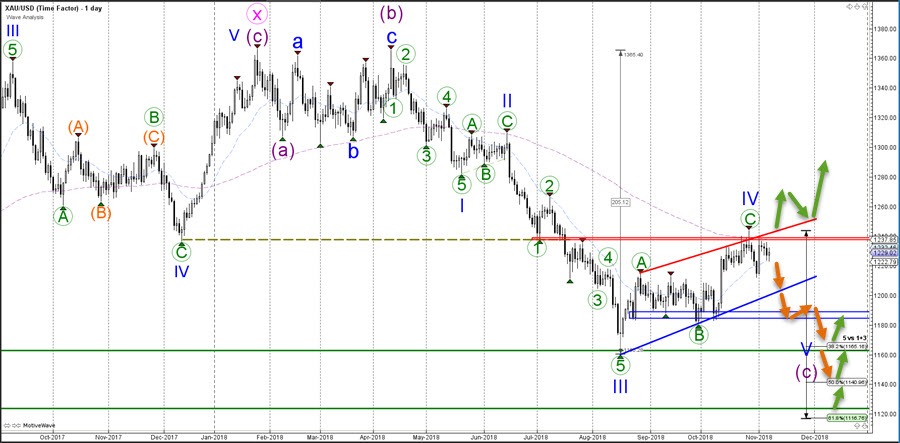
XAU/USD respected the 78.6% Fibonacci retracement level of wave 2 vs 1 (green) and reversed at the key level. A break above the 100% Fib invalidates the wave 1-2 (green) pattern whereas a break below the support trend line (blue) could confirm it.
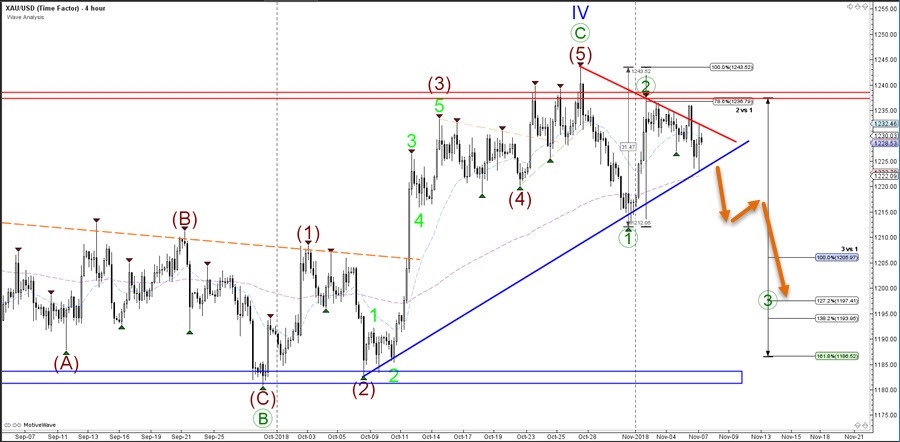
The bearish continuation is probably part of a final wave 5 (blue) of a larger wave C (purple). The downtrend could end in the support zone indicated by the green lines. A bullish break above the previous top and resistance zone (red) could indicate that the wave 4 (blue) pattern is not so likely and could lead to more upside if price builds a consolidation pattern after the bullish breakout.
AUDUSD Remains Above Long-Term Falling Trend Line, Indicators Suggest Bullish Correction Mode
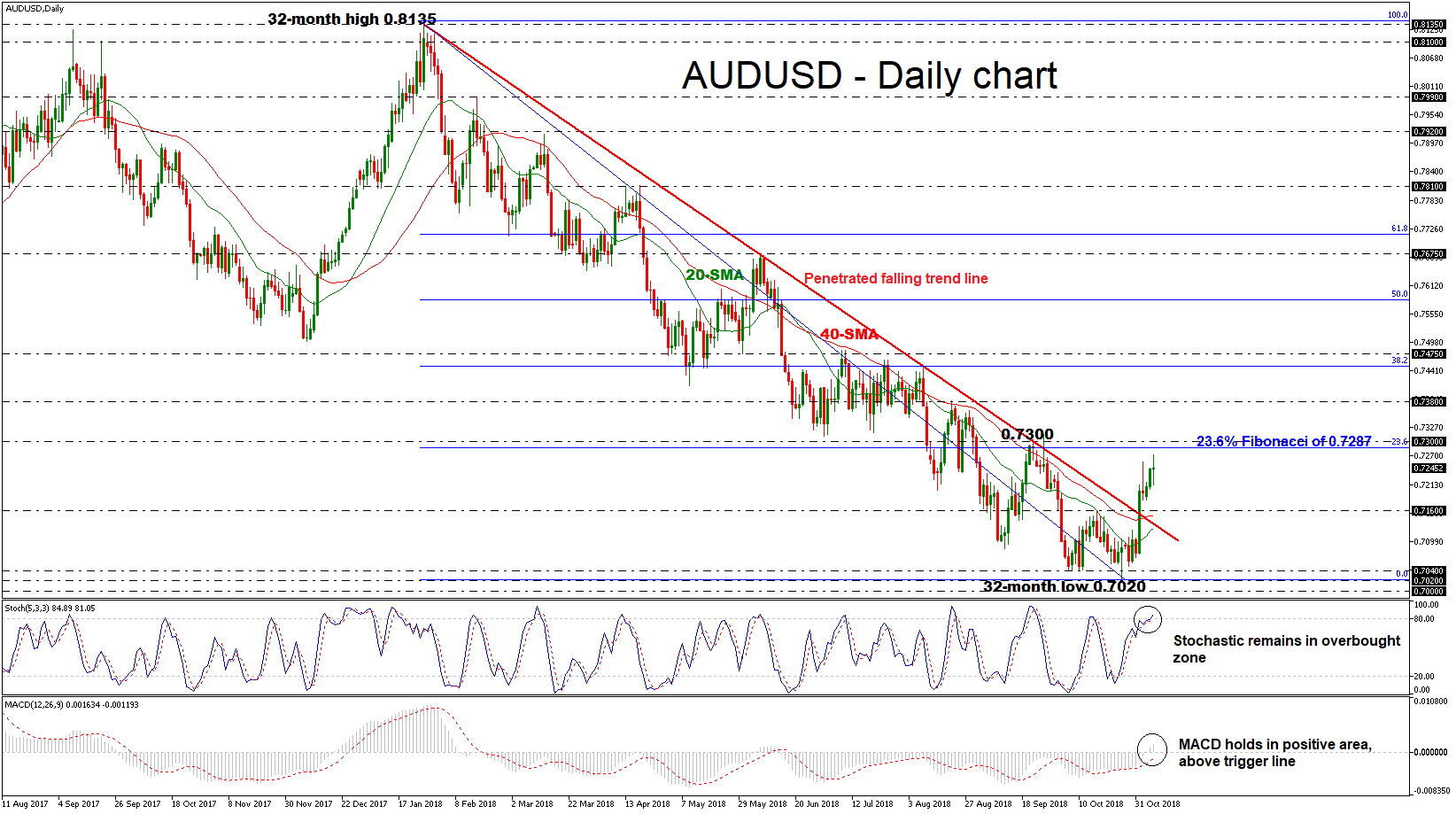
AUDUSD recorded a stunning rally last week, surpassing the long-term descending trend line. Earlier today, the pair reached a fresh six-week high of 0.7271 but returned quickly near its opening level. The price has almost violated the fall off 0.7314 turning somewhat neutral, with the technical indicators suggesting further upside to folllow up.
Looking at the daily timeframe, the stochastic oscillator entered the overbought zone with strong momentum and the MACD oscillator jumped above its trigger and zero line. Moreover, the simple moving averages (SMAs) changed direction to the upisde, supporting the recent positive price action.
If the market manages to pick up speed, the 23.6% Fibonacci retracement level of the downleg from 0.8135 to 0.7020, around the 0.7300 handle could offer nearby resistance to the bulls. A significant close above this level could raise chances for further increases, shifting focus to the 0.7380 barrier, taken from the high on August 21.
However, should prices decline, the pair could pare the last three days gains and hit support at the 0.7160 level, which stands near the 40-day SMA. A decisive move below this hurdle could open the way towards the key area within the 0.7000 psychological level and the 0.7040 mark, which encapsulates the 32-month low of 0.7020.
To summarize, AUDUSD is in progress to develop an upside tendency after it penetrated the long-term falling trendline. A climb above the 50.0% Fibonacci, which coincides with the 100-week SMA, would endorse the bullish structure
US Equity Futures And Dollar Fluctuate Amid Focus On Midterm Elections
General Trend:
- Asian equity markets trade mixed
- US midterm elections go as expected; Democrats taking control of the House, while Republicans gain a few more seats and retain control of the Senate
- China official said domestic vehicle sales may decline from 2017 levels
- China PBoC sells yuan-denominated bills in Hong Kong for the first time ever
- Reserve Bank of New Zealand (RBNZ) to hold policy meeting on Thursday
Headlines/Economic Data
Japan
- Nikkei 225 opened +0.2%
- (JP) Japan Oct Official Reserve Assets: $1.25T v $1.26T prior
- (JP) Japan Sept Labor Cash Earnings y/y: 1.1% v 1.1%e; Real Cash Earnings y/y: -0.4% v -0.3%e
- (JP) Bank of Japan (BoJ) official Funo: BoJ will continue to take appropriate policy; BOJ forward guidance indicates it will not whittle down powerful monetary stimulus for now
Korea
- Kospi opened flat
- (KR) Talks between US Sec of State Pompeo and North Korea official said to be delayed 'indefinitely' - South Korean Press
- (KR) South Korea Financial Services Commission (FSC) Chairman Choi Jong-ku hinted at cutting or removing the securities transaction tax on the Korean equity market and to discuss the matter with tax authorities - Korean press
- (KR) South Korea effectuated its temporary tax break on vehicle fuels in an effort to alleviate the economic burden, resulting in a sharp decline in the price of gasoline, diesel and liquefied petroleum gas - Korean press
China/Hong Kong
- Hang Seng opened flat, Shanghai Composite flat
- (CN) Reportedly China govt planning new tax cuts measures - Chinese press
- (HK) In Oct there were no applications for flat pre-sales in Hong Kong - Local Press
- (CN) China PBoC Gov Yi Gang: Affirms support for private sector - China Economic Information Daily
- (CN) China PBOC sells in Hong Kong CNY10B v CNY10B indicated in 3.79% 3-month bills; Sells CNY10B v CNY10B in 4.20% 1-yr bills
- (CN) China PBoC Open Market Operations (OMO): Skips OMO v skipped prior; Keeps neutral position
- (CN) China PBoC sets Yuan reference rate at: 6.9065 v 6.9075 prior
- (CN) China State Asset Supervision and Administration Commission (SASAC) Dir Xiao Yaqing: China is encouraging more foreign and private investors to take part in reforming state-owned enterprises (SOE) - speaking at CIIE
- (CN) China PBoC Gov Yi Gang: Affirms prudent, neutral monetary policy
- (CN) S&P: China home prices are at their peak, could fall up to 5% in 2019
- 388.HK Reports Q3 (HK$) Net 2.4B v 2.0B y/y, EBITDA 3.1B v 2.6B y/y, Rev 4.10B v 3.45B y/y
- (CN) China Premier Li: Ready to increase investment cooperation with Russia
Australia/New Zealand
- ASX 200 opened +1.0%
- (NZ) NEW ZEALAND Q3 UNEMPLOYMENT RATE: 3.9% V 4.4%E; Employment Change q/q: 1.1% v 0.5%e; y/y: 2.8% v 2.0% prior
- CBA.AU Reports Q1 (A$) cash profit 2.50B v 2.65B y/y
- WTP.AU Issues clarification of media reports related to the Linderman Island Project: Was recently named as the preferred contractor for the project, has not yet secured contract for main works
- (AU) Australia sells A$1.0B v A$1.0B indicated in 2.75% Nov 2028 bonds, avg yield 2.7387%, bid to cover 2.99x
- (NZ) New Zealand Q4 2-yr Inflation Expectations: 2.0% v 2.0% prior
Other Asia
- (SG) Singapore Central Bank (MAS) Menon: Debt risk has moved to emerging economies; need mechanism to help with dollar liquidity shortage
North America
- (US) Former Fed Chair Yellen: Unclear the US has tools to deal appropriately with risks
- (US) Midterm Elections: See Republicans retain control and give up control to Democrats in the House (as widely expected)
Europe
- (UK) UK Cabinet said to be close to a deal on Ireland border; ministers said to be on standby for a second cabinet meeting to sign off on agreed approach - press
- (FR) France Finance Min Le Maire: Europe will not allow US to be 'trade policeman' - FT
- (UK) BOE's Shafik: Most likely near term outcome is to delay Brexit - press
- (CH) SNB's Zurbruegg: Reiterates stance that still have room to maneuver on rates; ready to intervene on currency if needed - financial press
Levels as of 12:50ET
- Hang Seng -0.2%; Shanghai Composite -0.5%; Kospi -0.3%; Nikkei225 +0.4%; ASX 200 +0.4%
- Equity Futures: S&P500 +0.1%; Nasdaq100 +0.2%, Dax +0.1%; FTSE100 +0.0%
- EUR 1.1396-1.1473; JPY 112.97-113.82 ; AUD 0.7213-0.7272;NZD 0.6713-0.6779
- Dec Gold +0.3% at $1,229/oz; Dec Crude Oil -0.6% at $61.84/brl; Dec Copper +0.4% at $2.74/lb
US Mid-Term Elections: Divided Congress Means No Changes To Economic Policy
Key takeaways
- With a divided Congress, we should not expect changes to economic policy and hence we maintain our view that the implications for the economy and markets should be limited. US expansion is set to continue.
- Trump has criticised the Fed but it is likely to continue its hiking cycle by hiking once more this year and three times next year.
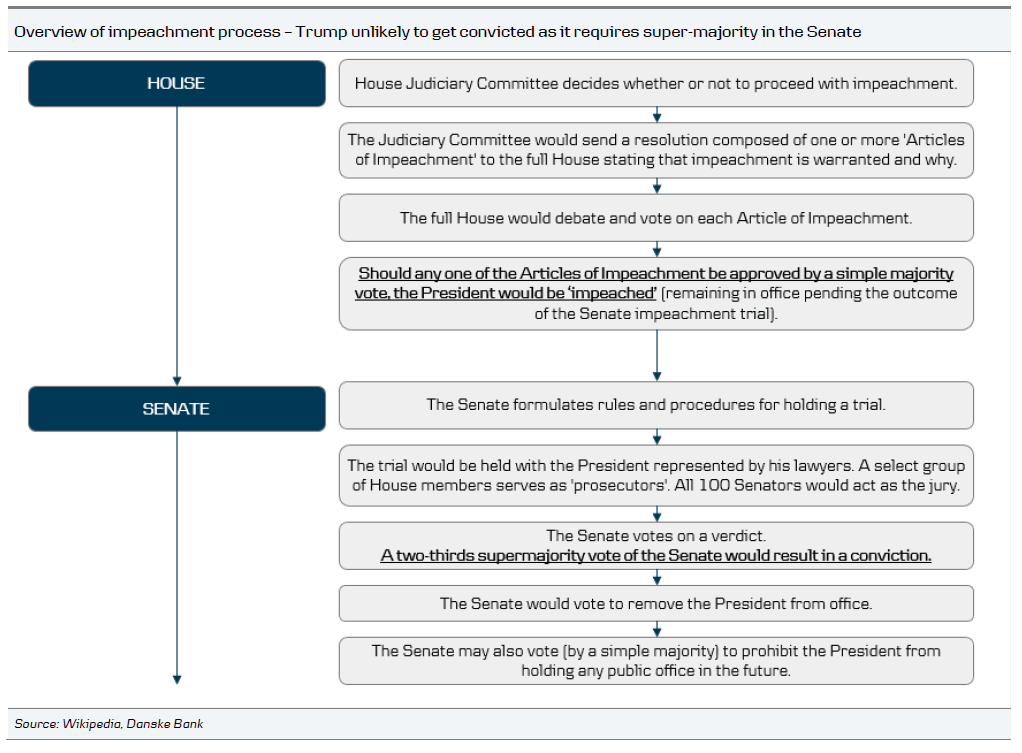
- Democrats likely to start impeachment process but Trump is unlikely to be convicted.
- We expect Trump to remain hawkish on foreign policy. Positive signs in US-China trade war lately with a 60% probability of a ceasefire.
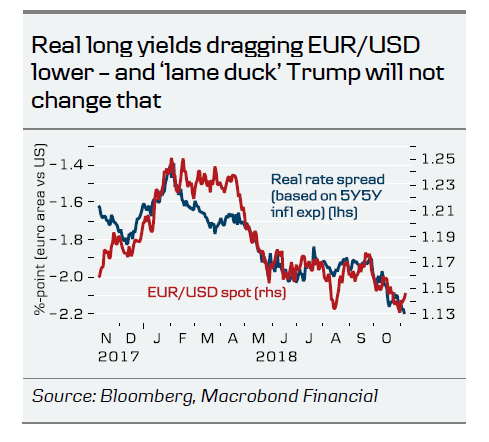
- The result is not a game changer for G10 FX markets. We still look for EUR/USD to move below 1.13 before year-end.
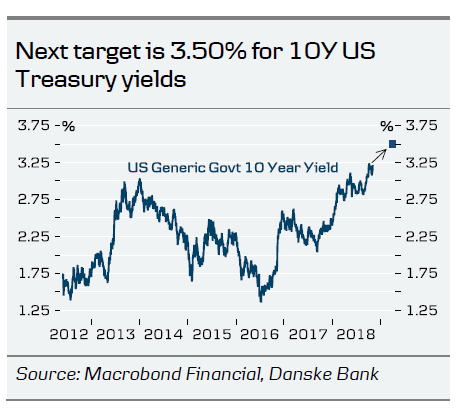
- Limited impact on US fixed income markets. We still expect 10Y UST to move towards 3.5% in 3M-6M.
- In our view, macro and monetary policy are more important for equities than politics. We are still positive on US equities.
Trump unable to get domestic agenda through Congress
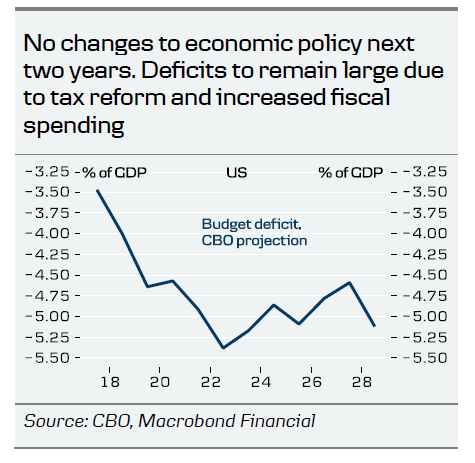
The US mid-term elections are now over and the result was more or less as expected with a divided Congress. The Democrats controlling the House of Representatives and the Republicans retaining control of the Senate. This makes President Donald Trump a 'lame duck' in the sense that he cannot get his domestic agenda through Congress. In addition, the two parties are not very good at making politics together. We maintain our view that the mid-term elections should only have limited implications for the economy and markets, as there will be no changes to economic policy in either direction over the coming two years and while volatility has risen, this is what matters for markets. We believe the US expansion is set to continue in coming years, as optimism remains high and fiscal policy remains expansionary. Private consumption will remain the main growth driver.
Despite Trump's criticism of the Federal Reserve's rate hikes, we believe the Fed is going to stick to its current strategy . The Fed seems very keen on getting the Fed funds rate to 3%, which will probably happen in June next year after hikes in December, March and June. After that, it is more stop and go depending on how the economy and markets are doing but we believe the Fed will hike once more next year (i.e. four hikes from now until year-end 2019). This is in line with Fed's own signal.
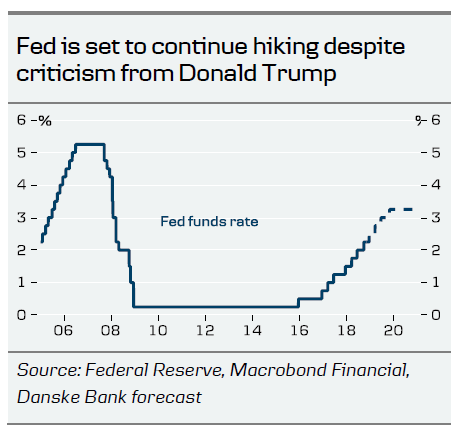
From an economic perspective, one could be worried about what is going to happen in 2020 when monetary policy has tightened further and fiscal policy is no longer expansionary.
Democrats to start impeachment process but Trump unlikely to be convicted
While the Democrats are not able to roll back Trumponomics, they will most likely start an impeachment process against Trump. While this would create a lot of headlines and noise, we do not think he will be convicted, as this requires super-majority in the Senate and the Republicans are reluctant to convict one of their own (it would probably also upset Trump’s voter base). This may change if we get a smoking gun in the Mueller investigation but we are not there yet. For an overview of the process, see chart on page 4.
Trump ready for a ceasefire with China?
As he is a ‘lame duck’ on domestic policy, Trump will most likely focus on foreign and trade policy, where he has more power without Congressional approval. US foreign policy is set to remain more hawkish than during Obama and Trump may continue to put pressure on trading partners ahead of the US presidential election in 2020. Remember, the Republicans are no longer a pro free-trade party, as 73% of the Republican voters think more protectionism is good for the US economy.
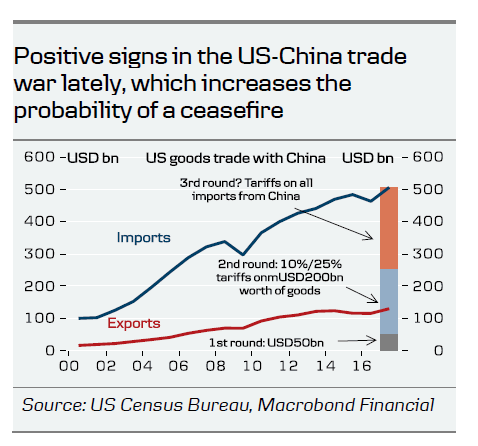
Last week, Trump signalled he might be ready for a trade war ceasefire at the Xi- Trump meeting on 1 December. According to US sources, Trump has instructed his trade officials to start drafting potential terms for an agreement. While markets welcomed the news, as it may reduce the probability of a prolonged and worsening trade war, the question is whether this was just rhetoric to improve markets ahead of the mid-term elections. We see a 60% probability of a ceasefire but any real deal will take time to reach and is unlikely to be done until some point in 2019. A 60% probability of a deal also means there is a 40% probability that the whole thing gets worse, which is quite high. In this regard, it is important to note that the Trump administration has shifted to a harsher stance against China, so it is no longer just about trade. For more, see US-China Trade: 60% chance of ceasefire at Xi-Trump meeting, 2 November.
FX: ‘Lame duck’ Trump adds marginally to list of USD positives
USD a tad weaker on as midterm result became known (with tail risk of Republican full control of Congress priced out), but as we discussed in FX Strategy - EUR/USD break of 1.13? Yes - and here's why, 6 November 2018, the widely expected mid-term result is unlikely to be a game changer for G10 FX markets: the USD is set to enjoy continued support from US cyclical and carry outperformance. A ‘lame duck’ Trump only adds marginally to the list of USD positives: new fiscal initiatives should be minimal (i.e. no tax reform 2.0) and the trade dispute should stay confined to China (i.e. not spreading). We expect a US-China trade deal further out, but this is not imminent, and hence any relief for EUR/USD from this should not be expected until well into 2019. Hence, we still look for EUR/USD to move below 1.13 before year-end.
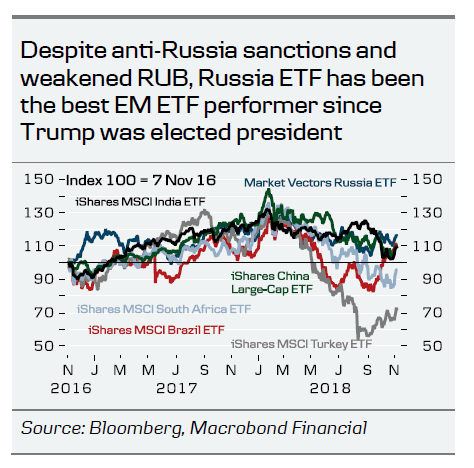
Emerging markets have reacted neutrally to the widely expected US midterm election result. The EM universe has followed USD’s mute reaction, while we have seen a rise in the RUB’s volatility ahead of the election. The post-election rhetoric in the US will be important for sentiment in Russia’s markets and the RUB. Anti-Russia rhetoric may return to the headlines on the meddling theme and the anti-Russia sanctions bill could see progress in the Congress soon, weighing on the RUB and local debt
FI: Initially lower yields, but it will be a temporary reaction
The election results should only have a modest impact on the US fixed income markets. It will be difficult for Trump to introduce new fiscal initiates but on the other hand, he can veto any attempts from the Democrats to roll back his laws/politics from the first two years. Hence, we are still faced with a significant budget deficit in 2019 and a record-high funding requirement. That said, the knee-jerk reaction to the result might be a modest support to US treasuries and slightly lower yields, as the risk of an even bigger budget deficit and subsequent tighter monetary policy should abate somewhat. However, any support is expected to be short-lived and we still expect a new leg higher in 10Y US treasury yields over the next three to six months. For more, see FI research: Next stop is 3.50% for 10Y US treasury yields, 15 October.
Limited equity impact
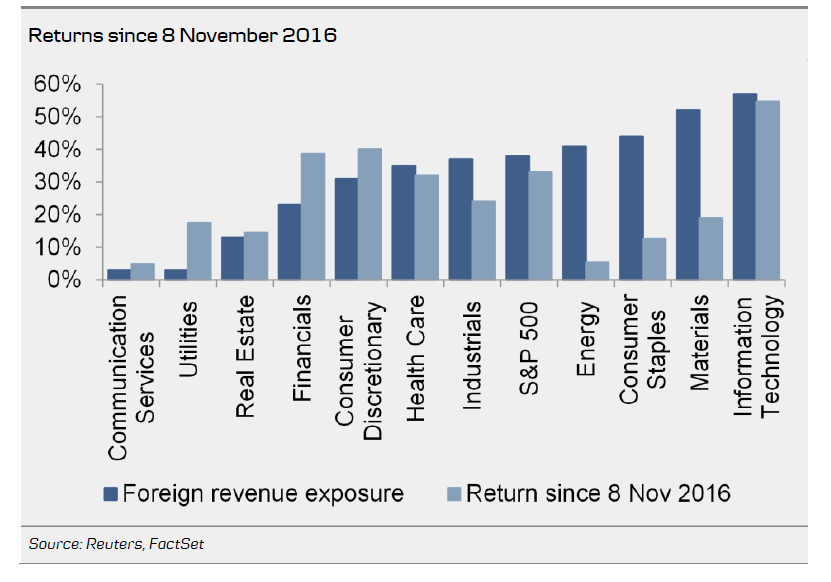
US equities are up 35% since the election in November 2016. The major drivers behind this are synchronised global expansion, tax reforms and increased US public spending. As none of these will change with the result of yesterday’s election, we see no reason to expect a significant market reaction.
With a ‘lame duck’ president, foreign policy and trade war could get even more attention. It would be straightforward to expect big cap and export-oriented sectors to suffer in this scenario but we disagree. Best performing sectors in the Trump president period and this year are cyclicals led by the tech sector, which generate the higher share of revenue abroad. At the same time, telecom is the worst performing sector despite it generating almost 100% of its revenue domestically.
This underlines our view that macro and monetary policy are much more important than politics. We recommend a slight overweight of equites and prefer Europe with a slightly cyclical tilt.