Sample Category Title
Eco Data 11/7/18
[php_everywhere instance="1"]
RBNZ Set to Keep Rates Unchanged But Could it Trim Rate Cut Bets?
Following the RBA, the Reserve Bank of New Zealand (RBNZ) will be next to decide on monetary policy this week. As their Australian counterparts, RBNZ policymakers are widely expected to leave interest rates unchanged on Wednesday at 1900 GMT under a fragile global trade environment and downbeat local business sentiment. The kiwi however could start fluctuating prior to the rate statement as the quarterly employment report out of the country and the outcome of the US midterm elections are poised to affect investors’ buying interest for the currency.
In the three months to September, consumer prices in New Zealand picked up steam for the third consecutive quarter, rising faster than analysts projected. The headline CPI rose by 1.9% year-on-year compared to 1.5% and 1.1% registered in the previous two quarters respectively, while the trimmed-mean measures, which adjust for volatility, ranged between 1.8% and 1.9%. In the wake of the data and given the comfort from a surprisingly stronger GDP growth in Q2, worries about a rate cut started to cool down even if probabilities of such a scenario were never particularly high.
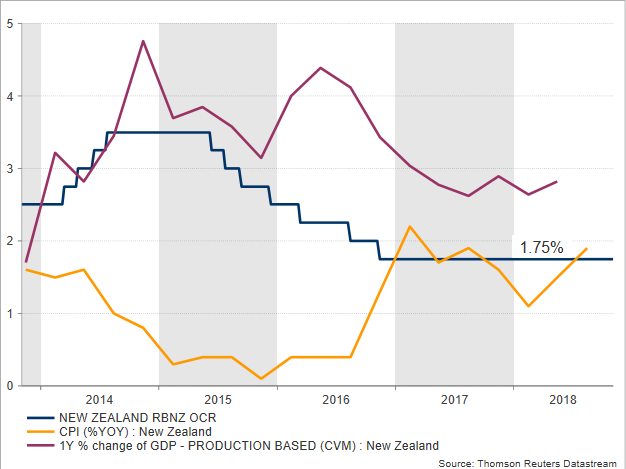
Yet, on Wednesday the Bank is widely anticipated to hold interest rates at the 1.75% record low for the second year, probably explaining that an accommodative policy is still needed to support consumption and business activities. Consumer confidence in the third quarter dropped to the lowest since the end of 2008 according to Westpac Banking corporation, while a business survey by ANZ found that companies were still pessimistic in October albeit less than in the past four months. The above evidence flags that the economy is not ready to pay higher interest rates, especially now when trade barriers between China and the US, the world’s two largest economies, have turned more restrictive, threatening to put breaks on global growth, if they have not already. New Zealand could be caught in the middle of this trade war if tensions fail to ease, something trade stats continue to support so far, with the trade deficit reaching the highest since early 2009 in October.
The progress in inflation however could alter forward guidance into favouring a rate hike instead of backing a rate cut. But before judging, the Bank will take advice from the Q3 employment report due late on Tuesday as unlike most other central banks the New Zealand monetary policy framework targets employment in addition to inflation. Should job growth surprise to the upside or more importantly wages increase at a stronger pace, policymakers might adopt a less dovish tone this time.
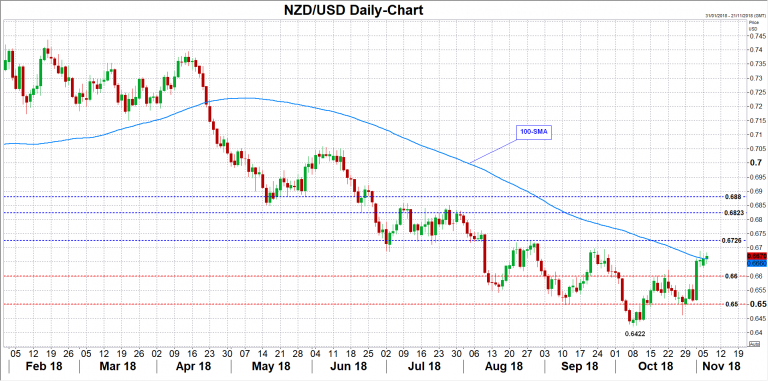
Turning to FX markets, the kiwi could benefit significantly on the back of upbeat employment readings and gain even more if the RBNZ plays down chances for a rate cut. In such a case, kiwi/dollar could rally above the 100-day simple moving average to retest the barrier between the 0.6700 round-level and the August 28 high of 0.6726. Steeper declines may also challenge the 0.6823-0.6858 zone identified by the lows on June 21 and May 23.
On the other hand, disappointing evidence out of the labour market may brush enthusiasm on inflation away, keeping the scenario of a rate cut in the table. In the aftermath kiwi/dollar could give up recent gains, running down to meet the 0.6600 psychological level. Beneath that, the focus will turn to the 0.6500 support, while a deeper decline may also stretch towards the 0.6422 bottom.
Elliott Wave Analysis: German DAX Trading at Resistance
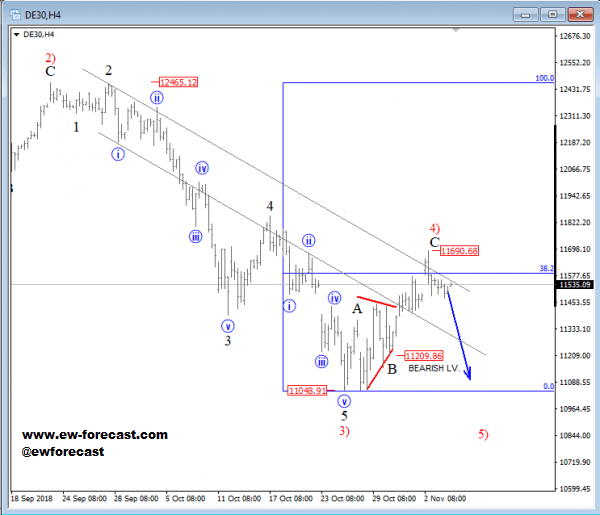
German DAX is still unfolding a wave 4) correction which can be looking for resistance and a reversal around the 11700 area; that's just above 38.2% Fib. level and close to a trendline connected from 12465 level. Also, recovery is overlapping so we would not be surprised if price would come lower in upcoming sessions. That said, a reversal in impulsive fashion would suggest a drop into wave 5).
German DAX, 4h
Gold Under Pressure as All Eyes on US Voters
Gold has posted slight losses in the Tuesday session. In North American trade, the spot price for one ounce of gold is $1227.67, down 0.34% on the day. On the release front, JOLTS Jobs Openings slipped to 7.01 million, well short of the estimate of 6.14 million. On Tuesday, U.S voters go to the polls in congressional elections, with control of the Senate and the House too close to call.
It is election day in the United States, and voter turnout appears to be heavy. Many analysts are calling the election a referendum on the presidency of Donald Trump, who has presided over a red-hot economy but has also alienated many voters with his controversial policies on health care and immigration. There are a host of races that are too close to call, but most analysts expect the Democrats to narrowly win the House while the Republicans will hold onto their majority in the Senate. If this scenario materializes, the result would be ‘political gridlock’, which could hamper Trump’s fiscal policy plans, which in turn could result in the Federal Reserve easing on its rate hike plans. Traders should expect some volatility in the currency markets once the results are announced.
Another key event this week which could affect gold prices is the Federal Reserve policy meeting on Thursday. The Fed is expected to maintain interest rate levels, with a 93% likelihood that the Fed will stay on the sidelines. However, the rate statement will be scrutinized, with investors looking for clues regarding future monetary policy, as well as the Fed’s view of the economy. If the Fed sounds optimistic about the economy, gold prices could come under pressure.
British Pound Gains Ground, Investors Eye US Elections
GBP/USD continues to post gains this week. In Tuesday’s North American session, the pair is trading at 1.3078, up 0.28% on the day. In the U.S, voter participation is expected to be heavy in the midterm congressional elections. As well, the U.S. releases JOLTS Jobs Openings. There are no major British releases on the schedule.
The pound climbed 1.1% last week, and the rally has continued, with gains of 0.75% so far this week. The pound remains attractive to investors, following reports that the U.K and the European Union have made substantial progress towards an agreement over Brexit. One of the most vexing issues facing the sides is the Irish border. The EU wants Northern Ireland to remain in a customs union with Ireland, but the U.K is unlikely to agree to any kind of border between the north and the rest of the UK. On Friday, David Lidington, a close adviser of Prime Minister May, said that the two sides were “very close to resolving” the dispute over the Irish border, one of the most vexing problems in the Brexit negotiations. May would like the EU to host a special Brexit summit this month, with an eye to signing a deal before the end of the year. However, the Europeans have not showed the same enthusiasm emanating from London, and they will likely want to see more concessions from May before agreeing to a Brexit summit.
All eyes are on the U.S mid-term elections, with voters deciding who will control Congress. Many analysts are calling the election a referendum on the presidency of Donald Trump, who has presided over a red-hot economy but has also alienated many voters with his controversial policies on health care and immigration. There are a host of races that are too close to call, but most analysts expect the Democrats to narrowly win the House while the Republicans will hold onto their majority in the Senate. If this scenario materializes, the result would be ‘political gridlock’, which could hamper Trump’s fiscal policy plans, which in turn could result in the Federal Reserve easing on its rate hike plans. Traders should expect some volatility in the currency markets once the results are announced.
Today’s top movers: GBP/JPY and GBP/CAD
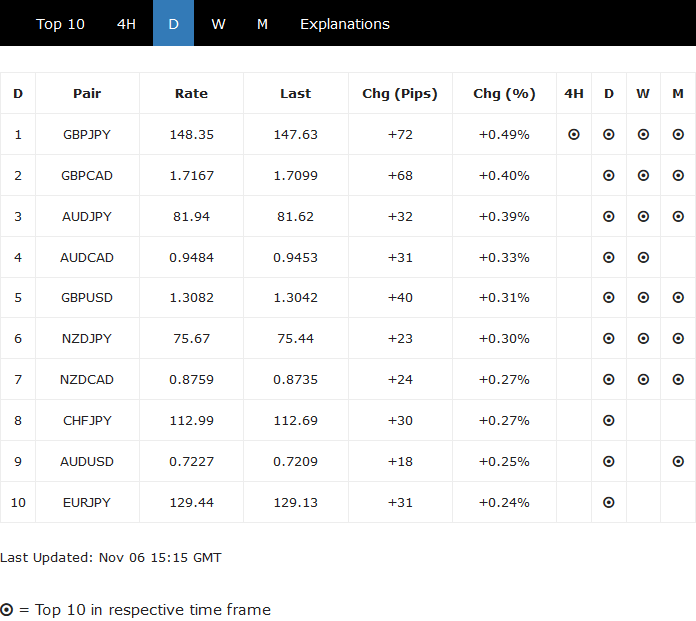
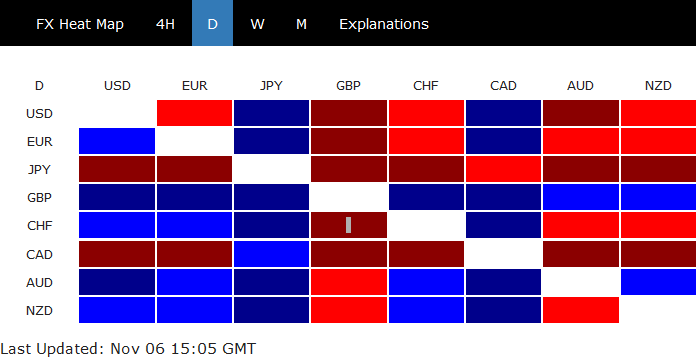
GBP/JPY and GBP/CAD are the two biggest movers today, thanks to broad based strength in the pound. Nonetheless, considering that they're up 72 pips and 68 pips only, it's indeed a very slow day.
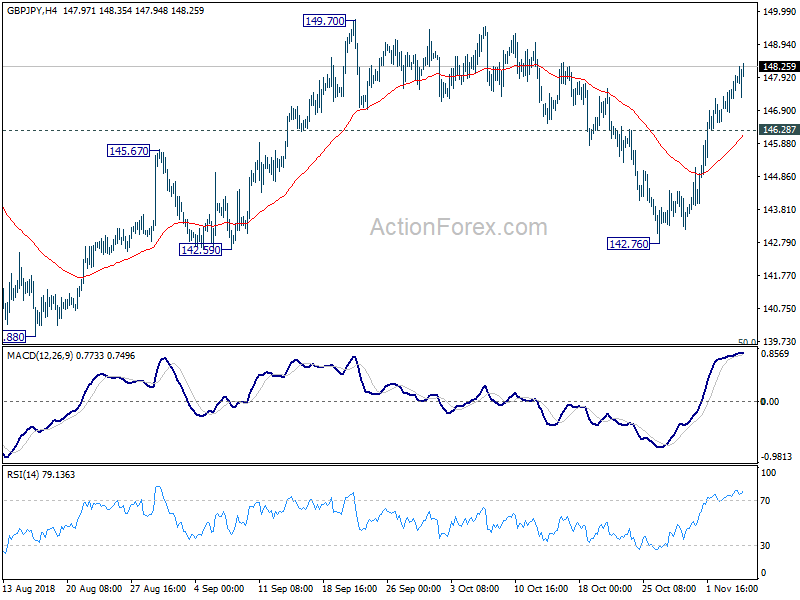
For GBP/JPY, rise from 147.26 is in progress for 1349.70 resistance. Our views as discussed in the daily report is unchanged.
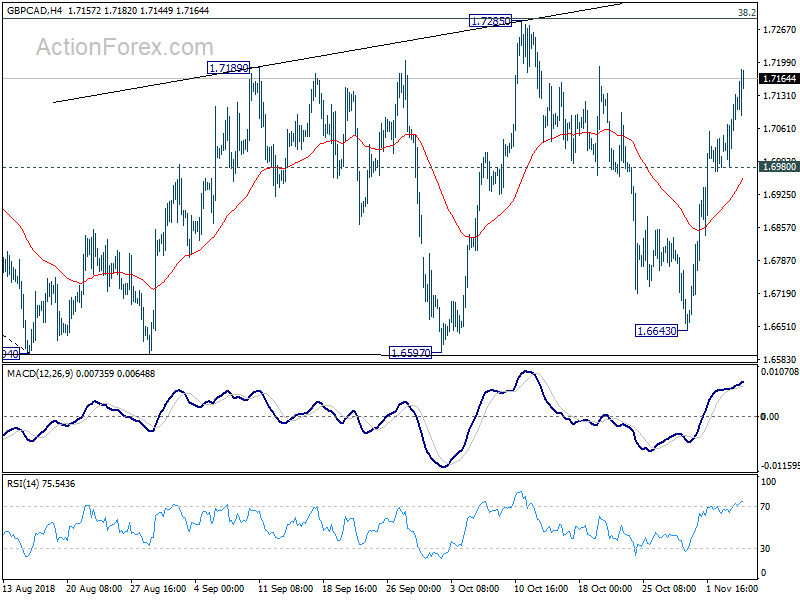
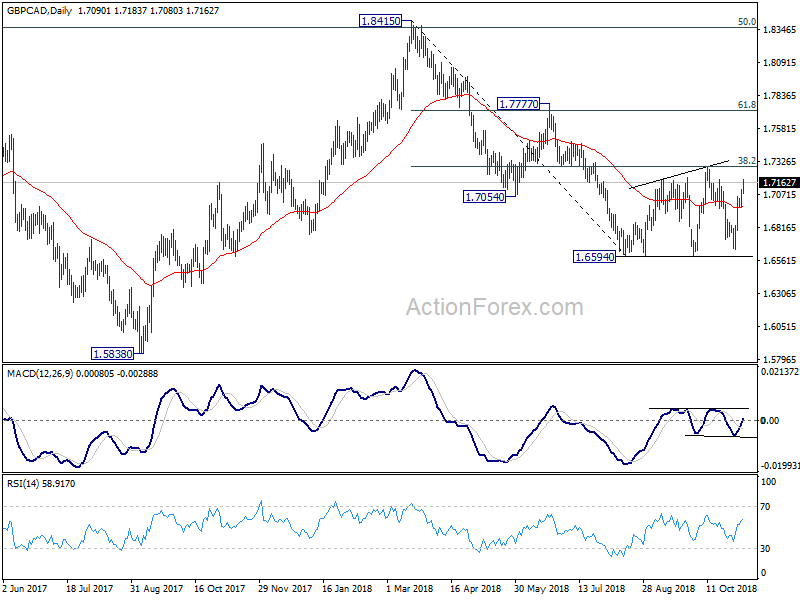
GBP/CAD's rebound from 1.6643 accelerates higher today and reaches 1.7183 so far. Further rise is likely for 1.7285 resistance. However, for now, we're viewing price actions from 1.6594 as forming a corrective pattern. That is, rise from 1.6643 is merely a leg inside the pattern. Hence, we'd expect strong resistance from 38.2% retracement of 1.8415 to 1.6594 at 1.7290 to limit upside. Break of 1.6980 minor support should bring retest of 1.6594 low.
Firm break of 1.7290 fibonacci level could bring stronger rebound to 61.8% retracement at 1.7719. But, we'll still treat it as part of the correction from 1.6594 unless we see more evidence of trend reversal, in terms of price structure. The down trend from 1.8415 is still expected to resume, just at a later stage.
EU Barnier said no operational Irish backstop, no brexit accord, but Sterling rallies anyway
More from EU chief Brexit negotiator Michel Barnier. He reiterated in a news conference that "we are still not at the 100 percent" on the Brexit agreement. And, "What is missing is a solution for the issue of Ireland." He added that "Without an operational backstop there will not be an accord and there will not be a transition period. That is certain." Besides Barnier also echoed Ireland's stance that the backstop "cannot have an end-date" and "it must be applicable unless and until another solution is found."
But Sterling pays little attention to the negative Brexit news this week. It's the strongest one for today and is extending recent rally.
Sunset Market Commentary
Markets
Global core bonds edged marginally lower today in a day clearly characterized by low volume trading ahead of the US midterm elections of tonight. German Bunds outperformed US Treasuries at opening but paired those gains throughout the day. European Commissioner Moscovici repeated a hard stance against Italy’s budget proposal and Italy’s PMI’s (final) printing lower than the first reading pushed BTP futures lower. European equities opened in red as well. This climate of risk aversion pushed the Bund higher. As there is no important economic data to steer trading today, investors remain on the sidelines awaiting the US midterm elections. A split Congress, where the Democrats take back control of the House and the Republicans holding on to their majority in the Senate remains the most likely scenario. First results will start to seep in tomorrow morning 5am. Final results are expected at Wednesday noon. Core bonds are currently trading near opening levels. The US yield curve moved little with changes ranging between -0.4 bps (30-yr) and +0.5 bps (5-yr). German yields edge less than 1 bp higher across the curve. Peripheral bond spreads widen with Italy (+8 bps) and Greece (+5 bps) underperforming.
Investors acted in some kind of no man’s land today. There were few eco data. EMU PMI’s were upwardly revised, but with little impact on the euro. Substantial political event risk was looming as the US is voting for Congress. Uncertainty on the outcome and on the consequences of the most likely outcome (a different majority in the House and the Senate) caused an attitude of overall investor caution. European stocks drifted slightly lower. US equities overcame initial weakness. Markets perhaps see less risks of an overheating US economy as president Trump faces more headwinds to implement aggressive fiscal stimulus in a split Congress. Whatever the interpretation, global sentiment was mixed and the dollar lost a few ticks in erratic trading. EUR/USD is rebounding in the 1.13/1.16 ST consolidation pattern, currently trading in the 1.1430 area. The yen recently profited only very modestly from an overall risk-off context. USD/JPY declined from the mid 113 area to the 113.15 area earlier today, but rebounds in line with US equity futures. The pair trades again in the 113.30 area
Sterling profited over the previous days from headlines/rumours that the UK and the EU were making substantial progress on a Brexit deal. That Brexit ‘optimism’ eased today. Fallout from a meeting of PM May’s cabinet suggests that the UK PM has still work to do to convince Conservative MP’s and Cabinet members that a prolonged membership of the EU customs union won’t keep the UK under EU rules indefinitely. The Northern Irish DUP party, supporting the UK government, also isn’t convinced that proposed solutions are workable/acceptable. After the recent rise of sterling, EUR/GBP entered a sideways trading pattern, mostly in the lower half of the 0.87 big figure (currently around 0.8740). Cable is trading higher in the 1.30 big figure, but this is mainly USD softness.
News Headlines
The Northern Irish DUP chief whip, Donaldson, warned that we are heading for a no deal brexit. The DUP is crucial in providing PM May the majority of her government. His comments are a reply to Irish FM Coveney’s statement that Ireland or the EU would never agree to a time-limited backstop or one that could be ended unilaterally by the UK.
Markit revised the final EMU composite PMI up from 52.7 to 53.1, driven by a correction higher for the German Services PMI (54.7 from 53.6). First publications for Spanish (53.7 from 52.5) and Italian composite PMI’s (49.3 from 52.4) were mixed. The Italian gauge drops below the 50 boom/bust mark to the lowest level since November 2013.
USD/JPY Mid-Day Outlook
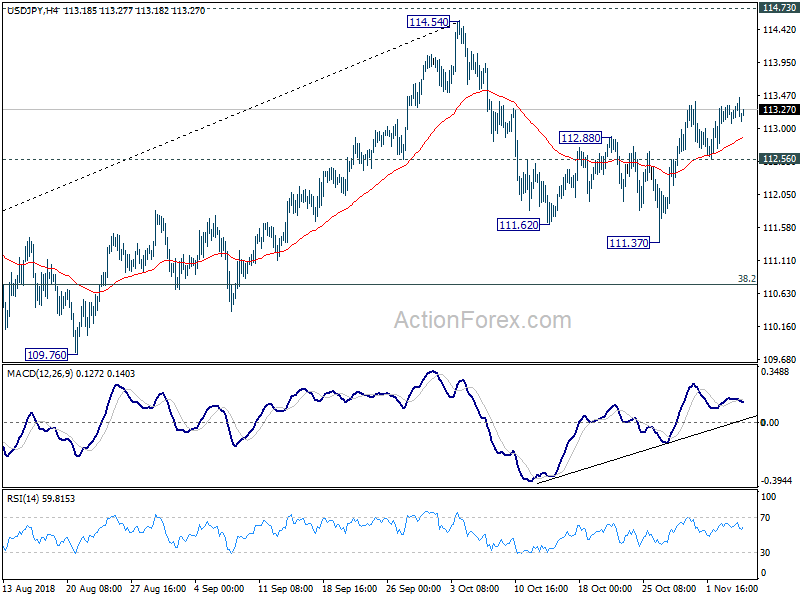
Daily Pivots: (S1) 113.07; (P) 113.20; (R1) 113.34; More..
Intraday bias in USD/JPY remains mildly on the upside as rebound from 111.37 is resuming. Further rise should be seen for 114.54/73 key resistance zone next. On the downside, break of 112.56 minor support will argue the the rebound has completed. And, in that case, the corrective pattern from 114.54 could have started the third leg for 111.37 support and possibly below.
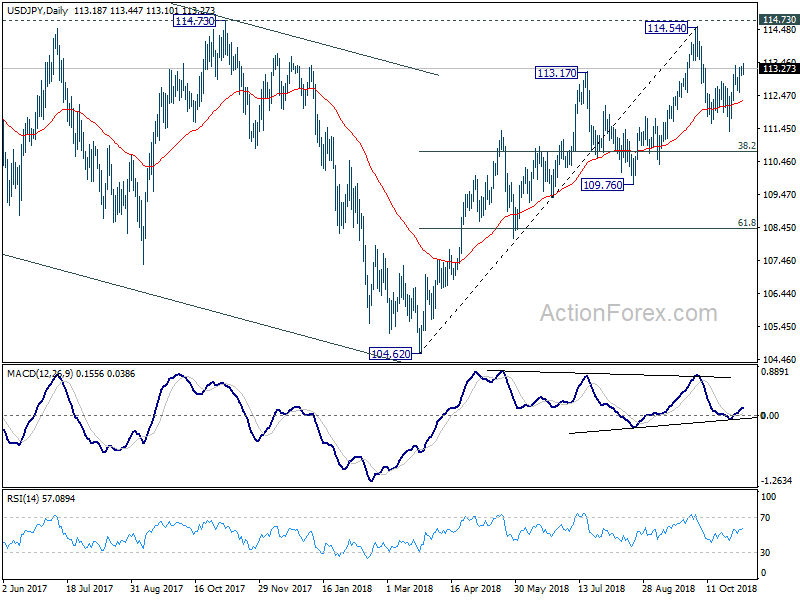
In the bigger picture, corrective fall from 118.65 (2016 high) should have completed with three waves down to 104.62. Decisive break of 114.73 resistance will likely resume whole rally from 98.97 (2016 low) to 100% projection of 98.97 to 118.65 from 104.62 at 124.30, which is reasonably close to 125.85 (2015 high). This will stay as the preferred case as long as 109.76 support holds. However, decisive break of 109.76 will dampen this bullish view and turns outlook mixed again.
USD/CHF Mid-Day Outlook
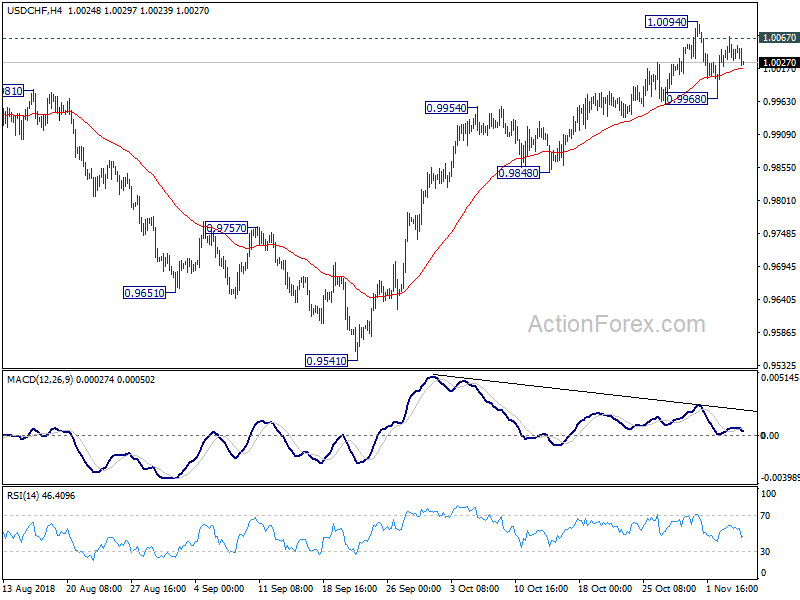
Daily Pivots: (S1) 1.0023; (P) 1.0046; (R1) 1.0069; More...
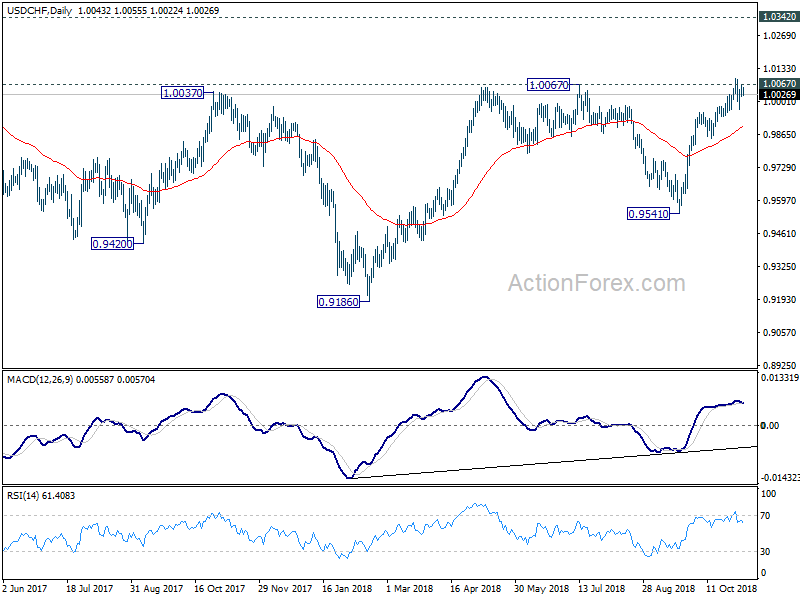
USD/CHF stays in range of 0.9968/1.0094 and intraday bias remains neutral. On the upside, decisive break of 1.0094 as well ass 1.0067 key resistance will confirm resumption of larger rise from 0.9186 and should target 1.0342 key resistance next. On the downside, below 0.9968 will extend the correction from 1.0094 towards 0.9848 support next.
In the bigger picture, the pullback from 1.0067 has completed at 0.9541 already. And rise from 0.9186 is likely resuming. Firm break of 1.0067 will pave the way to retest 1.0342 key resistance. We'd be cautious on strong resistance from there to limit upside to bring another medium term fall to extend long term range trading. However, firm break of 0.9848 near term resistance will dampen this view and bring deeper decline back to 0.9541 support and possibly below.