

Sample Category Title
Forex Technical Analysis: EUR/USD, USD/JPY, GBP/USD
EUR/USD
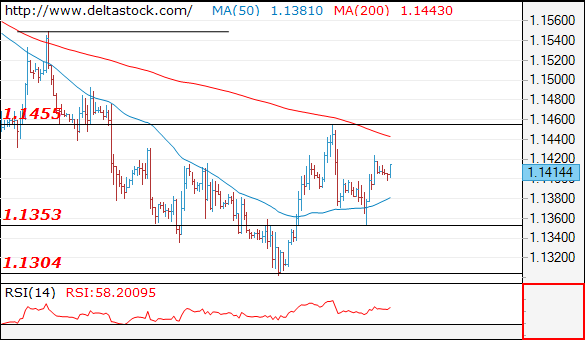
Current level - 1.1414
Yesterday's precise test of 1.1350 should provide a reliable base for continuation of the upmove, towards 1.1550 area. Initial intraday hurdle lies at 1.1450.
| Resistance | Support | ||
| intraday | intraweek | intraday | intraweek |
| 1.1450 | 1.1835 | 1.1350 | 1.1300 |
| 1.1530 | 1.2010 | 1.1300 | 1.1110 |
USD/JPY
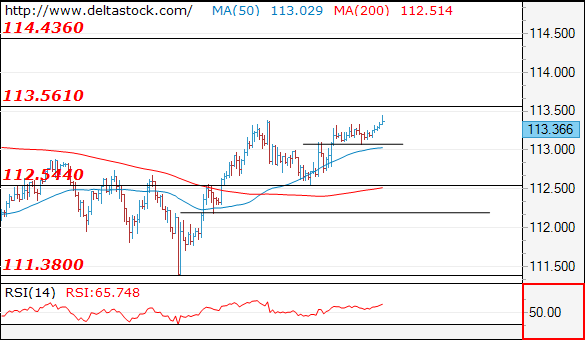
Current level - 113.36
Still counter-trend, for a violation of 113.07 static support, towards 112.50.
| Resistance | Support | ||
| intraday | intraweek | intraday | intraweek |
| 113.50 | 114.40 | 113.07 | 111.65 |
| 114.40 | 114.40 | 112.50 | 110.40 |
GBP/USD
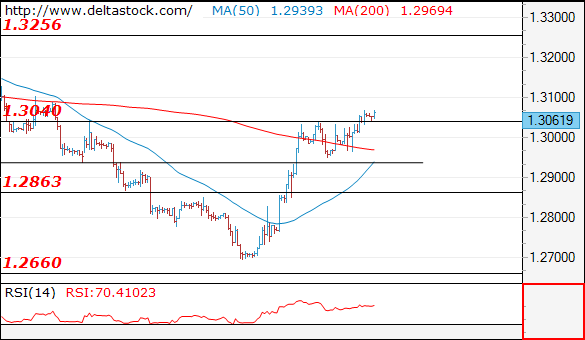
Current level - 1.3061
The violation of 1.3040 signals a completion of the consolidation pattern and the bias is positive, for a rise towards 1.3250. Crucial on the downside is 1.2970.
| Resistance | Support | ||
| intraday | intraweek | intraday | intraweek |
| 1.3100 | 1.3010 | 1.3040 | 1.2660 |
| 1.3250 | 1.3440 | 1.2970 | 1.2570 |
Investors Seek Clarity From U.S Elections
Tuesday November 6: Five things the markets are talking about
It not a surprise to see a mixed picture across global equity markets overnight as investors are very much in a ‘wait-and-see mode’ ahead of today’s U.S midterm elections.
The latest polls suggest the Democrats have a good chance of winning the House and the Republicans have a good chance of retaining the Senate. In that scenario, consensus sees the ‘mighty’ U.S dollar and interest rates easing on the view that chances for any further U.S fiscal stimulus are reduced, and thats assuming that political ‘gridlock’ has not already been priced-in.
But, if the Republicans surprisingly hold Congress, the dollar, stocks and Treasury yields would get a lift on the promise of Trumponomics 2.0.
Elsewhere, Euro bourses have edged a tad lower alongside U.S futures, while Asian stocks advanced, taking their cues from Wall St. Monday.
Sterling again has found some support on further Brexit hopes, while U.S Treasury yields and the ‘big’ dollar are steady.
1. Stocks mixed results
In Japan, the Nikkei average rebounded overnight, tracking gains stateside Monday, despite Apple suppliers falling on a report that the tech giant has scrapped plans to boost production of its new iPhone. The Nikkei rose +1.1%, recouping much of the previous sessions -1.6% losses. The broader Topix gained +1.2%.
Down-under, Aussie shares ended higher overnight as metals and mining heavyweights rallied on higher iron ore prices, although trading volumes were cautious ahead of today’s U.S. mid-terms. The S&P/ASX 200 index rose nearly +1% at the close of trade. In S. Korea, it was a similar scenario, the Kospi index ended higher, up +0.61%, but gains were capped on investor caution. The index is down nearly -10% in the past month.
In China, stocks ended lower overnight despite a number of policy moves to support equity markets amid worries over the possible impact of a new technology board. At the close, the blue-chip CSI300 index was down -0.6%, while the Shanghai Composite Index lost -0.2%.
In Hong Kong, stocks erased early losses and ended higher overnight on promised targeted policy steps to support private companies. At the close, the Hang Seng index was +0.7% higher, while the China Enterprises Index was up +0.8%.
In Europe, regional bourses trade mostly lower, following U.S futures in cautious trade ahead of today’s U.S mid-term elections.
U.S stocks are set to open in the ‘red’ (-0.3%).
Indices: Stoxx600 -0.3% at 362.3, FTSE -0.3% at 7081, DAX -0.5% at 11445, CAC-40 -0.5% at 5077, IBEX-35 -1.1% at 8913, FTSE MIB -1% at 19082, SMI -0.1% at 9002, S&P 500 Futures -0.3%
2. Oil prices fall on Iran sanction exemptions, gold unchanged
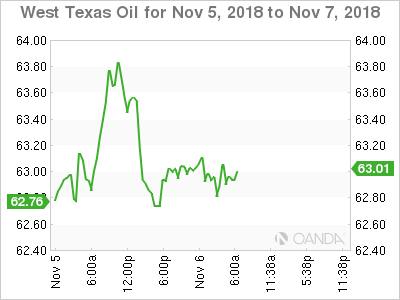
Oil prices remain under pressure, weighed down by sanction exemptions from Washington that will allow Iran to keep exporting to some of their largest clientele, as well as by concerns that an economic slowdown may curb fuel demand growth.
Brent crude oil futures are down -48c, or -0.7%, at +$72.69 a barrel, while U.S West Texas Intermediate (WTI) crude futures are at +$62.86 a barrel, down -24c, or -0.4% from yesterday’s close.
The Trump administration has given a six-month reprieve to eight importers – China, India, South Korea, Japan, Italy, Greece, Taiwan and Turkey. These are Iran’s biggest buyers.
While Iran’s crude exports could fall to little more than +1M bpd this month, the market believes that figure could rise again next month as importers – including China, Japan and South Korea – use their waivers to order crude from Iran.
Note: On the supply-side, oil remains plenty despite Iranian sanctions as output from Russia the U.S and Saudi Arabia continues to rise.
And finally, growing concerns over the prospect of a global slowdown amid the ongoing Sino-U.S trade war are also weighing on prices.
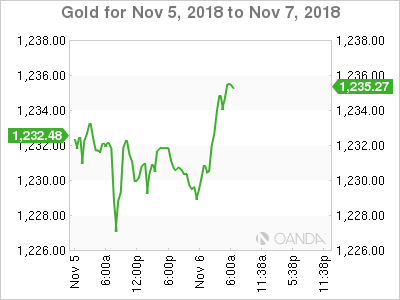
Ahead of the U.S open, gold prices are little changed before today’s U.S midterm elections that may fuel interest in the ‘yellow’ metal as a hedge against risk if the result sparks volatility. Spot gold is unchanged at +$1,233.20 per ounce, while U.S gold futures are up +0.1% at +$1,233.8 per ounce.
3. Italian yields rally on budget worries
Italian government BTP yields again have backed up after eurozone finance ministers called on Italy to change its budget, while broader eurozone bond markets are little changed ahead of U.S congressional elections.
Note: Eurozone finance ministers called on Italy to change its 2019 budget before a deadline set for next week to conform to E.U rules.
Italian BTP yields are +5-6 bps higher on the day. Italy’s 10-year bond yield has rallied as high as +3.39% this morning, pushing out the gap over German Bund yields to +295 bps from 289 bps late yesterday.
Germany’s 10-year Bund yield is holding steady at +0.43%, up +1 bps this morning, while French 10-year government OAT yields are also up +1 bps at +0.80%.
Elsewhere, the yield on U.S 10-year notes has increased less than +1 bps to +3.20%, while in the U.K, the 10-year Gilt yield has gained +1 bps to +1.515%, reaching the highest in more than two-weeks on its seventh consecutive advance.
Down-under, the Reserve Bank of Australia (RBA) left its Cash Rate Target unchanged at +1.50% (as expected) and reiterated their stance that low rates are supporting the economy. They raised 2018 and 2019 GDP forecasts from +3.0% to +3.5%.
4. U.S dollar remain little changed
The ‘mighty’ buck is little changed as investors focus shifts to the U.S midterm elections.
The market expects an +85% chance that Democrats take the House and +85% chance Republicans hold the Senate. However, if the GOP surprisingly holds onto its majority in Congress, the USD, equities and Treasury yields are expected to get a lift on the promise of Trump 2.0.
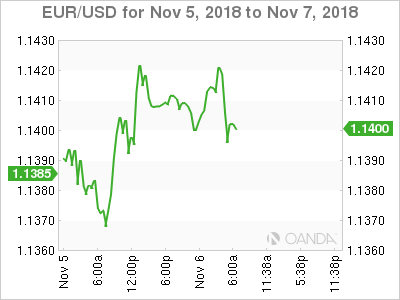
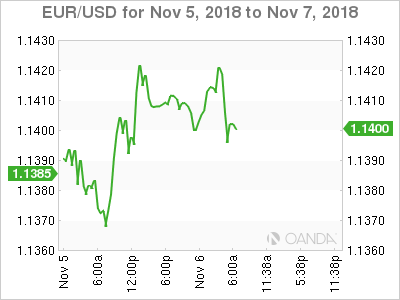
EUR/USD is unchanged, trading atop of the psychological €1.1400 handle.
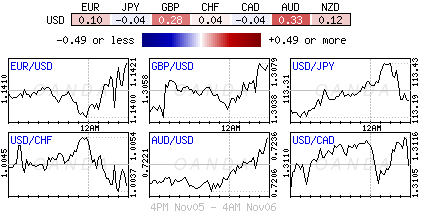
GBP/USD (£1.3031) is a tad lower on news from U.K Trade Secretary Fox that there are still a number of Brexit issues to be addressed. He reiterated that it was unacceptable for any deal to treat Northern Ireland differently.
The Japanese yen has dipped -0.1% to ¥113.26, the weakest print in more than a month.
5. Eurozone growth weakens to lowest in over two years
Data this morning from IHS Markit Eurozone PMI Composite Output Index showed that last month saw the euro area economy expand at its slowest rate for more than two-years.
Despite coming in higher than the earlier flash estimate of 52.7, October’s final reading of 53.1 was down from the previous month’s 54.1 to the lowest since September 2016.
Digging deeper, both the manufacturing and service sectors recorded slower rates of growth during the month.
Following on from September, manufacturing registered the weaker increase in output, posting its lowest growth in nearly four-years, while despite remaining at a solid level; the service sector saw its slowest expansion since the start of 2017.
By country, the strongest increase in activity was again seen in Ireland, while both France and Spain recorded firmer gains in activity.
In contrast, Germany saw growth slump to a five-month low, whilst Italy registered a fall in activity for the first time in four-years.
EUR/USD – Euro Unchanged As Investors Cautious Ahead Of US Vote
EUR/USD continues to have a quiet week. In the Tuesday session, the pair is trading at 1.1402, down 0.05% on the day. On the release front, Germany and eurozone services PMIs both beat their estimates and pointed to expansion. Eurozone PPI improved to 0.5%, beating the estimate of 0.4%. In the U.S, all eyes will be on the U.S midterm congressional elections. As well, the U.S. releases JOLTS Jobs Openings. On Wednesday, Germany releases industrial production and the eurozone publishes retail sales.
German indicators were lukewarm on Tuesday. Factory orders posted a gain of 0.3% in September, easily beating the forecast of -0.4%. Still, this was a significant drop from the August reading of 2.0%. The trend was similar in the services sector, as Final Services PMI dropped from 55.9 to 54.7 in October, marking a 3-month low. The reading did, however, beat the forecast of 53.6. On Monday, Sentix investor confidence pointed to a sharp drop. The indicator fell from 11.4 to 8.8 points, its lowest level since October 2016. The index has dropped sharply in 2018 – early in the year, the index was above the 30-point level. The eurozone economy slowed to 1.7% in the third quarter, down from 2.2% in the second quarter. There are concerns that the slowdown will continue into Q4, which could weigh heavily on the euro. The currency dropped 2.5% in October, but has started November with modest gains.
The markets are keeping a close eye on the U.S mid-term elections, as voters go to the polls on Tuesday. Many analysts are calling the election a referendum on the presidency of Donald Trump, who has presided over a red-hot economy but has also alienated many voters with his controversial policies on health care and immigration. The labor market is at or beyond capacity, and Friday’s employment numbers underscored the strength of the labor market. Nonfarm payrolls surged to 250 thousand, crushing the estimate of 194 thousand. Wage growth has also strengthened, with strong gains of 3.1% in the past year.
U.S. Mid-Term Election Carnage Playbook
I think it may not be wrong to say that these elections would act as a vote of confidence for Mr Trump.
The U.S. mid-term election is the biggest political event of the year over in the United States. The victory result of this election would not only have an impact on the economic condition of the United States but also in several other countries around the globe. In my opinion, I feel it may not be wrong to say that these elections would act as a vote of confidence for Mr Trump. Americans will have a chance to have their say about Trump's policies and show their support for the president. If we look through the lenses of promises that he made during his campaign, I think it is safe to say that most of his supporters are very pleased.
But let's keep our focus on the markets and discuss the landscape for the markets on the back of these elections. Historically speaking, mid-term elections do not usually carry much weight and we have not seen any significant impact on the dollar price or the financial markets. What I mean by this is that there weren't any immediate significant moves in the market as the results were announced. Of course, over the course of 9 months or 12 months, the market would react to the mid-term election results. Looking back in the history (since 1922) the market average performance 9 months prior to the mid-term election was 0.3% and 12 months after it was 17.1%. However, this year we are talking about Trump administration and given the amount of controversy we have around this government, these elections for the first time could bring some dramatic movement in the financial markets.
The U.S. economy is in a much stronger shape and this is a key reason that we have not seen much of the risk off trade kicking in. For instance, the dollar index has traded mostly lower against major pairs except against the Japenese Yen and Swiss Franck. Looking at other risk-averse assets such as VIX- the SPX volatility index has eased off from it's highs of $25 to $19.86. The precious metal, gold is also trading near its 1,230 level from it's previous high of $1,240. The Federal Reserve Bank over in the U.S hasn't shown any concern about the mid-term elections either. So, this strengthens the argument that the Fed has every plan to remain on the interest rate hike path.
In the absence of any important economic release, the majority focus remains on the U.S. mid-term elections. So the question is what to expect from this and how to play the results?
Accordingly, to the latest opinion calls, the Democrats could take control of the House and the Republicans would continue to control its majority in the Senate. However, the polls are nothing but indications and by learning from the past experience, one cannot rely on these opinion results either.
Nonetheless, one thing is pretty sure that the Republican-controlled Senate is good for the dollar bull rally purely because they support Trump's ideology. In other words, if the Republicans take the control of both governments, it would be highly positive for the dollar because this means that the Trump policies would control the U.S. In terms of number, the dollar-yen pair could easily touch the level of 114 and the euro-dollar pair could drop to 1.1350. Both numbers have significant importance because major support levels are there. Similarly, the equity market could continue to move higher and the bull momentum could easily push the indices like of S&P500 and Dow Jones to several new record highs.
If the Congress is split, Republicans controlling the Senate and Democrats in the house; this would simply mean gridlock for future Trump policies. President would never be able to see his policies becoming a reality - like a lower tax for the middle class along with several other controversial policies which he holds in the pipeline. However, the bearish momentum or the sentiment may not be able to last longer as the focus would shift towards the overall conditions of the economy which is strong. The worst-case scenario for Trump administration would be where Democrats control everything meaning the House and Senate. This would push the dollar index significantly lower and push the equity markets into the bear market territory.
Bitcoin Less Volatile Than Nasdaq And SPX
Bitcoin's volatility is at its lowest level, this increases the odds for the Bitcoin ETF to become a reality.
Bitcoin- a derivative which is known for its volatility has lost this crown. The 10-day historical volatility for cryptocurrency king is below the S&P500 and NASDAQ indices.
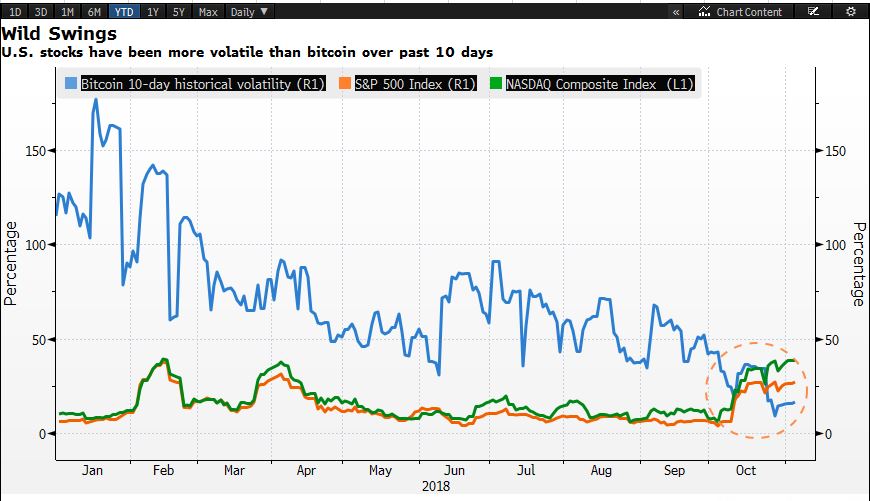
This may be just enough for all of those who always criticised bitcoin not satisfying the definition of money. We also think that the lower Bitcoin volatility also improves the chances of Bitcoin ETF being approved by the SEC. Of course, it has been a long time that we have been craving for this ETF to hit the market, because it would not only improve the liquidity in the market, but it also stamps the fact that the regulators are on board with the use of the digital currency.
Remember, the only reason that we have seen the Bitcoin price dropped so low is due to the global regulatory pressure. If the SEC improves its stance towards the cryptocurrency, it would be a huge signal of confidence and it then it would be only a matter of time that we will start to see a more softer stance from other regulators.
NZDUSD Recovers Higher Towards 0.6698 Resistance Zone
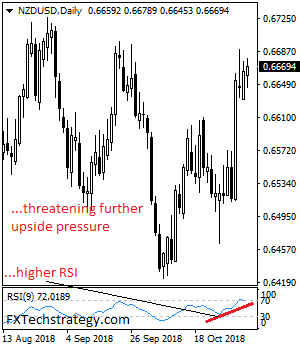
NZDUSD recovers higher towards 0.6698 resistance zone as the pair holds on to its upside pressure. Resistance comes in at the 0.6700 level where a break will turn focus to the 0.6750 level. A break of here will have to happen to open the door for a move towards the 0.6800 level. Further out, resistance stands at the 0.6850 level. On the downside, support lies at the 0.6700 level. Further down, the 0.6750 level comes in as the next downside target. And then the 0.6800 level. All in all, NZDUSD faces further upside pressure on further corrective recovery.
US Midterm Election
Euro under pressure as Italy's budget deadline approaches
EUR/USD is currently bouncing off a 1.1312 low (31 October), heading toward 1.1430 short-term. Italy's deficit budget proposal of two weeks ago has pushed the single currency down against major currencies. Meanwhile, the German Bund spread continues to widen as investors handicap Italy's bankruptcy risk: at 2.92, its highest in 30 months. If Italy does not fall in line with the European Union's budget guidelines, it will face fines as high as 0.20% of GDP, pushing the government further into bankruptcy which would weigh on the EUR.
The EU Commission is waiting for an Italian budget resubmission, due for 23 November. But Prime Minister Giuseppe Conte says there is alternative and that no changes will be made. The Commission will rule on all EU-members' budgets on 21 November.
US Midterm Elections
The US midterm elections could be a critical event. Especially should the result deviate from consensus. Tomorrow election results will be viewed as the first major electoral test of President Donald Trump's policy including trade policies and tax relief. While the race for the house has remained stable polls indicate that the senate has shifted back toward republicans maintaining control.
Base scenario - Democrats gaining a majority in the House and Republicans holding the Senate.
Nate Silvers FiveThirtyEight's general model gives the Republicans an 82% probability of retaining a majority in the Senate, up from 68% on Labor Day.
FiveThirtyEight's general model gives Democrats an 82% probability of taking control of the House, up from 72% on Labor
Day Poll closing times differ by state, fluctuating from 23.00-06.00 cet. Yet, 65 out of the 111 House seats considered competitive are in states were poll closing times are 01.00 cet. Which means that given the heavy US converge (experts, forecasting, modeling).
Therefore, we should have a solid understanding of incoming results are consistent with polling by approximately 02.00 cet. That said there are a few competitive races that will be later (California with 11 competitive seat close at 0.400 cet) so if the results are tight market will have to wait to react. According to experts Virginia, Florida, North Carolina and Ohio will be critical for the House in the pre-01.00 cet results while Texas, Pennsylvania, New Jersey, Illinois and Michigan will be critical for the 01.00 group.
Should the results go around the current polls the market reaction will be limited with slight improvements in USD especially against CNY. In addition, the stability of a republican control or a split should help equity prices. The highest generating of vol will be should democrats gain control of both House and Senate. We see this would be both negative of USD and US assets. CHF has been stable ahead of US events that could drive demand in the safe haven currency against risk if the uncertian result sparking volatility in wider financial markets.
A strong republican win is likely to see an continuation of Iran Sactions (driving oil prices higher) and further weakness in stocks on 2019 event risk.
Kiwi Looks To New Zealand Jobs Data To Sustain Upside Momentum And For RBNZ Clues
Traders will be turning to quarterly employment numbers out of New Zealand on Wednesday (21:45 GMT, Tuesday) to decide whether the kiwi’s rebound from the October lows can be extended. More significantly, the jobs data could provide an indication as to whether the Reserve Bank of New Zealand will maintain a dovish tilt or turn a little hawkish at its policy meeting a day later on Thursday.
Economic indicators out of New Zealand have been a bit more encouraging in recent months following the moderate deterioration of the economy seen during and after the September 2017 general election. GDP expanded by more than expected in the second quarter to the highest rate in two years, surging by 1% over the period, and inflation accelerated by more than anticipated during the third quarter. Annual inflation hit 1.9% in the three months to September, taking the CPI rate closer to the middle of the RBNZ’s 1-3% target band. Although the core price gauges remained subdued, the inflation data overall helped trim the odds of a near-term rate cut by the RBNZ.
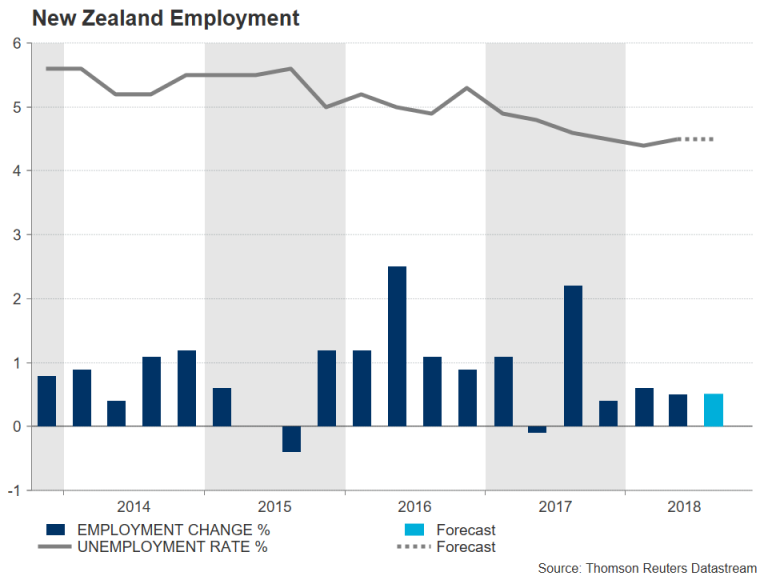
Wednesday’s employment report could further diminish talk of a possible rate cut if, as expected, the jobless rate holds steady at 4.5%. The rate of jobs and wage growth will also be watched for assessing the health of the labour market. Jobs growth stood at 0.5% in the second quarter and a similar pace of growth is forecast for the third quarter. An unexpected slowdown in employment growth would not bode well for third quarter GDP performance.
Even more significant will be the quarterly wage figures. New Zealand’s labour cost index rose by 0.6% quarter-on-quarter in the April-June period, taking the annual rate to a 6-year high of 2.1%. Wages will likely rise again by 0.6% on a quarterly basis but the annual rate is forecast to slow slightly to 1.9%. A sharper deceleration would weaken the outlook for inflation and, while the base case scenario for the next RBNZ move is still a hike, it would keep open the prospect for a rate cut.
The New Zealand dollar is vulnerable to negative surprises in Wednesday’s data, especially as risk sentiment remains fragile given the receding expectations of a quick resolution to the Sino-US trade dispute and a choppy recovery in global equities. Kiwi/dollar could break above immediate resistance at around 0.6695 if the employment figures beat the consensus forecast. A rise above the 0.67 handle could see the pair stumbling at the 0.6725 and 0.6760 hurdles before attention turns to the critical 0.68 level.
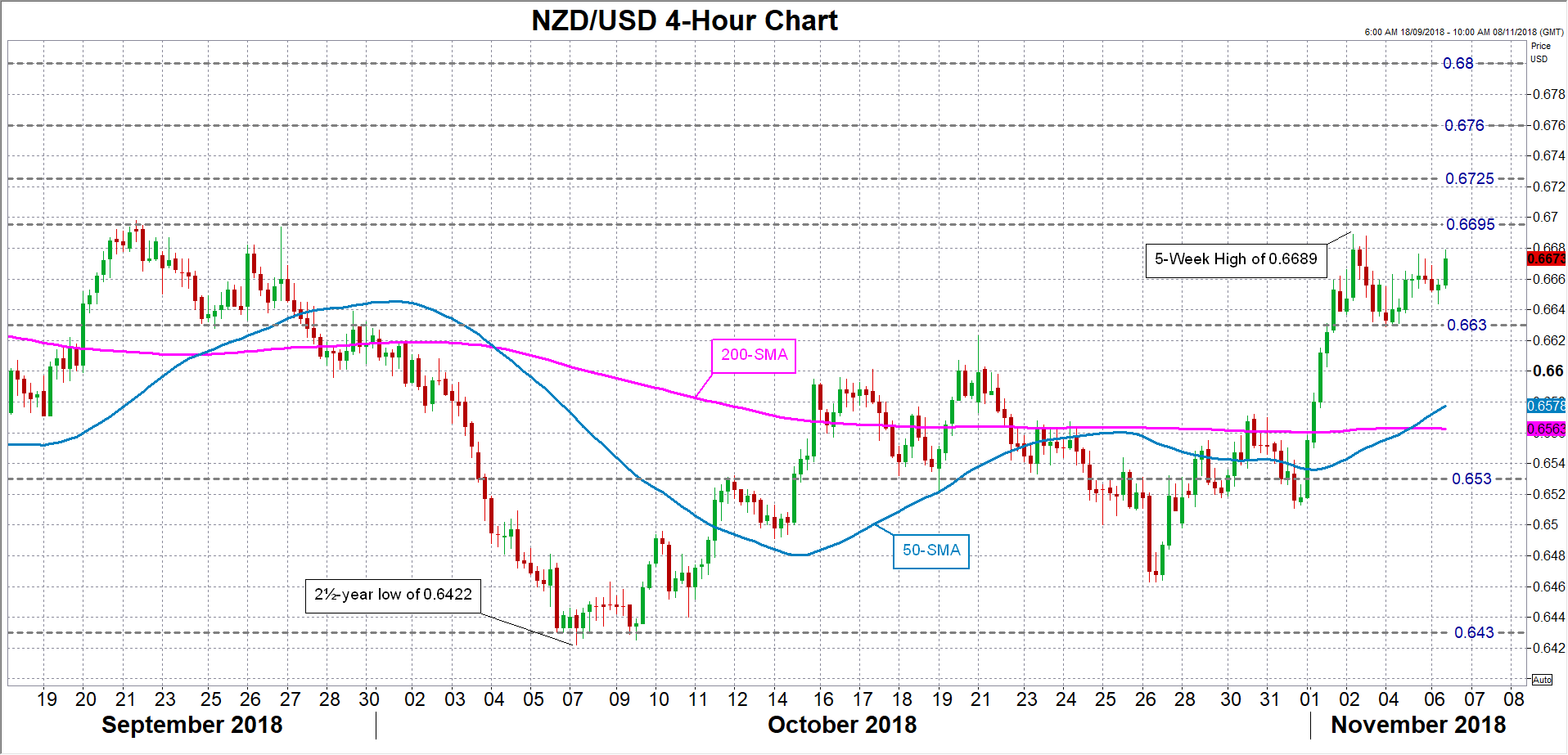
However, should the jobs numbers disappoint or raise doubts about the economic outlook, kiwi/dollar could seek support initially around the 0.6630 level. A drop below this mark would take the pair towards the 0.6565 region, which is where the 50- and 200-period moving averages intersect. Further down, the 0.6530 level could stall further declines as this area has acted as support in the past. A breach of this support would open the way for October’s 32-month low of 0.6422 and reinstate the pair’s medium-term bearish structure.
WTI Crude Oil Futures Hover Above 7-Month Low, Bearish Outlook In Place
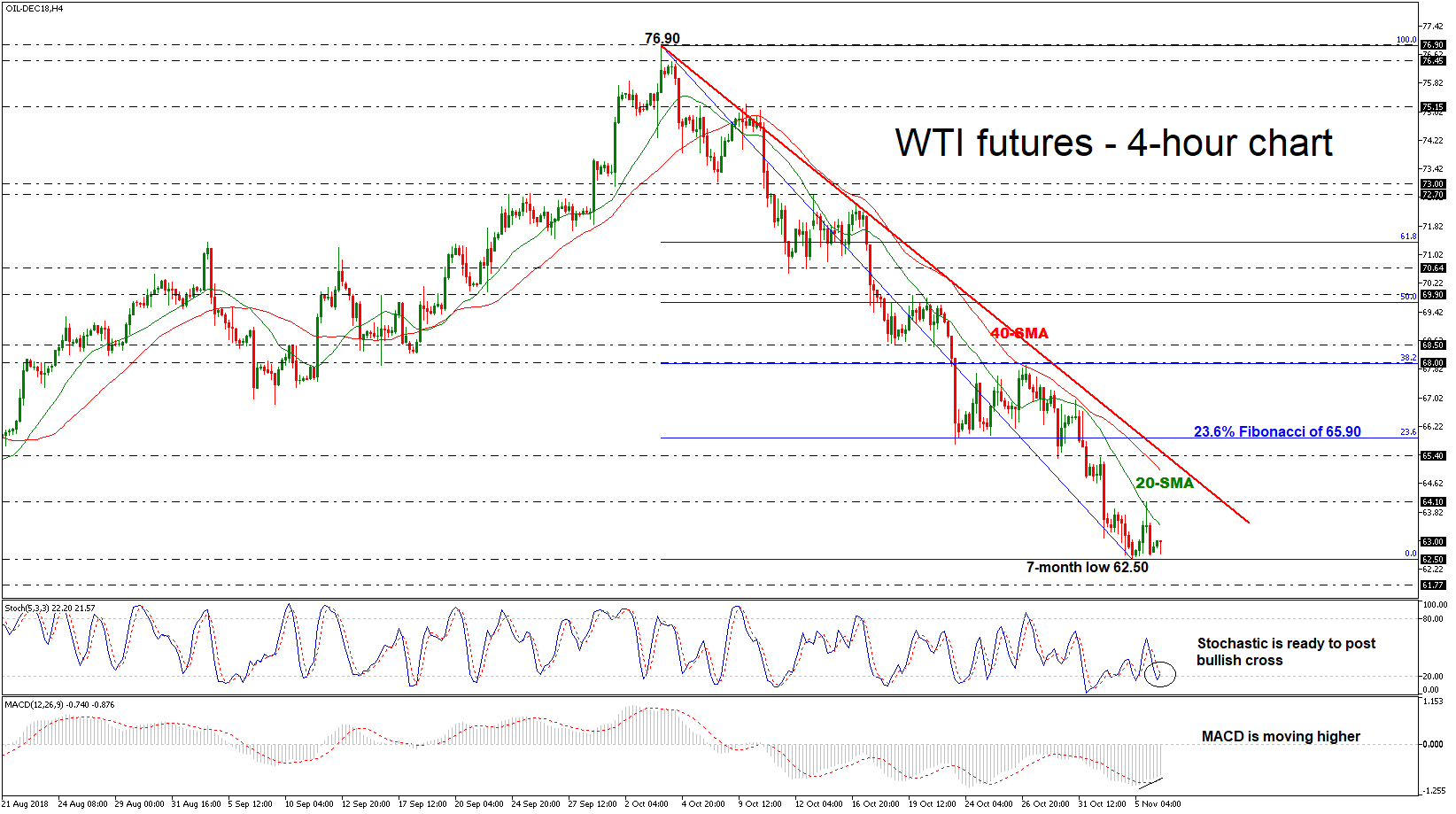
WTI crude oil futures sank to a new seven-month low of 62.51 on Monday, recording the sixth consecutive bearish day. Prices remain below the simple moving averages (SMAs) in the 4-hour chart and are hovering slightly above the aforementioned low.
Having a look at the technical indicators, the blue %K line of the stochastic oscillator is turning up, ready to create a bullish crossover with the red %D line. Moreover, the MACD oscillator stands above the trigger line in negative territory. These are signaling a potential change of momentum to the upside in the short-term and the very short-term.
Should the price manage to strengthen its negative bias and post a significant leg below the seven-month low, the next support could come around 61.77, taken from the low on April 6. A break below this area would shift the bias to a more negative one and open the way towards the 60.15 barrier.
On the flipside, if prices rebound from the recent low, they could touch the 20-SMA near 63.44 at the time of writing, before heading towards the 64.10 resistance level. Further improvement could drive oil prices until 65.40, given that the 40-SMA at65.00 is broken first. A penetration of this hurdle could send the price even higher until the 23.6% Fibonacci retracement level of the downleg from 76.90 to 62.50, around 65.90, breaking the short-term descending trend line to the upside.
To summarize, WTI crude shifted the bullish outlook to negative, especially after the slip below the 64.00 psychological level. In the short-term, the price has been mostly declining since October 3.
Why $70 Is So Important For Brent
October was a brutal month not only for the U.S. IT-Companies. Crude oil prices also had significant and important shifts.
After renewing the 4-year highs, Brent Crude Oil has lost more than 16% to date. By the beginning of October, its rally had been the strongest in more than 6 years, according to the RSI index. However, as in 2012, such a sharp growth was a harbinger of a serious twist of fate.
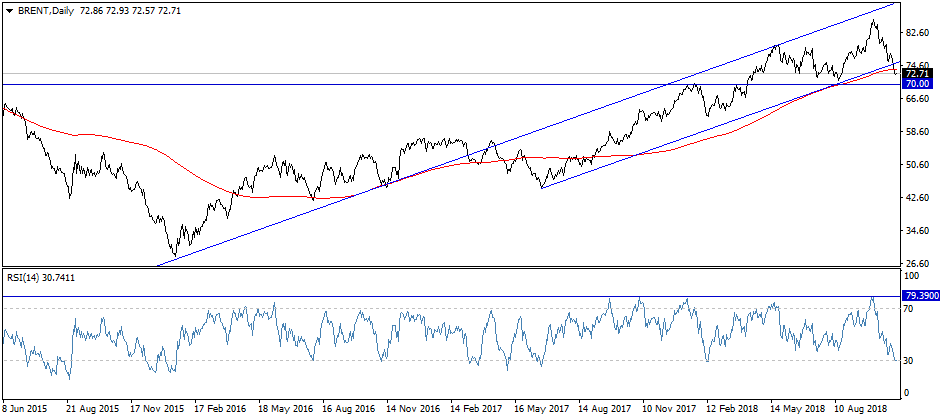
Losing for the previous 6 trading sessions in a row, the Brent price is now quickly approaching the important mark of $70 dollars per barrel, the dynamics near which may be the key for the next few months.
The current trend of oil growth was formed in the middle of last year and since then we have seen only small corrections in the growth trend. But at the end of October Brent broke the support line and “dropped out” from the current trend. The final approval of the scrapping trend may come from a decline below the preceding lows near $70.
It must be said that WTI has already descended to $63, which is below its previous local lows at about $64, having established itself a reversal to a decline. It is also worth to mention that the round mark of $70 is an important psychological moment. The fall below is able to attract additional attention and cause a rise in market pressure.
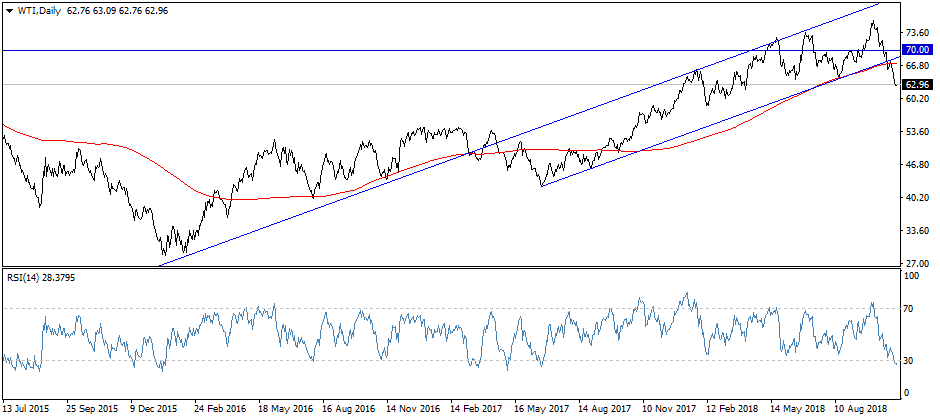
Already now Brent oil is below 200-day average, which is considered an indicator of the average annual trend. Falling below this line very often makes trend-followers reconsider their attitude to the instrument.
Moreover, within a reach of the mark $70 is situated another important level. $69.30 is an informal trait separating Brent from the bear market. Unofficially, the fall of more than 20% of the peak is considered a signal of the bear market beginning for the instrument and heralds a further loss, which often takes another 20%.
Fundamentally, the oil is being pressed by the fears of a new overproduction episode. However, the importance of technical analysis and the important psychological mark in this case is difficult to overestimate.
However, an alternative scenario cannot be completely ruled out. If the oil manages to stay above $70 or gets support near current levels, it will become a very strong signal for growth. Moreover, the impulse indicators are indicating the oversold now. After 2014, it was a good signal for the rebound very often.