Sample Category Title
U.S. Reimposes Iran Sanctions, Tehran Decries ‘Bullying’
The United States on Monday restored sanctions targeting Iran’s oil, banking and transportation sectors and threatened more action to stop its “outlaw” policies, steps the Islamic Republic called economic warfare and vowed to defy. The measures are part of a wider effort by U.S. President Donald Trump to curb Tehran’s missile and nuclear programs and diminish the Islamic Republic’s influence in the Middle East, notably its support for proxies in Syria, Yemen and Lebanon.
Trump’s moves target Iran’s main source of revenue – its oil exports – as well as its financial sector, essentially making 50 Iranian banks and their subsidiaries off limits to foreign banks on pain of losing access to the U.S. financial system. The return of the sanctions was triggered by Trump’s May 8 decision to abandon the 2015 Iran nuclear deal, negotiated with five other world powers during Democratic President Barack Obama’s administration. That agreement had removed many U.S. and other economic sanctions from Iran in return for Tehran’s commitment to curtail its nuclear program.
Trump denounced the deal because of time limits on some of Iran’s nuclear activities, as well as for its failure to address other Iranian activity that the United States does not like. In abandoning the agreement and imposing sanctions that it had lifted as well as adding new ones, the United States is betting the economic pressure will force Iran to change its behavior and agree to a new, much more restrictive deal.
Some analysts are skeptical Iran will knuckle under to U.S. pressure, at least in the short term. Iranian Foreign Minister Mohammad Javad Zarif said U.S. “bullying” was backfiring by making Washington more isolated, a reference to other world powers opposed to the initiative. The other parties to the 2015 nuclear deal, Britain, China, France, Germany and Russia, have said they will stay in it. European powers that continue to back the nuclear deal said they opposed the reapplication of sanctions and major oil buyer China said it regretted the move.
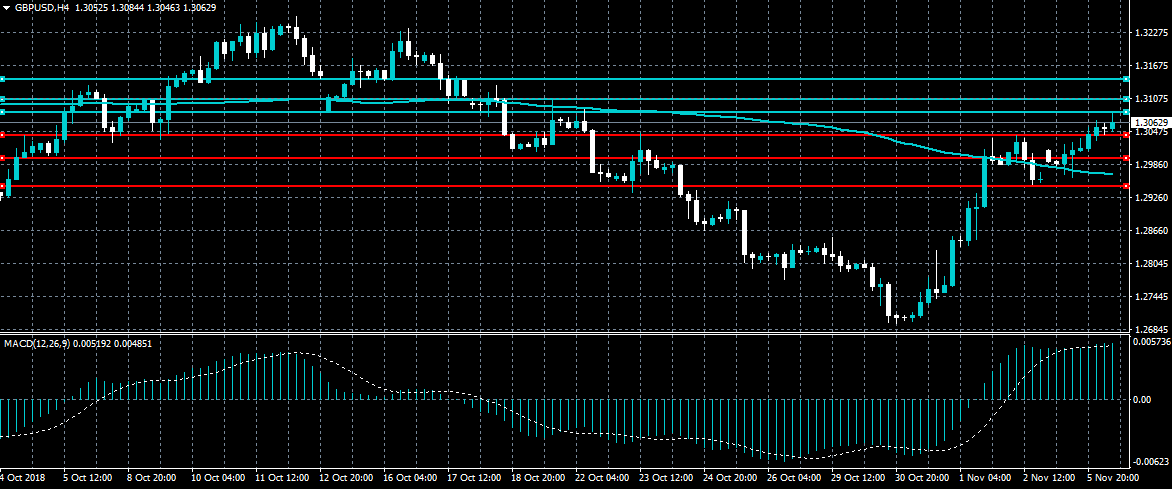
GBPUSD Edges Close To 1.3100 Level
The British pound has moved closer to 1.3100 resistance level against the US dollar during the European trading session, with price hitting 1.3084. Traders will now look for a clear break of the 1.3040 to 1.3084 price range for the next strong directional move in the GBPUSD pair. The key risk events for sterling are the US mid-term election results and UK PM Theresa May’s meeting with Cabinet Ministers later today.
The GBPUSD pair is intraday bullish while trading above the 1.3040 level, key resistance is found at the 1.3100 and 1.3155 levels.
If the GBPUSD pair moves below the 1.3040 level, sellers are likely to test towards the 1.3000 and 1.2965 support levels.
USDJPY Testing Trendline Support
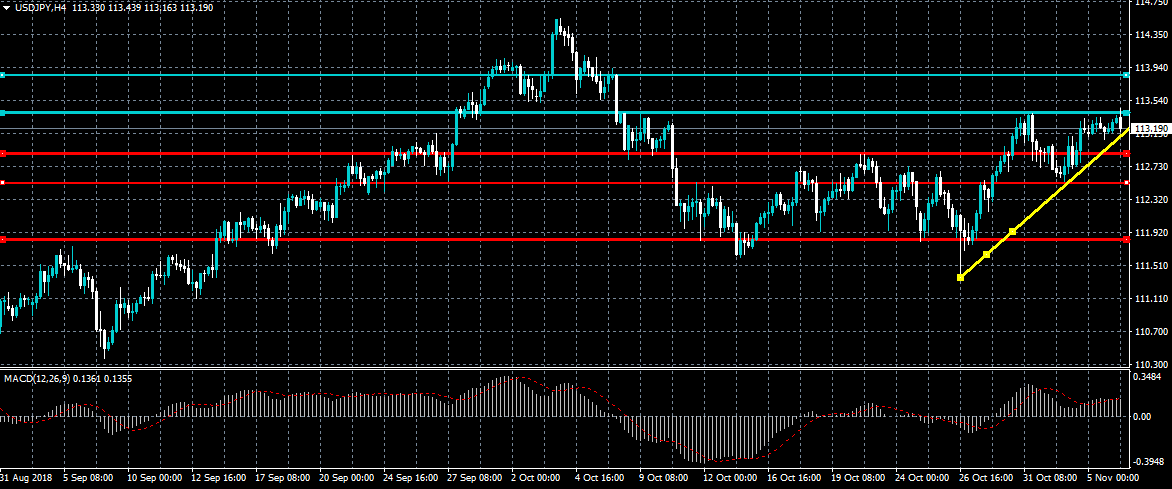
The US dollar is starting to correct lower against the Japanese yen, after being technically rejected from the 113.40 resistance level during the European trading session. The USDJPY pair is likely to become increasingly volatile ahead of the US mid-term election results. Buyers need to move price above the 113.40 level for further bullish advancement, while sellers need to break key trendline support.
The USDJPY pair is only bullish while trading above the 113.15 level, key resistance is now found at the 113.40 and 113.90 levels.
If the USDJPY pair trades below the 112.87 level, sellers are likely to test the 112.54 and 111.85 support levels.
DAX Loses Ground As German Service Sector Slows
The DAX index has edged lower in the Tuesday session. Currently, the DAX is trading at 11,469, down 0.34% on the day. On the release front, Germany and eurozone services PMIs both beat their estimates and pointed to expansion. Eurozone PPI improved to 0.5%, beating the estimate of 0.4%. In the U.S, all eyes will be on the U.S midterm congressional elections. On Wednesday, Germany releases industrial production and the eurozone publishes retail sales.
German indicators were lukewarm on Tuesday. Factory orders posted a gain of 0.3% in September, easily beating the forecast of -0.4%. Still, this was a significant drop from the August reading of 2.0%. The trend was similar in the services sector, as Final Services PMI dropped from 55.9 to 54.7 in October, marking a 3-month low. The reading did, however, beat the forecast of 53.6. On Monday, Sentix investor confidence pointed to a sharp drop. The indicator fell from 11.4 to 8.8 points, its lowest level since October 2016. The index has dropped sharply in 2018 – early in the year, the index was above the 30-point level. The eurozone economy slowed to 1.7% in the third quarter, down from 2.2% in the second quarter. There are concerns that the slowdown will continue into Q4, which could weigh heavily on European stock markets.
The markets are keeping a close eye on the U.S mid-term elections, as voters go to the polls on Tuesday. Many analysts are calling the election a referendum on the presidency of Donald Trump, who has presided over a red-hot economy but has also alienated many voters with his controversial policies on health care and immigration. There are a host of races that are too close to call, but most analysts expect the Democrats to narrowly win the House while the Republicans will hold onto their majority in the Senate. Traders should expect some volatility in the global equity markets once the election results are announced.
XAUUSD Analysis: Trades Between SMAs
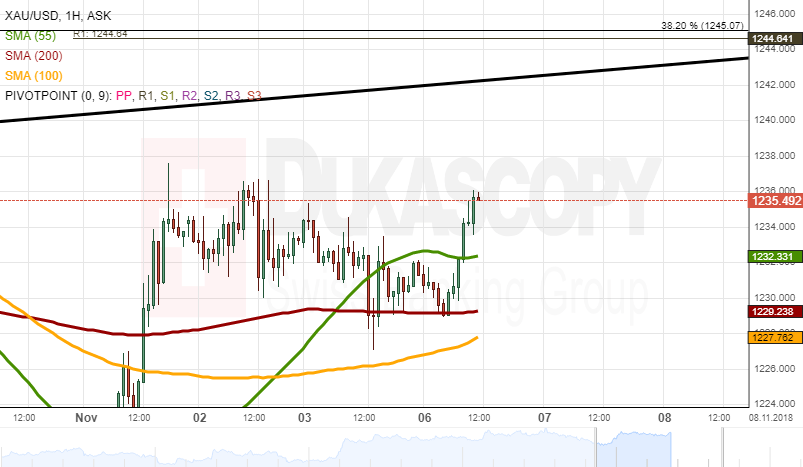
During Monday's trading session, the yellow metal was supported by the 200-hour SMA to end the trading day at the 1,230.28 mark. On Tuesday morning, the gold was located between the 55-hour and the 200-hour SMAs at the 1,232.31 mark.
In regards to the near-term future, most likely, the gold will break the resistance of the 55-hour simple moving average to surge towards the 1,235.00 level during the trading session. The 200-hour simple moving average should support the surge!
However, the yellow metal could pass through the simple moving averages to trade at the 1,220.00 level if the US Dollar will appreciate against the gold during today's United States Congressional Elections.
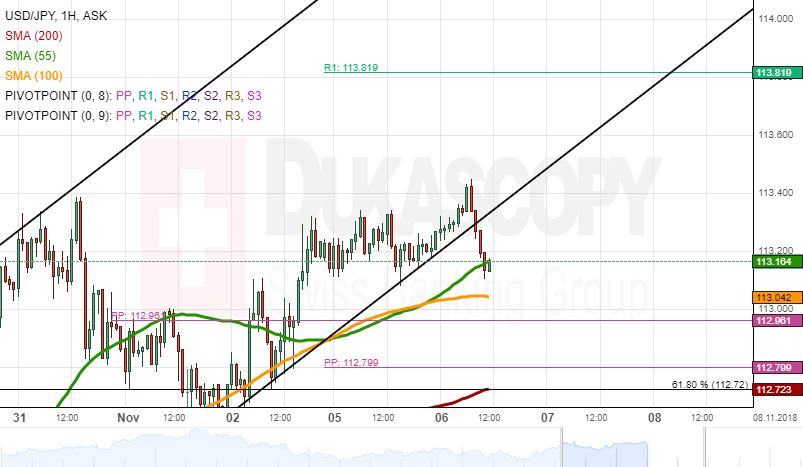
USD/JPY Analysis: Keeps To Surge
During Monday's trading session, the currency exchange pair was moving near the medium ascending pattern line to end the trading session at the 113.23 mark. On Tuesday morning, the US Dollar was keep trading near the medium pattern line at the 113.42 mark.
In regards to the near-term future, most likely, the US Dollar will keep appreciating against the Japanese Yen to push the rate to surge towards the weekly R1 at the 113.81 mark.
On the other side, the US Dollar could depreciate against the Japanese Yen during today's US Congressional Elections to pass through the support of the pattern line.
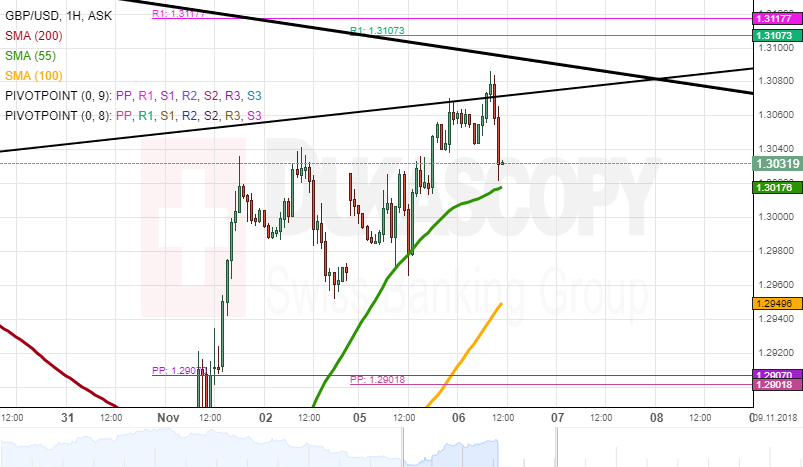
GBP/USD Analysis: Breaks Medium Pattern Line
During Monday's trading session, the British Pound was supported by the 55-hour simple moving average to end the trading session at the 1.3050 mark. On Tuesday morning, the British pound was located near the bottom boundary of the medium ascending pattern line at the 1.3050 mark.
In regards to the near-term future, the British Pound will be supported by the medium ascending pattern line and the 55-hour SMA to surge towards the 50.00 % Fibo at 1.3163 mark. Most likely, the rate will trade at the 1.3050 level on Tuesday.
On the other side, the rate could pass through the 55-hour SMA support if the US Dollar will appreciate against the British Pound during today's US Congressional Elections. In this case, the rate might move towards the monthly PP at 1.2907 mark.
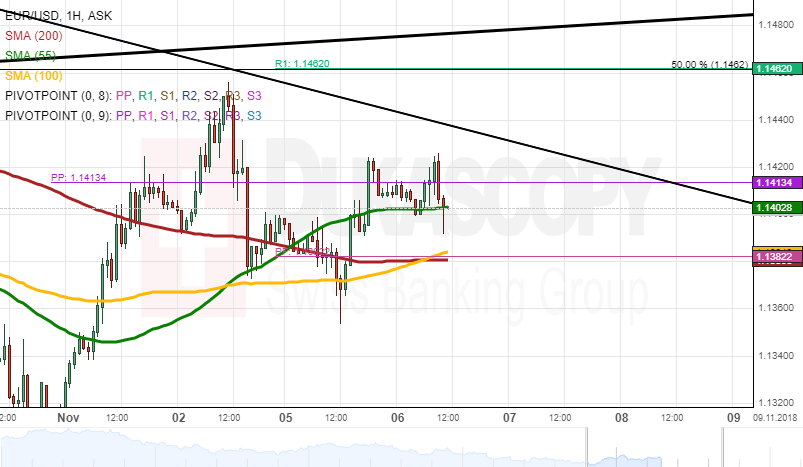
EUR/USD Analysis: Moves Sideways At 1.1450
During Monday's trading session, the currency pair passed through most of the technical indicators to end the trading day at the 1.1407 mark. During Tuesday morning hours, the European Single Currency was located near the monthly pivot point at the 1.1406 mark.
In regards to the near-term future, most likely, the currency exchange rate will trade sideways to stay in the range between the monthly pivot point at the 1.1413 and the weekly pivot point at the 1.1382.
However, today's US Congressional Elections may affect the rate to break the resistance of the monthly PP at 1.1413 or the support of the weekly PP at 1.1382.
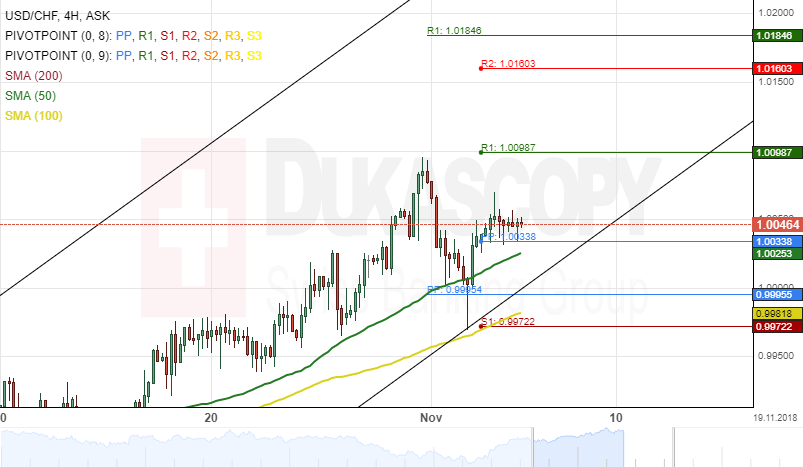
USD/CHF 4H Chart: Bullish Momentum Today
The US Dollar versus the Swiss Franc has been moving in an ascending channel since mid-September. The currency pair bounced off its lower boundary at 0.9550 on September 21 and followed by an upside wave.
The exchange rate breached the weekly resistance level at 1.0033 during yesterday's trading session.
Technical indicators flash bullish signals on the 4(H) chart. Therefore, it is likely that the currency exchange rate continues its upwards momentum within this session.
However, the pair could reverse from the current price level and aim for the lower boundary of the channel pattern at 0.9972 during the following trading sessions.
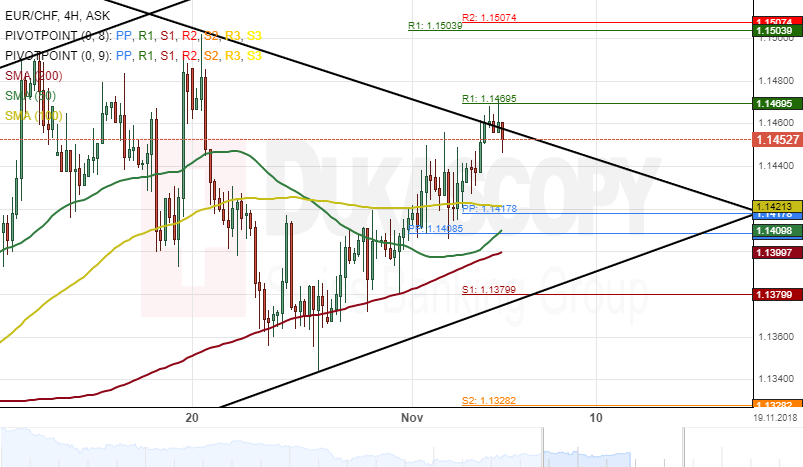
EUR/CHF 4H Chart: Breaches Resistance Level
The common European currency has been trading in an ascending channel against the Swiss Franc since early September. The exchange rate pullback from the lower boundary of the pattern at 1.1200 on September 7 and had since increased its trading range.
The currency pair breached the upper boundary of a long-term descending channel at 1.1456 during the Asian session on Tuesday.
If this resistance level formed by the upper border of the channel holds, the EUR/CHF pair could target a support cluster set by the 100-hour SMA and the weekly PP at 1.1417 today.
However, if the pair passes the resistance line, the currency exchange rate will aim at the 1.1503 area during the following trading sessions.