

Sample Category Title
EUR/USD Mid-Day Outlook
Daily Pivots: (S1) 1.1368; (P) 1.1396; (R1) 1.1436; More....
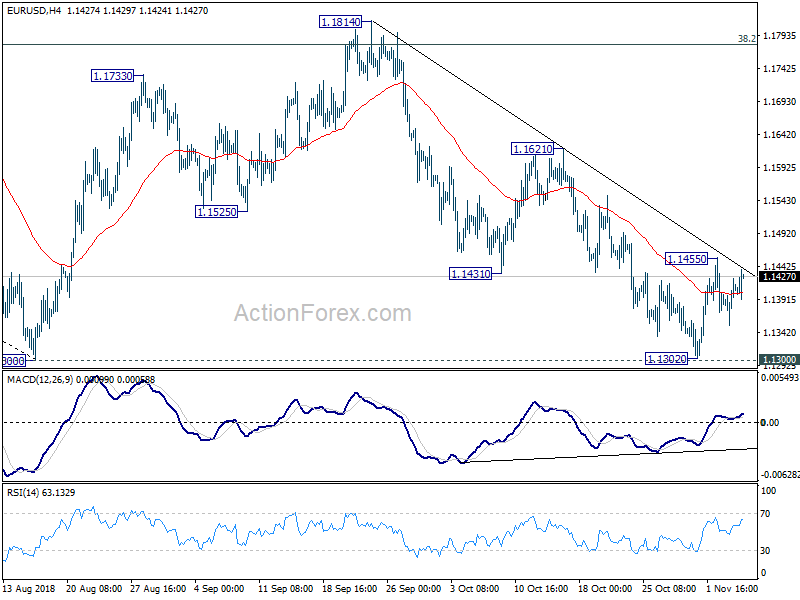
EUR/USD strengthens mildly today but stays below 1.1455. Intraday bias remains neutral first. On the upside, above 1.1455 will reaffirm that consolidation pattern from 1.1300 has started the third, rising leg. Further rise should be seen to 1.1621 resistance and above. But upside should be limited by 1.1814 to bring down trend resumption eventually. On the downside, break of 1.300 will resume whole down trend from 1.2555 and target 1.1186 fibonacci level next.
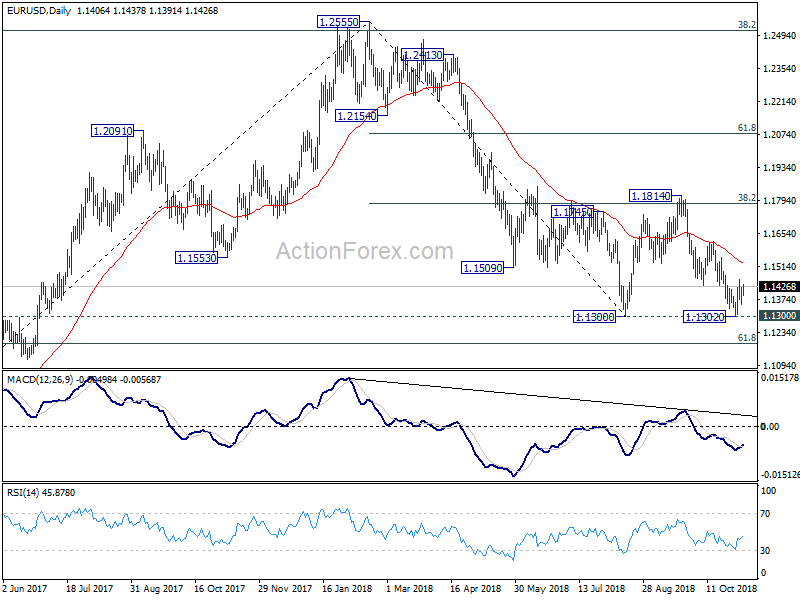
In the bigger picture, price actions from 1.1300 is seen as a corrective pattern. Decisive break of 1.1300 will resume the down trend from 1.2555 to 61.8% retracement of 1.0339 (2017 low) to 1.2555 at 1.1186 next. Sustained break there will pave the way to retest 1.0339. In case the consolidation from 1.1300 extends, upside should be limited by 1.1814 and 38.2% retracement of 1.2555 to 1.1300 at 1.1779. to bring down trend resumption eventually.
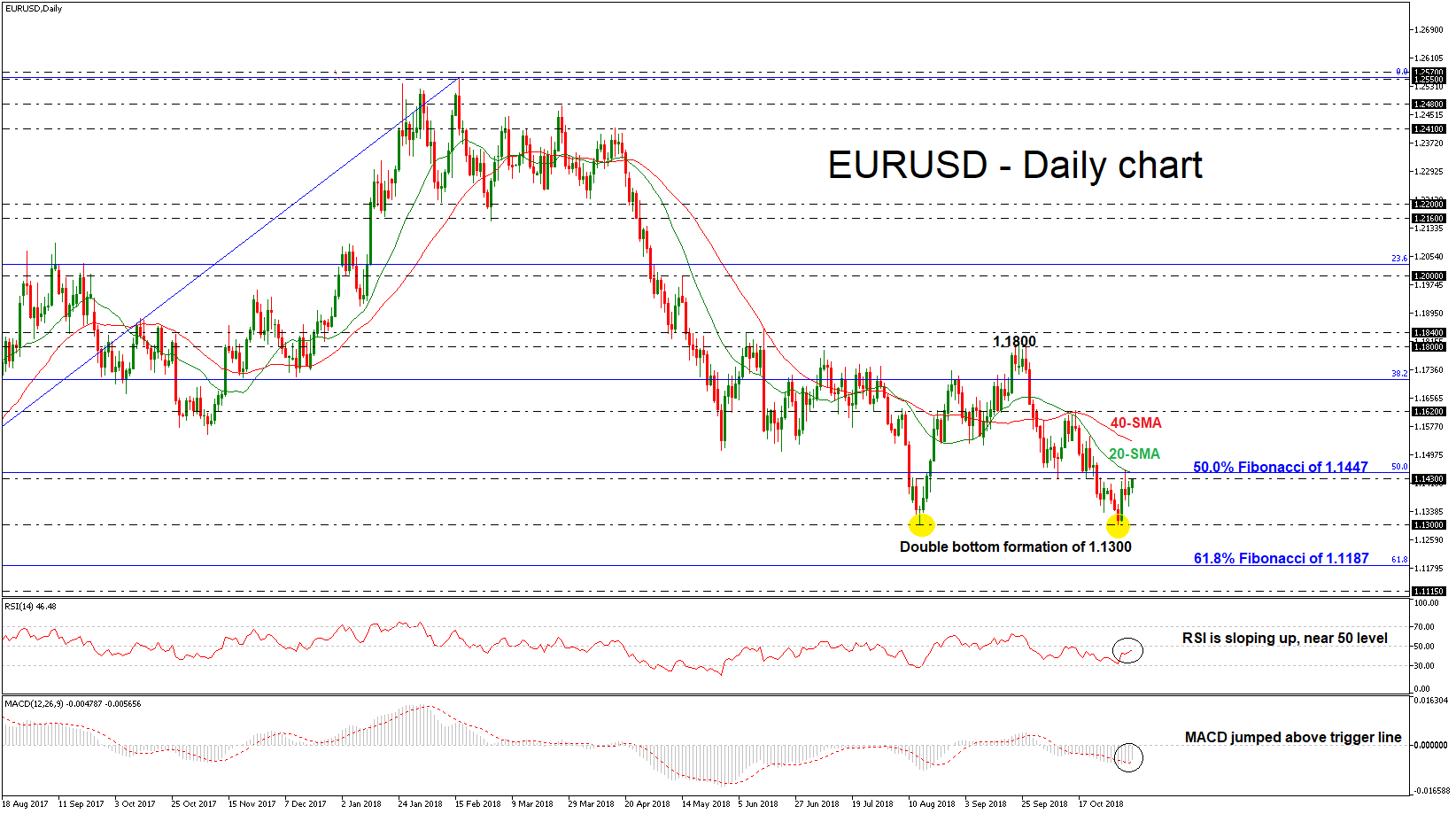
EURUSD Posts Double Bottom Formation at 1.1300
EURUSD re-challenged the 14-month low of the 1.1300 strong psychological level in the previous week, creating a double bottom formation. The price rebounded on it, heading north towards the 50.0% Fibonacci retracement level of the upleg from 1.0340 to 1.2550, which overlaps with the 20-day simple moving average (SMA) at 1.1447. The RSI indicator is approaching the threshold of 50 with strong momentum, while the MACD oscillator stands above its trigger line in the negative zone.
Immediate resistance to focus on is the 1.1430 and the 50.0% Fibonacci mark, while a jump higher could hit the 40-day (SMA) at 1.1535. Then, if the market fails to hold below these levels, the next stop could be at the 1.1620, reached on October 16.
If the pair bounces down again, the initial support to have in mind is the 1.1300 handle. Steeper declines could send prices until the 61.8% Fibonacci region of 1.1187, while even lower the 1.1115 support, could provide some support to investors, taken from the trough on June 2017.
To conclude, EURUSD seems to be in a bearish correction mode following the pullback on the 1.2550 resistance barrier on February 11. The long-term view is negative and a slip below the 61.8% Fibonacci would endorse the bigger negative picture as well.
GBP/USD Mid-Day Outlook
Daily Pivots: (S1) 1.2985; (P) 1.3021; (R1) 1.3077; More...
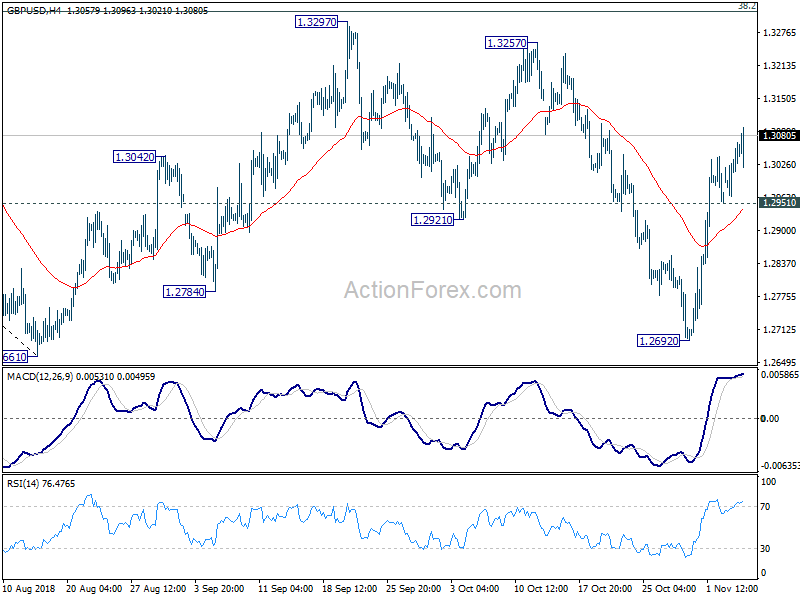
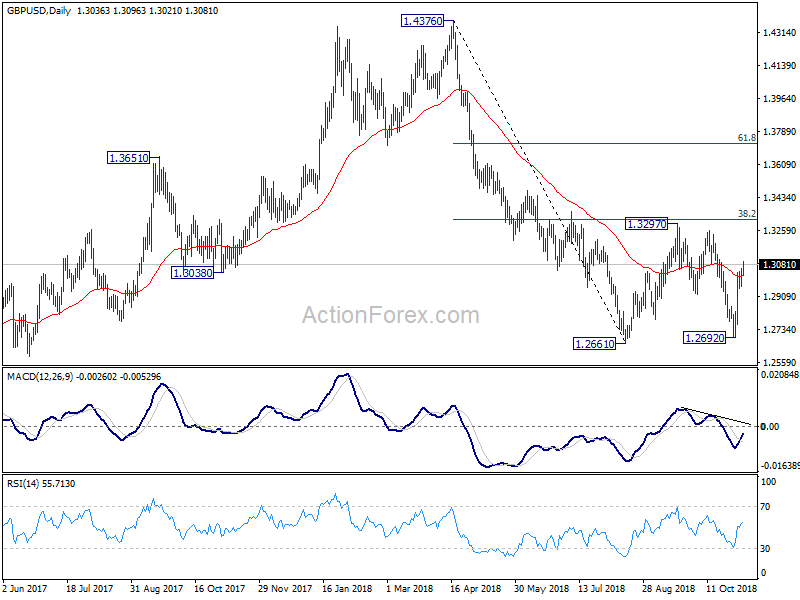
No change in GBP/USD's outlook as the rebound from 1.2692 is in progress. Intraday bias stays on the upside for 1.3257/3297 resistance zone. Such rally is seen as the third leg of consolidation pattern from 1.2661. Hence, we'd expect strong resistance from 1.3316 fibonacci level to limit upside to bring down trend resumption eventually. On the downside, below 1.2951 minor support will turn bias back to the downside for 1.2692 instead.
In the bigger picture, whole medium term rebound from 1.1946 (2016 low) should have completed at 1.4376 already, after rejection from 55 month EMA. The structure and momentum of the fall from 1.4376 argues that it's resuming long term down trend. And this will be the preferred case as long as 38.2% retracement of 1.4376 to 1.2661 at 1.3316 holds. However, firm break of 1.3316 would bring stronger rebound to 61.8% retracement at 1.3721. And, the eventual depth of the fall from 1.4376, and the chance of hitting 1.1946 low, will depend on the strength of the interim corrective rebound from 1.2661.
Sterling Rally Continues Even Though UK PM May Achieved Nothing on Brexit at the Cabinet Meeting
Sterling remains rather resilient despite more Brexit negative news today. There seems to be no progress on negotiation at all and there is little hope for a November EU summit. Nonetheless, the Pound defies gravity and is trading as the second strongest one today. Australian Dollar is the strongest as supported by upbeat RBA statement released earlier today. On the hand other, Canadian Dollar and Dollar are the weakest ones. The greenback is notably softer as markets await the result of US mid-term elections.
Stock markets are also mixed. At the time of writing, FTSE is down -1.06%, possibly mainly due to Sterling's rally. DAX is down -0.42% and CAC is down -0.52%. German 10 year yield is up 0.001 at 0.430. Italian 10 year yield is up 0.080 at 3.403. German-Italian spread is marginally below 300. Earlier in Asia, Nikkei closed up 1.14% at 22147.75. Hong Kong HSI closed up 0.72% at 26120.96. But China Shanghai SSE dropped -0.23% at 2659.36.
Technically, USD/JPY breached 113.38 resistance earlier today but traders refused to commit so far. Similarly, EUR?GBP also breached 0.8722 support but recovered quickly. These are some signs of hesitation. Though, the Dollar appears to weaken against Euro and Swiss Franc in early US session. And the development suggests that Dollar is now in another leg down as correction extends.
UK PM May made no progress on Brexit at the Cabinet meeting
It appears that no progress on Brexit is made after UK Prime Minister Theresa May's Cabinet meeting. May's spokesman James Slack told reporters that there's still a "significant amount of work" to do, "across government" on how the exit mechanism might work. The discussion inside the Cabinet was "constructive" and there was a shared view that the UK cannot remain in the "backstop indefinitely".
Separately, EU chief Brexit negotiator talked to Belgian broadcaster RTBF. He said "For now, we are still negotiating and I am not, as I am speaking to you this morning, able to tell you that we are close to reaching an agreement, since there is still a real point of divergence on the way of guaranteeing peace in Ireland, that there are no borders in Ireland, while protecting the integrity of the single market."
DUP Donaldson said they're heading for no-deal Brexit
Sterling dipped briefly today after Jeffrey Donaldson, a Democratic Unionist Party lawmaker, tweeted that "Looks like we're heading for no deal" Brexit. He warned that "such an outcome will have serious consequences for economy of Irish Republic". And, "in addition, UK won't have to pay a penny more to EU, which means big increase for Dublin."
Donaldson referred to Irish Foreign Minister Simon Coveney's tweet on Sunday that "the Irish position remains consistent and v clear that a "time-limited backstop" or a backstop that could be ended by UK unilaterally would never be agreed to by IRE or EU."
Eurozone PMI composite finalized at 53.1, notable slowdown in Italy
Eurozone PMI services was finalized at 53.7 in October, down from prior month's 54.7. PMI composite was finalized at 53.1, down from September's 54.1. Among the countries, Italy PMI composite dropped to 49.3, a 59-month low. German PMI composite also dropped to 5-month low at 53.4.
Chris Williamson, Chief Business Economist at IHS Markit said the PMI figures hint at upward revision to 0.2% Q3 GDP growth. But "the economy has slowed and that the weakness has intensified into the fourth quarter". Also, "Italy has recorded an especially noticeable slowdown, slipping into decline during October, whilst Germany has also seen a worrying easing of growth, with both countries affected by rising political uncertainty. France and Spain, in contrast, have seen more resilient business conditions, though both are registering much slower growth than earlier in the year."
European businesses increasingly desensitized to China Xi Jinping's constant repetition of empty promises
The European Chamber of Commerce in China blasted Chinese President Xi Jinping's speech regarding opening up the markets yesterday. In the keynote speech at the China International Import Expo (CIIE), Xi introduced five initiatives, including stimulating potential for imports, broadening market access for foreign investment, creating a world-class business environment, exploring new horizons of opening up, and promote international cooperation multilaterally and bilaterally.
In a statement, the Chamber criticized that much of the content delivered by Xi just "echoed" what was previously announced at Boao in April. And, this was just "constant repetition", without "sufficient concrete measures or times lines". And Xi has left the European business community "increasingly desensitized" to these kinds of promises.
RBA kept cash rate at 1.5%, raised growth forecast a little
RBA left cash rate unchanged at 1.50% as widely expected. Overtone is affirmative but as the improve in wages growth and inflation would be gradual, RBA is in no rush to raise interest rate. The central bank provided a glimpse of the new economic forecasts in the statement. We'll have to wait for the full Monetary Policy Statement on Friday for the details.
RBA noted that GDP growth forecasts for 2018 and 2019 were "revised up a little" to around 3.5%. GDP growth would slow in 2020 due to "slower export growth or resources". Growth in household consumption is "one continuing source of uncertainty" due to low income growth, high debt levels and some decline in asset prices. Stronger than expected terms of trade are expected to "decline over time" but stay at relatively high level.
Labor market outlook "remains positive" and unemployment rate is expected to drop further to around 4.75% in 2020. Rise is wages growth is "still expected to be a gradual process". Inflation outcomes were inline with expectations. CPI is expected to pickup over the next couple of years, gradually. CPI is forecast to be at 2.25% in 2019 and a bit higher in 2020.
More on RBA: RBA Turns More Upbeat Over GDP Growth, Keeps Rates Unchanged amidst Low Inflation
GBP/USD Mid-Day Outlook
Daily Pivots: (S1) 1.2985; (P) 1.3021; (R1) 1.3077; More...
No change in GBP/USD's outlook as the rebound from 1.2692 is in progress. Intraday bias stays on the upside for 1.3257/3297 resistance zone. Such rally is seen as the third leg of consolidation pattern from 1.2661. Hence, we'd expect strong resistance from 1.3316 fibonacci level to limit upside to bring down trend resumption eventually. On the downside, below 1.2951 minor support will turn bias back to the downside for 1.2692 instead.
In the bigger picture, whole medium term rebound from 1.1946 (2016 low) should have completed at 1.4376 already, after rejection from 55 month EMA. The structure and momentum of the fall from 1.4376 argues that it's resuming long term down trend. And this will be the preferred case as long as 38.2% retracement of 1.4376 to 1.2661 at 1.3316 holds. However, firm break of 1.3316 would bring stronger rebound to 61.8% retracement at 1.3721. And, the eventual depth of the fall from 1.4376, and the chance of hitting 1.1946 low, will depend on the strength of the interim corrective rebound from 1.2661.
Economic Indicators Update
| GMT | Ccy | Events | Actual | Forecast | Previous | Revised |
|---|---|---|---|---|---|---|
| 23:30 | JPY | Overall Household Spending Y/Y Sep | -1.60% | 1.60% | 2.80% | |
| 00:01 | GBP | BRC Retail Sales Monitor Y/Y Oct | 0.10% | 0.60% | -0.20% | |
| 03:30 | AUD | RBA Rate Decision | 1.50% | 1.50% | 1.50% | |
| 07:00 | EUR | German Factory Orders M/M Sep | 0.30% | -0.40% | 2.00% | 2.50% |
| 08:45 | EUR | Italy Services PMI Oct | 49.2 | 52.1 | 53.3 | |
| 08:50 | EUR | France Services PMI Oct F | 55.3 | 55.6 | 55.6 | |
| 08:55 | EUR | Germany Services PMI Oct F | 54.7 | 53.6 | 53.6 | |
| 09:00 | EUR | Eurozone Services PMI Oct F | 53.7 | 53.3 | 53.3 | |
| 10:00 | EUR | Eurozone PPI M/M Sep | 0.50% | 0.30% | 0.30% | 0.40% |
| 10:00 | EUR | Eurozone PPI Y/Y Sep | 4.50% | 4.20% | 4.20% | 4.30% |
| 13:30 | CAD | Building Permits M/M Sep | 0.40% | 0.30% | 0.40% |
No progress on Brexit mechanism after UK May’s Cabinet meeting
It appears that no progress on Brexit is made after UK Prime Minister Theresa May's Cabinet meeting. May's spokesman James Slack told reporters that there's still a "significant amount of work" to do, "across government" on how the exit mechanism might work. The discussion inside the Cabinet was "constructive" and there was a shared view that the UK cannot remain in the "backstop indefinitely".
Separately, EU chief Brexit negotiator talked to Belgian broadcaster RTBF. He said "For now, we are still negotiating and I am not, as I am speaking to you this morning, able to tell you that we are close to reaching an agreement, since there is still a real point of divergence on the way of guaranteeing peace in Ireland, that there are no borders in Ireland, while protecting the integrity of the single market."
Pound Intends to Rise
On Tuesday, November 6th, the British Pound remains strong against the USD. The key driver for the British currency is still the same as before – the Brexit negotiations. Nevertheless, the statistics matter as well, that’s why any progress in the Brexit talks and enthusiasm that accompanies it is somehow eliminated by weak macroeconomic readings that come from the United Kingdom.
It became known yesterday that the British government continued discussing the Irish border issue, which was believed as one of the most important things that prevented the parties from making progress in the talks.
The statistics published by the United Kingdom early in the week were not too positive. The Services PMI dropped up to 52.2 points in October after being 53.9 points in the previous month and against the expected reading of 53.4 points. The actual reading is the weakest since March, although it’s still higher than the psychologically-crucial level of 50 points, which usually marks decline and growth.
On one hand, the British economy is looking pretty strong right now and there are reasons to expect the GDP to continue improving. On the other hand, businesses and investors are still concerned about the economic uncertainty and lack of new orders.
This week, there will be a lot of numbers from the United Kingdom, which may really influence the Pound behavior. Some of them worth paying attention to are the preliminary GDP report and the Industrial Production reading to be published on Friday.
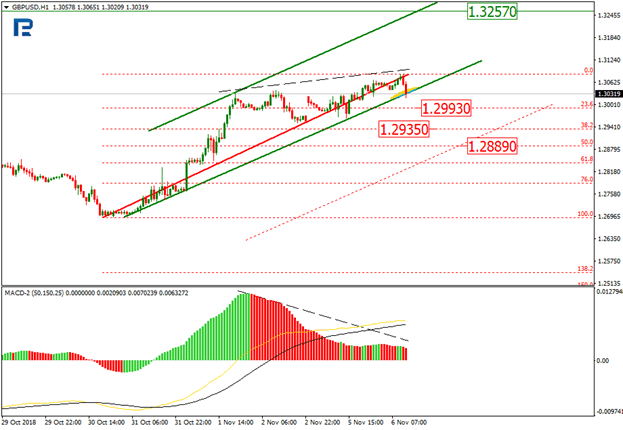
As we can see in the H1 chart right now, GBPUSD is testing the support line of the ascending channel. At the same time, there is a divergence in MACD, which may indicate a possible correction soon. If the pair breaks the support line, it may move downwards into the projected channel. The downside targets may be the retracements of 23.6%, 38.2%, and 50.0% at 1.2993, 1.2935, and 1.2889 respectively. After completing the correction, the instrument may start a new rising impulse. The target is the current high at 1.3257.
Canadian Dollar Subdued ahead of US Congressional Elections
The Canadian dollar remains close to the 1.31 level. In the Tuesday session, USD/CAD is trading at 1.3121, down 0.08% on the day. On the release front, Canadian Building Permits is expected to tick lower to 0.3%. In the U.S, voter participation is expected to be heavy in the midterm congressional elections. As well, the U.S. releases JOLTS Jobs Openings. On Wednesday, Canada releases Ivey PMI.
All eyes are on the U.S mid-term elections, with voters deciding who will control Congress. Many analysts are calling the election a referendum on the presidency of Donald Trump, who has presided over a red-hot economy but has also alienated many voters with his controversial policies on health care and immigration. There are a host of races that are too close to call, but most analysts expect the Democrats to narrowly win the House while the Republicans will hold onto their majority in the Senate. Traders should expect some volatility in the currency markets once the results are announced.
Canada released October employment data on Friday, and the releases were positive. The economy added 11.2 thousand jobs in October, although this was shy of the estimate 12.7 thousand. The unemployment rate ticked lower to 5.8%, a shade better than the forecast of 5.9%. These numbers will likely increase the likelihood of a rate hike from the Bank of Canada in early December. The economy is doing well and the BoC is also mindful that the Federal Reserve is expected to raise rates again in December, which would mark a fourth rate hike in 2018. Policymakers do not want to see divergence widen between U.S and Canadian rates, and another rate hike from the BoC would be bullish for the Canadian dollar.
Dollar Finds Resistance at 1-Month Highs vs Yen; US Midterm Elections Awaited
Here are the latest developments in global markets:
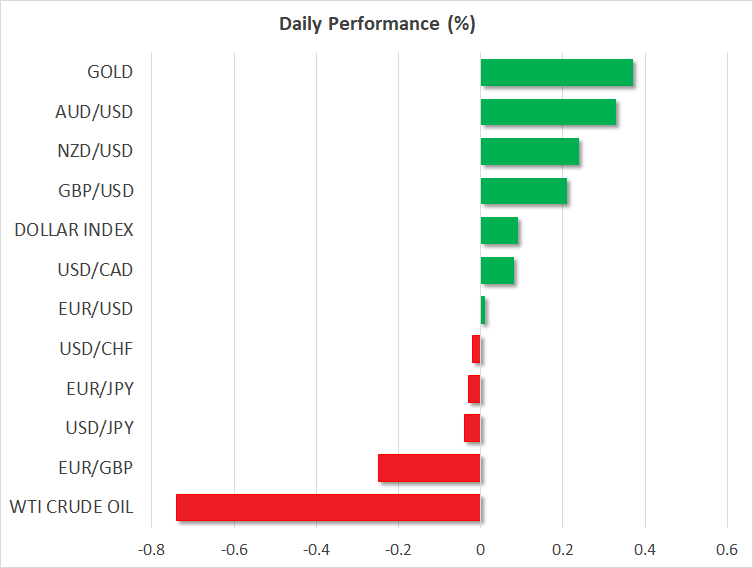
- FOREX: The US dollar hit one-month highs against the yen at 113.44 on Tuesday but it soon lost ground returning to 113.13 (-0.06%) before US midterm elections take place later today. The US dollar index, however, managed to climb by 0.14%, erasing some of yesterday’s losses on the back of a weaker euro and pound. Euro/dollar retreated by 0.10% despite the upward revision in final Markit Services PMI figures for October out of Germany and the Eurozone. Eurozone producer prices appeared better-than-expected as well in September, while August PPI readings were revised upwards. Regarding the Italian budget Eurozone finance ministers asked Italy to rethink its fiscal demands yesterday, while the European commissioner, Piere Moscovici argued today that sanctions can be applied if Italy shows no compromise. Pound/dollar reversed back down to 1.3036 after Jeffrey Donaldson, a DUP lawmaker, twitted that Britain “looks to be heading for no deal Brexit”. Earlier the pair had touched a new two-week high at 1.3084. As long as there isn’t anything concrete regarding the progress of negotiations, downside corrections are likely in the market. Euro/pound and pound/yen are in negative territory, inching down by 0.02% and 0.15% respectively. Turning to the antipodean currencies, aussie/dollar increased by 0.33% at 0.7231 after the Reserve Bank of Australia (RBA) left the cash rate unchanged at 1.5% for the 25th consecutive meeting as widely anticipated. Aussie/yen traded higher as well by 0.28%. Kiwi/dollar followed aussie’s upside structure, gaining 0.11% at 0.6668. Dollar/loonie climbed by 0.11% to 1.3122.
- STOCKS: European equities extended lower on Tuesday except for the Italian FTSE MIB which was up by 0.20% at 1100 GMT. The pan-European STOXX 600 and the blue-chip Euro STOXX 50 declined by 0.29% and 0.47% respectively. The German DAX 30 moved lower by 0.31%, the French CAC 40 fell by 0.31%, while the British FTSE 100 weakened by 0.35%. The worst performer was the Spanish IBEX 35, tumbling by 1.02% thanks to significant losses in consumer non-cyclicals. Among Spanish companies, the retailer Distribuidora Internacional de Alimentacion SA was downgraded by Deutsche Bank. In Asia, the majority of stocks closed strongly positive, while futures tracking US indices such the S&P 500, Dow Jones and Nasdaq 100 were slightly down, pointing to a softer negative open as investors await the US midterm elections.
- COMMODITIES: Oil prices were on the back foot amid fears US sanctions imposed on November 4 would disrupt oil supply in Iran, OPEC’s third largest producer. Yet waivers granted to some of Iran’s main oil buyers, provided some relief to investors, curbing steeper declines in the market. Meanwhile Iran asked OPEC’s Secretary general to scrap two committees which monitor a deal between OPEC and other countries led by Russia, saying that some of the OPEC members participating in the deal have taken sides with the US. WTI crude and Brent were changing hands lower at $62.92/barrel (-0.30%) and $72.92/barrel (-0.34%) respectively. In precious metals, gold advanced by 0.34% to $1,235/ounce.
Day ahead: US midterm elections kick off; New Zealand to report on employment
After two years since Trump’s victory in presidential elections, the US will head to the polls on Tuesday to choose members for each of the 435 House seats and 35 out of 100 Senate positions in Congress. While Trump’s Republicans are currently in charge in both chambers, polls suggest that the opposition Democrats have a decent chance to take the House of Representatives. If that comes true, Democrats could derail the president’s agenda, restricting Trump’s ability to pass new laws. On the other hand, if Republicans maintain control in the Congress, which is a less likely outcome, it would be another checkpoint for the US president and a dollar-positive event. Note that a party needs to win 218 seats out of 435 in the House to take power.
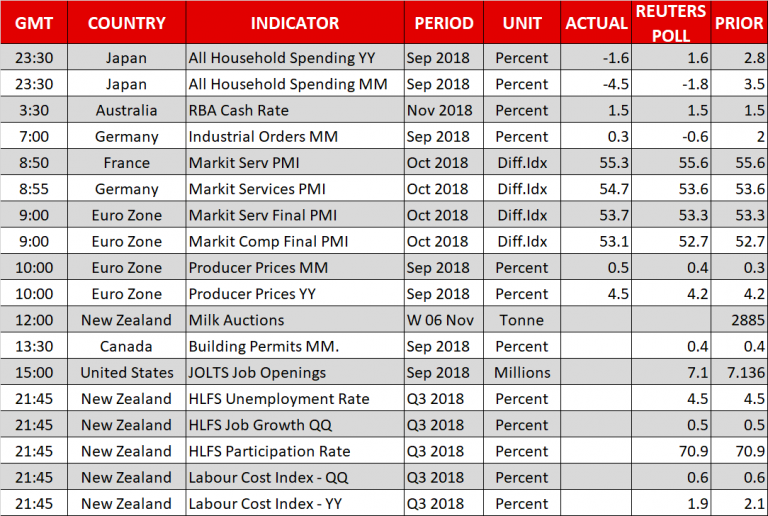
As vote results are not expected until Wednesday, US JOLTs job openings might attract attention at 1500 GMT. Forecasts are for available positions to have increased by 7.1 million in September, slightly less than in August when the measure showed an increase of 7.13mn.
In the meantime, employment figures for the third quarter will be a hot spot in New Zealand before the Reserve Bank meets to set monetary policy late on Wednesday. Analysts believe that employment grew by 0.5% q/q in the three months to September as in the previous quarter, while the unemployment rate steadied at 4.5%, which is the second lowest rate recorded since the end of 2008. In terms of costs payed to employees excluding overtime, benefits are said to have risen at the Q2’s pace of 0.6% in a quarterly basis, while year-on-year these are expected to have slowed down, showing an expansion of 1.9% compared to the 2.1% growth identified previously, which was the highest advance in six years. Should the data appear better than projections, the kiwi could see additional gains and vice versa. Encouraging numbers may also bring smiles to the RBNZ policymakers who target employment in addition to inflation to achieve a sustainable growth in the economy.
Besides the above, the outcome of the bi-weekly milk auctions is highly expected to bring volatility to the kiwi at a tentative time given that dairy products are a top export in New Zealand. China’s Premier Li Keqiang will be meeting the heads of IMF, World Bank and World Trade Organization in Beijing as part of an annual meeting.
Any headlines regarding the trade story, Brexit and the turnoil around the Italian budget will be valuable to the markets during the day.
Elsewhere, September’s building permits will come in public at 1230 GMT.
In energy markets, the API weekly report on US crude inventories will be closely watched for direction at 2130 GMT.
European Update: Sterling volatile on Brexit jitters, but still firm
Some volatility is seen in Sterling in European session. It reacted negatively to a DUP lawmaker's tweet that "Looks like we're heading for no deal" Brexit. But the Pound was lifted by Brexit Minister Dominic Raab's thumbs up out of the Cabinet meeting. Sterling is trading generally firm, as the second strongest, just next to Australian Dollar and above New Zealand Dollar. The Aussie is supported by slightly more upbeat RBA statement, after the central bank stood pat on interest rate.
On the other hand, Canadian Dollar, Dollar, and Euro are generally weak. The US calendar is empty today, making way for mid-term election. So volatility could dies down a bit too, until we get the results.
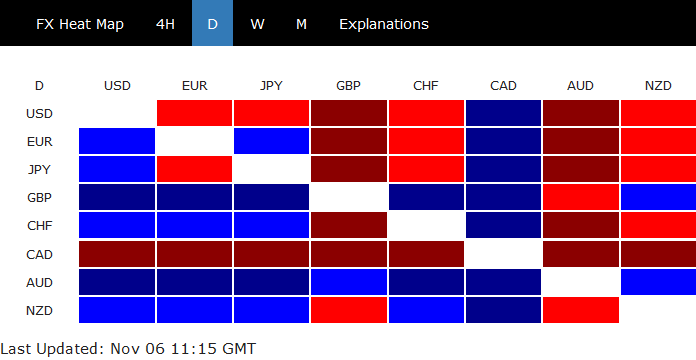
In European markets, at the time of writing:
- FTSE is down -0.66%
- DAX down -0.20%
- CAC down -0.26%
- German 10 year yield drops -0.008 at 0.421
- Italian 10 year yield rises 0.081 to 3.404. Spread is marginally below 300.
In Asia:
- Nikkei rose 1.14% to 22147.75
- Hong Kong HSI rose 0.72% to 26120.96
- China Shanghai SSE dropped -0.23% to 2659.36
- USD/CNH is now above 6.9, as range trading extends
Sterling dips as DUP Donaldson said they’re heading for no-deal Brexit
Sterling dipped briefly today after Jeffrey Donaldson, a Democratic Unionist Party lawmaker, tweeted that "Looks like we're heading for no deal" Brexit. He warned that "such an outcome will have serious consequences for economy of Irish Republic". And, "in addition, UK won't have to pay a penny more to EU, which means big increase for Dublin."
https://twitter.com/J_Donaldson_MP/status/1059748210271494144
Donaldson referred to Irish Foreign Minister Simon Coveney's tweet on Sunday that "the Irish position remains consistent and v clear that a "time-limited backstop" or a backstop that could be ended by UK unilaterally would never be agreed to by IRE or EU."
https://twitter.com/simoncoveney/status/1059349074183372800