

Sample Category Title
Chinese VP Wang: Ready to work for trade solution with US
The US and China will hold a top-level security meeting on Friday in Washington. Secretary of State Mike Pompeo, Defense Secretary Jim Mattis, Chinese politburo member Yang Jiechi and Defense Minister Wei Fenghe will be involved in the meeting. And it's generally seen as a sign of warming-up ahead of the meeting between Trump and Xi in the upcoming G20 summit later in the month.
Talking about the Trump-XI meeting, Chinese Vice President Wang Qishan said in Singapore today that "both China and the U.S. would love to see greater trade and economic cooperation." Wang added "the Chinese side is ready to have discussions with the U.S. on issues of mutual concern and work for a solution on trade acceptable to both side."
Eurozone finance minister rejected Italy budget, new or revised DBP a necessity
Eurozone finance ministers showed united stance against Italy's budget in the meeting in Brussels yesterday. In a statement, they said "we agree with the Commission assessment" on Italy's draft budget plan (DBP). And, the group "look forward for Italy and the Commission to engage in an open and constructive dialogue and for Italy to cooperate closely with the Commission in the preparation of a revised budgetary plan which is in line with the SGP (Stability and Growth Pact)."
At the post meeting press conference, Commissioner for Economic Affairs Pierre Moscovici reiterated that a "new" or "revised" DBP was requested by November 13, and "that is a necessity".
However, Italian Economy Minister Givoanni said after the meeting that the his government wasn't in the process of changing the budget. Instead, he added, "We hope that the spread will narrow when the market understands our strategy."
RBA kept cash rate at 1.5%, raised growth forecast, full statement
RBA left cash rate unchanged at 1.50% as widely expected. Overtone is affirmative but as the improve in wages growth and inflation would be gradual, RBA is in no rush to raise interest rate.
Here are some key points in the statement
- GDP growth forecasts for 2018 and 2019 were "revised up a little" to around 3.5%.
- GDP growth would slow in 2020 due to "slower export growth or resources".
- Growth in household consumption is "one continuing source of uncertainty" due to low income growth, high debt levels and some decline in asset prices.
- Stronger than expected terms of trade are expected to "decline over time" but stay at relatively high level.
- Labor market outlook "remains positive" and unemployment rate is expected to drop further to around 4.75% in 2020.
- Rise is wages growth is "still expected to be a gradual process".
- Inflation outcomes were inline with expectations. CPI is expected to pickup over the next couple of years, gradually.
- CPI is forecast to be at 2.25% in 2019 and a bit higher in 2020.
Here is the full statement.
Statement by Philip Lowe, Governor: Monetary Policy Decision
At its meeting today, the Board decided to leave the cash rate unchanged at 1.50 per cent.
The global economic expansion is continuing. A number of advanced economies are growing at an above-trend rate and unemployment rates are low. Growth in China has slowed a little, with the authorities easing policy while continuing to pay close attention to the risks in the financial sector. Globally, inflation remains low, although it has increased due to both higher oil prices and some lift in wages growth. A further pick-up in inflation is expected given the tight labour markets and, in the United States, the sizeable fiscal stimulus. One ongoing uncertainty regarding the global outlook stems from the direction of international trade policy in the United States.
Financial conditions in the advanced economies remain expansionary but have tightened somewhat recently. Equity prices have declined and yields on government bonds in some economies have increased, although they remain low. There has also been a broad-based appreciation of the US dollar this year. In Australia, money-market interest rates have declined recently, after increasing earlier in the year. Standard variable mortgage rates are a little higher than a few months ago and the rates charged to new borrowers for housing are generally lower than for outstanding loans.
The Australian economy is performing well. Over the past year, GDP increased by 3.4 per cent and the unemployment rate declined to 5 per cent, the lowest in six years. The forecasts for economic growth in 2018 and 2019 have been revised up a little. The central scenario is for GDP growth to average around 3½ per cent over these two years, before slowing in 2020 due to slower growth in exports of resources. Business conditions are positive and non-mining business investment is expected to increase. Higher levels of public infrastructure investment are also supporting the economy, as is growth in resource exports. One continuing source of uncertainty is the outlook for household consumption. Growth in household income remains low, debt levels are high and some asset prices have declined. The drought has led to difficult conditions in parts of the farm sector.
Australia's terms of trade have increased over the past couple of years and have been stronger than earlier expected. This has helped boost national income. While the terms of trade are expected to decline over time, they are likely to stay at a relatively high level. The Australian dollar remains within the range that it has been in over the past two years on a trade-weighted basis, although it is currently in the lower part of that range.
The outlook for the labour market remains positive. With the economy growing above trend, a further reduction in the unemployment rate is expected to around 4¾ per cent in 2020. The vacancy rate is high and there are reports of skills shortages in some areas. Wages growth remains low, although it has picked up a little. The improvement in the economy should see some further lift in wages growth over time, although this is still expected to be a gradual process.
Inflation remains low and stable. Over the past year, CPI inflation was 1.9 per cent and, in underlying terms, inflation was 1¾ per cent. These outcomes were in line with the Bank's expectations and were influenced by declines in some administered prices due to changes in government policies. Inflation is expected to pick up over the next couple of years, with the pick-up likely to be gradual. The central scenario is for inflation to be 2¼ per cent in 2019 and a bit higher in the following year.
Conditions in the Sydney and Melbourne housing markets have continued to ease and nationwide measures of rent inflation remain low. Growth in credit extended to owner-occupiers has eased but remains robust, while demand by investors has slowed noticeably as the dynamics of the housing market have changed. Credit conditions are tighter than they have been for some time, although mortgage rates remain low and there is strong competition for borrowers of high credit quality.
The low level of interest rates is continuing to support the Australian economy. Further progress in reducing unemployment and having inflation return to target is expected, although this progress is likely to be gradual. Taking account of the available information, the Board judged that holding the stance of monetary policy unchanged at this meeting would be consistent with sustainable growth in the economy and achieving the inflation target over time.
(RBA) Statement by Philip Lowe, Governor: Monetary Policy Decision
At its meeting today, the Board decided to leave the cash rate unchanged at 1.50 per cent.
The global economic expansion is continuing. A number of advanced economies are growing at an above-trend rate and unemployment rates are low. Growth in China has slowed a little, with the authorities easing policy while continuing to pay close attention to the risks in the financial sector. Globally, inflation remains low, although it has increased due to both higher oil prices and some lift in wages growth. A further pick-up in inflation is expected given the tight labour markets and, in the United States, the sizeable fiscal stimulus. One ongoing uncertainty regarding the global outlook stems from the direction of international trade policy in the United States.
Financial conditions in the advanced economies remain expansionary but have tightened somewhat recently. Equity prices have declined and yields on government bonds in some economies have increased, although they remain low. There has also been a broad-based appreciation of the US dollar this year. In Australia, money-market interest rates have declined recently, after increasing earlier in the year. Standard variable mortgage rates are a little higher than a few months ago and the rates charged to new borrowers for housing are generally lower than for outstanding loans.
The Australian economy is performing well. Over the past year, GDP increased by 3.4 per cent and the unemployment rate declined to 5 per cent, the lowest in six years. The forecasts for economic growth in 2018 and 2019 have been revised up a little. The central scenario is for GDP growth to average around 3½ per cent over these two years, before slowing in 2020 due to slower growth in exports of resources. Business conditions are positive and non-mining business investment is expected to increase. Higher levels of public infrastructure investment are also supporting the economy, as is growth in resource exports. One continuing source of uncertainty is the outlook for household consumption. Growth in household income remains low, debt levels are high and some asset prices have declined. The drought has led to difficult conditions in parts of the farm sector.
Australia's terms of trade have increased over the past couple of years and have been stronger than earlier expected. This has helped boost national income. While the terms of trade are expected to decline over time, they are likely to stay at a relatively high level. The Australian dollar remains within the range that it has been in over the past two years on a trade-weighted basis, although it is currently in the lower part of that range.
The outlook for the labour market remains positive. With the economy growing above trend, a further reduction in the unemployment rate is expected to around 4¾ per cent in 2020. The vacancy rate is high and there are reports of skills shortages in some areas. Wages growth remains low, although it has picked up a little. The improvement in the economy should see some further lift in wages growth over time, although this is still expected to be a gradual process.
Inflation remains low and stable. Over the past year, CPI inflation was 1.9 per cent and, in underlying terms, inflation was 1¾ per cent. These outcomes were in line with the Bank's expectations and were influenced by declines in some administered prices due to changes in government policies. Inflation is expected to pick up over the next couple of years, with the pick-up likely to be gradual. The central scenario is for inflation to be 2¼ per cent in 2019 and a bit higher in the following year.
Conditions in the Sydney and Melbourne housing markets have continued to ease and nationwide measures of rent inflation remain low. Growth in credit extended to owner-occupiers has eased but remains robust, while demand by investors has slowed noticeably as the dynamics of the housing market have changed. Credit conditions are tighter than they have been for some time, although mortgage rates remain low and there is strong competition for borrowers of high credit quality.
The low level of interest rates is continuing to support the Australian economy. Further progress in reducing unemployment and having inflation return to target is expected, although this progress is likely to be gradual. Taking account of the available information, the Board judged that holding the stance of monetary policy unchanged at this meeting would be consistent with sustainable growth in the economy and achieving the inflation target over time.
Market Morning Briefing: Pound Has Crucial Resistance On Weekly Candles At 1.31
STOCKS
There was minor profit-taking in some indices yesterday, but most were not very bearish either. The overall feel from the charts is that there is a bit of indecision in the markets with both bulls and bears not sure of themselves in the short term.
For instance, the Dow (25461.70, +190.87, +0.76%) surprised by actually going up, but it needs to be seen whether it will sustain and build on the gains. If it does, it could lead other markets higher as well. Although the DAX (11495, -0.21%) closed lower yesterday, and could fall towards 11000 in the coming days, it has important long-term Support at that level. So, it could be near-term bearish and long-term bullish.
On the other hand, in Asia, we note that although the KOSPI (2083.98, +0.38%) trades a little higher today, it could take a bearish turn unless it rises past 2120 (21-day MA) at least. Also, the Shanghai (2665.43, -0.41%) has long-term Resistance at 2700-50, or maybe even at current levels. Stronger Resistance seen at 2800 as well. So, the Shanghai might remain longer term bearish while below 2750-2800. The Nikkei (22113, +0.97%) had come down yesterday but is trading higher today. It will become bullish in case it manages to rise past 22400 and bearish if it happens to fall below 21200.
In India, the Nifty (10524) and Sensex (34951) were a little mixed yesterday. They may have near-term bullishness towards 10700 and 35500 respectively while above 34500 and 11200 respectively.
All in all, maybe Equities are trying to recover from the October decline. We are unable to be sure whether this is a mere "bear market rally" or a good buying opportunity for the long-term.
COMMODITIES
Brent (72.92) has important resistance near 74.0-74.2 which it tested yesterday. Only on a decisive break above 74.2 will the downside towards 71.70-70.30 be negated.
WTI (62.97) also has important resistances at 64 and then at 65. While below these levels, the chances of a fall to support on 3 day line chart near 60 in the next couple of weeks looks strong.
Gold (1232) might just fall towards support near 1225 in the next 2-3 sessions before it again moves up higher, possibly targeting resistance near 1250 over the next couple of weeks.
Copper (2.755) has fallen back below 2.80 and could now fall further towards 2.70 in this week. Over the next couple of weeks, a gradual fall towards 2.65 now looks more likely.
FOREX
With the US midterm election results tomorrow and FOMC on 8th Nov, we could expect some volatility in this week. Watch 1.145, 1.32 and 0.73 on Euro, Pound and Aussie. USDINR’s might not break below 72.44 in the near term.
Euro (1.1409) did fall to 1.135 yesterday as per our expectation, but then, rose again close to resistance near 1.1430 on daily candles. It seems that the markets might be waiting for the FOMC on 8th Nov and the US midterm election results over the next 2 days, before a decisive move is seen. As per the charts, there is strong resistance for the Euro in the 1.1425-1.1450 zone, which should continue to hold in the near term, taking it back towards 1.13.
Dollar Index (96.33) – Immediate support in the 96.30-96.00 zone continues to look strong for the Dollar Index – in fact, lower down, there is support near 95.50-70 as well. Preference continues to be for these supports to hold in the near term. Watch out for the US midterm election results and FOMC meet.
Dollar Yen (113.26) is continuing to stay above immediate support at 113. Preference is for a rise towards 114.0-114.5 by next week. A break below 112.75-50 would be required in the next couple of weeks to negate chances of another rise to 114 and beyond.
Euro-Yen (129.24): As Dollar Yen rises towards 114.0-114.5 while Euro stays below 1.1425, the upside for Euro Yen in the next couple of weeks should be capped below 130-131. Resistance is seen near 131 on 3 day line chart – so, a rise towards 130-131 by next week could take place, after which it could come off from there.
Pound (1.3061) has crucial resistance on weekly candles at 1.31. On daily candles, some scope is seen for a rise towards 1.3175-1.3200 in this week – we can allow for this rise but ultimately we need to see where it closes the week – a week close above 1.304 (21 weeks MA) would be bullish. Currently, our preference is for Pound to come off from 1.31-1.32.
Aussie (0.7210) : We need to watch if Aussie closes the week above the 21 weeks MA (0.7268) or not. On daily candles, there is crucial horizontal resistance near 0.73 as well – we can allow for a test of this level too, but preference is for it to come off from there, if not from lower levels itself.
Dollar Rupee (73.135) – Possibility of downside below 72.44 in the near term has greatly reduced. A rise towards 73.30-50 could take place in this week. Immediate support at 72.70-60 expected to hold.
INTEREST RATES
US Employment data had come in very strong on Friday. Average Hourly Earnings had accelerated to 3.14% Y/y growth while the nonfarm payrolls showed an increase by 250,000 (well over the expected 190,000). This suggests increased tightness in the US labour market and makes a rate hike in December a near-certainty.
This has led to an increase in US yields. The markets now await the US midterm election results tomorrow and the FOMC on the 8th - in this context it will be very important to watch a crucial resistance level on the US 10 year yield in this week (given below).
The US 10 year bond yield (3.20%) looks set to rise towards resistance near 3.25%-3.26% - it will be important to see if it breaches above this resistance or not - if that happens, it could become quickly bullish towards 3.40%. Let's wait and watch for the FOMC on 8th Nov.
As mentioned yesterday, The German 10Yr (0.43%) and the Japanese 10Yr (0.13%) also look like they can move up a bit towards 0.53% and 0.16% respectively.
However, the German-US 10Yr Spread (-2.77%) is at a crucial Support within an overall strong downtrend. We need to see if there is a bit of a bounce from here, or whether the Support is broken. Resistance for the US-Japan 10 year yield spread (3.07%) could be slightly above current levels near 3.15%.
GBP/USD Hesitates, But Further Gains Seem Likely
Key Highlights
- The British Pound recovered nicely and settled above the 1.2900 resistance against the US Dollar.
- There was a break above a significant bearish trend line with resistance at 1.2800 on the 4-hours chart of GBP/USD.
- The UK Services PMI in Oct 2018 declined from the last reading of 53.9 to 52.2.
- Today, the Euro Zone Services PMI for Oct 2018 will be released, which is forecasted to remain at 53.3.
GBPUSD Technical Analysis
The British Pound formed a solid support near 1.2690-1.2700 and recovered recently against the US Dollar. The GBP/USD pair broke the 1.2750, 1.2800, 1.2900 and 1.2960 resistance levels to move into a positive zone.
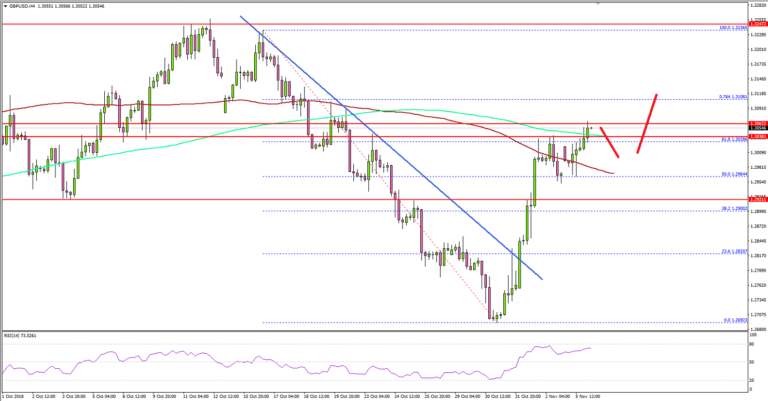
Looking at the 4-hours chart, the pair gained pace from the 1.2692 swing low and jumped above the 50% Fib retracement level of the last slide from the 1.3236 high to 1.2692 low.
More importantly, there was a break above a significant bearish trend line with resistance at 1.2800. The price even traded above the 1.3000 level and tested the 200 simple moving average (4-hours, green) plus the 61.8% Fib retracement level of the last slide from the 1.3236 high to 1.2692 low.
Presently, the pair is consolidating gains around the 1.3060-80 resistance zone. On the downside, there are many key support near the 1.2920 and 1.2900 levels, below which the price may move back into a bearish zone.
On the other hand, a successful close above 1.3080 and the 200 SMA could open the doors for more upsides towards the 1.3100 and 1.3150 levels in the near term.
Fundamentally, the UK Services PMI for Oct 2018 was released by both the Chartered Institute of Purchasing & Supply and the Markit Economics. The market was looking for a minor decline from the last reading of 53.9 to 53.3.
The actual result was lower than the forecast the UK Services PMI came in at 52.2, down from 53.9, which is the slowest rate of business activity expansion since March 2018.
The report added:
UK service providers signalled another increase in business activity during October, but the rate of expansion eased to its weakest since the snow-related soft patch seen in March. The loss of momentum largely reflected more cautious spending patterns among clients, as highlighted by the weakest upturn in new work since July 2016.
Overall, GBP/USD may correct lower, but as long as it is above 1.2900, it could bounce back.
Economic Releases to Watch Today
- Germany's Services PMI for Oct 2018 – Forecast 53.6, versus 53.6 previous.
- Spanish Services PMI for Oct 2018 – Forecast 51.8, versus 52.5 previous.
- Euro Zone Services PMI for Oct 2018 – Forecast 53.3, versus 53.3 previous.
- US IBD/TIPP Economic Optimism Index for Nov 2018 – Forecast 57.6, versus 57.8 previous.
Election Time
Markets
Monday's garden variety price action was par for the course as traders were most unwilling to extend risk with the US Midterms and the upcoming FOMC meeting in focus. As for the Midterms, consensus suggests that only a surprise sweep from either party will elicit much reaction in FX land. The Midterms have indeed fostered a lot of interest, but let's see if the polls will get it right this time around. However, flying under the radar is that these midterm elections carry a sizable legal risk for the GOP which could dent investor confidence as we will likely hear much more from Robert Mueller sooner rather than later.
As for the Fed, they will be hard-pressed given the strong labour markets to walk back any of the markets perceived hawkishness.
As for Presidents Xi speech, I don't think we need to look much further than his comments directed at Trump policy as ” the law of the jungle” to suggest the setup for the meetings later this month remains tenuous and on shaky ground. But again Presidents latest rally message indicates the US will make a deal with China; TRUMP SAYS BELIEVES WILL MAKE DEAL WITH CHINA'S PRESIDENT XI ( Bloomberg). But the markets can't help but think this messaging is little more than campaign fuel and the proof will be in the G-20 pudding.
Oil Markets
As expected the NY session was dominated by news flow around US sanctions on Iranian crude exports along with the temporary waivers granted to eight nations, including Iran's largest two customers: China and India. But there were no surprises at all which perhaps triggered and early NY session recovery in prices as profit-taking set in after oil trader felt prices had fallen sharply enough for the time being.
The question now has the current drop in prices entirely discounted the slowing economy doubts and rising supplies into the equation, thereby reducing the risk of a much more protracted plunge. But this now brings a high level of importance to the December 6 OPEC summit as their actions on the perceived supplies overhang could be signficant for prices.
Or like the recent commitment of traders(COT) overview suggests, hedge funds have turned negative on oi suggesting a negative downturn in the global economy could be the next big driver for oil prices.
But in the absence of a supply shocker or tweaks from OPEC, near-term price recovery may be elusive and short-lived as the market deal with what appears to be a short-term oil surplus while factoring in a slowing global economy. Indeed, if the COT overview signals anything, it's that Hedge Fund managers will be sellers on rallies.
Gold Markets
The precious metals markets have been relatively quiet this week thus far with very little flow to speak of dominated by short-term speculators trading edges of the current inside ranges 1233-1229. But most of the Gold investors await the results of midterm elections to provide a new sense of the direction of the market.
Asia Markets
The Malaysian Ringgit
Post-budget, its expected Malaysia, will receive a negative outlook if not a complete rating downgrade. While credit rating downgrades are not the death knell for a currency, but it will have significant short-term impacts, and that threat alone will keep the MYR trading defensively in the weeks ahead.
But with the deficit target at the higher end of market expectations, the MYR could weaken at a faster pace than expected and we could see 4.20 + by year-end.
Eco Data 11/6/18
[php_everywhere instance="1"]
Copper: Metal Pulls Back on Profit-Taking/News after 6% Advance Last Week
Copper was sharply lower on Monday as traders took profit after strong rally on last Thu/Fri, when the metal price rose over 6% on optimism over easing trading tensions between the US and China.
Release of China’s Oct services PMI, which showed sector’s slowest growth in over a year, added to downside pressure from profit taking.
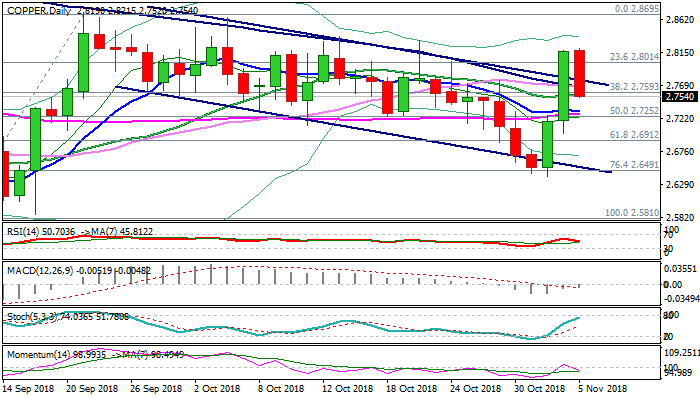
Pullback from new high at $2.8215 (the highest since 22 Oct) cracked pivotal supports at 2.7545 (20SMA) and 2.7525 (Fibo 38.2% of $2.6410/$2.8215), with sustained break here to generate signal for further easing after false break above the upper boundary of six-week bear-channel.
Pullback regained bearish momentum, which could help fresh bears to penetrate thickening daily cloud and further weaken near-term structure.
Next pivotal supports lay at $2.7325/$2.7291 (converged 10/55SMA), with break here (also near 50% of $2.6410/$2.8215) to confirm reversal and expose next pivotal support at $2.7100 (Fibo 61.8%).
On the other side, ability to hold above daily cloud would keep alive hopes of fresh attempts higher, but another catalyst would be required as metal’s recent strong price action was mainly driven by news.
Res: 2.7741; 2.8025; 2.8215; 2.8325
Sup: 2.7520; 2.7325; 2.7252; 2.7010
European Parliament Trade Committee approved EU-Japan trade deal, timely signal in support of open, fair, values-based and rules-based trade
The European Parliament's international trade committee voted 25-10 today to approve the EU-Japan trade deal signed back in July 17, 2018. The deal could now be sent to the full chamber for a vote in December plenary session. And, if it's approved, the deal could enter into force as soon as the Japanese Diet ratifies it.
In short, the EU-Japan trade deal will create a trade zone of 600m people, covering a third of of global GDP and around 40% of global trade. Eventually, the deal will remove almost all customs duties, worth roughly EUR 1B annually on European products and services exported to Japan.
The European Parliament's Trade Committee MEPs emphasized that the agreement "represents a timely signal in support of open, fair, values-based and rules-based trade, while promoting high standards, at a time of serious protectionist challenges to the international order".