Sample Category Title
U.S. Non-Manufacturing Activity Pulls Back from Record High in October
After rising to an all-time high in September, the Institute for Supply Management's (ISM) non-manufacturing index backed off in October to 60.3. Though lower, the headline print still surpassed consensus forecast for a larger pullback to 59.1.
The details of the report were mixed, with six of the ten sub-components edging lower, three pushing ahead and one remaining unchanged. Of note, backlog of orders was down 5 points to 53.5, business activity 2.7 points to 62.5 and employment 2.7 points to 59.7. Labor availability continues to be a challenge and is contributing to the deceleration in employment growth. The prices paid index also fell 2.5 points to 61.0.
In the growth category, both inventories (+1.5 to 56.0) and inventory sentiment (+2.5 to 62.0) picked up. The uptick suggests that services providers may be building a buffer to withstand any possible supply disruptions on the horizon.
Trade-related subcomponents were mixed. While imports fell by four points to 51.0, there was no movement for new export orders (unchanged at 61.0).
Business owners in the non-manufacturing sector were generally upbeat about current business conditions and the economy, but they remained apprehensive about continued capacity constraints, logistical difficulties and tariffs.
Key Implications
After a roaring September, the ISM non-manufacturing index came in a tad tamer in October. Despite the modest pullback, the U.S. services sector is still exhibiting solid growth. The fact that 16 out of the 17 industries surveyed reported an expansion in business speaks to the broad-based nature of this growth.
As has been the theme in several reports, firms continue to walk a fine line between finding enough workers and navigating the price pressures and uncertainty associated with tariffs. The latter is important. While capacity constraints and labor shortages augur for greater investment, these may be difficult in an environment in which global supply chains are in a state of flux.
Surging Pound Shrugs Off Soft Services PMI
GBP/USD has started the week with solid gains. In Monday’s North American session, the pair is trading at 1.3022, up 0.40% on the day. On the release front, Services PMI dipped to 52.2, shy of the estimate of 53.4 points. In the U.S, ISM Non-Manufacturing PMI posted a strong gain of 60.3, above the estimate of 59.3 points. On Tuesday, the U.S will release JOLTS Job Openings and all eyes will be on the U.S midterm congressional elections.
The pound jumped 1.1% last week, and the positive trend has continued on Monday. Reports that the U.K and the European Union are closing in on an agreement over Brexit has boosted the currency, after showing losses in October. On Friday, David Lidington, a close adviser of Prime Minister May, said that the two sides were “very close to resolving” the dispute over the Irish border, one of the most vexing problems in the Brexit negotiations. May would like the EU to host a special Brexit summit this month, with an eye to signing a deal before the end of the year. However, the Europeans have not showed the same enthusiasm emanating from London, and they will likely want to see more concessions from May before agreeing to a Brexit summit.
The U.S economy continues to perform well, a fact that will be hammered home by President Trump and the Republicans in the few hours left until Election Day on Tuesday. The labor market is at or beyond capacity, and nonfarm payrolls surged to 250 thousand, crushing the estimate of 194 thousand. Wage growth has also strengthened, with strong gains of 3.1% in the past year. Despite these strong numbers, the dollar failed to make headway on Friday, as reports that President Trump will present his Chinese counterpart with a trade deal proposal increased risk appetite and weighed on the greenback.
Conflicting Trade Signals Set the Tone; GBP Remains Way off 1.35 “Target” on Brexit Deal
What a difference two days in the financial markets can make when it comes to the trade tensions narrative. Many emerging market currencies have given back their gains from the end of last week after White House Economic Advisor Larry Kudlow conflicted late on Friday previous unexpected reports that President Trump had asked his cabinet to draw up a trade agreement with China.
The early part of trading for the week has already showed how sensitive emerging markets can react to newsflow around potential trade developments with a number of different emerging market currencies trading lower against the USD on Monday. This has included losses close to 1% in the Indian Rupee, while the Chinese Yuan has lost just over 0.5% and the Malaysian Ringgit above 0.4%.
This trend of trajectory does overall sum up how sensitive emerging market assets will be to newsflow around a potential breakthrough in trade talks between the two largest economies in the world.
Air of caution before U.S. risk events this week
Elsewhere, there are some indications at time of writing of limited trading volumes as the new trading week commences, which sum up that investors could be hesitant to add more positions into their portfolios just one day before mid-term elections take place in the United States.
When you consider how off-guard financial markets have been caught to political events in recent history, caution before the event is a likely investment strategy that is on the mind of investors. This means that we might not see much movement in global stocks before the event, while safe-haven assets like Gold and the Japanese Yen will be the first thing on traders’ minds if an air of market uncertainty comes their way.
The general consensus is that while, overall, mid-term elections do not on a historic basis create too much fuss in financial markets, this administration running the White House is unlike anything we have seen before and this is why it is expected that investors will tread with caution before the outcome becomes clearer.
It is not possible to predict potential political outcomes in the modern world of unpredictable politics, but most emerging market investors will be hoping the Dollar does sell-off on the outcome of the election because emerging markets do appear heavily undervalued at current levels.
The upcoming Federal Reserve meeting will be another risk event to monitor this week, but interest rates are not expected to change in November and as long as the FOMC carries the same narrative that U.S. interest rates will be gradually adjusted higher in the next 15 months or so, the mid-term elections should overshadow the Fed decision when it comes to potential financial market volatility.
The best-case scenario for investors who would like to consider selling the Dollar at what still appears to be historically-high valuations for the Greenback would most likely be that the mid-term election outcome encourages concerns that President Trump will face legislative resistance when it comes to pushing pro-America policies.
Emerging markets are those that remain greatly pressured from broad-based Dollar strength, so I would expect emerging market currencies to be contenders to benefit the most over the medium-term if the Dollar does get squeezed lower.
Sanctions were re-imposed into Oil price long time ago
The return of re-imposed sanctions on Iran on November 5 has encouraged a small recovery in the Oil markets today. However, I wouldn’t buy into this headline too much, because we could be in line for a small recovery in the Oil markets after the commodity edged dangerously close to bear market territory after withdrawing close to 20% from its multi-year highs a few weeks ago.
Re-imposed sanctions on Iran have been something that were priced into the Oil markets a long time ago, all the way back from when Trump confirmed he would pull out of the 2015 nuclear deal, so I wouldn’t associate sanctions coming back into play as a near-term driver for the price of Oil. I would instead, focus more heavily on the global demand outlook because of the ongoing external uncertainties weighing down on economic prospects. This is something I see of more of a risk for Oil over the coming months.
If concerns over slowing global growth come to fruition, it signals less demand is needed for commodities like Oil and I see this as a major risk to the valuation of Oil.
Hopes of Pound rising above 1.35 on Brexit deal long way off!
Optimism that a long-awaited breakthrough on the prolonged Brexit negotiations is close has sent British Pound forecasts into a frenzy. Suggestions are making their way that the Pound could rally all the way to 1.35, if not above on an eventual breakthrough in the Brexit drama, but I would personally stay away from such claims.
Yes, we all know how sensitive the British Pound has behaved to Brexit newsflow but let’s not get ahead of ourselves and suggest a return to 1.35 is imminent when the GBPUSD is trading marginally above 1.30 at time of writing.
UK Prime Minister Theresa May will still need to receive approval for the terms of the soon-to-be-expected agreement, which given the ongoing controversy that Brexit still receives around the United Kingdom will likely not be an easy task.
I would personally factor into consideration that the Pound is just as much likely to shoot lower once again on more Brexit gridlock, as it is to aim higher on a breakthrough. Such headlines on an expected rally in the Pound generally suggest that markets are positioning themselves on a breakthrough, meaning that I would factor into my own expectations how suddenly the Pound could fall sharply below 1.30 on another round of hard-Brexit fears.
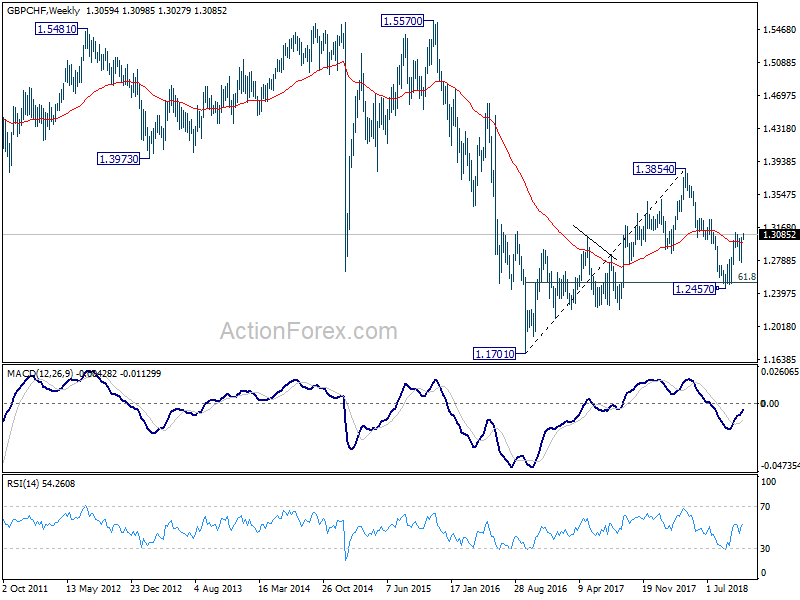
Today’s top mover: GBP/CHF ready to resume rise from 1.2457
GBP/CHF is so far the biggest mover for today. The race is actually quite tight with GBP/USD, GBP/JPY and NZD/CHF.
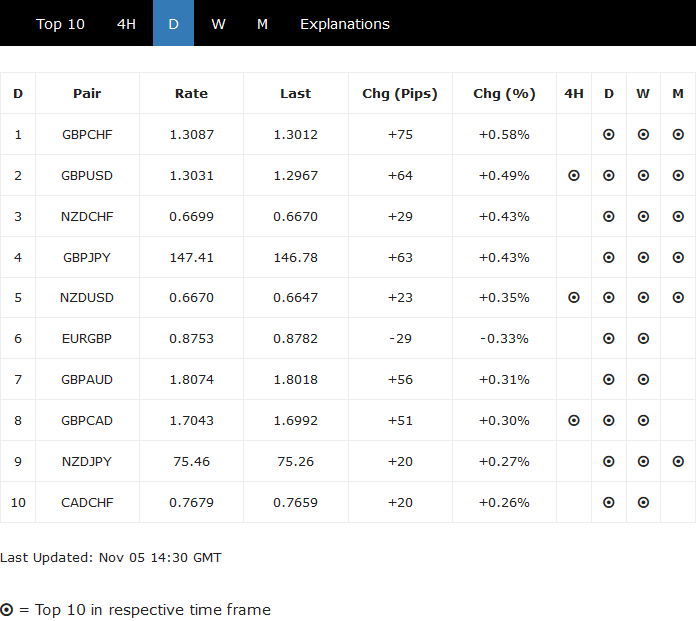
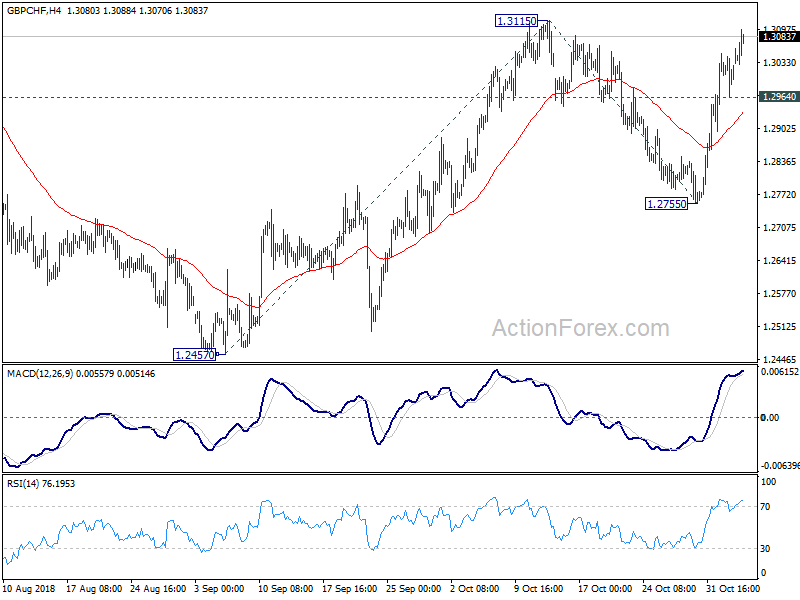
Anyways, GBP/CHF's rebound from 1.2755 accelerates further higher today and focus is now on 1.3115 resistance. Decisive break there will confirm resumption of whole rise from 1.2457. This will remain the favored case as long as 1.2964 minor support holds. Though, break of 1.2964 could prompt near term reversal.
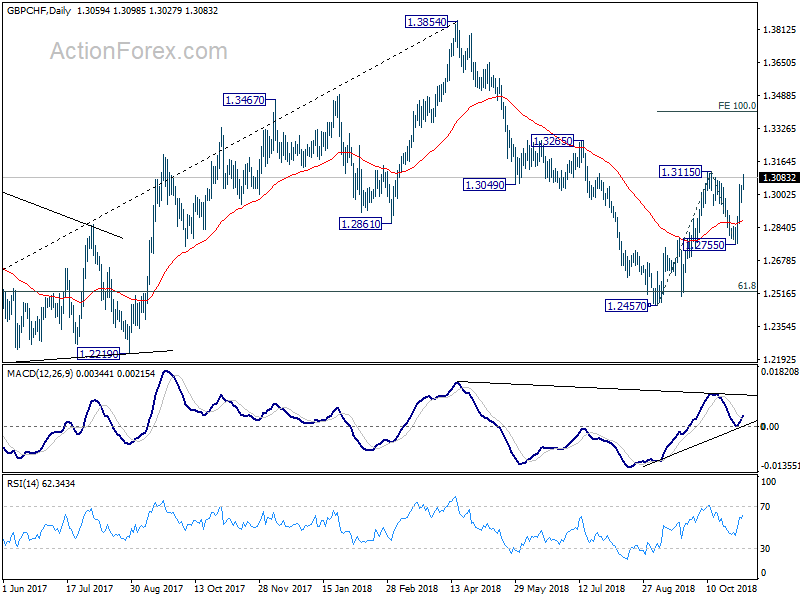
Prior break of 1.3049 support turned resistance suggests that whole decline from 1.3854 has completed at 1.2457. Such decline displayed a three wave corrective structure. The reversal also came after drawing support from 61.8% retracement of 1.1701 (2016 low) to 1.3854 (2018 high) at 1.2523. So overall, the fall from 1.3854 to 1.2457 should be a counter trend move. And, the current rise from 1.2457 is likely along the larger main trend. Hence, on decisive break of 1.3115, GBP/CHF should target 100% projection of 1.2457 to 1.3115 from 1.2755 at 1.3413 in near term.
Sunset Market Commentary
Markets
Global core bonds are little changed today with moves rather subdued on a low volume trading day. German Bunds outperformed at the opening, but soon paired gains. Both German Bunds and US Treasuries are hovering near opening levels. The relative weight of economic events today is meagre in comparison to what is coming in the next days. Investors await the US midterm elections of tomorrow. The most likely scenario (Democrats retake majority in the House, Republicans strengthen position in the Senate) promises to deliver a muted market reaction. The Federal Reserve meets on Wednesday, though no noteworthy changes are expected. The US Treasury sells 3-year notes tonight. There are no European data to steer trading. Italian BTP Futures lost some ground after the opening, but without any material news. The move may reflect some positioning ahead of the Eurogroup meeting of Finance Ministers today where Italy’s budget will be discussed for sure. In the meantime, European Commission Vice President Dombrovskis repeated that the Italian budget needs substantial adjustments but that both parties are continuing negotiations ahead of Italy’s budget deadline next Tuesday. BTP’s trade at the time of writing back at opening levels. The US yield curve edges lower at the time of writing with changes ranging between -0.1 bp (2-yr) and -1.7 bps (10-yr). The German yield curve flattens slightly with yield changes varying between -0.5 bps (30-yr) and +0.2 bps (2-yr). Yield spreads versus Germany remain quasi unchanged.
Trading in the major USD cross rates was mainly technical in nature today as most investors were reluctant to place directional bets ahead of the outcome of the US mid-term elections and the Fed policy decision later this week. EUR/USD initially traded with a cautious negative bias. Uncertainty on the next steps in the budget discussion between the EU and Italy maybe were a slightly negative for the euro (Italian bonds were also under light pressure this morning). However, as was the case after the payrolls on Friday, negative news from Europe or positive news from the US still wasn’t able to push EUR/USD back to 1.13 key technical support. The pair even reversed earlier losses early in US dealings this afternoon. EUR/USD is again coming close to the 1.14 barrier going into the publication of the US non-manufacturing ISM. USD/JPY also showed a small intraday loss of momentum and trades in the 113.15 area. USD traders basically are in wait-and-see modus awaiting upcoming (potential) event risk.
Sterling traders/investors continued to see the glass half full today. A series of positive Brexit headlines at the end of last week and during the weekend, were again a good enough reason for markets to turn more cautious on sterling shorts. In this respect, markets even ignored a weak UK services PMI. The index in the key services sector unexpectedly dropped from 54.1 to 52.1. This at least doesn’t match with the risk of an economy potentially nearing the status overheating that some BoE MPC members fear in case of an orderly Brexit. However, sterling trading is still mainly driven by Brexit sentiment/rumours and markets currently are handling those rumours with a positive bias. EUR/GBP is currently trading in the 0.8750 area. Cable hovers in the 1.30 area.
News Headlines
The US administration has announced, as expected, it will exclude eight countries from the Iranian oil sanctions that started this morning. The most important country among the exemptions is China. The group of eight is allowed to continue limited oil imports from Iran for the next six months. Iran is estimated to miss out on $2.5bn oil revenues.
Leo Varadkar, Ireland’s premier, has told UK PM May he is open to a “review” of the Irish border backstop in an effort to overcome deep divisions in Brexit talks. Previously, Varadkar had rejected suggestions made by Brexit secretary Dominic Raab to implement a three-month limit on the backstop.
US ISM Non-Manufacturing Index decreased less than expected in October to 60.3 from the 61.6 in September. Markets were expecting a stronger decrease to 59.0. The Markit/CIPS Services PMI in the UK decreased from 53.9 last month to 52.2 in October, which is a larger fall back than forecasted.
ISM non-manufacturing dropped to 60.3, strong growth despite a slight cooling off
US ISM non-manufacturing dropped to 60.3 in October, down from 61.6 but beat expectation of 59.5. Employment index dropped -2.7 to 59.7. ISM noted the reading respresnets "continued growth in the non-manufacturing sector at a slower rate."And, the sector "again reflected strong growth despite a slight cooling off after a record month in September". However, there are "continued concerns about capacity, logistics and tariffs. "
Some quotes from the respondents:
- "Tariffs are beginning to impact business. We ask our suppliers to hold pricing for six months, but we are experiencing difficulties." (Construction)
- "Wrapping up fiscal year budgets [and] seeing modest increases in volume and spend. Some price increases due to tariffs on computers/peripherals." (Finance & Insurance)
- "It has been very difficult to make decisions due to instability brought by the latest trading dispute. In this environment, clients tend to postpone capital-expenditure decisions." (Mining)
- "The promotional-products trade continues to stay strong going into the end of the year. This reflects the overall macroeconomics of how the economy is doing thus far. We have not yet begun to see the impacts on prices due to the additional tariffs against China. We anticipate that price increases may start to work into the supply chain early in the first quarter." (Management of Companies & Support Services)
BoC Poloz: Normalization produced welcome recalibration in equity markets
BoC Governor Stephen Poloz said today in speech that "after a decade of extraordinary effort by central banks to flood markets with liquidity, the global economy has reached the stage where stimulus can be steadily withdrawn." And, investors are now "confronting two sided risks to inflation", as central banks are "shifting" the risks back to the market, the " long-standing trend toward lower bond yields seems to be over". As a result, the turn produced a "recalibration in equity markets" which is "creating a more normal level of market volatility". But he emphasized such developments "do not point to a gloomy economy outlook by any means". And they are merely "welcome symptoms of normalization".
Poloz also emphasized that BoC must "attempt to weigh both the upside and downside risks and take a middle, risk-balanced path." And he reiterated the bank's stance on monetary policy. That is, given the growth and inflation outlook. BoC's
"policy rate will need to rise to a neutral stance to achieve our inflation target." And BoC will continue to monitor the economy's adjustments to higher interest rates to determine the pace of rate hikes.
Poloz's full speech, and video webcast.
RBA to Stick to Script as Risks Loom
The Reserve Bank of Australia will make an announcement on monetary policy on Tuesday at 0330 GMT and it is certain that policymakers will choose to keep interest rates at record lows for the 26th consecutive month. Some discomfort however is expected regarding recent weakness in economic data, while escalated global risks could be another reason to hold policy accommodative for now.
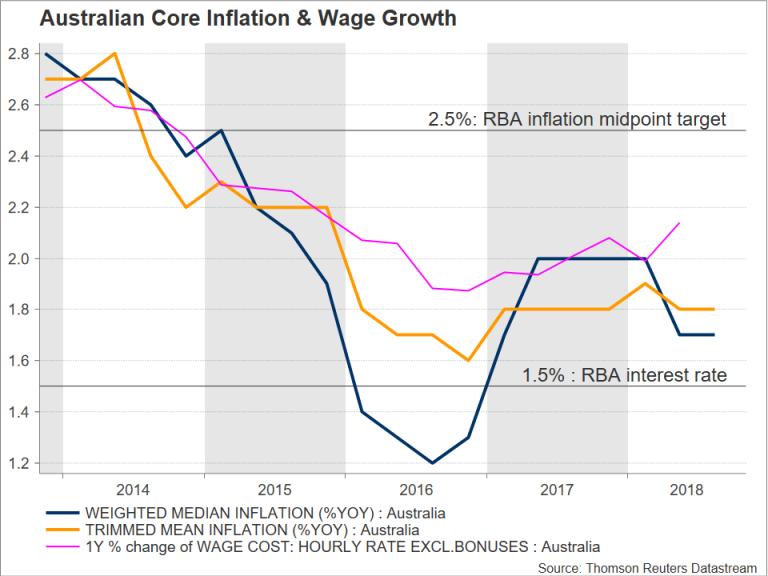
Australian consumer prices grew by 1.9% year-on-year in the third quarter, in line with forecasts but below the 2.1% mark printed in Q2. The core measures however surprised analysts, with the trimmed mean and the weighed median CPIs arriving lower on average at 1.75% compared to the 1.9% forecast, an indication that the RBA will more likely fail to achieve its 2-3.0% inflation goal for another year. With the final quarter underway, questions are also arising about whether the core inflation will remain steady at 1.75% for the second year as the Bank predicts. Another disappointing CPI report in Q4 for instance could shed more light about whether “the next move in rates should be up”.
While the RBA has already flagged that interest rates are not likely to change from a record low of 1.5% until late 2019, discouraging inflation prints ensured that the central bank will keep its guidance on Tuesday. But even if the readings were about to improve, a subdued wage growth would probably hold the RBA’s hands tight as policymakers are relying on wage dynamics to achieve their inflation goal. The latest evidence though showed that despite wages rising a bit faster in the second quarter as expected, the speed was still among record lows, a sign that consumers are not yet in a position to pay higher borrowing costs at a time when burdening debt obligations are barely met.
Besides the above, economic developments in China, a top buyer of Australian exports, is another reason to avoid rate hikes at the moment. In the three months to September, GDP growth in China slowed down for the third straight quarter, reaching the weakest pace in nine years, with investors speculating that US import tariffs on Chinese exports have started to bite activities in the world’s second biggest economy. Manufacturing PMIs were also not so encouraging over the past few months, indicating that Chinese factories are struggling to maintain healthy growth. This in return raised worries that if conditions deteriorate even further, China might turn more careful regarding its spending on foreign products, bringing headwinds to Australian exporters. Yet, latest trade data showed that Australian exports to China reached a new record high in September, whilst should Beijing materialize its proposed counter measures to avoid any disruption from tariffs, the damage on the Australian economy might appear minimal. Still, it remains to be seen whether the US is willing to relax its trade restrictions at the G20 meeting in Argentina later this month.
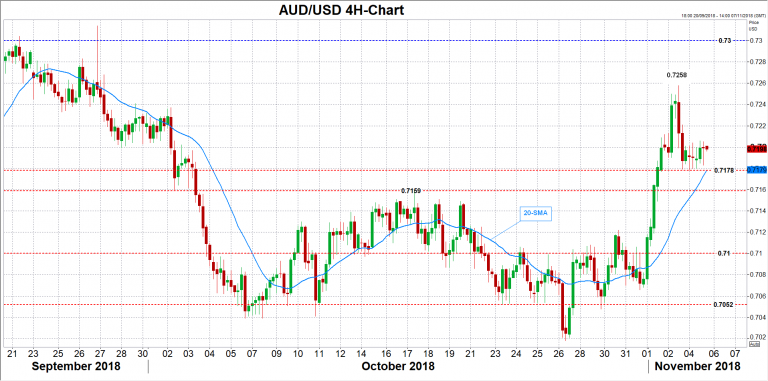
In the FX markets, aussie/dollar stretched its downtrend started in February towards 2 ½ -year lows in October, making Australian goods more competitive abroad. The pair could lose more if the RBA holds borrowing costs steady on Tuesday but uses a dovish tone to refer to inflation and/or trade-related risks. In such a case, bears could drive the price down to 0.7178, which the market was unable to break on Friday. A move lower and below the 20-period moving average currently at 0.7173, could bring the October 17 high of 0.7159 into view, while steeper declines may also reach the 0.7100 psychological level. Support around 0.7058 could be another barrier to downside movements.
Alternatively, remarks highlighting optimism that a tighter labor market may lift wages and thus price growth in coming months, could help the aussie to rally towards the five-week high of 0.7258 marked on Friday. Even higher, all eyes will shift to the 0.7300 round-level, last seen in September.
Later in the week, the outcome of the US midterm elections due on Wednesday may disrupt the market ahead of the RBA’s Monetary Policy Statement on Friday which will include new quarterly economic projections.
USD/JPY Mid-Day Outlook
Daily Pivots: (S1) 112.71; (P) 113.01; (R1) 113.51; More..
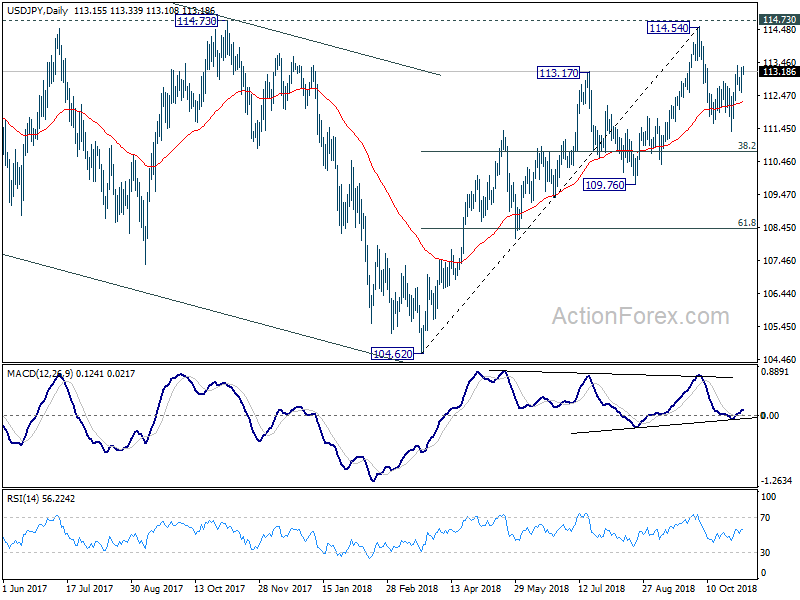
USD/JPY is staying in range below 113.38 and intraday bias remains neutral for the moment. Another rise is mildly in favor as long as 112.56 minor support holds. On the upside, break of 113.38 will resume the rebound from 113.37 to o retest 114.54/73 key resistance zone. On the downside, break of 112.56 will likely extend the correction from 114.54 to 38.2% retracement of 104.62 to 114.54 at 110.75 before completion.
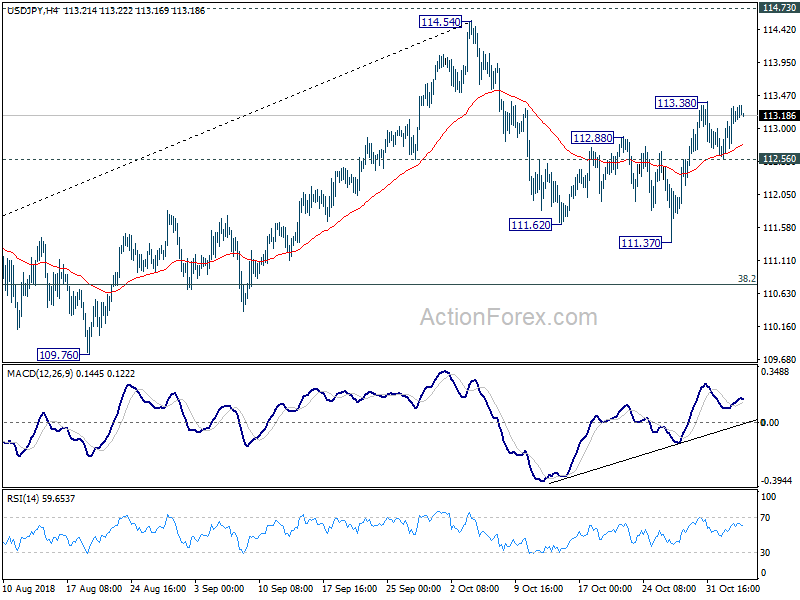
In the bigger picture, corrective fall from 118.65 (2016 high) should have completed with three waves down to 104.62. Decisive break of 114.73 resistance will likely resume whole rally from 98.97 (2016 low) to 100% projection of 98.97 to 118.65 from 104.62 at 124.30, which is reasonably close to 125.85 (2015 high). This will stay as the preferred case as long as 109.76 support holds. However, decisive break of 109.76 will dampen this bullish view and turns outlook mixed again.
USD/CHF Mid-Day Outlook
Daily Pivots: (S1) 0.9986; (P) 1.0017; (R1) 1.0067; More...
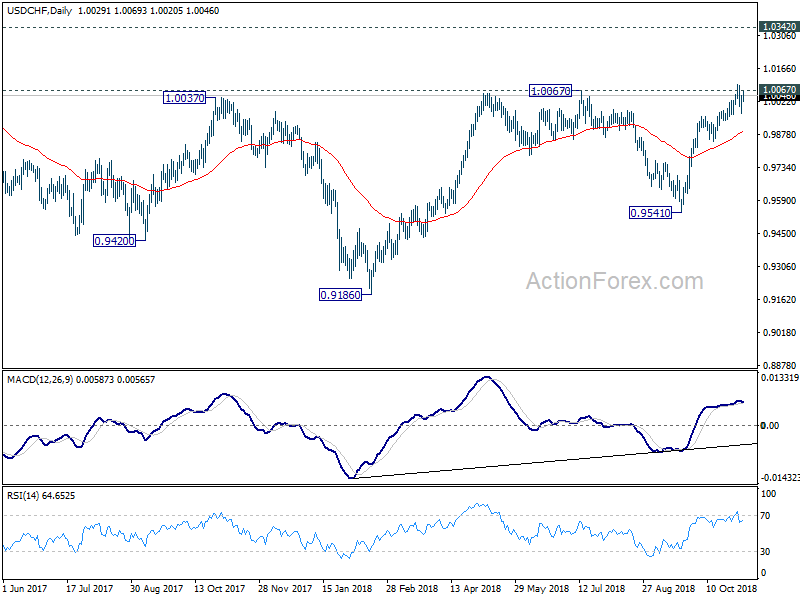
USD/CHF rebounds further today but stays below 1.0094. Intraday bias remains neutral first. Considering bearish divergence condition in 4 hour MACD, a short term top is possibly in place at 1.0094. On the downside, below 0.9968 will extend the decline from 1.0094 into 0.9848/9954 support zone. On the upside, though, break of 1.0094 and sustained trading above 1.0067 will confirm resumption of larger rise from 0.9186 and should target 1.0342 key resistance next.
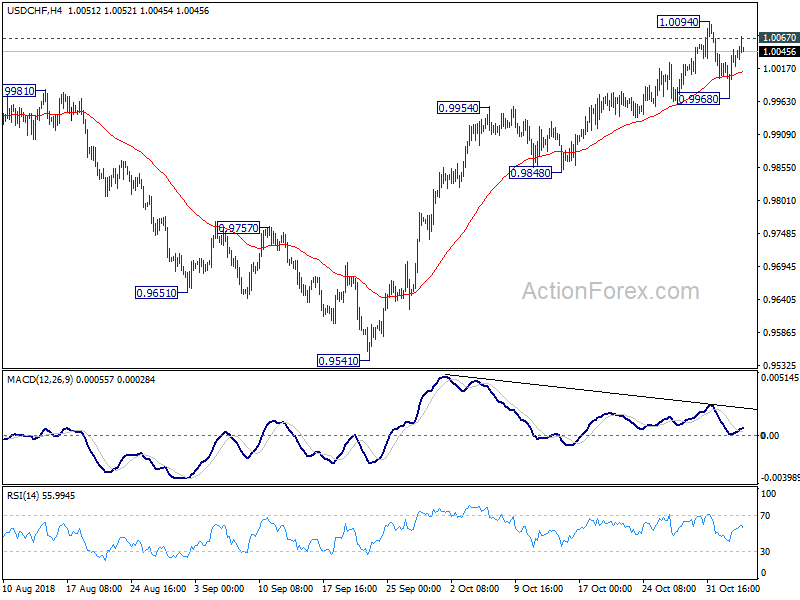
In the bigger picture, the pullback from 1.0067 has completed at 0.9541 already. And rise from 0.9186 is likely resuming. Firm break of 1.0067 will pave the way to retest 1.0342 key resistance. We'd be cautious on strong resistance from there to limit upside to bring another medium term fall to extend long term range trading. However, firm break of 0.9848 near term resistance will dampen this view and bring deeper decline back to 0.9541 support and possibly below.