Sample Category Title
EUR/USD Mid-Day Outlook
Daily Pivots: (S1) 1.1354; (P) 1.1406; (R1) 1.1439; More....
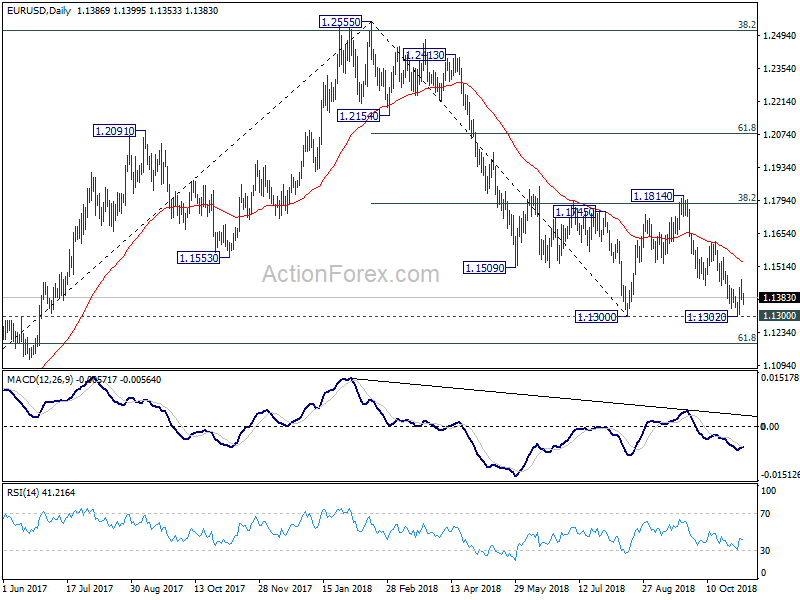
EUR/USD is staying in tight range below 1.1455 and intraday bias remains neutral first. On the upside, above 1.1455 will reaffirm that consolidation pattern from 1.1300 has started the third, rising leg. Further rise should be seen to 1.1621 resistance and above. But upside should be limited by 1.1814 to bring down trend resumption eventually. On the downside, break of 1.300 will resume whole down trend from 1.2555 and target 1.1186 fibonacci level next.
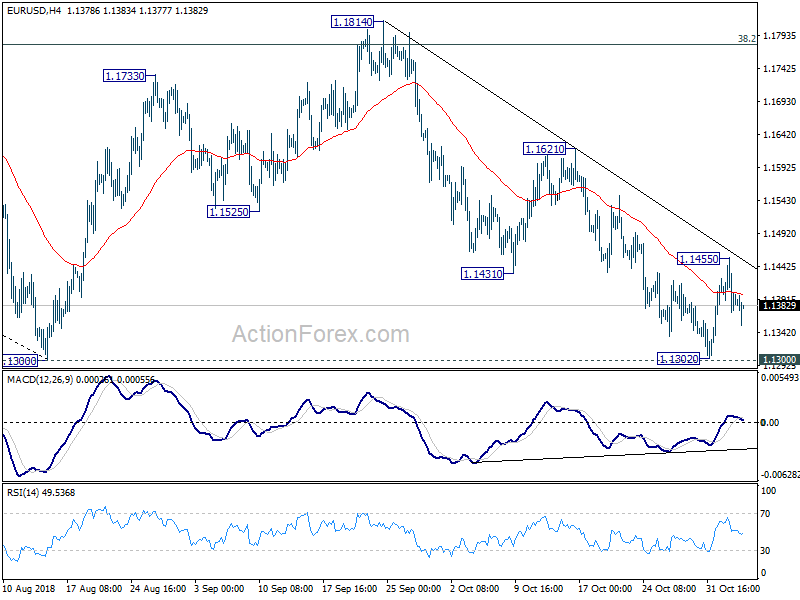
In the bigger picture, price actions from 1.1300 is seen as a corrective pattern. Decisive break of 1.1300 will resume the down trend from 1.2555 to 61.8% retracement of 1.0339 (2017 low) to 1.2555 at 1.1186 next. Sustained break there will pave the way to retest 1.0339. In case the consolidation from 1.1300 extends, upside should be limited by 1.1814 and 38.2% retracement of 1.2555 to 1.1300 at 1.1779. to bring down trend resumption eventually.
Canadian Dollar Trading Sideways, US Services Report Next
The Canadian dollar has edged lower in the Monday session. Currently, USD/CAD is trading at 1.3098, down 0.08% on the day. On the release front, there are no Canadian indicators. In the U.S, ISM Non-Manufacturing PMI is expected to drop to 59.3 points. On Tuesday, the U.S will release JOLTS Job Openings and all eyes will be on the U.S midterm congressional elections. Canada will release Building Permits.
Canadian employment data was solid in October. The economy added 11.2 thousand jobs in October, but this was shy of the estimate 12.7 thousand. The unemployment rate ticked lower to 5.8%, a shade better than the forecast of 5.9%. These numbers will likely increase the likelihood of a rate hike from the Bank of Canada in early December. The economy is doing well and the BoC is also mindful that the Federal Reserve is expected to raise rates again in December, which would mark a fourth rate hike in 2018. Policymakers do not want to see divergence widen between U.S and Canadian rates, and another rate hike from the BoC would be bullish for the Canadian dollar.
The U.S economy continues to perform well, a fact that will be hammered home by President Trump and the Republicans in the few hours left until Election Day on Tuesday. The labor market is at or beyond capacity, and nonfarm payrolls surged to 250 thousand, crushing the estimate of 194 thousand. Wage growth has also strengthened, with strong gains of 3.1% in the past year. Despite these strong numbers, the dollar failed to make headway on Friday, as reports that President Trump will present his Chinese counterpart with a trade deal proposal increased risk appetite and weighed on the greenback.
GBP/USD Mid-Day Outlook
aily Pivots: (S1) 1.2932; (P) 1.2986; (R1) 1.3022; More...
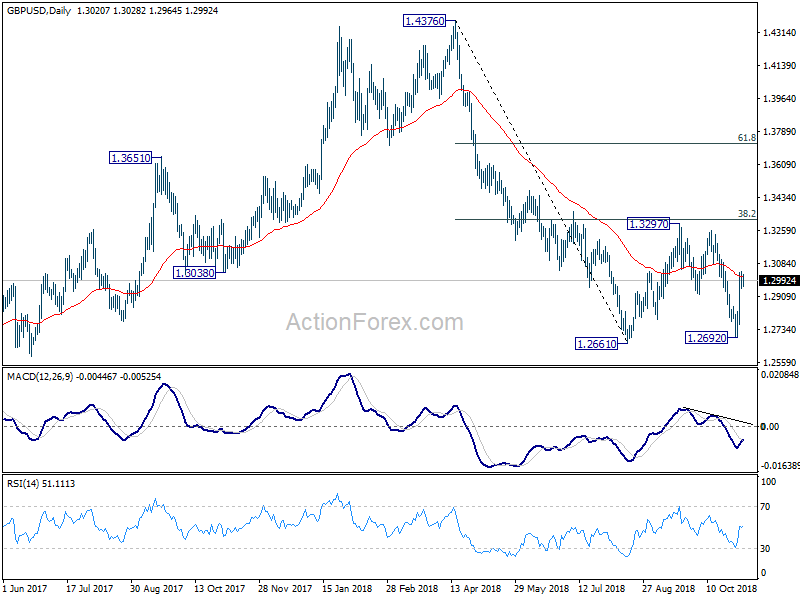
With 1.2908 minor support intact, intraday bias in GBP/USD remains on the upside. Rise from 1.2692 is seen as the third leg of consolidation pattern from 1.2661. Further rebound should be seen back towards 1.3297 resistance zone. However, we'd expect strong resistance from 1.3316 fibonacci level to limit upside to bring down trend resumption eventually. On the downside, below 1.2908 minor support will turn bias back to the downside for 1.2692 instead.
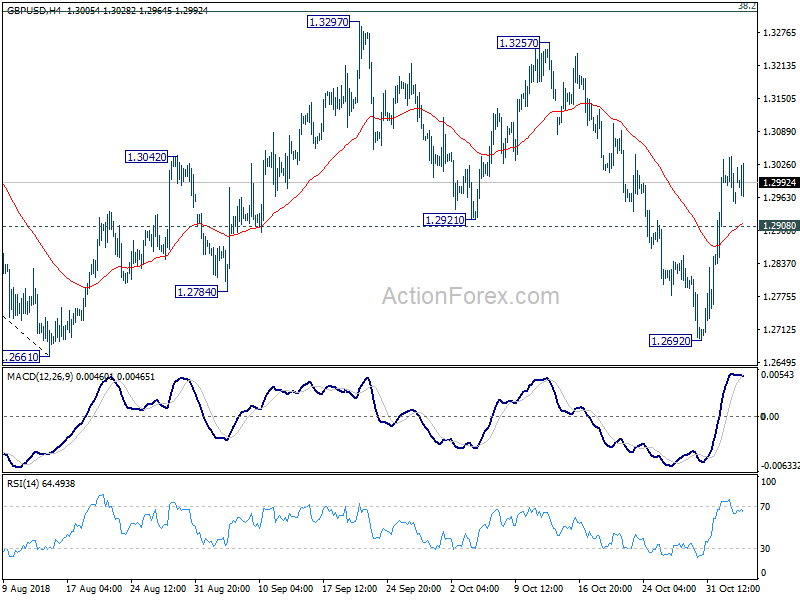
In the bigger picture, whole medium term rebound from 1.1946 (2016 low) should have completed at 1.4376 already, after rejection from 55 month EMA. The structure and momentum of the fall from 1.4376 argues that it's resuming long term down trend. And this will be the preferred case as long as 38.2% retracement of 1.4376 to 1.2661 at 1.3316 holds. However, firm break of 1.3316 would bring stronger rebound to 61.8% retracement at 1.3721. And, the eventual depth of the fall from 1.4376, and the chance of hitting 1.1946 low, will depend on the strength of the interim corrective rebound from 1.2661.
Sterling Firm Despite Weaker Data and Brexit News, Swiss Franc Weakest
Swiss Franc is clearly the weakest one for today so far. In particular selloff intensifies somewhat in European session. Weakness of the Franc also drags down Euro, which is trading as the second weakest. On the other hand, Sterling is taking turn to be the strongest with New Zealand Dollar today. There are a lot of rumors and noise flying around on Brexit, but the Pound generally shrugs them off. EU chief Brexit Michel Barnier's speech on the topic could probably give Sterling a decisive direction. Dollar is so far mixed, failing to ride on Friday's late rebound. Mid-term election is likely a factor delaying movements in the greenback.
The global stock markets are rather mixed today. Major European indices are trading higher at the time of writing. FTSE is up 0.40%, DAX up 0.12%, CAC up 0.26%. But major Asian indices ended all in red. Nikkei closed down -1.55%, Hong Kong HSI down -2.08%, China Shanghai SSE dropped -0.41%. Singapore Strait Times fell -1.79%. German 10 year yield is up 0.002 at 0.434. Italian 10 year yield is up 0.0407 at 3.346. German-Italian spread remains below 300.
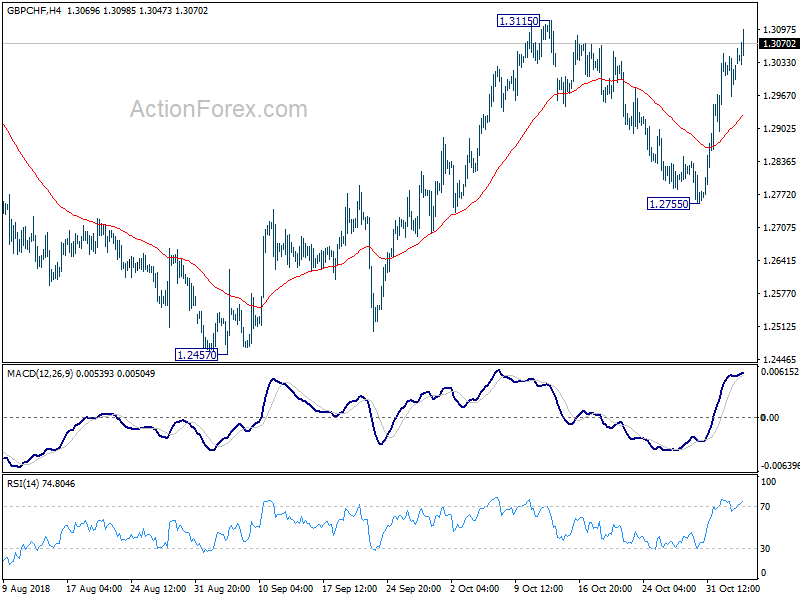
Technically, 113.38 in USD/JPY remains a focus, same as 0.8722 in EUR/GBP. GBP/CHF is now a pair note too with today's rise. Break of 1.3115 will resume whole rebound from 1.2457. Otherwise, the forex markets lag decisive movements for now. Most pairs are just consolidation in familiar range.
Brexit noise floating around
There is a lot of Brexit noise today. It's reported that EU is insisting on having an Irish backstop without time limit. On the other hand, UK Brexit Minister Dominic Raab pushing for a three-months expiry on the backstop. Prime Minister Theresa May's spokesperson also said "we don't want the backstop to be in place indefinitely and (we have said) that we would be looking to a mechanism to achieve that."
Meanwhile, out of UK, there are rumors that there will no Brexit deal to be made this week. And more importantly, there are even reports saying that a no-deal Brexit would be most probable if no agreement would be made within a week. On the other hand, Susan Hooper, a British executive who sits on the board of the Brexit ministry, said "I cannot imagine that we will not get a deal". But with regards to businesses, "the no deal is the hardest scenario and therefore I would plan for the hardest."
UK PMI services dropped to 52.2: GDP growth to weaken sharply in Q4
UK PMI services dropped to 52.2 in October, down from 53.9 and missed expectation of 53.4. Chris Williamson, Chief Business Economist at IHS Markit, noted that "the disappointing service sector numbers bring mounting evidence that Brexit worries are taking an increasing toll on the economy". And "combined with the manufacturing and construction surveys, the October services PMI points to the economy growing at a quarterly rate of just 0.2%, setting the scene for GDP growth to weaken sharply in the fourth quarter."
Eurozone Sentix investor confidence dropped to 8.8, the zenith is clearly passed
Eurozone Sentix Investor Confidence dropped to 8.8 in November, down from 11.4 and missed expectation of 9.9. Sentix noted "The problem areas in Europe and the global economy remain largely the same, which does not make it any better. Germany's weakness is also weighing on the Euroland economy." Also, "the Eurozone economy passed its zenith in January. Since then, economic expectations have reversed and since April they have been negative."
Sentix noted factors such as "US President's trade policy", "discussion about the future of the car industry in Germany", the "weakness of the banking sector" and the "budget question in Italy" are contributing to the development. Additionally, there is an "increasing perception of inflation" as "investors expect inflation to continue to rise. Thus, "central banks can hardly deviate from their current course towards a more restrictive monetary policy, at least not only because of an economic slowdown."
Eurozone FMs to discuss Italy's recipe for reviving growth
Italy's budget will certainly be a hot topic in the summit of Eurozone finance minister meeting in Brussels today. It comes at time time after European Commission rejected the country's 2019 budget, with deficit target at 2.4% of GDP. The Commission demand Italy to revise the plan by November 13, But Prime Minister Giuseppe Conte insisted there is no "Plan B" for the program and indicated no intention to comply with EU's demand.
Italian Deputy Prime Minister Luigi Di Maio, leader of the 5 Star Movement, said over the weekend that the coalition government "will not cede an inch" on the budget. He also hailed that their own plan will become a "recipe" for reviving European growth.
China Xi pledged unambitious USD 30T imports at CIIE
China is holding a week-long China International Import Expo, or CIIE, in Shanghai, starting today. President Xi Jinping said "CIIE is a major initiative by China to pro-actively open up its market to the world." And, he noted "economic globalization is facing setbacks, multilateralism and the free trade system is under attack, factors of instability and uncertainty are numerous, and risks and obstacles are increasing." That's the usual rhetorics that China has been using to position itself as defender of free trade.
Nevertheless, Xi also pledged to cut import taxes further and spend more on foreign goods and services. He said China's goods import will exceed USD 30T over the next 15 years. Meanwhile, Services import will exceed USD 10T. The figure on goods was somewhat raised from Xi's prior promise of USD 24T. But the fact is, USD 30T over 15 years means only USD 2T per annum, which Chin has already nearly met back in 2013 and 2014. After a dip to USD 1.6T in 2016, import has already bounced back to USD 1.8T in 2017. So, Xi's target is not that ambitious.
China Caixin PMI composite dropped to 28-month low, mounting downward pressure on the economy
China Caixin PMI services dropped to 50.8 in October, down from 53.1 and missed expectation of 52.9. That's the lowest level in 13 months. PMI composite output index dropped from 51.2 to 50.5, hitting a 28-month low, lowest since June 2016.
Dr. Zhengsheng Zhong, Director of Macroeconomic Analysis at CEBM Group said in the release that the fall in PMI composite indicated "mounting downward pressure on China's economy". Employment edged up but stayed negative, which " could possibly be due to government efforts". Future output index edged down, "reflecting weakening confidence among companies."
BoJ Kuroda: It's necessary to persistently continue with powerful monetary easing
BoJ Governor Haruhiko Kuroda delivered a speech to business leaders in Nagoya today. There he acknowledged that "the BOJ fully recognizes that, by continuing monetary easing, financial institutions' strength will be cumulatively affected." And, even though, "these risks are judged as not significant at this point", he pledged to "scrutinize developments and encourage financial institutions to take action as necessary."
US-China trade war is one of the risks surrounding Japan's outlook. Kuroda said "the impact of such problems on Japan's economy is limited for now ... ut if the problems persist, the effect on Japan's economy could become bigger".
Overall, Kuroda reiterated that "it's necessary to persistently continue with powerful monetary easing, while considering both the positive effects and side effects in a balanced manner." But BoJ will "of course" exit ultra-easy monetary policy when the 2% price target is reached.
BoJ minutes: Need to explain thoroughly the intention to continue with powerful easing
Separately, BoJ also released minutes of September 18-19 monetary policy meeting. The minutes reiterated that the measures taken back in July, including introduction of forward guidance, were for strengthening the framework for "continuous" powerful monetary easing. However, A few members noted some market participants still viewed BoJ's intention as "unclear". Thus, "it was important to continue to thoroughly explain that the measure was intended to make clearer the Bank's policy stance that it would persistently continue with powerful monetary easing while taking into account its side effects.
One member also pointed out that allowing long term yields to move in a "more flexible manner" prompted "heightened" volatility in JGB market. And, since it's only two months past that meeting, with small transactions volume of JGB in summer, "it was necessary to continue to carefully examine the effects on financial markets".
GBP/USD Mid-Day Outlook
Daily Pivots: (S1) 1.2932; (P) 1.2986; (R1) 1.3022; More...
With 1.2908 minor support intact, intraday bias in GBP/USD remains on the upside. Rise from 1.2692 is seen as the third leg of consolidation pattern from 1.2661. Further rebound should be seen back towards 1.3297 resistance zone. However, we'd expect strong resistance from 1.3316 fibonacci level to limit upside to bring down trend resumption eventually. On the downside, below 1.2908 minor support will turn bias back to the downside for 1.2692 instead.
In the bigger picture, whole medium term rebound from 1.1946 (2016 low) should have completed at 1.4376 already, after rejection from 55 month EMA. The structure and momentum of the fall from 1.4376 argues that it's resuming long term down trend. And this will be the preferred case as long as 38.2% retracement of 1.4376 to 1.2661 at 1.3316 holds. However, firm break of 1.3316 would bring stronger rebound to 61.8% retracement at 1.3721. And, the eventual depth of the fall from 1.4376, and the chance of hitting 1.1946 low, will depend on the strength of the interim corrective rebound from 1.2661.
Economic Indicators Update
| GMT | Ccy | Events | Actual | Forecast | Previous | Revised |
|---|---|---|---|---|---|---|
| 23:50 | JPY | BOJ Minutes of Policy Meeting | ||||
| 0:00 | AUD | TD Securities Inflation M/M Oct | 0.10% | 0.30% | ||
| 1:45 | CNY | Caixin PMI Services Oct | 50.8 | 52.9 | 53.1 | |
| 9:30 | GBP | Services PMI Oct | 52.2 | 53.4 | 53.9 | |
| 9:30 | EUR | Eurozone Sentix Investor Confidence Nov | 8.8 | 9.9 | 11.4 | |
| 14:45 | USD | Services PMI Oct F | 54.7 | 54.7 | ||
| 15:00 | USD | ISM Non-Manufacturing/Services Composite Oct | 59.5 | 61.6 |
Pound Holds Firm Ahead of Barnier’s Brexit Speech
Here are the latest developments in global markets:
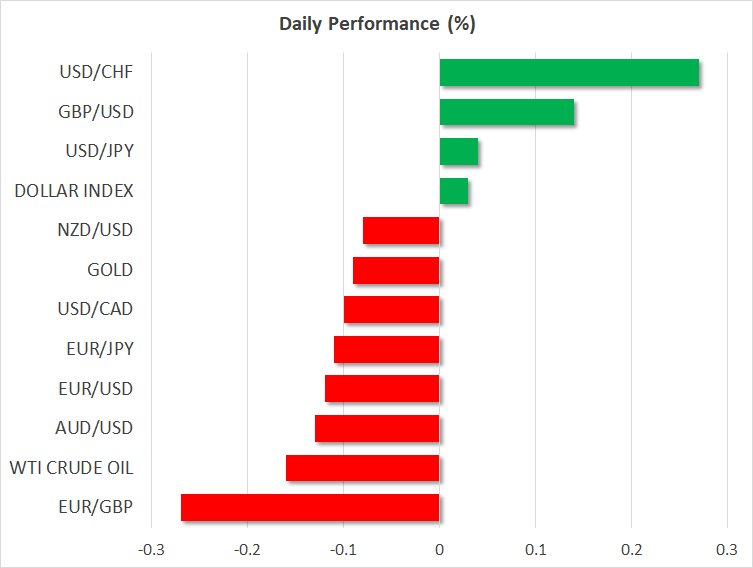
- FOREX: The dollar’s index against a basket of currencies reversed earlier losses to trade marginally higher on the day. The British pound continued to outperform on the back of rising hopes for a Brexit deal, though it reversed a considerable portion of earlier gains against both the dollar and the euro. Indicatively, GBPUSD traded below the 1.30 handle after previously hitting a two-week high of 1.3062. The UK came on the receiving end of weaker-than-anticipated services PMI data, with the index coming in at 52.2, its weakest since July 2016, immediately after the Brexit referendum. However, the main driving force for the currency is and will most probably continue to be any developments on Brexit. EURUSD was 0.1% lower at 1.1371. Earlier on the day, the Sentix index that gauges investor sentiment in the euro area disappointed in November, falling to its lowest since October 2016. Elsewhere, it is interesting that the dollar is higher against both the yen and the franc which are considered as safe-haven currencies. One might have expected the two to receive some inflows on cautiousness ahead of the US midterms. Yield differentials in the favor of the US are perhaps dominating such concerns at the moment.
- STOCKS: Excluding the Italian FTSE MIB and the Swedish OMX 30, that were both down by 0.4%, major European benchmarks were in the green at 1240 GMT. Italian equities were negatively affected after Goldman Sachs downgraded big banks in the country to “sell”. The pan-European Stoxx 600 was up by 0.2% and the blue-chip Euro Stoxx 50 traded higher by 0.3%. The UK’s FTSE 100, the German DAX and the French CAC 40 were up by 0.5%, 0.2% and 0.2% correspondingly. The move up in Europe is notable, especially in light of sharp losses for Asian equities earlier on Monday and Wall Street’s declines on Friday on the back of angst over the Sino-US trade dispute and rising US yields. Brexit and the US midterms are other factors that can affect equity market sentiment as the week unfolds. Futures on the Dow, S&P 500 and Nasdaq 100 recovered to now project a more or less flat open for these benchmarks.
- COMMODITIES: WTI fell by around 0.2%, extending its losses from previous days to trade not far above $62.52 per barrel, its lowest since April touched earlier on Monday. US sanctions on Iran went back into effect today, though the granting of temporary waivers to major buyers that allows them to continue purchasing Iranian oil has weighed on prices. Moreover, Tehran said it would defy US actions and continue selling as previously. Brent crude was near flat, at $72.87/barrel. In precious metals, gold was slightly down, trading at roughly $1,231.00/ounce.
Day ahead: US ISM non-manufacturing PMI, RBA decision coming up; Barnier to deliver Brexit speech
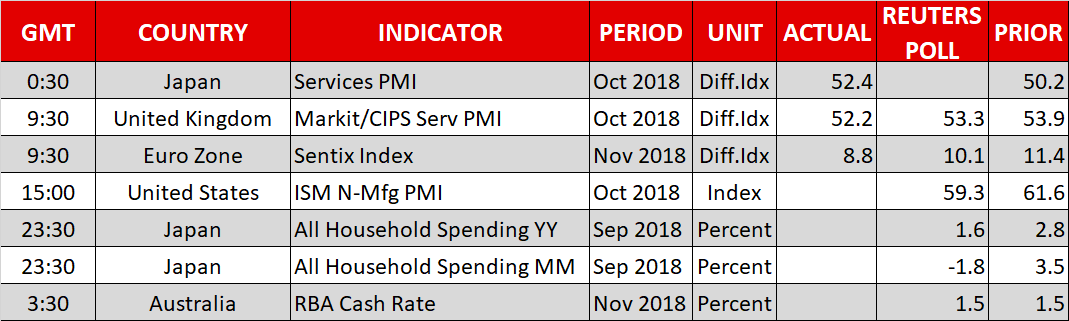
The ISM’s non-manufacturing PMI will be hitting the markets in the early hours of US trading. Beyond this and during Tuesday’s Asian session, the Reserve Bank of Australia (RBA) will be deciding on rates, while Japanese household spending figures are also slated for release. Elsewhere, the EU’s chief Brexit negotiator Michel Barnier will be delivering a speech on Brexit.
At 1500 GMT, the US ISM non-manufacturing PMI will be made public. The gauge is anticipated to fall from September’s 61.6, the highest since the index’s creation in 2008, to 59.3, which would also be a robust print. Barring a significant deviation from expectations, the release is not likely to prove a major market-mover. Meanwhile, politics are taking center stage in the US, with the midterm elections concluding on Tuesday.
A risk-event for sterling will be Barnier’s Brexit speech set to take place in Brussels at 1930 GMT. Should he reinforce the reports suggesting progress on Brexit negotiations, then the pound is likely to extend its recent gains versus major currencies, including the dollar and the euro. If instead he focuses on the impediments that hold the two sides away from a Brexit deal, then the British currency is expected to retreat.
Back on the data-front, Japanese household spending figures are due at 2330 GMT. Spending is projected to have contracted on a monthly basis in September after recording an unexpected jump in August.
Having more potential to prove market-moving during Tuesday’s Asian session will be the RBA’s policy decision due at 0330 GMT. The central bank is widely anticipated to yet again maintain its benchmark rate at a record low of 1.5%. In light of this, the Bank’s communication – how optimistic it is on the economy – is expected to dictate the Aussie’s movement in the aftermath of the decision.
ECB Vice President de Guindos and the Bank’s Chief Economist Praet will be speaking in Brussels, where eurozone finance ministers will also be meeting to discuss euro area integration.
Lastly, global trade considerations remain in the background with any updates having the capacity to rattle the markets. There was some optimism for de-escalating tensions between the US and China last week that spurred risk-on trades, though White House economic advisor Kudlow later downplayed the odds for a quick deal with China. For the record, Presidents Trump and Xi will be meeting at the G20 summit at the end of the month.
DAX Steady, Investor Confidence Drops
The DAX index has ticked higher in the Monday session. Currently, the DAX is trading at 11,537, up 0.13% on the day. On the release front, eurozone investor confidence slumped in November, dropping to 8.8 points. On Tuesday, Germany and the eurozone release services PMIs. As well, Germany releases factory orders and the eurozone will publish PPI. The U.S will hold midterm congressional elections.
The eurozone economy ran into some headwinds in the third quarter, and confidence indicators remain weak as we enter the fourth quarter. The well-respected Sentix investor confidence report for November fell to 8.8 points down from 11.4 a month earlier. This marked its lowest level since October 2016. The index has dropped sharply in 2018 – the heady days of January, when the index came in at 32.9, appear long gone.
After a dismal October, the DAX has rebounded with gains at the start of November. The DAX plunged 6.7% in October, its worst monthly performance since December 2016. However, the picture has changed in November, as the index has gained 1.0%. Investor sentiment has improved, following reports late last week that U.S President Trump is working on a trade agreement with China, which Trump will present to Chinese President Xi Jinping at a Group of 20 summit in Argentina later this month. The unpredictable Trump has taken a hard line on China, threatening to impose stiff tariffs on all Chinese imports if his meeting with Xi was not successful. This could mean that we are in store for plenty of volatility in the stock markets in November.
The German manufacturing sector slowed for a third straight month in October, as the slowdown has now entered the fourth quarter. The October Manufacturing PMI dipped to 52.2, down from 53.7 points in September. The reading, which points to limited expansion, is the lowest since May 2016. The weak data can be directly attributed to global trade tensions, which have dampened the German export sector. China is Germany’s third largest export market, and a slowdown in China due to U.S trade tariffs could have a chilling effect on the German economy. The German central bank is forecasting zero growth in the third quarter, and growth in the eurozone also softened in the third quarter. German economic data is a bellwether for the eurozone, which means that the eurozone economy could be facing significant headwinds in the fourth quarter, which could spell bad news for the euro.
Bitcoin Cash Volume Surges 7x To $1.4 Billion In Crypto Market Recovery
Major cryptocurrencies including Ethereum, Bitcoin Cash, and Litecoin have increased by more than 5 percent in value over the last 24 hours. The cryptocurrency market has started to demonstrate signs of recovery, as the daily trading volume of large digital asset trading platforms has increased over the past week.
Bitcoin Cash in specific has seen an increase of seven-fold in volume from less than $200 million to $1.4 billion. BCH has surpassed the peak volume Ripple (XRP) achieved in early October when its price tripled.
The volume of Bitcoin, led by an abrupt surge in volume in the cryptocurrency exchange market of South Korea and the BTC-to-KRW trading pair, increased from $3.1 billion to $4.4 billion within a span of seven days, increasing by 44 percent. Bitcoin recorded a mere 1 percent increase in its price and a minor price movement was expected, given that BTC has demonstrated its highest level of stability in recent years throughout the past three months.
For BTC to demonstrate a 5 to 10 percent in value in the current phase of the market, a major catalyst or a driving factor will be required. BTC is set to face some key resistance levels above the $6,400 mark and to confirm a positive short-term movement, it will have to demonstrate a strong movement above the $6,500 mark with decent supporting volume. While BTC has maintained a sideways market, other major cryptocurrencies like Ethereum and Bitcoin Cash have increased significantly in value over the last 24 hours. An increase in volume of BTC in both South Korea and Japan, two of the largest cryptocurrency exchange markets, could lead to a solid short-term movement for many major digital assets. But, until BTC breaks out of its tight range and tests $6,800, it will be difficult to confirm a short-term rally of any significance.
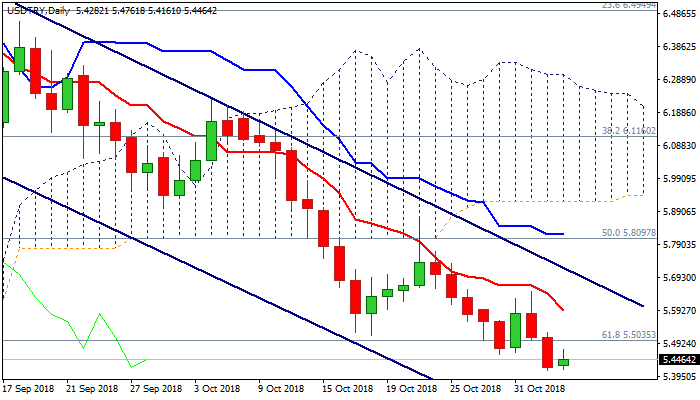
USDTRY Outlook: Further Rise In Inflation Could Undermine Lira’s Bulls
The US dollar trades slightly higher against Turkish lira on Monday, as disappointing results of Turkey's Oct inflation raise concerns.
The lira advanced strongly after CBRT's massive rate hike in September, gaining nearly 10% against its US counterpart, regaining confidence of traders after it hit all-time low at 7.1074.
Strong bullish signal for lira was generated on last Friday's break and close well below key points at 5.5035 and 5.50 (Fibo 61.8% of 4.5121/7.1074/psychological), as lira hit the highest level in three months at 5.4124 on Friday.
Turkey CPI data released today, disappointed markets, as inflation rose 2.67% on monthly basis, overshooting forecast for 2.0% rise and annualized figure hit 25.24% (the highest in fifteen years), coming well above expectations at 24.5%.
Inflation rose despite lira being on positive path and significant fall in oil prices, with negative impact on emerging markets seen from weaker China's economy. CPI miss could have negative impact on lira's recent bulls, which could be helped by oversold daily techs, with initial basing signal to be expected on sustained break back above 5.50, for swing towards 5.59 zone (100SMA), next pivotal point
Res: 5.4761, 5.5035, 5.5653, 5.5960
Sup: 5.4124, 5.3000, 5.2689, 5.1800
European update: Sterling strongest, shrugs off Brexit noises
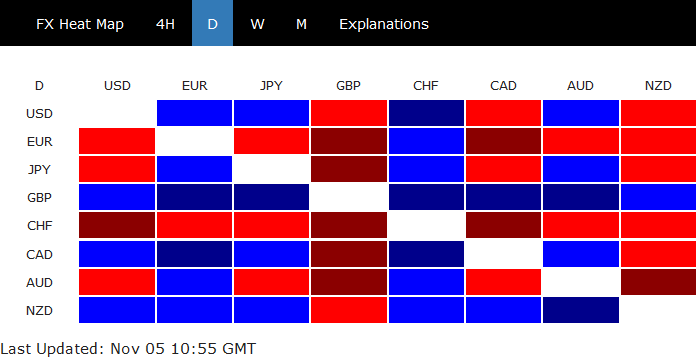
Sterling is so far the strongest today despite all the Brexit negative noises. It's reported that EU is insisting on having an Irish backstop without time limit. On the other hand, UK Brexit Minister Dominic Raab pushing for a three-months expiry on the backstop. There are even reports saying that a no-deal Brexit would be most probable if no agreement would be made within a week. But the pound just shrugs them off and stays firm. New Zealand Dollar is following as the second strongest. Dollar and Canadian follow. Meanwhile, fresh selling is seen Swiss Franc just now, and it's the weakest for today, followed by Euro. Yen follows together with Australian Dollar.
Reactions to European data are rather muted. Eurozone Sentix Investor Confidence dropped to 8.8 in November, down from 11.4 and missed expectation of 9.9. Sentix noted that the zenith is clearly passed in Eurozone back in January. UK PMI services dropped to 52.2 in October. Markit said that brought "mounting evidence" of Brexit impact on the economy.
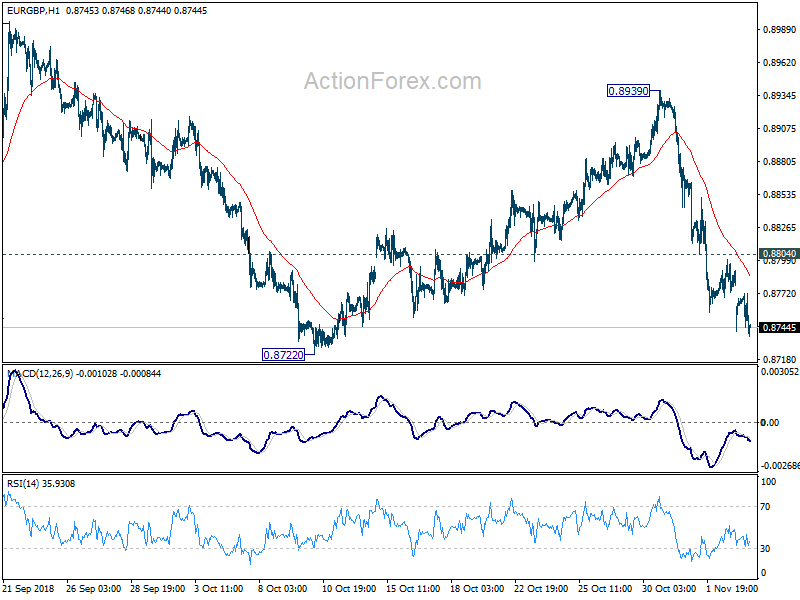
Technically, whether Dollar could take extend late Friday's rebound is a development to watch. For now, USD/JPY is staying below 113.38 temporary top. USD/CHF, in spite of today's rebound, is staying well below 1.0094 (last week's high). USD/CAD, is at middle of tight range of 1.3048/3170. EUR/GBP will also be a pair to watch as it's heading back to 0.8722 near term support.
In other markets, major European indices are slightly firmer:
- FTSE is up 0.25%
- DAX is up 0.16%
- CAC is up 0.14%
- German 10 year yield is up 0.0028 at 0.435
- Italian 10 year yield is up 0.451 at 3.351. Spread stays below 300
In Asia:
- Nikkei closed down -1.55% at 21898.99
- Hong Kong HSI closed down -2.08% at 25934.49
- China Shanghai SSE closed down -0.41 at 2665.43
- Singapore Strait Times closed down -1.790% at 3060.62
- 10 year JGB yield rose 0.0015 to 0.131.
USDJPY Struhhling With 113.37 Resistance Level
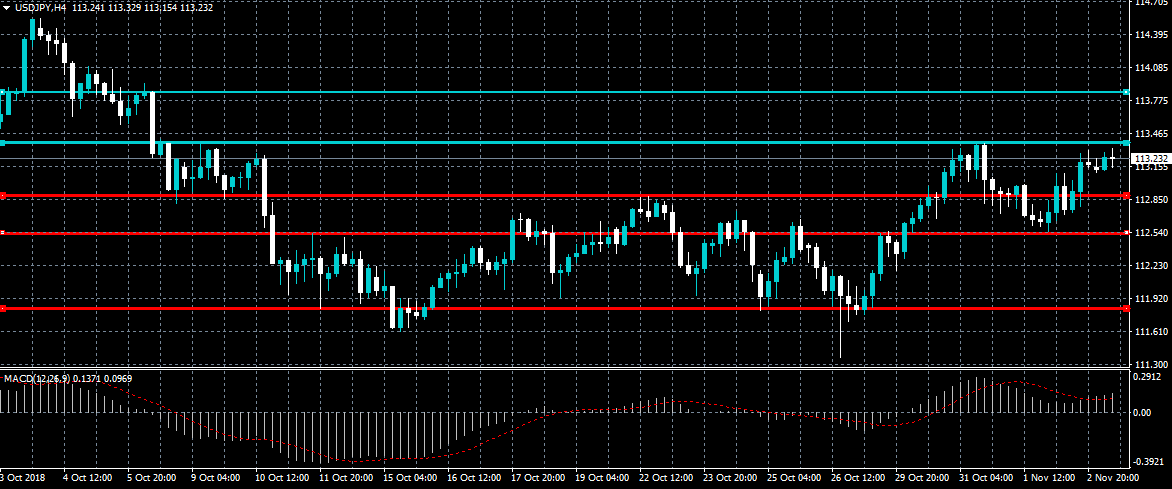
The US dollar is struggling to break above the 113.37 resistance level against the Japanese yen currency, as traders remain cautious ahead of the US mid-term elections. The overall sentiment surrounding the USDJPY pair is bullish while price trades above the 112.87 level. Technical sellers need to force price below the 112.54 level, while buyers will look to target the 113.90 level.
The USDJPY pair is bullish while trading above the 112.87 level, key resistance is now found at the 112.37 and 112.90 levels.
If the USDJPY pair trades below the 112.87 level, sellers are likely to test the 112.54 and 111.85 support levels.