Sample Category Title
GBP/JPY Uptrend Continuation Above W L3 Camarilla Pivot
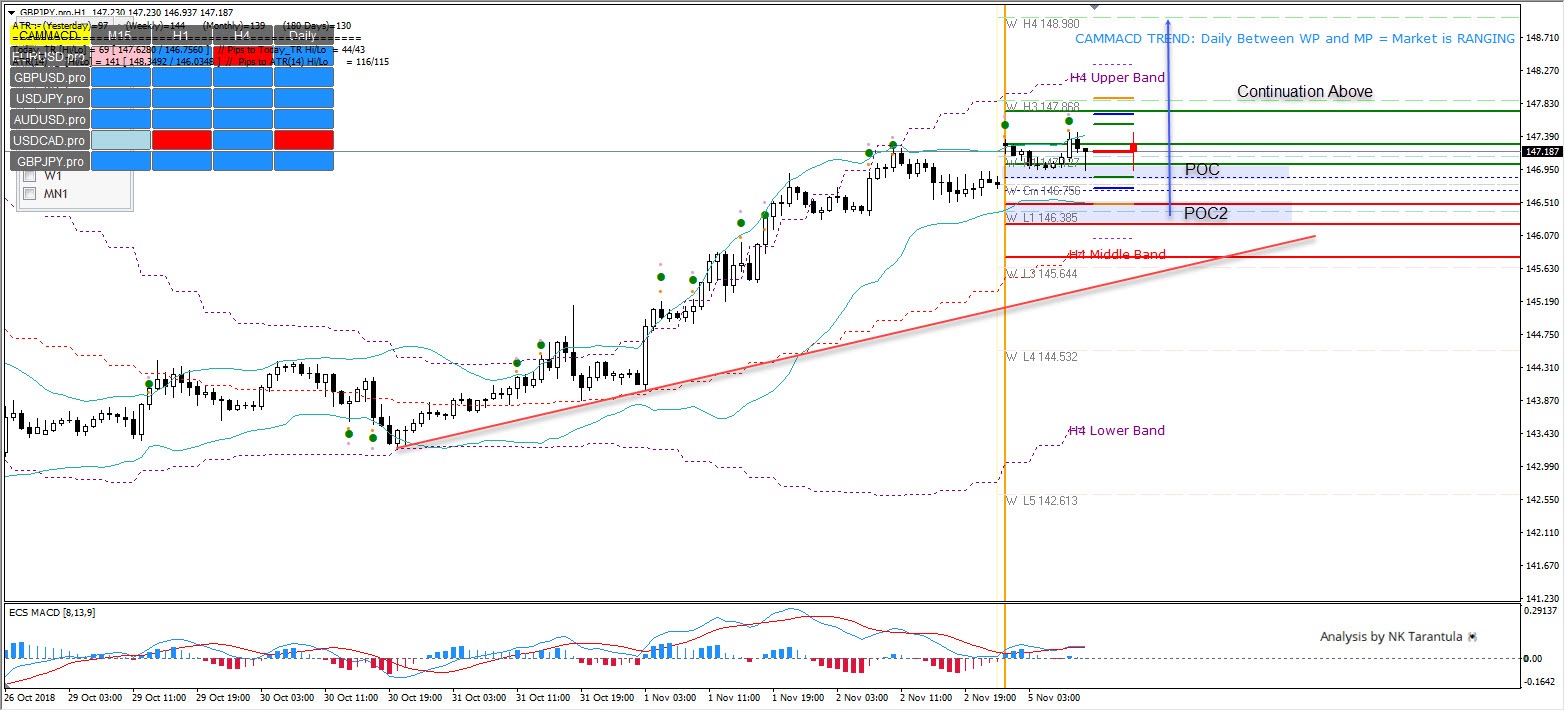
The GBP/JPY has made a strong uptrend move and at this point we see a consolidation. Next bullish impulse is possible.
Bounce from any of POC zones should target W L3 pivot at 143.87. POC1 146.90-147.00 and POC2 146.20-40 are zones where bulls should search for bouncing opportunities. Only a close above 147.90 will make a further continuation move towards 148.35 and 148.90. However, a drop below 146.20 will make pair more neutral again. If any emerging bullish pattern appears at the POC zones, that will be a sign for next bullish impulse and fresh buyers should appear.
XAUUSD Intraday Analysis
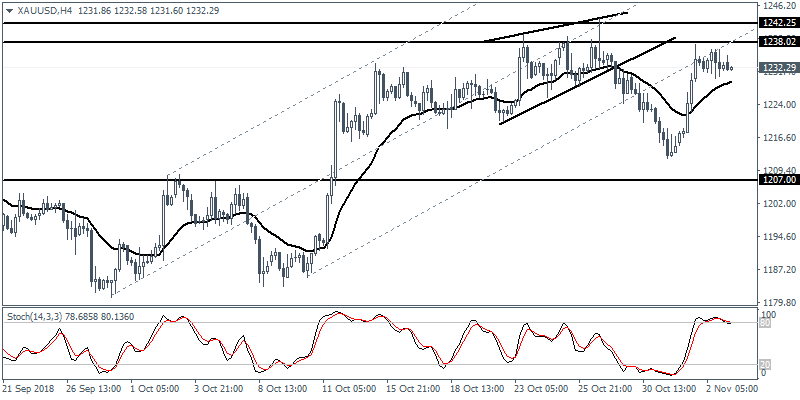
XAUUSD (1232.29): Gold prices were seen mostly consolidating near the highs established on Thursday. Price action is trading below the previously established resistance level of 1238.02 region. As long as this resistance level holds, gold prices could remain trading subdued. Failure to retest the lower support at 1207 remains a key point of interest as a decline in the precious metal could see this level being tested.
GBPUSD Intraday Analysis
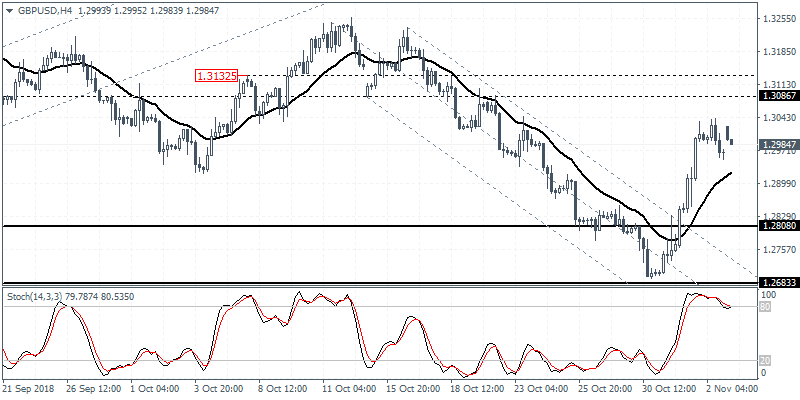
GBPUSD (1.2984): The GBPUSD currency pair maintained strong gains, but Friday's price action saw the cable taking a breather. Price action was subdued as the GBPUSD retraced some of the gains from earlier in the week. The resistance level at 1.3087 remains a key level of interest. To the downside, support at 1.2808 is quite likely to hold out as support. If GBPUSD falls below 1.2808, then we expect to see a test of the lower support at 1.2683 level.
EURUSD Intraday Analysis
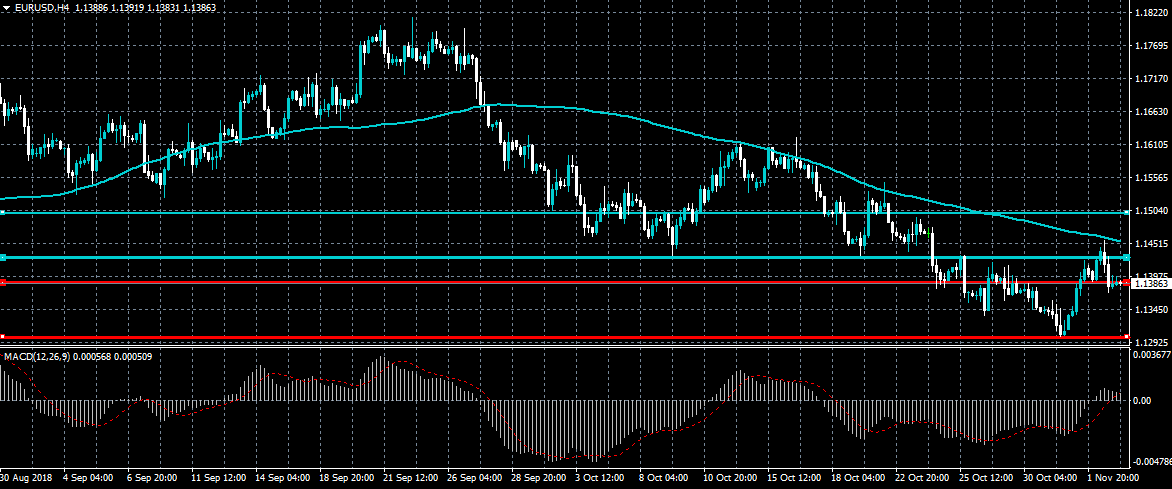
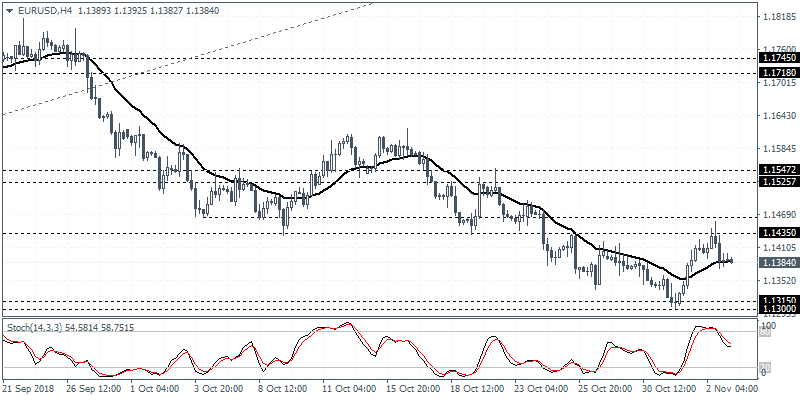
EURUSD (1.1384): The euro currency managed to rebound to the upside, but price action was stuck within the resistance level that was previously established. A quick reversal was therefore seen at 1.1435 - 1.1462 region. The EURUSD remains trading flat within the resistance level and the lower support level formed at 1.1315 - 1.1300. A breakout from this range is required for the currency pair to mark the next direction in the trend potentially. Further losses could be expected if the EURUSD falls below the support level.
Markets Open To A Quiet Trading Day
The U.S. labor market data released last week on Friday showed that the U.S. unemployment rate held firm at 3.7%, marking a 49-year low. The U.S. economy added 250k jobs during October beating estimates of 194k jobs.
However, the jobs for September were revised lower to 118k. Wage growth in the U.S. rose 3.1% on the year in October marking the most significant increase.
Meanwhile, Canada's unemployment data was also released. The official data showed that Canada's unemployment rate fell unexpectedly to 5.8%. However, the employment change rose just 11.2k which was below estimates of 12.7k.
The markets are looking to a quiet open today. The European trading session is expected to see only the release of Spain's unemployment change and the Eurozone Sentix investor confidence report.
In the UK, the services PMI report from Markit will be out. Economists polled forecast that the services sector could fall to 53.4 after registering 53.9 in the month before.
The NY trading session will see Markit's final services PMI coming out followed by the ISM non-manufacturing PMI. Estimates put non-manufacturing activity index to ease to 59.3 from 61.6 in September.
FOMC Preview – Affirming a Strong Economic Case for December Rate Hike
The aim of the FOMC meeting later this week is to prepare the market for a December rate hike. While the recent stock market crash and slowdown in inflation have trimmed bet for a December rate hike to 77.5% from 80% a month ago, the macroeconomic environment is still supportive for such a move. We expect Fed to affirm that the domestic economy remains strong. As such, the case for a December hike, as well as three hikes in 2019 (as suggested by the September median dot plot), remain intact.
Macroeconomic Developments
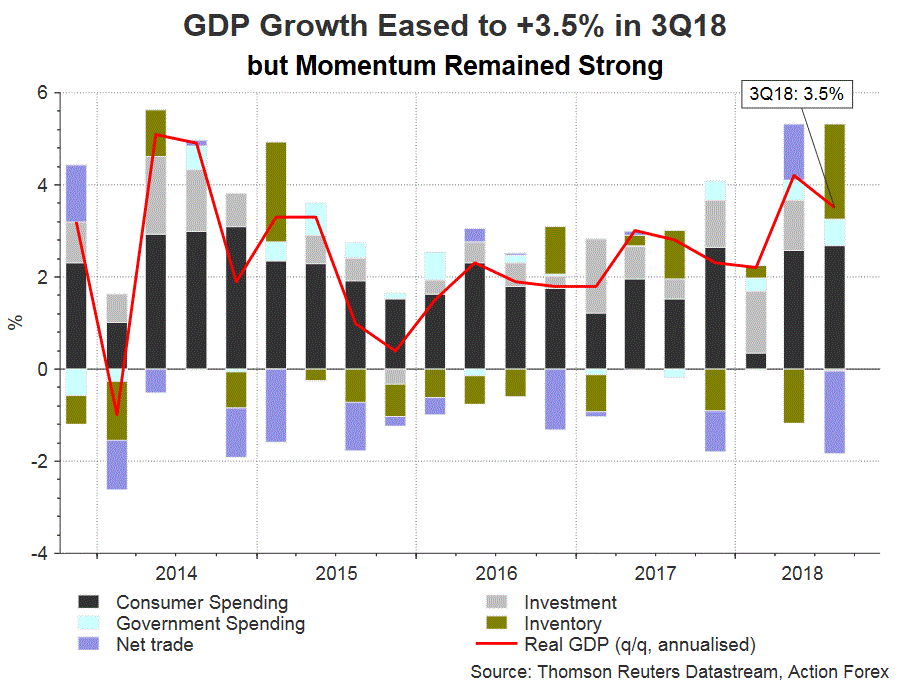
The first estimate of 3Q18 GDP growth moderated to an annualized +3.5% from +4.2% in 2Q18. Consumer spending, the biggest component of GDP, jumped +2.7% in the third quarter, accelerating from +2.6%. Business investment and net trade were the key drags of growth.
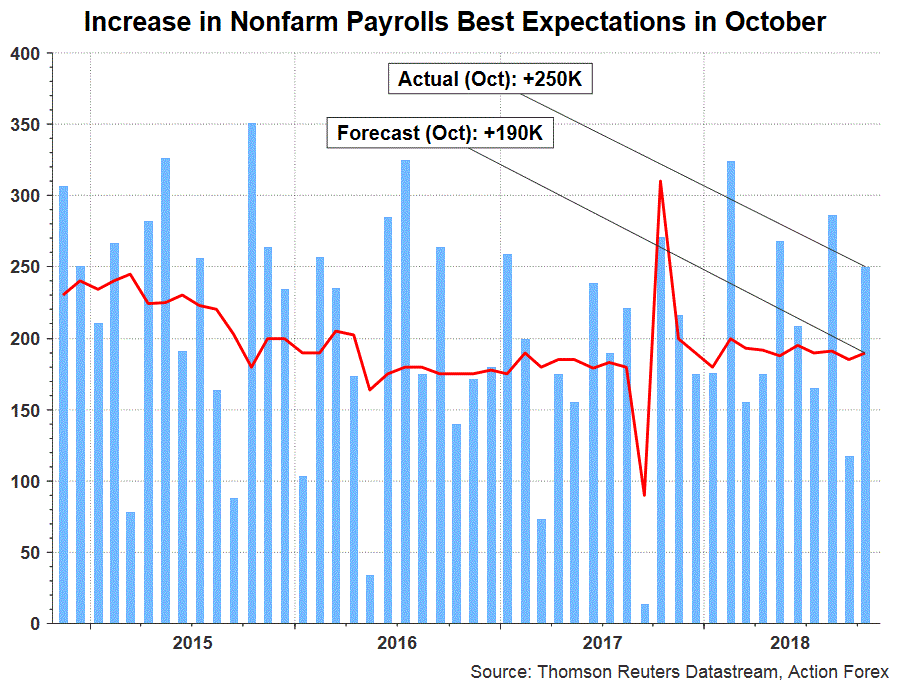
The job market remained strong in October. Non-farm payrolls increased +250K, beating consensus of a +190K addition. The unemployment rate steadied at record low of 3.7%. Average hourly earnings for private workers jumped +3.1% y/y, the fastest pace since 2009. Acceleration in real wage growth signaled a boost in consumers’ purchasing power. This should eventually be reflected in the price index, causing inflation to pick up again.
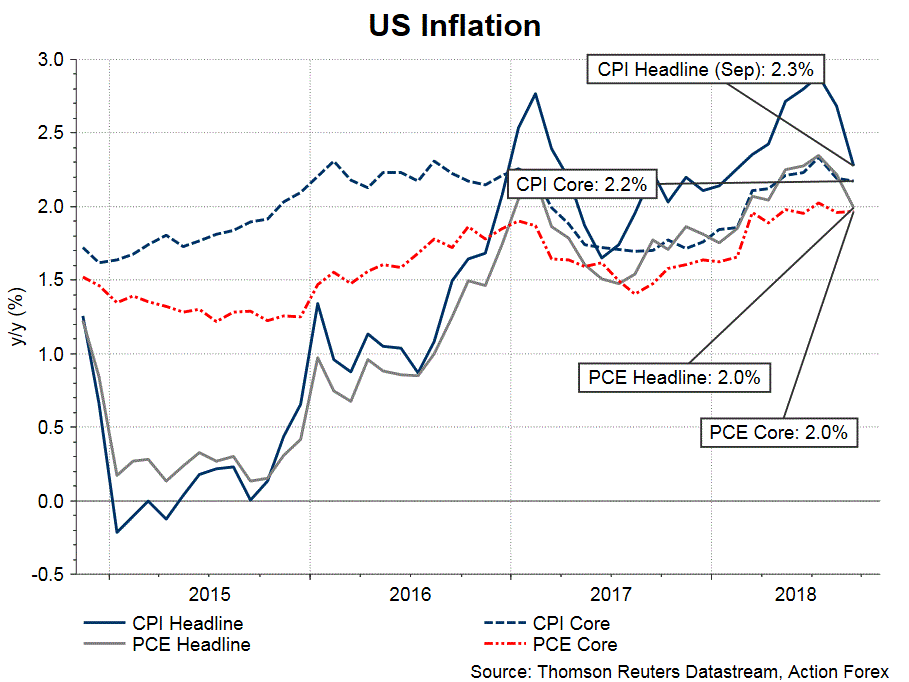
Headline inflation continued to moderate in September. Yet, the Fed’s +2% target remained intact in all key measures. Headline CPI moderated to +2.3% while PCE slipped to +2%. Core CPI and PCE were at +2.2% and +2% respectively.
The sentiment indices were mixed. ISM manufacturing index plunged -2.1 points to 57.7 in October. Meanwhile, the University of Michigan consumer confidence index was revised lower to 98.6 in October from the preliminary reading of 99. Yet, the index for consumer expectations climbed +0.2 point higher to 89.1.
IOER
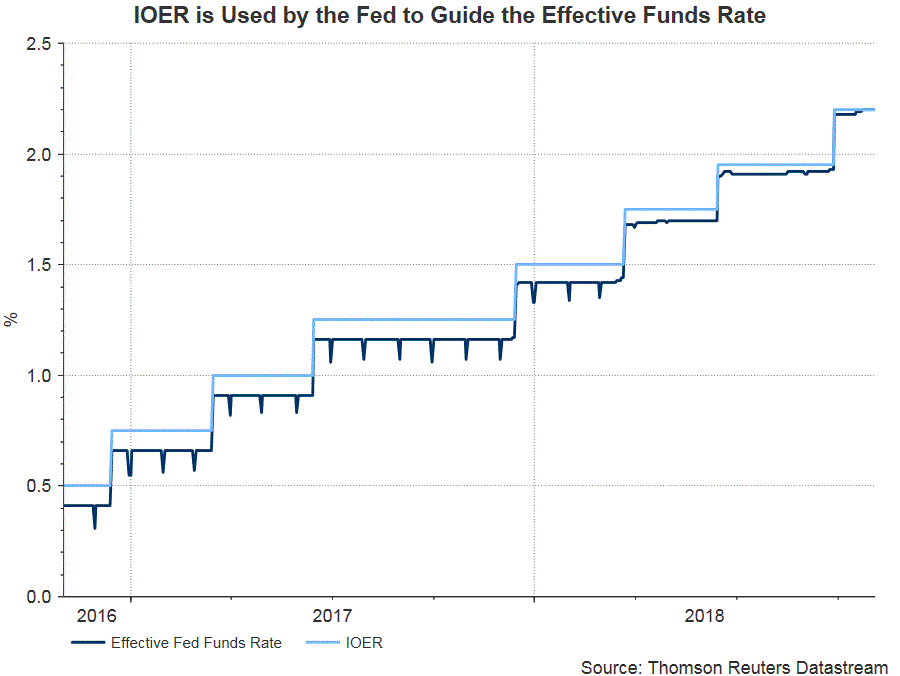
This week’s meeting would bring no change to the Fed funds rate, which has been staying at 2-2.25% since the increase in September. There is, however, chance that the committee would raise the interest rate on excess reserve (IOER). The chance is not high, though.
The effective funds rate, currently at 2.2%, has been trading about the midpoint of the target range since September 27. This might trigger the Fed to lower the IOER, a rate to guide the funds rate. Back in May, the Fed noted in the minutes that it might lower the IOER by -5 bps at a meeting in which the Committee left the policy rate.
At that time, the Fed funds rate was set at 1.5-1.75%, where the mid-point was at 1.625%. The effective funds rate has been trading at 1.7%, +7.5 bps above the mid-point. Yet, what the Fed eventually did was to increase to IOER by +20 bps, accompanying with a +25 bps Fed funds rate hike, June. We expect it to do the same in December, i.e.: raising the IOER by +20 bps, while hiking the policy rate by +25 bps.
Sterling Outperforms On Brexit News, UK Services PMI Due
Here are the latest developments in global markets:
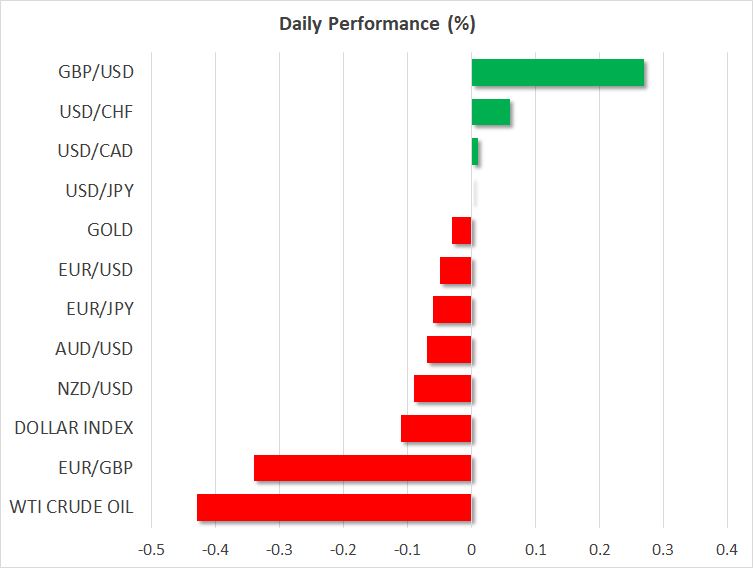
FOREX: The dollar was down by 0.1% versus a basket of currencies on Monday after rising on Friday, when the US saw the release of a robust October jobs report. Sterling outperformed even though it gave up on part of earlier gains, being helped by positive Brexit news.
STOCKS: Wall Street finished lower on Friday, with the Dow Jones (-0.43%), the S&P 500 (-0.63%) and the Nasdaq Composite (-1.04%) all unable to extend Thursday’s gains. Trade uncertainty remains in the background despite recent optimism for a de-escalation in Sino-US tensions, while Treasury yields jumped in the aftermath of the US jobs report that saw annual wage growth rising by the most in nearly ten years. Asian markets took their cue from Friday’s US equity market close, with the Japanese Nikkei 225 and Topix indices losing 1.55% and 1.1% respectively on Monday. Hong Kong’s Hang Seng was down by 2.05%. At 0759 GMT, futures markets were pointing to a mostly lower open for major European benchmarks, though they weren’t projecting steep losses. Contracts on the Dow, S&P and Nasdaq 100 were also in the red; similar to Europe, they weren’t projecting sharp declines.
COMMODITIES: WTI traded lower by 0.4% at $62.86 per barrel. The US proceeded with the re-imposition of sanctions on Iran on Monday – a positive for prices –, though it granted waivers, allowing major buyers to continue purchasing Iranian oil and this has weighed on the precious liquid. Brent crude was down by 0.2%, at $72.67/barrel. In precious metals, gold was roughly flat at around $1,235.50/ounce.
Major movers: Sterling gains on Brexit hopes; dollar modestly down
The dollar’s index against a basket of six major currencies was last down, though by a moderate 0.1%. The greenback gained on Friday as October’s nonfarm payrolls report delivered a notable beat on the number of positions added to the economy, while annual wage growth rose by its fastest since April 2009.
Consequently, markets continue to expect the Fed will remain on track as regards its policy normalization plans. Specifically, Fed funds futures assign an 81% probability for a December 25bps hike, which would constitute the fourth such more during the year. More hints on the US central bank’s thinking are expected during Thursday’s meeting, the penultimate for the year.
Sterling outperformed out of major currencies, with GBPUSD touching a two-week high of 1.3062. News of further progress in Brexit negotiations acted as the catalyst for the move up. In particular, the Times reported PM May has secured concessions from her EU counterparts that will allow all of Britain to remain in a customs union with the EU and avoid a hard border in Northern Ireland.
However, the British currency later reversed part of its gains, as investors appear wary in the absence of anything concrete. PM May will be discussing the latest Brexit proposals with her cabinet on Tuesday. The pound was also up versus the euro, with EURGBP trading lower by 0.35%.
EURUSD was marginally down, not far below the 1.14 handle, while USDJPY was flat at 113.17 even as Bank of Japan Governor Kuroda hinted on Monday that he wants to normalize monetary policy once the central bank edges closer to its inflation target. Perhaps market participants are becoming immune to such comments, waiting for a meaningful pickup in price pressures before taking long positions on the yen.
In emerging markets, the dollar was 0.3% higher against the offshore yuan (USDCNH) after losing ground the previous week, recording its first weekly losses after gaining in the preceding five weeks. Of note, White House economic advisor Larry Kudlow downplayed the chances for a quick trade deal with China, something which also likely aided the move down for Asian stock markets on Monday.
Day ahead: UK services PMI, eurozone Sentix index and US ISM non-manufacturing PMI on the agenda
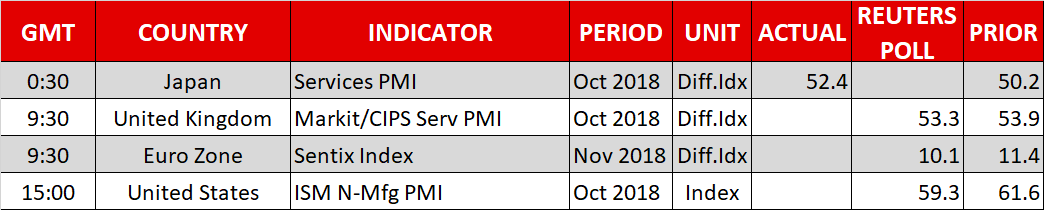
Monday’s a relatively light data day, with the UK services PMI and the eurozone’s Sentix index, as well as the ISM’s non-manufacturing PMI out of the US being the only notable releases on the agenda.
At 0930 GMT, the UK services PMI for October will be hitting the markets. The index is anticipated to ease to 53.3 from 53.9, which would constitute its lowest since April. Despite the services sector prominence within the UK economy – it accounts for roughly 80% of the economic pie –, sterling is yet again expected to prove most sensitive to Brexit developments rather than on economic releases. Brexit optimism last week and earlier on Monday allowed GBPUSD to touch a two-week high of 1.3062; early last week the pair traded as low as 1.2693. Still, the figures on services PMI may offer some near-term direction to pound pairs.
The eurozone’s Sentix index for November is also slated for release at 0930 GMT. Further weakness is forecast for the gauge of investor morale, which at 10.1 is predicted to touch its lowest since June. Uncertainty around trade and politics – Italian budget angst and a relatively fragile government coalition in Germany – are some of the factors at play that may weigh on sentiment; the automobile industry’s compliance with emissions rules has also been morale-negative recently.
Out of the US, the ISM’s non-manufacturing PMI is due at 1500 GMT. The measure is projected to fall from September’s 61.6, the highest since the index’s creation in 2008, to 59.3, which would also be a robust number. Last week’s manufacturing PMI out of the ISM disappointed, coming in at its weakest since April; still, at 57.7, it remained comfortably in expansion territory. Politics are also taking center stage in the US, with the midterm elections concluding on Tuesday.
Beyond data, trade developments which have boosted sentiment, allowing equity markets and risk-on currencies such as the Aussie to rally towards the latter part of the previous week will be closely watched. Any indication that China and the US are indeed edging closer to a trade deal is likely to be met with a continuation of the rally. Conversely, a correction is likely in store should the confrontational rhetoric make a comeback.
Bank of Canada Governor Poloz will be giving a speech at the Canada-UK Chamber of Commerce at 1210 GMT. ECB Vice President de Guindos and the Bank’s Chief Economist Praet will be speaking in Brussels, where eurozone finance ministers will also be meeting to discuss euro area integration.
Technical Analysis: GBPUSD looks mostly neutral in the short-term
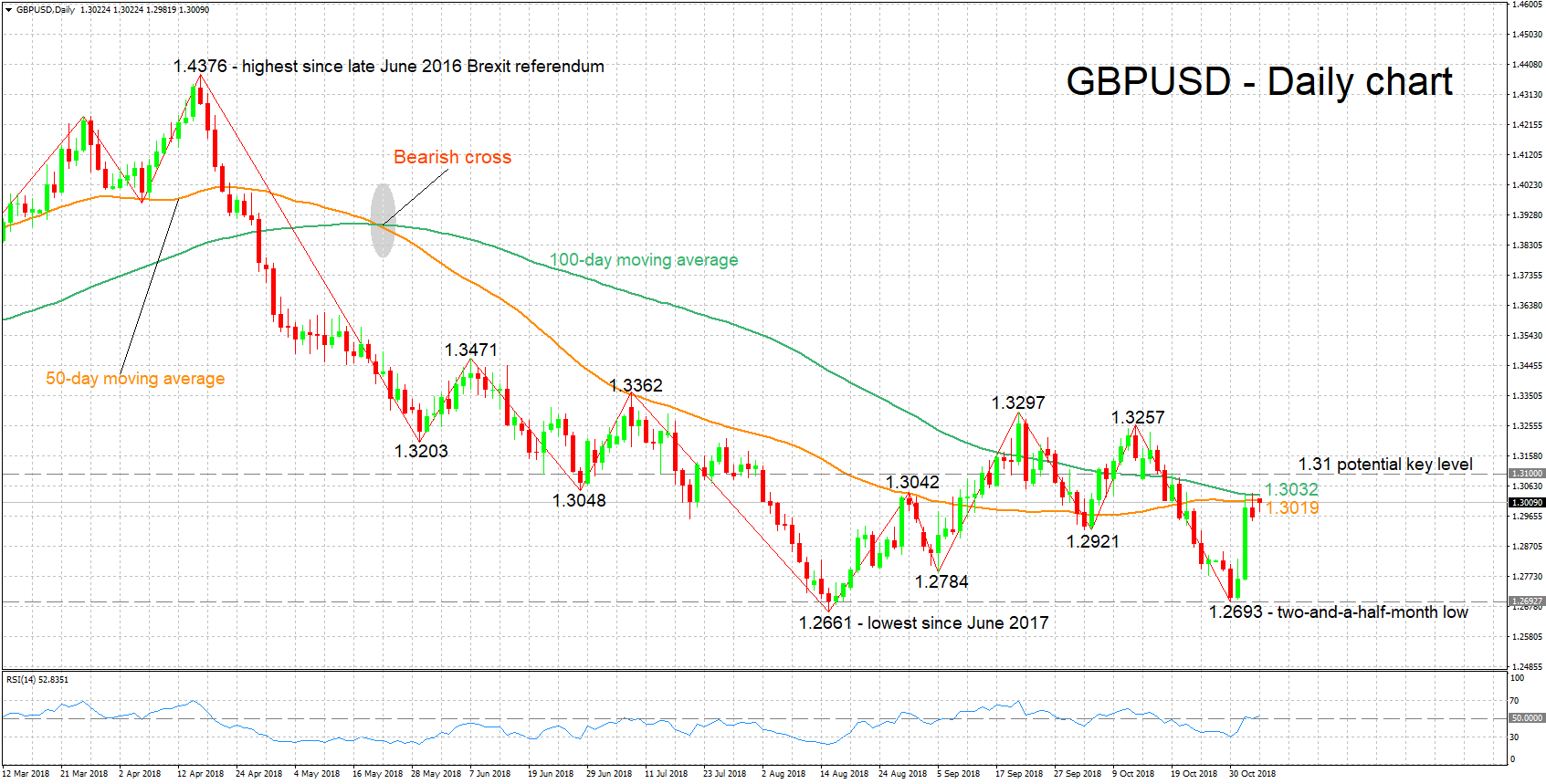
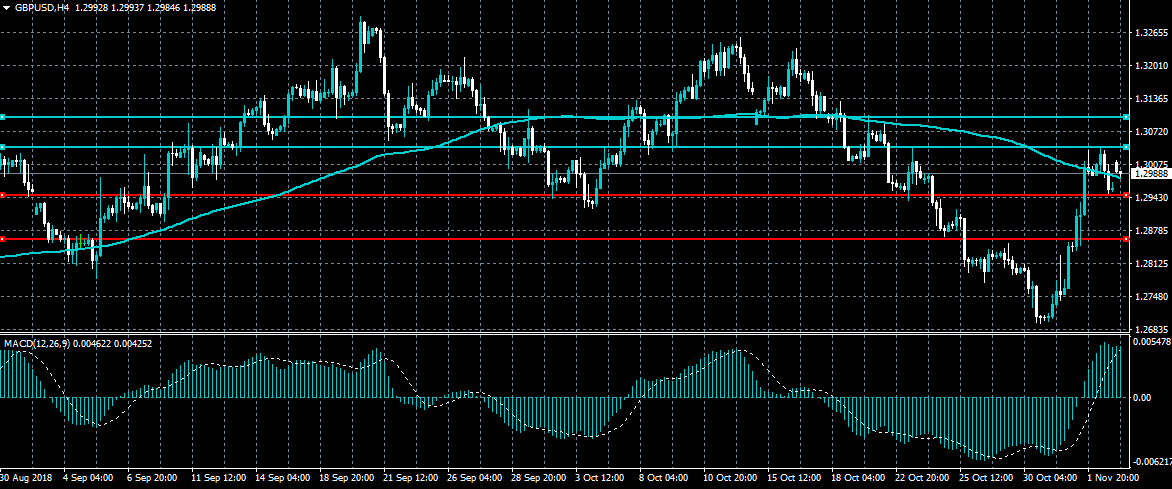
GBPUSD has eased a bit from an earlier hit two week-high but continues to trade above the 1.30 handle, having staged a recovery after falling to a two-and-a-half-month low of 1.2693 last Tuesday. The RSI has eased after climbing previously. It is currently hovering around the 50 neutral level, mostly pointing to the absence of short-term momentum in either direction, the upside or the downside.
A stronger-than-projected services PMI print out of the UK, or more importantly positive Brexit developments, are expected to boost the pair. Immediate resistance to gains seems to be taking place around the current levels of the 50- and 100-day moving average lines at 1.3019 and 1.3032 respectively. Further above, an additional barrier may occur around the 1.31 handle; the area around this point was relatively congested in the past. Higher still, the October 12 peak of 1.3257 would increasingly come within scope.
On the downside and in the event of weak UK data or a no-deal Brexit again picking up steam, support could come at 1.2921, a previous bottom. Another trough from the past at 1.2784 would come into focus in the event of steeper losses. Even lower, late October’s two-and-a-half-month low of 1.2693 would be eyed; the zone around this also captures the pair’s lowest since June 2017 of 1.2661.
GBPUSD Awaiting UK Services Data
The British pound is trading close to the 1.3000 level against the US dollar after giving back gains following Friday’s impressive Nonfarm payrolls job report from the US economy. The intraday bias surrounding the GBPUSD pair remains bullish while price continues to trade above the 1.2950 support level. Traders now await key PMI Services data from the United Kingdom economy this morning.
The GBPUSD pair is only bullish while trading above the 1.2950 level, key resistance is now found at the 1.3040 and 1.3100 levels.
If the GBPUSD pair moves below the 1.2950 level, sellers may test towards the 1.2900 and 1.2866 support levels.
GBP/USD Gaining Bullish Momentum, USD/CAD Under Pressure
GBP/USD recovered nicely and moved back above 1.2900. USD/CAD is currently showing negative signs and it could decline further towards 1.3050.
Important Takeaways for GBP/USD and USD/CAD
- The British Pound formed a solid support near 1.2710 and recovered nicely.
- There is a steep bullish trend line formed with support at 1.2955 on the hourly chart of GBP/USD.
- USD/CAD declined recently and broke a bullish trend line at 1.3120 on the hourly chart.
- The pair could continue to move down as long as there is no close above 1.3135.
GBP/USD Technical Analysis
After heavy declines, the British Pound found support near the 1.2700-1.2710 zone against the US Dollar. The GBP/USD pair started a fresh upward move and traded above the 1.2750, 1.2800 and 1.2880 resistance levels.
The upward move was strong as the pair even settled above the 1.2900 level and the 50 hourly simple moving average. It traded close to the 1.3050 resistance and formed a high at 1.3040.
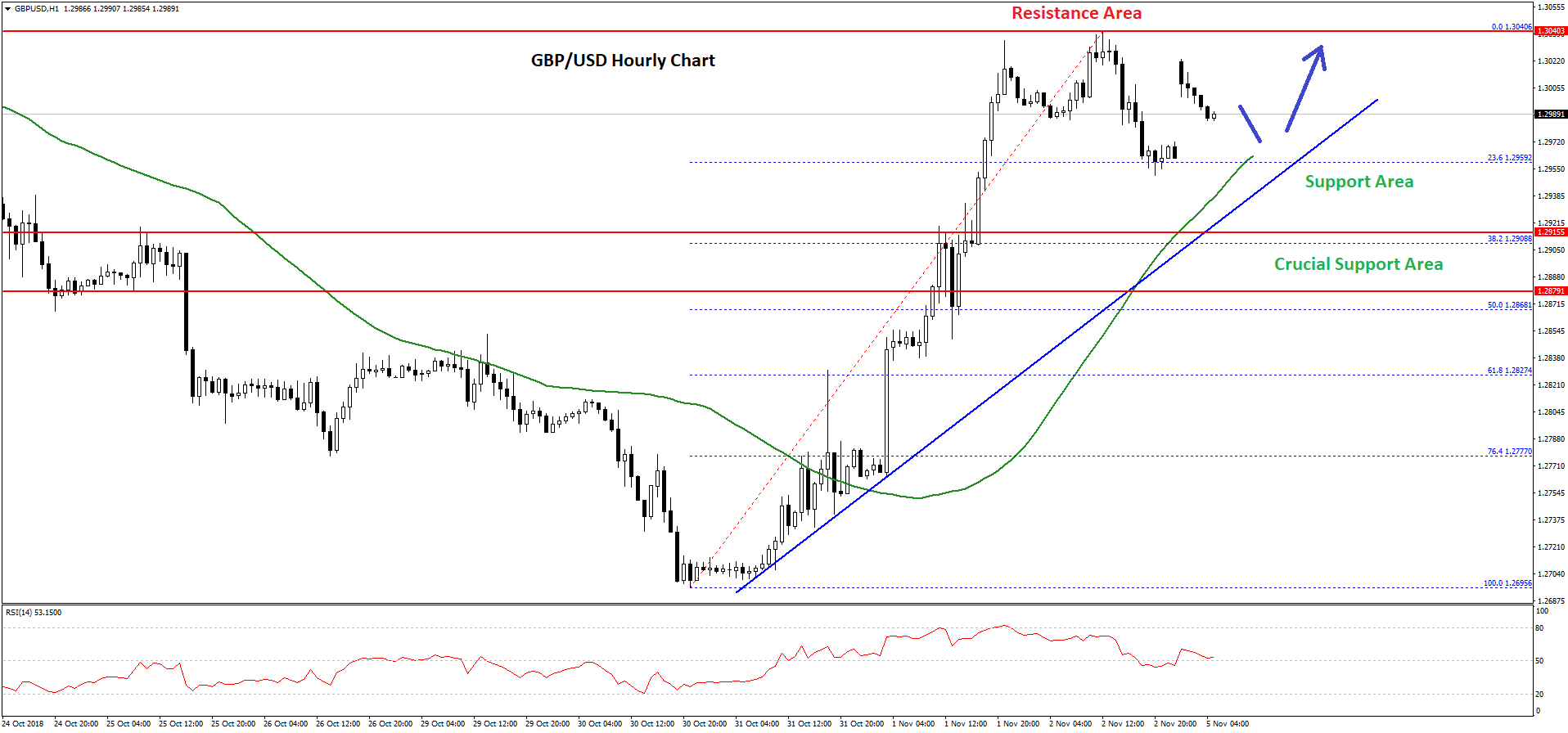
Later, the pair started a downside correction and traded below the 1.3000 level. It tested the 23.6% Fib retracement level of the recent wave from the 1.2695 low to 1.3040 high. On the downside, there are many supports near the 1.2950 level and the 50 hourly SMA.
Moreover, there is a steep bullish trend line formed with support at 1.2955 on the hourly chart. If there is a downside break below the trend line and the 50 SMA, the pair could correct sharply towards the 1.2880 zone.
The 50% Fib retracement level of the recent wave from the 1.2695 low to 1.3040 high is also around the 1.2870 level to act as a strong support.
Therefore, if the pair continues to correct lower, it could find support near the 1.2950 or 1.2880 level. On the upside, an initial resistance is at 1.3020, above which the pair could find resistance near 1.3040.
If there is a proper break above the 1.3040-1.3050 zone, the pair will most likely gain further towards the 1.3100 or 1.3120 level.
USD/CAD Technical Analysis
The US Dollar struggled to settle above the 1.3160-1.3170 zone against the Canadian Dollar. The USD/CAD pair started a downside correction and declined below the 1.3120 support recently.
During the recent decline, the pair even broke the 1.3100 support and the 50 hourly simple moving average. Moreover, there was a break below a bullish trend line at 1.3120 on the hourly chart.
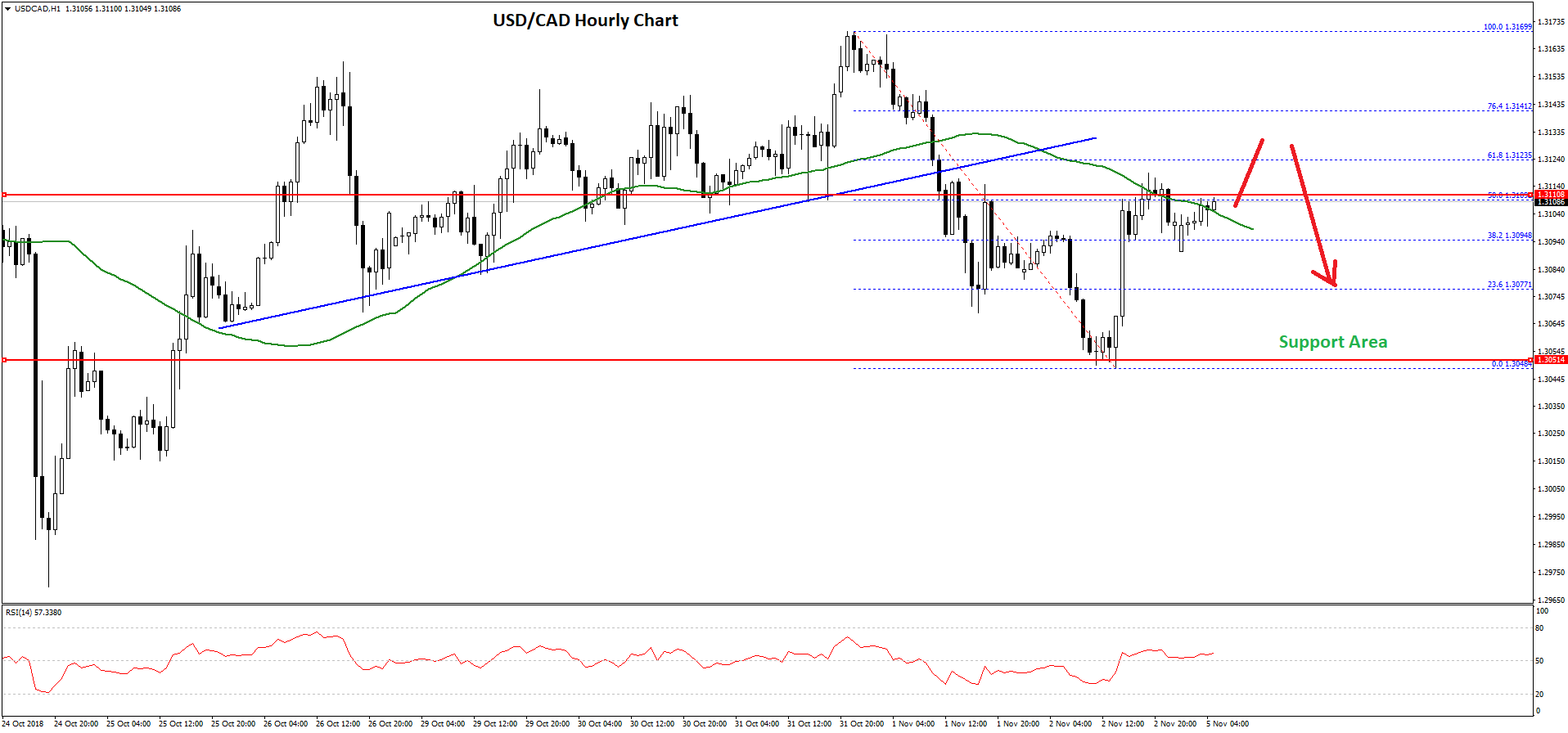
The pair traded as towards the 1.3050 support where buyers emerged. A low was formed at 1.3048 and later the pair started a recovery. It moved above the 23.6% Fib retracement level of the recent decline from the 1.3169 high to 1.3048 low.
However, buyers failed to surpass the 1.3120 zone and the 50% Fib retracement level of the recent decline from the 1.3169 high to 1.3048 low.
In the short term, there could be a spike above the 1.3120 resistance, but the pair is likely to struggle near the 1.3135 or 1.3140 level. If there is no break above 1.3140, the pair could decline once again towards the 1.3050 level.
On the other hand, if USD/CAD climbs above 1.3140, it may even break the 1.3160-1.3170 resistance zone to test the next hurdle near the 1.3200 zone.
EURUSD Intraday Bearish Below 1.1387
The euro currency is once again trading on the backfoot against the US dollar after price was strongly rejected from the 1.1450 level. From a technical perspective, the intraday bias surrounding the EURUSD pair is bearish while price trades below the 1.1387 resistance level. Buyers will likely aim to move price above the 1.1431 level, while sellers will attempt to break the 1.1300 level.
The EURUSD pair is bearish while trading below the 1.1387 level, key support is found at the 1.1330 and 1.1300 levels.
If the EURUSD pair moves above the 1.1431 level, buyers are likely to test towards the 1.1450 and 1.1500 resistance levels.