Sample Category Title
Italy’s Rating In Focus
Market movers today
Today, S&P may publish its rating decision on Italy. We expect that the S&P will change the outlook to negative but keep the rating unchanged. This should have modest negative impact on Italian government bonds on Monday next week.
In the US, we get the first estimate of GDP growth in Q3. Atlanta Fed's GDPNow estimate says it was 3.9% q/q AR, while the NY Fed Nowcast indicator says it was just 2.2% q/q AR. We are believe it was probably slightly higher than 3.0% q/q AR, which is relatively strong, at least in this expansion.
Another important US release is the PCE core which we estimate rose 0.1% m/m in September and it is likely core PCE rose 1.5% q/q AR, but watch out for revisions. The figure will probably not change anything for the Fed, which is on autopilot until it reaches 3% in June next year after hikes in both December and March.
In Russia, the Bank of Russia (CBR) will have to make the penultimate monetary policy decision of the year today. Inflation has started climbing on a low base effect and fuel price increases. At the same time, the approaching VAT hike and the surge in the RUB's volatility have pushed up inflation expectations, which are closely monitored by the CBR. While we expect Russia's key rate to remain unchanged at 7.50% today, there is a risk that the CBR could refer to surging inflation expectations and deliver a 25bp hike.
Selected market news
Although the US stock markets rebounded yesterday and periphery spreads narrowed in Europe, Asian stocks continued to fall overnight and US futures headed lower after disappointing earnings reports from US tech giants. The risk-off sentiment in Asia sent the USD/CNY to its highest level this year. The pressure on the Chinese currency probably also comes after a news report yesterday suggested that U.S. won't resume trade talks without firm proposal from a wary China, bringing the possible meeting between Chinese leader Xi and US president Trump in late November in danger.
Yesterday, ECB President Mario Draghi provided some interesting assessments during the press conference as he acknowledged that recent incoming data has been weaker than expected. ECB did not formally announce an end to the APP by the end of the year. We think the next ECB meeting on 13 December 2018 will be likely lead to a significant market reaction as significant decisions must be taken. For more discussion, please see our ECB Review - Steady Draghi amid disappointing data , 25 October 2018.
In the Nordic region, Norges Bank left the sight deposit rate unchanged at 0.75% as expected. This was a 'small' meeting, i.e. there was no monetary policy report, rate path or press conference but just a press release. As has been the case with recent interim meetings, the press release revealed little news from the Board. Norges Bank repeated its message that the 'assessment of the outlook and balance of risks suggested that the key policy rate would most likely be increased further in Q1 19.'
Elliott Wave: Further Downside Looming Large For IBEX?
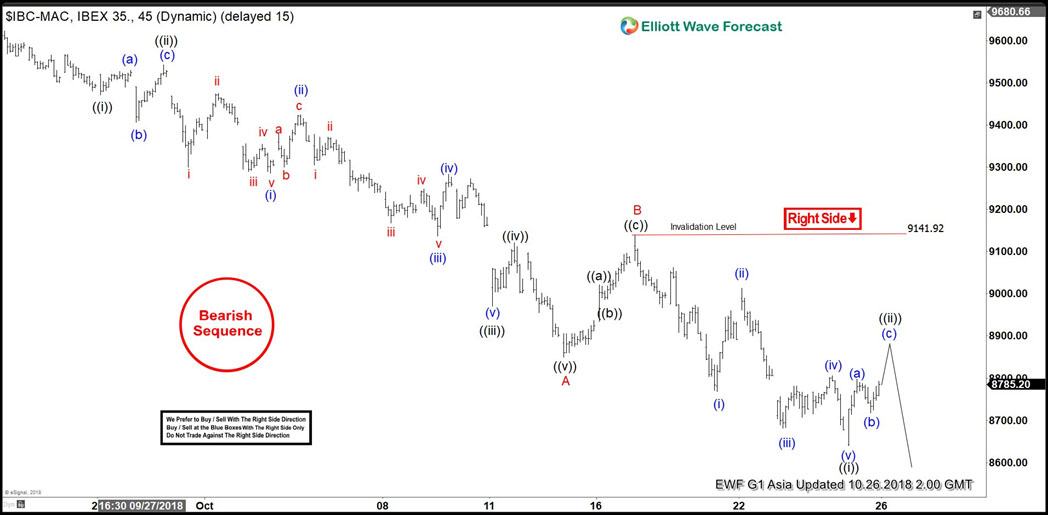
IBEX short-term Elliott wave view suggests that a decline to 8850.20 low ended Minor wave A of a zigzag structure. The internals of that decline unfolded as 5 waves impulse structure where Minute wave ((i)) ended at 9471.20 low. Minute wave ((ii)) ended in 3 swings at 9542.80 high. Minute wave ((iii)) ended in lesser degree 5 waves at 8971.30 low. Then Minute wave ((iv)) bounce ended at 9120.80 high and Minute wave ((v)) ended at 8850.20 low.
Up from there, the index made a 3 wave bounce to 9141.92 high & ended Minor wave B in lesser degree zigzag structure. Where Minute wave ((a)) ended at 9021.10. Minute wave ((b)) ended at 8986.80 low. And Minute wave ((c)) at 9141.92 high. Down from there, the index has made new lows already confirming the next extension lower in Minor wave C and creating a short-term bearish sequence from 9/21/2018 peak. Where a decline to 8639.70 low ended Minute wave ((i)) of C. Near-term, while below 9141.92 high expect index to fail in Minute wave ((ii)) of C in 3, 7 or 11 swings for more downside. We don’t like buying it and expect bounces to fail in 3, 7 or 11 swings against 9141.92 high.
IBEX 1 Hour Elliott Wave Chart
GBP/USD Non-Stop Bearish Momentum Triggers 3rd Wave
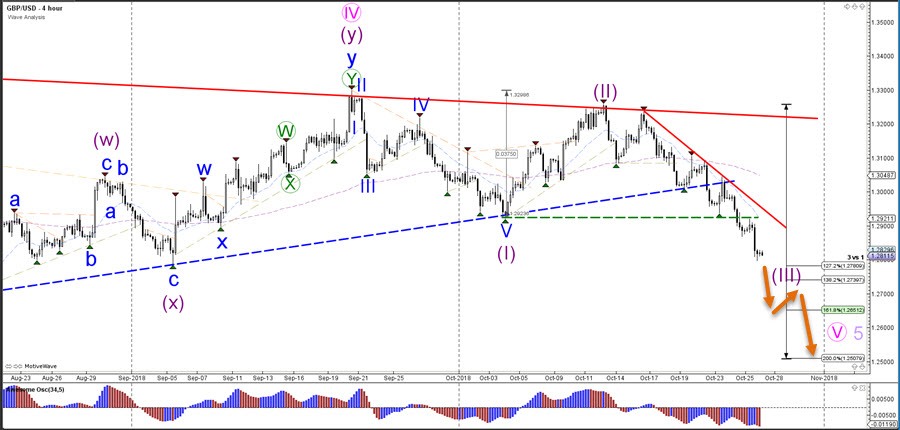
The GBP/USD made a bearish breakout, pullback and bounce at the broken horizontal support level (dotted green). The bearish continuation is making the expected wave 3 (purple) more likely but the confirmation occurs when price reaches at least the 161.8% Fibonacci target.
The GBP/USD is in a bearish impulsive price swing at the moment due to the fact that most 4-hour candles are showing lower lows and lower highs. The bearish momentum could be aiming for the Fibonacci targets.
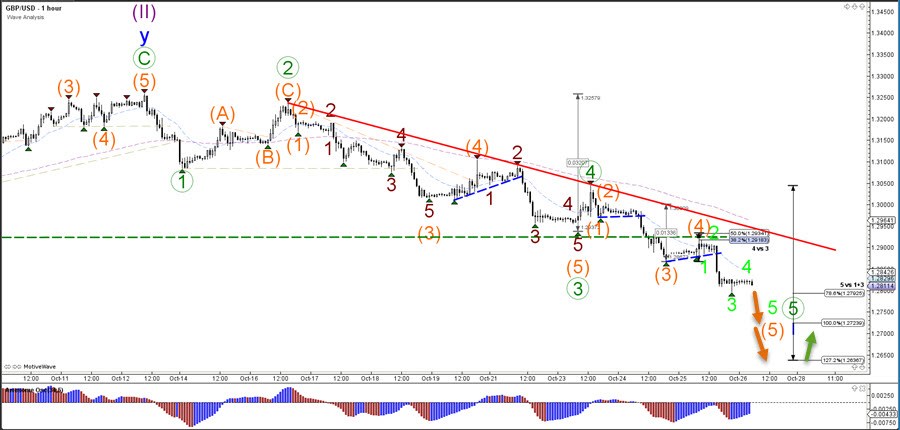
The GBP/USD bounced at the shallow Fibonacci retracement levels of wave 4 vs 3. A bearish continuation towards the next round quarter level at 1.2750 seems likely at the moment
Draghi Seeks To Reassure By Suggesting Economy Is Solid But ECB Will Be Slow
- Draghi suggests no change in ECB thinking in spite of softer data and nervous markets
- Volatile financial markets likely added to arguments for stable outlook from ECB
- Draghi lists range of arguments why slower Euro area growth is not a slump
- Review of outlook promised in December but ECB still on slow path toward normalisation
- Draghi suggests Italy not an issue for ECB and signals no special support can be expected; will this add to pressure on Rome?
- Brexit financial stability risks seen manageable but no deal could do economic damage
ECB says little has changed in spite of market nervousness. So policy path remains the same
Very little was expected from yesterday’s ECB policy meeting and press conference and the lack of significant market reaction to Mr Draghi’s pronouncements suggests very little was exactly what was delivered. However, against a backdrop of nervous markets and an increasingly uncertain economic outlook, the ECB may well feel the lack of any notable market reaction represents a job well done.
With net monthly purchases under the Asset Purchase Programme scheduled to end in December and key policy rates predicted ‘to remain at their present levels at least through the summer of 2019’, the overwhelming sense in markets is that the ECB is set to remain on the side-lines for some considerable time.
However, the immediate backdrop to yesterday’s meeting did add a little more interest to proceedings. The recent turmoil in equity markets, heightened concerns about the outlook for Italian fiscal policy and the trajectory of that economy as well as increasing nervousness about the course the UK’s withdrawal from the EU might have all contributed both to notably more volatile trading conditions of late as well as increased downside risks to the Euro area economy.
In these circumstances, Mr Draghi’s repeated message that ECB thinking on economic prospects and the related policy outlook hasn’t changed materially likely reflects the consensus view of the Governing council but it may also owe something to a strong desire not to frighten the horses and aggravate market turmoil by suggesting that the ECB shares investors current worries to any material degree.
Instead, there was a strong determination to signal that economic and financial conditions remain sufficiently healthy to warrant the ECB remaining on its current course towards a gradual and predictable reduction in the degree of policy support it now provides. In addition, Mr Draghi continued to emphasise that this process would still leave ECB monetary policy significantly supportive for the foreseeable future.
Recovery to continue albeit at a more modest pace and inflation will gradually rise
Although Mr Draghi readily acknowledged that recent data was ‘somewhat weaker than expected’, he went on to provide a fairly lengthy list setting out why the ECB believed ‘a broad-based expansion of the euro area economy’ was likely to continue. The wide range of explanations offered to allay concerns about slower growth of late is likely intended to ward off any suggestion that the Euro area recovery is under any significant threat.
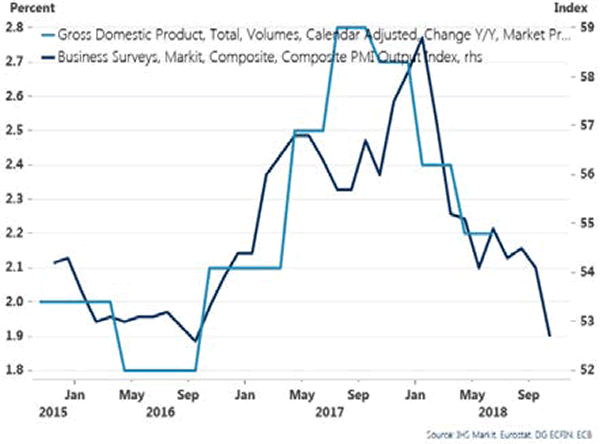
Mr Draghi noted that the pace of growth was now normalising from the exceptional pace seen through 2017 and this reflected a return to more usual export performance. As a result, the recent slowdown, illustrated by the softening in PMI data shown in diagram 1 below, should be seen as signaling weaker momentum towards a more sustainable pace rather than a downturn
Mr Draghi added that specific and temporary factors such as weakness in German industrial production caused by difficulties that country’s car manufacturers had in adapting to new EU-wide emissions tests for new vehicles exaggerated the measured softening in economic conditions of late.
The ECB president further added that expansionary and, in some instances, pro-cyclical fiscal policy would support activity further and this should ensure domestic demand remains robust. Importantly, improving domestic demand is also seen sustaining healthy employment growth and ensuring the persistence of a pick-up in wage inflation that Mr Draghi emphasised was permanent rather than temporary in nature. For these reasons, Mr Draghi concluded that risks around the outlook for activity were still broadly balanced rather than tilted to the downside.
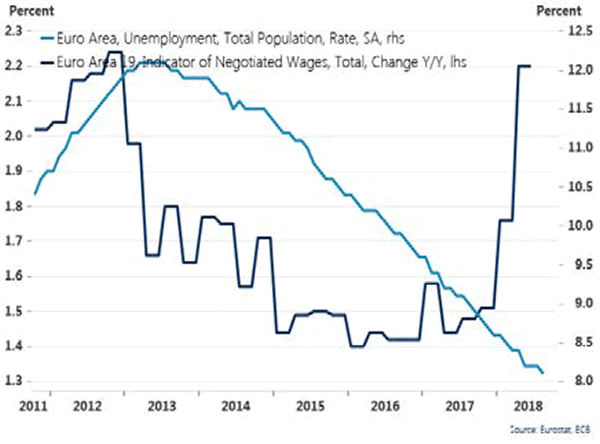
Together with a high level of capacity utilisation, the current positive momentum in wages is seen delivering an increase in underlying inflation, in time, that would ‘gradually’ bring it in line with the ECB’s target. As diagram 2 below illustrates, the trend decline in unemployment and recent acceleration in wage growth might also be expected to provide some further impetus to domestic spending that might offset some external risks to Euro area growth
ECB will review the outlook in December as policy wasn’t discussed
Although Mr Draghi offered a strong defence of the ECB’s current assessment and policy intentions, he also indicated that these would be reviewed in the light of new economic projections which the ECB will release at its next policy meeting on December 13th. So, Mr Draghi has preserved a significant measure of wriggle room. He repeatedly said that the Governing council had not discussed what it would do next but indicated that the ECB had a policy toolbox that was quite ‘rich’ in terms of a capacity to deal with any downside risks that might materialise in the future.
Italy is not an issue for the ECB…at least in public
While there was no expectation of any major shift in ECB thinking on monetary policy yesterday, there was substantial interest in Mr Draghi’s assessment of developments in Italy. His reflex refusal to offer any significant view beyond the indication that a solution could be found contrasted starkly with additional comments that suggest there has been a lengthy but largely confidential consideration of the potential impact of Italy’s altered fiscal course on ECB policymaking.
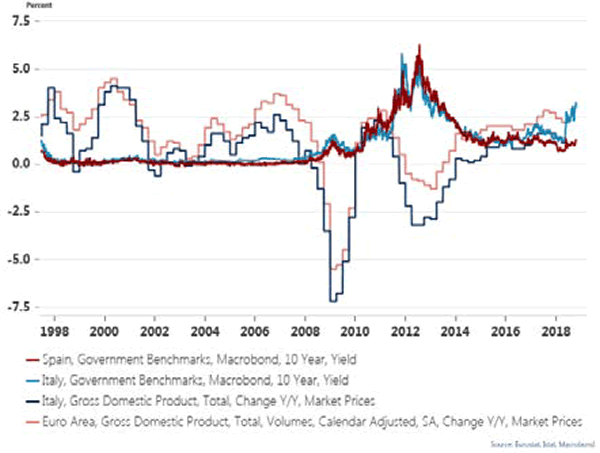
Mr Draghi adopted the usual defence of indicating there had been no material discussion of Italy at yesterday’s meeting, adding that current travails were a ‘fiscal discussion’. However, he went on to say that any contagion appeared limited and that some signs of spill-over in terms of higher yields in other countries might be a reflection of specific issues in these countries and, consequently, not a signal of the spread of Italian woes across the broader Euro area. As diagram 3 below illustrates, the current spread between Spanish and German bond yields is not threatening by historic standards and the Euro area has long been capable of withstanding the headwinds from sub-par Italian growth.
More notably, Mr Draghi suggested that in the event of seriously increased turmoil, Italy would have the option to access Outright Monetary Transactions (the support mechanism announced by the ECB in 2012 but never utilised). Of course, as this would imply participation in an EU/IMF support programme and adherence to that programme’s fiscal requirements, it is most unlikely to represent a feasible course of action for the Italian government. Mr Draghi also pointedly noted that financing government budget deficits was not part of the ECB’s mandate, further emphasising that adjustments would need to occur in Rome rather than Frankfurt.
Brexit threat to financial stability is limited but ‘no deal’ damaging to economic outlook
In response to another question, Mr Draghi indicated that while the ECB was not party to Brexit negotiations, it was working closely with the Bank of England to guard against major technical fallout in the financial system that might result from the UK’s departure from the EU. Again, he indicated confidence that any such stability risks could be managed at a technical level. However, he also noted that in the absence of a speedy agreement of a withdrawal deal, the private sector would have to begin to make preparations for a hard and disorderly Brexit. This, he suggested, was likely to be costly in terms of economic and financial disruption and, consequently, highlighted the need for a solution that minimises such risks.
Conclusions: Mr Draghi makes a little go a long way
The main task for Mr Draghi yesterday was to sound calm and emphasise continuity in ECB policy. He achieved this by stressing the positive in terms of the Euro area economy and the accommodative in terms of future ECB policy changes. He avoided what was, arguably, the major misstep he might have made which would have been to indicate heightened concern about slowing economic growth in the Euro area - an assessment that would have heightened market nervousness.
By continuing to emphasise a predictable and slow path of policy normalisation, the ECB may hope to limit volatility in Euro area interest rate markets. A notably more dovish tone from the ECB than the US Federal Reserve, which reflects notable differences in economic momentum in the two zones at present, may also weigh on the euro in the near term.
Although Mr Draghi didn’t say anything too surprising about Italy, his tone did send a clear message to Rome that the ECB doesn't see any role for itself in easing pressure on Italian bond yields. This may encourage the market to test the pain threshold for Italian bonds
The ECB Kept Its Benchmark Interest Rate Unchanged And Reaffirmed Plans To End Stimulus Program In December
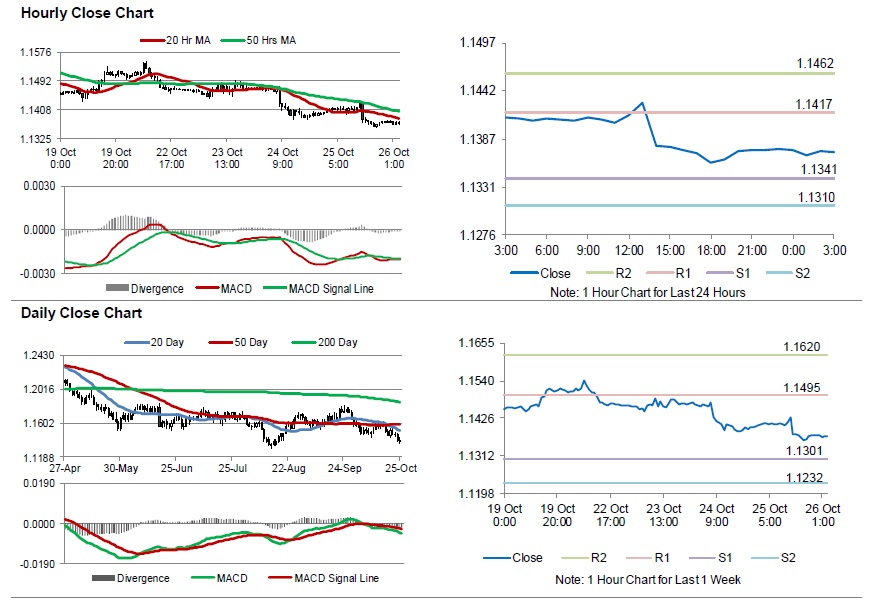
For the 24 hours to 23:00 GMT, the EUR declined 0.20% against the USD and closed at 1.1375.
The European Central Bank (ECB), in its October monetary policy meeting, decided to keep its benchmark interest rate steady at 0.00%, for a third consecutive policy session. Further, the bank reiterated that its QE programme would cease in December. Additionally, officials signalled that the key interest rates will remain at their present levels at least through the summer of 2019. In a statement following the ECB meeting, President, Mario Draghi stated that that policymakers were confident about the economy’s strength and that the inflation is gradually approaching its goal of “below, but close to 2%”.
On the data front, Germany’s IFO business climate index dropped more-than-estimated to a level of 102.8 in October, compared to market expectations for a fall to a level of 103.2. In the previous month, the index had registered a level of 103.7. Moreover, the nation’s IFO business expectations index slid to a level of 99.8 in October, following a reading of 101.0 in the prior month. Market participants had envisaged for the index to drop to a level of 100.4. Additionally, IFO current assessment index eased to a level of 105.9 in October, compared to a reading of 106.4 in the preceding month. Market participants had anticipated the index to decline to a level of 106.0.
In the US, data showed that the US preliminary durable goods orders unexpectedly climbed 0.8% on a monthly basis in September, defying market expectations for a drop of 1.5%. In the prior month, durable goods orders had recorded a revised gain of 4.6%. Meanwhile, the nation’s pending home sales surprisingly advanced 0.5% on a monthly basis in September, compared to a revised fall of 1.9% in the previous month. Market participants had anticipated pending home sales to record an unchanged reading.
However, advance goods trade deficit unexpectedly widened to a level of $76.0 billion in September, compared to a deficit of $75.8 billion in the prior month. Market participants had envisaged the nation to post a deficit of $75.1 billion. Further, seasonally adjusted initial jobless claims jumped to a level of 215.0K in the week ended 20 October 2018, in line with market expectations. Initial jobless claims had registered a reading of 210.0K in the previous week.
In the Asian session, at GMT0300, the pair is trading at 1.1371, with the EUR trading a tad lower against the USD from yesterday’s close.
The pair is expected to find support at 1.1341, and a fall through could take it to the next support level of 1.1310. The pair is expected to find its first resistance at 1.1417, and a rise through could take it to the next resistance level of 1.1462.
Going forward, investors would closely monitor the European Central Bank, President Mario Draghi’s speech, and Germany’s GFK consumer confidence index for November, due in a few hours. Later in the day, the US 3Q gross domestic product figures along with the Michigan consumer sentiment index for October, will keep traders on their toes.
The currency pair is trading below its 20 Hr and 50 Hr moving averages.
Update on AUD/USD short: Trail the stop lower
Here's an update on our AUD/USD short (entered at 0.7100, stop at 0.7165), last discussed here.
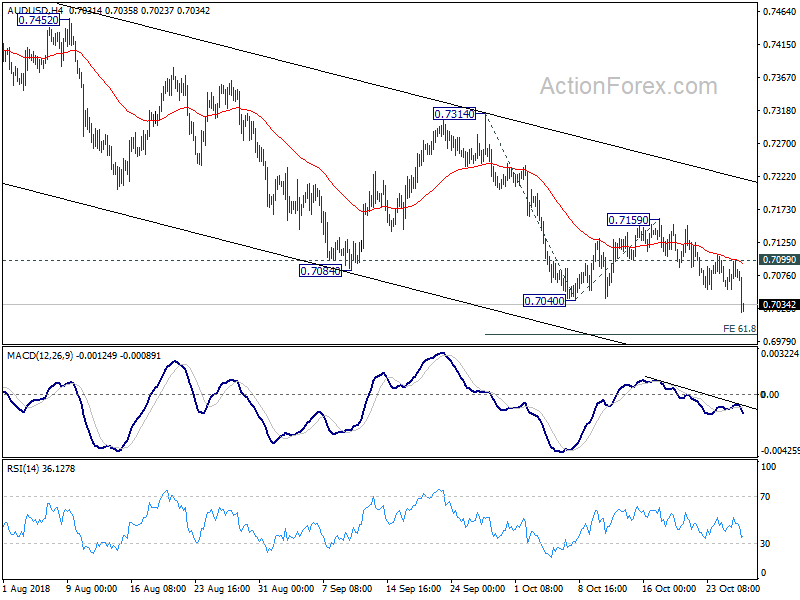
Finally, AUD/USD has completed the consolidation from 0.7040 and resumed recent down trend. That came later then we expected, but nevertheless, it's a positive development for our strategy. As noted before, we'd expect the down trend from 0.8135 to target a test on 0.6826 (2016 low). At the same time we're also looking at the possibility of resuming long term down trend from 1.1079 (2011 high).
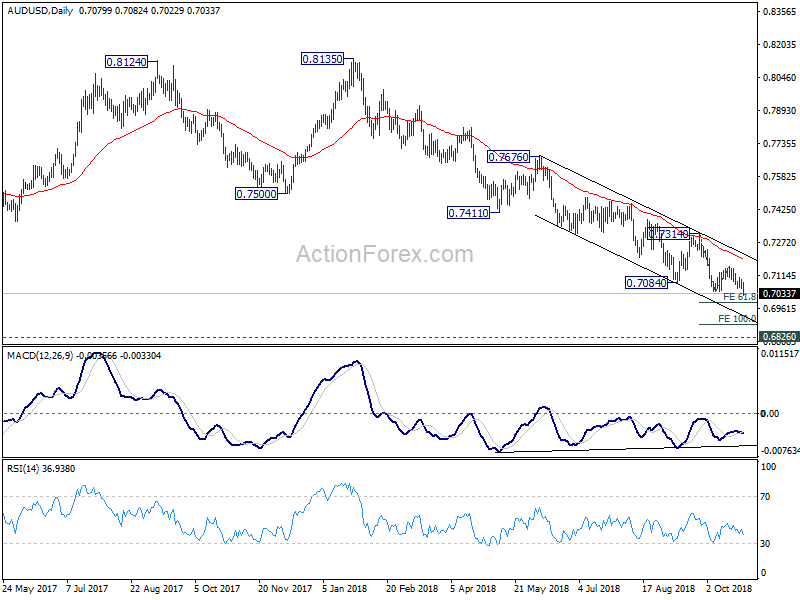
For the latter case, it should now be time to see some downside acceleration, ideally. And to show that momentum, AUD/USD should break through 61.8% projection of 0.7314 to 0.7040 from 0.7159 at 0.6990 easily and firmly without much hesitation. If that's the case, even though, support zone between 0.6826 and 100% projection 100% projection at 0.6885 might limit downside at first attempt, support won't last long. However, if the break of 0.6990 is sluggish, we'd probably not even see a break of 0.6826 low.
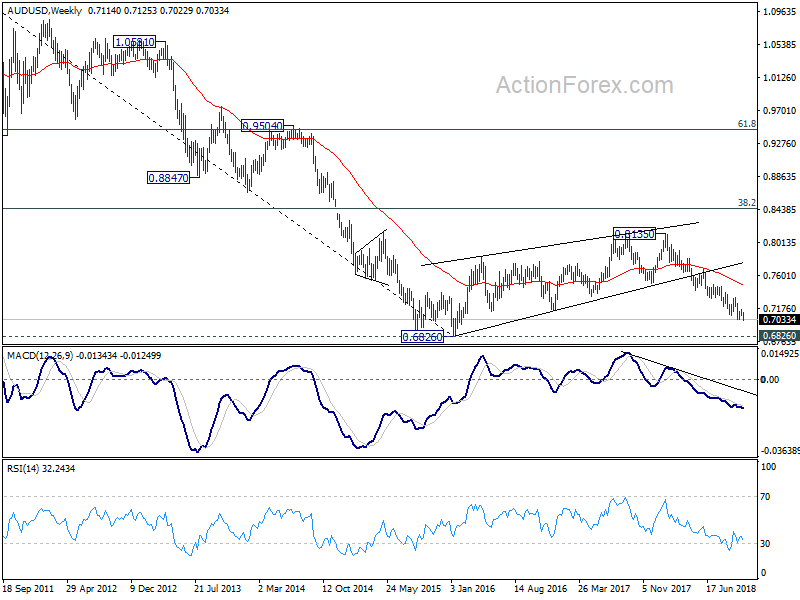
For now, we'll hold on to the short position, lower the stop to 0.7100 (breakeven). We wont' put a target yet and will keep on monitoring to decide the exit.
Sterling Trading Flat In The Asian Session
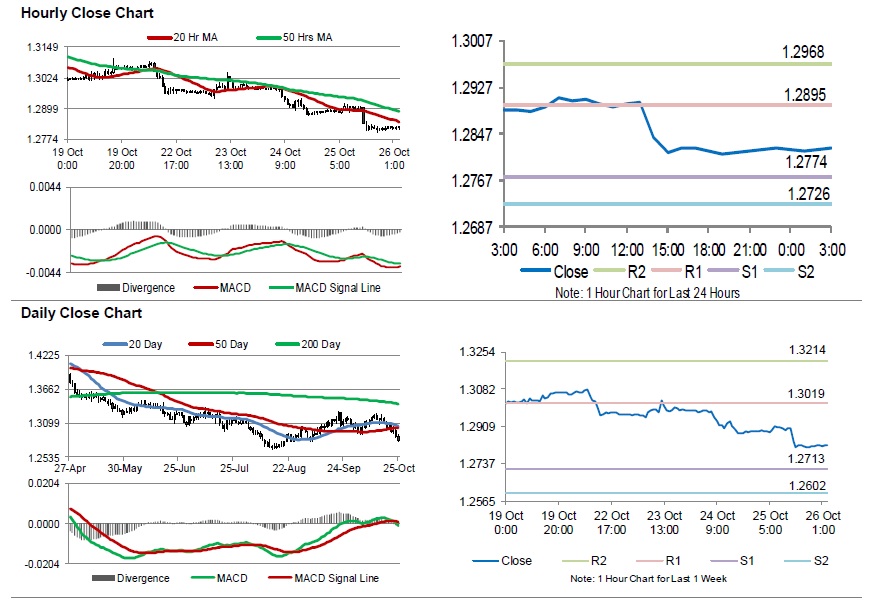
For the 24 hours to 23:00 GMT, the GBP declined 0.49% against the USD and closed at 1.2823, following European Central Bank President, Mario Draghi’s comments on Brexit.
In the Asian session, at GMT0300, the pair is trading at 1.2823, with the GBP trading flat against the USD from yesterday’s close.
The pair is expected to find support at 1.2774, and a fall through could take it to the next support level of 1.2726. The pair is expected to find its first resistance at 1.2895, and a rise through could take it to the next resistance level of 1.2968.
Amid lack of macroeconomic releases in the UK today, investor sentiment will be determined by global macroeconomic news.
The currency pair is trading below its 20 Hr and 50 Hr moving averages.
Japanese Yen Trading Higher This Morning
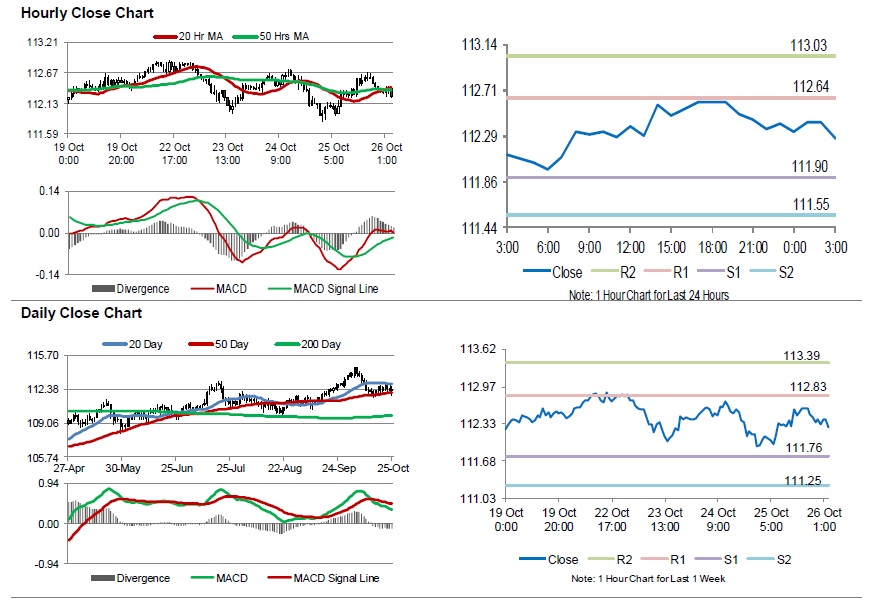
For the 24 hours to 23:00 GMT, the USD rose 0.23% against the JPY and closed at 112.40.
In the Asian session, at GMT0300, the pair is trading at 112.26, with the USD trading 0.12% lower against the JPY from yesterday’s close.
The pair is expected to find support at 111.90, and a fall through could take it to the next support level of 111.55. The pair is expected to find its first resistance at 112.64, and a rise through could take it to the next resistance level of 113.03.
The currency pair is showing convergence with its 20 Hr and 50 Hr moving averages.
Swiss Franc Trading A Tad Lower In The Asian Session
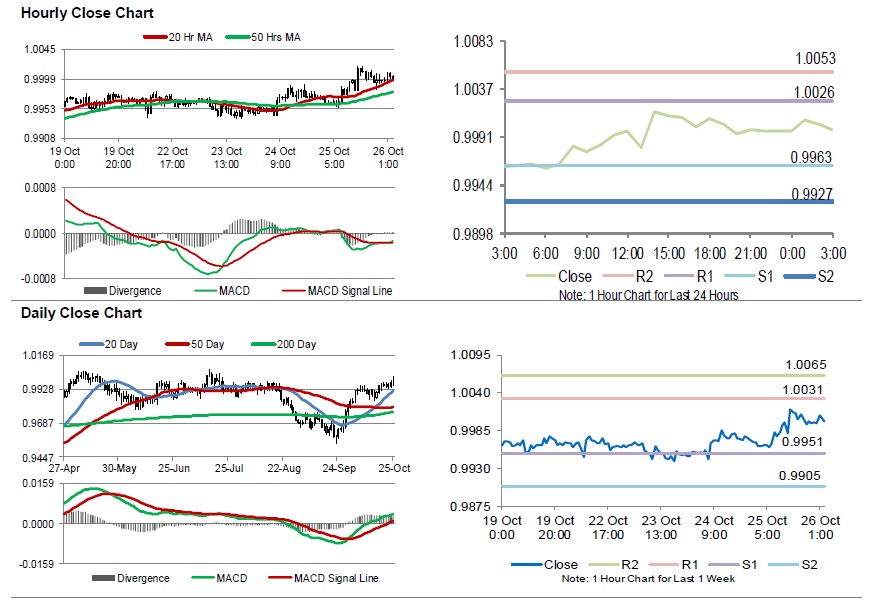
For the 24 hours to 23:00 GMT, the USD rose 0.26% against the CHF and closed at 0.9997.
In the Asian session, at GMT0300, the pair is trading at 0.9998, with the USD trading slightly higher against the CHF from yesterday’s close.
The pair is expected to find support at 0.9963, and a fall through could take it to the next support level of 0.9927. The pair is expected to find its first resistance at 1.0026, and a rise through could take it to the next resistance level of 1.0053.
Moving ahead, investors would await Switzerland’s SECO consumer confidence, the KOF leading indicator, consumer price index, retail sales and manufacturing PMI, all scheduled to release next week.
The currency pair is showing convergence with its 20 Hr moving average and trading above its 50 Hr moving average.
Loonie Extends Its Losses In The Morning Session
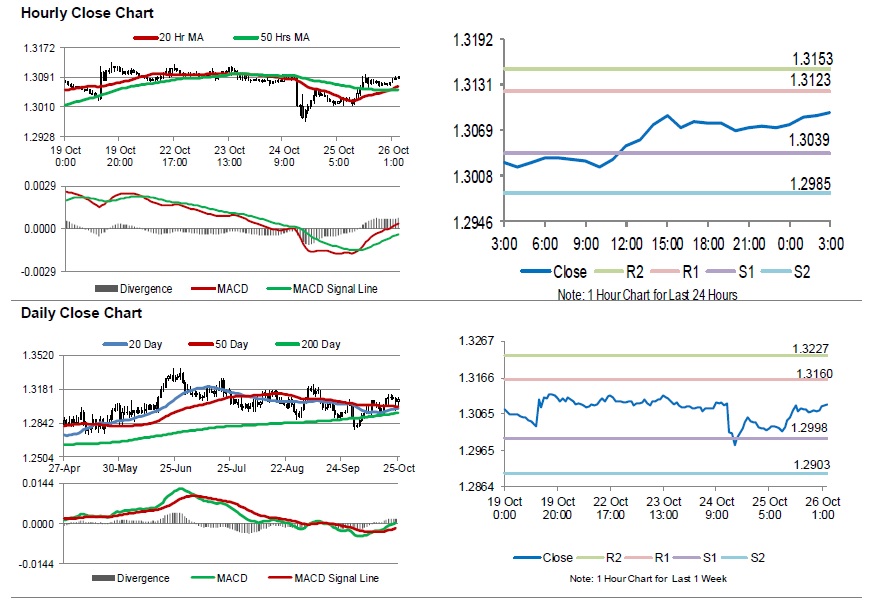
For the 24 hours to 23:00 GMT, the USD rose 0.22% against the CAD and closed at 1.3072.
In the economic news, Canada’s business barometer eased to a level of 60.5 in October, compared to a reading of 61.4 in the preceding month.
In the Asian session, at GMT0300, the pair is trading at 1.3093, with the USD trading 0.16% higher against the CAD from yesterday’s close.
The pair is expected to find support at 1.3039, and a fall through could take it to the next support level of 1.2985. The pair is expected to find its first resistance at 1.3123, and a rise through could take it to the next resistance level of 1.3153.
Amid lack of economic releases in Canada today, traders would focus on global macroeconomic events for further direction.
The currency pair is trading above its 20 Hr and 50 Hr moving averages.