

Sample Category Title
Moody US Markets
Moody US Markets
Risk markets tentatively stabilised overnight attempting to bounce back from Wednesday ‘s steep equity sell-off. Of course, the big question is why given that little has changed and if anything, the Feds new Vice Chair Clarida, who the markets were extremely focused on, stuck to the data dependent optimistic view his boss Chair Jay Powell rolled out last FOMC cementing the December rate hike narrative. Not the best news for equity investors in the unstable environment as the FOMC continues to dig in their monetary policy heels.
But without trying to oversimply matters, the reason the markets stabilised is that everyone is still in buy the dip mode and or wants to sell the year-end rally as everyone expects 2019 to be a real stinker. But this also tells me that the market is nowhere near bearish enough and suggesting we’ve not even come remotely close to putting in a low on the S&P.
I’m always a long-term equities bull, and who isn’t?
Now, I’m still a long-term bull when it comes to equity markets. I know five years down the road the S&P will be trading much higher than it is today if history tells me anything. But when my signals suggest with more certainty, that the S&P will sell down to 2300-2400 before breaching 3000, I remain a much better seller of risk until the markets prove me wrong. I don’t think I’m alone as the short-lived move above 2700 was faded as investors took their cue from Nasdaq Emini’s which are tanking as various tech stocks are melting post-earnings.
What’s different about this sell-off
So, what is different this time around versus the undulating markets we’ve seen for the past two months. Unlike the previous sell-off in 2018 that tended to hit a sector or two at a time, the breadth of the latest rout was much more pronounced as it was heavyweight champions of the US markets that were leading the way. Indeed, this sell-off is entirely different as on top of the mountains of geopolitical risk; US interest rates are rising quickly and mercilessly squeezing financial conditions. In turn, this is putting immense stress on both long bonds -long equity positioned portfolios that have been the markets mainstay due to central bank largesse.
With the Feds committed to draining the trough, and with US tax cuts expected to run its course. Markets will then pivot to the not too cherry prospect of a massive US deficit to fund. Sometimes you must pay the piper, and just maybe we’re going to have to pay the piper for a while.
Since the fasten the seatbelt sign is still on in my plane it suggests market turbulence is unlikely to leave the picture anytime soon.
First look at Tokyo
Osaka looks a bit firmer in pre-market action, but this will be as much about position squaring as it is bullish sentiment.
Oil Markets
Oil markets moved higher on profit taking after risk sentiment tentatively stabilised overnight. But the gains were further supported by another apparent shift in Saudi and OPEC oil policy. From putting customers minds at ease that the response to US sanctions on Iran will be to maintain adequate supply (maybe even a bit oversupplied) towards now keeping inventories under control. Indeed a subtle bullish retort. Market positioning is much cleaner now after the recent long oil position shakes out, so buyers. Bulls are less concerned about the crowded trade mentality trampling over bullish bets.
On the flip side, US inventory builds the proclivity for the front ” time spreads” to move to contango as well the macro sell-off which should continue to be critical downside catalyst are huge concerns. But the subtle shift in Saudi policy language should be enough to keep the bears caged, at least for the time being.
Gold Markets
It does appear the battle lines are getting defined as Gold markets have entered a new trading zone $ 1228-1238, but of course, investor mood swings on the S&P are steering the ship. However, a hawkish nod from Vice Chair Clarida dented sentiment. Markets had shifted from 80 % probability of a December rate hike to only ~ 65 % after Wednesday equity rout. But Clarida optimistic view of the US economy has increased those odds today.
Ultimately, however, Gold will be a crucial hedge against a possible protracted global equities market meltdown, and with risk aversion gripping the market more aggressively than risk on, gold should remain bid on dips.
Currency markets
The Malaysian Ringgit
Regional sentiment remains very shaky but even more so for the Ringgit as budget time looms. The stronger USD profile across G-10 is not helping sentiment, and neither does Fed Clarida cementing his views for a US rate hike for December.
While global risk sentiment is improving into the weekend, all bets are off for next week as we continue to expect the USDMYR to nudge higher and test 4.18 resistance into the November budget release.
Eco Data 10/26/18
[php_everywhere instance="1"]
US Q3 GDP Growth Seen Softer But Still Trump-Supportive
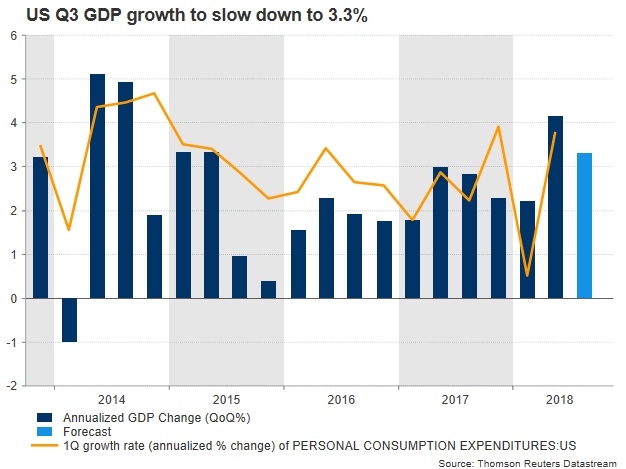
The US will issue preliminary GDP growth figures for the third quarter on Friday at 1230 GMT and markets will take a very close look at the data which will be the latest evidence on how well the world’s biggest economy performed before midterm congressional elections take place on November 6. While the consensus is for a slower pace of expansion, a steeper deceleration than expected is needed to persuade investors that Trump’s administration 3.0% growth goal for 2018 is unrealistic.
According to analysts, US GDP growth in the three months to September eased to 3.3% in annualized terms after hitting 4.2% in Q2, the fastest rate recorded in four years and almost twice the 2.2% pace it printed in Q1. Even if forecasts prove accurate on Friday, such an expansion is still a healthy one as long as it is bigger than 2.0% and smaller than 4.0% which economists consider an optimal range for GDP growth.
Income tax cuts applied to businesses and consumers in December 2017 are likely aiding the economy to get larger quicker, with average hourly earnings surging by 2.9% y/y in August, the fastest increase since 2009 and the unemployment rate dropping to 3.7% in October, to the lowest since 1969. Inflation as gauged by the core PCE price index finally reached the Fed’s 2.0% y/y price target in July and remained at that level in August, while real wages held in positive territory, supporting household spending. Indeed, growth in personal consumption expenditures is forecasted to have stood solid at 3.5% in annualized terms in the third quarter, slightly below the 3.8% rise seen in Q2. At the same time, the Conference Board Consumer Confidence index hit an 18-year high in September, flagging further buying interest in coming months.
Meanwhile on the business front, economic indicators look to be in good shape as well, despite US tariffs restricting access to inputs and Chinese countermeasures reducing demand for US products.The ISM manufacturing PMI jumped to the highest mark in 14 years in August before inching down in September, while in the services sector, the corresponding index spiked to an all-time high in September. Yet survey participants especially in supply chains were overwhelmingly worried that US trade protectionism could constrain investments and weigh on economic growth in the coming years. Something strongly evident from the recent sell-off in global stock markets, as well as from the US trade deficit which widened for the fourth consecutive month in August. However, with a new NAFTA deal settled between the US, and its closest trade partners Canada and Mexico (after China), trade terms might rebound in subsequent years. Yet the new agreement might not take effect until 2020 as the new accord needs to pass from legislator bodies in each of the three nations.
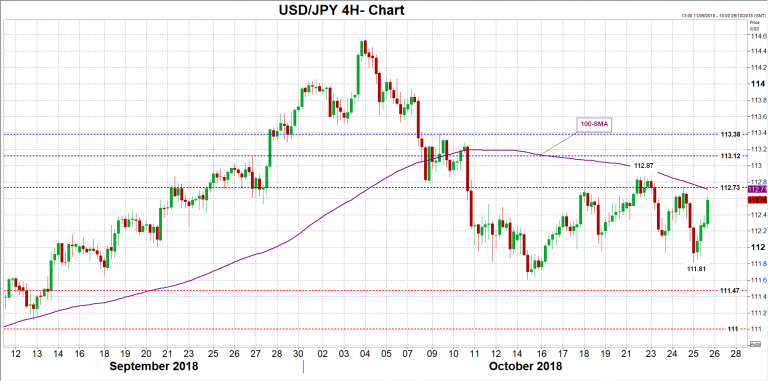
In FX markets, USDJPY slipped to a more than a week low of 111.81 early on Thursday before reversing back above the 112 handle. An upbeat GDP growth report on Friday would boost confidence in the US economy and more importantly provide a helpful hand to Trump’s Republicans in the midterm elections which are currenlty . Under this scenario the dollar may retest the recent peaks between 112.73 and 112.87, while if these fail to hold, traders could look for resistance in the 113.12-113.38 area, identified by the highs on September 26 and October 9 respectively.
Otherwise, a bigger slowdown than anticipated could raise speculation that the US economy has reached its peak and the Fed, which plans to hike rates at least four times until year-end 2019, may use a more careful rate guidance in the coming policy meetings. As such, the pair could move back down to 111.81, before the 111.61 trough on October 15 comes into view. A decisive close beneath that bottom would signal a resumption of this month’s downtrend from 114.54, turning the market from neutral to bearish again. In this case support could run towards 111.47 – a strong barrier during August. If the price manages to pierce that level too, the next stop could be around the 111.00 psychological mark.
Today’s top mover GBP/AUD: Downside momentum more powerful than expected
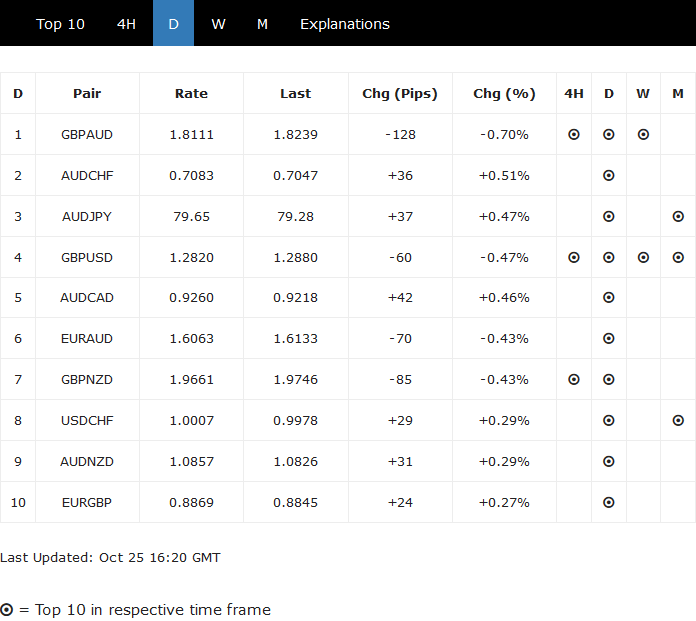
GBP/AUD is the biggest mover today. At the time of writing, it's down -128 pips or -0.70%.
As we expected here, the fall from 1.8726 did extend lower and met 38.2% retracement of 1.7282 to 1.8726 at 1.8174. But out of our expectation, the decline is much more powerful than anticipated and 55 day EMA is taken out without much hesitation.
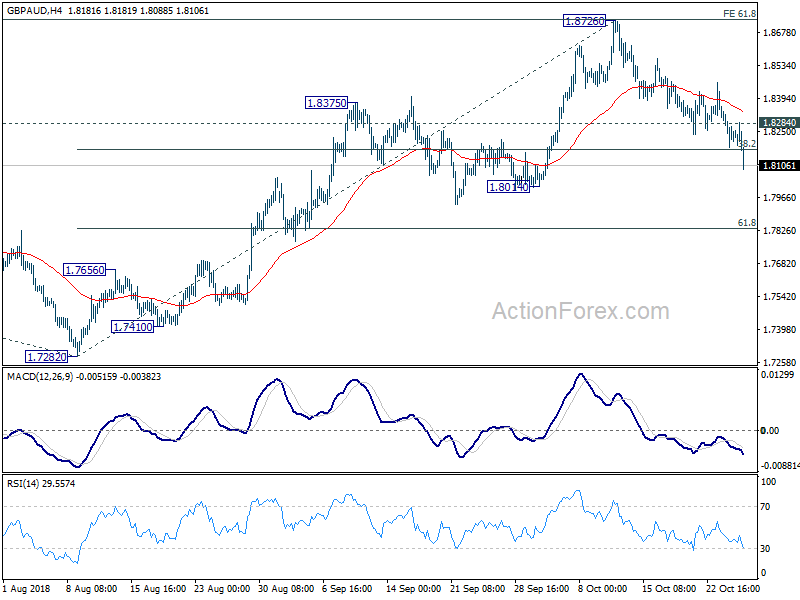
For now, further decline is expected as long as 1.8284 minor resistance holds. Deeper fall should be seen to 61.8% retracement at 1.7863. Though, break of 1.8284 will suggest short term bottoming and bring stronger rebound.
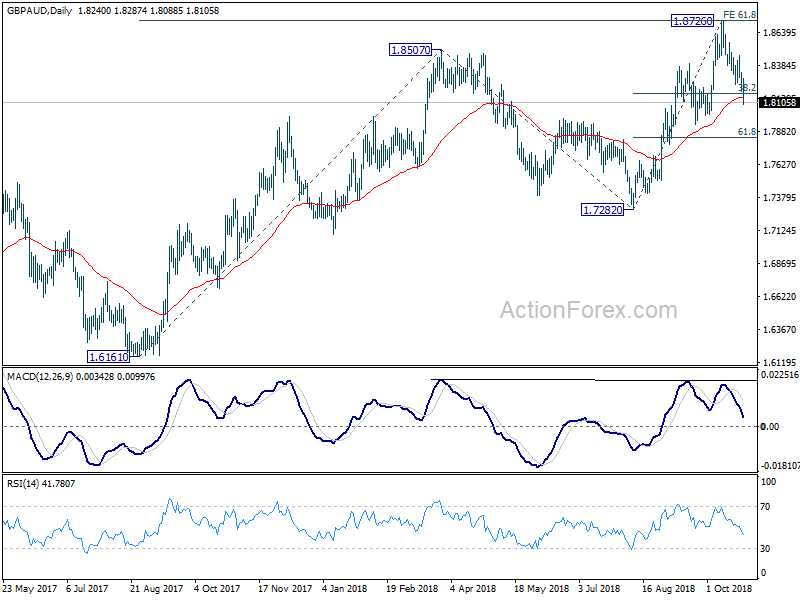
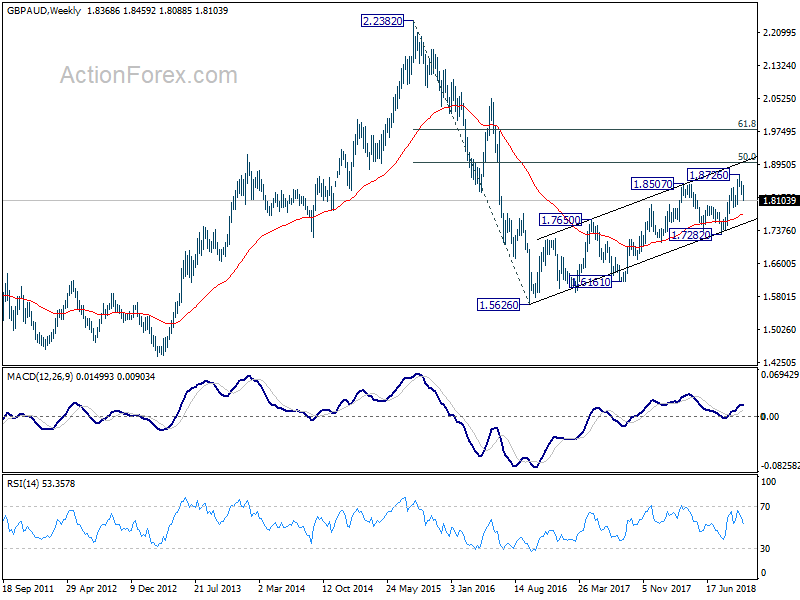
In the bigger picture, there is no clear sign of trend reversal in GBP/AUD yet, except bearish divergence condition in daily MACD, and the fact that it just missed 61.8% projection of 1.6161 to 1.8507 from 1.7282 at 1.8732. That is, we can't tell whether the corrective up trend from 2016 low at 1.5626 has completed yet. So, we'll look for bottoming signal again below 1.7863 fibonacci level.
Mid-US update: Sterling weakest on its own, Euro mixed after ECB, DOW rebouds
Risk aversion recedes quick notably in US session. DOW is currently trading above more than 350 pts and that helps major European indices closed higher too. As we noted here, DOW's rebound is not too much a surprise based on technical consideration. But for the near term, the question it whether is can sustain.
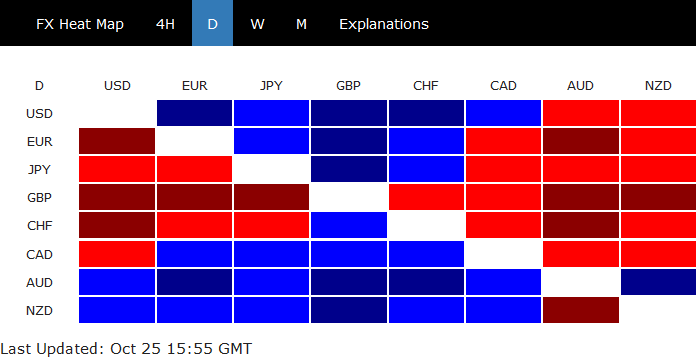
In the currency markets, Australian and New Zealand Dollar are trading as the strongest one for now, followed by the US Dollar. Sterling is doing it's own thing, basically react to no event today, and extends recent selloff. Following Sterling, Swiss Franc is the second weakest. Based on recent pattern, Franc's decline can be attributed to the rally in Turkish Lira, suggesting easing pressure on emerging markets. Yen is the third weakest, partly on market sentiments stabilization. Also, 10 year JGB yield closed sharply lower again today 0.114. It was above 0.15 just a few days ago.
Euro is mixed for the moment. But it does extend recent decline against Dollar. ECB stands pat today as widely expected. President Mario Draghi also delivered a composed, yet uninspiring press conference. Euro is just resuming what it has been doing after the event. Here are some suggested reading on ECB:
- ECB Reveals No Details about Reinvestment. December in Focus
- ECB Review: Steady Draghi Amid Disappointing Data
- ECB press conference live stream, starting in a few minutes
- ECB Recap: Draghi Sticks to the Script, EUR/USD Bears Eye 16-Month Low Near 1.13
A quick snapshot at the markets in the US:
- DOW is up 346 pts or 1.39% at 24925. Let's see if it can reclaim 25000 today.
- S&P 500 is up 1.55%
- NASDAQ is up 2.41%
- Five-year yield is up 0.016 at 2.980
- 10-year yield is up 0.010 at 3.134
- 30-year yield is down -0.001 at 3.345
- Gold is down 0.3% at 1230
In Europe:
- FTSE closed up 0.59% at 7004.10, regained 7000 handle
- DAX rose 1.03% to 11307.12
- CAC rose 1.60% to 5032.30, back above 5000 psychological level
- German 10 year yield rose 0.0032 to 0.401, still defending 0.4
- Italian 10 year yield dropped -0.1281 to 3.489. That's a good sign as spread with German is now rather close to 300.
Gold Dips as Greenback Continues to Shine
Gold prices have dropped in the Thursday session. In North American trade, the spot price for one ounce of gold is $1229.10, down 0.39% on the day. In the U.S, durable goods reports were mixed, and unemployment claims moved higher. On Friday, the U.S releases two key indicators – Advance GDP and UoM Consumer Sentiment.
U.S durable goods reports for September were mixed. Core durable goods orders came in at 0.1% for a second straight month, missing the estimate of 0.5%. Durable goods orders dropped from 4.5% to 0.8%, but this was much better than the forecast of -1.3%. Unemployment claims rose to 215 thousand, a shade above the forecast of 214 thousand. Despite these tepid numbers, the U.S dollar is broadly higher on Thursday, and the struggling pound has fallen to its lowest level since the first week of September.
Gold often acts as a safe-haven, but it’s the U.S dollar that continues to be a magnet for nervous investors, due to increasing geopolitical tensions. These include the U.S-China trade war, the uproar over the killing of a Saudi journalist in Turkey and tense relations between Moscow and Washington. There are headaches in Europe as well, with concerns over the Italian budget and the Brexit negotiations.
The Federal Reserve is widely expected to raise rates in December, which would mark the fourth rate hike this year. What can we expect in 2019? Many economists expect three rate hikes next year, and this was reinforced by Dallas Federal Reserve Bank President Robert Kaplan on Wednesday. Kaplan said he expects rates to rise into a range of 2.5% to 2.75%, or more likely, into a range of 2.75% to 3.00%. Kaplan noted that his estimate of a “neutral rate’ is slightly below 3% – anything above this level would move rates into a “restrictive’ stance, which could hamper economic growth and push inflation lower. The stock markets received a jolt this week as Chinese growth slipped to a 10-year low in the third quarter, and further weak numbers out of China could affect the U.S economy and cause the Fed to scale back its rate hike plans for 2019.
British Pound Falls to 7-Week Low Despite Lukewarm US Data
GBP/USD continues to slide, as the pair has lost ground in the Thursday session. In North American trade, the pair is trading at 1.2814, down 0.53% on the day. There are no British indicators on the schedule. In the U.S, durable goods reports were mixed, and unemployment claims moved higher. On Friday, the U.S releases two key indicators – Advance GDP and UoM Consumer Sentiment.
U.S durable goods reports for September were mixed. Core durable goods orders came in at 0.1% for a second straight month, missing the estimate of 0.5%. Durable goods orders dropped from 4.5% to 0.8%, but this was much better than the forecast of -1.3%. Unemployment claims rose to 215 thousand, a shade above the forecast of 214 thousand. Despite these tepid numbers, the U.S dollar is broadly higher on Thursday, and the struggling pound has fallen to its lowest level since the first week of September.
The safe-haven U.S dollar has attracted nervous investors, due to increasing geopolitical tensions. These include the U.S-China trade war, the uproar over the killing of a Saudi journalist in Turkey and tense relations between Moscow and Washington. There are headaches in Europe as well, with concerns over the Italian budget and the Brexit negotiations. The Brexit talks remain at an impasse, despite Prime Minister May declaring in Parliament earlier this week that the 95% of the issues between the EU and the UK have been resolved. Britain departs the EU at the end of March, and the uncertainty surrounding Brexit is likely to continue to weigh on the pound.
ECB Reveals No Details about Reinvestment. December in Focus
ECB left it policy rates and the asset purchase program unchanged. The members remained confident over the economic outlook but acknowledges some risks, including protectionism and financial market volatility, that could derail the recovery path. As we had anticipated, ECB has kept the details of the reinvestment schedule after QE ends until December.
The main refi rate stays at 0% and the deposit rate at -0.4%. The rationale for the latter is to encourage banks to increase lending, hence stimulate the economy. It reaffirmed that the policy rates would stay on hold until at least the summer of 2019, to ensure that inflation returns sustainably to the target of below, but close to, 2%. Meanwhile, ECB maintains the target of buying 15B euro of assets per month from October to December, reiterating the anticipation that the entire program would finish by until the end of the year.
President Mario Draghi appeared confident over the inflation, expecting underlying inflation ”to pick up towards the end of the year and to increase further over the medium term”. He added that “the underlying strength of the economy continues to support our confidence that the sustained convergence of inflation to our aim will proceed and will be maintained even after a gradual winding down of our net asset purchases”.
While reiterating the risk to the growth outlook remains “finely balanced”, Draghi identified that protectionism, emerging market vulnerabilities and financial market volatility as important risks to Eurozone’s recovery. While Trump has made a deal with Canada and Mexico to replace NAFTA, formal renegotiation of trade deal between the EU and the US is yet to begin. Trump has been threatening to impose tariff on EU exports, such as automobile.
As we suggested at the preview, Italy is under the spotlight. Draghi refrained from answer many questions related to the country’s debt problem. For instance, one question was about whether he think the spread between Italian and German bonds would widen to as much as 400 bps and whether that would cause impairments to Italian banks’ balance sheets. Draghi noted that he does not have a crystal ball, whilst admitting that Italy’s banking system might be at risk as it holds huge amounts of the country’s sovereign debts
Regarding Trump’s criticism of the Fed, Draghi urged respect to the independence of a central bank. As he noted, “central bank independence is a precious thing. It’s precious because it’s essential for the credibility of the central banks, and credibility is essential for effectiveness”. Indeed, Trump is a demagogic leader. While he understands that calling the Fed “crazy” would not change its stance of gradual rate hike, Trump intentionally did to arouse the attention of his supporters, in particular his Republican party is lagging behind in the mid-term elections according to polls.
The December meeting would be a busy one. ECB would announce a formal end of QE, reveal details of the reinvestment plan and release latest staff economic projections.
GBPUSD Outlook: Bears Resume after Brief Pause
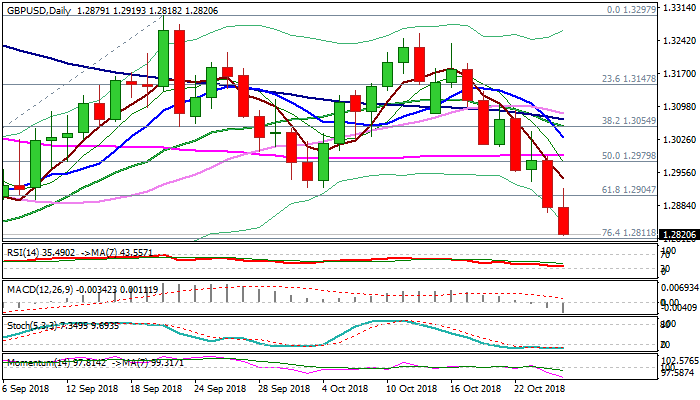
Cable accelerated to new seven-week low after broader bears ended narrow recovery during Asian/European trading, with fresh weakness of Euro, pulling sterling lower. Also, the greenback was higher across the board on strong Wall St start on Thursday, adding to negative tone. The pair holds in strong bearish mode and is on track for the second strong bearish daily performance. Fresh weakness approaches targets at 1.2811 (Fibo 76.4% of 1.2661/1.3297) and 1.2785 (05 Sep trough), violation of which would open way towards key support at 1.2661 (15 Aug low). Uncertainty over Brexit talks which stalled last week, maintains strong bearish pressure, along with bearish daily/weekly techs, with the pair being on track for the biggest weekly fall since the first week of August.
Res: 1.2904; 1.2921; 1.2941; 1.2992
Sup: 1.2811; 1.2785; 1.2729; 1.2697
ECB Review: Steady Draghi Amid Disappointing Data
- The ECB did not formally announce an end to the APP by the end of the year. There were no questions at the press conference on the first rate hike.
- The strong forward guidance of 'rates remain at present levels at least through the summer of 2019' remains.
- Markets moved mainly sideways during the press conference. The next ECB meeting on 13 December 2018 is likely to lead to a significant market reaction, as significant decisions have to be taken.
Politics getting in the way
ECB President Mario Draghi provided some interesting assessment during the press conference. He acknowledged that recent incoming data has been weaker than expected but tried to soften this by putting it into the context of growth returning to potential from the elevated levels last year and some country-specific/transitory factors affecting momentum in Q3. We see scope for a political will to end QE here playing into the assessment and acknowledging downside risks would probably complicate the policy change communication. The same downside risks were mentioned as last time – financial markets, emerging markets and protectionism – but overall the ECB still sees the growth risks as broadly balanced and, therefore, it is still on track to end the QE programme by the end of this year.
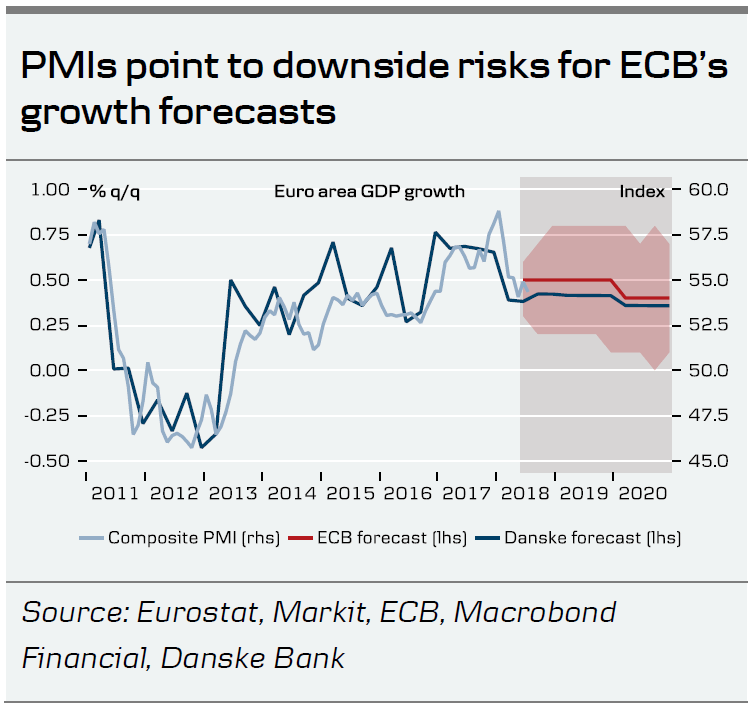
The ECB's language on the assessment of the inflation outlook remains broadly unchanged. The ECB still draws strong confidence from rising negotiated wages (meaning that wage increases are of a more permanent nature), a tightening labour market and high capacity utilisation. Interestingly, the statement left out the part regarding 'receding uncertainty around the inflation outlook', which on balance could be interpreted as a dovish signal in light of recent core inflation misses.
Regarding Italy, Draghi stressed that it is so far more a fiscal discussion, rather than one of economic policy. He expressed confidence that an agreement will be found but cautioned that Italian interest and lending rates for households and firms have gone up and credit standards have tightened somewhat, meaning that the room to expand the budget as the government plans is getting smaller.
Draghi also refrained from giving any indication on the capital key update but tried to downplay the importance. We beg to disagree, as this matters for the reinvestment strategy.
The December meeting will be a very interesting one, where the ECB will formally end QE, outlining the reinvestment strategy including the capital key, update of staff projections (which may contain a downward revision to 2018 growth projection) and the inflation assessment, particularly if downside misses persist.
Markets
FX: distant hikes keep EUR/USD heading for 2018 lows
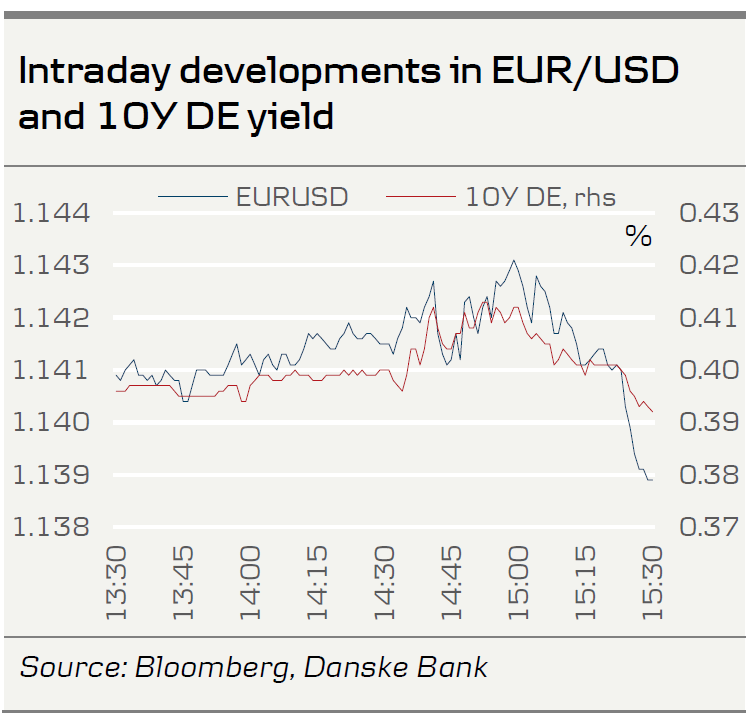
Even though the ECB refrained from introducing downside growth risks and maintained its relatively upbeat stance on inflation (both possible sources of EUR support), the EUR reaction was minimal and any initial support quickly faded with EUR/USD settling below 1.1450. In our view, today's message underlines that it is still far too early for the ECB 'normalisation' path to provide more broad-based support to the single currency: we are simply too far away from the point in time when rates could possibly be raised for the FX market to care. Currently, the ECB is focused solely on ending QE and notably the lag to when rates will be lifted is both long and variable. That is there may be a political will to end QE but the ability to start hiking rates, which is the key to the FX-market reaction, remains distant. Further, the potential to start an outright hiking cycle may be questioned. Meanwhile, the carry lure of USD is helping keep USD bid despite the greenback's somewhat wobbly safe-haven properties during the recent risk sell-off. In addition, Italy remains a factor placing a lid on EUR rather than a significant negative factor at this stage. Thus, we see EUR/USD heading for a test of the 2018 lows (support at 1.1301, 15 August low) and more broadly to be range bound around 1.15 ahead of year-end.
Fixed income: more range trading to come
Fixed income markets traded mostly sideways (10Y Bund within 2bp range), with no news (as expected) on the end of QE, the reinvestment strategy and capital key discussions. We believe the 10Y Bund will continue to stay range bound and see very limited risk of a taper tantrum on the back of a formal decision to end QE.