

Sample Category Title
EUR/USD Mid-Day Outlook
Daily Pivots: (S1) 1.1356; (P) 1.1416; (R1) 1.1454; More....
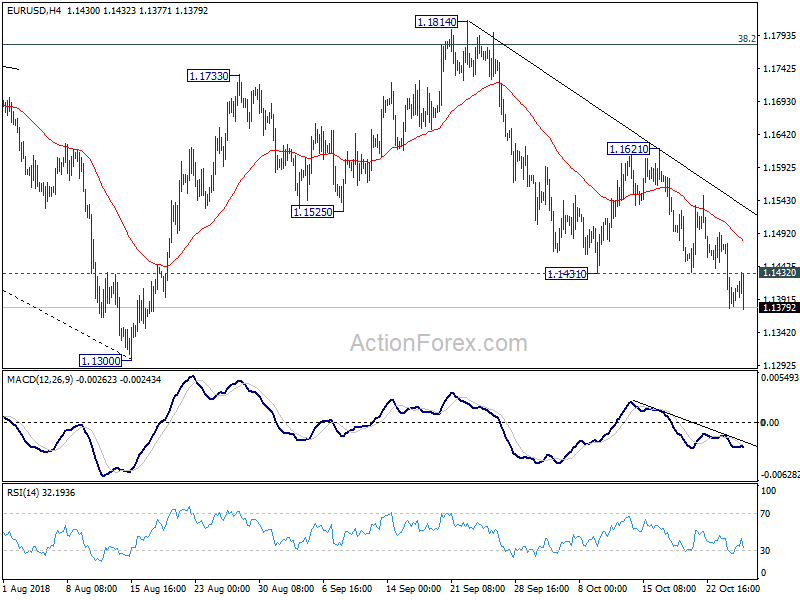
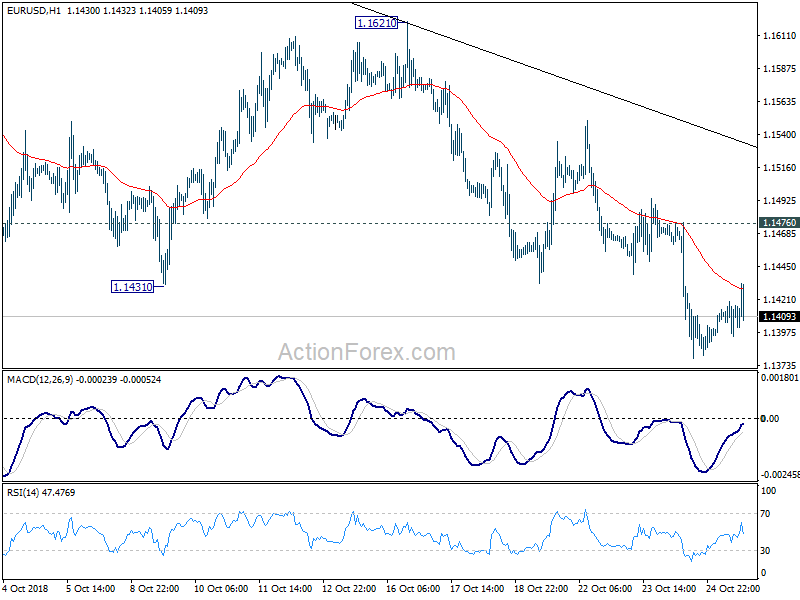
EUR/USD recovers after hitting 1.1378 but quickly lost steam. Intraday bias stays on the downside at this point. Current fall from 1.1814 should extend to retest 1.1300 low. Decisive break there will resume whole down trend from 1.2555. On the upside, above 1.1432 minor resistance will turn intraday bias neutral first. But outlook will remain cautiously bearish as long as 1.1621 resistance holds.
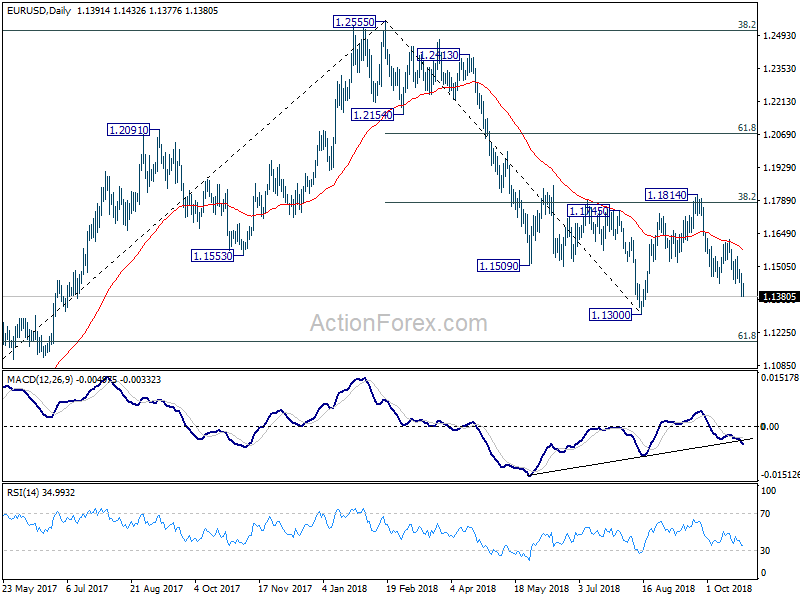
In the bigger picture, corrective pattern from 1.1300 could have completed at 1.1814 after hitting 38.2% retracement of 1.2555 to 1.1300 at 1.1779. Decisive break of 1.1300 will resume the down trend from 1.2555 to 61.8% retracement of 1.0339 (2017 low) to 1.2555 at 1.1186 next. Sustained break there will pave the way to retest 1.0339. On the upside, break of 1.1814 will delay the bearish case and extend the correction from 1.1300 with another rise before completion.
Euro Recovers Briefly on Confident ECB Draghi, But Strength Fades Quickly
Euro enjoys a brief recovery after ECB stands pat on monetary. ECB President Mario Draghi expressed his confidence on inflation outlook due to underlying strength of the economy. But together with other European majors, the common currency is quickly under selling pressure again. Dollar is trading to rally in early US session but stays overwhelmed by Australian and New Zealand Dollar, which are the strongest. Swiss Franc and Canadian are the weakest ones for the moment.
Technically, one development to note is that strong rebound in USD/CAD today. And the focus is back on 1.3132 resistance for the pair. AUD/USD has been very resilient so far despite risk aversion. Nonetheless, it's equally sluggish in rally attempt. We'd expect more downside in AUD/USD to 0.7040 should Dollar takes back the stage.
In other markets, European stocks are mixed for the moment. FTSE is trading down -0.34%, DAX is down -0.08% but CAC is up 0.89%. German 10 year yield is flip-flopping around 0.4 handle. Italian 10 year yield, though is down slightly by -0.115 at 3.502. German-Italian yield spread is below Italian Economy Minister Giovanni Tria's 320 unsustainable level, but still well above 300.
Earlier in Asia, Nikkei closed sharply lower by -822.45 pts or -3.72% to 21268.73. Hong Kong HSI lost -1.01% and Singapore Strait Times dropped -0.63%. But China Shanghai SSE staged late rebound to close "up" 0.02% at 2603.80, even reclaimed 2600 handle. On development to note is that Japanese 10 year JGB yield dropped for another day by -0.0206 to 0.114. It was above 0.15 just a few days ago. But such decline should be welcomed by BoJ, which set the allowed range for 10 year JGB yield to be -0.1 to 0.1%.
ECB stands pat as widely expected, Draghi confident on inflation outlook
ECB left main refinancing rate unchanged at 0.00% as widely expected. Marginal lending rate and deposit rate were held at 0.25% and -0.40% respectively. It also reiterated that interest rates will "remain at their present levels at least through the summer of 2019". ECB also sticks with the plan to end the EUR 15B per month asset purchase after December.
In the post meeting press conference, ECB President Mario Draghi said "incoming information, while somewhat weaker than expected, remains overall consistent with an ongoing broad-based expansion of the euro area economy and gradually rising inflation pressures." Also, "the underlying strength of the economy continues to support our confidence that the sustained convergence of inflation to our aim will proceed and will be maintained even after a gradual winding down of our net asset purchases."
On inflation, Draghi noted while underlying inflation remains muted, they have been increasing from earlier lows. And underlying inflation is expected to increase further over the medium term. For now, Draghi iterated that significant amount of monetary policy stimulus is still needed to support buildup of price pressure. On growth, Draghi said risks can still be assessed as "broadly balanced". Main prominent downside risks include trade protectionism, emerging markets and financial market volatility.
Overall Draghi's press conference is composed as usual. EUR/USD recovers mildly but there is no change in it's near term bearish outlook.
German Ifo dropped to 102.8, global uncertainty increasingly taking its toll
German Ifo business climate dropped to 102.8 in October, down from 103.7, below expectation of 103.2. Current assessment gauge dropped to 105.9, down from 106.4 and missed expectation of 106.0. Expectations gauge dropped to 99.8, down from 101 and missed consensus of 100.3. Manufacturing, services and trade indices record decline in the month, but construction hit another record high.
Ifo president Clemens Fuest noted in the release that "firms were less satisfied with their current business situation and less optimistic about the months ahead. Growing global uncertainty is increasingly taking its toll on the German economy."
Italy Di Maio: Markets not concerned with budget, but false storytelling of Euro exit
Italian Deputy Prime Minister, leader of the Five-Star Movement, Luigi Di Maio reiterates today the government will not change its 2019 budget deficit target of 2.4% despite rejection by the European Commission. He added, "in the following weeks we'll discuss our budget with the European Union and it will be possible to read out the details of our fiscal plan."
He also tried to play down recent surge in German-Italian spread, which is a serious sign of investor nervousness. Di Maio said "Markets are not concerned about Italy not respecting the EU budget rules. Investors are worried about false storytelling according to which Italy wants to leave the euro and the European Union. That is not the case."
US jobless claims rose to 215k, core durable orders missed
US initial jobless claims rose 5k to 215k in the week ended October 20, above expectation of 208K. Four-week moving average of initial claims was unchanged at 211.75k. Continuing claims dropped -5k to 1.636m in the week ended October 13, lowest since August 4, 1973. Four-week moving average of continuing claims dropped -6.75k to 1.6465m, lowest since August 11, 1973.
Also from the US, trade deficit widened to USD -76.0B in September. Headline durable goods orders rose 0.8% September, above expectation of -1.1%. But ex-transport orders rose 0.1%, below expectation of 0.3%. Wholesale inventories rose 0.3% mom in September.
Fed's Beige Book: Tariffs getting more attentions from businesses
Fed's Beige Book economic report, released yesterday, warned that "manufacturers reported raising prices of finished goods out of necessity." Such price hikes were attributed to higher raw materials costs "which they attributed to tariffs." Though, overall inflation pressure were just "modest-to-moderate" in all districts. In the 32-page report, the word "tariff" or its derivations were mentioned a total of 51 times. And, with the exception of St. Louis, all districts made reference to tariffs one way or the other. That's quite a sharp jump from 42 times in September.
For example, In Dallas, it's noted that "among manufacturers, roughly 60 percent of contacts said the tariffs announced and/or implemented this year have resulted in increased input costs. The share was even higher among retailers, at 70 percent." In Minneapolis, "a producer of dry beans reported that a large regular annual order from European Union countries was canceled due to tariffs." In Philadelphia, "other firms reported difficulty meeting the prices of foreign competitors who are not exposed to tariffs on the primary input commodities of their products."
EUR/USD Mid-Day Outlook
Daily Pivots: (S1) 1.1356; (P) 1.1416; (R1) 1.1454; More....
EUR/USD recovers after hitting 1.1378 but quickly lost steam. Intraday bias stays on the downside at this point. Current fall from 1.1814 should extend to retest 1.1300 low. Decisive break there will resume whole down trend from 1.2555. On the upside, above 1.1432 minor resistance will turn intraday bias neutral first. But outlook will remain cautiously bearish as long as 1.1621 resistance holds.
In the bigger picture, corrective pattern from 1.1300 could have completed at 1.1814 after hitting 38.2% retracement of 1.2555 to 1.1300 at 1.1779. Decisive break of 1.1300 will resume the down trend from 1.2555 to 61.8% retracement of 1.0339 (2017 low) to 1.2555 at 1.1186 next. Sustained break there will pave the way to retest 1.0339. On the upside, break of 1.1814 will delay the bearish case and extend the correction from 1.1300 with another rise before completion.
Economic Indicators Update
| GMT | Ccy | Events | Actual | Forecast | Previous | Revised |
|---|---|---|---|---|---|---|
| 21:45 | NZD | Trade Balance Sep | -1560M | -1365M | -1484M | -1470M |
| 23:50 | JPY | Corporate Service Price Y/Y Sep | 1.20% | 1.20% | 1.30% | |
| 08:00 | EUR | German IFO Business Climate Oct | 102.8 | 103.2 | 103.7 | |
| 08:00 | EUR | German IFO Current Assessment Oct | 105.9 | 106 | 106.4 | 106.6 |
| 08:00 | EUR | German IFO Expectations Oct | 99.8 | 100.3 | 101 | 100.9 |
| 11:45 | EUR | ECB Rate Decision | 0.00% | 0.00% | 0.00% | |
| 12:30 | EUR | ECB Press Conference | ||||
| 12:30 | USD | Advance Goods Trade Balance Sep | -76.0B | -74.9B | -75.5B | |
| 12:30 | USD | Durable Goods Orders Sep P | 0.80% | -1.10% | 4.40% | |
| 12:30 | USD | Durables Ex Transportation Sep P | 0.10% | 0.30% | 0.00% | |
| 12:30 | USD | Wholesale Inventories M/M Sep P | 0.30% | 0.50% | 1.00% | |
| 12:30 | USD | Initial Jobless Claims (OCT 20) | 215K | 208K | 210K | |
| 14:00 | USD | Pending Home Sales M/M Sep | -0.20% | -1.80% | ||
| 14:30 | USD | Natural Gas Storage | 47B | 81B |
ECB Draghi confident on inflation outlook with underlying economic strength
ECB left main refinancing rate unchanged at 0.00% as widely expected. Marginal lending rate and deposit rate were held at 0.25% and -0.40% respectively. It also reiterated that interest rates will "remain at their present levels at least through the summer of 2019". ECB also sticks with the plan to end the EUR 15B per month asset purchase after December.
In the post meeting press conference, ECB President Mario Draghi said "incoming information, while somewhat weaker than expected, remains overall consistent with an ongoing broad-based expansion of the euro area economy and gradually rising inflation pressures." Also, "the underlying strength of the economy continues to support our confidence that the sustained convergence of inflation to our aim will proceed and will be maintained even after a gradual winding down of our net asset purchases."
On inflation, Draghi noted while underlying inflation remains muted, they have been increasing from earlier lows. And underlying inflation is expected to increase further over the medium term. For now, Draghi iterated that significant amount of monetary policy stimulus is still needed to support buildup of price pressure. On growth, Draghi said risks can still be assessed as "broadly balanced". Main prominent downside risks include trade protectionism, emerging markets and financial market volatility.
Overall Draghi's press conference is composed as usual. EUR/USD recovers mildly but there is no change in it's near term bearish outlook.
US 500 Index Steadies after Strong Tumble Below Uptrend Line; Records 6-month Low
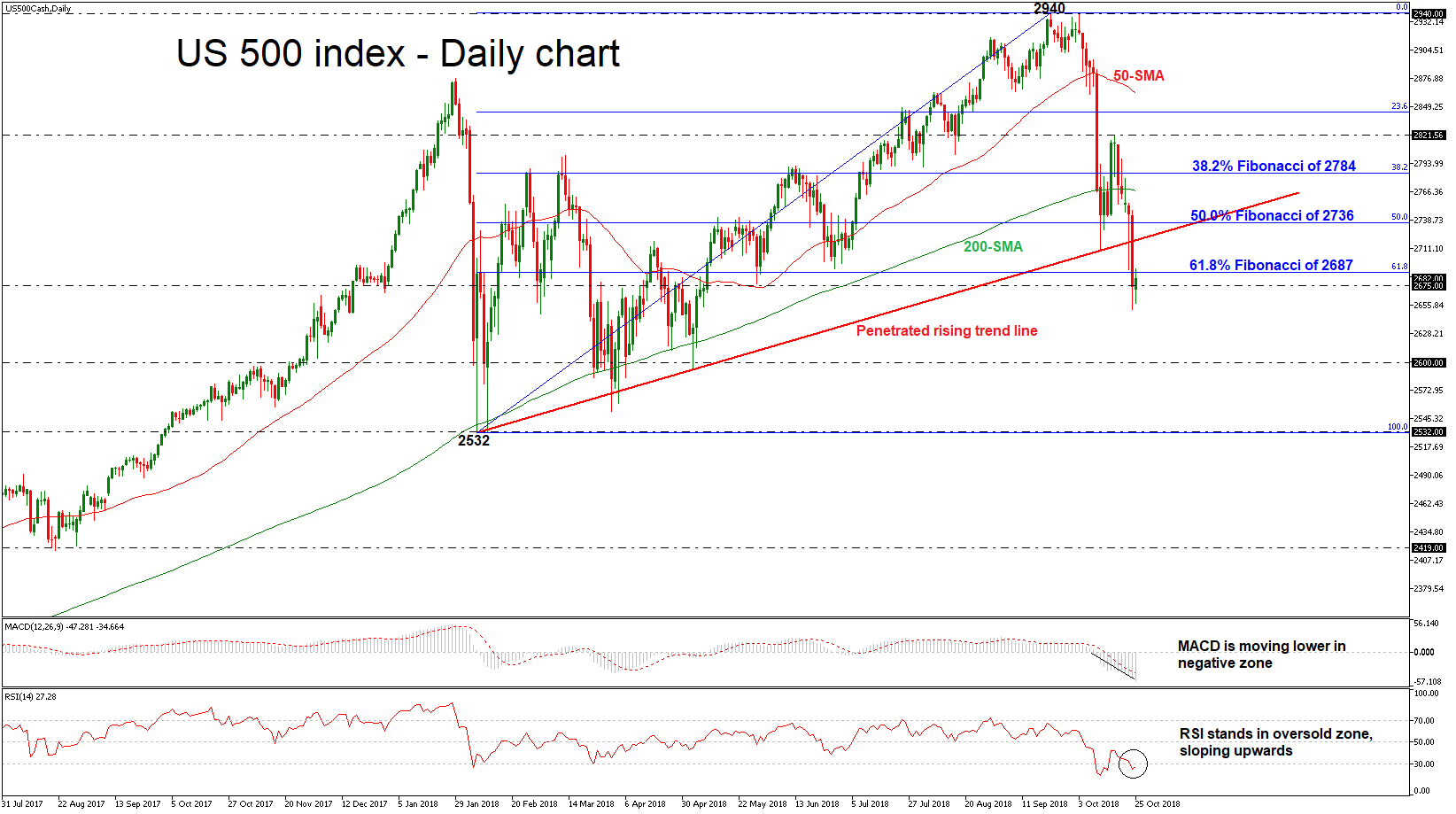
The US 500 index has come under renewed selling pressure falling back below its 200-day simple moving average (SMA) and beneath the long-term ascending trend line. Despite today’s rebound, the index has posted a fresh lower low, which makes traders more confident for further declines for now. Moreover, the price dipped below the Fibonacci levels, erasing the scenario for a possible bearish correction rally and confirming the negative outlook.
Looking at momentum oscillators in the daily chart though, they suggest further declines may be on the cards in the short-term. The RSI is below the threshold of 30 but pointing slightly upwards, indicating an overstretched sell-off. The MACD, already negative, lies below its trigger and zero lines.
In the negative scenario, where the price continues to slip below yesterday’s almost six-month low of 2651, the next strong hurdle to focus on is the 2600 handle, achieved on May 3. If the market manages to penetrate that area, traders could look for support at 2532, taken from the trough on February 6.
A reversal to the upside could stall at the 61.8% Fibonacci retracement level of the upleg from 2535 to 2940, around 2687. Higher up, the 50.0% Fibonacci of 2736 could also provide resistance and any violation at this point could potentially trigger further buying interest in the market, probably leading the price up to the 38.2% Fibonacci of 2784.
To sum up, the short-term bias is bearish after the significant sell-off on Wednesday and the tumble below the ascending trend line, which had been standing since February 6. However, the medium-term outlook looks neutral at the moment.
(ECB) Introductory Statement to the Press Conference
Mario Draghi, President of the ECB,
Luis de Guindos, Vice-President of the ECB,
Frankfurt am Main, 25 October 2018
INTRODUCTORY STATEMENT
Ladies and gentlemen, the Vice-President and I are very pleased to welcome you to our press conference. We will now report on the outcome of today's meeting of the Governing Council, which was also attended by the Commission Vice-President, Mr Dombrovskis.
Based on our regular economic and monetary analyses, we decided to keep the key ECB interest rates unchanged. We continue to expect them to remain at their present levels at least through the summer of 2019, and in any case for as long as necessary to ensure the continued sustained convergence of inflation to levels that are below, but close to, 2% over the medium term.
Regarding non-standard monetary policy measures, we will continue to make net purchases under the asset purchase programme (APP) at the new monthly pace of €15 billion until the end of December 2018. We anticipate that, subject to incoming data confirming our medium-term inflation outlook, we will then end net purchases. We intend to reinvest the principal payments from maturing securities purchased under the APP for an extended period of time after the end of our net asset purchases, and in any case for as long as necessary to maintain favourable liquidity conditions and an ample degree of monetary accommodation.
Incoming information, while somewhat weaker than expected, remains overall consistent with an ongoing broad-based expansion of the euro area economy and gradually rising inflation pressures. The underlying strength of the economy continues to support our confidence that the sustained convergence of inflation to our aim will proceed and will be maintained even after a gradual winding-down of our net asset purchases. At the same time, uncertainties relating to protectionism, vulnerabilities in emerging markets and financial market volatility remain prominent. Significant monetary policy stimulus is still needed to support the further build-up of domestic price pressures and headline inflation developments over the medium term. This support will continue to be provided by the net asset purchases until the end of the year, by the sizeable stock of acquired assets and the associated reinvestments, and by our enhanced forward guidance on the key ECB interest rates. In any event, the Governing Council stands ready to adjust all of its instruments as appropriate to ensure that inflation continues to move towards the Governing Council's inflation aim in a sustained manner.
Let me now explain our assessment in greater detail, starting with the economic analysis. Euro area real GDP increased by 0.4%, quarter on quarter, in both the first and the second quarter of 2018. Incoming information, while somewhat weaker than expected, remains overall consistent with our baseline scenario of an ongoing broad-based economic expansion, supported by domestic demand and continued improvements in the labour market. Some recent sector-specific developments are having an impact on the near-term growth profile. Our monetary policy measures continue to underpin domestic demand. Private consumption is fostered by ongoing employment growth and rising wages. At the same time, business investment is supported by solid domestic demand, favourable financing conditions and corporate profitability. Housing investment remains robust. In addition, the expansion in global activity is expected to continue supporting euro area exports, though at a slower pace.
The risks surrounding the euro area growth outlook can still be assessed as broadly balanced. At the same time, risks relating to protectionism, vulnerabilities in emerging markets and financial market volatility remain prominent.
Euro area annual HICP inflation increased to 2.1% in September 2018, from 2.0% in August, reflecting mainly higher energy and food price inflation. On the basis of current futures prices for oil, annual rates of headline inflation are likely to hover around the current level over the coming months. While measures of underlying inflation remain generally muted, they have been increasing from earlier lows. Domestic cost pressures are strengthening and broadening amid high levels of capacity utilisation and tightening labour markets. Looking ahead, underlying inflation is expected to pick up towards the end of the year and to increase further over the medium term, supported by our monetary policy measures, the ongoing economic expansion and rising wage growth.
Turning to the monetary analysis, broad money (M3) growth stood at 3.5% in September 2018, after 3.4% in August. Apart from some volatility in monthly flows, M3 growth is increasingly supported by bank credit creation. The narrow monetary aggregate M1 remained the main contributor to broad money growth.
The growth of loans to the private sector strengthened further, continuing the upward trend observed since the beginning of 2014. The annual growth rate of loans to non-financial corporations rose to 4.3% in September 2018, from 4.1% in August, while the annual growth rate of loans to households stood at 3.1%, unchanged from the previous month. The euro area bank lending survey for the third quarter of 2018 indicates that loan growth continues to be supported by increasing demand across all loan categories and favorable bank lending conditions for loans to enterprises and loans for house purchase.
The pass-through of the monetary policy measures put in place since June 2014 continues to significantly support borrowing conditions for firms and households, access to financing – in particular for small and medium-sized enterprises – and credit flows across the euro area.
To sum up, a cross-check of the outcome of the economic analysis with the signals coming from the monetary analysis confirmed that an ample degree of monetary accommodation is still necessary for the continued sustained convergence of inflation to levels that are below, but close to, 2% over the medium term.
In order to reap the full benefits from our monetary policy measures, other policy areas must contribute more decisively to raising the longer-term growth potential and reducing vulnerabilities. The implementation of structural reforms in euro area countries needs to be substantially stepped up to increase resilience, reduce structural unemployment and boost euro area productivity and growth potential. Regarding fiscal policies, the broad-based expansion calls for rebuilding fiscal buffers. This is particularly important in countries where government debt is high and for which full adherence to the Stability and Growth Pact is critical for safeguarding sound fiscal positions. Likewise, the transparent and consistent implementation of the EU's fiscal and economic governance framework over time and across countries remains essential to bolster the resilience of the euro area economy. Improving the functioning of Economic and Monetary Union remains a priority. The Governing Council urges specific and decisive steps to complete the banking union and the capital markets union.
We are now at your disposal for questions.
US jobless claims rose to 215k, core durable orders missed
US initial jobless claims rose 5k to 215k in the week ended October 20, above expectation of 208K. Four-week moving average of initial claims was unchanged at 211.75k. Continuing claims dropped -5k to 1.636m in the week ended October 13, lowest since August 4, 1973. Four-week moving average of continuing claims dropped -6.75k to 1.6465m, lowest since August 11, 1973.
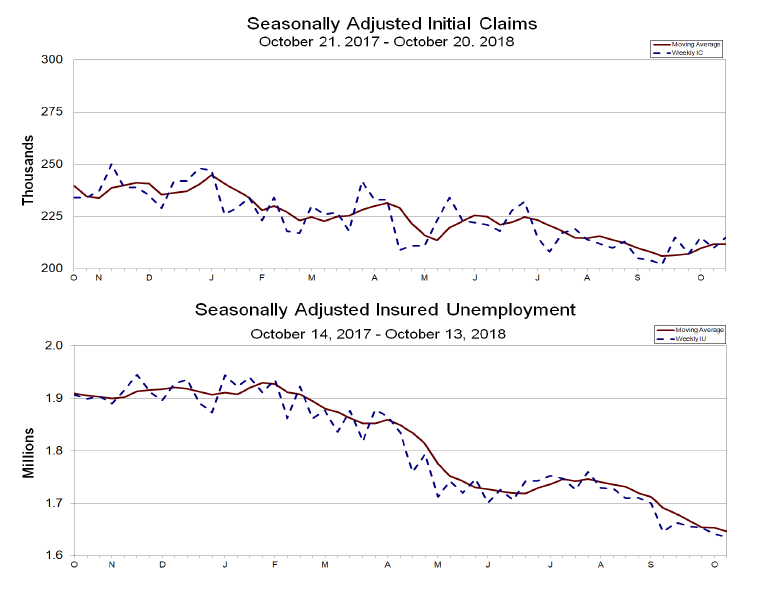
Also from the US, trade deficit widened to USD -76.0B in September. Headline durable goods orders rose 0.8% September, above expectation of -1.1%. But ex-transport orders rose 0.1%, below expectation of 0.3%. Wholesale inventories rose 0.3% mom in September.
Dollar has little reaction to the batch of data overall.
ECB press conference live stream, starting in a few minutes
ECB press conference live stream, starting in a few minutes
https://www.youtube.com/watch?v=I57EGZriMlE
Draghi's statement.
INTRODUCTORY STATEMENT
Ladies and gentlemen, the Vice-President and I are very pleased to welcome you to our press conference. We will now report on the outcome of today's meeting of the Governing Council, which was also attended by the Commission Vice-President, Mr Dombrovskis.
Based on our regular economic and monetary analyses, we decided to keep the key ECB interest rates unchanged. We continue to expect them to remain at their present levels at least through the summer of 2019, and in any case for as long as necessary to ensure the continued sustained convergence of inflation to levels that are below, but close to, 2% over the medium term.
Regarding non-standard monetary policy measures, we will continue to make net purchases under the asset purchase programme (APP) at the new monthly pace of €15 billion until the end of December 2018. We anticipate that, subject to incoming data confirming our medium-term inflation outlook, we will then end net purchases. We intend to reinvest the principal payments from maturing securities purchased under the APP for an extended period of time after the end of our net asset purchases, and in any case for as long as necessary to maintain favourable liquidity conditions and an ample degree of monetary accommodation.
Incoming information, while somewhat weaker than expected, remains overall consistent with an ongoing broad-based expansion of the euro area economy and gradually rising inflation pressures. The underlying strength of the economy continues to support our confidence that the sustained convergence of inflation to our aim will proceed and will be maintained even after a gradual winding-down of our net asset purchases. At the same time, uncertainties relating to protectionism, vulnerabilities in emerging markets and financial market volatility remain prominent. Significant monetary policy stimulus is still needed to support the further build-up of domestic price pressures and headline inflation developments over the medium term. This support will continue to be provided by the net asset purchases until the end of the year, by the sizeable stock of acquired assets and the associated reinvestments, and by our enhanced forward guidance on the key ECB interest rates. In any event, the Governing Council stands ready to adjust all of its instruments as appropriate to ensure that inflation continues to move towards the Governing Council's inflation aim in a sustained manner.
Let me now explain our assessment in greater detail, starting with the economic analysis. Euro area real GDP increased by 0.4%, quarter on quarter, in both the first and the second quarter of 2018. Incoming information, while somewhat weaker than expected, remains overall consistent with our baseline scenario of an ongoing broad-based economic expansion, supported by domestic demand and continued improvements in the labour market. Some recent sector-specific developments are having an impact on the near-term growth profile. Our monetary policy measures continue to underpin domestic demand. Private consumption is fostered by ongoing employment growth and rising wages. At the same time, business investment is supported by solid domestic demand, favourable financing conditions and corporate profitability. Housing investment remains robust. In addition, the expansion in global activity is expected to continue supporting euro area exports, though at a slower pace.
The risks surrounding the euro area growth outlook can still be assessed as broadly balanced. At the same time, risks relating to protectionism, vulnerabilities in emerging markets and financial market volatility remain prominent.
Euro area annual HICP inflation increased to 2.1% in September 2018, from 2.0% in August, reflecting mainly higher energy and food price inflation. On the basis of current futures prices for oil, annual rates of headline inflation are likely to hover around the current level over the coming months. While measures of underlying inflation remain generally muted, they have been increasing from earlier lows. Domestic cost pressures are strengthening and broadening amid high levels of capacity utilisation and tightening labour markets. Looking ahead, underlying inflation is expected to pick up towards the end of the year and to increase further over the medium term, supported by our monetary policy measures, the ongoing economic expansion and rising wage growth.
Turning to the monetary analysis, broad money (M3) growth stood at 3.5% in September 2018, after 3.4% in August. Apart from some volatility in monthly flows, M3 growth is increasingly supported by bank credit creation. The narrow monetary aggregate M1 remained the main contributor to broad money growth.
The growth of loans to the private sector strengthened further, continuing the upward trend observed since the beginning of 2014. The annual growth rate of loans to non-financial corporations rose to 4.3% in September 2018, from 4.1% in August, while the annual growth rate of loans to households stood at 3.1%, unchanged from the previous month. The euro area bank lending survey for the third quarter of 2018 indicates that loan growth continues to be supported by increasing demand across all loan categories and favorable bank lending conditions for loans to enterprises and loans for house purchase.
The pass-through of the monetary policy measures put in place since June 2014 continues to significantly support borrowing conditions for firms and households, access to financing – in particular for small and medium-sized enterprises – and credit flows across the euro area.
To sum up, a cross-check of the outcome of the economic analysis with the signals coming from the monetary analysis confirmed that an ample degree of monetary accommodation is still necessary for the continued sustained convergence of inflation to levels that are below, but close to, 2% over the medium term.
In order to reap the full benefits from our monetary policy measures, other policy areas must contribute more decisively to raising the longer-term growth potential and reducing vulnerabilities. The implementation of structural reforms in euro area countries needs to be substantially stepped up to increase resilience, reduce structural unemployment and boost euro area productivity and growth potential. Regarding fiscal policies, the broad-based expansion calls for rebuilding fiscal buffers. This is particularly important in countries where government debt is high and for which full adherence to the Stability and Growth Pact is critical for safeguarding sound fiscal positions. Likewise, the transparent and consistent implementation of the EU's fiscal and economic governance framework over time and across countries remains essential to bolster the resilience of the euro area economy. Improving the functioning of Economic and Monetary Union remains a priority. The Governing Council urges specific and decisive steps to complete the banking union and the capital markets union.
We are now at your disposal for questions.
Canadian Dollar Edges Higher as BoC Raises Rates, U.S. Durable Goods Orders Next
The Canadian dollar has ticked higher in the Thursday session. Currently, USD/CAD is trading at 1.3043, down 0.10% on the day. On the release front, there are no Canadian events. In the U.S, the markets are braced for mixed news from durable good orders. Core durable goods orders are expected to improve to 0.5%, while durable goods orders are forecast to plunge to -1.3%, after a strong gain of 4.5% in the previous release. Unemployment claims are expected to rise to 214 thousand. On Friday, Germany releases GfK Consumer Climate and the U.S publishes Advance GDP and UoM Consumer Sentiment.
As widely expected, the BoC raised the benchmark rate by a quarter-point, to 1.75%. The BoC gave the economy high marks, while at the same time noting that lower oil prices and the U.S-China trade dispute could dampen economic growth. BoC Deputy Governor Carolyn Wilkins noted that even with the increase, rate policy remains “accommodative”, as the “neutral rate” stance won’t be reached until rates are between 2.5% and 3.5%. As the move was priced in, the Canadian dollar could only muster slight gains on Wednesday. Still, the currency has posted modest gains this week, after recording three straight weekly losses. Geopolitical hotspots continue to weigh on investor risk appetite, which has weighed on the Canadian dollar, a minor currency. Trouble spots include the spike in Italian bond yields, the Brexit impasse and the U.S-China trade war.
Into US session: Australian Dollar strong as Chinese stocks closed up, Swiss Franc weakest
Entering into US session, Euro is mixed after ECB left monetary policy unchanged as widely expected. Focus will turn to President Mario Draghi's press conference. But other than comments regarding Italy, there shouldn't be anything that could move markets much.
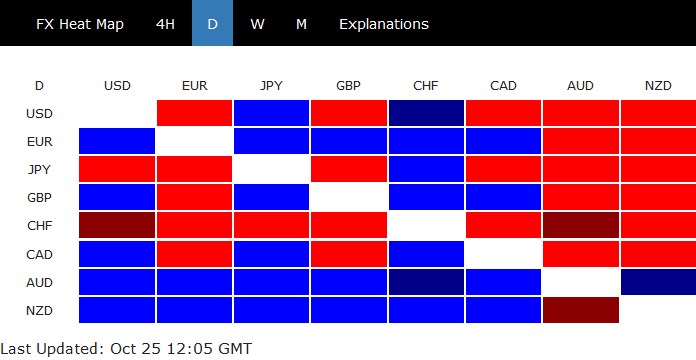 For now, Australian Dollar is trading as the strongest one for today. The late rebound in Chinese stocks is a factor that's supporting the Aussie. Indeed, while it's all red in Asia, the Shanghai SSE composite closed up 0.02% at 2603.80, even defended 2600 handle. Swiss Franc is the weakest one. We've noticed that recently, the Franc has been much more sensitive to emerging markets than Eurozone or EU. And, today's decline in USD/TRY is possibly a factor dragging down the Franc.
In Europe, at the time of writing:
- FTSE is down -0.12 at 6955
- DAX is up 0.25% at 11219
- CAC is up 1.13% at 5009
- German 10 year yield is up 0.0032, just above 0.4 at 0.401
- Italian 10 year yield is down -0.1032 at 3.514. German-Italian spread is below 320, an unsustainable level to Tria, but still way above 300.
Earlier in Asia:
- Nikkei dropped sharply by -3.72% or -822.45 pts to 21268.73
- Hong Kong HSI closed down -1.01 at 24944.46
- China Shanghai SSE "rose" 0.02% to 2603.80
- Singapore Strait Times dropped -0.63% to 3012.84.
- 10 year JGB yield dropped -0.0206 to 0.114. It was above 0.15 just a few days ago. But BoJ might like to see it moving closing back to it's allowed back of -0.1 to 0.1%.
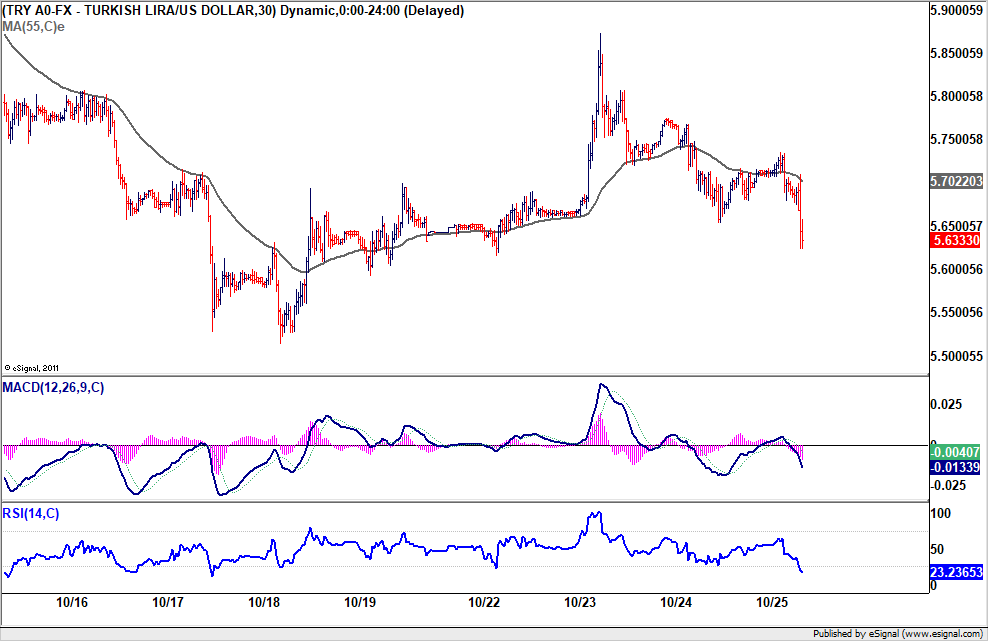
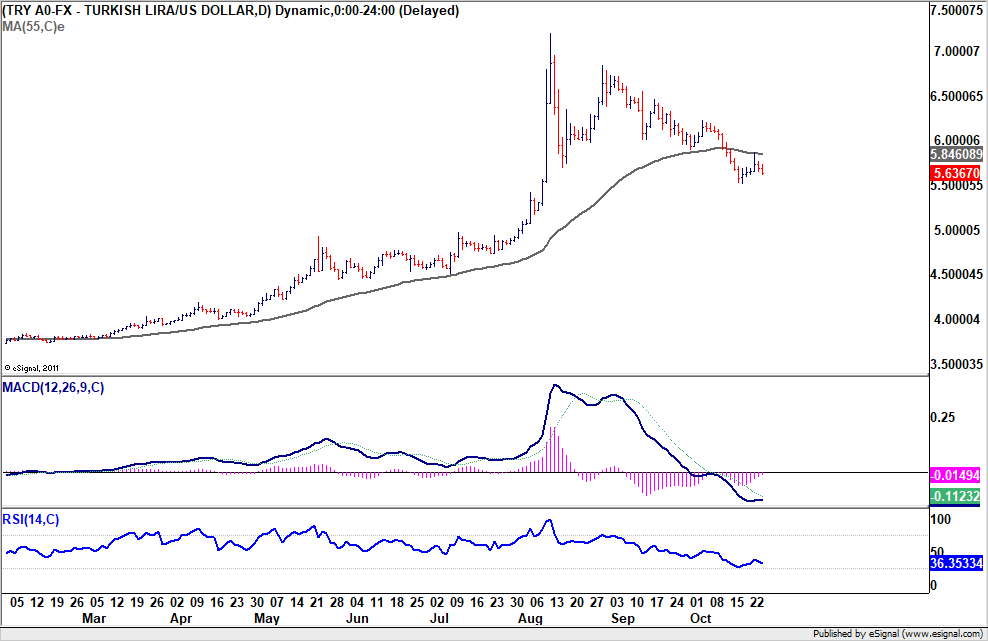
USD/TRY is currently down 09.75% at 5.64. The recovery since last week could have completed after hitting 55 day EMA.
(ECB) Monetary Policy Decisions
At today's meeting the Governing Council of the European Central Bank (ECB) decided that the interest rate on the main refinancing operations and the interest rates on the marginal lending facility and the deposit facility will remain unchanged at 0.00%, 0.25% and -0.40% respectively. The Governing Council expects the key ECB interest rates to remain at their present levels at least through the summer of 2019, and in any case for as long as necessary to ensure the continued sustained convergence of inflation to levels that are below, but close to, 2% over the medium term.
Regarding non-standard monetary policy measures, the Governing Council will continue to make net purchases under the asset purchase programme (APP) at the new monthly pace of €15 billion until the end of December 2018. The Governing Council anticipates that, subject to incoming data confirming the medium-term inflation outlook, net purchases will then end. The Governing Council intends to reinvest the principal payments from maturing securities purchased under the APP for an extended period of time after the end of the net asset purchases, and in any case for as long as necessary to maintain favourable liquidity conditions and an ample degree of monetary accommodation.
The President of the ECB will comment on the considerations underlying these decisions at a press conference starting at 14:30 CET today.