Sample Category Title
EUR/GBP Daily Outlook
Daily Pivots: (S1) 0.8842; (P) 0.8863; (R1) 0.8894; More...
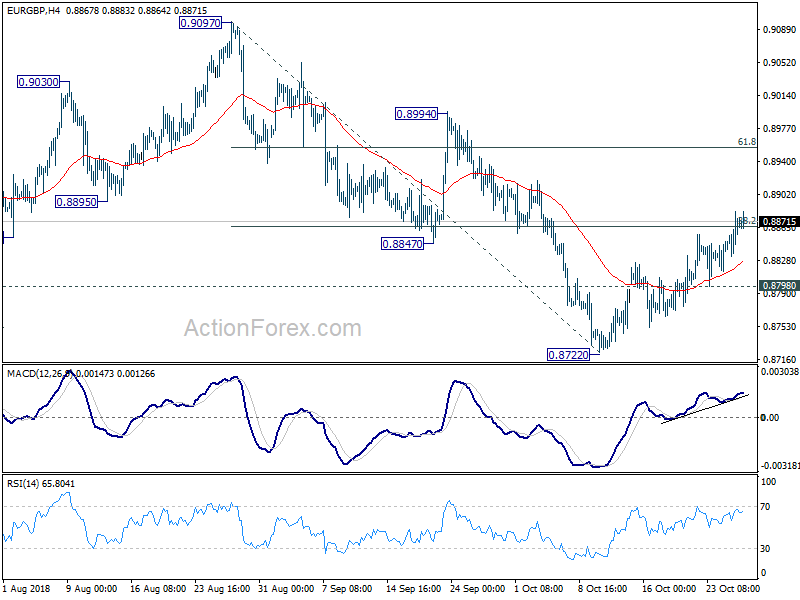
EUR/GBP's corrective rebound from 0.8722 is still in progress. Intraday bias stays on the upside for 61.8% retracement of 0.9097 to 0.8722 at 0.8954 and above. On the downside, break of 0.8798 minor support will turn bias back to the downside for 0.8722 and possibly below.
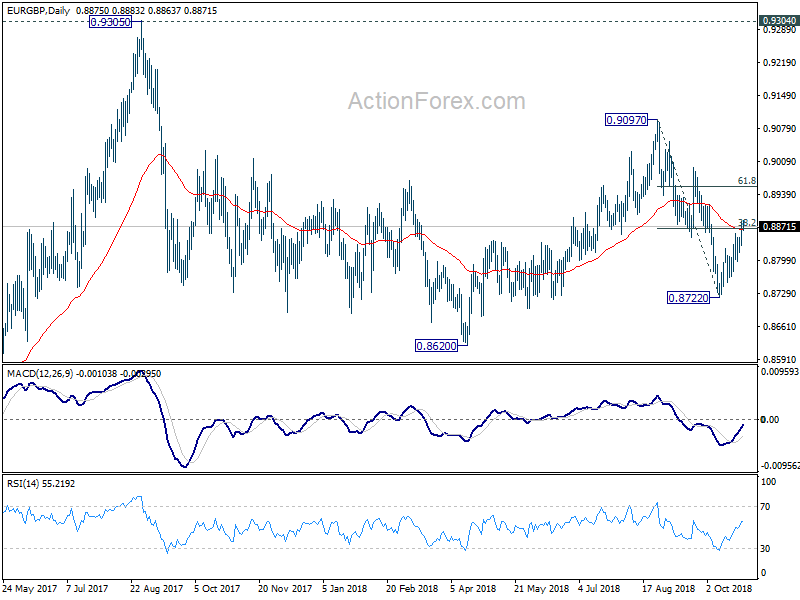
In the bigger picture, EUR/GBP is seen as staying in long term range pattern started at 0.9304 (2016 high). Current development suggests that fall from 0.9303, as a down leg in the pattern, is still in progress. But in case of deeper fall, downside should be contained by 0.8116 cluster support, 50% retracement of 0.6935 (2015 low) to 0.9304 at 0.8120, to bring rebound. On the upside, break of 0.9097 will target 0.9304 resistance instead.
GBPUSD Watching 1.2785 Support Level
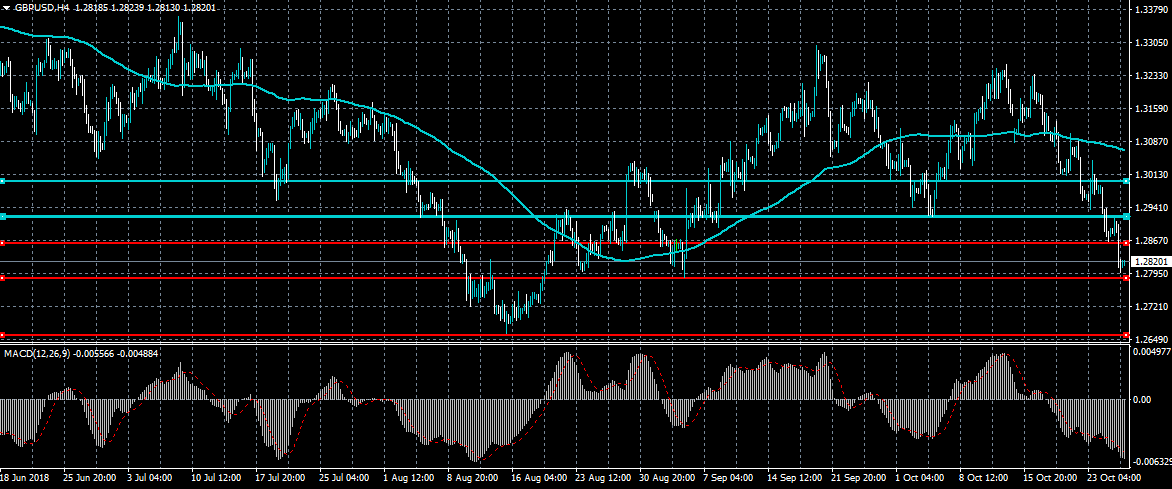
The British pound has slumped towards the 1.2800 level against the greenback after a fresh round of US dollar strength and bearish Brexit headlines. A clear break below the 1.2785 support level will likely accelerate the GBPUSD pairs downside towards the 1.2700 support level. Sterling buyers need to move price above the 1.2866 resistance level to negate intraday selling pressures.
The GBPUSD pair is strongly bearish while trading below the 1.2800 level, key support is now found at the 1.2785 and 1.2700 levels.
If the GBPUSD pair moves above the 1.2866 level, buyers will likely test towards the 1.2900 and 1.2921 resistance levels.
EUR/AUD Daily Outlook
Daily Pivots: (S1) 1.6007; (P) 1.6094; (R1) 1.6154; More....
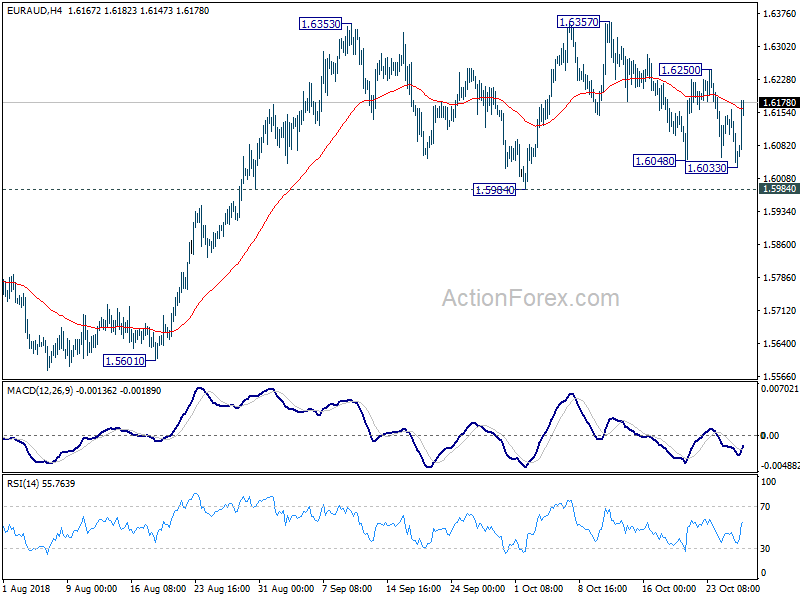
EUR/AUD rebounds strongly after hitting 1.6033 but it's staying in range below 1.6357. Intraday bias remains neutral first. After all, as long as 1.5984 support holds, further rise is expected. On the upside, break of 1.6357 will resume larger up trend to 1.6587 key resistance next. However, break of 1.5984 will be an early sign of trend reversal and turn outlook bearish.
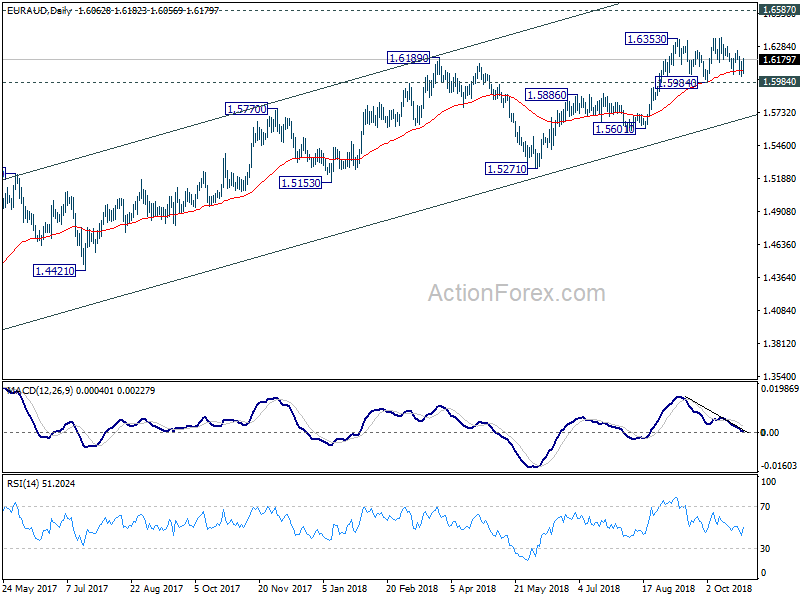
In the bigger picture, up trend from 1.3624 (2017 low) is still in progress. Further rise should be seen to retest 1.6587 (2015 high). Decisive break there will resume the long term rally and target 1.7488 fibonacci level. On the downside, break of 1.5984 support is need to be the first sign of medium term reversal. Otherwise, outlook will remain bullish in case of deep pull back. However, sustained break of 1.5984 will be an early sign of trend reversal.
US Technology Companies Lose $100 Billion As Earnings Disappoint
Yesterday, Wall Street rallied sharply with the Dow and Nasdaq gaining by 400 and 210 points respectively. This came after sharp declines from the previous day. However, all changed during after-hours trading when top technology companies announced their earnings. Amazon and Alphabet reports missed analysts' forecasts, which led to a sharp decline in their stocks. Amazon fell by 7.5% while Alphabet declined by 4% causing the technology sector to lose more than $100 billion in value.
The US dollar rose yesterday after the inaugural speech by Richard Clarida, the Trump-appointed Vice Chairman of the Federal Reserve. In his speech, he said that the US needed more rate hikes to sustain a healthy and robust economy – a likely disappointment for Trump who nominated him. This week, the President continued his criticism of the Fed stating he ‘maybe' had regrets for nominating Jerome Powell as FED chair. “It almost looks like he's happy raising interest rates” Trump proclaimed.
The Japanese yen rose against the USD after Japan released inflation numbers for Tokyo, the biggest city in Japan with a population of almost 10 million people. In September, the core CPI for the city was 1%, which was unchanged from that of August. At the same time, the headline CPI rose from 1.3% to 1.5%. In the United States, an important inflation number that measures the 10-year breakeven inflation rate declined to 2.05%, which was the lowest level since January. Today, this pair will likely be moved by the US GDP numbers.
EUR/USD
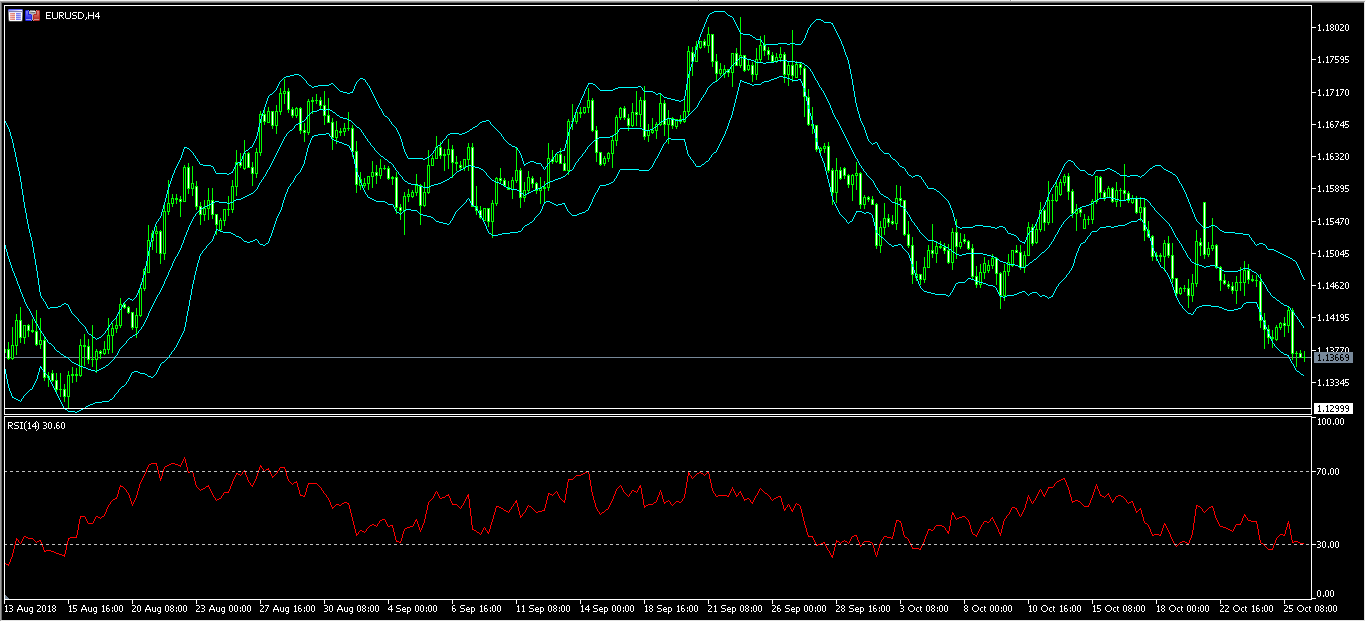
The EUR/USD pair declined to an intraday low of 1.1355. This was the lowest level since August 15 and was a reflection of the stronger dollar. This decline was a continuation of a trend that started on September 25 when the pair reached a high of 1.1815. The price is along the lower line of the Bollinger Bands while the RSI is at the oversold level of 30. As the pair nears the previous low of 1.1300, there is a possibility that the downward momentum will reduce. Therefore, while the pair will likely continue moving down, it is important to be cautious about a short-term bounce.
USD/JPY
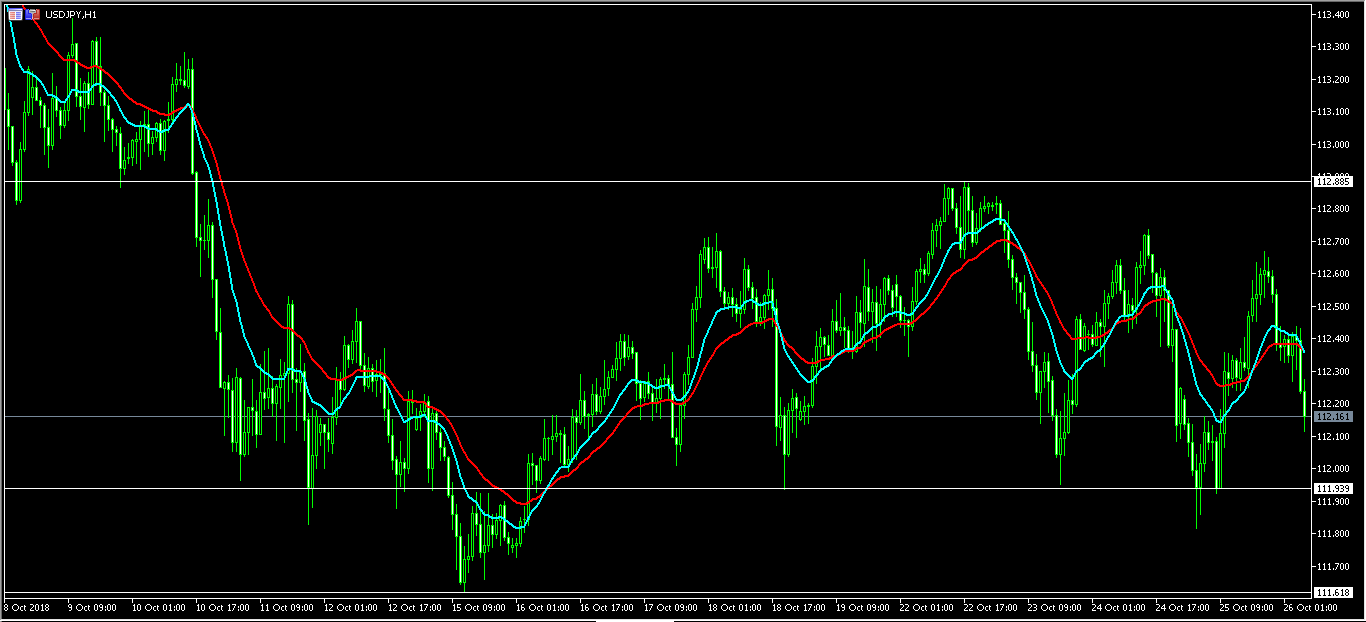
Over the past week, the USD/JPY pair has moved on a wide horizontal channel that has ranged from 111.60 and 112.88. In the Asian session today, the pair fell to an intraday low of 112.10. As the horizontal trend continues, it is likely that the pair will continue moving lower to test the important support of 111.94. This movement looks set to be influenced by today's GDP numbers and a likely sell-off in the stocks market.
NAS100
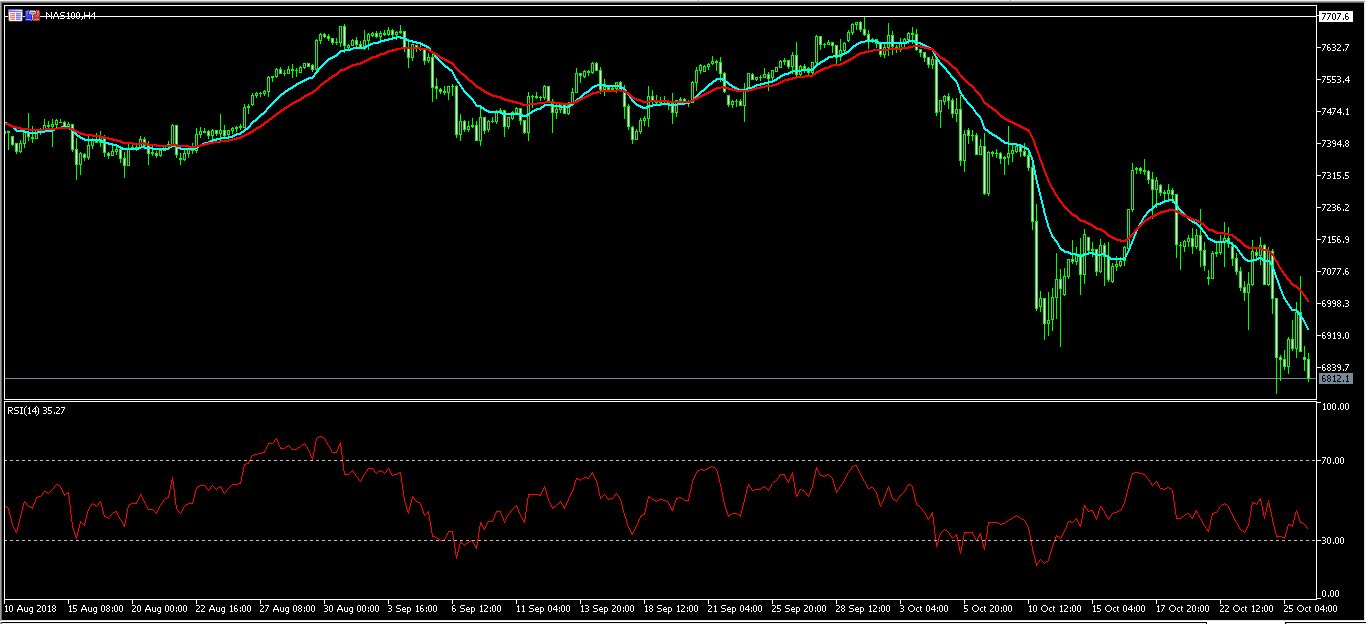
The Nasdaq index is the largest technology-focused index in the world. It is made up of blue chip stocks like Alphabet, Amazon, and Apple. In the past month, the index has fallen sharply from a high of $7710 to a low of $6800. The Nasdaq futures fell during the Asian session to a low of $6775 as technology companies' earnings disappointed. This price is below the 28 and 14-day EMA while the RSI on the four-hour chart is close to the oversold level of 30. There is a likelihood that the index will continue to decline today. However, there is also a possibility that it will recover as the new month approaches
EUR/CHF Daily Outlook
Daily Pivots: (S1) 1.1343; (P) 1.1380; (R1) 1.1407; More...
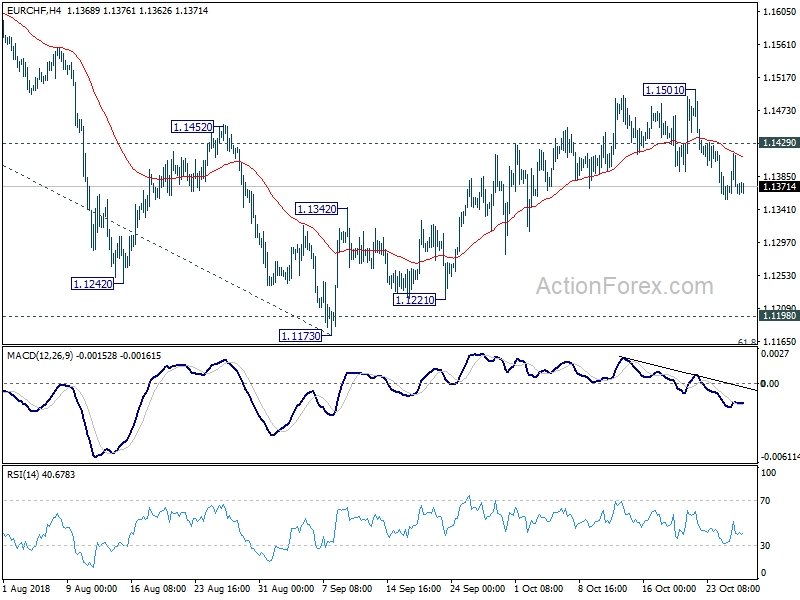
Intraday bias in EUR/CHF remains on the downside with 1.1429 minor resistance intact. Corrective rise from 1.1173 could have completed at 1.1501 already. Deeper fall would be seen back to 1.1154/98 key support zone again. At this point, we'd still expect this key support zone to hold. On the upside, above 1.1429 minor resistance will turn focus back to 1.1501 first. But still, break there is needed to confirm rally resumption. Otherwise, risk will stay on the downside even in case of strong recovery.
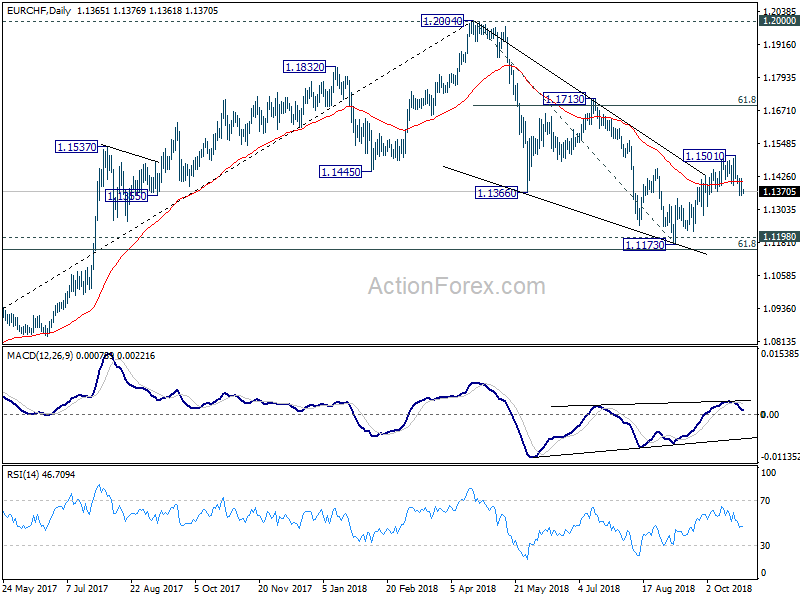
In the bigger picture, price actions from 1.2004 medium term top is seen as a correction only. Downside should be contained by support zone of 1.1198 (2016 high) and 61.8% retracement of 1.0629 to 1.2004 at 1.1154 to complete it and bring rebound. This cluster level is in proximity to long term channel support (now at 1.1234) too. A break of 1.2 key resistance is still expected in the medium term long term. However, sustained break of the mentioned support zone will mark reversal of the long term trend. In that case, 1.0629 key support will be back into focus.
No Love For Euro Despite Steady ECB, US GDP Growth Eyed
Here are the latest developments in global markets:
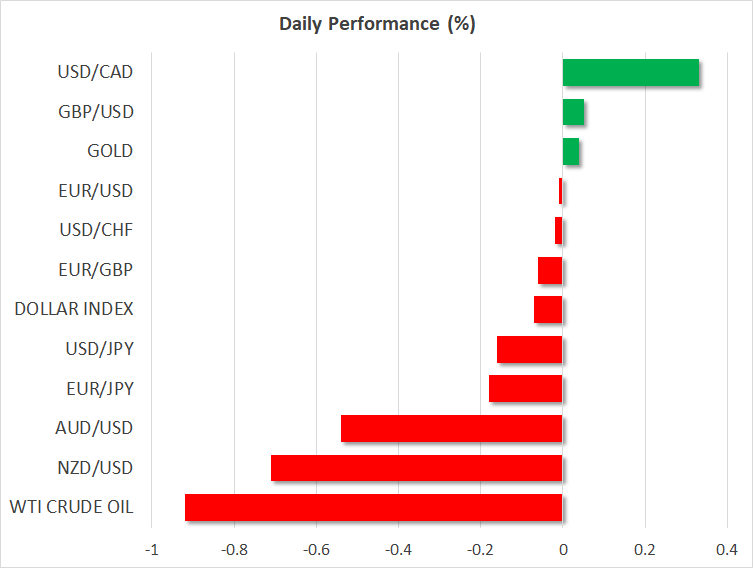
FOREX: The dollar index is little changed on Friday (-0.06%), holding on to the gains it recorded yesterday. Although there wasn't anything new out of the US, the greenback capitalized on weakness in the euro and sterling (see below), touching fresh two-month highs against both. Meanwhile, the safe-haven Japanese yen is outperforming today, as the recovery in risk sentiment seen yesterday appears to have been short-lived. Consequently, the commodity-linked currencies (aussie, kiwi, and loonie) are all on the back foot.
STOCKS: US markets rebounded on Thursday, with the S&P 500 (+1.86%) and the Dow Jones (+1.63%) recovering some of their recent losses, bringing their year-to-date performance back to positive. Meanwhile, the tech-heavy Nasdaq Composite (+2.95%) outpaced its peers, aided by upbeat earnings from Microsoft (+5.84%). That said, sentiment reversed after US markets closed and Amazon as well as Google-parent Alphabet reported disappointing revenues. Accordingly, futures tracking the S&P, Dow, and Nasdaq 100 are all flashing red again, pointing to a negative open today. The pessimism spilled over into Asia on Friday, with Japan's Nikkei 225 (-0.40%) and Topix (-0.31%) inching lower, alongside the Hang Seng in Hong Kong (-0.76%). Europe didn't escape unscathed either, with all the major indices expected to open notably lower today, futures suggest.
COMMODITIES: Oil moved in line with stocks, namely higher yesterday as risk appetite recovered, and lower today amid renewed pessimism. In terms of fundamentals, Saudi Arabia's OPEC governor said yesterday that oil markets could face oversupply by year-end, something evident by rising inventories. WTI is down by 0.90% today at $66.63 per barrel, and Brent is lower by 0.98% at $76.14/barrel. In precious metals, gold is practically flat on Friday at $1233 an ounce, slowly grinding higher amid the general risk-off undertones in recent days.
Major movers: Stocks bounce, but still on wobbly legs; no love for euro after ECB
US equity markets staged a comeback on Thursday, recovering some of their losses from earlier in the week, without any fresh trigger. That said, sentiment seems to have turned sour again, with Asian markets being a sea of red on Friday, and futures tracking the US indices pointing to a lower open today, following lackluster earnings from tech heavyweights Amazon and Google parent Alphabet. Indeed, the earnings season has been mixed at best so far, lending increasing credence to the narrative that profit growth may have already peaked, and potentially helping to explain the recent weakness across equities. Some reports that the US won't resume trade talks without a firm proposal from China probably didn't do risk appetite any favors either.
In FX markets, the euro found no love after the ECB meeting yesterday, even though President Draghi appeared as confident as he could be, given the current landscape. The ECB chief acknowledged the weaker momentum in economic data, but downplayed it as growth merely returning to “normal” levels after being above potential in 2017. He also noted the risks are not dire enough for the ECB to downgrade its balance of risks from “roughly balanced”, hinting that recent developments won't derail – or even delay – the Bank's normalization plans. Yet, the euro touched a fresh two-month low against both the dollar and yen in the aftermath. Looking ahead, S&P is expected to announce its review on Italy's credit rating today; a potential downgrade could keep the single currency under pressure.
Sterling underperformed even the soft euro, tumbling to its own two-month lows against the dollar and yen, in the midst of reports that PM May's Cabinet cannot agree on a way forward for the Brexit talks to resume. Specifically, over how to avoid customs checks at the Irish border, without the UK remaining in the EU's customs union indefinitely. The news likely poured cold water on optimism that a deal may be outlined on time for the EU to hold a special summit in mid-November, signaling that the proverbial can may indeed be kicked further down the road to December.
Elsewhere, the commodity-linked currencies aussie, kiwi, and loonie recorded meaningful losses earlier today as sentiment shifted back to “risk-off”. Aussie/dollar touched a fresh 2½ year low. Accordingly, the defensive yen is outperforming.
Day ahead: US GDP growth takes center stage
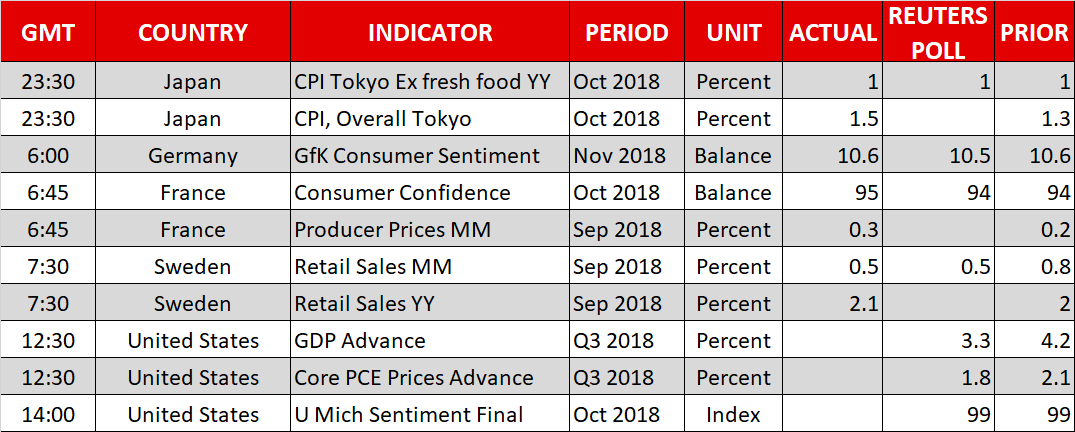
US GDP growth for the third quarter will be the highlight release of the day (1230 GMT) and may prove to be another win for President Trump if the figures surprise to the upside, indicating that the 3.0% growth target set by the his administration is achievable by the end of the year. Better results could also help Trump's Republicans to gain support in the midterm elections as so far polls suggest they are behind the Democrats.
According to analysts, the world's biggest economy is said to have expanded by 3.3% in annualized terms in the three months to September, after hitting 4.2% in Q2, the fastest rate recorded in four years and almost twice the 2.2% pace it printed in Q1. Even if forecasts for a slowdown prove accurate on Friday, such an expansion is still a healthy one as long as it is bigger than 2.0% and smaller than 4.0%, which economists consider an optimal range for GDP growth.
As risk aversion grows in FX and stock markets amid disappointing earnings releases and fears about the consequences the US-Sino trade war could have in global economy, an upbeat GDP report out could somewhat calm investors by showing that things are not evolving that bad after all. In such case, demand for dollar could go up, while US stock futures may turn green before the US market open. The core Personal Consumption Expenditure Index for the third quarter delivered alongside the GDP figures will be also eyed for evidence on inflation trends, while the final October University of Michigan Consumer sentiment index will come in light at 1400 GMT.
In equities, Moody's corporation and Royal Bank of Scotland will be among companies reporting quarterly earnings results prior the market open.
In public speeches today, ECB President Mario Draghi will be presenting at a conference on “Understanding inflation dynamics” at 1400 GMT. A few minutes later at 1415 GMT ECB Executive Board Member Benoit Coeure will be commenting at a session on “Central banks facing a global interdependent financial and monetary environment” during the Euro 50 – CF40 – CIGI meeting in Paris.
After Moody's downgrade, the S&P will be the next to review Italy's sovereign credit rating today along with Germany and the UK. The latter will be also rated by Fitch
Technical Analysis – Dollar index unlocks fresh 2-month highs; looks overbought
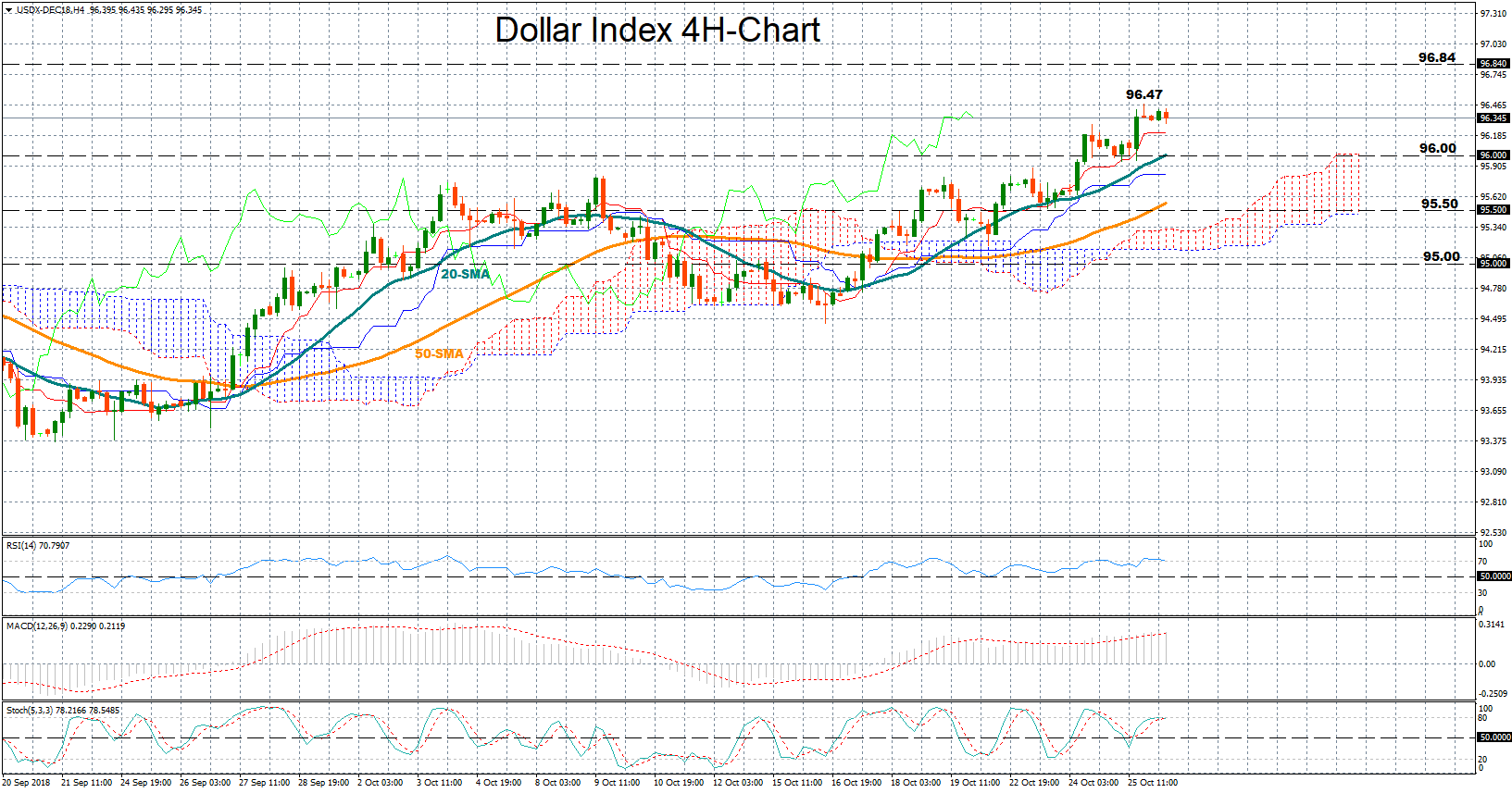
The dollar index which gauges the strength of the dollar versus six major currencies hit a new two-month high at 96.47 on Thursday. Today the index trades sideways around this peak, with the RSI lacking direction above 70 in overbought territory and Stochastics being ready to reverse lower after touching the 80 overbought mark. While this is a signal that the recent rally could be overdone, and the bears may be waiting around the corner, the MACD holds above zero and its red signal line, suggesting that any weakness could be short-lived.
Yet if US GDP growth surpasses expectations, the dollar could pick up steam to retest yesterday's top 96.47. Above from there, the way could open towards the more-than-a-year high of 96.84 reached on August, while if this proves easy to get through, the next level to watch could be 97.60, a previous resistance area in 2017 and 2016.
Alternatively, disappointing prints would boost risk aversion, sending the index down to the area between 96 and 95.50 where the price paused several times in previous sessions and the 20- and the 50-period moving averages currently stands. Moving lower, the 95 psychological level could be another level to keep in mind.
EUR/USD Is Drifting In Lower In The 1.1621/1.13 Consolidation Pattern
Markets
Global core bonds initially lost ground yesterday as risk-sentiment improved. However, swings in German Bunds and US Treasuries were again modest given the swings in the equity markets. At the ECB press conference, president Draghi confirmed the economic assessment from September and maintained his mildly positive tone despite growth concerns. Risk sentiment changed when major US tech companies published disappointing earnings (Amazon, Alphabet (Google)) after the close. Treasuries regained ground into US close. The US yield curve shifted higher with changes between 1.3 bps (10-yr, 30-yr) and 2.0 bps(5-yr). German yields rose marginally ranging from 0.2 bps (10-yr) and 0.8 bps (2-yr). Core bonds continued to rise at opening this morning as risk sentiment is again negative in Asia. Eye catcher on today's eco calendar is the US Q3 GDP. A solid report is probably needed to reverse the down in US yields. A disappointing outcome results could confirm investor concerns on slowing growth. This scenario will give some backwind to US Treasuries and could push US yields even further down. The US 10-y yield needs to regain the 3.10/12% area soon to prevent a deterioration in the ST technical picture.
European equity markets resisted the equity sell-off in the from the US and Asia yesterday, but the direct impact on the dollar (and on core bonds) was modest. EUR/USD settled in a tight range in the low 1.14 area. The pair gained a few ticks early at the ECB press conference as president Draghi basically confirmed the economic assessment from September, but the gain was short lived. The pair even set a new ST correction low later. The move was probably mainly USD strength as US equities rebounded after Wednesday's sell-off. EUR/USD closed the session at 1.1375. Overnight, Asian equities are again under pressure. Korean markets are underperforming. The USD/CNY (6.96) briefly touched beyond the end 2016 peak, even as China's PM Li reiterated that the country won't recur to a competitive devaluation. Negative risk sentiment also weighs on the Aussie dollar, with AUD/USD (0.7028) touching the lowest level since February 2016. EUR/USD (1.1365 area) hovers within reach of yesterday's low. The yen gains a few ticks (USD/JPY 112.15). Later today, the first estimate of the US Q3 GDP will be closely looked at. Growth is expected at 3.3% Q/Qa (from 4.2%). We assume that the dollar needs a really good figure. Otherwise, markets might question the Fed rate hike intentions going forward. Sentiment on risk remains a wildcard. Risk-off weighs on USD/JPY, but the impact on EUR/USD is less obvious. Of late, we had a cautious USD positive view. EUR/USD is drifting in lower in the 1.1621/1.13 consolidation pattern. There is no reason to row against the tide for now. However, USD bulls might feel some vertigo when nearing the EUR/USD 1.1301 2018 low.
Sterling remained in the defensive yesterday as ECB's Draghi made some cautious remarks on the Brexit process. Voice from the UK only confirmed that it is very difficult to reach on consensus within the government on the Brexit strategy. With no important eco data on the agenda, we expect sterling to remain in the defensive. News Headlines
Richard Clarida, Fed's new vice-chairman, signaled more gradual rate rises are ahead despite US President Trump's attacks. He added that there is room for the US jobs market to strengthen further without fuelling excessive inflation, suggesting he is not set to increase short-term interest rates too aggressively.
Japanese PM Shinzo Abe and Chinese PM Li Keqiang announced that they will work together on the North Korea issue as they have major responsibility for ensuring regional security. Both countries also signed a bilateral currency swap agreement of $30 billion aimed at enhancing financial stability.
XAUUSD Intraday Analysis
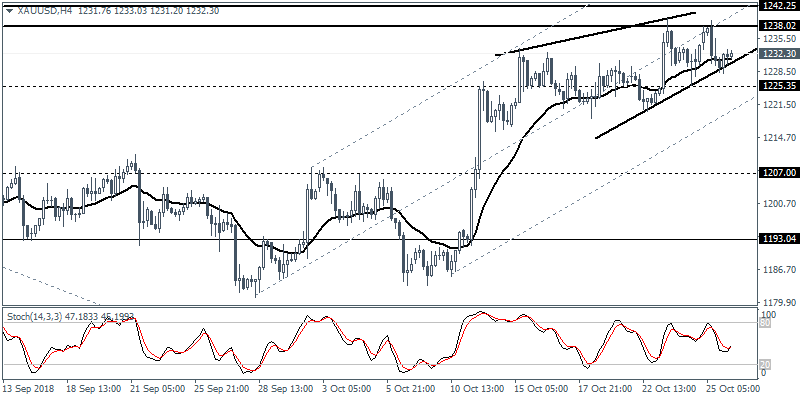
XAUUSD (1232.30): Gold prices posted modest declines, but price action quickly recovered towards the closing session on Thursday. The consolidation is currently forming into a rising wedge pattern. Gold prices will need to break out from the lower rising trend line in order to validate this pattern. The lower support at 1225.35 will be the immediate target to the downside. A break down below this level could trigger further declines to the 1207.00 region.
GBPUSD Intraday Analysis
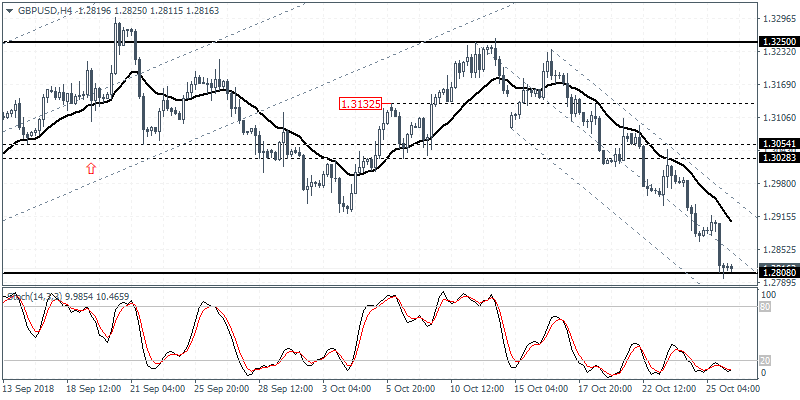
GBPUSD (1.2816): The GBPUSD currency pair reached its downside target of 1.2806 which marks a correction and a retest of this support level. We expect to see some consolidation taking place at this level following which price action could attempt to post a rebound. The recovery to the upside could see the GBPUSD attempting to retest the breached support level area of 1.3054 - 1.3028. However, if the cable breaks down below 1.2806, we expect the bearish trend to continue.
EURUSD Intraday Analysis
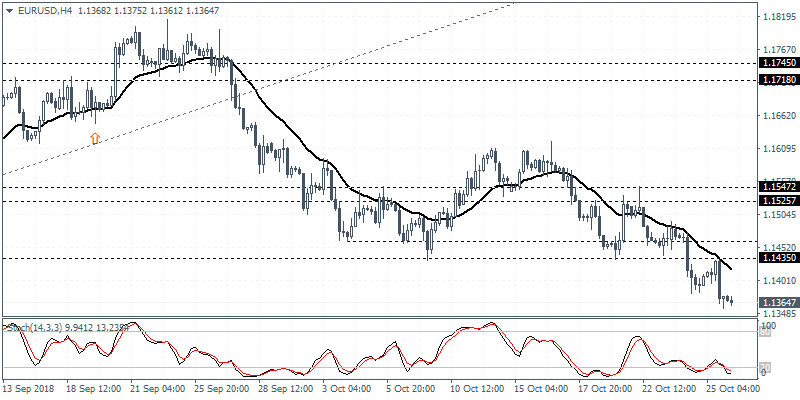
EURUSD (1.1364): The EURUSD continued to extend declines on Thursday as price action was seen closing below 1.1400 level. The break down below this level could potentially signify further declines in price action. Any short-term rebound is likely to be met with the resistance level formed at 1.1435 region. A close above this region is required for the EURUSD to post any meaningful correction