Sample Category Title
House Brady agreed to work on 10% middle class tax cut
House Ways and Means Committee Chairman Kevin Brady, Republican, said in a statement to work with the White House on delivering the 10% tax cut for the middle class. In the statement, he said "resident Trump believes American families deserve to keep more of what they work so hard to earn. We agree. After all, it's your money – not Washington's."
Brady added "We will continue to work with the White House and Treasury over the coming weeks to develop an additional 10 percent tax cut focused specifically on middle-class families and workers, to be advanced as Republicans retain the House and Senate."
Trump unsure if he regrets on Fed Powell
Trump repeated his attack on Fed and its Chair Jerome Powell again yesterday. He told WSJ that "I'm very unhappy with the Fed because Obama had zero interest rates". And, referring to Powell, Trump added, "every time we do something great, he raises the interest rates", and Powell "almost looks like he's happy raising interest rates."
Asked if he regrets nominating Powell, Trump said it's "too early to tell, but maybe". Further, when asked on what circumstances would lead him to remove Powell, Trump said "I don't know". That's already a shift in stance from "I'm not going to fire him" on October 11.
Fed Bostic: With strong economy, rate hikes to neutral appropriate
Atlanta Fed President Raphael Bostic said is a speech that the US economy is "in a good place", and he "struggled to come up with sufficient variations on the word 'strong'". And to him strong economy means "able to withstand great force or pressure". "Tariffs, trade restrictions, and market volatility" are the headwinds. But there are also tailwinds in "recent tax reform and fiscal stimulus". And because of strong GDP numbers in Q2 and Q3, he's revised up 2018 and 2019 growth projections.
On monetary policy, he said "unless the data talk me out of it, I view a continued, gradual removal of policy accommodation as appropriate until we get to a neutral policy rate." And he emphasized that the current Fed policy rate "has not yet reached a neutral stance" and Fed is "still providing accommodation". The Fed has "yet to pump the brakes".
Bostic's full speech A View of the Fed's Policy Path.
Market Morning Briefing: Aussie Has Risen After Testing Support Near 0.7056 Yesterday
STOCKS
Major stock indices are trading low and have fallen sharply in the last trading session. While the correction deepens, stock indices may be vulnerable to further losses if immediate recovery is not seen.
Dow (25191.43, -0.50%) and Dax (11274.28, -2.17%) declined further yesterday. Dow almost tested 24750 before bouncing back from there while Dax closed in the red. Dax could continue its fall towards 10900 if it does it recover immediately from current levels while Dow could fall towards 24000 if it sees another dip below 25000. There are crucial support levels just now on both Dow and Dax and a break or bounce from here would decide the direction for the near term.
Asia-Pac is also trading lower as expected. Nikkei (21973.55, -0.17%) and Shanghai (2591.34, -0.13%) have also fallen and look bearish for the near term. Nikkei clearly has broken below 22000 and while the bears dominate, Nikkei could continue to fall towards 21000-20800 levels in the near term. Decline in Shanghai from 2650 could now push the index towards 2450 again in the next 2-3 sessions before a bounce from there. Overall near term looks bearish.
Nifty (10146.80, -0.96%) could well follow other stock indices and open lower today. But some recovery if not seen today could gradually drag the index towards 10000. Below 10000, the fall could extend towards 9700-9500 in the longer run if the bears take over in the near term. We prefer a bounce from 10000 in the medium term.
COMMODITIES
Crude prices have declined sharply. Pressure from the stock markets and assurance by Saudi Arabia to meet the world oil demands have triggered the fall. The prospect of weaker-than-expected economic growth as projected by some forecasters this month like the OPEC and the International Energy Agency are enough to keep traders under pressure and to trim their bets on crude prices rising in the near term.
Brent (76.71) fell as expected but was rather quick than our expectations. As mentioned yesterday, there is support in the 76-74 region and a bounce from there looks likely. A test of 76 has already been seen and if the Brent does not recover from here, it could target 74 in the near term.
WTI (66.58) on the other hand has support at current levels and needs to bounce back immediately to keep the bullish possibilities alive. A break below 66 could make it vulnerable to a further fall towards 64.
Brent-WTI (9.83) spread has come off a bit. While the spread moves lower and falls from the crucial medium term resistance, it could indicate bearish Crude prices for the near term; the spread could come off towards 9-8 levels in the near term.
Gold (1235.70) attempted to rise above 1240 but came down to close at lower levels. An attempt to break above 1240 could be seen in the near term and if the price manages to move higher, 1250/60 would be seen in the next 1-2 weeks. Else, a fall back to 1210 is possible.
Copper (2.7620) continues to remain in the sideways consolidation and the narrow 2.70-2.83 region may continue to hold in the near term.
FOREX
Watch crucial resistance near 96.2-96.3 on the Dollar Index. A breach above this level could bring weakness in Euro, Pound and INR.
Euro (1.1463): Currently, the bias is slightly shifted to the downside with a re-test of support near 1.142-1.143 looking likely in the near term. On the upside, it has immediate intra-day resistance near 1.1475, which if broken could take it towards 1.1525. It would need to break above 1.1525-1.1550 for higher levels of 1.16-1.17 to come into play.
Dollar Index (95.99) – A further rise towards crucial resistance at 96.2-96.3 is possible in the next couple of sessions. A break above this resistance (if it happens) would be very bullish for the near to medium term.
Dollar Yen (112.48) – While below 112.5-112.6, Dollar Yen could dip more towards support at 112.2-112.0 in the next 1-2 sessions. If this support breaks, then there is lower support near 111.25 on daily candles.
Euro-Yen (128.95) could continue to fall towards 128.50-128.00 in the next couple of sessions while it remains below resistance near 129.1-129.2 on daily candles.
Pound (1.2979) : While below 1.30, it is likely to fall in the next couple of weeks to target support on weekly candles near 1.28. This week could see a gradual fall towards 1.295-1.290.
Aussie (0.7090) has risen after testing support near 0.7056 yesterday. There are chances of some ranging between 0.715 and 0.705 in the near term. Note that 0.705-0.704 is a crucial long term support level, which if broken, could be very bearish for the Aussie.
Dollar Rupee (73.57): Important resistance near 73.80 and 74 while above 73.20. If it breaks on the upside, it could be very bullish for USDINR. The next couple of sessions could see trade in the 73.20-73.80 region.
INTEREST RATES
The VIX (24.66) has moved up from levels near 11.61 in the beginning of the month and has seen highs near 28.84. If it continues to rise, we might see a rise in bond prices and consequently, a fall in yields globally.
Moreover, conflicts in Europe regarding Italy’s budget proposal also seems to be making investors nervous – thereby leading to a fall in German yields.
The US 10 Year (3.15%) has broken below the support near 3.17% which we had mentioned yesterday. It could now target support near 3.10%. If 3.10% also breaks, then the yield could even move down towards 3% in the next few weeks.
2 Year German-US Spread (-3.50%) : While below -3.46%, there are chances of a fall towards -3.60% in the near term.
German 10 year yield (0.41%) – As per expectation, the German 10 year yield is continuing its fall and could soon test support near 0.35%-0.30% in the next 1-2 weeks. A break of 0.30% (if it happens) would be very bearish. Watch out for the ECB meet tomorrow.
Can EUR/GBP Continue To Recover?
Key Highlights
- The Euro started an upside correction from the 0.8720 support against the British Pound.
- There is a major ascending channel formed with support at 0.8800 on the 4-hours chart of EUR/GBP.
- The UK CBI Industrial Trends Orders Survey declined from -1 to -6 in Oct 2018 (MoM).
- Today, the Euro Zone Manufacturing PMI for Oct 2018 (Preliminary) will be released, which is forecasted to decline from 53.2 to 53.0.
EURGBP Technical Analysis
After a major decline, the Euro found support near the 0.8720 level against the British Pound. The EUR/GBP pair started an upside move and traded above the 0.8780 and 0.8800 resistance levels.
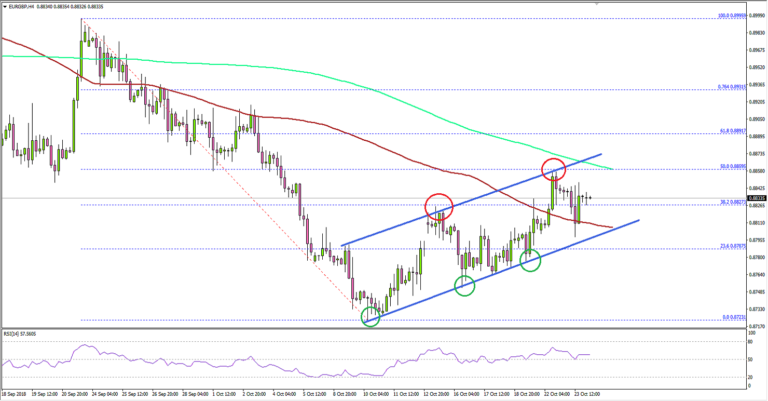
Looking at the 4-hours chart, the pair recovered nicely above the 0.8780 level. It even moved above the 38.2% Fib retracement level of the last slide from the 0.8995 high to 0.8723 low, and the 100 simple moving average (red, 4-hours).
However, the pair struggled to clear the 0.8860 resistance and the 50% Fib retracement level of the last slide from the 0.8995 high to 0.8723 low. The pair declined and tested the 0.8800 support area.
There is also a major ascending channel formed with support at 0.8800 on the same chart. As long as the pair is trading above the 0.8800 support, it could bounce back towards the 0.8860 resistance.
Above 0.8860, the pair will most likely surge towards the 0.8900 level. On the other hand, a break below 0.8800 may push the pair towards the 0.8750 level in the near term.
Looking at EURUSD, the pair remains in a bearish zone below 1.1550, and GBP/USD recently declined towards the 1.2950 support area.
Economic Releases to Watch Today
- Germany’s Manufacturing PMI for Oct 2018 (Preliminary) – Forecast 53.4, versus 53.7 previous.
- Germany’s Services PMI for Oct 2018 (Preliminary) – Forecast 55.5, versus 55.9 previous.
- Euro Zone Manufacturing PMI Oct 2018 (Preliminary) – Forecast 53.0, versus 53.2 previous.
- Euro Zone Services PMI for Oct 2018 (Preliminary) – Forecast 54.5, versus 54.7 previous.
- US Manufacturing PMI for Oct 2018 (Preliminary) – Forecast 55.5, versus 55.6 previous.
- US Services PMI for Oct 2018 (Preliminary) – Forecast 54.0, versus 53.5 previous.
- US New Home Sales for Sep 2018 (MoM) – Forecast -1.4% versus +3.5% previous.
- BoC Interest Rate Decision – Forecast 1.75%, versus 1.5% previous.
When The (Equity) Walls Come Tumbling Down
When the (equity)walls come tumbling down
What started as an innocent equities correction in Asia, spilt over into the NY session as classic risk-off unfolded as US yields dipped with oil and gold prices rocketed higher. Risk sentiment is on its back foot this morning with global equities and commodities weaker. The catalysts are nothing new and are a toxic geopolitical cocktail of nagging concerns: i) Chinese growth levels (despite their recent stimulus), ii) lack of progress on Brexit (despite reports that a deal is near), iii) the Italian budget issues and iv) the Khashoggi investigation. But significant for global equity investors, the US equities Teflon persona was seriously questioned as price action suggested there is one asset class investors fear: equities. And like migratory birds heading south for winter, the icy chill enveloping global stock markets has sent investors flocking to safe to haven assets.
The writing was on the wall when equities traded weaker across the board after Monday’s intervention induced rally in Chinese stocks had little effect on global sentiment and reversed sharply lower in yesterday’s Asia session.
But for me, it was the Bloomberg headlines that suggested the PBoC plans to give CNY10bn to bond guarantee firm China Bond Insurance to provide credit support for debt issuances by private firms, that sent off alarm bells rather than support equity markets. Often these types of interventions suggest much deeper rooted economic issues and as we saw from yesterday action can trigger a negative backlash.
With the S&P now drawn into the global equity maelstrom, gold and bonds are the safe havens, not king dollar which is trading slightly weaker if anything from yesterday with USDJPY leading back towards 112 and EURUSD failing to break through 1.1430 . A move lower in US equities does create haven flows and gives the greenback very mixed feelings about it. But with so many crosscurrents swirling, Italy and Saudi fears when combined with US domestic concerns over what has suddenly become a collapse in the housing-related asset has made for a toxic combination sending equity investors packing who are now expecting a much bigger fire sale before re-engaging as risk aversion feels like it has much further to run.
Still, with no key US economic data for markets to tether themselves to, buckle up as there are a plethora of potential potholes to navigate on Wednesday in the form of an expected Bank of Canada rate hike PMI prints for EUR, while USD sees Fedspeak and a fresh Beige Book. A hawkish Fed lean will add more fuel the already raging market fires.
And finally, if you don’t think China-US hopes are fading, with both sides now looking set to dig in for the long haul markets could get much worse before better . Asian investors better hold on to their hats, as markets are about to get extremely blustery.
Oil Markets
The long oil contract unwinds continued with front-month WTI -and Brent plunging more than 4 % in heavy selling on the combination of macro weakness, and more headlines from Saudi Arabia about their ability & willingness to increase production are the primary catalysts. Indeed, the petroleum complex extended their slide after Saudi Energy Minister Khalid Al-Falih stated that OPEC’s current policy was to “produce as much as you can” to reassure customers that they are ready to meet “any demand that materialises.”
Let’s not make any illusions about this shift in Saudi policy; this is about oversupplying markets short-term needs not just adding barrels to meet Iran and Venezuela shortfall and this nascent shift in Saudi policy could translate into a much more significant impact for energy markets.
US weekly petroleum inventory data did little to stem the tide after the American Petroleum Institute (API) reported a massive build of 9.88 million barrels of United States crude oil inventories for the week ending October 19, compared to analyst expectations that this week would see a hefty build in crude oil inventories of 3.694 million barrels. Threatening a deeper free fall as whatever bullish remnant remain are heading for the exits.
Gold Markets
Gold is following Yen and US Treasuries, of course, risk aversion is in play. But frankly, we’ve been dealing with this for months, the difference this time around is the US dollar does not have a go-to haven appeal it had from escalating trade war tension. The latest Gold Rush is a direct result of tensions between the US and Saudi Arabia and increasing nervousness about risk assets. Increased US -Saudi strains has middle east geopolitical embers burning and gives rise to the notion that regional sparring partners will compete for the influence which could ignite a middle east powder keg. While the Gold market still fears the Feds, however on a broader and more pronounced equity rout, this will bring the Fed December rate hike into question. Gold prices were unable to hold gains after testing above 1234-36, but traders remain on watch given US equity markets weaker complexion.
Currency Markets
Despite all the market hoopla, G-10 moves were very pedestrian suggesting as we have thought all along, currency markets are suffering a bad case of trader fatigue.
The Malaysian Ringgit: It’s hard to find a silver lining in the market with global risk sentiment going into the tank and oil prices following suit. With the upcoming budget looming ominously, it suggests the Ringgit will continue to trade with a defensive posture.
The Pound is entering that mode again, where no position is a good position as the negative headlines continues to compound extremely negative sentiment.
The Yen rallies on haven demand, but tremendous support remains at 112 which should keep USDJPY downside in check at least until the traders have then next negative equity mood swing.
Geopolitical Risk Hits Dollar as Other Safe Havens Rise
The US dollar is lower across the board on Tuesday. The market is navigating a perfect storm as the stock rally hit a speed bump at the same time geopolitical risk is on the rise. Multiple elections around the globe and trade concerns between big economies (China-US, EU and UK) have triggered risk aversion. Asset classes that had lost their safe haven appeal are back. Gold is having a moment as even the USD is not the final destination. Investors are dialling back their risk appetite and pulling out of stocks, flocking to traditional safe haven assets.
The Bank of Canada (BoC) will publish its benchmark rate on Wednesday, October 25 at 10:00 am EDT and will host a press conference with Governor Stephen Poloz at 11:15 am EDT.
- BoC expected to hike interest rate to 1.75%
- API crude inventory points to a buildup, but weather could play a factor
- Fed speakers to boost US dollar
Loonie Flat Awaiting BoC Rate Decision and Poloz Speech
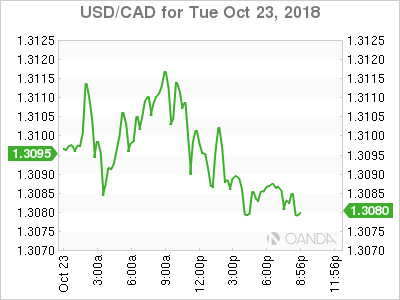
The USD/CAD lost 0.10 percent on Tuesday. The currency pair is trading at 1.3086 ahead of the Bank of Canada (BoC) rate announcement. The central bank is highly anticipated to lift interest rates to 1.75 percent. The move is for the most part priced into the loonie, but the press conference by Governor Stephen Poloz is what investors will be focusing on. The expectation is for a dovish hike, rising rates while at the same time highlighting the major headwinds facing the Canadian economy.
Inflation and retail sales disappointed, but still showed enough momentum behind the economy to validate a higher benchmark rate. The biggest factor keeping the BoC awake at night was the uncertain fate of NAFTA. Teh signing of the USMCA has taken that away, although ratification is still six months away.
The loonie is slightly higher ahead of the BoC, with risk appetite subdued as the global stock market sell off has safe havens bid. Geopolitics continue to be a major factor with currencies reflecting the market sentiment.
Euro Higher as US dollar Loses Footing
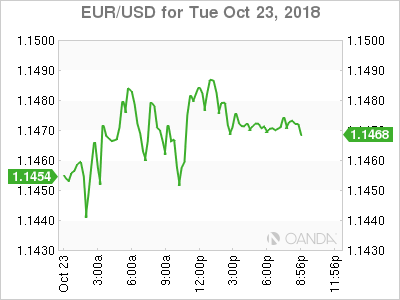
The EUR/USD is flat on Tuesday, but has accumulated 0.34 percent in losses this week. The single currency is trading at 1.1474 as the Italian budget continues to put downward pressure on the currency. The European commission has rejected the 2019 budget proposed by Italy with a three week period to submit a new one.
Italian politicians are sticking to their guns and the showdown between Rome and Brussels shows no sign of a reaching a middle ground.
The European Central Bank (ECB) will publish its monetary policy decision on Thursday, with no changes expected. The central bank is set to start hiking rates next summer, but higher spending from Italy could derail those plans.
GBP Rebounds on Irish Backstop Alternative
Sterling is higher against the US dollar on Tuesday, but continues to be under pressure raking up a 0.59 percent loss this week as Brexit turmoil puts pressure on the pound.
Risk aversion has made investors seek the safety of gold, the Japanese yen and the Swiss franc. Political uncertainty around PM Theresa May has also done the currency no favours.
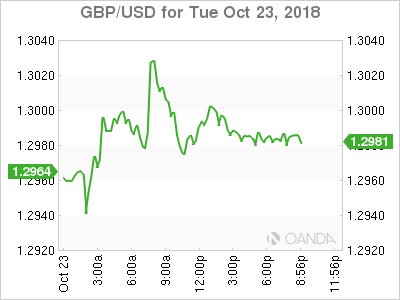
The lockdown on the Irish border received some good news as the EU could offer a UK wide customs union and avoid a hard border between Northern Ireland and the Republic.
So far positive rhetoric has pushed the currency higher, but lack of details is a concern as being 90 or 95 percent close to a deal during a speech is not the same as being close to signing an agreement. The market is expecting details sooner rather than later as the deadline is fast approaching and without a backstop there can be no trade deal.
Oil Lower as Saudi Arabia Pledges to Close Production Gap
Oil is trading lower on Tuesday. West Texas Intermediate lost 4.56 percent as the Saudi Arabia investment conference drew to a close. Energy prices recorded a the biggest daily loss in three months as rising global growth concerns hit stock markets and demand for crude going forward.
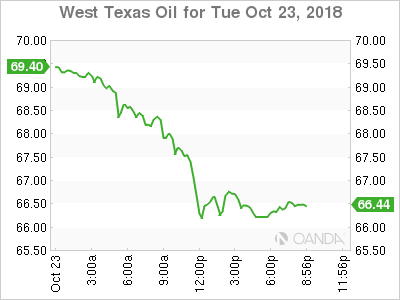
Saudi Arabia has pledge it will increase production to keep prices stable and concerns of negative backlash following the killing of journalist Jamal Khashoggi have eased.
US sanctions against Iranian exports are providing some support but downward pressure has been more persistent. The release of the US weekly crude inventories published by the Energy Information Administration (EIA) on Wednesday could tip the balance, although the market has been pricing in a drawdown due to minor weather disruptions.
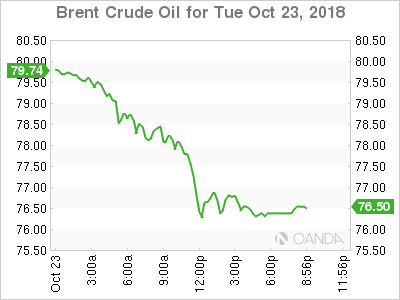
Geopolitics directly affecting the supply of oil was a big factor in October, but it now seems Saudi Arabia will increase production as much as possible sending energy prices lower.
Gold Higher on Safe Haven Demand
Gold rose 0.76 percent on Tuesday. The yellow metal was supported by a soft dollar and the stock market fall.
The market is in a perfect storm as the stock rally hit a speed bump at the same time geopolitical risk is on the rise. Multiple elections around the globe and trade concerns between big economies (China-US, EU and UK).
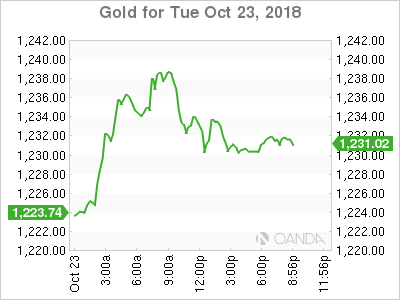
Investors are pulling back as stock market sell off has been the trigger. Asset classes that had lost their safe haven appeal are back. Gold is having a moment as even the USD is not the final destination. Investors are dialling back their risk appetite and pulling out of stocks, flocking to traditional safe haven assets.
The Trump tax cut boost is starting to fade and is being replaced by trade concerns are starting to hit companies. Caterpillar is citing rising costs and has underperformed. There is little hope the US-China trade dispute will end as quickly as the USMCA was signed.
The last quarter of 2018 will be packed with market events as central banks are expected to close out the year with major policy decisions and big political events (US midterms, Italian budget, Brazil elections, etc)
Market events to watch this week:
Wednesday, October 24
10:00am CAD BOC Monetary Policy Report
10:00am CAD BOC Rate Statement
10:00am CAD Overnight Rate
11:15am CAD BOC Press Conference
Thursday, October 25
7:45am EUR Main Refinancing Rate
8:30am EUR ECB Press Conference
8:30am USD Core Durable Goods Orders m/m
Friday, October 26
8:30am USD Advance GDP q/q
Oil Drops As Saudi Arabia Pledges More Supply
Oil is trading lower on Tuesday. West Texas Intermediate lost 4.56 percent as the Saudi Arabia investment conference drew to a close. Energy prices recorded a the biggest daily loss in three months as rising global growth concerns hit stock markets and demand for crude going forward.
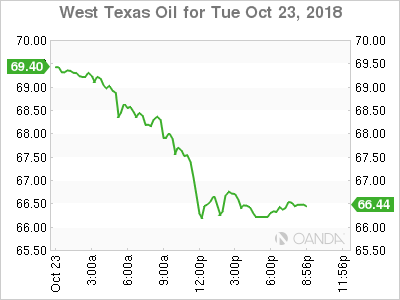
Saudi Arabia has pledge it will increase production to keep prices stable and concerns of negative backlash following the killing of journalist Jamal Khashoggi have eased.
US sanctions against Iranian exports are providing some support but downward pressure has been more persistent. The release of the US weekly crude inventories published by the Energy Information Administration (EIA) on Wednesday could tip the balance, although the market has been pricing in a drawdown due to minor weather disruptions.
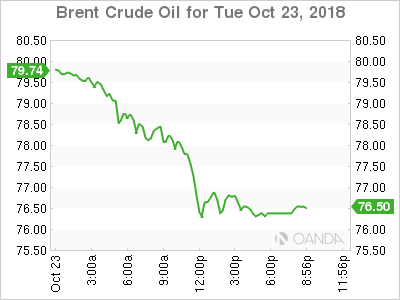
Geopolitics directly affecting the supply of oil was a big factor in October, but it now seems Saudi Arabia will increase production as much as possible sending energy prices lower.
Eco Data 10/24/18
[php_everywhere instance="1"]
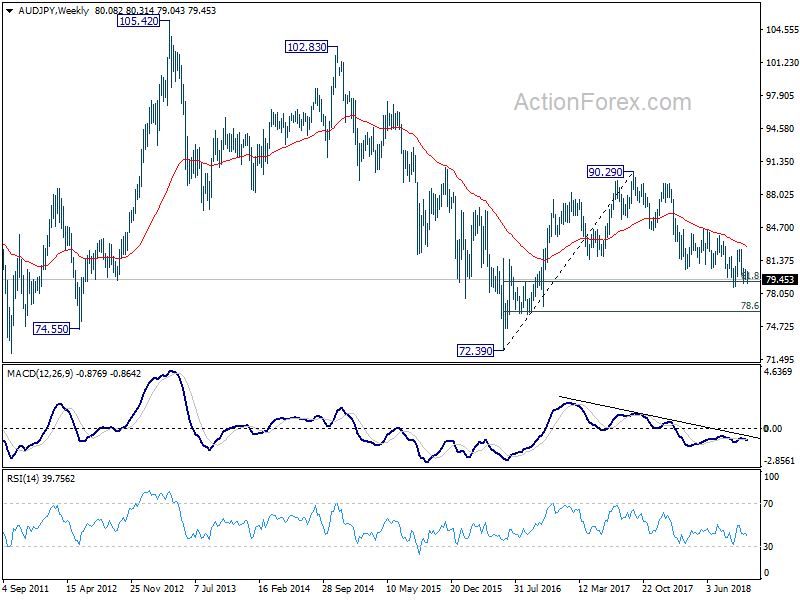
Today’s top mover AUD/JPY: Bearish but no commitment yet
In such a day of global stock market selloff, it's unsurprising that AUD/JPY is the top mover so far.
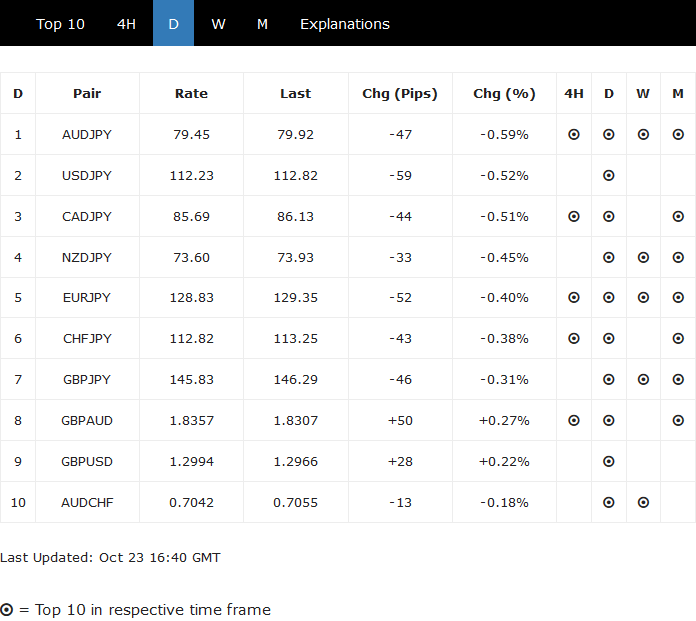
But we'd like to point out that, as in EUR/JPY and even USD/JPY, Yen bulls seem refusing to commit for now. AUD/JPY breached 79.05 support but quickly recovered. It could take more time for them to make up their mind.
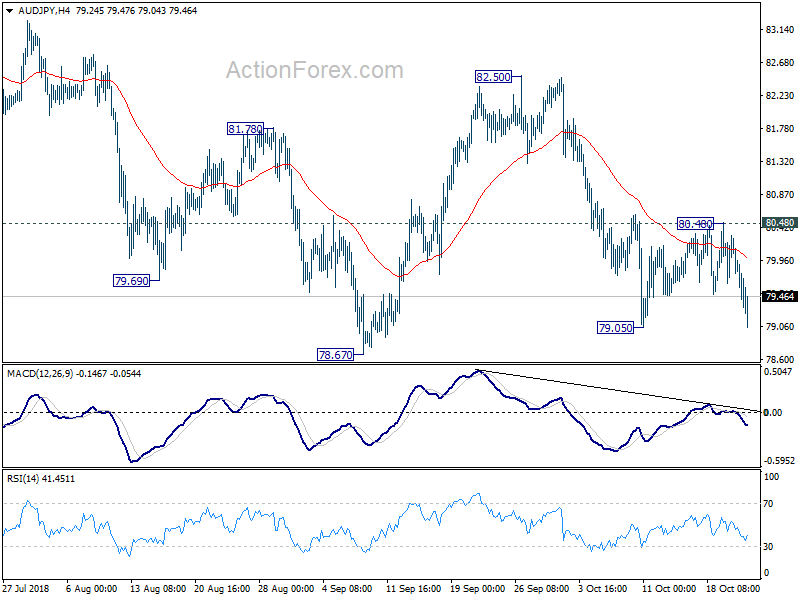
For AUD/JPY specifically, it might be because it's now close to key long term fibonacci level of 61.8% retracement of 72.39 to 90.29 at 79.22.
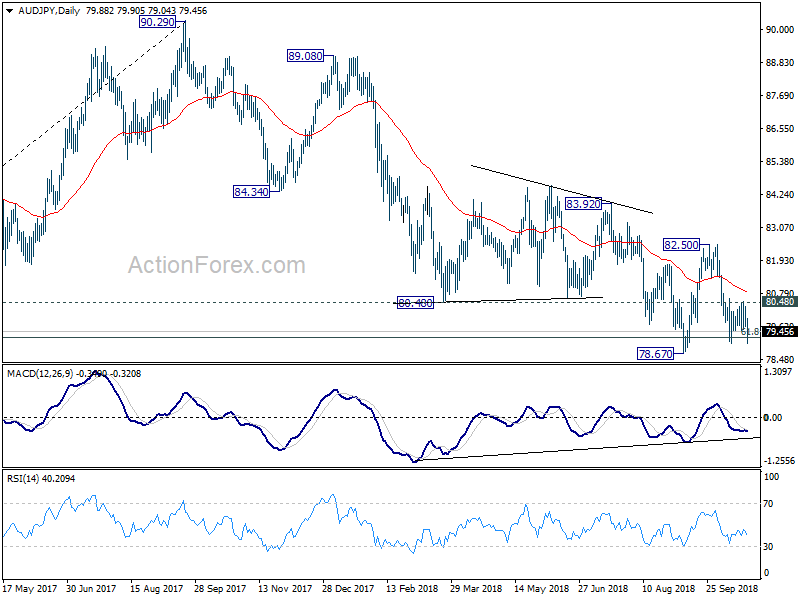
But after all, outlook in AUD/JPY is rather bearish as it's staying comfortably below falling 55 day EMA and falling 55 week EMA. So, as long as 80.48 resistance holds, we'd expect further downside ahead. Break of 78.67 low should be seen next. And in that case, next target will be 78.6% retracement of 72.39 to 90.29 at 76.22.