

Sample Category Title
Eurozone Markit PMIs Could be a Warning Call for Growth
The Eurozone will see the release of the flash October PMI survey on Wednesday at 0800 GMT, a day before the European Central Bank (ECB) meets to decide on monetary policy. Consensus is for the data to soften both in the services sector as well as in the manufacturing industry, potentially providing signals that expansion within the single currency area may slow further in the final quarter of the year.
In September, IHS Markit found that manufacturing activity in the Eurozone was the weakest in two years as new export orders stagnated for the first time since June 2013, driving the Manufacturing PMI down to 53.3. Although anything above 50 indicates growth, the slowdown was enough to prove that uncertainties about whether the UK will have an orderly exit from the bloc, in addition to rising risks from the US-Sino trade war, kept investments under a tight leash in the euro area last month.
In October, sentiment among manufacturers looks to have worsened even further according to analysts, who estimate that the index has slipped to a fresh 2-year low of 53.0, making a rebound towards December’s all-time high of 60.6 appear much more difficult.
Meanwhile in the services sector, where companies hired at the fastest pace since 2007 in September, leading the relative PMI to a three-month high of 54.7, forecasts are also not encouraging. Particularly, the measure is projected to come slightly lower at 54.5 and with manufacturing activity expected to soften as well, the composite PMI which blends the two industries could decline from 54.1 to 53.9, according to projections.
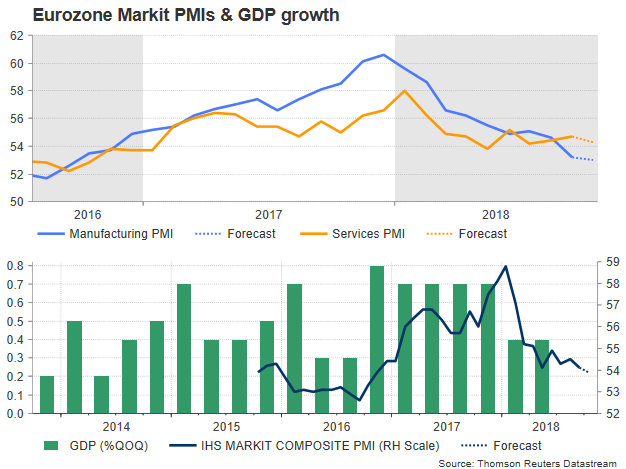
On the monetary policy front, a discouraging PMI report might not affect the ECB plans on Thursday, as the Bank has already informed markets about its intention to keep interest rates steady until the end of the 2019 summer and its decision to terminate the quantitative easing program in December. Even if the ECB is not scheduled to update its economic forecasts at this week’s meeting, ECB members could still translate lower PMI readings into expectations for slower GDP growth in the fourth quarter as the correlation between the two indicators has somewhat strengthened in recent years (see chart). Recall that the expansion rate in the Eurozone continued drifting south for the third straight quarter this year following the pullback off the multi-year peak of 2.8% registered in December. Should the PMI figures show further deterioration in business activities, GDP growth could challenge the ECB’s 2018 growth target of 2.0%.
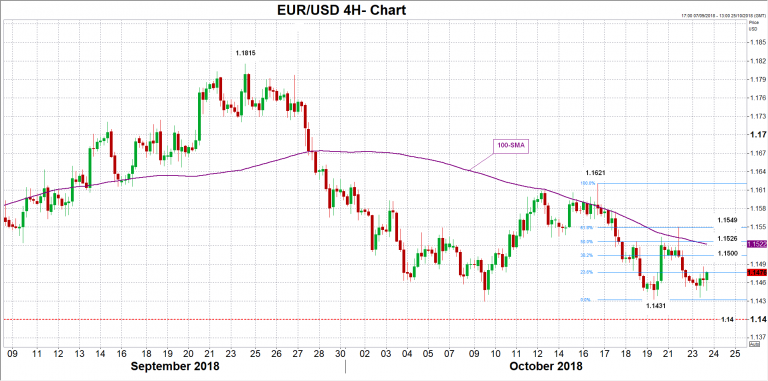
Turning to FX markets, demand for the euro has been subdued over the past couple of months, with risks around the Italian spending plans and how these would affect Eurozone’s welfare keeping investors away from the market. A downside PMI surprise on Wednesday could harm optimism on eurozone’s economic performance even more and thus reduce positioning in the euro/dollar market. In such case the pair may extend losses towards the 1.1431 bottom first reached on October 9, while a bigger disappointment may also open the door for the 1.1400 round level. Below that, support could run down to the 1.1300 bottom.
In the alternative scenario, a data beat could lift the price up to 1.1500 where the 61.8% Fibonacci of the downleg from 1.1621 to 1.1431 is placed. Moving higher, the area between the 50% and the 61.8% Fibonacci levels of 1.1526 and 1.1548 respectively would be in focus before attention turns to the 1.1621 top.
Gold Jumps to 13-Week High as Global Equity Markets Slip
Gold has recorded strong gains in the Tuesday session. In North American trade, the spot price for one ounce of gold is $1234.11, up 0.99% on the day. There are no key releases on the schedule. The Richmond Manufacturing Index dropped sharply to 15 in October, down from 29 points in September.
Global equity stock markets are seeing red on Tuesday, as geopolitical concerns and soft third-quarter earnings have dampened risk appetite. U.S markets are recording sharp losses, as poor earnings reports from industrial giants Caterpillar and 3M have pulled Wall Street lower. Investors are also nervous over weak Q3 growth in China and tensions between Saudi Arabia and the U.S over the death of a Saudi dissident in the Saudi consulate in Istanbul. Investors have responded by flocking to gold, a traditional safe-haven in times of crisis. We could see gold prices continue to fall in the North American session.
The trade war between the U.S and China continues to simmer, with the markets nervous that that trade tensions could escalate. The U.S Treasury Department released its semi-annual report on foreign exchange rates on Thursday, and there was some relief in the markets as the report did not name China as a currency manipulator. Still, the report said that the U.S was “deeply disappointed’ with that China refuses to disclose the extent of its foreign currency intervention. The Chinese yuan has slipped some 9 percent since April, and U.S officials are concerned that China has deliberately weakened the currency in order to counter U.S tariffs on Chinese goods, and will continue to monitor China’s currency practices.
Mid-US update: Risk aversion dominates, Yen surges but bulls seem refusing to commit further
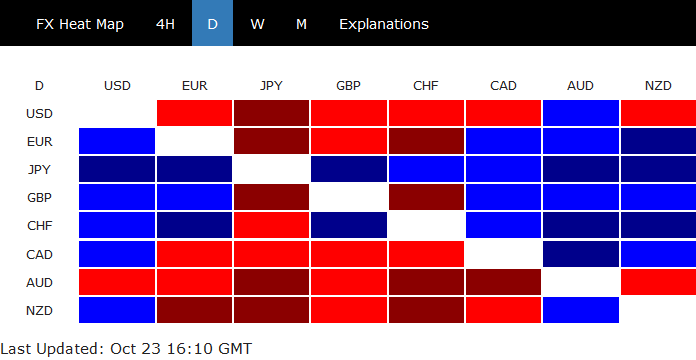
Yen remains the strongest one for today at the time of writing as global market rout spreads to the US. Swiss Franc trails as the second strongest.
On the other hand, Australian Dollar is the weakest one while Dollar is not that far away.
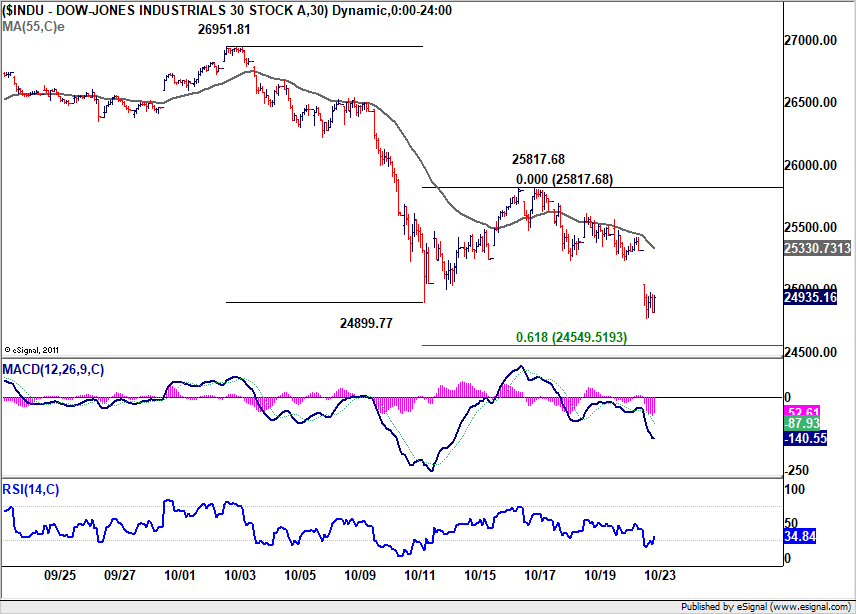
DOW is currently down -1.45 at 24949 after dropping to as low as 24768.79 earlier today. The break of 24899.77 support indicates resumption of the whole decline from 26951.81 and suggests more downside ahead. S&P 500 is down -1.98% while NASDAQ is even worse, down -2.15%.
Treasury yields are also in red with 10 year yield down -0.49 at 3.324.
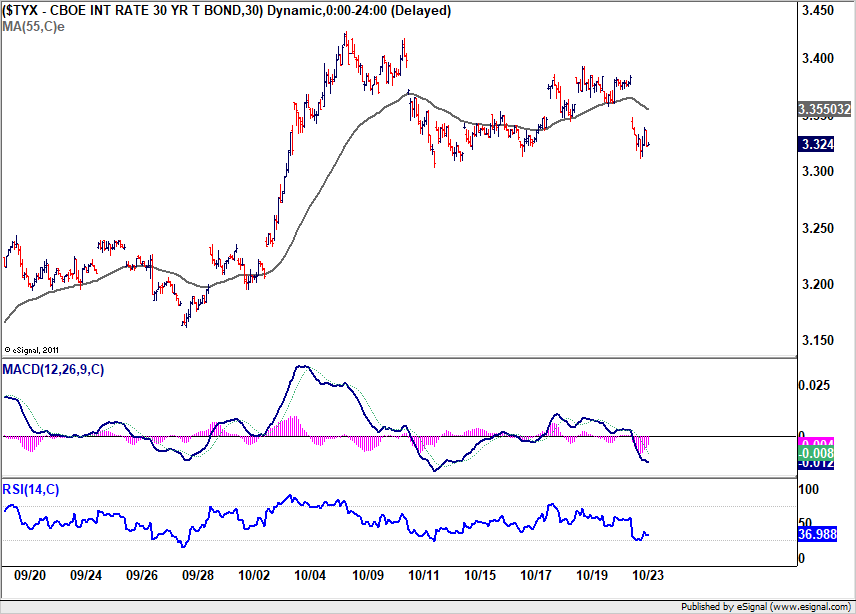
However, we'd like to point out that despite the strong rally, Yen bulls seem refusing to commit yet. USD/JPY is held by 111.94 minor support for now. EUR/JPY breached 128.32 low but quickly recovered. More is needed to confirm the strength of Yen.

In Europe:
- FTSE closed down -1.24% at 6955.21, broke 7000 psychological level
- DAX closed down -2.17% at 11274.28
- CAC closed down -1.69% at 4967.689, below 5000 psychological level.
- Italian 10 year yield jumped 0.10003 to 3.58 after EU rejection of Italian budget
- German 10 year yield is down -0.0407 at 0.411. German-Italian spread is back above 310.
Italy Di Maio demands respect from EU after unsurprised budget rejection
Italian Deputy Prime Minister, leader of the Five-Star Movement Luigi Di Maio said in his Facebook page that European Commission's rejection of the country's budget is not a surprise. He said, "this is the first Italian budget that the EU doesn't like. I am not surprised. This is the first Italian budget that was written in Rome and not in Brussels."
And he added "with the damage they had done before, we could not continue with their policies", referring to the European commission". Di Maio pledged to " continue to tell the European commission what we want to do with respect. But equally respect must be for the Italian people and the government that represents it today."
https://www.facebook.com/LuigiDiMaio/posts/1950064895030047?__xts__%5B0%5D=68.ARD2S2srlGcwsxjB-d9rX3hs8BGeNj9T8b6oBb9-ESKZfWI_8mDM7-imuENvyk68b30OJTVjC0eOpakTpduWRhkLbJ_ByknNq6jfV9zjGlIFQLnlgM2C-NkvsUOvqbQxpysIozmK3vE0Q2ik4GWn3mNsf85xSkgvcuzGqxW453nc-pW588RC2Q9BGW86sO7OYZDTV554HZIJz8qrLbSpYtI&__tn__=-R
British Pound Steadies after Sharp Losses
GBP/USD has ticked higher in the Tuesday session, following sharp losses at the start of the week. In North American trade, the pair is trading at 1.2984, up 0.15% on the day. On the release front, there are no major British or U.S events. British CBI Industrial Order Expectations remained in negative territory for a third straight month, dropping to -6 points. This was the weakest reading since October 2016. In the U.S, Richmond Manufacturing Index dropped sharply to 15 in October, down from 29 points in September.
Brexit negotiations appear at an impasse, although Prime Minister May put on a brave face on Monday, stating in parliament that 95% of the issues have been resolved, with the status Irish border remaining in dispute. May continues to face difficulties with a restless cabinet, as some ministers are uneasy about her remarks last week that she was open to extending the transition period. Brexiteers are also unhappy that May appears willing to accept the Irish backstop clause without a time limit, which could leave the UK tied to the EU for an interminate period of time. This means that May could face a leadership challenge, and a huge anti-Brexit rally in London on the weekend underscores the volatile political climate in Britain ahead of Brexit Day in just five months time. The uncertainty surrounding Brexit continues to weigh on the pound, which dropped below the symbolic 1.30 line on Monday, for the first time since October 4.
The trade war between the U.S and China continues to simmer, with the markets nervous that that trade tensions could escalate. The U.S Treasury Department released its semi-annual report on foreign exchange rates on Thursday, and there was some relief in the markets as the report did not name China as a currency manipulator. Still, the report said that the U.S was “deeply disappointed’ with that China refuses to disclose the extent of its foreign currency intervention. The Chinese yuan has slipped some 9 percent since April, and U.S officials are concerned that China has deliberately weakened the currency in order to counter U.S tariffs on Chinese goods, and will continue to monitor China’s currency practices.
Will the Bank of Canada Deliver a “Dovish Hike”?
The Bank of Canada (BoC) is nearly certain to raise interest rates by 25bps when it announces its decision on Wednesday, at 1400 GMT. Such a move is virtually fully priced in already and hence, price action in the loonie will hinge mainly on what signals the Bank sends regarding the likelihood of further hikes going forward. Following a marked slowdown in wages, policymakers may prefer to err on the side of caution for now, which renders the loonie vulnerable to a so-called “dovish” rate hike.
The Canadian dollar underperformed in recent weeks, giving back all the gains it recorded after a new NAFTA deal was announced in late September, to trade even lower against its US counterpart. The loonie tumbled even as investors priced in more and more tightening by the BoC over the coming years, as the new-found clarity around trade was expected to lead to faster rate increases. Indeed, it seems the currency’s latest troubles were driven by third factors, such as declining oil prices and a deterioration in market risk appetite, rather than anything related to monetary policy per se.
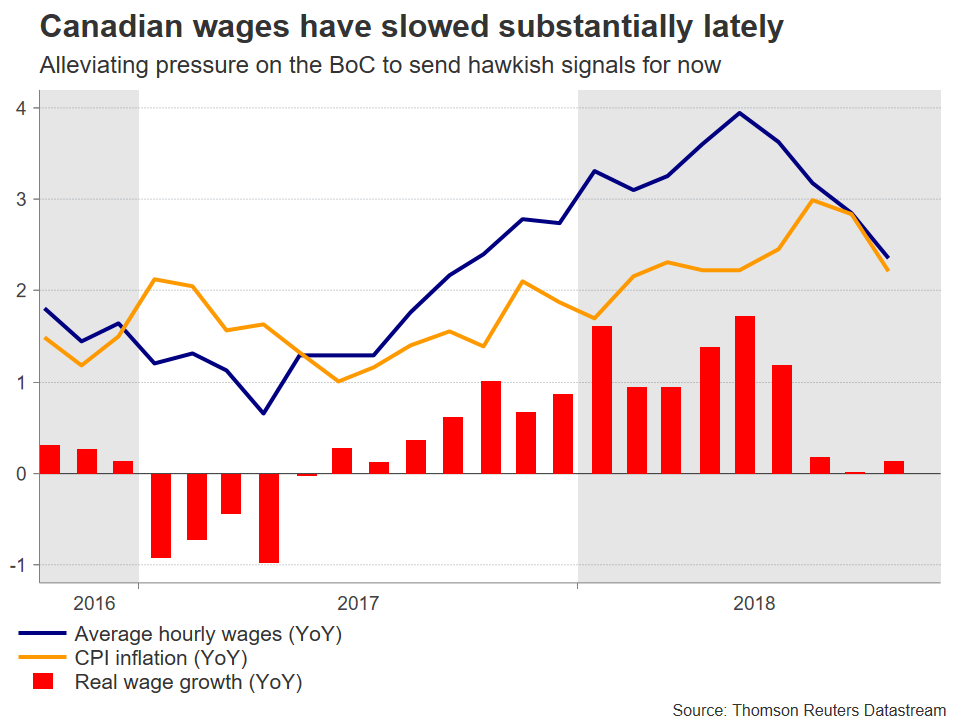
With respect to Canada’s economy, the situation is still solid, but some recent data suggest caution is warranted. On the bright side, the unemployment rate continues to hover near four-decade lows, while core inflation as measured by the BoC continues to track near its 2% target. Meanwhile, the Bank’s latest business survey – that is crucial for policy decisions – was quite upbeat, reporting rising expectations of future sales by firms and a rebound in investment intentions. In fact, considering this survey was conducted prior to the NAFTA-deal news, business optimism may be even higher now.It’s not all rosy though, with a notable slowdown in wages over recent months likely to give policymakers pause for thought. Real wage growth is back to virtually flat, which is particularly discouraging for an economy where households still carry high debt levels, but interest rates are rising. In such an environment, consumers may increasingly struggle to make ends meet, generating downside risks for consumption and hence, economic growth. Besides wages, retail sales data and forward-looking surveys like the PMIs have also disappointed lately, while headline inflation has eased back towards 2% faster than the Bank had anticipated.
Market-implied odds currently suggest a 95% probability for the BoC to raise rates by a quarter-point on Wednesday, according to Canada’s OIS. With a hike being practically fully factored in already, the market reaction will hinge on the signals policymakers send regarding the prospect of further action before long. Will the Bank place more emphasis on trade risks dissipating, stoking expectations for more hikes and thereby boosting the loonie? Or will officials err on the side of caution and signal little urgency for another move soon, triggering a negative reaction in the currency?
It’s a close call, but the latter scenario of a “dovish” hike appears slightly more likely. Markets have already priced in quite some tightening by the BoC in the coming quarters and thus, for the loonie to rally on the back of policy signals it may require very optimistic commentary from policymakers – which seems unlikely against a backdrop of slowing wages. Indeed, from a risk-management perspective, officials have little reason to signal faster hikes now, and risk having to backpedal on that commitment later should the data deteriorate.
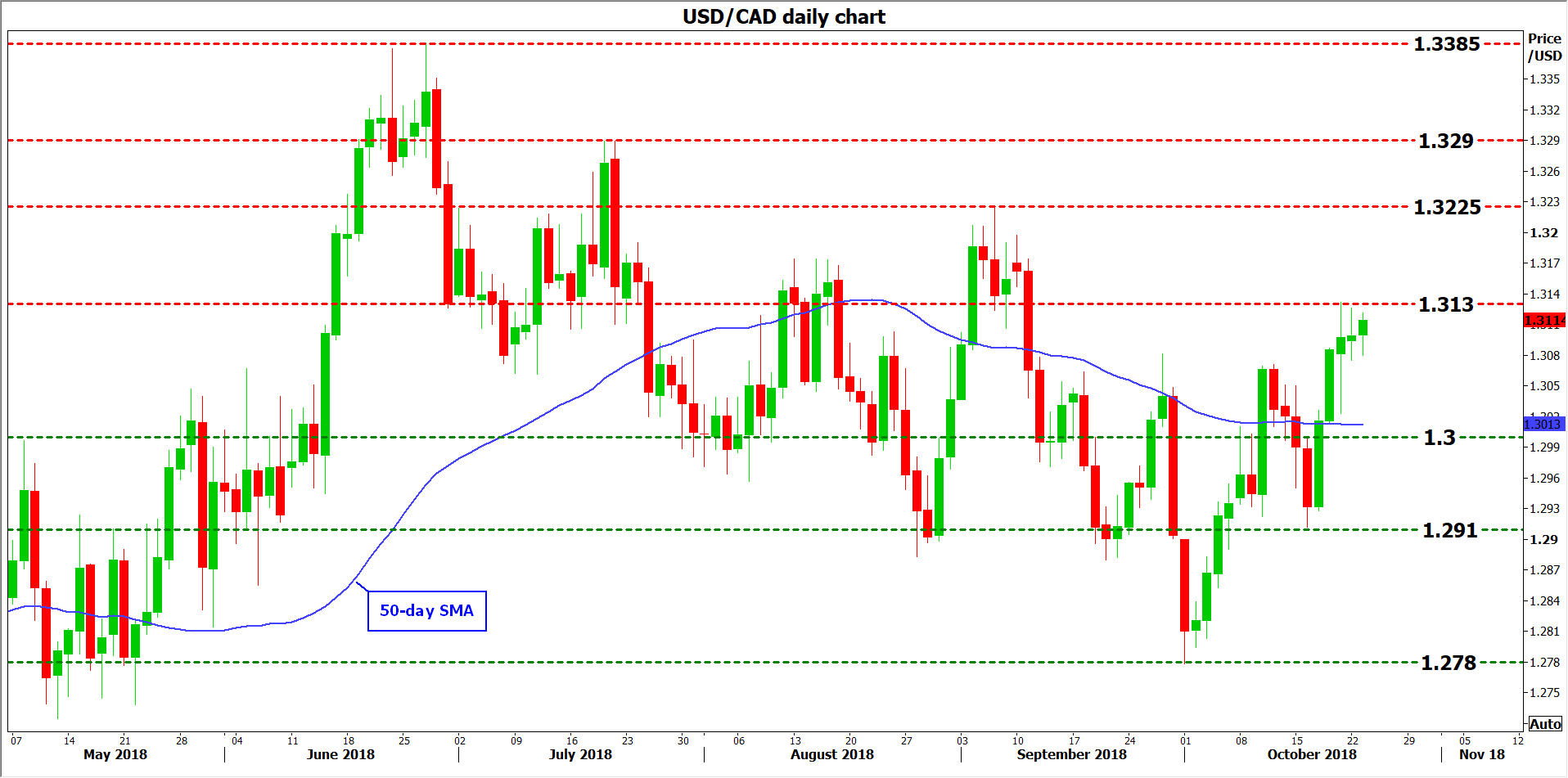
If the Bank disappoints those looking for hawkish signals, then the loonie could come under renewed selling interest. Technically, advances in dollar/loonie could encounter preliminary resistance near 1.3130, the October 19 high. An upside break could see scope for a test of the September 6 peak at 1.3225, before the July 19 top of 1.3290 come into view.
Conversely, a hawkish tone that stokes speculation for more hikes could see dollar/loonie drop, initially towards the round figure of 1.3000. If the bears pierce below it, support may come near 1.2910, this being the October 16 low, with even steeper declines aiming for the 5-month low of 1.2780.
In the (highly unlikely) event of no hike at all, the loonie could plunge.
Beyond monetary policy, the direction of oil prices will also prove crucial for the loonie given Canada’s status as a major crude exporter; higher prices are positive for the currency, and vice versa.
Erdogan’s Speech Adds to Market Gloom, Geopolitics Weigh
The manner in which investors hung with anticipation to the address from Turkish President Recep Erdoğan on Tuesday has highlighted that geopolitical risk headlines are back on the frontline radar of financial markets.
Those hoping that the Turkish president would have made new revelations were largely left empty-handed after Erdoğan mostly repeated information that has already been circulated. However, he did speak with enough conviction to show that this situation will not be going away anytime soon.
This consequently means that an element of political and geopolitical risk will remain in the marketplace, meaning that we can expect further pressure on riskier assets as investors become reluctant to take on risk. Stock markets are at threat of remaining pressured, while many emerging market currencies are once again noticing a lack of buying demand.
There has however been an increase in valuation for both Gold and the Japanese Yen, highlighting investor anxiety over the return of potential geopolitical tensions and a green light for an overdue rally in safe-haven assets
How will the Trump Administration respond?
The strongest takeaways from Erdogan’s address were arguably his admission that he will continue to pursue the investigation into the journalist’s disappearance.
This is an incident that has received widespread negativity with world leaders demanding “credible facts” from Saudi Arabia. Most will now be awaiting to see if President Trump comments on the speech from Erdogan earlier today.
This is obviously an unusual situation which would normally be seen as a political or diplomatic issue, but it has attracted international attention and it highlights that investors do need to reassess potential geopolitical risks as a result.
Emerging market currencies in crosshair
Emerging market currencies were an easy target for sellers today as concerns over Italy’s budget, trade tensions, Brexit uncertainty and geopolitical tensions soured risk appetite.
With risk aversion likely to remain a dominant theme this week amid the mounting geopolitical tensions, this is bad news for EM currencies. The selling momentum is set to intensify if the Dollar later jumps on potential safe-haven flows.
GBP/JPY Mid-Day Outlook
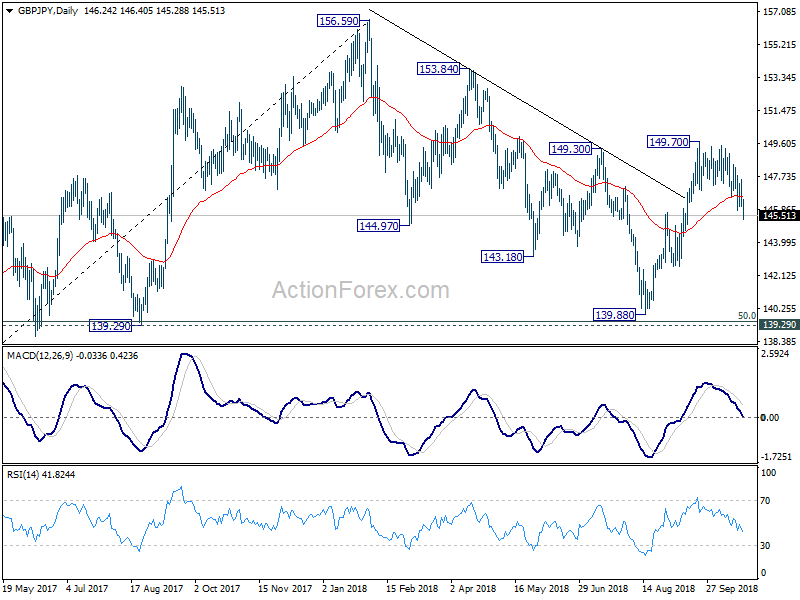
Daily Pivots: (S1) 145.70; (P) 146.65; (R1) 147.23; More...
GBP/JPY's break of 145.67 resistance turned support now suggests that whole rise from 139.88 has completed at 149.70 already. Intraday bias is now on the downside for 142.59 support first. Break will target 139.88 low next. On the upside, break of 147.57 resistance is needed to indicate completion of fall from 149.70. Otherwise, near term outlook will now stay mildly bearish even in case of recovery.
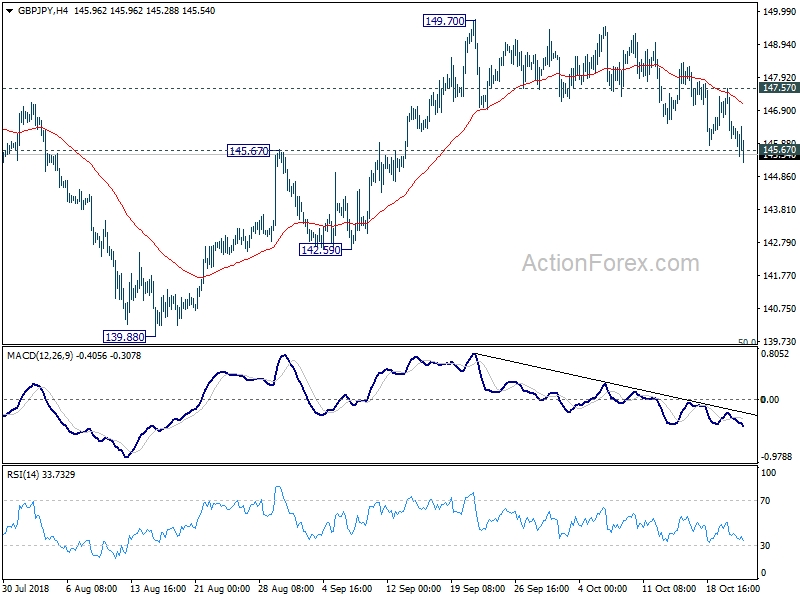
In the bigger picture, as long as 139.29 cluster support (50% retracement of 122.36 to 156.59 at 139.47) holds, up trend from 122.36 (2016 low) would still extend beyond 156.69 high. However, decisive break of 139.29/47 will suggest that such up trend is completed and turn outlook bearish.
EUR/JPY Mid-Day Outlook
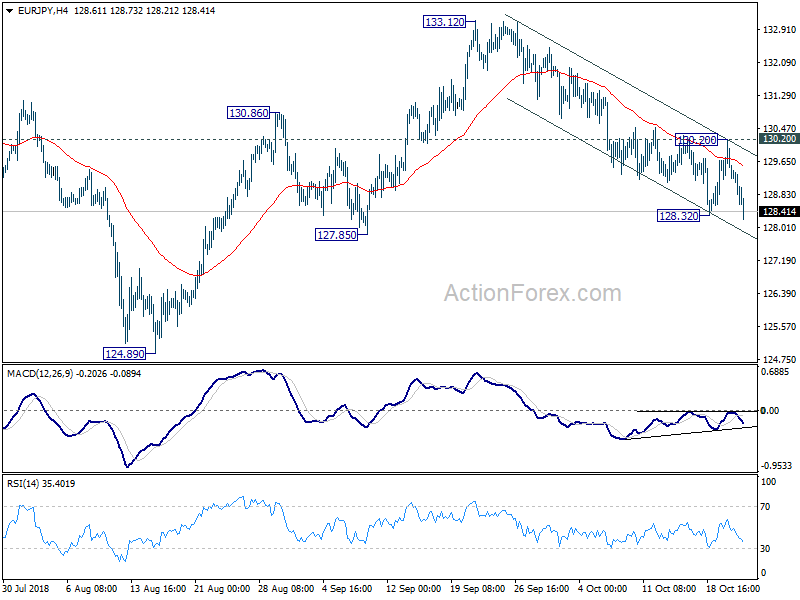
Daily Pivots: (S1) 128.96; (P) 129.59; (R1) 129.97; More....
EUR/JPY's break of 128.32 support today indicates resumption of fall from 133.12. Intraday bias is back on the downside for 127.85 support next. Firm break there should confirm completion of rebound from 124.89 at 133.12 and bring retest of this low. On the upside, break of 130.20 resistance is needed to indicate short term bottoming. Otherwise, outlook will remain bearish even in case of recovery.
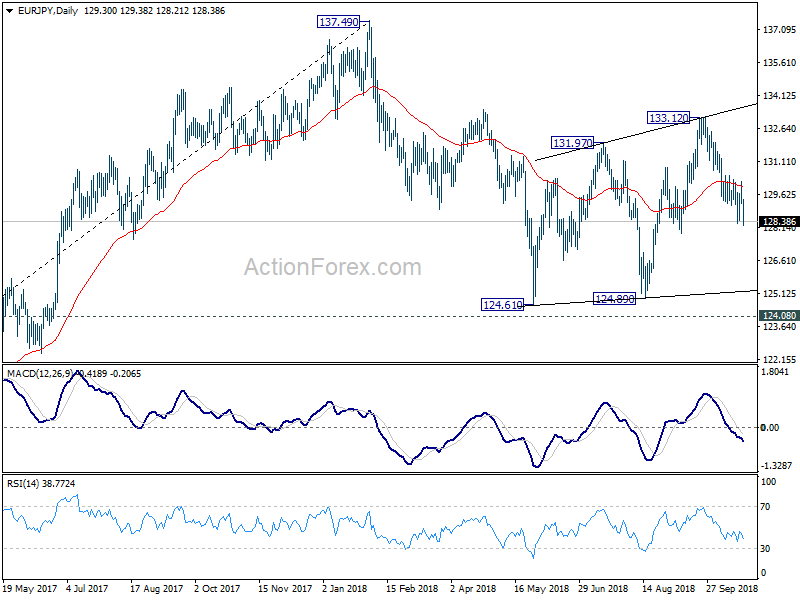
In the bigger picture, as long as 124.08 key resistance turn supported holds, larger up trend from 109.03 (2016 low) is still in progress. Firm break of 137.49 structural resistance will target 141.04/149.76 resistance zone next. However, decisive break of 124.08 will argue that such rise from 109.03 has completed and turn outlook bearish.
Safe-Haven Yen Jumps as Markets Lose Ground
The Japanese yen has posted sharp gains in the Tuesday session. In North American trade, USD/JPY is trading at 112.01, down 0.73% on the day. Investors have supported the safe-haven yen, as global equity markets are in red territory on Tuesday. On the release front, BoJ Core CPI posted a gain of 0.5%. In the U.S, the Richmond Manufacturing Index dropped sharply to 15 in October, down from 29 points in September. We’ll get another look at Japanese inflation on Wednesday, with the release of SPPI.
The Bank of Japan’s radical monetary easing policy has cut into the profits of many financial institutions, but the BoJ has no plans to alter course. The bank released its semiannual financial system report, which noted that the financial sector shows no signs of overheating and that banks continue their “active lending attitudes”. However, there was a warning as well, with the report noting that the extremely low interest rates and led to lenders being more aggressive and entering less-profitable loans with small businesses. The BoJ is unlikely to make any changes to policy before 2020, aside from some minor tweaks. Bank policymakers will meet on Oct. 30-31 for the next policy meeting.
The trade war between the U.S and China remains a serious concern for Japan, whose economy is heavily dependent on exports. A Japanese government report released on Tuesday sounded pessimistic about the export sector. The October report lowered its forecast for exports, due to the ongoing trade war. The report said that exports were flat, but also noted that the Japanese economy continued to recover at a moderate pace. President Trump has spared Japan’s auto sector from tariffs for now, but Japan could be in serious trouble if the trade war escalates. China is Japan’s largest trading partner and the downturn in China’s growth in the third quarter is not good news for Japan.