Sample Category Title
Euro Trades Flat as Italy Awaits EU’s Verdict; European Stocks in the Red
Here are the latest developments in global markets:
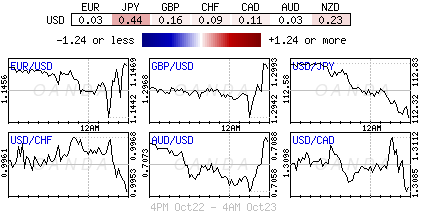
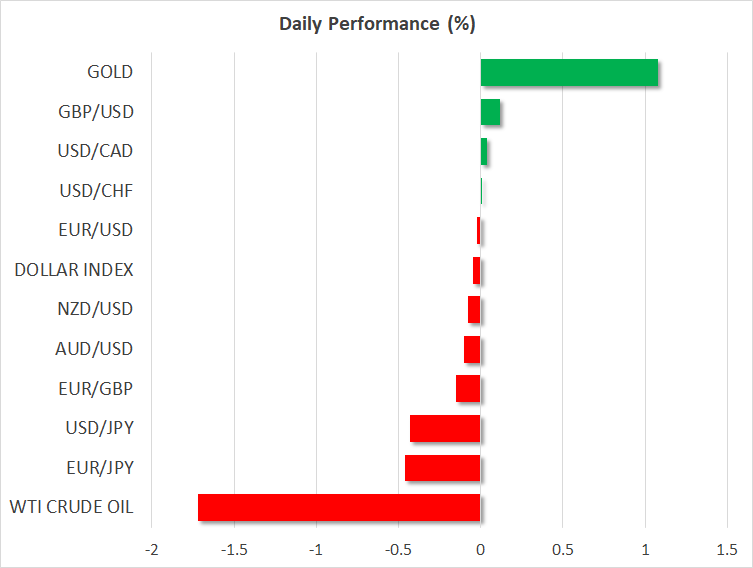
- FOREX: The dollar index was trading weaker by 0.10% while dollar/yen failed to pierce the 113 round level and instead dived to 112.30 (-0.43%), as the yield on 10-year Treasuries dropped by 5 basis points to 3.14%. Meanwhile the US President promised to give the middle class a 10% tax cut yesterday, intensifying his campaign ahead of US midterm elections on November 6. Euro/dollar was flat at 1.1468 as investors awaited the EU to give an answer on the Italian draft budget later today. Pound/dollar was up by 0.20% at 1.2985 despite worries over British Prime Minister Theresa May’s political future, and a continued deadlock in the Brexit talks. However, with demand for safe-havens rising, pound/yen fell to negative territory, losing 0.25%. Taking a look at the antipodean currencies, aussie/dollar and kiwi/dollar moved marginally lower by 0.07%. Dollar/loonie remained flat for another day, hovering near the 1.3100 handle. The Turkish lira plummeted by almost 2.0% after the Turkish president said that his ruling AK party will not unite with the nationalist party for the 2019 local elections, though he added that both parties will keep close ties. Note that the parties had formed an alliance before June elections but were in disagreements about legal issues.
- STOCKS: European shares were a sea of red on Tuesday at 1100 GMT, creating multi-month lows after disappointing third-quarter earnings results, especially in the tech sector. Moreover, a cocktail of negative factors including Brexit uncertainties, Italy’s budget, Saudi isolation, Chinese growth and US trade protectionism were keeping investors away from riskier assets. The pan-European STOXX 600 and the blue-chip Euro STOXX 50 declined by 1.17% and 0.83% respectively, to their lowest levels since December with almost all sectors flashing red. The German DAX 30 was the worst performing index, diving by 1.78%, the French CAC 40 tumbled by 1.26%, while the Italian FTSE MIB declined by 0.46%. UK’s FTSE 100 saw a loss of 0.66%. In the US, futures tracking the major stock indices were pointing to a significantly negative open.
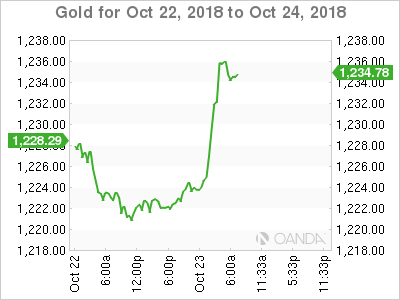
- COMMODITIES: Oil prices plummeted as well today, as Iran’s oil minister said that the US cannot stop Iranian oil exports by imposing sanctions on Tehran. WTI crude oil plunged by 1.77% to $68.13/barrel and London-based Brent dived by 2.17% to $78.10/barrel. In precious metals, gold prices returned to gains (+1.08%), recording a new 3-month high of $1236 per ounce, as stock markets suffered amid political and economic uncertainties.
Day Ahead: Italy to receive budget feedback from the EU; May could face leadership challenge
The future of the Italian spending outline, the ongoing US-Sino trade war, and questions of whether the UK and the EU will ever agree on divorce terms before Brexit are likely to continue to feed risk-off sentiment in the markets later in the day.
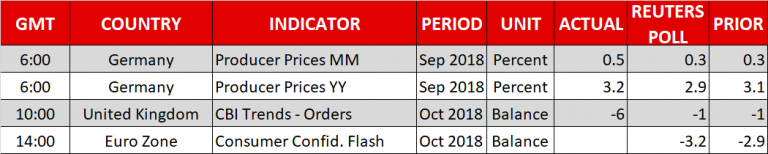
In Italy, the coalition government will be expecting official budget feedback from the European Commission until next Monday which is highly likely to be a negative one after the aforementioned legislative institution said in a letter that Italy’s fiscal demands are unprecedented given the country’s overloaded public debt (130% of GDP). In case the EU rejects the 2019 budget draft which aims for a deficit target of 2.4% compared to 1.8% in 2018, Rome will have to re-submit new spending plans in three weeks. While the Italian Finance Minister, Giovanni Tria, revealed on Monday that Italy is open for dialogue with the EU and has no intention to overcome the 2.4% target in 2020 and 2021, he did not show any commitment to change the 2019 budget outline, suggesting Italy might not leave this battle so early. Especially after he warned that the government is ready to intervene so that these targets are respected. Traders will be closely watching the Italian 10-year government bond yield as risk aversion could help the yield to catch the 4-year high of 3.78% marked on Friday. Yet given that a rejection is highly priced in the markets, the impact on yields as well as on the euro might be minimal. The latter however, could see some volatility after the release of the October flash Consumer Confidence index at 1400 GMT. Analysts believe that consumers turned more pessimistic this month, leading the index to a fresh 1 ½ -year low of -3.2 compared to -2.9 before.
In the UK, the British Prime Minister, Theresa May is under pressure over her Brexit plans as members within her Conservative party as well as rivals from the rival Labour party turned more frustrated after reports her administration is willing to accept an open-ended timeframe for the Irish border and prolong the transition period. Should ministers issue a no-confidence vote against May’s leadership in coming sessions, the pound could extend even lower. Recall that although May said that 95% of the Brexit deal is done, she needs to pass the withdrawal bill through Parliament before implementation.
In Sweden, the Riksbank will meet to decide on monetary policy at 0830 GMT on Wednesday. In September, policymakers signaled that interest rates will remain steady in October but hinted that in December or February a rate hike could be on the cards. As inflation readings appeared stronger than expected in September, the central bank may well use a more hawkish tone on the path of interest rates, potentially helping the krona to head up.
Meanwhile in Turkey, the murder of the Saudi Washington Post journalist which has raised political tensions between US and Saudi Arabia remains a puzzle. The Turkish President called statements from Saudi Arabia, which is blamed for killing the columnist, inconsistent earlier today and argued that the death was a planned murder, adding further pressure on Saudi Arabia.
In oil markets, the American Petroleum Institute will publish its weekly report on US crude inventories at 2030 GMT, with traders looking forward to seeing whether US stocks continued to build up in the week ending October 20. In case this comes true, oil prices will probably lose further ground.
Equities will be also under the spotlight following the recent sell-off and ahead of important earnings releases from Google’s parent Alphabet, Amazon, Microsoft and Twitter later in the week.
Any potential updates on the trade front would be valuable during the day as China tries to mitigate negative risks from US import tariffs after GDP growth figures in the third quarter slowed surprisingly to levels never seen since 2009.
As for today’s public appearances, at 1730 GMT Atlanta Fed President Raphael Bostic will be commenting on the economic outlook and monetary policy before the Committee of 100, while at 1815 GMT Dallas Fed President Robert Kaplan will be participating in a Q&A session before the Galveston Economic Development Partnership 7th Annual Economic Development Summit, in Galveston, Texas. Later at 2215 GMT,Chicago Fed President will be talking at the Northwestern University.
Sterling rebounds as EU may offer a UK-wide customs union
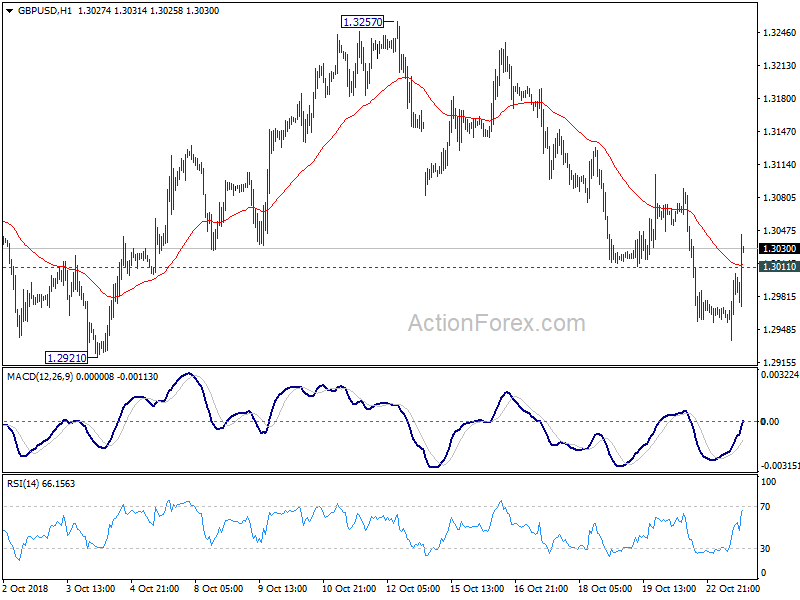
Sterling rebounds strongly on an RTE news report that EU is going to offer the a UK-wide customs union as a way to work around the Irish backstop deadlock. And, the way to handle it is that in the Brexit Withdrawal Agreement, there will be a specific commitment to a UK wide customs arrangement. However, a formal EU-UK customs union will require a separate agreement. By offering that, EU will still insist on a backstop to be in place.
The details of the idea are remain to be seen. And it's uncertain whether UK Prime Minister Theresa May will accept it. Nor is it clear whether there is any technical issues overlooked. But for now Sterling is enjoying a notable rebound as seen in GBP/USD.
Into US session: Yen strongest, Aussie weakest. Risk aversion lifts gold
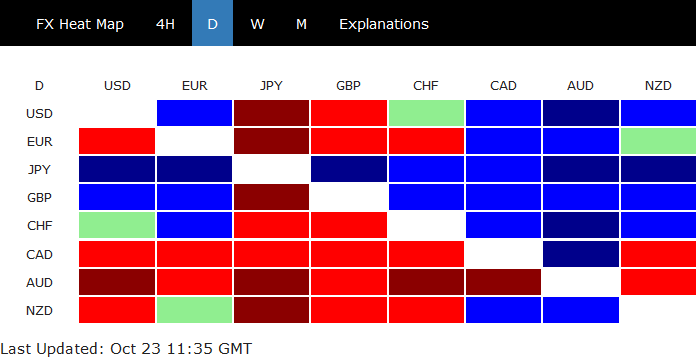
Entering into US session, Yen remains the strongest one as global stock market rout deepens. Meanwhile, Australian Dollar is the weakest one, followed by Canadian and then Euro. Gold also rides on risk aversion and hit as high as 1236.7 so far. Economic calendar is light in the US session. So major focus will remain on risk sentiments, currently, DOW futures are dropping more than 300 pts. Euro will also be moved by news on European Commission's reaction to Italy's reply on budget.
In Europe, at the time of writing:
- FTSE is down -0.52% at 7006.14
- DAX is down -1.55% at 11345.8
- CAC is down -1.02% at 50001.79
- German 10 year yield is down -0.0204 at 0.431
- Italian 10 year yield is down -0.005 at 3.474. Spread with German remains around 300.
Earlier today in Asia:
- Nikkei dropped -2.6% to 22010.78
- Hong Kong HSI dropped -3.08% to 25346.55
- China Shanghai SSE dropped -2.26% to 2594.83
- Singapore Strait Times dropped -1.52% to 3031.39
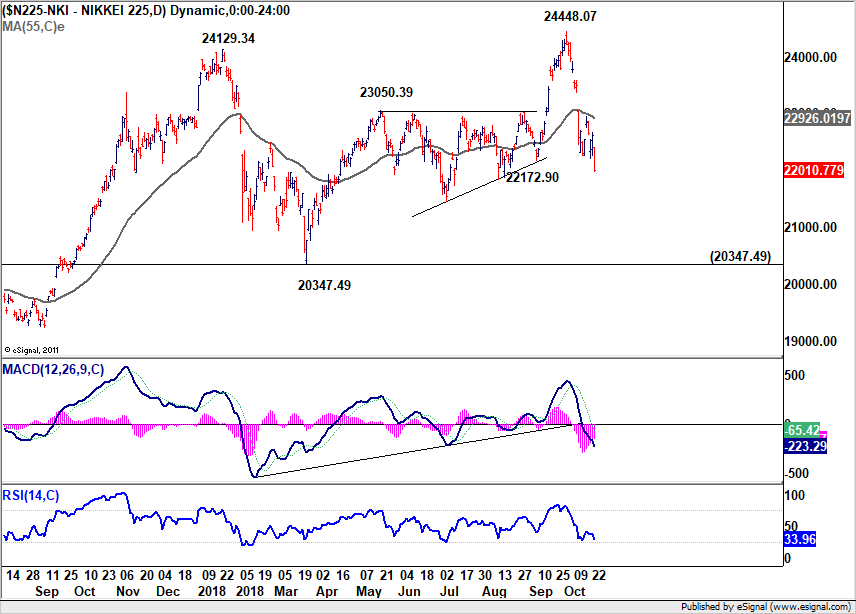
Nikkei's fall from 24448.07 high resumed today and the break of 22172.90 support confirmed completion of rise from 20347.49. Near term outlook is rather bearish with prior rejection by 55 day EMA. Further fall is now likely to be seen towards 20347.59 key support level. At this point, we don't expect a break there yet.
Gold Analysis: Jumps On Tuesday
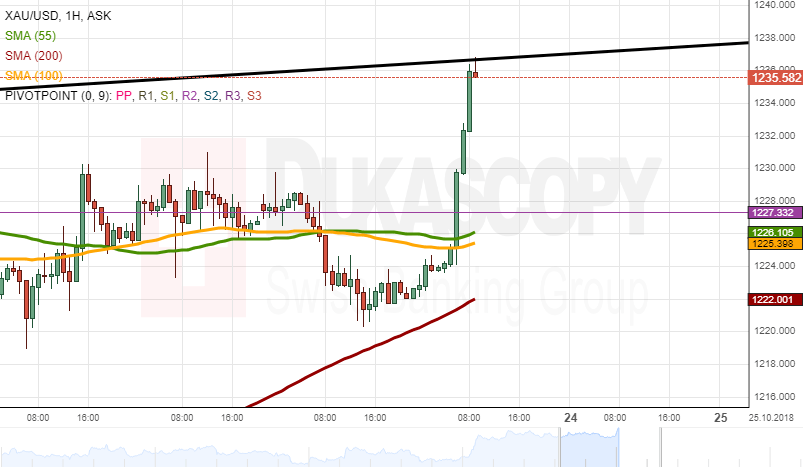
Gold prices have surged on Tuesday morning and reached the upper trend line of a dominant ascending pattern near the 1,235.00 level.
If the commodity price breaks the resistance of the trend line, the metal is set to surge at least up to the 1,240.00 mark.
Meanwhile, a bounce off from the resistance and a following decline would reach back down to the pivot point at the 1,227.30 level.
USDJPY Analysis: Might Reach 112.00
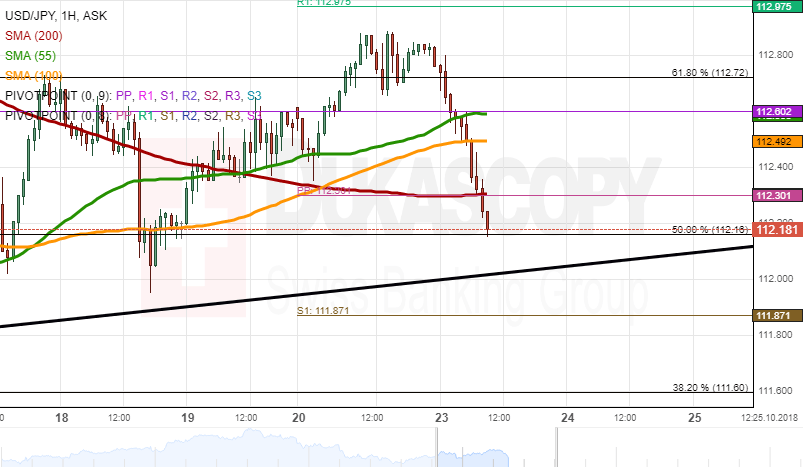
The US Dollar continued to plummet in value against the Japanese Yen on Tuesday. Namely, the rate had fallen down tot he 112.15 mark by the middle of the day. At that level a 50.00% Fibonacci retracement level was located at.
If the level does not stop the decline of the pair, it will reach for the lower trend line of the dominant ascending pattern near the 112.00 level.
On the other hand, the rate might bounce off the Fibo and surge up to the 112.30 level. At that level the 200-hour simple moving average together with the weekly PP were located at.
GBPUSD Analysis: Reaches Up To 1.30
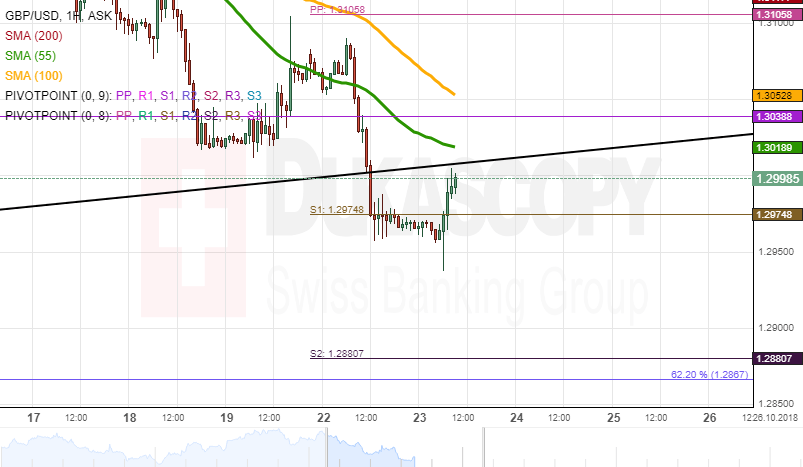
On Tuesday, the GBP/USD continued its decline, which was occurring after the rate passed the support line of a large scale channel up pattern.
Although, by the middle of Tuesday's trading the rate had surged back up to the passed trend line to support it as resistance. Such moves happen often after the breaking of larger patterns.
In general, it is expected that the rate will bounce off the trend line near the 1.30 level and decline down to the 1.2975 level where the weekly S1 is located at.
EURUSD Analysis: Retreats To 1.1440
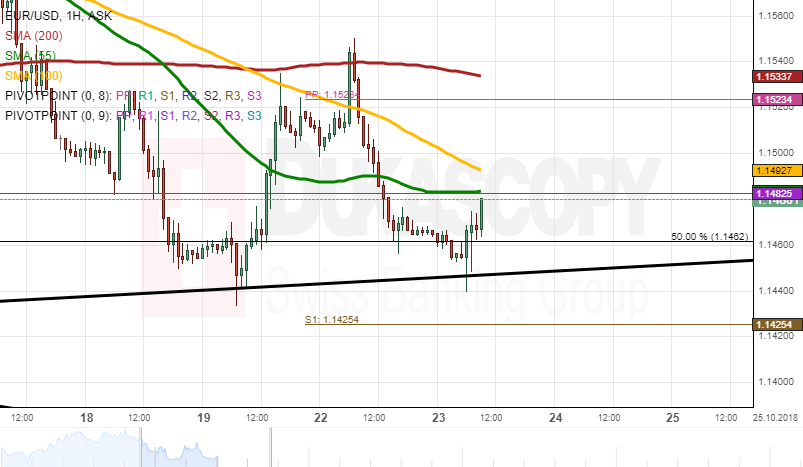
The common European currency has retreated against the US Dollar down to the 1.1440 mark. At that level the pair had met the support of a dominant pattern and surged.
By the middle of Tuesday's trading the EUR/USD pair was located at a strong resistance near the 1.1480 mark. If this level is passed, the currency exchange rate would surge up to the 1.1520 mark, where the weekly PP is located at.
On the other hand, the pair might fail to pass the resistance and once more retreat downwards to the 1.1462 level. At that level a 50.00% Fibonacci retracement level was located at.
AUD/CHF 4H Chart: Breaches SMAs
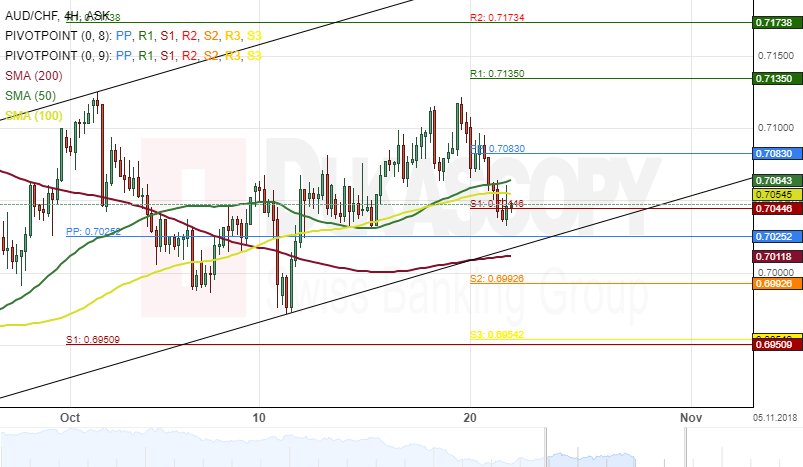
The Australian Dollar has been appreciating against the Swiss Franc after the currency pair bounced off the lower boundary of a seven-week ascending channel at 0.6850.
Presently, the exchange rate is trading near the bottom border of the seven weeks channel and the 200-hour simple moving average at 0.7011. If this support level holds, it is expected that the pair will aim for the upper boundary of the channel at 0.7173 during the following trading sessions.
If given resistance line holds, the currency exchange rate might make a reverse and move downward for a re-test of the lower channel pattern level at 0.7011.
NZD/CHF 4H Chart: Moving Towards 50-Hour SMA
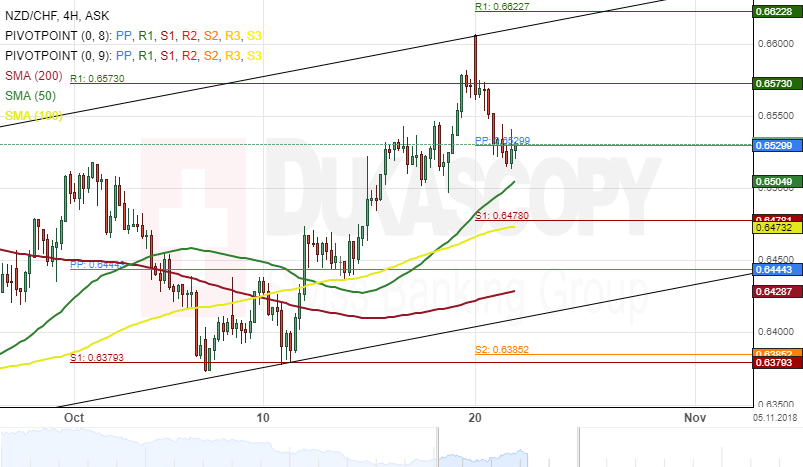
The New Zealand Dollar has appreciated massively against the Swiss Franc since the middle of September after the currency pair reversed from the lower boundary of a four-week ascending channel at 0.6333.
The exchange rate tested the upper boundary of the channel pattern at 0.6600 during yesterday's trading session. After hitting the resistance level, the pair made a pullback south and currently moving towards a support level formed by the 50-hour simple moving average at 0.6502.
If this support level holds, it is expected that the currency exchange rate will aim for a re-tests at the upper border of the channel at 0.6600 during the following trading sessions.
Bullying Up On Safe Havens
Tuesday October 23: Five things the markets are talking about
Global stocks have swung sharply lower overnight, amid growing fears about the health of the Chinese economy and a slew of geopolitical concerns – U.K, Italy and Saudi Arabia.
In Italy, the populist-led government has indicated that they plan to proceed with their spending plans despite the opposition from E.U lawmakers. Markets are awaiting the formal E.U decision on Italy’s budget.
In the U.S, President Trump indicated late Monday he wanted more information about the death of Jamal Khashoggi before the U.S proposed an official reaction.
In the U.K, the ‘no-confidence’ threat to PM Theresa May leadership over Brexit discussions has, thus far, come to nought, but not before pushing sterling to three-week lows earlier this morning.
All this heightened geopolitical risks is pushing investors to seek shelter in safe-haven assets – pushing up prices of the yen (¥112.31), gold ($1,235) and U.S Treasuries (10’s 3.15% -5 bps).
1. Stocks fail miserably
Global equities have failed to gain a third consecutive session reprieve after China announced Monday new measures to ease the funding worries of private companies, as they sought to restore confidence in China’s economy.
In Japan, stocks fell on Tuesday, with the broad Topix index retreating to a seven-month low as subdued corporate earnings and a pullback in global equities weighed on investor sentiment. The Nikkei closed -2.67% lower, while the broader Topix fell -2.63%.
Down-under, Aussie shares also closed lower as sentiment was hit by domestic and global political uncertainty. The S&P/ASX 200 index closed down -1.1%, a third consecutive session of losses, following Monday’s -0.6% drop. In S. Korea the Kospi index fell -2.3% to its lowest level in over two-years. The potential for U.S tariffs on Korean cars and auto parts has been stocks biggest blight for months now.
In China, the Shanghai Composite Index and the Shenzhen A Share dropped -2.3% and -2.1%, while Hong Kong’s Hang Seng was dragged down -2.8% by sinking financial stocks. The overnight losses marked an end to the regions sharpest two-day rise in nearly three-years.
In Europe, regional bourses trade lower across the board tracking weaker Asian indices and lower U.S futures, again pressured by underwhelming corporate earnings.
U.S stocks are set to open deep in the ‘red’ (-1.1%).
Indices: Stoxx600 -1.38% at 354.78, FTSE -0.90% at 6,979.19, DAX -2.16% at 11,275.03, CAC-40 -1.43% at 4,981.00, IBEX-35 -1.19% at 8,702.00, FTSE MIB -1.02% at 18,773.50, SMI -1.12% at 8,762.50, S&P 500 Futures -1.21%
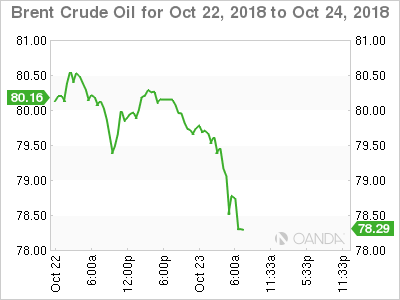
2. Oil falls as the Saudi’s say they will be ‘responsible,’ gold higher
Oil prices has eased a tad ahead of the U.S open after Saudi Arabia said it would play a “responsible role” in energy markets.
Nevertheless, the underlying market sentiment remains somewhat nervous ahead of new U.S. sanctions on Iran’s crude exports that begin on Nov 4.
Brent crude oil is down -55c a barrel at +$79.28, while U.S light crude is -35c lower at +$69.01.
Investors had been worried that Saudi Arabia would cut crude supply in retaliation for potential sanctions against it over the Jamal Khashoggi murder.
The Saudi’s have given assurance that it intends to keep markets well supplied despite its increasing isolation by the western hemisphere.
Saudi Energy Minister Khalid al-Falih stated Monday that they would play a “responsible role” in world energy markets. Basically, the Saudi’s don’t want to lose market share to other world exporters.
OPEC agreed in June to boost supply to make up for the expected shortfall in Iranian exports, however, recent data suggests that OPEC is struggling to add barrels as an increase in Saudi supply was offset by declines elsewhere.
Nevertheless, relief may come from the U.S, where offshore drillers added four oilrigs in the week to Oct. 19, bringing the total count to 873, according to Baker Hughes data last Friday. After months of stagnation, U.S crude production is expected to rise.
However, undermining sentiment is weaker China growth data and the ongoing Sino-U.S trade dispute. The full impact of the trade war is expected to hit markets early next year and provide a considerable drag on oil demand.
Ahead of the U.S open, gold prices have jumped higher overnight as global equities see ‘red,’ weighed down by geopolitical tensions. Spot gold is up +1.1% at +$1,235.95 an ounce, while U.S. gold futures have edged + 1.2% higher to +$1,233.20 an ounce.
3. Central banks monetary policy decisions
Last Friday was a disappointing end to the week for Canadian numbers, as consumer spending and inflation data both dropped into negative territory. The disappointing headlines are not expected to affect the Bank of Canada’s (BoC) plan to hike rates tomorrow (10:00 am EDT) by +25 bps to +1.75% – it would mark the third rate increase in 2018.
Current market consensus believes that Italian budget worries are unlikely to influence the ECB’s upcoming decisions on Thursday – the ECB is expected to stay on track to end net asset purchases in December and raise the deposit rate by +20 bps in Q3, 2019. Draghi and company will certainly be worried about the potential implications of escalating market tensions and true to form, markets can expect the ECB to intervene “if and when” a further escalation raises the chances of a systemic problem.
Sweden’s Riksbank meets tomorrow and the focus will be on whether the central bank will forecast a December or a February rate increase – market expectations are for a Dec hike. Expect little movement to SEK if the Riksbank guides on a December rate increase. Norway’s Norges Bank meets Thursday and no rate announcement is expected.
The Central Bank of the Republic of Turkey (CBRT) is expected to hold its main interest rate steady at its meeting on Thursday. At its September meeting, the CBRT raised its main interest rate by +625 bps to +24%. Having an influence on higher rates was the volatility and negativity of TRY. However, the TRY has recently rallied on the back of Turkey releasing American priest, Andrew Brunson, leading to a softening of diplomatic tensions.
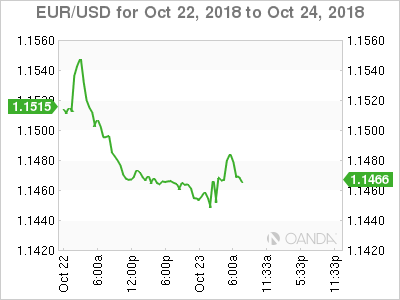
4. Safe haven flows dominate
The ‘sea of red’ in stocks across the board has the market bulling up on the historical go to safe haven flows – CHF, JPY, USD, gold and Treasuries.
The market is waiting for the E.U’s formal decision on Italy’s budget, but both parties are looking to sort out their material differences. Investors expect a market-friendly outcome from S&P Ratings on Italy this coming Friday (Oct 26th), similar to Moody’s announcement last week.
EUR/USD (€1.1483) began the session on back foot, but hope expressed by Italy that the ECB would stand by with support has helped to calm any volatility and push the single currency towards the psychological €1.15 handle.
GBP/USD (£1.2989) main focus is Brexit negotiations. PM May is meeting her cabinet today and no leadership challenge appears to be on the horizon, for the moment at least. The pound is handily off its three-week lows regarding May’s tenure.
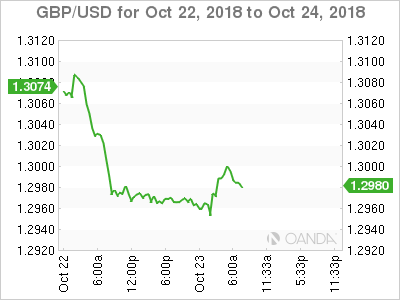
5. German producer price inflation highest in a year
Data earlier this morning showed that Germany’s producer prices rose the fastest pace in a year in September.
Producer prices grew +3.2% year-on-year in September, after rising +3.1% in the previous month. The market was looking for a +3.0% gain.
The inflation rate was the highest in 12-months, when prices advanced +3.2%.
Digging deeper, on a month-on-month basis, producer prices climbed +0.5% after a +0.3% increase in August. The market was looking for an unchanged at +0.3%.
Ex-energy, PPI remained unchanged m/m, while rising +1.6% on the year.
Note: Energy prices have rallied +8.5% y/y.