Sample Category Title
Italy may adjust budget plan if markets react negatively
Italian newspaper Il Messaggero reported today that the coalition government is prepared to adjust its budget plan should markets react negatively. For now, the government is sticking to its deficit target of 2.4% of GDP in 2019. And there could be a plan B for the government including redefining the key elements of the expansive budget. Those adjustments could even include retirements and basic income for the poor.
European Commissions will discuss today what's next regarding Italy, after formally getting its reply. It's generally expected that the Commission will reject the budget and demand resubmission from Italy.
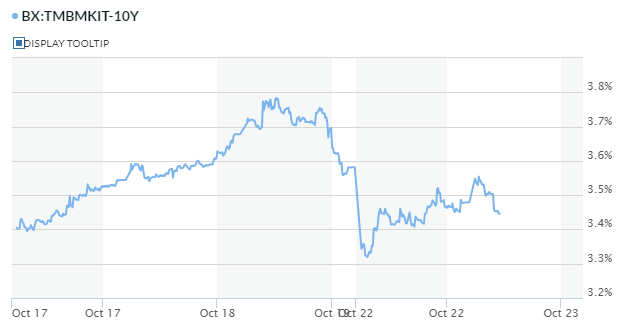
EUR/USD's weak recovery ahead of 1.1432 supprot today could be an reaction to the news. But it's so far very weak.
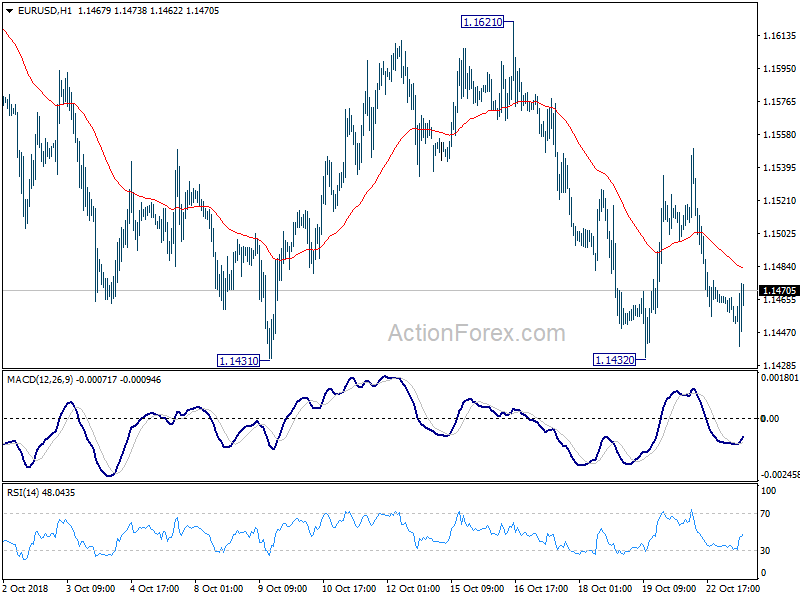
Italian 10 year yield is down -0.033 at 3.447 for the moment. It's already way off last week's high near to 3.8%. But German 10 year yield is currently at 0.445. Spread remains close to 300.
Pound Weakens On Market’s Worries
Cable dropped as market worries about Brexit, as well as a possible leadership challenge in the Tory party, intensified yesterday. A possible proposal on behalf of UK’s PM Theresa May, of extending a customs union within the EU, has angered hard Brexiteers, according to media. Analysts point out that the leadership challenge is hanging over the sterling which is (also) waiting for another steer on Brexit. Conservative parliament members seem to play down the risks of a possible challenge, as they stated yesterday that a leadership challenge this week is unlikely. Should there be more negative headlines about Brexit, we could see the pound weakening even further.
Cable dropped yesterday, from the highs of the 1.3080 (R3) resistance level, breaking the 1.3025 (R2) and the 1.2965 (R1) support lines (now turned to resistance). The pound is expected to continue to be heavily Brexit driven (inner political stage as well as Brexit negotiations with EU) today, as there is an absence of important financial releases. Should there be further negative headlines regarding the UK political scene or the ongoing Brexit negotiations we could see the pound weakening and vice versa. Technically it should be noted that the pair’s RSI indicator in the 4 hour chart, is testing the reading of 30 implying an overcrowded short position. Should the bears be in charge of the pair’s direction we could see the pair breaking the 1.2920 (S1) support line and aiming for the 1.2850 (S2) support barrier. Should on the other hand the pair’s direction be dictated by the bulls, we could see the pair breaking the 1.2965 (R1) resistance line and aim for the 1.3025 (R2) resistance hurdle.
Euro weakens on Italian budget issue
The common currency lost ground against the USD yesterday, as the market feared further political instability in the Eurozone due to the Italian budget issue. The weakening of the common currency took place despite a large drop in Italian government borrowing costs. It should be noted that rating agency Moody’s had downgraded Italy’s credit rating, however kept the outlook at stable. Analysts point out, that there are signs of more conciliatory tones from both sides, but it is clear that this dispute is not over yet. Fundamentally the dispute’s significance, especially should Brussels reject Rome’s budget, would test the strength of one member against the rest of Eurozone’s members as well as the possible countermeasures, Brussels have in their arsenal in case of a lonely rebellion. Should there be further negative headlines about the issue or an escalation, we could see the Euro weakening.
EUR/USD dropped yesterday, after rallying for a short period of time above the 1.1480 (R2) resistance line, breaking the 1.1430 (R1) support line (now turned to resistance). The pair may continue to trade in a bearish market today, should the forecasts of today’s financial releases be realised or if there are more negative headlines for the Italian budget issue or Brexit. Should the market to favour the pair’s long positions, we could see the pair breaking the 1.1480 (R1) resistance line and aim for the 1.1525 (R2) resistance level. Should the pair continue to be under the market’s selling interest, we could see it breaking the 1.1430 (S1) support line and aim for the 1.1360 (S2) support zone.
In today’s other economic highlights:
In the European session we get Germany’s Producer prices growth rate for September, while in the American session, we get Eurozone’s Consumer Confidence indicator for October and from the US the API weekly crude oil figure. As for speakers, BoE’s governor Mark Carney and Andy Haldane, as well as Minneapolis Fed President Neel Kashkari, Atlanta Fed President Raphael Bostic and Dallas Fed President Robert Kaplan speak.
EUR/USD 4H
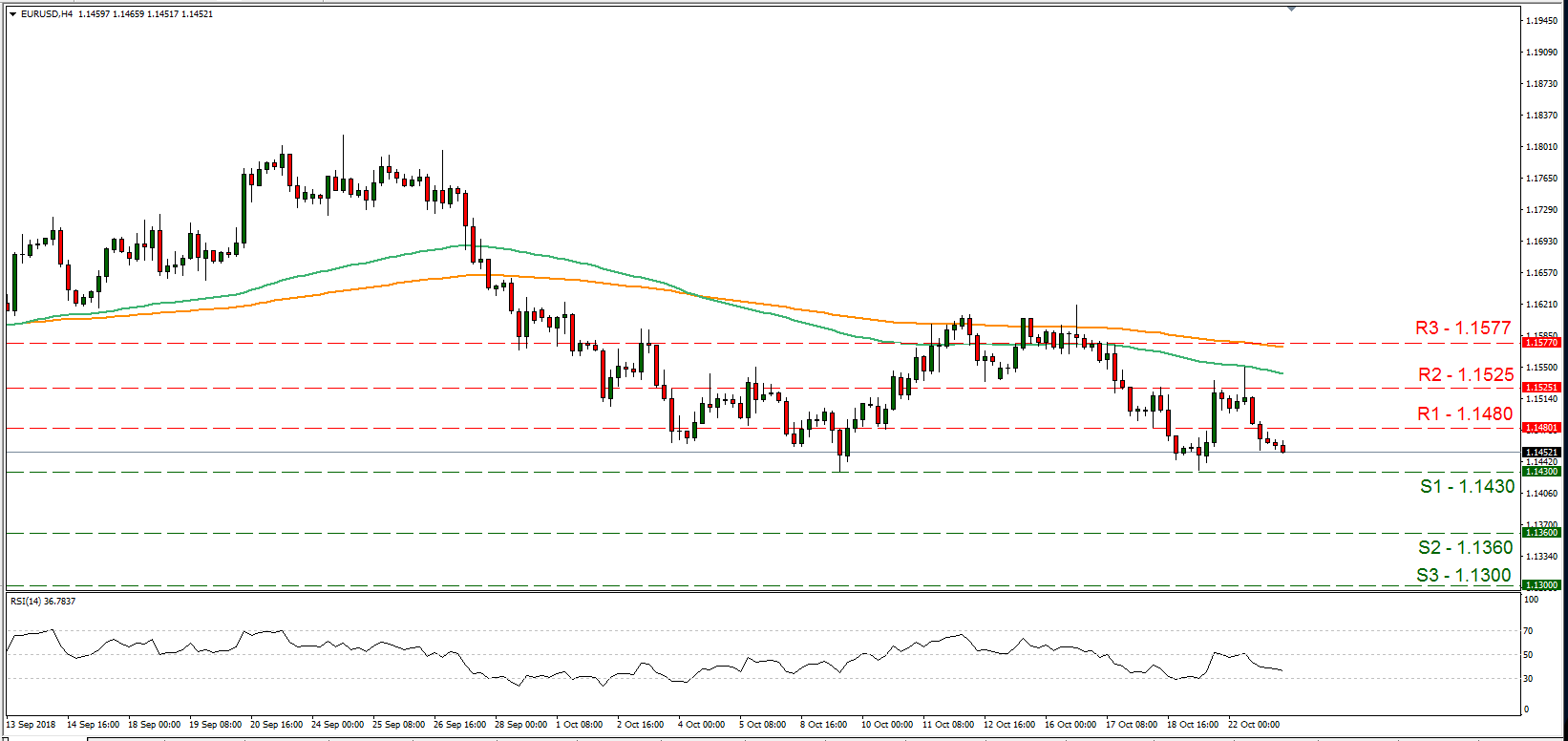
Support: 1.1430 (S1), 1.1360 (S2), 1.1300 (S3)
Resistance: 1.1480 (R1), 1.1525 (R2), 1.1577 (R3)
GBP/USD 4H
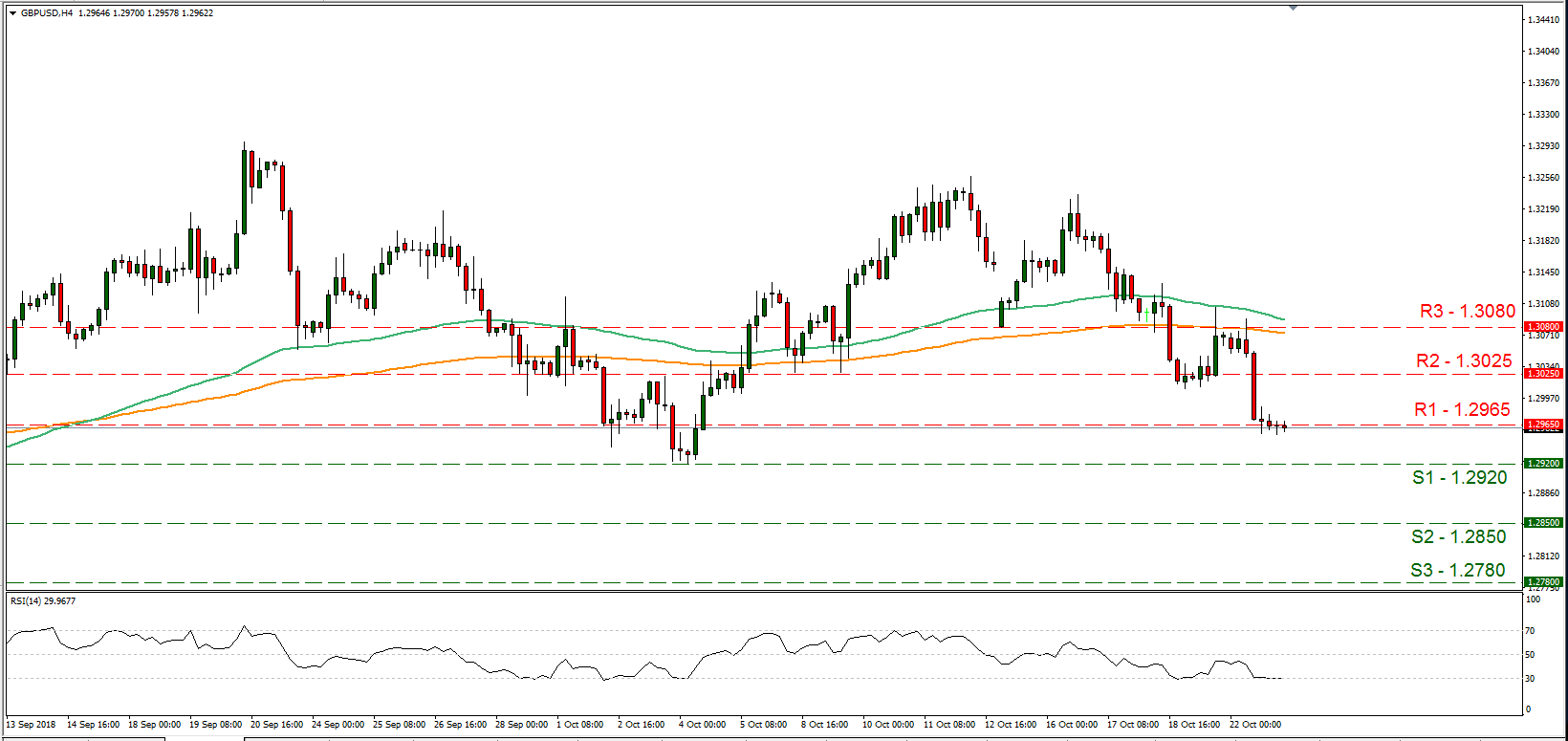
Support: 1.2920 (S1), 1.2850 (S2), 1.2780 (S3)
Resistance: 1.2965 (R1), 1.3025 (R2), 1.3080 (R3)
Japan Cabinet Office: Economy recovering at a moderate pace but exports almost flat
In Japanese Cabinet Office's monthly report, general economic assessment was held unchanged. That is, the economy is "recovering at a moderate pace". It also maintained that "private consumption is picking up", "business investment is increasing", "industrial production is increasing moderately", "corporate profits are improving", "employment situation is improving steadily", and "consumer prices are rising at a slower tempo recently".
However, exports are somewhat downgraded from "pausing recently" to "almost flat". The report maintained the urged that "attention should be given to the effects of situations over trade issues on the world economy, the uncertainty in overseas economies and the effects of fluctuations in the financial and capital markets. "
On prices, the report noted "the Government expects the Bank of Japan to achieve the price stability target of two percent in light of economic activity and prices. "
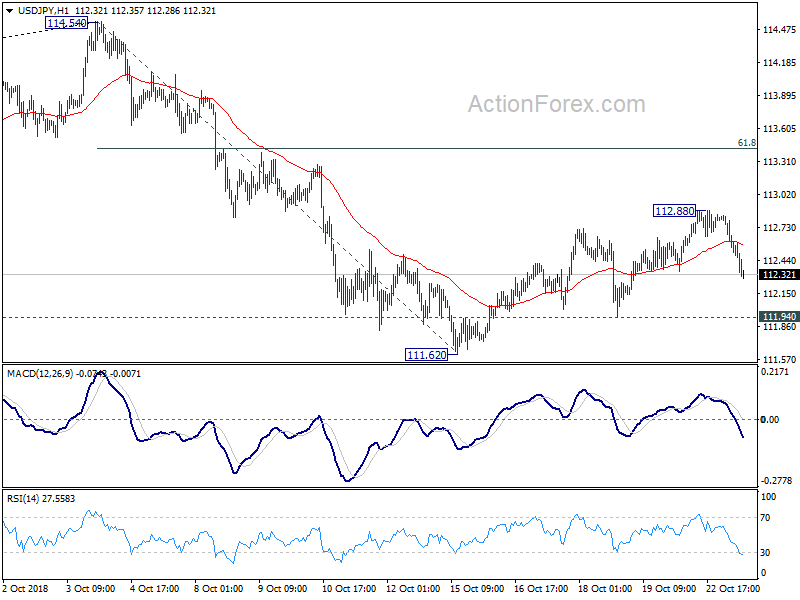
Yen surges broadly today but that's mainly due to risk aversion as Nikkei closed down -604.04 pts or -2.67%.
Stocks Pressured As Risk Aversion Strikes Back, EU To Reject Italy’s Budget
Here are the latest developments in global markets:
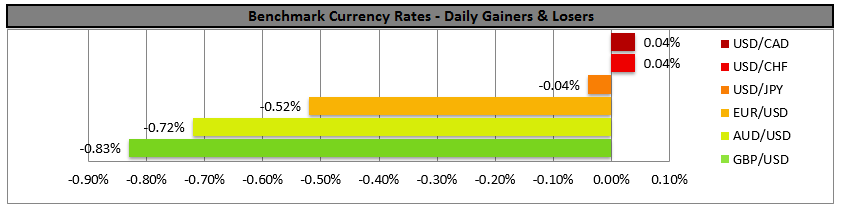
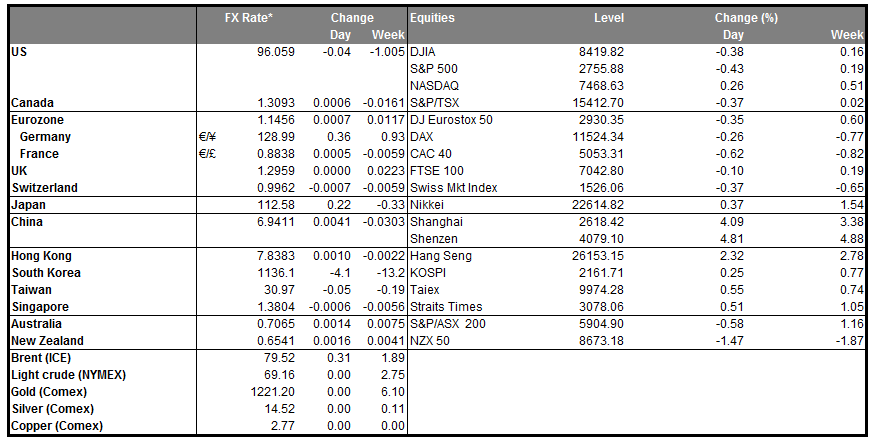
FOREX: The dollar index is higher on Tuesday, albeit by only 0.10%, attempting to extend the gains it recorded yesterday. The yen is reigning supreme among the G10 currencies amid renewed risk aversion, while the antipodeans aussie and kiwi are underperforming. Meanwhile, the pound is consolidating losses from yesterday, and the euro is also retaining a soft undertone amid the poor risk appetite and fading relief in the Italian bond market.
STOCKS: US markets closed mostly in the red on Monday, with the S&P 500 (-0.43%) and Dow Jones (-0.50%) edging lower, but the tech-heavy Nasdaq Composite posting a 0.26% gain. Risk sentiment is not out of the woods yet, and in fact seems to have deteriorated further, as futures tracking the Dow, S&P, and Nasdaq 100 are pointing to a significantly lower open for these indices today, of around -1.0%. Every index in Asia ended lower on Tuesday as well, even though China hinted at further monetary easing. Japan's Nikkei 225 and Topix dropped by 2.67% and 2.63% respectively, while in Hong Kong, the Hang Seng was down by 2.92%. Europe seems set to follow suit, with all the major indices set to open lower today, futures suggest.
COMMODITIES: Oil edged lower, perhaps pressured by Saudi Arabia's pledge that it will not reduce its production amid mounting international pressure on the Kingdom over the killing of a journalist. This put to bed, for now at least, speculation that Riyadh may respond to foreign sanctions by “closing the taps”. WTI is down by 0.40% at $68.95 per barrel today, while Brent declined by 0.78% to $79.21/barrel. In precious metals, dollar-denominated gold is up by 0.50% at $1233 per ounce. This is especially encouraging for the bulls considering that the dollar is also higher today, which denotes that safe-haven buying is behind the latest upleg. Technically, a clear break above $1238 could see scope for a test of the $1265 territory.
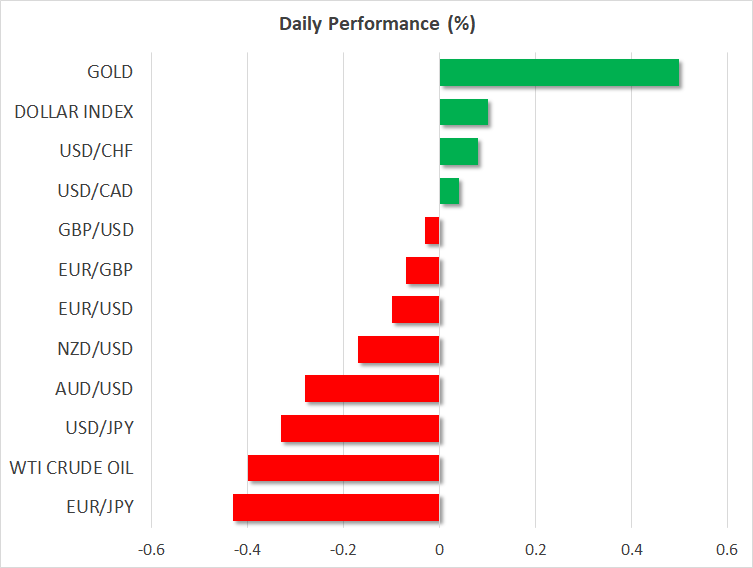
Major movers: Yen roars back, stocks slump as risk aversion engulfs markets again
Global risk appetite turned sour again on Tuesday, with the safe-haven Japanese yen coming under renewed buying interest and Asian equity indices being a sea of red, in the absence of any major news. In fact, the selloff occurred even though Beijing hinted at a fresh dose of monetary stimulus, on top of the income tax cuts floated earlier. US markets didn't escape unscathed, with futures tracking major indices like the S&P 500 pointing to a lower open today. Accordingly, risk-sensitive commodity currencies like the aussie and kiwi are both on the back foot, while the dollar has evidently caught a small safe-haven bid, attempting to extend its gains from yesterday.
In terms of potential catalysts, it seems to be another case of the “usual suspects”, ranging from the continuing US-China trade standoff, renewed focus on the Italian budget, bond yields remaining high, and ever-increasing tensions in the Saudi Arabian saga. With regards to trade, it is most interesting that Chinese markets remain in dire straits even after a barrage of promises for fiscal and monetary easing by the authorities. With Beijing looking to shield its economy from the trade fallout through stimulus that takes months to filter into the economy, it is likely signaling it expects this conflict to be a prolonged one and is “digging in” for the long haul, thereby spooking foreign investors instead of soothing them.
Elsewhere, sterling surrendered ground across the board on Monday, after media reports suggested that Northern Ireland's DUP party – that props up PM May's administration – will back an amendment proposed by Brexiteers to make the EU's Irish backstop proposal illegal. The news highlighted the fact that even in case PM May manages to broker a deal with the EU on the Irish border soon, the Brexit drama will be far from over, as she would still need to push any deal through Parliament, which is no easy task.
In euro land, the common currency declined in sympathy to sterling, weighed down by another rout in Italian markets. Italian bond yields edged back up amid a plethora of comments from Italian officials. While the remarks were not aggressive per se, mostly suggesting a compromise can be struck on the deficit, that was evidently not enough to calm investors. The EU Commission is now expected to respond negatively to the budget proposal, and the tone of the reply may be vital in determining the short-term mood in Italian assets and by extent, in the euro.
Day Ahead: EU to decide on Italian budget; Flash Eurozone consumer confidence eyed
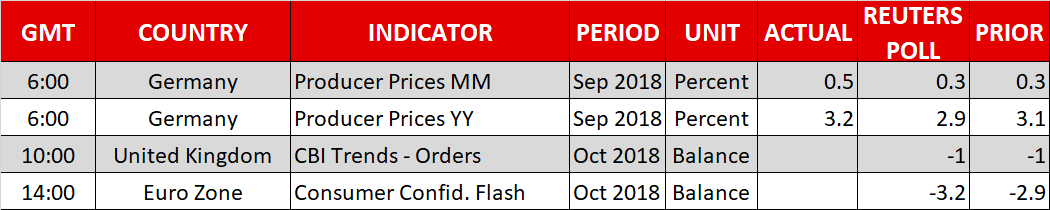
In the Eurozone, the European Commission will give an answer on the 2019 Italian budget which analysts widely expect to be rejected after the aforementioned legislative institute called Italy's fiscal demands unprecedented as the indebted government aims to lift the public deficit from 1.8% to 2.4% of GDP. On Monday, the Italian Finance Minister backed the draft spending outline but showed willingness to adjust plans in coming years if economic growth stalls, while remaining open to dialogue with the EU. Yet he mentioned that Rome is ready to intervene so that targets are respected, a stance hinting that Italy wont easily step back from its budget goals in coming weeks. Should the EU ask the Italian government to revise its draft budget plan, Rome will have a three-week timeframe to re-submit new ideas. It is worth mentioning that a refusal to comply with EU rules could cost Italy million of euros of fines, though it is highly doubtful the Commission would seek such a confrontational route.
In the FX markets, the euro might not react much as investors have already priced in a no answer from the EU. Yet the common currency could see some fluctuation in the wake of the flash consumer confidence index out of the eurozone. Forecasts are for the index to have declined further in October, retreating from -2.9 to a fresh 1 ½-year low of -3.2. A worse-than-expected outcome could shift funds out of the euro, and vice versa.
Political concerns continue to drive sentiment in the UK as well, as uncertainties around Brexit remain high. Speaking before Parliament on Tuesday, the British Prime Minister reiterated that a Brexit deal is almost done, while saying that the details remaining to be solved are crucial. Still a few months before the UK departures from the EU, May continues to face leadership risks and perhaps even a no-confidence vote today as some members within her party as well as rivals from the Labour party turned more frustrated after May showed willingness to extend the transition period. Besides that, reports that May's administration could accept an open-ended timeframe for the Irish backstop instead of thefixed-end date previously supported brought further disappointment to Brexiteers.
In oil markets, the American Petroleum Institute will deliver its weekly statement on US crude inventories at 2030 GMT.
In equity markets, Boeing, Caterpillar, Harley Davidson and McDonalds will be among companies to report on earnings before the US open bell.
In terms of public appearances, the economy ministers of Germany, Switzerland, Austria and Liechtenstein will hold their annual meeting in Zurich at 0900 GMT, where questions about the global economy could be of interest. At 1730 GMT Federal Reserve Bank of Atlanta President Raphael Bostic will be commenting on the economic outlook and monetary policy before the Committee of 100, in Baton Rouge, while at 1815 GMT Dallas Fed President Robert Kaplan will be participating in a Q&A session before the Galveston Economic Development Partnership 7th Annual Economic Development Summit, in Galveston, Texas.
Any potential updates regarding the US-Sino trade war could move the markets during the day.
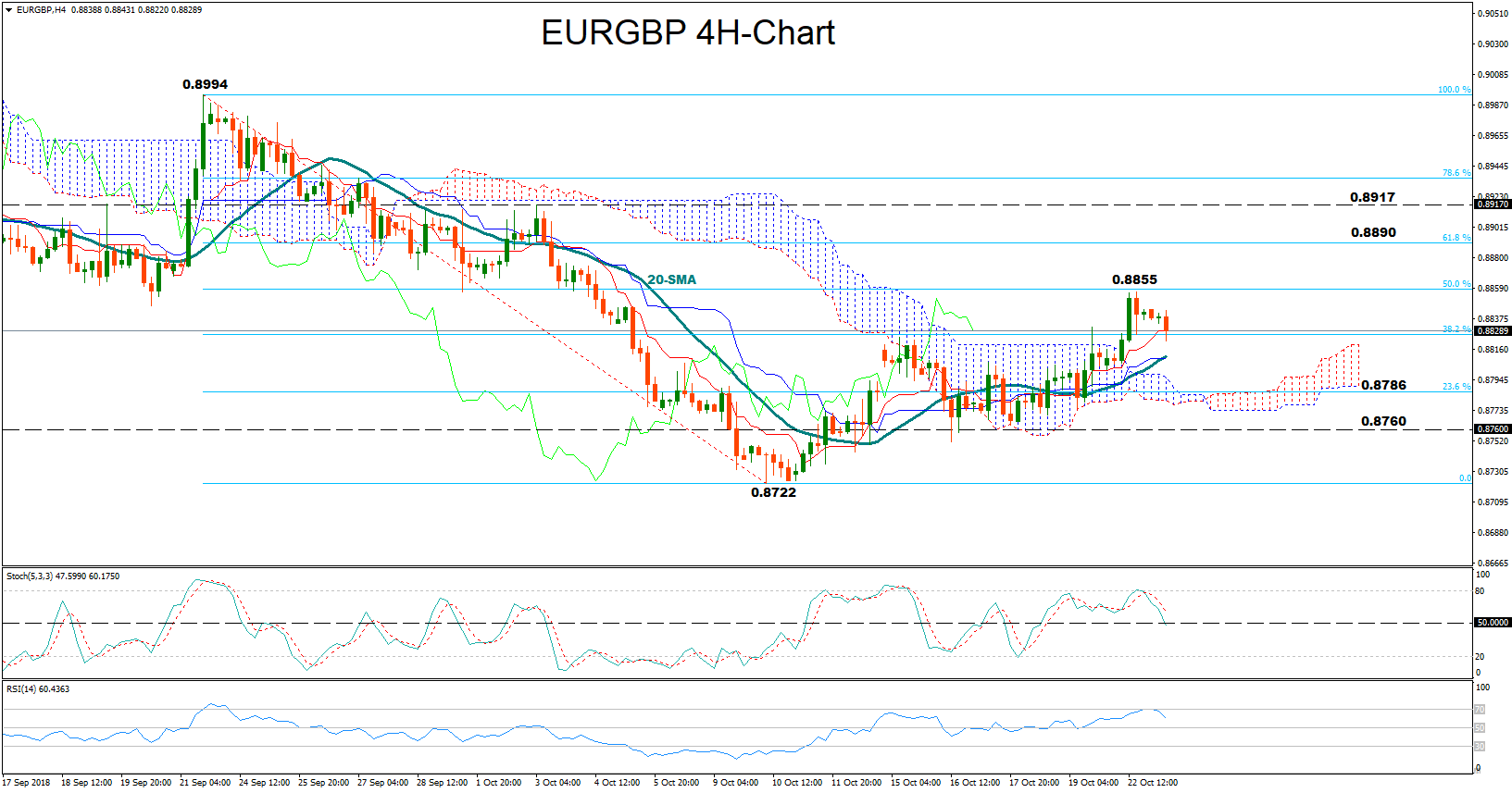
Technical Analysis – EURGBP reaches overbought levels; could move sideways in short-term
EURGBP managed to jump above the Ichimoku cloud early on Tuesday in the four-hour chart, rising as high as 0.8855, the highest in almost three weeks. But the pair failed to sustain gains as both the RSI and the Stochastics touched overbought levels, with the former hitting 70 and the latter posting a bearish cross around 80. The RSI now heads lower towards its 50-neutral mark, hinting that the price might enter consolidation in the short-term.
However if eurozone consumer confidence proves better than projected in October, the pair could reverse higher probably with scope to retest the 0.8855 peak. That is also where the 50% Fibonacci of the downleg from 0.8994 to 0.8722 stands. Above that the focus could shift towards the 61.8% Fibonacci of 0.8890 and the area around 0.8917 where the bulls found some resistance back in September.
Alternatively, a miss in the data could see prices falling towards 0.8810, a previous resistance zone, while slightly lower the 23.6% Fibonacci of 0.8786 could be also another obstacle to have in mind before eyes turn to 0.8760, which acted as support last week. Steeper bearish extensions could open the way towards the 0.8722 bottom.
Bank of Canada’s Business Outlook Survey Points to Higher Inflation
The Bank of Canada released its third quarter business outlook survey on Monday last week. The data showed that Canadian firms were upbeat on the third quarter. The BoC's Business Outlook Survey (BOS) indicator was at elevated levels despite easing to 2.8 from 3.1 previously.
The business outlook survey was done between August 24 and September 19 and the survey period comes just before Canada negotiated the revamped North American Free Trade Agreement (NAFTA) to the newly formed USMCA trade deal.
The survey's opinions showed that futures sales would rebind 15% from 6% that was seen in the second quarter of this year. Businesses said that they anticipate strong growth in the U.S. over the next year as it helps to boost exports from Canada.
However, in contrast, another indicator of future sales which captures order books and advanced bookings showed the index easing to 40% after it surged strongly over the past two consecutive quarters.
Investment intentions saw the balance of opinions rising to 33% after it fell for two consecutive quarters this year. The 33% increase was the highest since 2017's first quarter report. The details showed capacity constraints were helping to drive investment intentions higher. Firms were also seen to be on a drive to improve the production efficiency.
Only a few firms intend to maintain their current capital base. Domestic and foreign demand was seen as the critical drivers for investments. However, there was some uncertainty surrounding the regulation and taxes, firms that participated in the survey reported.
Capacity expansion was also seen pushing firms to increase hiring in the next 12 months. However, this might come as a challenge due to labor shortages which have become widespread in recent months. The balance of firms showed a 50% reading, reporting more labor shortages and the index rose to the highest level since the third quarter of 2006.
Capacity pressures were also seen to be rising as a result of labor shortages alongside the higher tariffs on steel and aluminum exports to the United States. The higher commodity prices were seen feeding through into the expectations.
Firms expect input costs to rise at a faster pace next year. As a result, firms are said to raise output prices with about 70% firms expecting inflation to rise in the 2% - 3% range next year. Competitiveness concerns are expected to keep inflation in check among firms.
Overall, the BoC's business outlook survey showed that firms were bullish about the future. The boost in investment intentions corresponded to higher capacity pressures. This is expected to help alleviate concerns about firms not being able to meet the anticipated increase in domestic and foreign sales.
The anticipated shortage of labor is also expected to boost wage pressures alongside pushing inflation higher in the next few months.
The Bank of Canada will be holding its monetary policy meeting on October 24. The central bank hiked the interest rates at its previous meeting in September. Canada's interest rates currently stand at 1.75%.
Interest rates have been steadily rising in Canada since July 2017 which kickstarted a tighter monetary policy. The Bank of Canada had previously lowered interest rates to 0.50% in July 2015 amid a plunge in oil prices.
Last week, Canada also reported on its monthly inflation figures. Data showed that consumer prices fell 0.4% on the month. On a yearly basis, Canada’s inflation rate was seen at 2.2%. This was the slowest pace of increase in four months.
However, the decline in consumer prices was seen to ease the pressure off the Bank of Canada officials.
GBPUSD Outlook: Bears Are Taking A Breather Before Attacking Key Supports As Politics/Bearish Techs Weigh
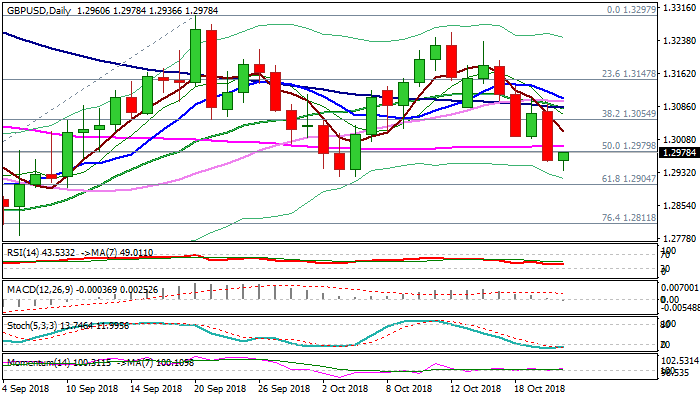
Cable hit new three-week low at 1.2936 in early European trading on Tuesday, in extension of Tuesday's 0.9% fall (the biggest daily loss in October). Politics remain pound's key driver, as reports suggest that Brexit talks stalled, and UK PM May faces strong opposition in her own party over her Brexit plan, which further weakens her position. Pound's strong negative sentiment is reinforced by bearish daily / weekly techs, as daily MA's turned to bearish setup and momentum studies point lower. Monday's close below 55SMA (1.2992) was bearish signal, with long red daily candle also weighing. Bears probed below daily cloud base (1.2944) on Tuesday, with firm break lower to generate negative signal, which would be confirmed by extension and close below pivots at 1.2921 (03/04 Oct lows) and 1.2904 (Fibo 61.8% of 1.2661/1.3297 rally). The action in past week was entrenched within steep bear-channel, which shows intention to extend lower. Sustained break below 1.2904 would also complete failure swing pattern on daily chart, which would trigger fresh weakness and also signal an end of corrective phase from 1.2661 (15 Aug low). Meanwhile, the pair is holding within narrow consolidation in early Tuesday's trading, with oversold slow stochastic warning of stronger correction. Broken 55SMA (1.2992) and daily cloud top (1.3012) mark initial resistances, with extended upticks to be capped by broken 100SMA (1.3080). Only break and close above 10SMA (1.3102) would neutralize bearish bias.
Res: 1.2992, 1.3012, 1.3054, 1.3080
Sup: 1.2936, 1.2921, 1.2904, 1.2811
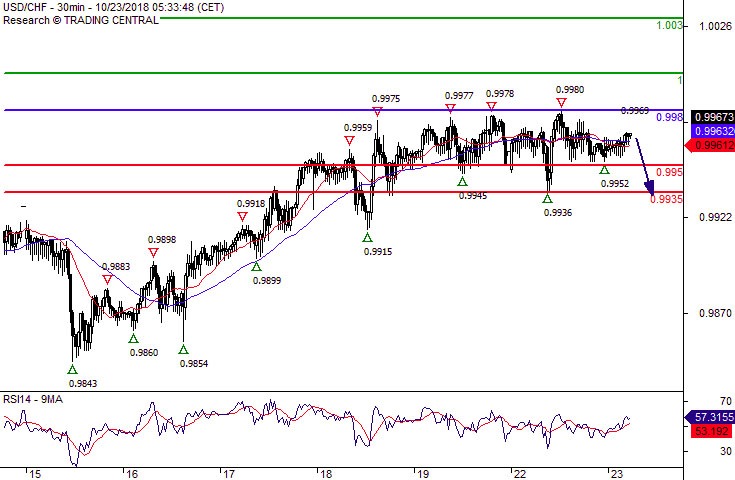
USD/CHF Key Resistance At 0.9980
Pivot (invalidation): 0.9980
Our preference Short positions below 0.9980 with targets at 0.9950 & 0.9935 in extension.
Alternative scenario Above 0.9980 look for further upside with 1.0000 & 1.0030 as targets.
Comment As Long as 0.9980 is resistance, look for choppy price action with a bearish bias.
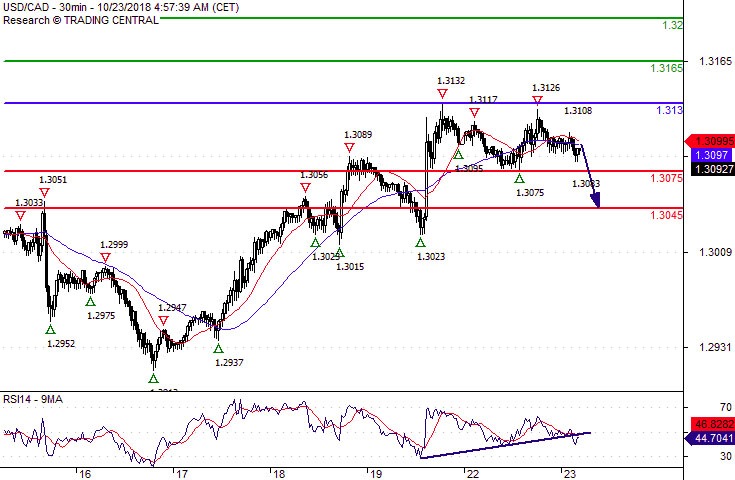
USD/CAD Key Resistance At 1.3130
Pivot (invalidation): 1.3130
Our preference Short positions below 1.3130 with targets at 1.3075 & 1.3045 in extension.
Alternative scenario Above 1.3130 look for further upside with 1.3165 & 1.3200 as targets.
Comment A break below 1.3075 would trigger a drop towards 1.3045.
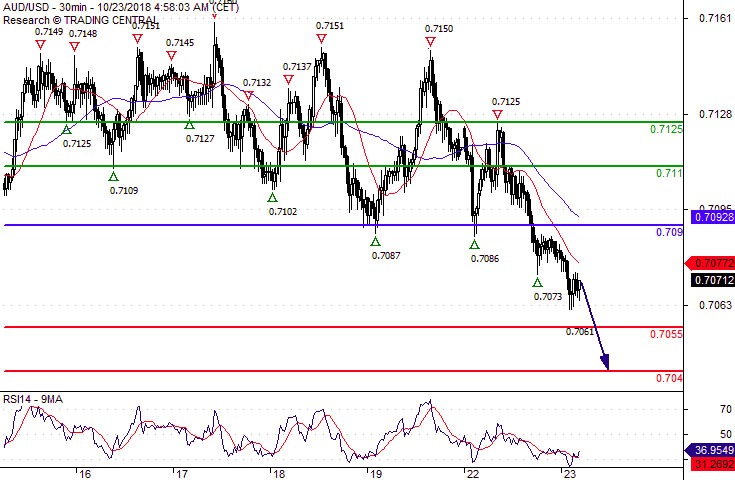
AUD/USD The Downside Prevails
Pivot (invalidation): 0.7090
Our preference Short positions below 0.7090 with targets at 0.7055 & 0.7040 in extension.
Alternative scenario Above 0.7090 look for further upside with 0.7110 & 0.7125 as targets.
Comment The RSI calls for a drop.
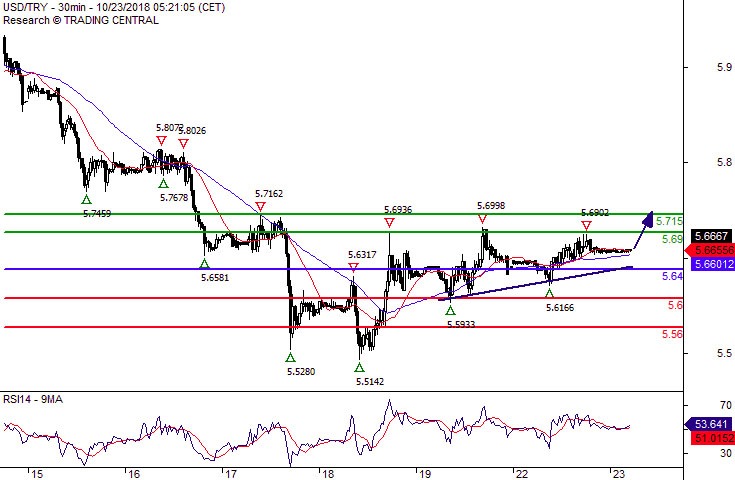
USD/TRY Bullish Bias Above 5.6400
Pivot (invalidation): 5.6400
Our preference Long positions above 5.6400 with targets at 5.6900 & 5.7150 in extension.
Alternative scenario Below 5.6400 look for further downside with 5.6000 & 5.5600 as targets.
Comment The RSI has just landed on its neutrality area at 50% and is turning up.