

Sample Category Title
DAX Slips Over Italy Debt, Trade War Tensions
The DAX index continues its losing ways this week. In the Tuesday session, the index is at 11,336, down 1.63% on the day. On the release front, there are no major events. German WPI gained 0.5% in September, its highest level since May. The eurozone will release consumer confidence, which is expected to post a second straight reading of -3 points. On Wednesday, Germany and the eurozone release Manufacturing PMIs.
The ECB holds its next policy meeting on Wednesday, and the bank is expected to hold the course with interest rate levels, which have been pegged at a flat 0.00% for almost three years. However, there are plenty of trouble spots, including the spike in Italian bond yields, the Brexit impasse and continuing volatility in global equity markets. Despite these issues, the ECB is expected to end its massive stimulus program in December. The markets are now looking ahead to 2019, focusing on the timing of a rate hike. The ECB has adhered to the line that rates will stay on hold “through the summer of 2019”. However, it’s unlikely that policymakers can ignore the issue of a rate hike, which would be a historic move, as the bank last raised rates in 2011. The head of the Dutch central bank, Klaas Knot, recently said that the ECB will have to initiate discussions over the timing of a rate hike in January. Investors will be keeping a close eye on the ECB, and any hints of an interest rate move could send the euro upwards.
There was some good news out of Italy on Friday, as the Moody’s credit rating agency maintained the outlook on Italy’s credit rating as ‘stable’. There had been fears that Moody’s might downgrade Italy’s debt to ‘junk’, after it lowered its rating to Baa3, its lowest grade. The yield on Italian 10-year bonds dropped to 3.30%, its lowest level in two weeks. Italy’s draft budget has become the latest crisis for the European Union. The budget boosts public spending and cuts, and sets a budget deficit goal of 2.4%, which would be higher than last year, in breach of EU law. Italy’s debt stands at an astounding 132% of GDP, and there is a real risk that the country’s financial woes could destabilize the entire eurozone.
USDCHF Outlook: Initial Signs Of Reversal
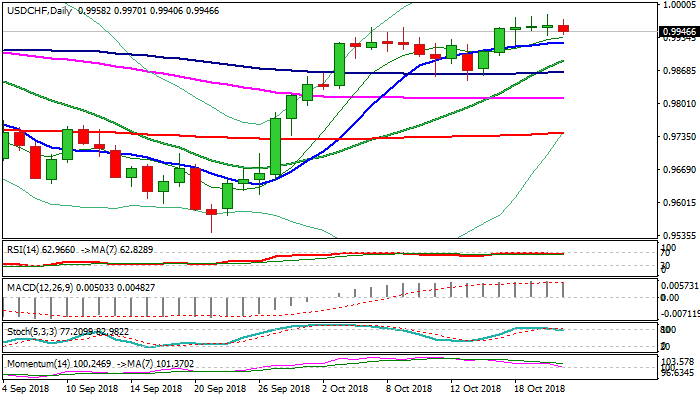
The pair holds in red on Tuesday, as risk aversion increased demand for safe haven assets and boosted Swiss franc. Reversal pattern is developing on daily chart, as fresh weakness emerges after triple-Doji signaled that larger bulls stall at strong 0.9980 resistance zone (Aug former highs) and on approach to psychological parity level. Weakening daily studies support the idea as RSI and slow stochastic turned south after forming bearish divergence and 14-d momentum is approaching negative territory. Fresh weakness eyes support at 0.9925 (10SMA/Fibo 38.2% of 0.9847/0.9979 upleg), break of which would generate initial bearish signal and open way towards next pivots at 0.9898 (Fibo 61.8%) and 0.9889 (rising 20SMA). Key near-term support lays at 0.9847 (15 Oct trough). Alternatively, sustained break above 0.9980/1.0000 pivots would generate bullish signal for continuation of larger uptrend from 0.9542 (21 Sep low).
Res: 0.9980, 1.0000, 1.0043, 1.0068
Sup: 0.9938, 0.9925, 0.9889, 0.9847
EUR/USD – Higher German Inflation Helps Steady Euro
EUR/USD has steadied on Tuesday, after starting the week with considerable losses. Currently, the pair is trading at 1.1484, up 0.17% on the day. It’s another quiet day on the release front, with no major indicators. German WPI gained 0.5% in September, its highest level since May. The eurozone will release consumer confidence, which is expected to post a second straight reading of -3 points. In the U.S, the Richmond Manufacturing Index is expected to drop to 25 points.
The ECB holds its next policy meeting on Wednesday, and the bank is expected to hold the course with interest rate levels, which have been pegged at a flat 0.00% for almost three years. However, there are plenty of trouble spots, including the spike in Italian bond yields, the Brexit impasse and continuing volatility in global equity markets. Despite these issues, the ECB is expected to end its massive stimulus program in December. The markets are now looking ahead to 2019, focusing on the timing of a rate hike. The ECB has adhered to the line that rates will stay on hold “through the summer of 2019”. However, it’s unlikely that policymakers can ignore the issue of a rate hike, which would be a historic move, as the bank last raised rates in 2011. The head of the Dutch central bank, Klaas Knot, recently said that the ECB will have to initiate discussions over the timing of a rate hike in January. Investors will be keeping a close eye on the ECB, and any hints of an interest rate move could send the euro upwards.
Relations between the U.S and China remain tenuous, with the markets nervous that the trade war could worsen. The U.S Treasury Department released its semi-annual report on foreign exchange rates on Thursday, and there was some relief in the markets as the report did not name China as a currency manipulator. Still, the report said that the U.S was “deeply disappointed’ with that China refuses to disclose the extent of its foreign currency intervention. The Chinese yuan has slipped some 9 percent since April, and U.S officials are concerned that China has deliberately weakened the currency in order to counter U.S tariffs on Chinese goods, and will continue to monitor China’s currency practices.
EURUSD 1.1431 Support Level Survives Second Technical Test
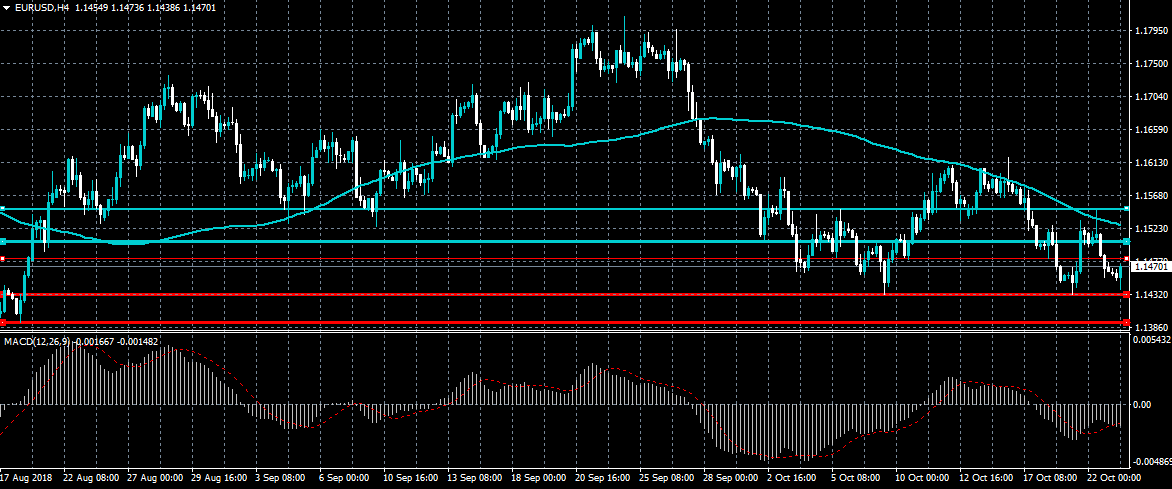
The euro is heading back towards key 1.1480 resistance level against the US dollar after sellers once again failed to break below the current monthly trading low, at 1.1431. As previously mentioned, a sustained break below the 1.1431 support level exposes the neckline of a bearish head and shoulder pattern with a two-hundred point downside target. EURUSD traders now await a key directional breakout from the 1.1431 to 1.1480 trading range.
The EURUSD pair remains bearish while trading below the 1.1480 level, key support is found at the 1.1431 and 1.1390 levels.
If the EURUSD pair breaks above the 1.1480 level, key intraday resistance is found at the 1.1500 and 1.1550 levels.
USDJPY May Have Reached Bullish Target
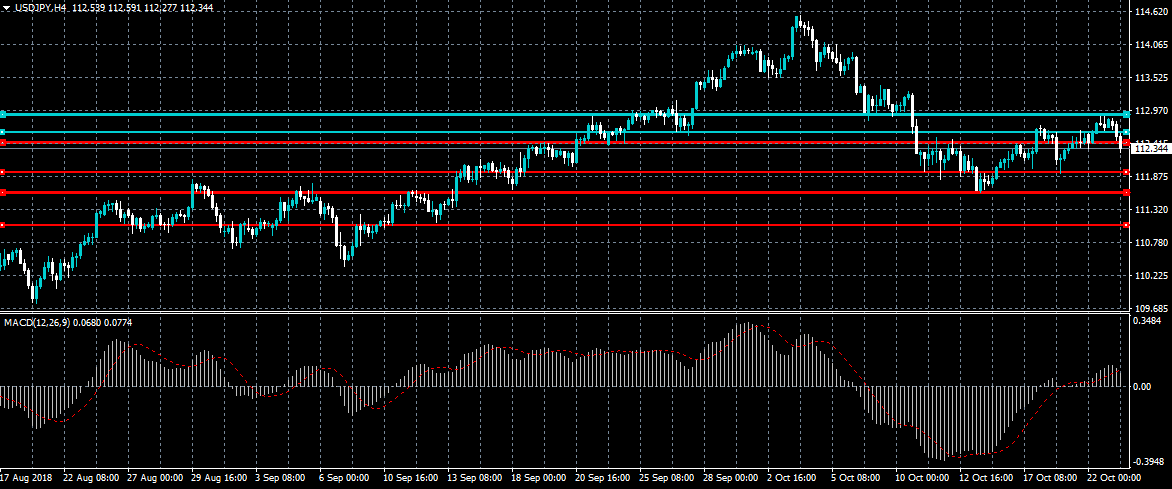
The US dollar is now moving to the downside against the Japanese yen currency, as global equity markets start to trade lower once again. The USDJPY pair was strongly rejected from the 112.87 resistance level and may have reached its bullish correction target. Buyers need to move price above the pivotal 112.45 level, while sellers will attempt to break the 111.90 support level to accelerate the current intraday decline.
The USDJPY pair is intraday bearish while trading below the 112.45 level, key support is now found at the 111.90 and 111.60 levels.
If the USDJPY pair trades above the 112.45 level, buyers may test towards 112.65 and 112.87 resistance levels.
WTI Oil Outlook: Fresh Bears Probe Below Daily Cloud As Concerns About Supply Disruption Ease
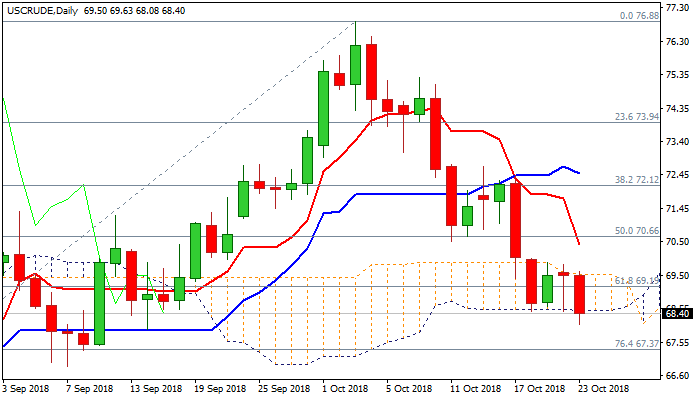
WTI oil price fell to five-week low at $68.08 on Tuesday, amid nervous market sentiment ahead of US sanctions against Iran start early Nov, as Saudi Arabia said it will keep markets supplied on supply shortage once Iran’s exports stop.
Saudi Arabia said it will play responsible role in energy markets despite rising pressure and isolation on death of Saudi journalist.
Fresh weakness generated bearish signal on probe below daily cloud base ($68.48) after the action in past three days was moved within the cloud (spanned between $68.48 and $69.55).
Negative sentiment on easing fears of reduced supply is boosted by bearish daily techs which maintain strong bearish momentum for further weakness.
Close below daily cloud base would be negative signal for extension towards next strong support at $67.44 (200SMA) also near Fibo 76.4% of $64.43/$76.88).
Releases of US crude inventories (API report is due later today and EIA report will be released on Wednesday) will be closely watched for fresh signals.
Res: 69.19, 69.57, 69.90, 70.51
Sup: 68.08, 67.93, 67.44, 66.85
Global Risk-Off Sentiment Continues, Awaiting EU Formal Response To Italy 2019 Budget
Notes/ObservationsAsia:
- Earnings season showing that companies mostly missed expectations; safe-haven flows dominate the session
- Awaiting the formal EU decision on Italy’s budget but both sided look to sort out differences
Asia:
- China govt official Zhang Qingli reportedly told US investors at meeting that 'We don't fear a trade war with the US'
- Japan Fin Min Aso: 'In principle' the sales tax increase will happen as planned, some disruption expected when it takes place but will not delay for that
Europe:
- PM May: the broad shape of a Brexit deal is now clear and could guarantee UK would leave EU in March 2019. Must make the UK backstop legally binding. Had not committed to extending transition period; any transition extension would be undesirable. Extending the transition might be preferable to a backstop
- UK Brexit Min Raab: It's up to the speaker to decide on the terms of a meaningful vote on Brexit deal. Amendments to meaningful vote cannot delay or prevent Brexit; it's important parliament is presented with a clear choice in a meaningful vote
- UK Conservative MP Baker said to withdraw amendments that could have torpedoed Brexit talks on the Irish backstop
- Eurogroup chief Centeno stated that he still expected a deal to be reached over Italian budget; the latest reaction by Italy to the EU commission's budget warning was constructive
- OBR underestimate on tax receipts gives Finance Ministry a £13B/yr windfall in budget to ease pressure on National Health Service (NHS)
Americas:
- President Trump seeking extra tax cut of 10% for middle income (Reminder: On Oct 20th Trump stated that was studying a major tax cut for middle income Americans; would give details in early November
Macro
- (US) United States: Markets are likely to become increasingly nervous as the November 6 Midterms get closer. Most polls point to the Democrats flipping the House and gaining the majority, while a still Republican-controlled Senate likely leading to gridlock. Such a result would obviously stall the Trump administration's agenda, limit spending, block further tax cuts, and delay action on tariffs. A split Congress though could see lawmakers try to reach across the aisle to strike deals on trade, infrastructure, taxes, and drug policies. A Democratic sweep would see heightened probability of impeachment proceedings, keeping the government in limbo, though again likely a net negative for stocks, while GOP control of both Houses likely would see support for the market.
- (US) United States: 3M Libor has risen to 2.4874%, the highest since late 2008, as the FOMC continues its normalization path. This, along with the firmer dollar, are adding to global financial concerns - the rise in rates at the beginning of the year actually weighed on the markets, although that was likely due to the surge in bill issuance that pushed up short rates.
- (DE) Germany: PPI inflation unexpectedly ticked up to 3.2% y/y in September. Energy price inflation accelerated to 8.5% y/y during the month - the highest rate since November 2011. Prices for mineral oil products rose 18.5%% y/y. Cost pressures continue to increase then, which in combination of ongoing capacity constraints in some sectors should gradually push up underlying inflation.
SPEAKERS/FIXED INCOME/FX/COMMODITIES/ERRATUM
Equities
- Indices [Stoxx600 -1.38% at 354.78, FTSE -0.90% at 6,979.19, DAX -2.16% at 11,275.03, CAC-40 -1.43% at 4,981.00, IBEX-35 -1.19% at 8,702.00, FTSE MIB -1.02% at 18,773.50, SMI -1.12% at 8,762.50, S&P 500 Futures -1.21%]
Market Focal Points/Key Themes:
Equities
- European Indices trade lower across the board tracking weaker Asian Indices and lower US futures. Underwhelming corporate earnings pressuring markets as Renault, Whitbread, Logitech, AMS, Sartorius, SAAB, AMS and ATOS among the notable decliners following earnings and guidance. Ingenico trades higher despite cutting their EBITDA outlook after growth in revenue, Luxottica also bucks the trend with a slight Rev beat while Innate pharma trades higher after a partnership with Astrazeneca.
- Looking ahead notable earners include Catepillar, 3M, Verizon, Lockheed Martin, United Technologies and McDonalds among others.
- Consumer discretionary: Ingenico [ING.FR] +0.5% (earnings), Whitbread [WTB.UK] -3% (earnings), Communisis [CMS.UK] +37% (proposed to be acquired)
- Consumer staples: Scandinavian Tobacco Group [STG.DK] -2% (transformation program)
- Financials: Swedbank [SWEDA.SE] +0.5% (earnings; comments on Danske Bank case), St. James Place plc [STJ.UK] -4.5% (reports increase in FUM), Gam Holding AG [GAM.CH] -18% (reports fall in AUM)
- Healthcare: Bayer [BAYN.DE] -7% (new press speculation on Roundup case; Trump drug prices comments), Innate Pharma [IPH.FR] +29%, AstraZeneca [AZN.UK] -0.5% (partnership with Astrazeneca; sold stake to it), UCB [UCB.BE] -1.5% (positive topline results with Biogen),
- Industrials: Renault [RNO.FR] -2.5% (earnings; global market growth cut), Anglo American plc [AAL.UK] -1.5% (reports copper production; raises platinum production outlook), Saab AB [SAABB.SE] -13% (earnings), DP World [DPW.UK] +1.5% (trading update),
- Technology: Logitech International [LOGN.CH] -6% (earnings), AMS AG [AMS.CH] -30% (earnings), Atos SE [ATO.FR] -23% (earnings, outlook cut), Avast Software [AVST.UK] -7% (one of holders sold shares), Sartorius [SRT.DE] -7% (earnings)
Speakers
- Italy said to have expressed hope that ECB would purchase the country's securities if needed
- ECB said to have raised its monitor of the Italian banking sector liquidity
- ESM chief Regling: Worried about Italy due to its fiscal plans. Reiterated view that Italy was not Greece; contagion risk seen limited
- Bank of Spain: Aug Non-performing Loans (NPLs) Ratio at 6.32%
- Bank of Italy (BOI) Lending Survey: Banks saw credit standards unchanged for both households and companies in Q4
- Indonesia Central Bank (BI) left the 7-Day Reverse Repo Rate unchanged at 5.75% (as expected)
- Indonesia Central Bank Policy Statement noted that the current level of Interest rate was in-line to lower the current account deficit and would continue to monitor C/A balance, inflation and exchange rate. Reiterated stance that would continue with stabilization measures. Did not see Q3 GDP as strong as previously expected due to weak exports. Inflation remained low and stable; govt to strengthen the coordination to manage CP. Remained committed to lowering the current account deficit and would guard IDR currency (Rupiah) to be in-line with fundamentals.
- Japan Cabinet Office Oct Monthly Economic Report: Maintained economic assessment, economy is recovering at moderate pace. Lowered assessment on exports from ‘recent pause’ to 'almost flat'
- Japan Econ Min Motegi: Domestic fundamentals remained solid
- Saudi Oil Min Al-Falih: Oil demand to reach 120M bpd in three decades time
Currencies
- The slide in equity markets prompted the usual safe-haven flows but overall dealers cited the absence of clear trends.
- Awaiting the formal EU decision on Italy’s budget but both sides looked to sort out differences . Analysts forecast a relatively market-friendly outcome from S&P Ratings on Italy this coming Friday (Oct 26th). EUR/USD began the session on soft footing but hope expressed by Italy that the ECB would stand by with support helped to calm any volatility in the BTP markets for now. EUR/USD little changed but still below the 1.15 handle.
- GBP/USD main focused remained on Brexit negotiations. PM May will meet her cabinet on Tuesday and no leadership challenge appears to be the norm for the moment. GBP/USD holding below the 1.30 level ahead of the NY morning.
Economic Data:
- (DE) Germany Sept PPI M/M: 0.5% v 0.3%e; Y/Y: 3.2% v 3.0%e
- (DK) Denmark Oct Consumer Confidence: 5.1 v 6.9 prior
- (FI) Finland Sept Unemployment Rate: 6.3% v 6.8% prior
- (JP) Japan Sept Final Machine Tool Orders Y/Y: 2.9% v 2.8% prelim
- (ZA) South Africa Aug Leading Indicator: 104.9 v 105.4 prior
- (TR) Turkey Oct Consumer Confidence: 57.3 v 59.3 prior
- (PL) Poland Sept Unemployment Rate: % v 5.8%e
- (TW) Taiwan Sept Industrial Production Y/Y: 1.5% v 1.6%e
- (ES) Spain Aug Trade Balance: -€3.1B v -€3.3B prior
- (HK) Hong Kong Sept CPI Composite Y/Y: 2.7% v 2.6%e
- (IS) Iceland Sept Wage index M/M: +0.6% v -0.1% prior; Y/Y: 5.9% v 6.0% prior
Fixed Income Issuance
- (NL) Netherlands Debt Agency (DSTA) sold €1.925B vs. €1.5-2.5B indicated range in 0.75% July 2028 DSL Bonds; Avg Yield: 0.555% v 0.471% prior
- (ID) Indonesia sold total IDR20T vs. IDR10T target in 3-month and 9-month Bills, 5-year, 15-year, 20-year bonds
Looking Ahead
- (UR) Ukraine Sept Industrial Production M/M: No est v -0.5% prior; Y/Y: No est v -0.5% prior
- (RO) Romania Sept M3 Money Supply Y/Y: No est v 10.8% prior
- (SA) Saudi Investment Conference begins (Davos in the desert)
- (UK) PM May holds Cabinet meeting
- 05:30 (UK) Weekly John Lewis LFL sales data
- 05:30 (EU) ECB allotment in 7-Day Main Refinancing Tender (MRO)
- 05:30 (HU) Hungary Debt Agency (AKK) to sell in 3-month Bills
- 05:30 (ZA) South Africa to sell combined ZAR2.4B in 2023, 2032 and 2048 bonds
- 05:30 (UK) DMO to sell 0.125% Index-linked 2028 Gilts
- 06:00 (UK) Oct CBI Industrial Trends Total Orders: +2e v -1 prior, Selling Prices: 15e v 13 prior, Business Optimism: -4e v -3 prior
- 06:00 (TR) Turkey to sell Bonds
- 06:30 (UK) BOE’s Haldane (chief economist) in Paris
- 06:45 (US) Daily Libor Fixing
- 08:00 (BR) Brazil Mid-Oct IBGE Inflation IPCA-15 M/M: 0.7%e v 0.1% prior; Y/Y: 4.6%e v 4.3% prior
- 07:45 (US) Weekly Goldman Economist Chain Store Sales
- 08:05 (UK) Baltic Dry Bulk Index
- 08:55 (US) Weekly Redbook Sales
- 09:00 (MX) Mexico Aug IGAE Economic Activity Index (monthly GDP) Y/Y: 1.9%e v 3.3% prior
- 09:00 (EU) Weekly ECB Forex Reserves
- 09:00 (RU) Russia announces weekly OFZ bond auction (held on Wed)
- 09:30 (US) Fed’s Kashkari (dove, non-voter)
- 10:00 (US) Oct Richmond Fed Manufacturing Index: 24e v 29 prior
- 10:00 (EU) Euro Zone Oct Advance Consumer Confidence: -3.2e v -2.9 prior
- 11:20 (UK) BOE Gov Carney in Toronto
- 11:30 (US) Treasury to sell 4-Week Bills
- 13:00 (US) Treasury to sell 2-Year Notes
- 13:30 (US) Fed’s Bostic (dove, voter)
- 14:15 (US) Fed’s Kaplan (dove, non-voter)
- 15:00 (AR) Argentina Sept Trade Balance: +$0.2Be v -$1.1B prior
- 16:30 (US) Weekly API Oil Inventories
- 18:15 (US) Fed’s Evans (dove, non-voter)
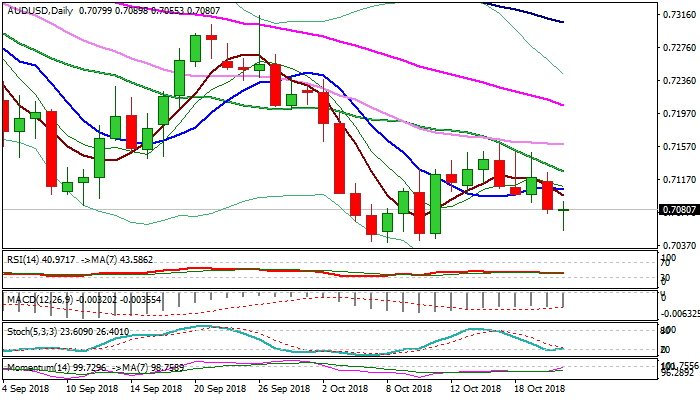
AUDUSD Outlook: Bears Are Positioning For Eventual Break Through 0.7040 Base
The AUDUSD dipped to 0.7055 on Tuesday (the lowest since 11Oct), pressuring key supports at 0.7040 zone base.
Fresh risk aversion keeps Aussie at the back foot and risks eventual attack at 0.7040 base, as today’s dip marked nearly full retracement of 0.7040/0.7159 recovery leg.
Conflicting signals from daily techs (MA’s in firm bearish setup / strengthening momentum) suggest that bears may face strong headwinds on attempts to clear 0.7040 base.
Extended consolidation could be likely scenario, with thickening 4-hr cloud (spanned between 0.7100 and 0.7124) expected to cap and maintain bearish bias.
Eventual break below 0.7040 would expose psychological 0.7000 support, with stronger bearish acceleration capable of travelling to 0.6906 (04 Sep 2015 low).
Only bounce and close above 4-hr cloud top (reinforced by falling daily 20SMA would sideline bears.
Res: 0.7089, 0.7115, 0.7124, 0.7149
Sup: 0.7076, 0.7055, 0.7040, 0.7000
Sea Of Red As Risk Appetite Fizzles Out
Risks pile up to derail investor sentiment
There's a sea of red in equity markets on Tuesday, as risk appetite is quickly dissolved and safe havens come back into favour.
The sell-off came following a reversal in fortune in the US on Monday, where early gains fizzled out and some additional selling late in the session appeared to rattle the markets. This apparent lack of confidence even in the US - which has shown more resilience than its Asian and European counterparts in recent months - has spread anxiety throughout the markets and got people talking about the prospect of a greater downturn.
This is coming back to the number of underlying risk factors in the markets right now, be it US interest rates, Brexit, Italian debt, trade wars or emerging markets. These are all destabilising factors and sentiment may finally be caving under the weight of it all. Trump's tax cuts ensured that the US is the last to fall, with companies reporting stunning earnings growth in the first two quarters and the third shaping up the same way, but this can only last so long and its finally taking its toll.
The question now is how bad it gets and what is done to reassure investors. Instability in the markets could encourage the Fed to take its foot off the gas when it comes to interest rate hikes which may ease some of the tension in the markets, given that the sell-off appeared to start with Powell's claim that the central bank is a long way from neutral. This came in the same week that we got some solid economic figures that did little to change people's views that rate hikes could be too aggressive.
Gold safe haven demand returns
Appetite for Gold is certainly picking up in these very unsettled markets, with the yellow metal scaling levels not seen in three months despite the fact that stock markets in that time have performed quite poorly, particularly in Europe and Asia. Gold's role as a traditional safe haven was called into question at times this year when it sunk around 15% between April and August, even during times of apparent risk aversion in markets.
This may well have something to do with the fact that US Treasuries were seeing increased interest as Trump ramped up trade tensions with various countries. The fact that US stock markets also continued to perform well during this period which will have offered further support for the dollar won't have helped matters either. A stronger dollar is typically negative for Gold and will have weighed on price. Even US markets though have been vulnerable to the latest moves which likely explains the sudden appetite for Gold again.
Equity Sell-Off Continues, FX Market Stabilises
Euro holds ground in Italian budget flap
Is the next crisis finally here? Asian equities erased yesterday, with Chinese markets bearing the brunt. The CSI 300 fell 2.66%, while Hong Kong’s Hang Seng gave up 3.13%. In Europe, equities are also blinking red: the EuroSTOXX 600 fell 1.05% to 356 points, its lowest level since mid-December 2016. In FX, the single currency held up surprisingly well against persistent tensions over the Italian budget. EUR/USD edged up 0.5%. Similarly, pound sterling, which rose 0.22% against the buck, trimmed losses as investors hope the European Union and UK will reach an agreement soon.
The European Commission will discuss Italy today. Italy said it would stick to its budget plans, although these breach EU rules. On Monday, Economy Minister, Giovani Tria told Brussels the budget is necessary to restore growth. Brussels usually takes a hard line against budget breaches; however, Italy insists on this one. We expect the EU Commission will reject Italy’s budget, but in a soft way that would keeps discussion open. Therefore, we do not expect a strong reaction from financial markets. We also maintain our long EUR/USD view in the medium to long-term.
Weaker oil despite Washington-Riyadh tensions
Amidst lower Iranian exports, oil prices are dropping, pushed by mounting tensions between Saudi Arabia and the US in the wake of the Khashoggi murder. Brent Crude is below USD 80/barrel while WTI trades below USD 70, both under last weekend’s levels. Investors were hoping that Saudi, the world’s leading exporter, would use its black gold to make itself heard politically. However, Saudi Energy Minister Khalid Al-Falih confirmed intentions to produce 11 million barrels per day and its unwillingness to implement any embargo. Meanwhile, US inventories published Wednesday for the week ending 19 October are expected to remain in positive territory, where they have been since March 2017.
Still, the global landscape has not changed fundamentally. US sanctions against Iran exports start in 12 days (4 November 2018), and sanctions against Venezuela are ramping up. In the short-term, crude prices are expected to drop slightly, but looking ahead, a bounce is likely.