

Sample Category Title
The Weekly Bottom Line: Higher Interest Rates May be Starting to Bite
U.S. Highlights
- Equity markets stopped hemorrhaging and partially recovered from last week's downturn. Domestic data was predominantly underwhelming, but did little to change the status quo of a solidly-growing U.S. economy.
- Retail sales, existing home sales and housing starts all fell in September, with figures likely swayed by Hurricane Florence. Core retail sales however, rose by 0.5%, which suggests that consumption grew at a healthy 3% (ann.) in Q3.
- The FOMC minutes reinforced the view for continued interest rates hikes. Still, downside risks are percolating (mostly external) and the path ahead will require careful navigation.
Canadian Highlights
- Indicator data released this week, while mixed, remained consistent on balance with our view that the Canadian economy likely expanded at an above-trend pace in the third quarter.
- Elevated business optimism is likely to transform into action, as a strong sales outlook motivates firms to invest in order to expand capacity.
- With another interest rate hike a done deal next week, evidence may be materializing that higher interest are starting to have an impact on household spending.
U.S. - Plenty of Potholes Will Require Careful Navigation Ahead
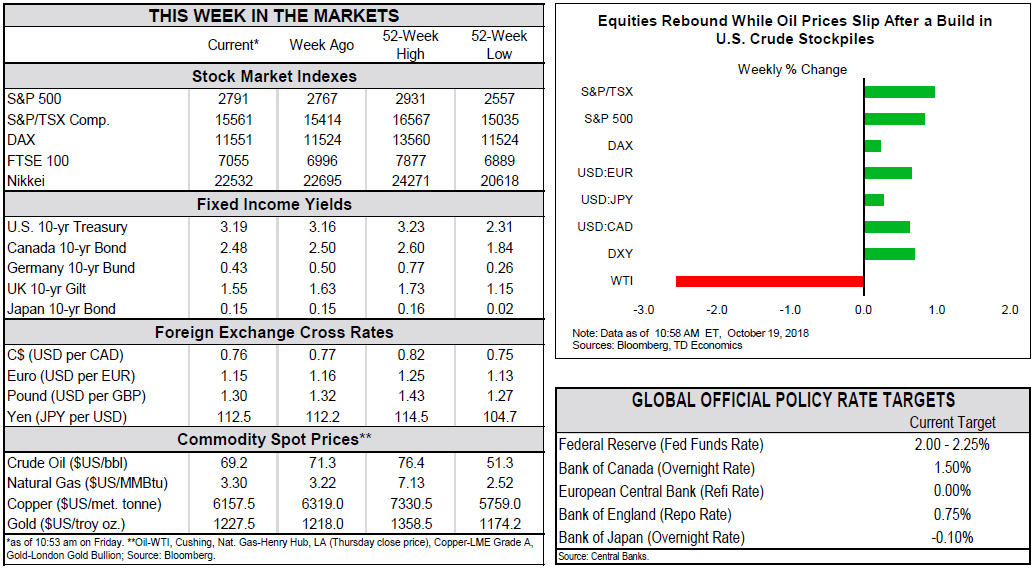
Equity markets stopped the hemorrhaging and partially recovered from last week's downturn. A cocktail of information, which included FOMC minutes, domestic data and thorny international developments, resulted in bouts of volatility. Domestic data was predominantly underwhelming, but did little to change the status quo of a solidly-growing U.S. economy. Retail sales edged up by only 0.1% (m/m) in September – well below market expectations. While disappointing, the report did not raise any red flags. The headline print was likely swayed by Hurricane Florence, given a steep drop in spending at bars and restaurants. More importantly, core sales still rose at a healthy pace of 0.5%, pointing to continued robust momentum in consumption. With September retail sales in the bag, consumer spending in the third quarter likely rose at solid pace of around 3% annualized.
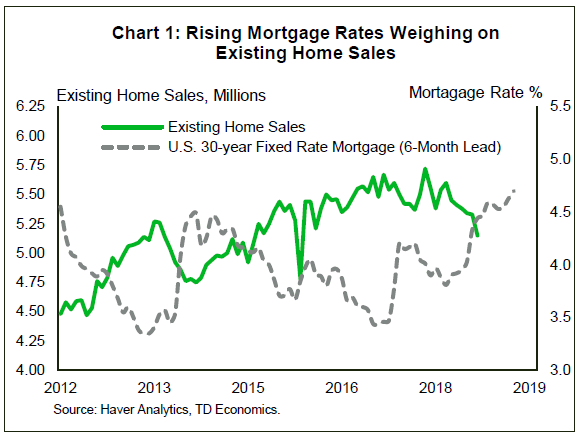
Despite a strong consumer backdrop, the housing market continues to struggle. Existing home sales fell 3.4% in September, marking the sixth straight monthly decline. Housing starts didn't do any better, falling 5.3% to 1.20 million. Again, part of the weakness can be chalked up to weather-related disruptions, with both existing home sales and starts in the South recording the sharpest drops since late 2015. Going forward, tight inventories of homes for sale should help support moderate gains in new homebuilding. Still, limited supply will keep upward pressure on prices and weigh on demand, especially in the near-term. Rising interest rates, which appear to be behind some of the recent malaise, will be an added headwind (Chart 1).
The FOMC minutes released this week reinforced the view of higher interest rates ahead. The key message here is that as long as the economy continues to expand at a solid pace and inflation remains close to target, the Fed will continue to hike rates, likely by 25 basis points a quarter. In addition, a number of participants believe that it will be necessary to raise rates above neutral temporarily, in order to avoid overshooting inflation or contributing to financial imbalances. For a deeper dive on how high rates can go, see here.
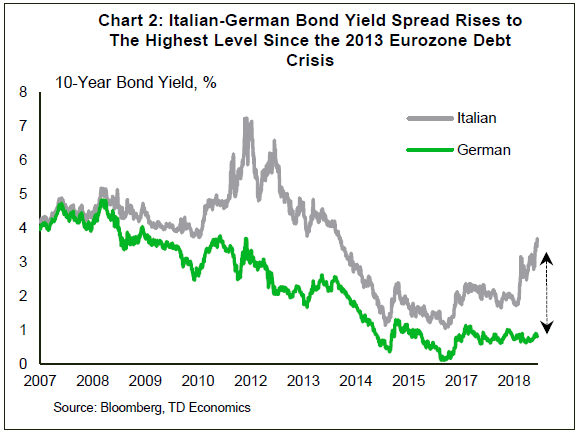
While the data remain supportive of ongoing rate hikes, there is no shortage of potholes in the path ahead, particularly on the international front. Across the pond, Brexit remains a source of uncertainty, while recent developments in Italy have also become a major cause of concern. The EU Commission has determined that Italy's draft budget is in serious breach of EU budget rules, and may reject it. The Rome-Brussels rift, which has sent Italian bond yields skyward (Chart 2), will bear close watching next week with Italy expected to reply to the commission by Monday. Chinese economic growth is slowing and policymakers there have a tough balancing act between deleveraging and maintaining adequate growth. A sour exchange between trade representatives of the EU and U.S. this week also reminds us that the Trans-Atlantic trade truce rests on feeble foundations. All told, plenty of risks remain and it won't be an easy path to navigate.
Canada - Higher Interest Rates May be Starting to Bite
This week's news flow was dominated by the legalization of cannabis nationwide. The economic data was less ebullient, but remained consistent with our view that the Canadian economy expanded at an above trend-pace in the third quarter.
Retail sales in August declined unexpectedly on both a nominal (-0.1% m/m) and volumes basis (-0.3% m/m). The decline in nominal spending appears to have been limited to Saskatchewan, Quebec, Alberta and British Columbia, however seven of eleven retail industries recorded lower sales. This soft print puts some downside risk on our forecast for consumer spending to advance at a 1.8% annualized pace in the third quarter.
The recovery in Canadian existing homes sales also hit a hiccup in September, as national sales slipped 0.4%, marking the first monthly decline since April. Sales slipped in a little over half of all markets. When combined with an uptick in new listings, the supply-demand dynamic remained balanced in most regions, with Quebec remaining as the sole sellers' market. As a result, growth in the national average existing home price remained subdued, although there were pockets of strength in Ontario and Quebec. Going forward, we anticipate housing activity to inch up gradually, but remain below the peak observed last year as rising borrowing costs and stretched affordability act to keep a lid on demand.
Rounding out the trio of soft data, headline inflation decelerated sharply in September, with CPI up 2.2% y/y versus market expectations for a firmer 2.7% advance. A correction in airfares and travel services were largely responsible for the slowdown. Meanwhile, the Bank of Canada's trio of core measures each drifted 0.1 percentage points lower to an average of 2.0% in the month.
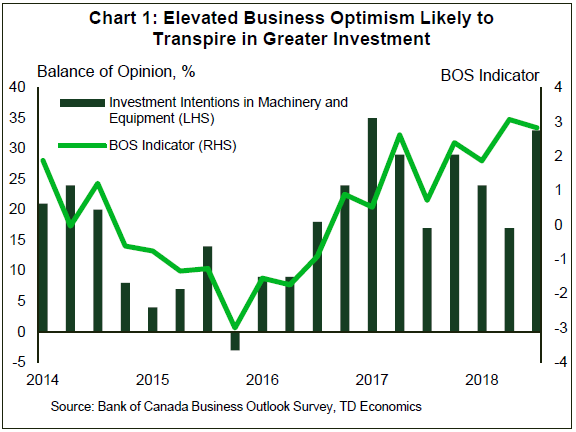
On a positive note, the Bank of Canada's Business Outlook Survey for the third quarter revealed that business optimism is likely to transform into action. A solid sales outlook is leading firms to report an increased likelihood to invest not only to meet rising demand, but to also improve productive efficiency (Chart 1). In addition, labour shortages may signal budding wage pressures, adding to the basket of inflationary pressures down the road.
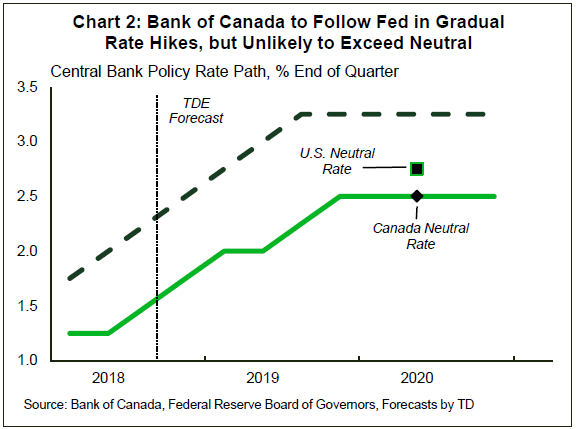
Altogether, this week's potpourri of data support our view that the Canadian economy continues to expand at a pace strong enough to tolerate higher interest rates. Next week's Bank of Canada rate hike is a done deal, and another rate hike is likely in the first quarter of 2019, so long as underlying inflation remains near target and real activity transpires as expected. But, as we've been cautioning, higher interest rates could reveal the fragility of household spending. As mentioned in our Dollars and Sense publication, if yields rise as projected, Canadian homeowners may see their debt service costs rise to roughly 15% of disposable income. This calls for a more cautious rather than aggressive move up in short term interest rates in the year ahead (Chart 2).
U.S.: Upcoming Key Economic Releases
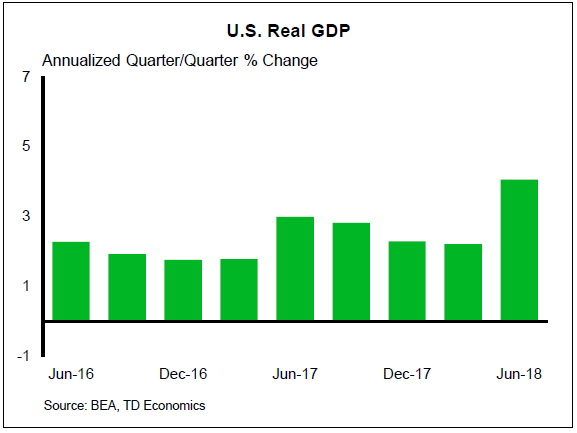
U.S. Real GDP - Q3 2018
- Release Date: October 25, 2018
- Previous: 4.2%
- TD Forecast: 3.5%
- Consensus: 3.4%
We expect a 3.5% advance in Q3 GDP, reflecting solid consumer spending (3.0%) and an outsized boost from inventories. Business investment is expected to see more modest growth of 2.6%, which we expect is a temporary breather after growing at double digits in the first half of the year. Trade is also expected to be a significant drag in Q3, more than reversing the lift in Q2. Also in the release is core PCE, which we expect to rise 1.5% q/q (annualized), implying a 1.9% y/y print for September.
Canada: Upcoming Key Economic Releases
Bank of Canada Rate Decision
- Release Date: October 24, 2018
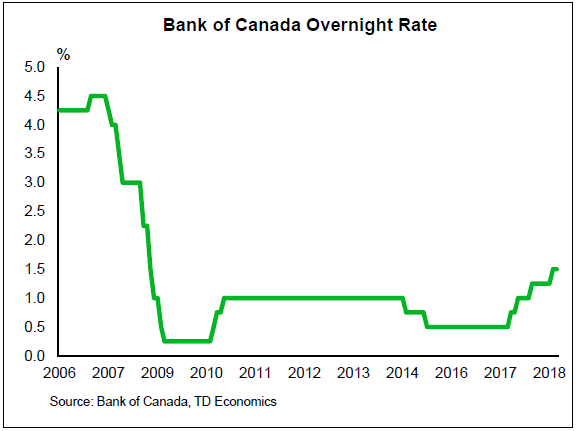
- Previous: 1.50%
- TD Forecast: 1.75%
- Consensus: 1.75%
We expect the Bank of Canada to hike rates by 25 bps next week, in line with consensus. Recent economic activity has surprised to the upside relative to the BoC's last forecast in July and downside risks related to US trade action have diminished with the USMCA deal, so the communique should sound reasonably upbeat. Crucially though, forward looking language should be similar to July, emphasizing a gradual and data dependent tightening path. We expect the Bank to revise their forecast for 2018 growth higher by 0.2 p.p., but we do not expect material changes to forecasts for 2019 and 2020 as tighter financial conditions should roughly offset the boost from greater certainty on trade with the US. Still, with the economy tilting a bit further into excess demand, we now look for three BoC hikes in 2019.
US Growth in Q3 to Guide Dollar
The US dollar is mixed on Friday. Investor’s appetite for risk rose and safe haven currencies (JPY and CHF) fell while positive China and Brexit news saw the NZD, EUR, GBP and AUD advance against the USD. The Canadian dollar was dragged down in the last trading day of the week after softer than expected retail sales and inflation data. Next week’s Bank of Canada (BoC) monetary policy meeting is anticipated to bring a 25 basis point rate hike. Despite the miss inflation has been above the central bank’s target and businesses are optimistic about strong sales.
- BoC expected to hike interest rate to 1.75%
- German Business Climate to cool down
- US first estimate of Q3 GDP to confirm solid growth
Euro Caught Between Brexit and Italian Budget
The EUR/USD fell 0.41 percent in the last five days. The single currency is trading at 1.1510 after rising on Friday due to a combination of softer US housing data and positive Brexit News. The gradual pace of rate lifts by the U.S. Federal Reserve had a negative impact on previously owned homes in September.
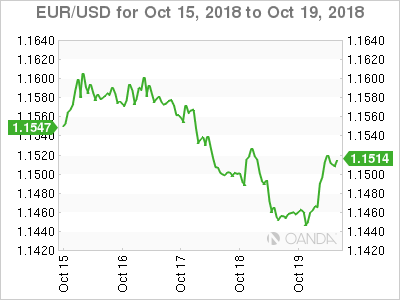
Italian budget issues continue to drag on the euro. The threat of a downgrade of Italian debt does not seem to faze local politicians that are ready to square off against Brussels.
The European Central Bank (ECB) will publish its main refinancing rate and host a press conference on Thursday, October 25. No changes are expected, but investors need to be aware of the tone of the press conference as Mario Draghi could push a more dovish rhetoric.
Loonie to get BoC Rate Hike Boost
The USD/CAD fell 0.74 percent in a weekly basis. The currency pair is trading at 1.3117 and will look at the Bank of Canada (BoC) for support. The central bank is highly anticipated to announce a 25 basis points interest rate hike. The central bank has lifted rates twice in 2018 and rising inflation is forcing the hand of the BoC.
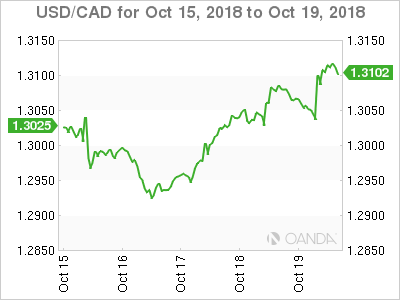
With inflation data lower than forecasted it now validates the gradual approach of the BoC and unless there is hawkish rhetoric from Governor Poloz, the loonie will continue to underperform against the USD.
Oil Drops as US Weekly Buildup Pressures Prices
West Texas Intermediate lost 0.95 percent this week. WTI is trading at $69.36 after staring a rebound on Friday due to surging Chinese demand. Supply concerns continue to guide daily price action. The US weekly inventories showed a buildup last week and pushed prices lower. Iranian exports have been cut ahead of the start of US sanctions, but there are reports that OPEC and other major producers are already closing the gap.
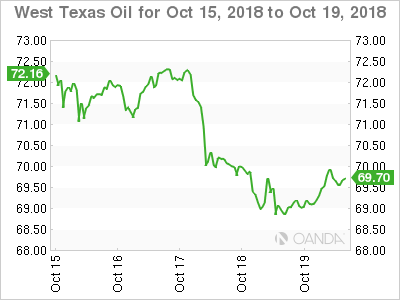
Trade war concerns eased on Friday as China and the US have agreed to meet during the sidelines of the G20 meeting in Buenos Aires. The leaders of the two nations will fly in a day ahead of the event to try and mend the trade relationship.
Gold Rises for Third Week Straight
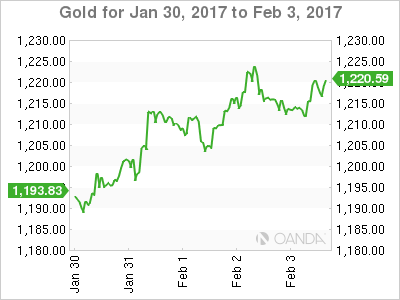
Gold rose 0.6 percent last week. The yellow metal is trading at $1,229.40 despite gradual rate hike talk by Fed members and the minutes form the September FOMC. The rebound of the stock market correlated with the rise of the yellow metal. Safe haven appetite in gold holdings has returned and in a market with no shortage of geopolitical risk for the remainder of the year the yellow metal is set to continue on its rise.
Wednesday, October 24
- 10:00am CAD BOC Monetary Policy Report
- 10:00am CAD BOC Rate Statement
- 10:00am CAD Overnight Rate
- 11:15am CAD BOC Press Conference
Thursday, October 25
- 7:45am EUR Main Refinancing Rate
- 8:30am EUR ECB Press Conference
- 8:30am USD Core Durable Goods Orders m/m
Friday, October 26
- 8:30am USD Advance GDP q/q
*All times EDT
Euro recovers, Italian yeild reverses as EU Moscovici wants to reduce tensions with Italy
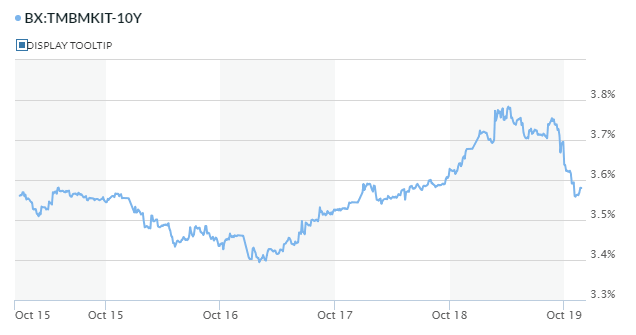
That's the power of words. Euro recovers notably while Italian yield reversed after European Economic Affairs Commissioner Pierre Moscovici said he wanted to reduce tensions with Italy, regarding the budget, through "constructive dialogue". He emphasized that both EU shared the populist coalition government's goal of boosting growth and cutting debt. And he also reiterated that no formal decision was made from the Commissions side yet. Yesterday, EU sent a letter warning Italy's budget as "obvious significant deviation" of the recommendations adopted by the European Council.
Italian 10 year yield is now at 3.581, down -0.097, after hitting as high as 3.784 earlier today.
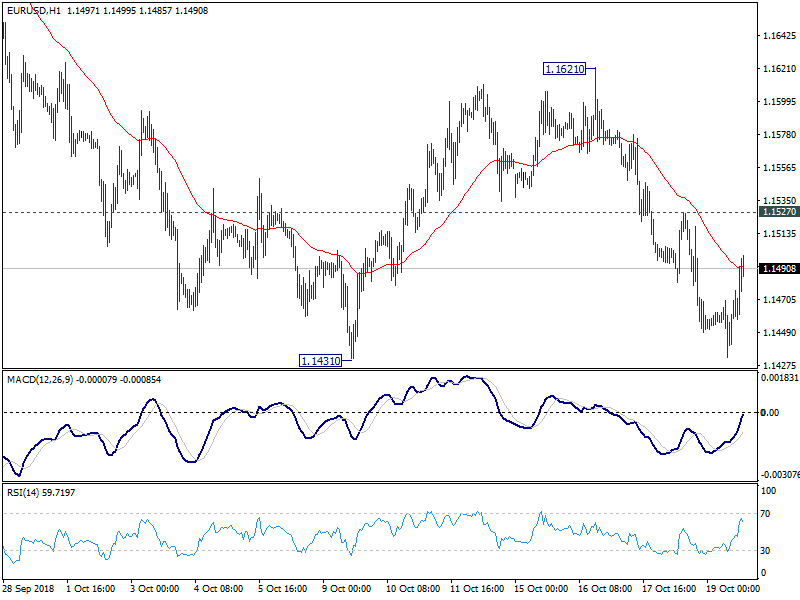
EUR/USD also recovered notably after defending 1.1431 support.
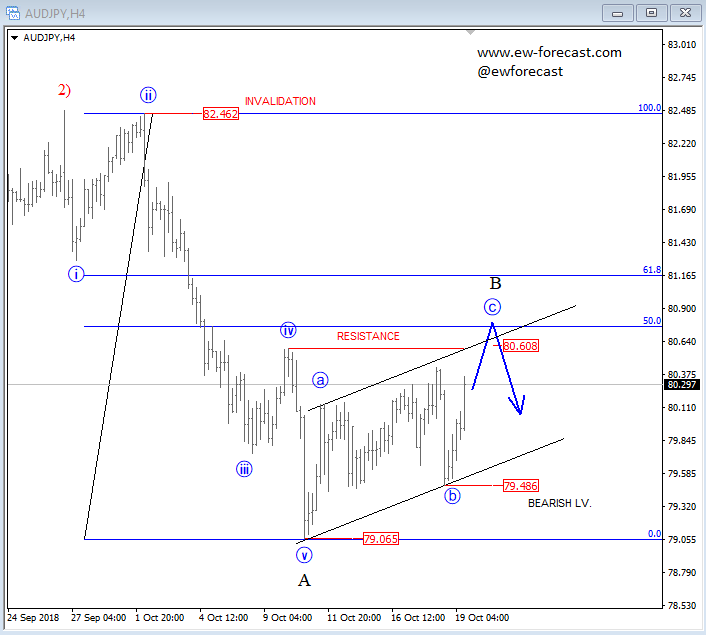
Temporary Consolidation on AUDJPY Points Lower – Elliott Wave Analysis
AUDJPY is slowly recovering within very choppy and overlapping price action, which means that we have to track it as a corrective rally, especially because of bearish looking stocks. What we see is a three-wave a-b-c corrective rise within channel range, where we see a room towards 80.60, maybe even 81.00 resistance area. Even if price goes higher, invalidation level remains at 82.46 level, just keep in mind that bears can be confirmed only below 79.48 region.
AUDJPY, 4h
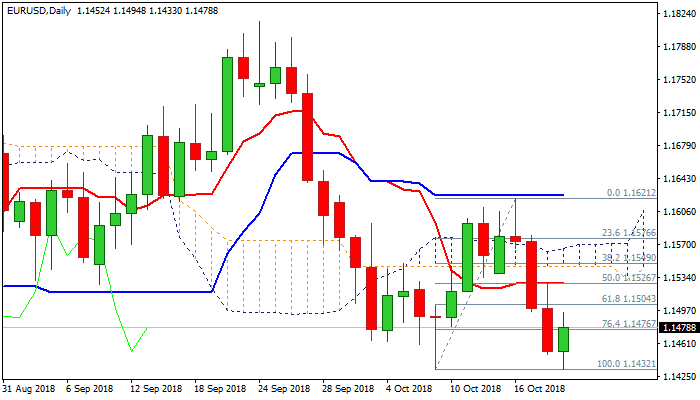
EURUSD Outlook: Bounces on Profit-Taking Seen as Positioning ahead of Fresh Weakness
The Euro hit session high at 1.1494 in US trading on Friday, following bounce from key near-term support and target at 1.1432 (09 Sep spike low) which was touched earlier today. Pre-weekend profit-taking on strong two-day fall on Wed/Thu and rising stock prices that reduced demand for greenback, support the advance. On the other side, overall picture remains negative, with persisting tensions over Brexit and Italian budget story, seen as negative factors which could keep the single currency under pressure in coming days. Adding to the notion is bearish close this week and also negative weekly techs. Bounce could be seen as positioning for fresh weakness, with initial resistance at 1.1497 (broken Fibo 61.8% of 1.1300/1.1815 ascend), capping the action for now and guarding 1.1523 barrier (falling 10SMA). Only extended bounce through thin daily cloud (1.1545/65) would neutralize bears.
Res: 1.1497; 1.1523; 1.1567; 1.1578
Sup: 1.1432; 1.1422; 1.1387; 1.1360
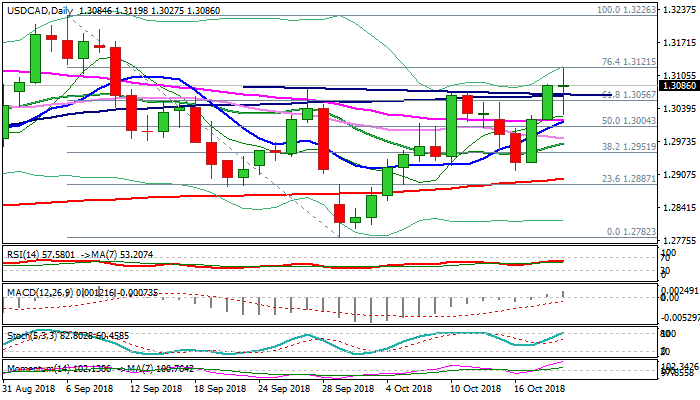
USDCAD Outlook: Loonie Falls on Weak Canadian Data, Strong Greenback and Oil Price Fall
The USDCAD pair rose to new five-week high at 1.3119 on Friday, on nearly 100-pip jump after disappointing data from Canada. Canadian CPI m/m fell 0.4% in Sep vs -0.1% f/c, while annualized figure was 2.2% in Sep, falling below 2.7% f/c and 2.8% previous month. Canada’s retail sales also disappointed (Aug m/m -0.1% vs 0.3% f/c / Core Aug m/m -0.4% vs 0.2% f/c). Negative data added to loonie’s existing bearish outlook, driven by stronger greenback across the board and strong fall in US oil price. Fresh bullish acceleration broke above thin daily cloud (spanned between 1.3078 and 1.3088) and came ticks ahead of next barrier at 1.3121 (Fibo 76.4% of 1.3226/1.2782, adding to bullish signals on Thursday’s close above pivotal barriers at 1.3056/65 (Fibo 61.8% of 1.3226/1.2782 / 100SMA).
Daily MA’s are in positive setup and along with rising bullish momentum, underpin the advance. Friday’s close above broken 1.3056/65 barriers is needed to confirm bullish stance on completion of inverse H&S pattern on daily chart for further upside, as the pair is on track for the third straight bullish weekly close. This is also needed to complete inverse H&S pattern on daily chart and open way towards key barrier at 1.3226 (06 Sep high). Bears could be delayed on weekly close below 1.3056/65 (Fibo / 100SMA), now acting as support.
Res: 1.3121; 1.3174; 1.3197; 1.3226
Sup: 1.3065; 1.3056; 1.3027; 1.3014
US Election Monitor #3: Standstill as US Criticises China Trade Policy
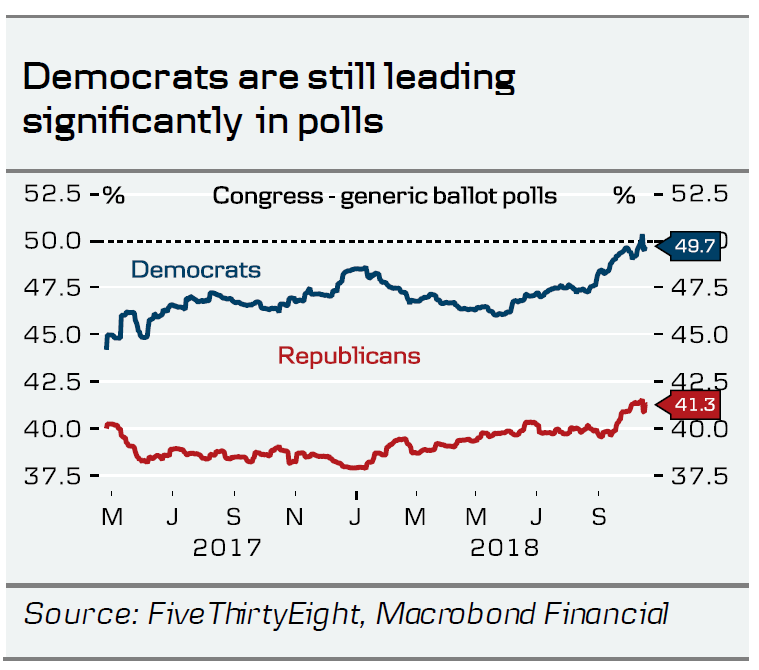
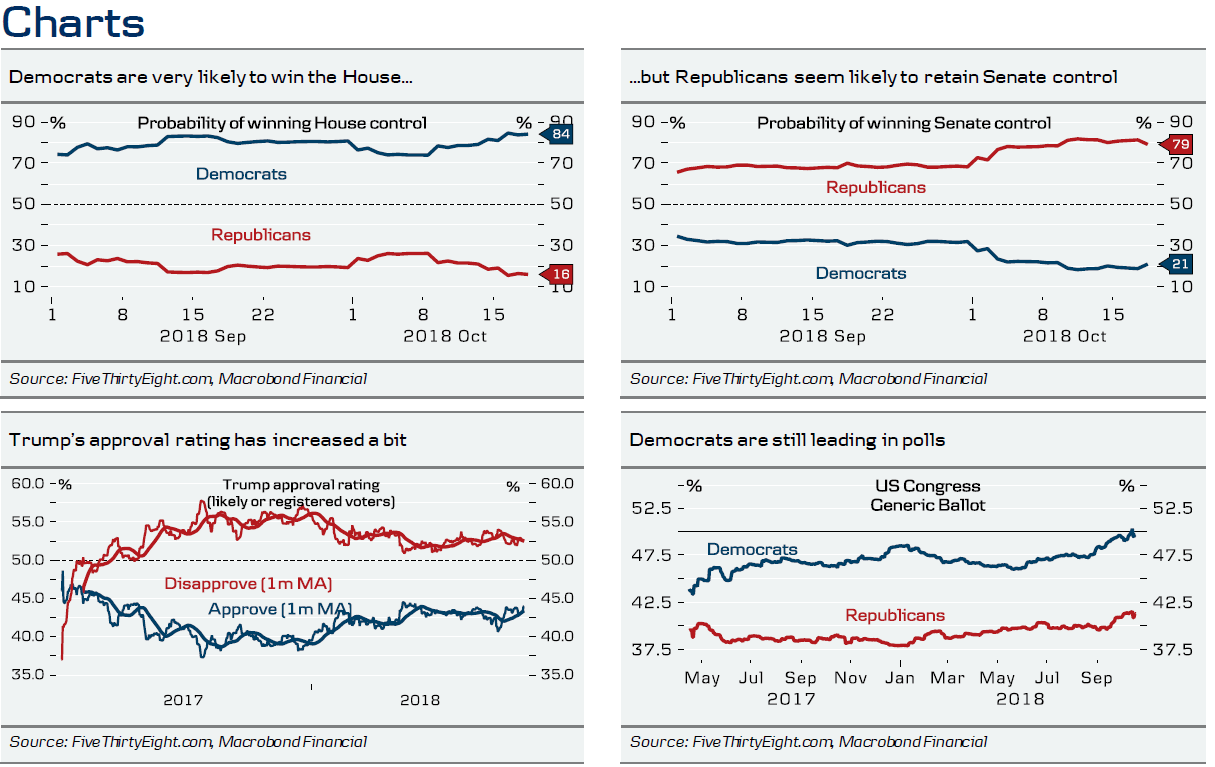
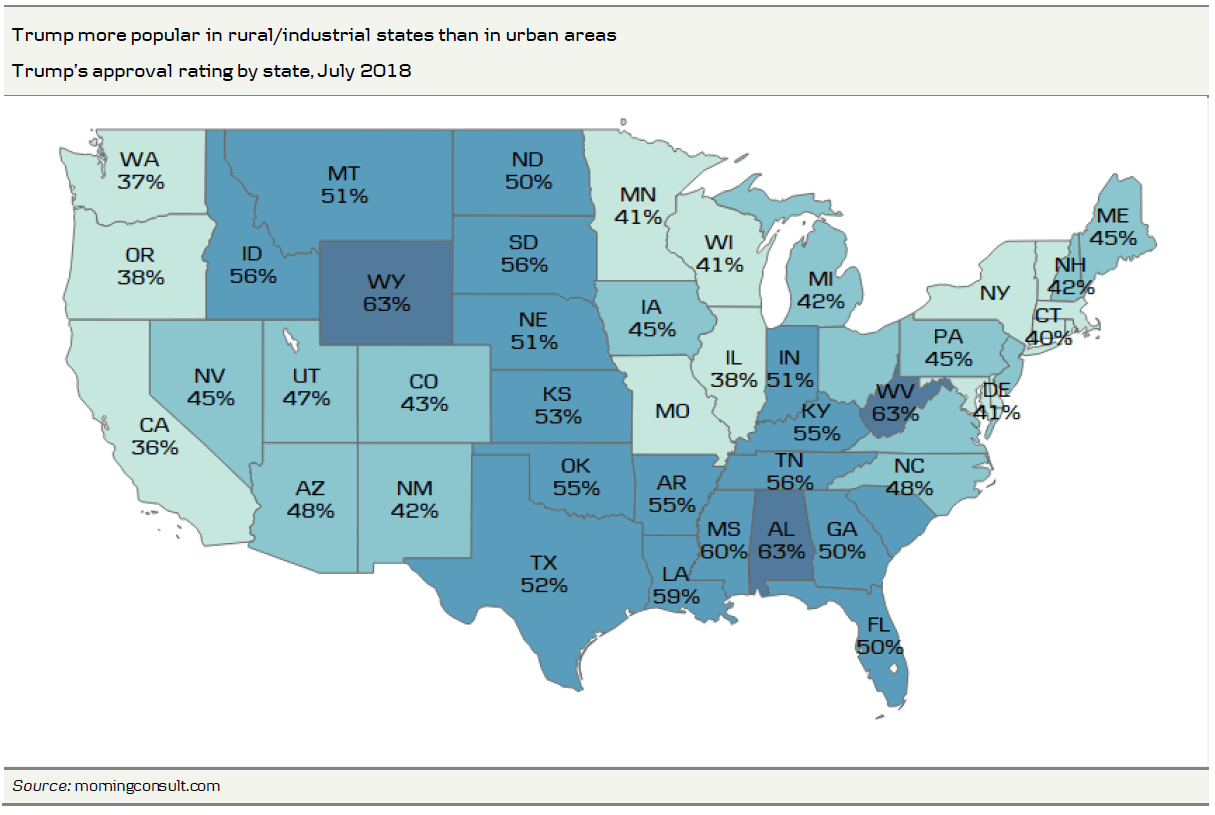
With less than three weeks to go, the Democrats are still leading significantly in the opinion polls. FiveThirtyEight models still point towards a divided Congress (79% probability of the Republicans taking the Senate and 84% probability of the Democrats winning the majority in the House of Rep resentatives). Trump 's ap p roval rating has risen (and disapproval fallen) slightly in recent weeks but Trump remains unpopular.
As expected, the Trump administration did not officially declare China as a currency manipulator in its semi-annual report (despite Trump claiming it). China simply does not live up to the three criteria. Still, the report included very hawkish language against China. It is difficult to see a solution to the trade war/strategic conflict in the short term, as the US economy is strong and China does not want to negotiate under pressure and seems to be preparing for a long fight. Due to monetary policy divergence, we expect CNY to weaken further and forecast USD/CNY in 7.20 in 12M.
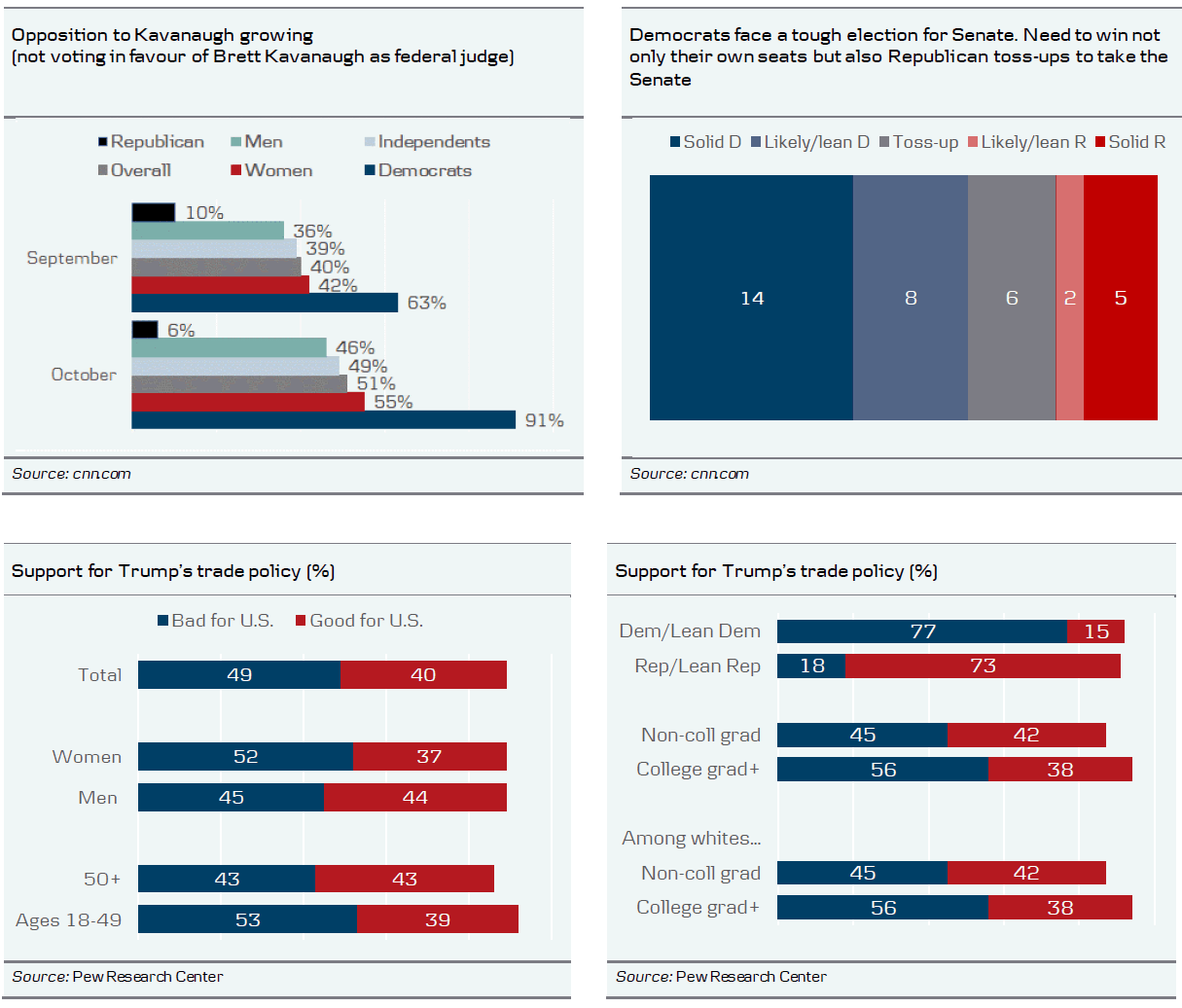
US Commerce Secretary Wilbur Ross has indicated that he is annoyed with the lack of progress in the trade talks with the EU by saying that 'the President's patience is not unlimited'. It is difficult not to see the trade disputes in light of the upcoming mid-term elections, as many Republican voters are in favour of a more protectionist trade policy (see chart page 3).
FOMC minutes released this week revealed a central bank on track to deliver hikes until the 'neutral' 3% is reached (p robably in June 2019 after hikes in both December-18 and March-19). After that, monetary p olicy will be more 'stop and go' dep ending on how the economy and markets are doing, but 'a substantial majority' expect policy to turn contractionary. In other words, the FOMC minutes did not give any indications that the Fed is listening to President Trump's critique .
Look out for the rising tensions between the US and Saudi Arabia on the back of the killing of the Saudi journalist Jamal Khashoggi. President Trump now acknowledges that high-level Saudis played a role.
A divided US Congress means that Trump would be unable to push his domestic policy agenda through. In our view, the mid-term elections should have limited implications for markets and the economy, as it would be difficult for the Democrats to roll back Trumponomics even if they won both chambers. However, the risk is that he becomes even more hawkish on foreign policy and trade policy after the election.
Week Ahead- ECB Decision, US GDP and Davos In Desert
Markets will keep an eye on the development of Italy’s budget. China grew slower than expected. The Philly Fed index dipped from 22.9 to 22.2 vs. 19.7 forecast. Brexit negotiations have also run into new trouble. The FOMC minutes were as expected and showed that the Fed is on track to deliver rate hikes until they reach the 3% neutral rate.
Technical Analysis
EURUSD
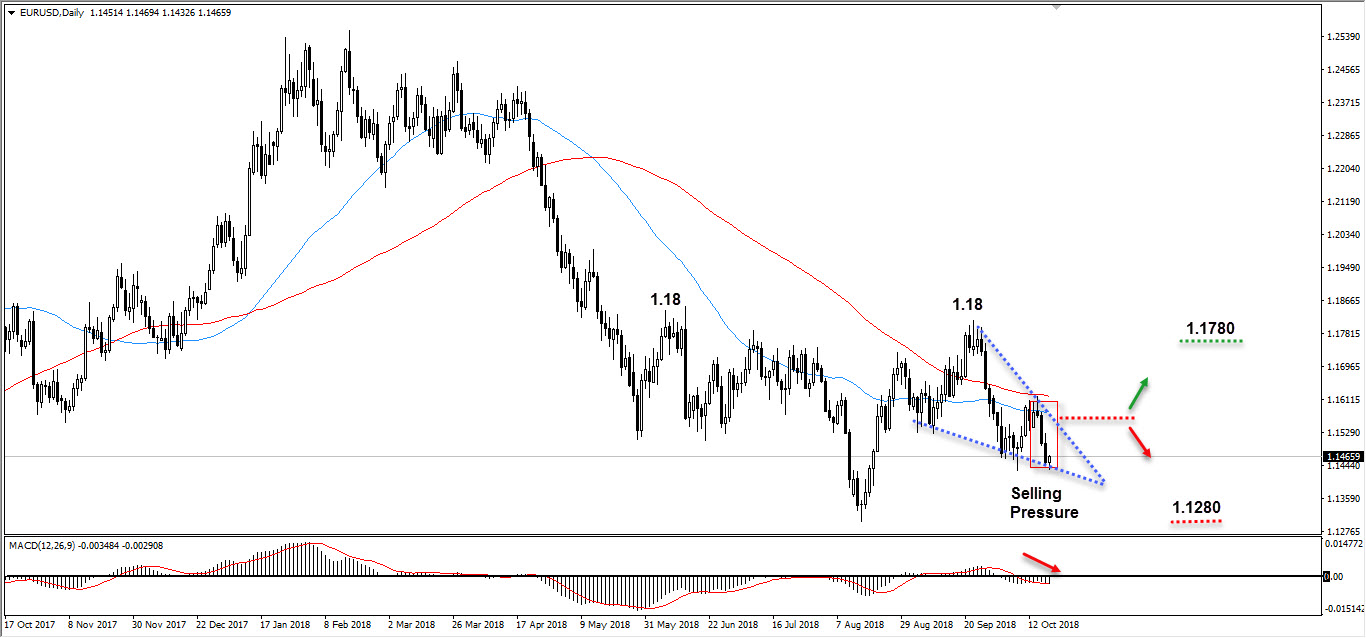
EURUSD is trading under selling pressure on a daily time frame. The price is trading in a downward wave and this confirms that the trend is skewed to the downside. Having said this, the price is firmly trading below the 100 and 200-day moving averages, which shows that there are higher chances for further declines. Currently, there is a battle between the price and the major support level at 1.1420. If the price breaks below that level, the odds will be even stronger that the uptrend will shape up from there. The Balance of Power shows that the bears are still controlling the momentum. We need to see this continue and that would support the above argument. The resistance is shown by the green horizontal line, which is the highest point the price made on 27th of September. The support is shown by the red line, which is the lowest point formed on 18th June 2017.
GBPUSD
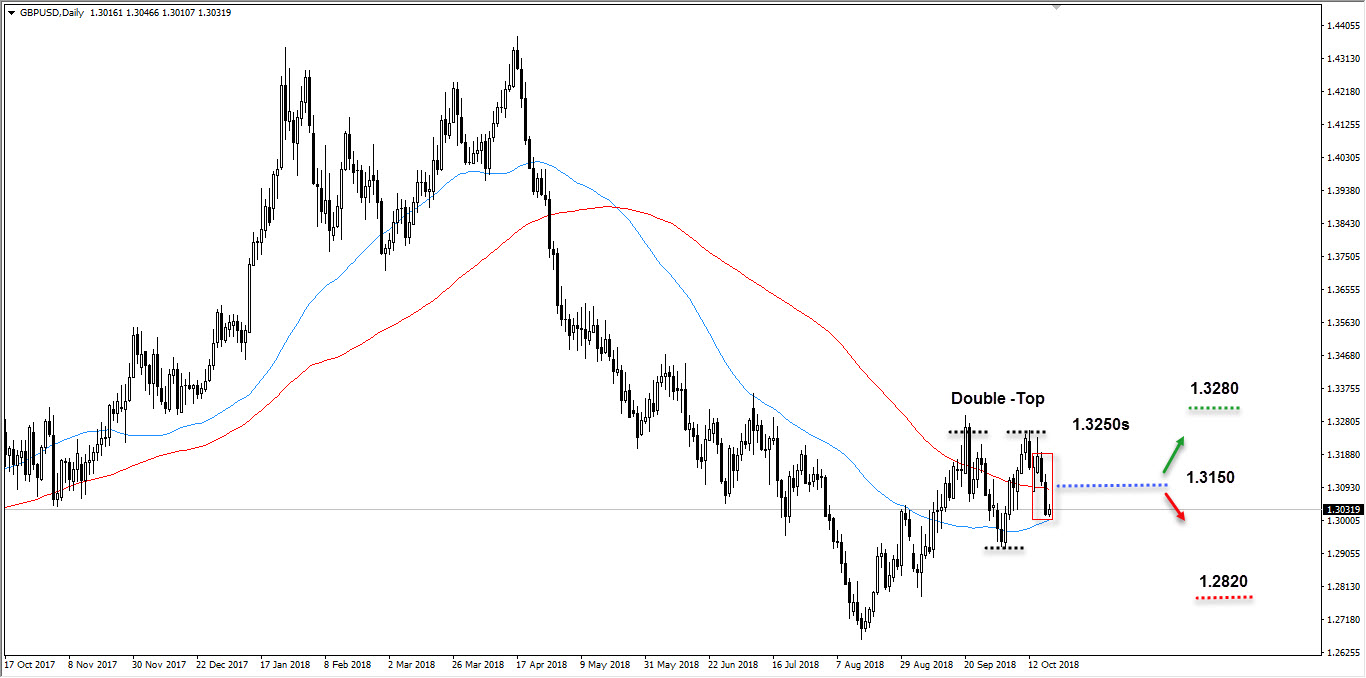
GBPUSD trading has failed to break the major resistance at 1.3250s as shown on the daily time frame. The price is trading under strong selling pressure. This confirms that the trend is skewed to the downside. Having said this, the price is firmly trading below 200-day moving average, which shows that there are higher chances that the price may break below the support level of 1.2905. (The nick line for the double top pattern). Currently, there is a battle between the price and the 50-day moving average and if the price closes below it, the odds will be even stronger that the downtrend will shape up from there.
The Balance of Power shows that the bears are still controlling the momentum. We need to see this continue and that would support the above argument.
The resistance is shown by the green horizontal line, which is the highest point the price made on 21st September. The support is shown by the red line, which is the lowest point formed on 5th September.
USDJPY
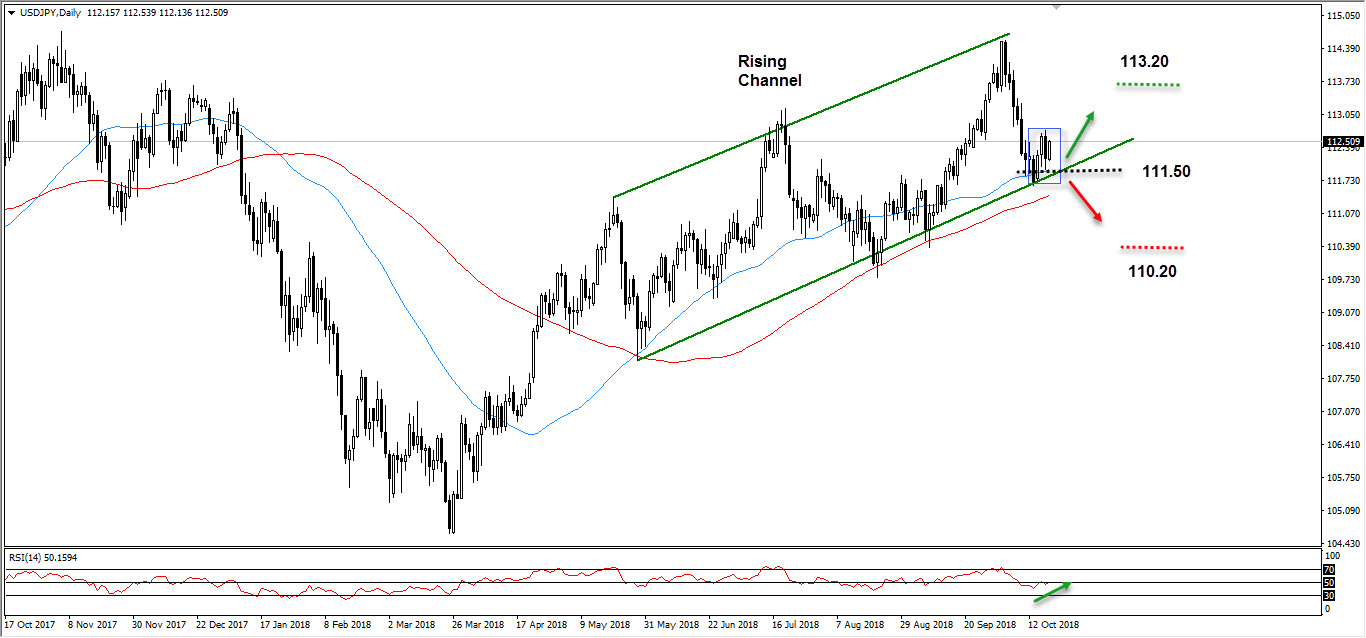
The pair is trading within a rising channel on the daily time frame. The price is trading near the lower boundary of that channel. Having said this, the price is firmly trading above the 50 and 200-day moving averages which shows that there are higher chances that the price may rebound. The Balance of Power shows that the bears are still controlling the momentum, we need to see this fading and that would support the above argument. The resistance is shown by the green horizontal line which is the point which the price made on the 8th of October. The support is show by the red line which is the lowest point formed on the 10th of September.
XAUUSD
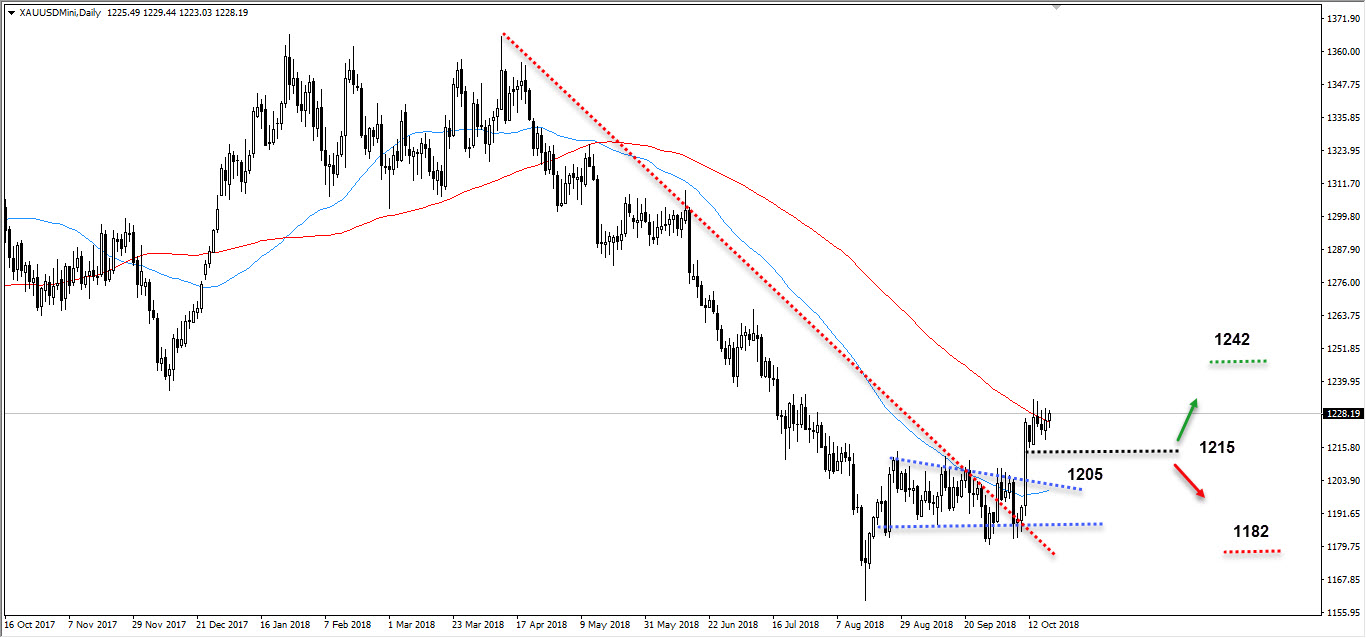
The yellow metal has broken the descending triangle on a daily time frame. The price is trading within the breakout phase and this confirms that the trend is skewed to the upside. Having said this, the price is firmly trading above the 50 and 200-day moving averages, which shows that there are higher chances that the price may continue the bullish momentum. The Balance of Power shows that the bulls are still controlling the momentum. We need to see this continue and that would support the above argument. The resistance is shown by the green horizontal line, which is the highest point the price made on the 12th of July. The support is shown by the red line which is the lowest point formed on 10th October.
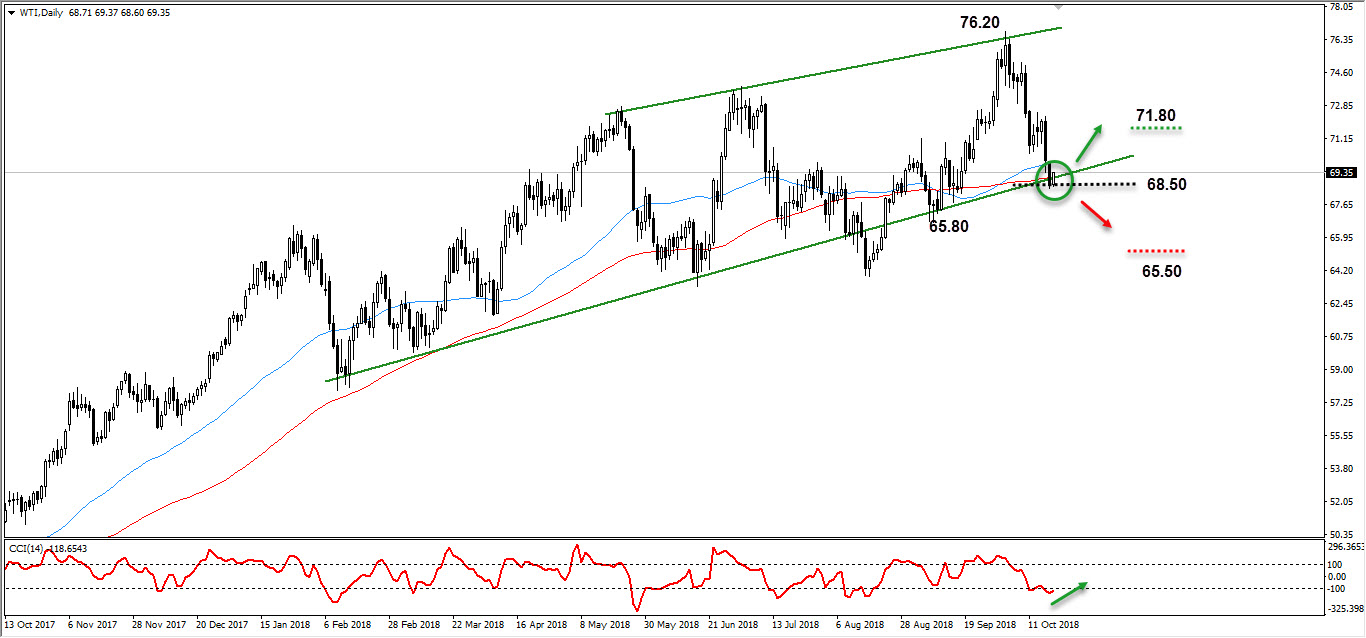
WTI
Oil trading has rebounded from the lower boundary of its upward channel on a daily time frame and this confirms that the trend is skewed to the upside. Having said this, the price is firmly trading above the 200-day moving average, which shows that there are higher chances that the price may rebound from this level toward the shown resistance level. Currently, there is a battle between the price and the 50-day moving average and if the price breaks towards the upside, the odds will be even stronger that the uptrend will shape up from there. The Balance of Power shows that the bears are still controlling the momentum. We need to see this fading and that would support the above argument.
The resistance is shown by the green horizontal line which is the highest point the price made on 17th October. The support is shown by the red line, which is the lowest point formed on 21st August.
Dow Jones
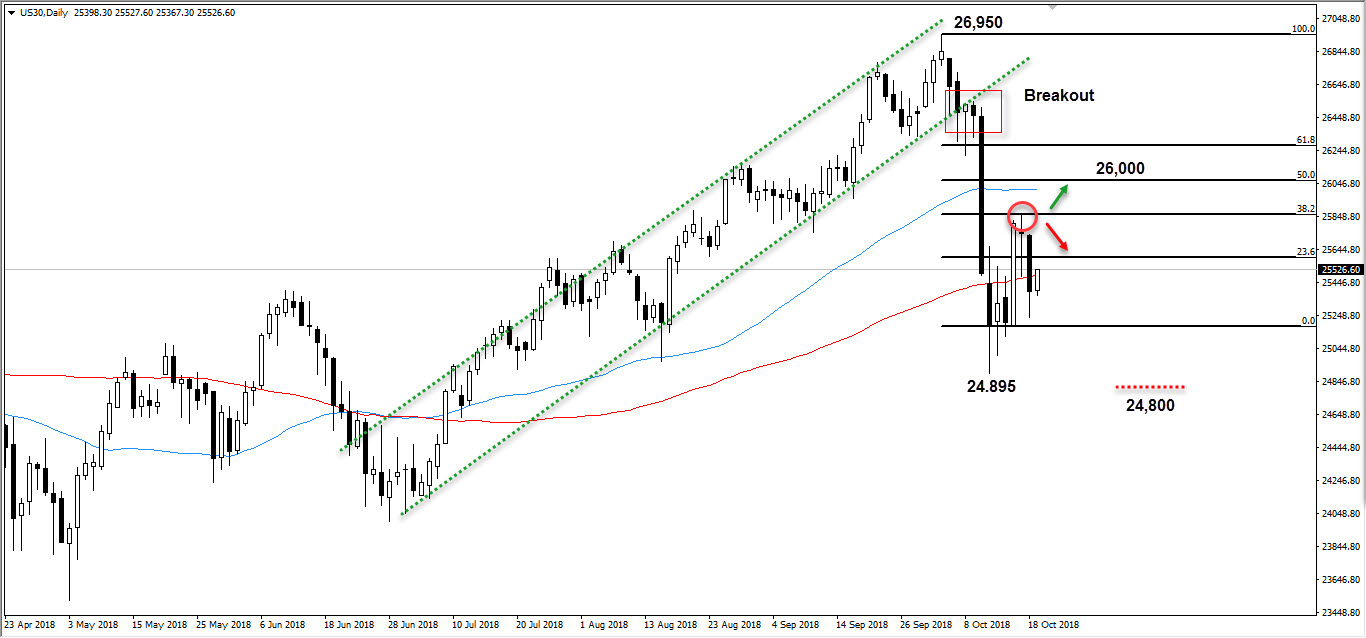
Dow Jones has broken its upward channel on a daily time frame. The price is trading in a downward wave and this confirms that the trend is skewed to the downside. Having said this, the price is firmly trading below the 100 and 200-day moving averages, which shows that there are higher chances that the price may continue downward wave. Currently, there is a battle between the price and the 200-day moving average and if the price closes below it today, the odds will be even stronger that the downtrend will shape up from there. The Balance of Power shows that the bears are still controlling the momentum, we need to see this continue and that would support the above argument. The resistance is shown by the green horizontal line, which is the point the price made on 10th October. The support is shown by the red line, which is the point formed on 12th July.
Week Ahead – Central Banks and US Q3 GDP in Focus; BoC Poised to Raise Rates
Central bank meetings will take centre stage in the coming week as economic data will be in short supply. With four policy meetings lined up, comprising the European Central Bank, the Bank of Canada, the Riksbank and the Norges Bank, only the BoC is anticipated to take action next week. The preliminary reading of third quarter GDP growth in the United States will likely be the most highly awaited release of the week, followed by the October flash PMIs in the Eurozone, the US and Japan.
Bank of Canada to hike again
The BoC has been one of the few central banks among advanced economies other than the Federal Reserve that’s been able to raise interest rates beyond crisis era levels. Having increased rates four times since 2017, the BoC is expected to deliver another 0.25% rate hike on Wednesday when it announces its latest policy decision. The market odds for a rate increase have been rising since the successful conclusion to the NAFTA renegotiation earlier in the month and a bullish quarterly business survey by the BoC this week. However, the Canadian dollar has been weakening after that initial lift from the trade deal as oil prices have been on a downtrend in October. The loonie may be able to get on a stronger footing if the BoC accompanied its rate hike with a hawkish outlook.
ECB to meet amid Italy tensions and growth worries
The euro will be under the spotlight next week, as apart from the ongoing drama with the Italian budget, the flash PMIs for the Eurozone and an ECB meeting will be drawing investors’ attention. The Eurozone’s economy has been unable to regain steam after a notable slowdown at the start of 2018. The ECB has insisted the region’s fundamentals remain strong as it readies to conclude its asset purchase program at the end of December. However, investors are more sceptical about the growth outlook and this cautiousness is one of the reasons why many analysts are bearish on the single currency for the next few months. Another reason is the stand-off between Italy and the European Union over Italy’s budget deficit targets, which looks set to escalate in the coming weeks as the EU will likely reject the submitted plans.
ECB chief Mario Draghi will probably have to address these concerns when he holds a post-meeting press conference on Thursday. As for the policy decision itself, the ECB is widely anticipated to keep policy on hold in October.
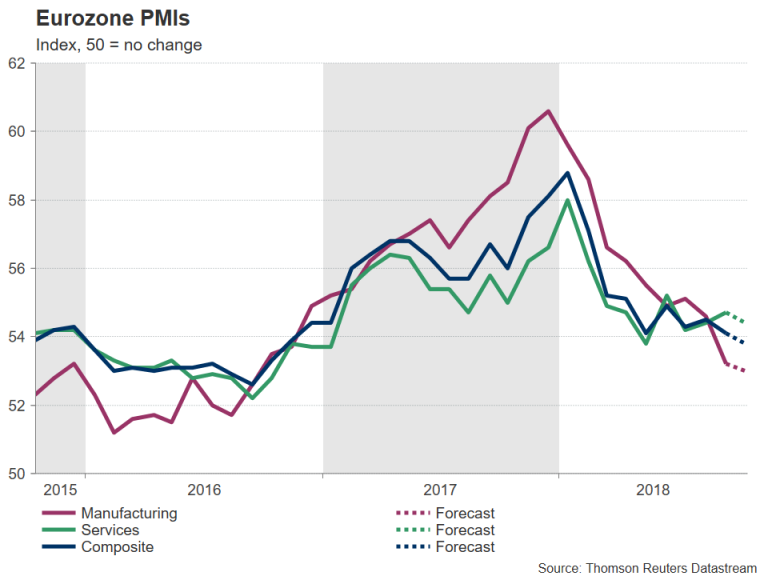
Reassuring comments from Draghi may provide some support to the euro, but traders shouldn’t expect any reprieve from economic indicators. The flash estimates of Eurozone PMIs by IHS Markit, due on Wednesday, are set to show further deterioration in economic momentum. The manufacturing PMI is forecast to decline further in October, falling to 53.0 from 53.2, which would be a two-year low if confirmed. The services PMI is also forecast to drop, from 54.7 to 54.4, suggesting no rebound in sight just yet for the euro area. Another important business sentiment gauge will be the German Ifo survey on Thursday. The Ifo’s business climate index is not expected to buck the trend, slipping from 103.7 to 103.2 in October.
Riksbank and Norges Bank to stand pat
Sweden’s central bank, the Riksbank, will announce its policy decision on Wednesday ahead of the ECB’s announcement. Inflation in Sweden has been slowly edging up in recent months but at its last policy meeting in September, the Riksbank pushed back the timing of the first rate hike since 2011 to December/February from earlier forecasts of October/December. Although stronger-than-expected CPI readings for September raised the odds of a rate hike arriving in December, February remains very much in play and policymakers will possibly use next week’s meeting to provide clearer guidance.
The Swedish krona has firmed by around 2% versus the US dollar and the euro since last week’s inflation data and could extend those gains if policymakers signal a rate hike before year-end.
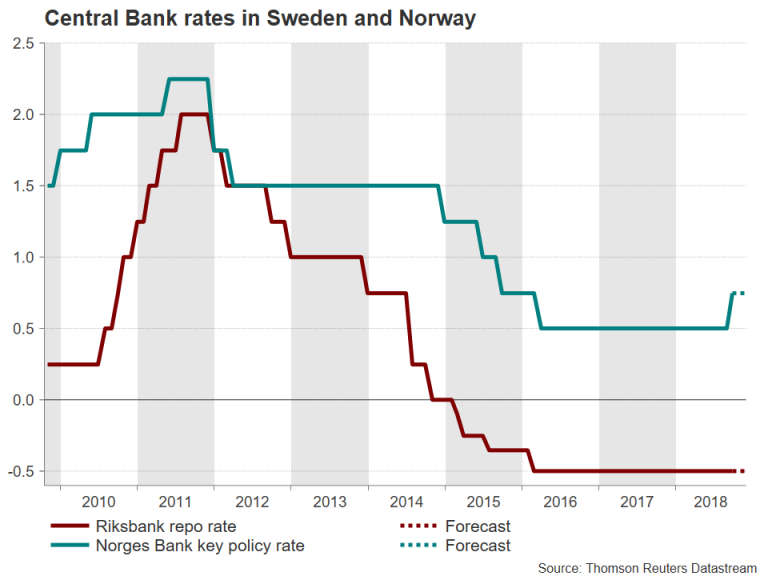
But as the Riksbank hesitates whether or not to tighten policy, neighbouring Norway’s central bank has already begun the process, raising rates in September from 0.50% to 0.75%. The next hike is not anticipated until the first quarter of 2019 and the Norges Bank is almost certain to keep rates unchanged at its meeting on Thursday. The Norwegian krone is therefore unlikely to see much reaction to the central bank’s decision unless there’s a surprise tweak to the projected rate path.
US GDP likely slowed in Q3
The US will have the busiest calendar next week with Friday’s GDP numbers being the highlight. Before then though, attention will fall on October flash PMIs and September new homes sales on Wednesday. IHS Markit’s manufacturing PMI is expected to stay unchanged at 55.6 in October’s preliminary reading, while the services PMI is projected to rise slightly from 53.5 to 53.9. On Thursday, the latest durable goods orders are due along with the advanced trade balance and pending home sales, all for September. Durable goods orders are forecast to have fallen back by 2.3% month-on-month in September after a 4.4% gain in the prior month. However, core capital goods orders, which are a more accurate indication of the business spending component of GDP, are expected to have increased by 0.3% m/m in September.
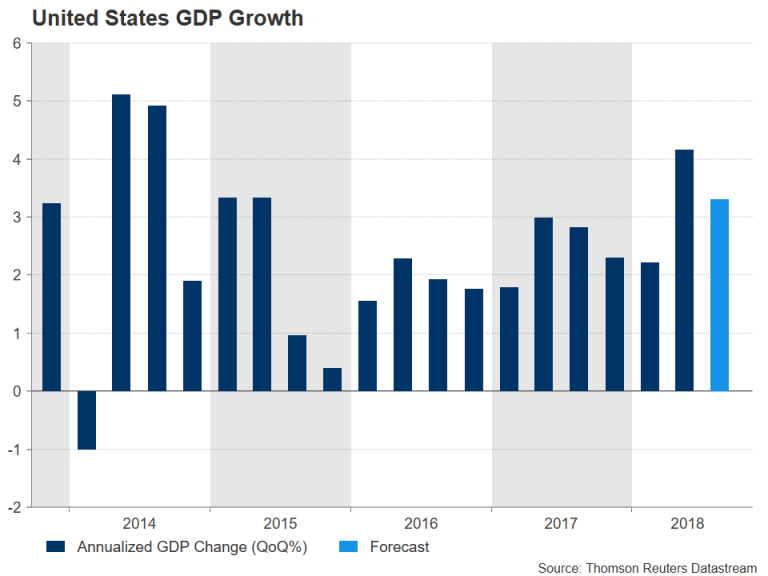
On Friday, investors will get the first look at US growth for the three months to September. Following the robust 4.2% annualized expansion of the second quarter, growth is forecast to have moderated to 3.3% in the third quarter, which still represents above trend growth for the US economy. The dollar, which against a basket of currencies has been consolidating since mid-August, could resume its uptrend if there is an upside surprise to the GDP figures. Though, with US stocks being sensitive to big jumps in Treasury yields, another potential sell-off on Wall Street could cap gains for the greenback if strong data drive up long-term Treasury yields to uncomfortable levels.
Weekly Focus: Pressure on Italy is Set to Intensify
Market Movers ahead
- In the euro area, focus will remain on the Italian budget turmoil and the ECB meeting on Thursday. We will get the first indication of Q4 GDP with the flash PMI.
- In the US, the first estimate for Q3 GDP is due to be released, as well as PMI for October.
- We are likely to have to wait another two months at least for a deal to be agreed on Brexit.
- In the Nordics, the key event will be the Riksbank meeting, as well as projections from the Swedish Debt Office. We also have the Norges bank meeting.
Global macro and market themes
- Brexit negotiations failed to reach breakthrough at EU summit. No deal within the next two months.
- Harsh EU letter to the Italian government.
- US sell-off took a breather amid moderate risk sentiment.