Sample Category Title
Canadian Inflation Closer to 2% in September after Summer Spike
Highlights:
- CPI inflation dropped to 2.2% in September year-over-year from 2.8% in August. Market expectations were for a more gradual slowing to 2.7%.
- The year-over-year increase in the transportation component slowed to an eight-month low as gasoline and airfare prices reversed earlier gains.
- Other major components like food and shelter saw price growth tick higher.
- The Bank of Canada’s core measures averaged 2.0% for the sixth month this year. This is the steadiest period of core inflation since 2011.
Our Take:
Canadian inflation slowed more than expected, returning to a 2.2% year-over-year rate in September after hitting 3% over the summer. The spike higher in July and August largely reflected a jump in the transportation component with both airfares and gasoline prices rising. Cooling in energy price growth was expected as last year’s hurricane-related increase in gasoline prices fell out of the calculation. It was the timing on airfares that caught us off guard, as July’s 16% spike was fully reversed in September. That the summer’s higher inflation was largely noise is reflected in the BoC’s favoured core measures, which on average haven’t budged from a 1.9-2.1% range since February. That compares with a 1.5% average last year. Those numbers are key to the Bank of Canada’s assessment that the economy has been “operating near capacity for the past year.”
The BoC has indicated higher rates will be needed to keep inflation on target, and we expect they’ll act on that bias next week by lifting the overnight rate to 1.75%. With markets having priced in that move for some time now, focus will be on the pace of tightening going forward. At their last meeting, Governing Council debated whether a gradual approach to raising rates remained appropriate. The topic will likely be discussed again next Wednesday. But even if the BoC goes for less explicit forward guidance, we don’t see them speeding up the pace of hikes. Household sensitivity to rising rates remains a key issue, and today’s inflation numbers allow the BoC to continue tightening at a manageable pace.
Canadian August Retail Sales Decline
Highlights:
- Retail sales dropped 0.1% in the month with the volumes measure down a greater 0.3%
- The nominal decline reflected gasoline station sales dropping 2.0% moderated by motor vehicle sales rising 0.8%. Excluding these two components, sales dropped 0.1% following a 0.5% gain in July.
- E-commerce sales rose 13.9% compared to overall retail sales gain of 3.7%.
Our Take:
The nominal value of August retail sales declined 0.1% with the volumes measure down 0.3% following a 0.2% drop in July. These volumes declines continue to unwind an outsized 2.1% monthly surge in May. However, it is still the case that the average monthly increase in volumes to date this year is one-half the 0.3% average gain achieved in 2017. This difference has contributed to the year-over-year rate moderating to around 1% from the almost 6% gain recorded through 2017. This slowing in retail sales volumes is not necessarily unwanted. With the economy operating at capacity, monetary policy is being tightened to slow overall GDP growth closer to the economy’s long-run potential rate of around 1.8%. The Bank of Canada has long wanted to see a shift away from robust consumer spending, which has contributed to rising household debt, and towards greater expenditure in investment and exports.
Today’s decline in retail sales volumes follows indications earlier this week that the volume of manufacturing sales dropped 0.3% in August. However we are assuming offsetting gains in mining output along with continued trend increases in most other service-producing sectors that will result in overall August GDP rising 0.1% in the month. This is consistent with Q3 GDP growth likely rising 2.3%. With this rate slightly above potential, and being achieved despite a temporary shutdown of a key oil sands production facility, it is expected to keep the Bank of Canada tightening. Our forecast assumes a 25 basis point hike next Wednesday will be followed by two further similar-sized hikes over the first half of next year.
Sunset Market Commentary
Markets
Global core bonds trade near opening levels as markets calmed down as the past days’ concerns proved somewhat exaggerated. Risk aversion initially persisted though this morning, with Asian equity markets losing ground apart from China. High-ranked Chinese officials pledged support for the stock market, causing some backwind for local markets. Global core bonds first edged higher with German Bunds outperforming US Treasuries. Italian BTP’s moved south, pushing Italian yields near multi-year record highs. The EC officially expressed its concerns over the Italian budget proposal. Calm returned to markets before noon. However, Italy for the first time really dragged Spain and the semi-core lower as well. Not surprisingly, Spanish and Belgian bonds underperform others as both countries are also pushing for higher deficits. An Italian-like stand-off with Europe most probably won’t occur. The Spanish 10-yr yield spread (+3 bps) matches the end of May high (136 bps). The Italian spread widens over 330 bps. Daily changes on the German yield curve vary between -0.1 bp (5-yr) and -2.0 bps (30-yr). The US yield curve moves north, but remains close to unchanged. Moves range from +0.36 bps (5-yr) to +1.1 bp (30-yr).
Political noise on the Italian budget, a global risk-off and a generous interest rate differential in favour of the dollar weighed on the EUR/USD cross rate yesterday. With no important eco data on the agenda, question was whether this trade would continue. EUR/USD stabilized this morning as the action of the PBOC put a floor for Asian markets. However, in Europe, doubts persisted. Intra-EMU spreads still widened a few bp, European equities failed to maintain modest opening gains. EUR/USD also tried a new downside test and came close to the 1.1432 support. However, the move lacked conviction. In lackluster trading, EUR/USD returned to opening levels. The political risks linked to the Italian budget are still at work, but at current levels (both in intra-EMU spreads and in the euro), quite some bad news is apparently already discounted. At the same time, there was also no news to support further USD-gains today. EUR/USD trades in the 1.1465 area, near opening levels. USD/JPY succeeded some cautious gains in Asia this morning and hovers currently in the 112.50 area.
Sterling developed a similar erratic-like trading pattern today, as was mostly the case earlier this week. There were again plenty of quotes from policy makers of both sides on Brexit. Amongst others EU’s Barrier said that a Brexit deal was 90% done. EUR/GBP declined a few ticks this morning. However sterling investors still want confirmation on the remaining 10% before engaging in additional sterling long positions. UK September budget data were again better than expected but also failed to support sterling. Cable held a very tight sideways range in the lower half of the 1.30 big figure. In line with EUR/USD, EUR/GBP reversed a small earlier dip. The pair trades again in the 0.88 area.
News Headlines
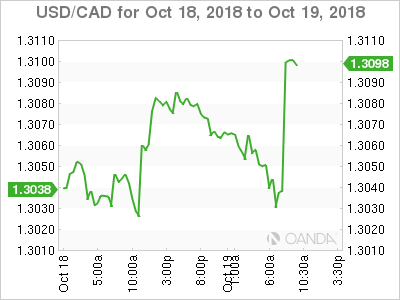
Canadian eco data disappointed. Headline August retail sales declined by 0.1% M/M with core sales down 0.4% on a monthly basis. Consensus expected a modest increase for both. September headline inflation unexpectedly fell back from 2.8% Y/Y to 2.2% Y/Y (vs 2.7% Y/Y expected). Core CPI slowed from 2% Y/Y to 1.9% Y/Y. The loonie lost ground with USD/CAD spiking north of 1.31.
Portuguese media reported that Secretary of State for Finance Ricardo Mourinho Felix hinted at repaying €2bn of the €4-4.5bn outstanding IMF loans later this year.
The UK’s budget deficit was smaller than expected in September, dropping to £4.12bn from £4.96bn one year ago. For the first half of the financial year, the deficit reached £19.9bn, down 35% from last year, the lowest at this stage since 2002.
Chinese Economic Growth Slows to Weakest Pace in Almost a Decade
Chinese real gross domestic product (GDP) rose by 6.5% (year-on-year) in the third quarter of 2018, a touch weaker than the consensus expectation for a 6.6% advance. This is down from a 6.7% advance in the second quarter, and marks the slowest 12-month change since the first quarter of 2009. On a quarter-over-quarter basis, growth ticked down to 1.6% (prev: 1.7%) or roughly a 6.6% annualized pace. This was broadly in line with the consensus estimate. Historical revisions to previous quarters help to mark down 2017 annual growth by about 0.2 ppts to 6.8%, and weigh slightly against annual growth in 2018 as well.
Nominal GDP grew 9.6% (y/y) in the third quarter, a bit weaker than the 9.8% advance recorded in the second quarter. The GDP deflator rose 2.9% y/y, the same pace as the previous quarter.
On an industry basis, the slowdown was concentrated in the secondary sector (construction and manufacturing), with growth easing to 5.3% on a year-on-year basis from 6% in the second quarter. Primary industry (e.g. agriculture and mining) registered a 3.6% year-on-year advance. Activity in tertiary (services) industries – the largest sector of the Chinese economy – registered a 7.9% y/y advance, a slight uptick from the second quarter.
Monthly activity indicators signal that the deceleration in growth is likely to extend into the fourth quarter. The reading for fixed asset investment (excluding rural areas) in September was a bit firmer than consensus expectations, coming in at 5.4% growth (y/y, year-to-date basis), but remains well below historical norms. The pace of fixed investment is a far cry from post-financial crisis highs in early-2013 when it was rising by around 20% per year, reflecting the shift away from investment toward services, and more recently, efforts by Chinese authorities to rein in excessive credit growth. Industrial production for September missed consensus expectations (+5.8% y/y vs. 6%), but retail sales managed to just beat expectations (+9.2% y/y vs. 9%). Nevertheless, retail sales growth remains below the 10-11% y/y pace typical of the past few years.
Key Implications
This report confirms that China's economic growth is easing broadly as expected, and reflects a combination of domestic policy action to slow credit growth as well as external pressures. Growth in total social financing has slowed materially through September, rising 10.6% y/y from a high of 12.7% at the start of 2018. This is despite the impact of U.S. tariffs which have added an extra layer of downside risk to growth and led policymakers to ease credit conditions since the start of the year. All told, today's report remains consistent with our September forecast update that expected Chinese economic growth to slow from a 6.6% pace in 2018 to a 6.2% pace in 2019.
An escalation in the trade spat to include a 25% tariff on all Chinese imports to the U.S. with limited Chinese retaliation could shave up to 0.5ppts off China's economic growth over the next year or so. However, Chinese policymakers have reacted by easing domestic credit conditions, have allowed a more than 8% depreciation in the renminbi relative to the U.S. dollar to offset much of the effect from U.S. tariffs, and are likely to ramp up fiscal stimulus spending in the months ahead if growth begins to decelerate more than anticipated. However, there remains a concern that a protracted trade spat with the U.S. could begin to endanger growth in both countries' East Asian supply chain partners, which could weigh further on global trade and economic growth.
CAD Plummets on Disappointing Retail Sales and Weak Inflation
Canadian inflation slowed significantly last month as temporary factors that lifted the cost of gas and air travel dissipated.
Canada’s CPI climbed +2.2% y/y, following a +2.8% increase in August and a +3% climb in July.
The market was looking for a solid +2.7% gain in September.
On a month-over-month basis, CPI declined -0.4%.
Digging deeper, the Bank of Canada (BoC) three preferred measures supporting inflation also weakened – core-inflation prices rose in a range from +1.9% to +2.1% for an average of +2.0%, down from the previous month’s +2.1% average.
Despite this morning miss, the headline annual inflation rate in Canada has come in +2%+ for eight consecutive month.
Canada retail sales miss
Canadian retail sales fell unexpectedly in August, led mostly by gas stations receipts declines.
Canada retail sales fell -0.1% in August, m/m, to a seasonally adjusted +C$50.76B. The market was looking for a +0.3% rise.
In volume terms, retail sales declined by a steeper -0.3% in August.
The previous month’s data were revised downward, and indicated receipts rose +0.2% vs. +0.3% estimate.
On a 12-month basis, retail sales rose +3.6% on a nominal basis and +0.7% in volume terms.
On the release, the CAD came under immense, trading at C$1.3030 before the headlines to C$1.3116.
Next up, the BoC monetary policy announcement is next Wednesday (Oct 24). Despite a weaker retail sales and inflation, the market is currently pricing in another +25 bps hike by Governor Poloz. The OIS mkt still at +97% that they hike.
Canada: Retail Sales Unexpectedly Drop in August
Canadian retail spending unexpectedly dipped 0.1% month-on-month in August, disappointing calls for a 0.3% gain. What's more, spending growth was revised down slightly in July to show a 0.2% gain (previous: 0.3%). Stripping out price effects, the story was even worse, with volumes down 0.3% in August.
Sales at motor vehicles and parts dealers advanced 0.8% during the month, making the largest positive contribution to overall sales. Excluding this category, spending was down 0.4%, weighed on heavily by sales at gasoline stations (-2.0%). Sales were also lower at furniture and home furnishing stores (-1.4%), electronics and appliance stores (-1.4%), building material and garden equipment supplies stores (-1.1%), clothing stores (-1.1%), and for miscellaneous retailers (-2.3%). Conversely, a relatively strong gain was reported for health and personal care stores (+1.6%).
Regionally, the weakness was relatively narrow, with sales lower in 4 of 10 provinces. Spending was sharply lower in Saskatchewan (-2.7%) while also falling in Quebec (-0.7%), Alberta, and British Columbia (-0.1% in both provinces).
Key Implications
Rising borrowing costs appear to be weighing on household spending, with retail spending gearing down in the third quarter. With August's soft print, volumes are 0.5% lower so far in Q3 compared to their Q2 average. This puts some downside risk to our (already modest) forecast for consumer spending to grow at a 1.8% (annualized) pace in the third quarter.
One of the main concerns held by the Bank of Canada was how highly-indebted consumers would respond as interest rates move higher. On this score, August's soft spending report may suggest that given these challenges, the number of rate hikes required to keep the economy on an even keel may be smaller than it has been in the past.
Canada: Inflation Slows to 2.2% in September as Previous Air Transportation Price Surge Reverses
Canadian consumer price inflation slowed to 2.2% in September, down from 2.8% in August and well below the consensus forecast for 2.7%. Adjusted for seasonal patterns, prices fell 0.1% month-on-month.
The slowdown in inflation was led almost entirely by transportation prices, which eased to 3.9% (from 7.2% in August). Gas price growth eased to 12% (year-on-year) from 20% in August, but the biggest mover was air transportation, which went from 26.4% to 7.4%. Together, these two items took 0.5 percentage points from the headline reading.
The Bank of Canada's core measures all edged lower by a 10th of a percentage point, with CPI-trim falling to 2.1% (from 2.2%), CPI-median to 2.0% (from 2.1%), and CPI-common to 1.9% (from 2.0%).
Key Implications
Inflation has been volatile over the past few months, but the signal beneath the noise is an underlying rate close to the Bank of Canada's 2.0% target. The relative stability of the Bank of Canada's core measures is consistent with an economy operating close to potential, but not ringing any alarm bells in terms of overheating.
Without any urgency on inflation, the Bank of Canada can continue with its risk management framework. And, with one major downside to Canadian growth taken off the table with the USMCA agreement, the Bank can refocus its energies on the challenge of raising interest rates in an era of high households debt. As mortgages reset to higher rates, debt service costs will eat into household disposable income, weighing on credit growth and consumer spending in the years ahead and auguring for caution from the central ban
EUR/USD Mid-Day Outlook
Daily Pivots: (S1) 1.1424; (P) 1.1476; (R1) 1.1502; More.....
Intraday bias in EUR/USD remains on the downside for 1.1431 support. Break there will resume whole decline from 1.1814 and target 1.1300 low. On the upside, above 1.1527 minor resistance will turn intraday bias neutral first. But near term outlook will remain mildly bearish as long as 1.1621 resistance holds.
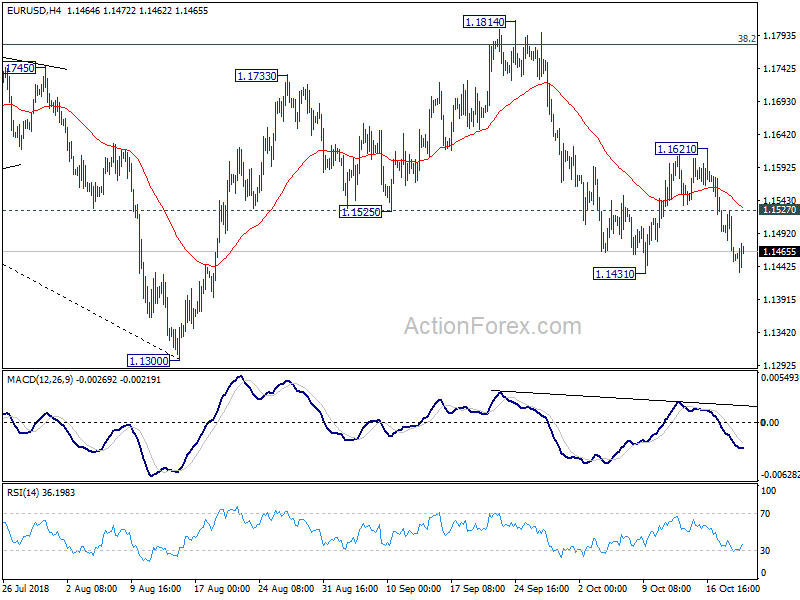
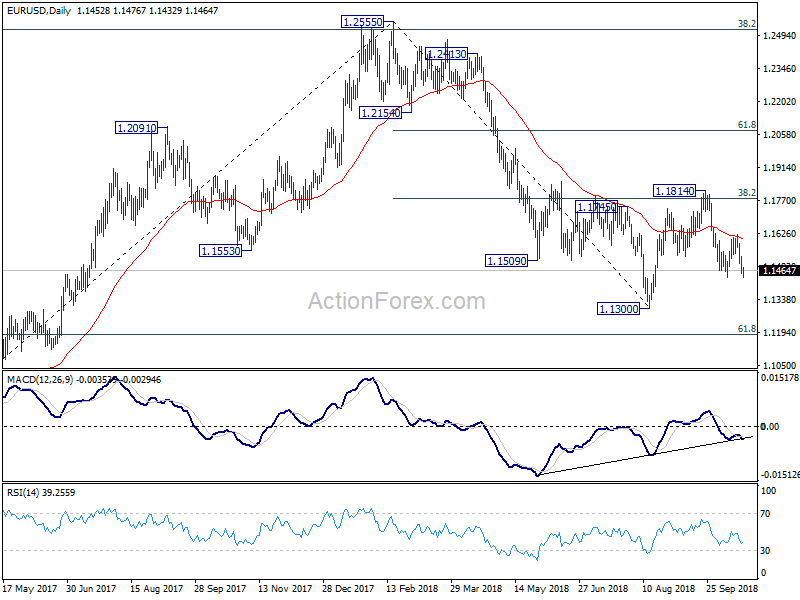
In the bigger picture, corrective pattern from 1.1300 could have completed at 1.1814 after hitting 38.2% retracement of 1.2555 to 1.1300 at 1.1779. Decisive break of 1.1300 will resume the down trend from 1.2555 to 61.8% retracement of 1.0339 (2017 low) to 1.2555 at 1.1186 next. Sustained break there will pave the way to retest 1.0339. On the upside, break of 1.1814 will delay the bearish case and extend the correction from 1.1300 with another rise before completion.
GBP/USD Mid-Day Outlook
Daily Pivots: (S1) 1.2977; (P) 1.3055; (R1) 1.3093; More...
Intraday bias in GBP/USD remains on the downside for 1.2921 support first. Firm break there will target a test on 1.2661 low. On the upside, above 1.3131 minor resistance will turn bias to the upside for another rise. But still, price actions from 1.2661 are viewed as a corrective pattern. In case of another rise, upside should be limited by 1.3316 key fibonacci level to bring down trend resumption eventually.
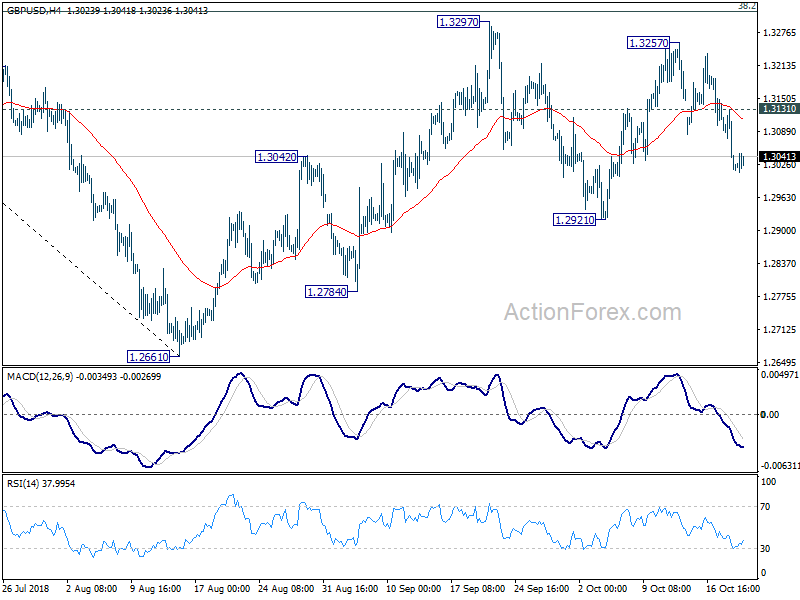
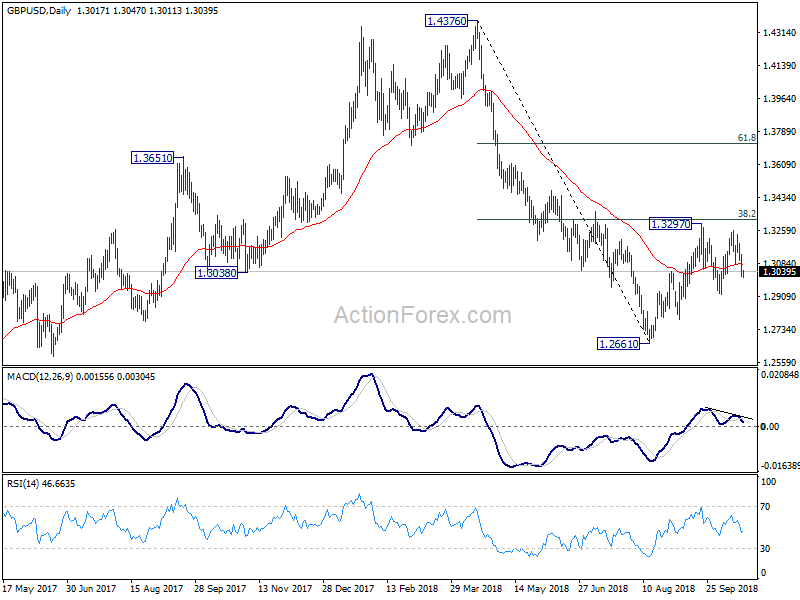
In the bigger picture, whole medium term rebound from 1.1946 (2016 low) should have completed at 1.4376 already, after rejection from 55 month EMA. The structure and momentum of the fall from 1.4376 argues that it's resuming long term down trend. And this will be the preferred case as long as 38.2% retracement of 1.4376 to 1.2661 at 1.3316 holds. However, firm break of 1.3316 would bring stronger rebound to 61.8% retracement at 1.3721. And, the eventual depth of the fall from 1.4376, and the chance of hitting 1.1946 low, will depend on the strength of the interim corrective rebound from 1.2661.
USD/CHF Mid-Day Outlook
Daily Pivots: (S1) 0.9925; (P) 0.9950; (R1) 0.9981; More...
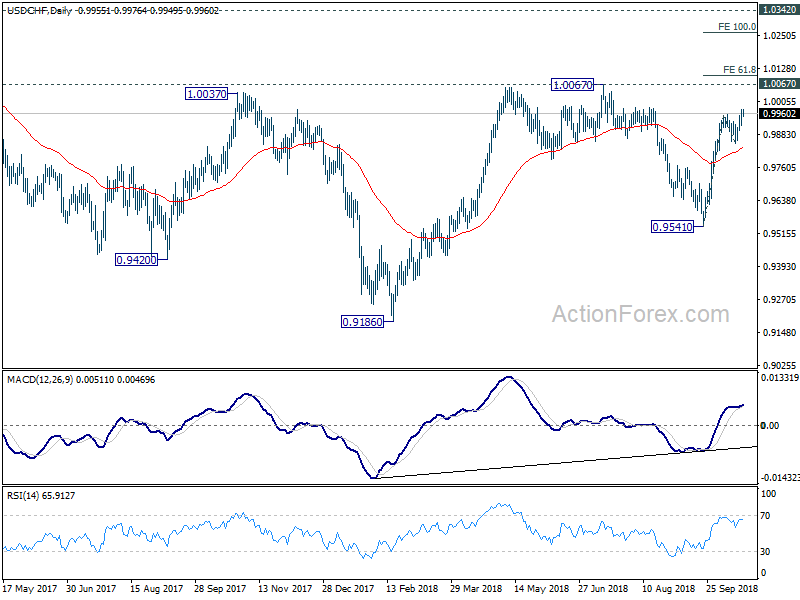
USD/CHF's rally is still in progress and intraday bias remains on the upside. Current rise from 0.9541 should target t 1.0067 key resistance and then 61.8% projection of 0.9541 to 0.9954 from 0.9848 at 1.0103. On the downside, break of 0.9848 support is needed to indicate short term topping. Otherwise, further rally will be expected even in case of retreat.
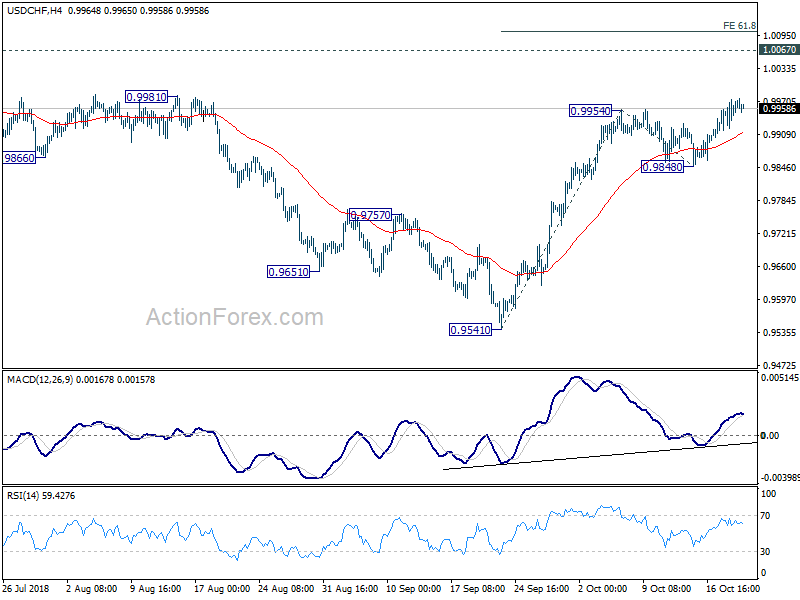
In the bigger picture, the pullback from 1.0067 has completed at 0.9541 already. And rise from 0.9186 is likely resuming. Firm break of 1.0067 will pave the way to retest 1.0342 key resistance. We'd be cautious on strong resistance from there to limit upside to bring another medium term fall to extend long term range trading.