Sample Category Title
USD/JPY Mid-Day Outlook
Daily Pivots: (S1) 111.85; (P) 112.29; (R1) 112.63; More..
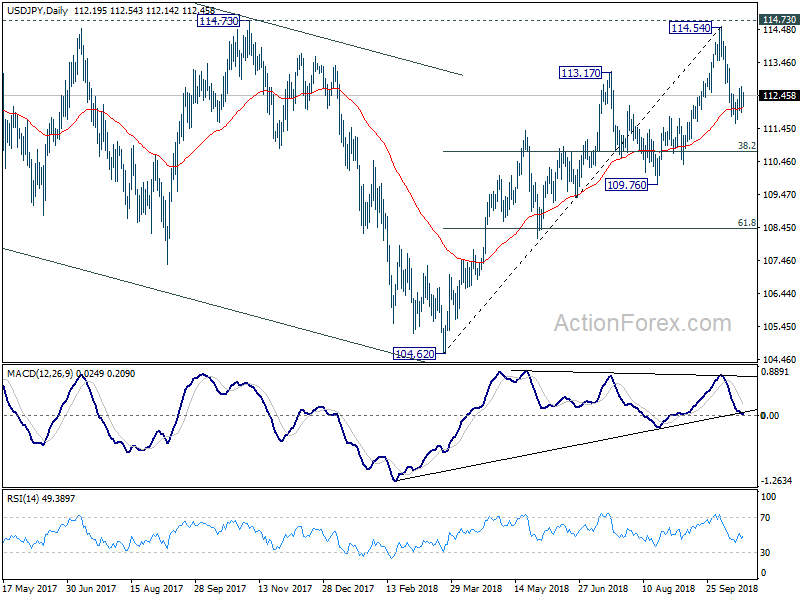
Intraday bias in USD/JPY remains neutral at this point. On the upside, above 112.71 will extend the rebound from 111.62 to retest 114.54 high. On the downside, below 111.62 will resume the correction from 114.54 to 38.2% retracement of 104.62 to 114.54 at 110.75. We'll look for bottoming signal above 109.76 key support in that case.
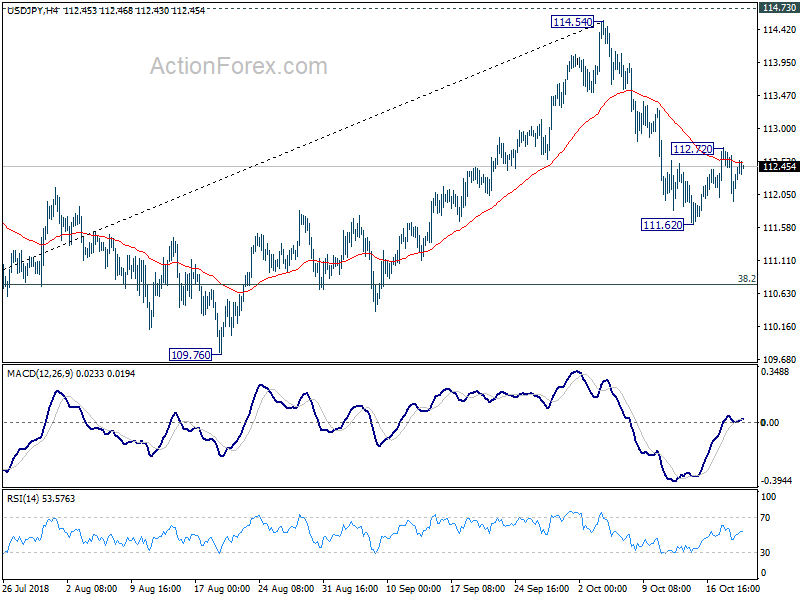
In the bigger picture, corrective fall from 118.65 (2016 high) should have completed with three waves down to 104.62. Decisive break of 114.73 resistance will likely resume whole rally from 98.97 (2016 low) to 100% projection of 98.97 to 118.65 from 104.62 at 124.30, which is reasonably close to 125.85 (2015 high). This will stay as the preferred case as long as 109.76 support holds. However, decisive break of 109.76 will dampen this bullish view and turns outlook mixed again.
USD/CAD Mid-Day Outlook
Daily Pivots: (S1) 1.3036; (P) 1.3063; (R1) 1.3112; More...
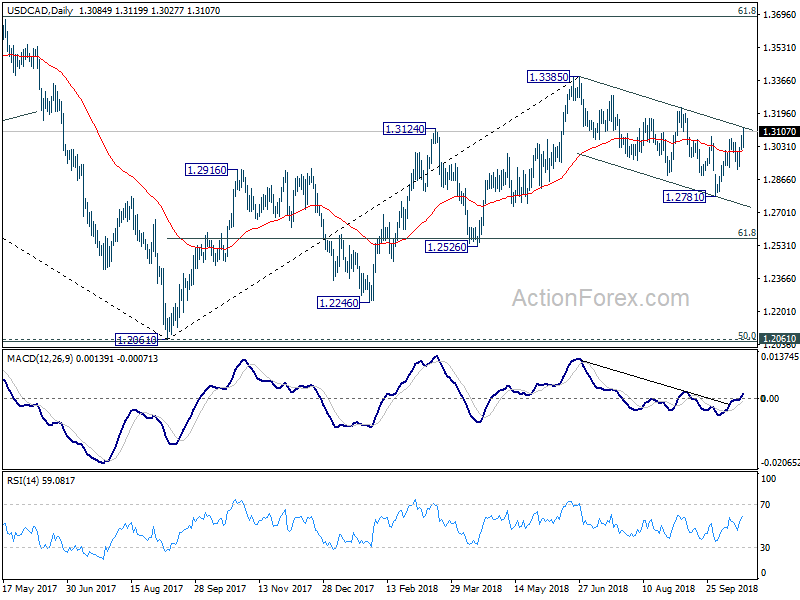
USD/CAD's rally extends to as high as 1.3119 so far today. The strong break of 1.3081 resistance is taken as first sign of completion of whole choppy fall from 1.3385. Intraday bias remains on the upside for 1.3225 resistance to confirm this bullish case. Decisive break there will pave the way to retest 1.3385 high. On the downside, below 1.3027 minor support will turn intraday bias neutral first. But as long as 1.2916 support holds, further rally will remain mildly in favor in case of retreat.
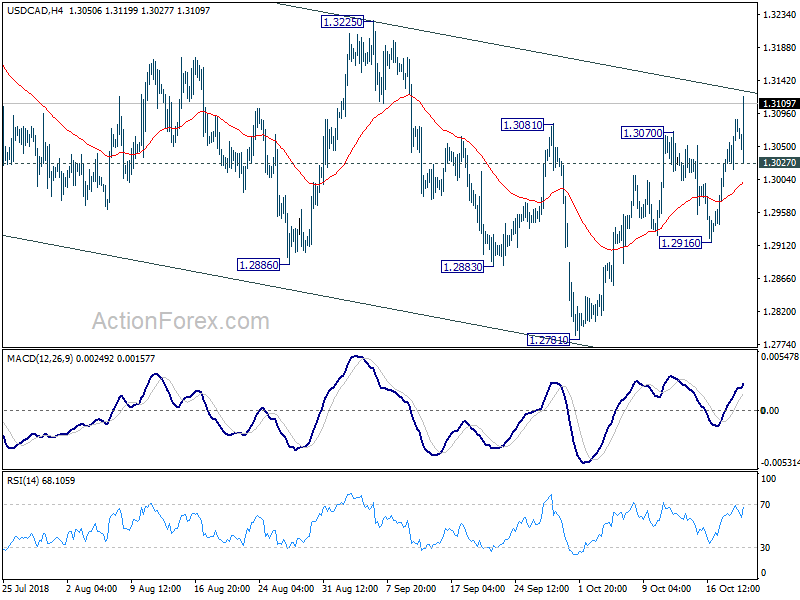
In the bigger picture, current development argues that choppy corrective fall from 1.3385 has completed at 1.2781 already. And that in turns suggests that the up trend from 1.2061 is still in progress. Decisive break of 1.3385 will pave the way to 61.8% retracement of 1.4689 to 1.2061 at 1.3685. On the downside, though, break of 1.2916 support will likely extend the fall fro 1.3385 to 61.8% retracement of 1.2061 to 1.3385 at 1.2567 before completion.
Canadian Dollar Dives after Weak CPI and Retail Sales, Euro Steady Despite Widening German-Italian Spread
Canadian Dollar suffers heavy selling in early US session as the large deceleration in CPI to 2.2% raising doubts on whether BoC would still hike next week. Meanwhile Yen and Swiss Franc are among the weakest ones. Widening of German-Italian spread is not translated into selloff in European stocks nor any meaningful movements in the forex markets. New Zealand Dollar and Australian Dollar are the strongest ones, with help from reversal in Chinese stocks despite GDP miss.
Technically, USD/CAD's strong break of 1.3081 resistance is taken as a solid sign of bullish trend reversal. Focus is turned to 1.3225 resistance for confirmation. Euro is consolidating above yesterday's low against Dollar and Yen. While there is no extended selloff in Euro, it remains technically vulnerable for another fall. AUD/USD, despite today's rebound is still holding in tight range below 0.7159 temporary top.
In Europe, FTSE is trading up 0.37%, DAX is down -0.16% and CAC is down -0.66%. German 10 year yield is down -0.005 at 0.416. Italian 10 year yield is up 0.059 at 3.737. That is, German-Italian yield spread is now above 330.
In Asia, Chinese stocks staged a strong rebound after initial selloff. The Shanghai SSE dipped to 2449.20 but ended up 0.26% at 2550.47, reclaiming 2500 handle. Hong Kong HSI was also lifted and rose 0.42% to 25561.40. However, Singapore Strait Times fell -0.23% while Nikkei lost -0.56%. Japan 10 year JGB yield dropped -0.0044 to 0.151.
Canadian Dollar dives notably after a set of much weaker than expected data.
Headline retail sales dropped -0.1% mom in August versus expectation of 0.4% mom. Ex-auto sales dropped -0.4% mom versus expectation of -0.2% mom.
Headline CPI dropped sharply by -0.4% mom in September versus expectation of -0.1% mom. Annually, CPI slowed to 2.2% yoy, down from 2.8% yoy and missed expectation of 2.9% yoy.
CPI core common slowed to 1.9% yoy, down from 2.0% yoy. CPI core median slowed to 2.0% yoy, down from 2.1% yoy. CPI core trim slowed to 2.1% yoy, down from 2.2% yoy.
The set of data, in particular the sharp fall in CPI, raises the important question of whether BoC is still going to hike next week on October 24.
EU: Italy's budget an obvious significant deviation of Stability and Growth Pact
EU Commissioners Valdis Dombrovskis and Pierre Moscovici wrote a joint letter to warn Italy of its budget plan. Handing the letter directly to Italian Economy Minister Giovanni Tria, the EU started the first formal step to reject the budget which will lead to direct clash between Rome and Brussels. Italy will now have until October 22 to respond to the letter.
EU said in the letter that Italy's plan is an "obvious significant deviation" of the recommendations adopted by the European Council under the 2019 Stability and Growth Pact. Also, while the Council suggested fiscal adjustment, the Italy plans fiscal expansion of close to 1% of GDP, and the "size of the deviation (a gap of around 1.5% of GDP) are unprecedented".
EU also criticized that the macroeconomic forecasts under the plan has not been endorsed by the Parliamentary Budget Office. And this appears "not to respect" the rules of having forecasts produced or endorsed by an "independent body".
Released in European session, Eurozone current account surplus widened to EUR 23.9B in August. UK Public sector net borrowing dropped to GBP 3.3B in September.
China Q3 GDP slowed to 6.5%, slowest since Q1 2009
China's economic growth decelerated further in 3Q18, as the impacts of restraining infrastructure investment and trade war surfaced. GDP growth moderated to 6.5% yoy in the third quarter, the slowest since the first quarter of 2009. Growth came in lower than market expectations and second quarter's 6.7%. On an annualized basis, GDP eased to 5.9% qoq, from 6.4% in 2Q18 and 7.2% in 1Q18.
Statistics bureau spokesman Mao Shengyong said China is still able to reach the full-year growth target of around 6.5% in 2018 even though downward pressure increases. He added that infrastructure investment growth will stabilize and "consumption upgrade" will continue. Nonetheless, Mao also admitted that external environment will pose uncertainties on stabilizing growth.
Also released, industrial production grew 5.8% yoy in September, down from 6.1% and missed expectation of 6.0% yoy. But retail sales rose 9.2% yoy, up from 9.0% yoy and beat expectation of 9.0% yoy. Fixed asset investment rose 5.4% ytd yoy, up from 5.3% ytd yoy and beat expectation of 5.3% ytd yoy.
More on China in China's Economic Growth Slowed More than Expected. Worst of Trade War Yet to Come
Also released in Asian session, Japan national CPI core accelerated to 1.0% yoy in September, up from 0.9% yoy and matched expectations.
USD/CAD Mid-Day Outlook
Daily Pivots: (S1) 1.3036; (P) 1.3063; (R1) 1.3112; More...
USD/CAD's rally extends to as high as 1.3119 so far today. The strong break of 1.3081 resistance is taken as first sign of completion of whole choppy fall from 1.3385. Intraday bias remains on the upside for 1.3225 resistance to confirm this bullish case. Decisive break there will pave the way to retest 1.3385 high. On the downside, below 1.3027 minor support will turn intraday bias neutral first. But as long as 1.2916 support holds, further rally will remain mildly in favor in case of retreat.
In the bigger picture, current development argues that choppy corrective fall from 1.3385 has completed at 1.2781 already. And that in turns suggests that the up trend from 1.2061 is still in progress. Decisive break of 1.3385 will pave the way to 61.8% retracement of 1.4689 to 1.2061 at 1.3685. On the downside, though, break of 1.2916 support will likely extend the fall fro 1.3385 to 61.8% retracement of 1.2061 to 1.3385 at 1.2567 before completion.
Economic Indicators Update
| GMT | Ccy | Events | Actual | Forecast | Previous | Revised |
|---|---|---|---|---|---|---|
| 23:30 | JPY | National CPI Core Y/Y Sep | 1.00% | 1.00% | 0.90% | |
| 02:00 | CNY | GDP Y/Y Q3 | 6.50% | 6.60% | 6.70% | |
| 02:00 | CNY | Retail Sales Y/Y Sep | 9.20% | 9.00% | 9.00% | |
| 02:00 | CNY | Industrial Production Y/Y Sep | 5.80% | 6.00% | 6.10% | |
| 02:00 | CNY | Fixed Assets Ex Rural YTD Y/Y Sep | 5.40% | 5.30% | 5.30% | |
| 08:00 | EUR | Eurozone Current Account (EUR) Aug | 23.9B | 21.4B | 21.3B | 19.5B |
| 08:30 | GBP | Public Sector Net Borrowing Sep | 3.3B | 4.6B | 5.9B | 4.8B |
| 12:30 | CAD | Retail Sales M/M Aug | -0.10% | 0.40% | 0.30% | 0.20% |
| 12:30 | CAD | Retail Sales Ex Auto M/M Aug | -0.40% | -0.20% | 0.90% | 0.80% |
| 12:30 | CAD | CPI M/M Sep | -0.40% | -0.10% | -0.10% | |
| 12:30 | CAD | CPI Y/Y Sep | 2.20% | 2.90% | 2.80% | |
| 12:30 | CAD | CPI Core - Common Y/Y Sep | 1.90% | 2.00% | ||
| 12:30 | CAD | CPI Core - Median Y/Y Sep | 2.00% | 2.10% | ||
| 12:30 | CAD | CPI Core - Trim Y/Y Sep | 2.10% | 2.20% | ||
| 14:00 | USD | Existing Home Sales Sep | 5.31M | 5.34M |
Canada CPI slowed to 2.2%, retail sales contracted, CAD dives as BoC hike in question
Canadian Dollar dives notably after a set of much weaker than expected data.
Headline retail sales dropped -0.1% mom in August versus expectation of 0.4% mom. Ex-auto sales dropped -0.4% mom versus expectation of -0.2% mom.
Headline CPI dropped sharply by -0.4% mom in September versus expectation of -0.1% mom. Annually, CPI slowed to 2.2% yoy, down from 2.8% yoy and missed expectation of 2.9% yoy.
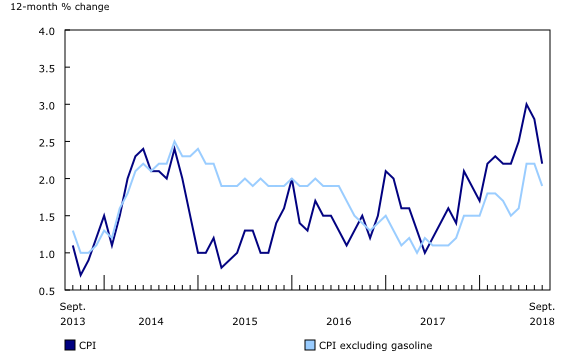
CPI core common slowed to 1.9% yoy, down from 2.0% yoy. CPI core median slowed to 2.0% yoy, down from 2.1% yoy. CPI core trim slowed to 2.1% yoy, down from 2.2% yoy.
The set of data, in particular the sharp fall in CPI, raises the important question of whether BoC is still going to hike next week on October 24.
Full CPI and retail sales release.
Euro Ticks up Despite EU’s Italy Warning; Loonie Edges Higher ahead of Canadian CPI
Here are the latest developments in global markets:
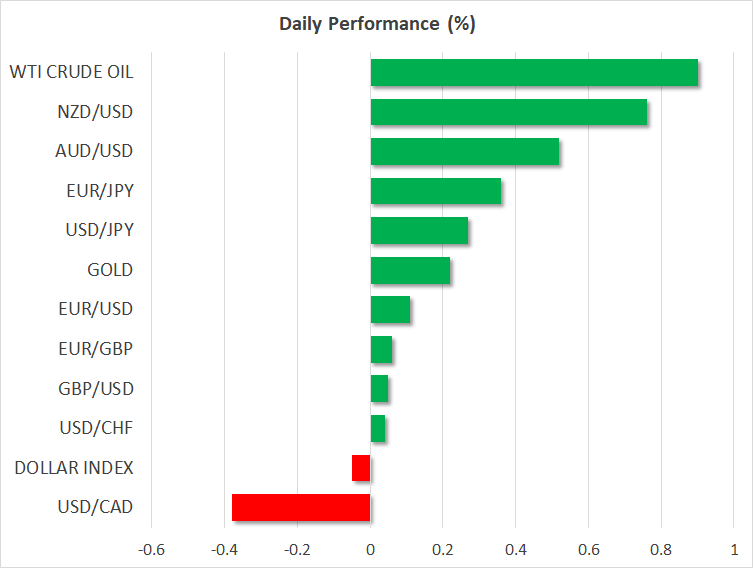
- FOREX: The euro reached a new 10-day low at 1.1431 against the US dollar earlier on Friday after the European Commission sent a cautionary letter to Italy over the submitted draft of their budget plan. However, euro/dollar managed to pare its losses, rising by 0.10% to 1.1462 later in the day, while euro/yen improved as well, jumping by 0.23% on the day. Pound/dollar moved slightly higher by 0.09% earlier today after European Union negotiator Michel Barnier said that a Brexit deal is very close even if the EU summit failed to provide any significant progress, but oppositions over the Brexit plan in the UK kept gains limited. Pound/yen was in a better position, adding more than 0.20% to its performance. Dollar/yen jumped by 0.28%, holding above the 112.00 handle. The antipodeans currencies were in bullish mode after two consecutive red days despite disappointing GDP growth figures out of China. Aussie/dollar traded up by 0.56% at 0.7118, while kiwi/dollar edged higher by 0.66% to 0.6586. Meanwhile, dollar/loonie was down by 0.37% at 1.3037 ahead of Canadian inflation and retail sales data later today.
- STOCKS: European stocks were mostly on the downside on Friday amid rising fears that the Italian budget could fail to get an approval from the EU, while discouraging earnings results from Michelin and Bouygues weighed on construction and auto equities. The benchmark European STOXX 600 tumbled by 0.46% for the third day in a row, whereas the blue-chip Euro STOXX 50 was up by 0.11% on the back of consumer non-cyclicals and utilities. The German DAX 30 dropped by 0.33%, the French CAC 40 dived by 0.89% and the Spanish IBEX 35 slipped by 0.81%. The British FTSE 100 increased by 0.16%. In Asia, Japan’s Nikkei 225 and Topix closed lower. In the US, even though the S&P, Dow Jones and the Nasdaq all plunged yesterday, futures tracking these indices are currently in the green, pointing to a higher open today.
- COMMODITIES: Oil prices recovered from one-month lows after China’s GDP growth slowed down more than analysts expected in the third quarter, raising fears that oil demand from the world’s largest oil importer might stall. In other news ,sources with knowledge shared that OPEC/non-OPEC compliance with the supply pact stood at 111% in September, above the 129% mark in August. Yet crude markets were set to finish lower for the second straight week. WTI and Brent crude were on the upside at $69.16 and $80.10 per barrel respectively. In precious metals, gold climbed by 0.19% to trade around $1,227 per ounce.
Day Ahead: Canada reports on inflation and retail sales; Italy’s budget to weigh on sentiment
Canada is expected to deliver key data releases later on Friday as the central bank prepares to raise interest rates next week for the third time this year. The conflict between Italy and the European Union will continue to feed risk-off sentiment in the eurozone, while political conditions in the UK will be closely monitored as some Conservative and Labour lawmakers look unhappy with May’s Brexit plans.
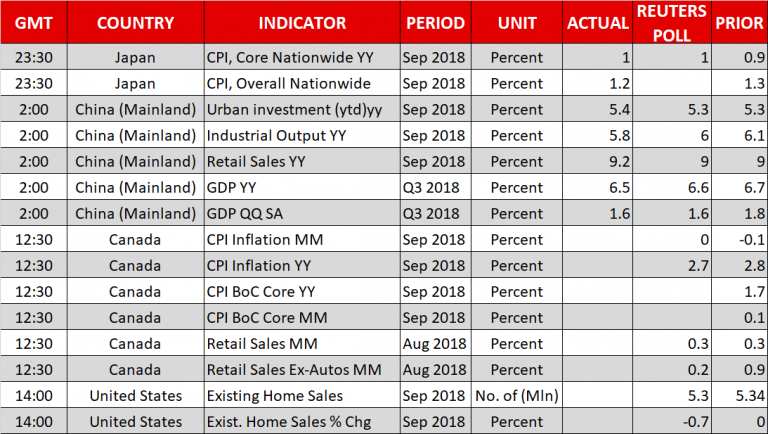
At 1230 GMT, Statistics Canada is projected to show that year-on-year the Consumer Price Index retreated to 2.7% in September, down from 2.8% in August and lower than the 3.0% peak in July. The modest slowdown however might not be much of worry to policymakers as long as the measure holds above Bank of Canada’s 2.0% midpoint target, while core measures fluctuate near that threshold. Note that the Bank of Canada anticipates the headline CPI to return towards 2.0% in early 2019 as the effect from higher oil prices is projected to fade.
Separately, Canadian retail sales growth for the month of August is said to have steadied at 0.3% m/m. Yet in the absence of automobile items, the core equivalent is seen easing by 0.7 percentage points to 0.2% m/m.
In the aftermath, an upside surprise in the data is highly likely to boost odds for a rate hike next Wednesday, with the loonie probably jumping on the news as well. Overnight indexed swaps are currently giving a 98.5% probability for a 0.25 bps rate rise by the BoC next week. Yet loonie traders will be also be monitoring crude prices as any potential fluctuations in the oil market may affect the currency’s performance. Note that Baker Hughes is due to report on US oil rig counts at 1700 GMT.
In the US, September’s existing homes sales will come into light at 1400 GMT, with analysts estimating a decline of 0.7% versus 0.0% in August. Still investors could shrug off the data and turn focus to trade after Chinese GDP growth figures proved that expansion in the world’s second biggest economy weakened for the third consecutive quarter to levels not seen since the first quarter of 2009. An evidence that US trade tariffs might have started to affect the country’s economic performance at a time when the government is focusing its efforts on deleveraging the economy. Industrial production figures also appeared discouraging, though Chinese stocks managed to rebound from earlier losses to close in the positive territory instead.
Meanwhile in Turkey, investigations around the disappearance of the Saudi Washington Post journalist continue, with the US President saying that consequences to Saudi Arabia could be “very severe” if the nation is found to have ordered the death of the journalist. The remarks followed the return of the Secretary of State Mike Pompeo from Ankara and Riyadh.
Elsewhere, the climate surrounding Italy’s fiscal demands turned more toxic after the European Commission sent Rome a notice, warning that the government’s spending plans seem to be in “particularly serious non-compliance” with EU regulations as they “unprecedently” deviate from targets. Italy which continued to back its fiscal plans today despite the EU’s objections, has to respond by Monday.
In terms of public appearances, Bank of England Governor Carney will be speaking at the Economic Club of New York at 1530 GMT. Later at 1445 GMT, Dallas Fed President Robert Kaplan, a non-voting FOMC member in 2018, will be talking on the state of monetary and fiscal policy in New York. On Saturday at 1500 GMT Atlanta Fed President Raphael Bostic will be participating in armchair discussion on the economic outlook, in Macon.
Canadian Dollar Gains Ground ahead of CPI, Retail Sales
The Canadian dollar has posted gains in the Friday session, erasing most of the losses sustained on Thursday. Currently, USD/CAD is trading at 1.3030, down 0.42% on the day. On the release front, Canadian consumer indicators are in the spotlight and traders should be prepared for volatility from the Canadian dollar during the North American session. After a shocking decline in August, CPI for September is expected to gain 0.1%. Retail Sales is forecast to remain at 0.3%, but Core Retail Sales is expected to drop sharply to just 0.1%, compared to 0.9% in August. In the U.S, there are no key releases. Existing Home Sales is expected to drop to 5.29 million.
Employment numbers are important leading indicators of consumer spending, and there was good news on Thursday, ahead of key Canadian retail sales reports on Friday. ADP nonfarm payrolls jumped 28.8 thousand in September, up from 13.6 thousand a month earlier. Will the retail sales numbers also point higher? The Bank of Canada will be carefully monitoring the retail sales and CPI releases, ahead of a policy meeting next week. The markets are expecting the BoC to raise rates by a quarter-point, which would mark the third rate increase in 2018. With Canada, the U.S and Mexico about to enter the USMCA, which replaces the NAFTA pact, the last obstacle for the BoC on the path to normalization has been removed and analysts are now expecting three rate hikes in 2019, up from a forecast of two hikes just a few months ago.
The U.S dollar is broadly higher on Thursday, after a hawkish tone from the Federal Reserve minutes. The minutes indicated that a majority of members want to continue raising interest rates until the U.S economy shows signs of slowing down. However, the duration of a tighter policy remains unclear, as the minutes noted that “there is considerable uncertainty surrounding all estimates of the neutral federal funds rate.” This would likely be around the 3 percent level, which will not be reached until the second half of 2019, as the Fed has indicated it will raise rates three times next year. At the September meeting, the Fed removed the phrase “the stance of monetary policy remains accommodative”, which was considered outdated, given the policy of steady rate hikes. As rates approach the “neutral rate”, we could see further changes in language at upcoming policy meetings.
USD/CAD – Canadian Dollar Gains Ground Ahead Of CPI, Retail Sales
The Canadian dollar has posted gains in the Friday session, erasing most of the losses sustained on Thursday. Currently, USD/CAD is trading at 1.3030, down 0.42% on the day. On the release front, Canadian consumer indicators are in the spotlight and traders should be prepared for volatility from the Canadian dollar during the North American session. After a shocking decline in August, CPI for September is expected to gain 0.1%. Retail Sales is forecast to remain at 0.3%, but Core Retail Sales is expected to drop sharply to just 0.1%, compared to 0.9% in August. In the U.S, there are no key releases. Existing Home Sales is expected to drop to 5.29 million.
Employment numbers are important leading indicators of consumer spending, and there was good news on Thursday, ahead of key Canadian retail sales reports on Friday. ADP nonfarm payrolls jumped 28.8 thousand in September, up from 13.6 thousand a month earlier. Will the retail sales numbers also point higher? The Bank of Canada will be carefully monitoring the retail sales and CPI releases, ahead of a policy meeting next week. The markets are expecting the BoC to raise rates by a quarter-point, which would mark the third rate increase in 2018. With Canada, the U.S and Mexico about to enter the USMCA, which replaces the NAFTA pact, the last obstacle for the BoC on the path to normalization has been removed and analysts are now expecting three rate hikes in 2019, up from a forecast of two hikes just a few months ago.
The U.S dollar is broadly higher on Thursday, after a hawkish tone from the Federal Reserve minutes. The minutes indicated that a majority of members want to continue raising interest rates until the U.S economy shows signs of slowing down. However, the duration of a tighter policy remains unclear, as the minutes noted that “there is considerable uncertainty surrounding all estimates of the neutral federal funds rate.” This would likely be around the 3 percent level, which will not be reached until the second half of 2019, as the Fed has indicated it will raise rates three times next year. At the September meeting, the Fed removed the phrase “the stance of monetary policy remains accommodative”, which was considered outdated, given the policy of steady rate hikes. As rates approach the “neutral rate”, we could see further changes in language at upcoming policy meetings.
US 500 Index Finds Support At Trendline, Outlook Still Cautiously Positive
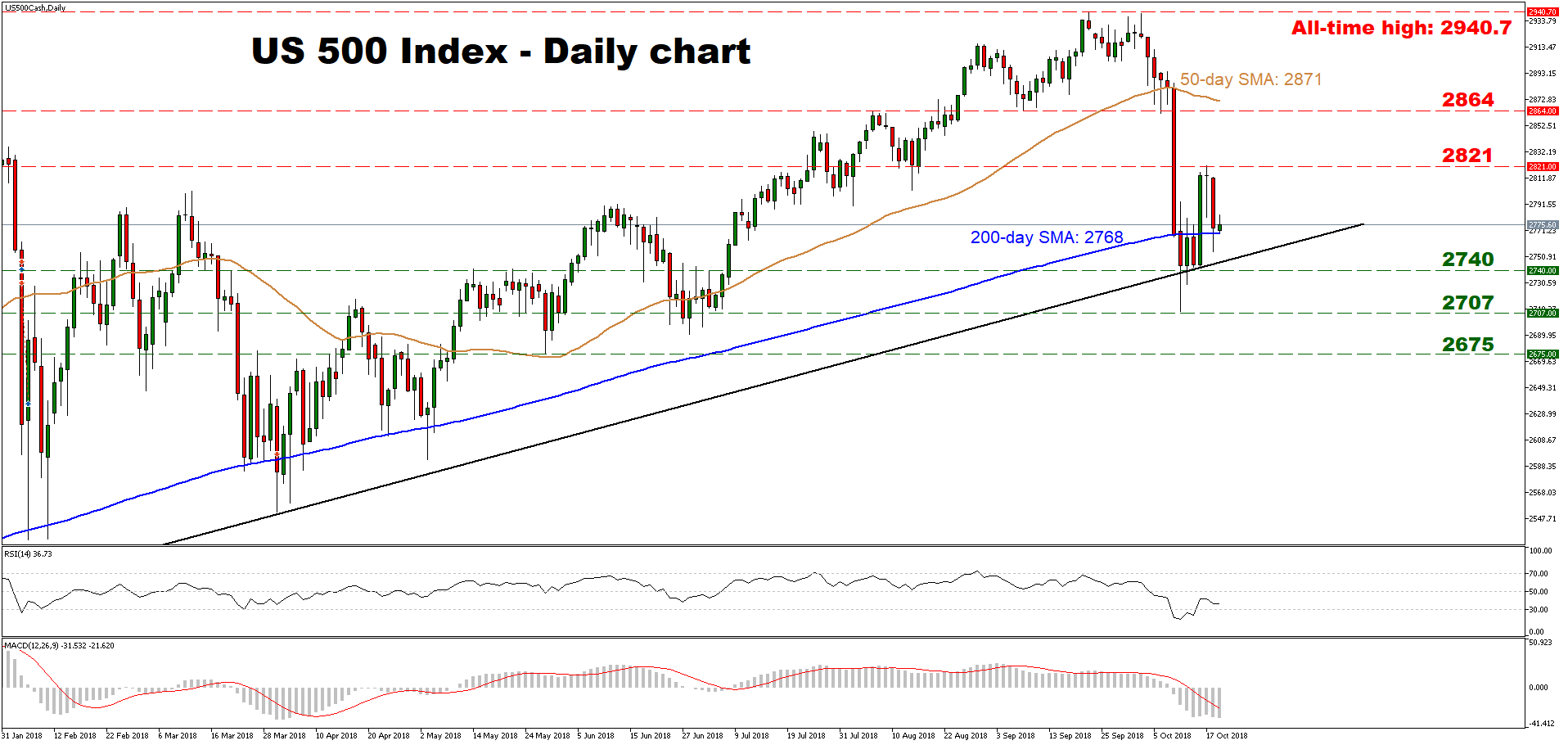
The US 500 index posted considerable losses in early October, falling below its 50- and 200-day simple moving averages (MA) before finding support near a long-term uptrend line drawn from the lows of February 2016, and subsequently rebounding somewhat. The index has now crossed back above its 200-day MA, which keeps the broader outlook cautiously positive. For the bias to turn to neutral, the price would need to close below the crossroads of the aforementioned trendline, the 200-day MA, and the 2740 zone.
Looking at short-term oscillators, the RSI is pointing sideways albeit below its neutral-50 line, detecting downside momentum. Similarly, the MACD – already in negative territory – has also crossed below its red trigger line.
Further retreat in the index could encounter a first wave of support near the uptrend line and the 2740 zone, with a downside break turning the medium-term bias to neutral, potentially setting the stage for more declines – initially for a test of the October 11 low at 2707. Even lower, the bears could stall near 2675, the May 29 trough.
On the flipside, a recovery in the market may meet initial resistance around the 2821 hurdle, marked by the peak of October 17. An upside break may see scope for advances towards the 2864 area, defined by the inside swing low of September 7, with even steeper bullish extensions eyeing the all-time high of 2940.7.
Overall, as long as the index continues to trade above the long-term upside support line, the bigger picture remains cautiously bullish.
USD/CAD Analysis: Awaits Data Releases
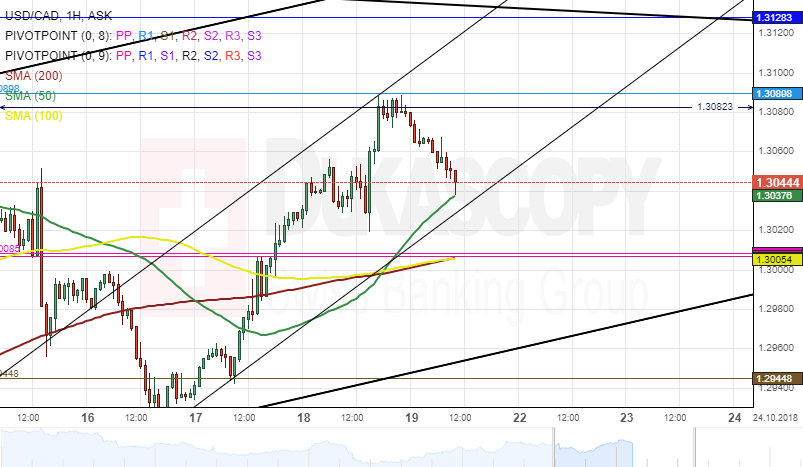
Upside risks dominated the US Dollar against the Canadian Dollar on Thursday. The currency pair tested the swing high at 1.3072 as predicted by the analyst during the end of yesterday's session.
Presently, the exchange rate is trading near the bottom border of a one-week ascending channel at 1.304 and could be set for a breakout.
If this breakout occurs, the next target for the currency pair will be at a support cluster formed by the combination of the weekly and the monthly PPs near the 1.30 mark.
Moreover, the Canadian fundamental releases scheduled at 12:30 GMT could play a roll in the positioning of the pair today.
XAUUSD Analysis: Will Break Monthly R2
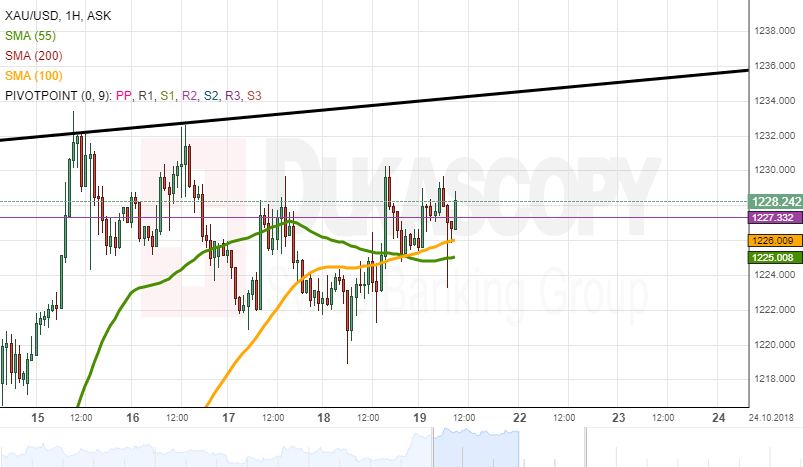
The gold price appreciated 0.43% since Thursday's session. During the previous trading session, the yellow metal broke the resistances of the 55-hour and the 100-hour SMAs to stop the trade at the 1,225.36. On Friday morning, the gold was supported by the 55-hour SMA to trade at 1,226.26 mark.
In regards to the near-term future, most likely, the gold will break the resistance of the monthly R2 at 1,227.33 mark to surge to the upper boundary of the ascending dominant channel line at 1,235.63 mark.
On the other side, the rate might be resisted by the monthly R2 at 1,227.33 mark to push the rate to pass the 55-hour and the 100-hour SMAs to trade at 1,220.00 level.