Sample Category Title
EUR/USD Mid-Day Outlook
Daily Pivots: (S1) 1.1483; (P) 1.1515; (R1) 1.1550; More.....
EUR/USD edges higher to 1.1598 in early US session as rebound from 1.1431 extends. Intraday bias stays mildly on the upside for 55 day EMA (now at 1.1617) and possibly above. But we'd expect upside to be limited by 1.1779/1814 resistance zone to bring down trend resumption eventually. On the downside, below 1.1514 minor support will turn bias back to the downside. Further break of 1.1431 will bring retest of 1.1300 low.
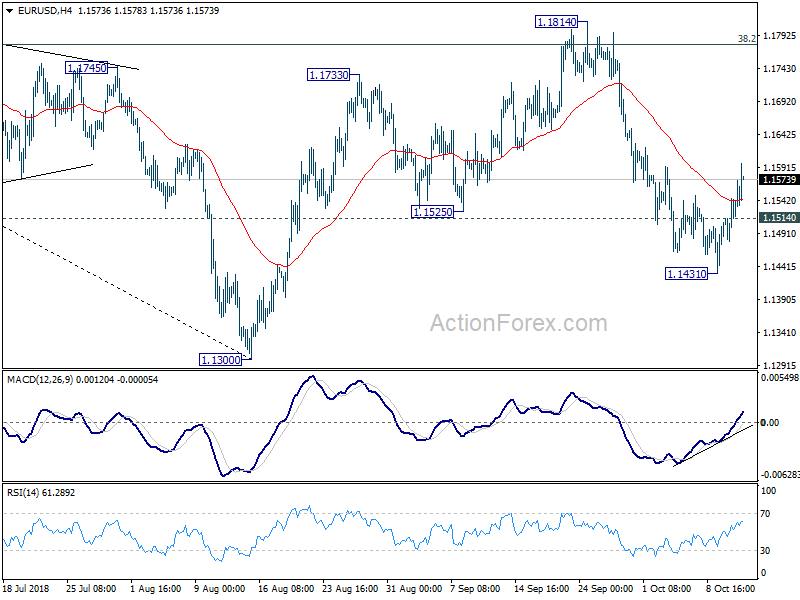
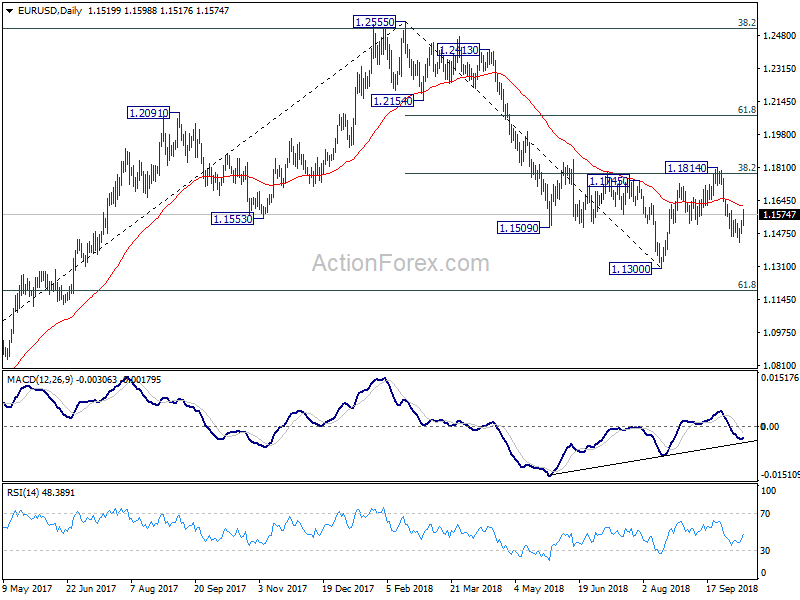
In the bigger picture, corrective pattern from 1.1300 could have completed at 1.1814 after hitting 38.2% retracement of 1.2555 to 1.1300 at 1.1779. Decisive break of 1.1300 will resume the down trend from 1.2555 to 61.8% retracement of 1.0339 (2017 low) to 1.2555 at 1.1186 next. Sustained break there will pave the way to retest 1.0339. On the upside, break of 1.1814 will delay the bearish case and extend the correction from 1.1300 with another rise before completion.
Dollar Softens Again as Investors Cheer US CPI Miss
After suffering yesterday's deeper selloff, there's hope for some stabilization and recovery in US stocks. Investors are cheering US CPI miss as DOW futures pare back some of earlier losses. The greenback, on the other hand, is suffering refreshed selling after the release. Japanese yen follow as the second weakest one as it could take advantage on global risk aversion. As for today, Australian Dollar and New Zealand Dollar are the strongest ones.
The US CPI miss might add some bullets for Trump to harass the Federal reserve for rate hikes. But it should be reminded that even with a strong economy and record low unemployment, core inflation is kept close to target. Fed, the committee of seasoned central bankers, and the hundreds of economists and staff working in all the branches, have done a marvellous job. Anyone with a little bit of decency will just let these professionals continue with their work.
European stocks stay weak though. At the time of writing, DAX is down -0.66%, CAC down -1.43%, FTSE down -1.31%. Italian 10 year yield is rising 0.055 at 3.559. German 10 year yield is down -0.035 at 0.522. German-Italian spread is hovering slightly above 300 handle. Earlier in Asia, Nikkei lost -3.89% to 22590.86. Singapore Strait Times lost -2.69% to 3047.39. Hong Kong HSI fell -3.54% to 25266.37. China Shanghai SSE dropped -5.22%, to close at 2583.46, breaking key support level of 2638.3 (2016 low).
Technically, Dollar's selloff against European majors and Yen will likely continue for a while. The question is whether commodity currencies would have that sustainable buying in the overall risk averse environment. In particular, USD/CAD retreats mildly but it's still in proximity to 1.3081 resistance Firm break there will be a strong sign of bullish reversal in the pair.
US core CPI failed to accelerate, initial jobless claims rose
Dollar trades generally lower in early US session after slightly lower than expected inflation reading. Headline CPI slowed from 2.7% yoy to 2.3% yoy, missed expectation of 2.4% yoy. Core CPI was unchanged at 2.2% yoy, missed expectation of 2.3% yoy.
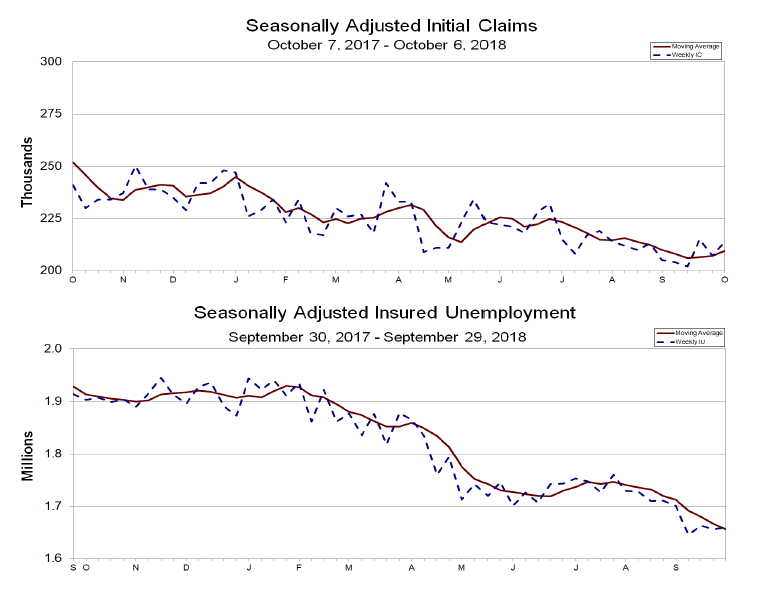
Initial jobless claims rose 7k to 214k in the week ended October 6, missed expectation of 205k. Four-week moving average of initial claims rose 2.5k to 209.5k. Continuing claims rose 4k to 1.66m in the week ended September 29. Four-week moving average of continuing claims dropped -10k to 1.656m, lowest since August 18, 1973.
Also released Canada new housing price index rose 0.0% mom in August, missed expectation of 0.2% mom.
Fed Bullard: No need to do more on monetary policy normalization
St. Louis Fed President James Bullard said "with respect to the (monetary policy) normalization, we have already reached a point when policy rates are in a good position." And he suggested that Fed policymakers "don't need to do much more to normalize policy."
Separately, he also welcomed the USMCA North America trade agreement. He said "this is very good news, because it shows that despite the ups and down of negotiations, you can reach a conclusion …on trade relations." And he hope the US "can get deals like this elsewhere and we might get the uncertainty down on this issue."
ECB: Uncertainty around the inflation outlook was receding
The accounts of September ECB monetary policy meeting provide no surprise nor anything of particular importance. One thing to note is that the Governing Council was more comfortable with the inflation outlook. It's noted that there was "broad agreement" on the "progress towards a sustained adjustment in the path of inflation". And, "while measures of underlying inflation remained generally muted, they had been increasing from earlier lows."
ECB added that "Comfort was drawn from the strengthening and broadening of domestic cost pressures, which were supported by the ongoing economic expansion, high levels of capacity utilisation and increasing labour market tightness, which was leading to rising wages." Most importantly, "uncertainty around the inflation outlook was receding."
ECB Hansson: Rather risky to be more precise in forward guidance now
ECB Governing Council member Ardo Hansson said urged not to be more specific on forward guidance yet. He said "To be any more precise than that, to lock in a date, to tie our hands would be rather risky". Instead, "when we get closer, we can have another discussion if we need to adjust the language again, but this is not a debate we are going to have just yet."
Separately, another Governing Council member Olli Rehn "core inflation is still rather weak in the euro zone at around 1 percent, as it has been for the last couple of years, so an accommodative monetary policy is still needed in Europe."
IMF Lagarde urged to de-escalate trade wars for the innocent bystanders
In a conference in Indonesia, IMF Managing Director Christine Lagarde urged countries to "de-escalate" trade wars was they could hurt "innocent bystanders". She said, "We certainly hope we don't move in either direction of a trade war or a currency war. It will be detrimental on both accounts for all participants… and there would also be lots of innocent bystanders."
Regarding recent depreciation of the Chinese Yuan, Lagarde said it's mainly driven by the strengthen of Dollar. And she noted that Yuan has not depreciated as much against a basket of currencies. She acknowledged that "we're seeing more and more countries, China included, let their currencies fluctuate." At the same time she also supported "the move of China toward (currency) flexibility" and urged China to go down that path."
EUR/USD Mid-Day Outlook
Daily Pivots: (S1) 1.1483; (P) 1.1515; (R1) 1.1550; More.....
EUR/USD edges higher to 1.1598 in early US session as rebound from 1.1431 extends. Intraday bias stays mildly on the upside for 55 day EMA (now at 1.1617) and possibly above. But we'd expect upside to be limited by 1.1779/1814 resistance zone to bring down trend resumption eventually. On the downside, below 1.1514 minor support will turn bias back to the downside. Further break of 1.1431 will bring retest of 1.1300 low.
In the bigger picture, corrective pattern from 1.1300 could have completed at 1.1814 after hitting 38.2% retracement of 1.2555 to 1.1300 at 1.1779. Decisive break of 1.1300 will resume the down trend from 1.2555 to 61.8% retracement of 1.0339 (2017 low) to 1.2555 at 1.1186 next. Sustained break there will pave the way to retest 1.0339. On the upside, break of 1.1814 will delay the bearish case and extend the correction from 1.1300 with another rise before completion.
Economic Indicators Update
| GMT | Ccy | Events | Actual | Forecast | Previous | Revised |
|---|---|---|---|---|---|---|
| 23:01 | GBP | RICS House Price Balance Sep | -2.00% | 2.00% | 2.00% | 1.00% |
| 23:50 | JPY | Domestic Corporate Goods Price Index Y/Y Sep | 3.00% | 2.90% | 3.00% | |
| 00:00 | AUD | Consumer Inflation Expectation Oct | 4.00% | 4.00% | ||
| 11:30 | EUR | ECB Monetary Policy Meeting Accounts | ||||
| 12:30 | CAD | New Housing Price Index M/M Aug | 0.00% | 0.20% | 0.10% | |
| 12:30 | USD | CPI M/M Sep | 0.10% | 0.20% | 0.20% | |
| 12:30 | USD | CPI Y/Y Sep | 2.30% | 2.40% | 2.70% | |
| 12:30 | USD | CPI Core M/M Sep | 0.10% | 0.20% | 0.10% | |
| 12:30 | USD | CPI Core Y/Y Sep | 2.20% | 2.30% | 2.20% | |
| 12:30 | USD | Initial Jobless Claims (OCT 6) | 214K | 205K | 207K | |
| 14:30 | USD | Natural Gas Storage | 87B | 98B | ||
| 15:00 | USD | Crude Oil Inventories | 2.3M | 8.0M |
Dollar lower as US core CPI failed to accelerate, initial jobless claims rose
Dollar trades generally lower in early US session after slightly lower than expected inflation reading. Headline CPI slowed from 2.7% yoy to 2.3% yoy, missed expectation of 2.4% yoy. Core CPI was unchanged at 2.2% yoy, missed expectation of 2.3% yoy.
Initial jobless claims rose 7k to 214k in the week ended October 6, missed expectation of 205k. Four-week moving average of initial claims rose 2.5k to 209.5k. Continuing claims rose 4k to 1.66m in the week ended September 29. Four-week moving average of continuing claims dropped -10k to 1.656m, lowest since August 18, 1973.
Also released Canada new housing price index rose 0.0% mom in August, missed expectation of 0.2% mom.
USD/CAD Punches above 1.30 as Canadian Dollar Sags, CPI Next
The Canadian dollar has edged lower in the Thursday session. Currently, USD/CAD is trading at 1.3042, down 0.19% on the day. On the release front, Canada releases the New Housing Price Index, which is expected to post a gain of 0.1% for a third straight month. In the U.S., CPI and Core CPI are both expected to post gains of 0.2%. As well, unemployment claims are forecast to remain pegged at 207 thousand. On Friday, the U.S releases a key consumer confidence gauge, UoM Consumer Sentiment.
With bonds yields continuing to rise, investors have reacted negatively and stock markets continue to spin lower. With risk appetite taking a beating, investors gave a thumbs down to minor currencies like the Canadian dollar, sending USD/CAD above the symbolic 1.30 level on Wednesday. The markets will be keeping a close eye on U.S consumer inflation data – strong numbers would likely increase the likelihood of a December rate hike in the U.S and further boost the U.S dollar.
With the U.S economy continuing to post strong numbers, the Federal Reserve is on track to raise rates in December. This would be the fourth rate hike in 2018, and the markets are expecting three more hikes in 2019. Not surprisingly, this has put pressure on the Bank of Canada to raise rates as well. The Canadian economy is in good shape, but not nearly as strong as its southern neighbor. The Bank of Canada holds its next policy meeting on October 24, and the strength of key Canadian releases will be a major factor as to whether policymakers raise rates.
Global Selloff Deepens on Risk Aversion, Dollar Tumbles
Global stock markets crumbled on Thursday following a painful session on Wall Street overnight that saw U.S. stocks suffer their worst selloff in more than eight months.
While U.S. President Donald Trump’s renewed criticism of the Federal Reserve for hiking interest rates played a role behind the steep selloff, there were other key factors brewing in the background. It is becoming clear that global equity markets are facing a perfect storm of headwinds such as rising U.S. bond yields, U.S.-China trade disputes, global growth concerns and prospects of higher U.S. interest rates. For as long as these themes remain, appetite for stocks are likely to diminish further consequently fueling speculation over the bull party coming to an end.
Asian stocks fell sharply during early trade to close in the red while European shares slumped this morning. With the negative sentiment from Asian and European markets deterring investors from riskier assets, Wall Street is at threat of trading lower this afternoon.
Dollar extends losses ahead of US CPI
It has not been the best of trading weeks for the Greenback which has consistently depreciated against a basket of major currencies since Tuesday.
A combination of factors ranging from President Trump’s latest criticism of the Federal Reserve to general profit-taking has contributed towards the Dollar’s weakness. With the Dollar still supported by confidence over the strength of the U.S. economy and prospects of higher U.S. interest rates, the medium- to longer-term outlook remains bullish. Investors will keep a close eye on September’s pending U.S. CPI reading which could impact rate hike expectations for 2019. Signs of rising inflationary pressures in the United States could prompt the Federal Reserve to adopt a more aggressive approach towards monetary policy normalization.
Solely focusing on the technical picture, the Dollar Index is currently controlled by intra-day bears with prices sinking closer towards 95.00 as of writing. A decisive breakdown and daily close below this level may open the gates towards 94.60.
Commodity spotlight - WTI and Brent Crude
The clear lack of appetite for risk across the board has seeped into oil markets with West Texas Intermediate (WTI) and Brent Crude extending losses on Thursday.
Official reports from the U.S. Energy Information Administration showing U.S. crude inventories rising more than expected complemented the sell-off with WTI trading marginally below $71.80 and Brent approaching $81.00 as of writing. While the combination of risk aversion and easing supply worries may translate to lower oil prices, the downside remains limited by geopolitical risk factors. With looming sanctions against Iran and falling production from Venezuela fueling uncertainty over the global supply outlook, oil bulls have enough ammunition to fight back.
Technical traders will continue to closely observe if Brent crude is able to breach below $81.00. Sustained weakness below this level should provide intraday-bears with enough confidence to challenge $80.20.
Dollar Cautious ahead of US CPI; Europe Joins in Global Stock Sell-off
Here are the latest developments in global markets:
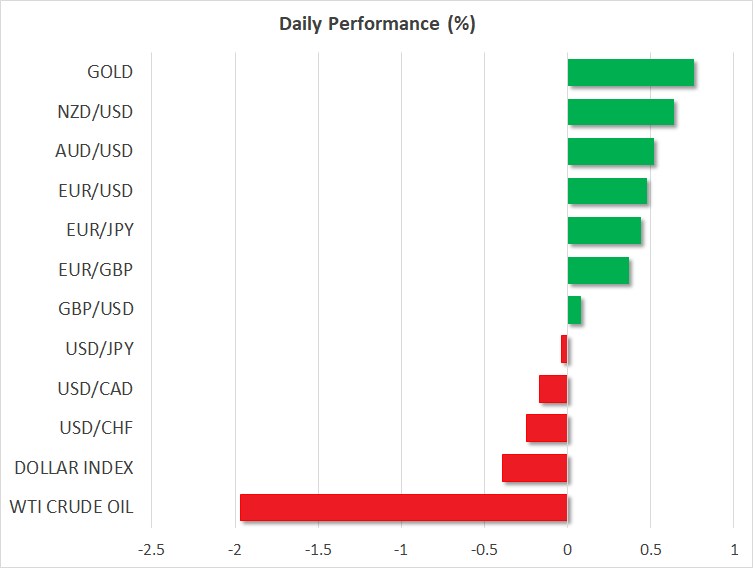
- FOREX: Dollar/yen was barely moving around 112.22 after dropping to 111.95 early on Thursday as US 10-year Treasury yields weakened to 3.15% from 3.24% on Wednesday. Trade worries were also weighing on investors appetite despite China’s Commerce Ministry saying Beijing is open for dialogue with Washington. US CPI figures later today could bring fresh waves of volatility to the greenback (see below). The dollar index was struggling too at 95.32 (-0.20%) on the back of a stronger euro. Euro/dollar climbed further to 1.1550 (+0.28%) ahead of the ECB meeting minutes which are expected to explain in detail ECB chief Mario Draghi’s hawkish mood at his last press conference. Euro/yen recovered to 129.68 (+0.28%) and euro/pound increased positive momentum towards 0.8752 (+0.25%). The Swedish krona was the best performer rallying by 1.69% against the dollar and 1.28% against the euro after Swedish CPI figures beat expectations. Meanwhile, Riksbank’s Deputy Governor admitted that if the economy evolves according to the central bank’s projections monetary stimulus could be reduced. Pound/dollar flattened at 1.3197 although comments on Brexit so far in the day were not positive; The Irish foreign minister claimed that it is too soon for an agreement, while the former UK prime minister, Tony Blair, said that the Brexit question should be put back to the people. Blair reiterated his backing for a second referendum, highlighting the division among lawmakers in the British parliament. The antipodeans were outperforming, with aussie/dollar and kiwi/dollar jumping by 0.47% and 0.67%, respectively. In emerging markets the Turkish lira was up by almost 2.0%, paring all losses made the past two weeks.
- STOCKS: European stocks followed their Asian and US counterparts deeply to the downside feeling the stress over elevated government bond yields. The pan-European STOXX 600 and the blue-chip STOXX 50 tumbled by 1.76% and 1.39% respectively to 20-month lows at 1120 GMT with energy and technology losing the most (-2.14%). The German DAX 30 declined by 1.25%, the French CAC 40 fell by 1.58%, while the Spanish IBEX 35 declined by 1.31%. The Italian FTSE MIB lost 1.07% and the British FTSE 100 moved down by 1.59%. In Asia, stocks printed considerable losses particularly Shanghai’s Composite SSE index which dived by more than 5%. In the US, futures tracking Dow Jones, S&P 500 and Nasdaq 100 were in the red, flagging a strong negative open.
- COMMODITIES: Oil prices were trading heavily early in the European session as stock markets suffered and the API weekly oil report showed on Wednesday that US crude inventories increased the sharpest in more than a year. Hurricane Michael which turned to category 4 in Florida causing energy producers to cut 42% of their daily output in the Gulf of Mexico failed to provide much support. In the aftermath, WTI crude oil dived by 1.69% to $71.73/barrel and Brent slid by 1.87% to $81.54, both plunging to 2-week lows. In precious metals, gold was benefitting on risk-off sentiment, crawling up to 1,203/ounce (+0.71%).
Day Ahead: ECB minutes and US CPI attracting attention
Thursday’s calendar features numerous releases that could spur positioning in the markets.
The European Central Bank will release minutes of the latest monetary policy meeting at 1130 GMT. While no surprises are expected after the central bank maintained the guidance that the asset purchase program will end in December 2018 and interest rates will remain steady until summer 2019, investors will be interested to get clarification on the central bank’s economic views and particularly on wage growth prospects. Especially after the ECB’s Mario Draghi increased hopes that a tighter labor market could provide support to underlying inflation at the September meeting. Still, he mentioned that the balance of risks surrounding growth has not changed. Traders will probably also be watching for any comments relating to the Italian fiscal burden and US trade protectionism as well.
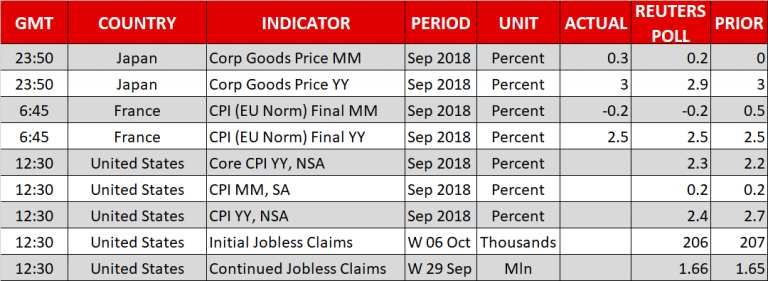
Out of the US, the Consumer Price Index will come under the spotlight at 1330 GMT, while earlier at 1230 GMT weekly jobless claims – initial and continued – will be also awaited. The number of initial benefits claimants for the week ending October 6 is anticipated to be 206k, little changed from the preceding week’s 207k.
The headline CPI is expected to stand at 2.4% y/y, the lowest since March, compared to 2.7% seen in the previous month while, on monthly basis, is predicted to remain unchanged at 0.2%. Excluding food and energy, the core index is expected to tick higher to 2.3% y/y from 2.2% y/y previously. After the aggressive sell-off in Wall Street and thus the slide in the US dollar, any upside surprise in the data could prove dollar-positive.
On the Brexit front, EU Brexit negotiator Michel Barnier said yesterday the parties had agreed on much of the withdrawal agreement ahead of a summit of the bloc’s 28 national leaders next week, driving sterling higher. Today any fresh evidence that the EU and the UK are coming closer to a deal could provide tailwinds to the pound.
In oil markets, the EIA weekly report due at 1500 GMT is expected to indicate a smaller increase in US crude oil stocks for the week ending October 5 relative to the preceding week – the increase is estimated at 2.620 million barrels versus the previous week’s build-up of 7.975 million barrels.
In terms of public appearances, ECB President Mario Draghi and ECB Board Member Benoit Cœure will be attending the IMF and World Bank Annual meetings in Indonesia today and the next two days.
ECB: Uncertainty around the inflation outlook was receding
The accounts of September ECB monetary policy meeting provide no surprise nor anything of particular importance. One thing to note is that the Governing Council was more comfortable with the inflation outlook. It's noted that there was "broad agreement" on the "progress towards a sustained adjustment in the path of inflation". And, "while measures of underlying inflation remained generally muted, they had been increasing from earlier lows."
ECB added that "Comfort was drawn from the strengthening and broadening of domestic cost pressures, which were supported by the ongoing economic expansion, high levels of capacity utilisation and increasing labour market tightness, which was leading to rising wages." Most importantly, "uncertainty around the inflation outlook was receding."
(ECB) Account of the monetary policy meeting 12-13 September
of the Governing Council of the European Central Bank, held in Frankfurt am Main on Wednesday and Thursday, 12-13 September 2018
1. Review of financial, economic and monetary developments and policy options
Financial market developments
Mr Cœuré reviewed the latest financial market developments since the Governing Council's previous monetary policy meeting on 25-26 July 2018.
Heightened volatility had been observed in the currencies of some emerging market economies, especially Argentina and Turkey, but also Brazil and South Africa. In fixed income markets, Argentina's and Turkey's sovereign bond spreads had widened proportionately more than those of other emerging markets, with only limited signs of spillovers.
In advanced economies, the euro/US dollar exchange rate had exhibited some volatility, with the euro first falling to its lowest level in more than a year after the Governing Council's July monetary policy meeting, only to reverse most of this movement thereafter. From around mid-April, and increasingly since mid-June, there had been a reduction in net long speculative positions in euro to broadly neutral levels, which might have contributed to amplifying movements in the euro/US dollar exchange rate.
Turning to bond markets in the United States, domestic demand and monetary policy could be expected to continue putting upward pressure on the ten-year government bond yield. At the same time, increasing global risk and safe haven flows into US Treasuries had likely exerted downward pressure on yields, which roughly offset the upward pressure. Similarly, global risk aversion had likely amplified the upward pressure on the US dollar, exerted as a result of improved economic prospects and tighter monetary policy in the United States.
In the euro area bond markets, prices in the Italian sovereign bond market had been quite volatile over the previous few weeks. Of late there had been some stabilisation, but at notably higher levels than prior to the formation of the new Italian government. Spillovers from the Italian sovereign bond market to the rest of the European bond markets had, however, been very limited.
In equity markets, the EURO STOXX 50 index had fallen by around 5% since the Governing Council's July monetary policy meeting and was down by more than 10% from its peak in January 2018. One of the drivers of this decline had been European banks, as evidenced by the underperformance of the EURO STOXX Banks index. By contrast, US equity prices had increased continuously since the correction in spring 2018, with the Standard & Poor's 500 index presently 8% above its level at the beginning of 2018.
Finally, with regard to monetary policy expectations, the overnight indexed swap (OIS) curve had shown various episodes of flattening after the Governing Council's monetary policy meeting on 13-14 June 2018, which indicated that markets expected a slower pace of rate normalisation. The expected date of a first increase in policy rates had, however, not changed materially since 25-26 July. A first 10-basis point increase in the ECB's deposit facility rate was currently priced in for the fourth quarter of 2019, while survey-based information suggested a somewhat earlier timing, which might in part reflect the presence of negative term premia in OIS rates.
The global environment and economic and monetary developments in the euro area
Mr Praet reviewed the global environment and recent economic and monetary developments in the euro area.
Regarding the external environment, the global economic expansion was continuing at a steady pace, at rates close to potential but with substantial cross-country divergences. Inflation and wage dynamics had gained some momentum. At the same time, global trade had decelerated, while protectionist threats persisted. Brent crude oil prices had risen by 8% (in US dollar terms) since the Governing Council's July monetary policy meeting, and non-oil commodity prices had fallen by 2.3%. The euro had appreciated somewhat in nominal effective terms but had depreciated slightly against the US dollar.
Turning to the euro area, recent data indicated that the moderation in the first half of 2018 had reflected a pull-back from very high growth in the previous quarters, mainly on account of weaker export demand. Since the Governing Council's July meeting, high-frequency indicators had stabilised and remained at elevated levels, underlining the overall robustness of economic activity. Private consumption had continued to grow at a robust pace in the second quarter of 2018, supported by the ongoing rise in labour income. Strong demand and earnings remained supportive of business investment. Surveys showed that capacity utilisation in the capital goods-producing sector had remained at all-time highs. At the same time, euro area trade momentum had continued to moderate in May. This weakening in momentum reflected mainly a deceleration in extra-euro area trade, especially with Asia, and was concentrated in the trade of intermediate goods.
These developments were also reflected in the September 2018 ECB staff macroeconomic projections for the euro area, which projected real GDP growth at 2.0% in 2018, 1.8% in 2019 and 1.7% in 2020, with real GDP growth revised down by 0.1 percentage point for both 2018 and 2019. The revisions were mostly attributable to a weaker than previously expected contribution from net trade, reflecting downward revisions to foreign demand and a stronger effective exchange rate of the euro. These effects offset the upward impact on domestic demand stemming from lower lending rates and some fiscal stimulus. The ECB staff projections stood at the lower end of other available forecasts for 2018 and 2019, and at the upper end of the range for 2020.
Turning to price developments, according to Eurostat's flash estimate, annual HICP inflation was 2.0% in August, down from 2.1% in July, with HICP inflation excluding energy and food edging down to 1.0%, from 1.1%, over the same period. Measures of underlying inflation remained muted but were on a gradually improving path. Incoming data supported the assessment that domestic cost pressures were strengthening and broadening. In the domestic supply chain, producer price inflation for both goods and services was increasing, and prices of imported consumer goods were again rising. As regards wage developments, the annual growth in compensation per employee had increased to 2.3% in the second quarter of 2018, up from 1.9% in the first quarter.
In the September ECB staff projections, headline inflation was expected to stand at 1.7% in each year of the projection horizon, unchanged from the June Eurosystem staff projections. The stable path of annual average inflation rates continued to mask a decline in the annual growth rate of the energy component – as the impact of the past increases in oil prices faded – which was offset by gradually rising underlying inflation as supply constraints became increasingly binding. The September projections were in line with the forecasts of other international and private sector institutions.
Market-based inflation expectations were largely unchanged since the Governing Council's July monetary policy meeting.
Financial conditions had tightened to some degree, while the cost of financing for non-financial corporations (NFCs) and households remained favourable. The expected timing of a first increase in ECB policy rates was largely unchanged. Euro area equity markets had declined since the Governing Council's July meeting, with earnings expectations broadly unchanged. The overall cost of financing for euro area firms had remained very favourable by historical standards.
Turning to money and credit developments, M3 growth had moderated in July to 4.0%, partly reflecting volatility and base effects. At the same time, the sources of money creation had continued to shift from the asset purchase programme (APP) towards private credit. Euro area bank lending rates remained favourable and stood close to historical lows. The composite cost of borrowing for NFCs had decreased to 1.6% in July, while the composite rate on loans to households for house purchase had remained stable at 1.8%.
Regarding fiscal policy, the euro area fiscal stance, as measured by the change in the cyclically adjusted primary balance, was projected to move from broadly neutral to mildly expansionary in 2019.
Monetary policy considerations and policy options
Summing up, Mr Praet concluded that, since the Governing Council's July monetary policy meeting, financial conditions had tightened somewhat, while borrowing conditions for households and firms remained very favourable.
The incoming information, including the September 2018 ECB staff projections, confirmed the previous assessment of an ongoing broad-based expansion of the euro area economy at growth rates above potential. Growth projections for 2018 and 2019 had been revised down slightly, mainly reflecting weaker foreign demand.
Risks to the growth outlook could still be assessed as broadly balanced. At the same time, risks relating to the threat of protectionism, vulnerabilities in emerging markets and financial market volatility had gained more prominence recently.
While measures of underlying inflation remained generally muted, they had been increasing from earlier lows. Domestic cost pressures were strengthening and broadening, supported by the ongoing economic expansion, high levels of capacity utilisation and increasing labour market tightness. The September 2018 ECB staff projections foresaw inflation at 1.7% throughout the projection period, unrevised from the June 2018 Eurosystem staff projections.
On this basis, and in line with the anticipation expressed at the Governing Council's June monetary policy meeting, Mr Praet proposed, first, to reduce, as of October, the monthly pace of the net asset purchases to €15 billion until the end of December 2018; second, to reiterate the anticipation that – subject to incoming data confirming the medium-term inflation outlook – the Governing Council would end its net purchases at the end of December 2018; and, third, to reassert all remaining elements of the forward guidance pertaining to the key ECB interest rates, including the expectation that they would remain at their present levels at least through the summer of 2019, and in any case for as long as necessary to ensure the continued sustained convergence of inflation to levels below, but close to, 2% over the medium term, and the forward guidance on APP reinvestments.
Accordingly, the external communication should: (a) emphasise that the incoming information confirmed the ongoing broad-based expansion in the euro area; (b) stress that risks to the growth outlook could still be assessed as broadly balanced, and acknowledge that risks relating to the threat of protectionism, vulnerabilities in emerging markets and financial market volatility had gained more prominence recently; (c) underline that the strength of the euro area economy supported confidence that the sustained convergence of inflation to the Governing Council's aim would proceed and be maintained even after a gradual winding-down of its net asset purchases; and (d) reiterate that significant monetary policy stimulus was still needed for a continued and durable convergence of inflation to the Governing Council's aim and that this support would continue to be provided by the net asset purchases until the end of the year, by the sizeable stock of acquired assets and the associated reinvestment, and by the enhanced forward guidance on the key ECB interest rates.
2. Governing Council's discussion and monetary policy decisions
Economic and monetary analyses
With regard to the economic analysis, members generally shared the assessment of the outlook and risks for economic activity in the euro area provided by Mr Praet in his introduction. Real GDP growth had moderated in the first half of 2018, a pull-back from the strong growth in 2017 that was mainly related to weaker foreign demand. However, the latest indicators and survey results broadly confirmed the previous assessment of an ongoing broad-based expansion of economic activity in the euro area, at growth rates which were above potential, as broadly reflected in the September 2018 ECB staff projections.
Considering the outlook and the risks for the external environment, members agreed that global activity continued to expand at a steady pace. The picture of a continued economic expansion was reflected in the September projections, which foresaw global activity excluding the euro area growing at 3.9% in 2018, before decelerating to 3.7% in 2020, with slight downward revisions in 2018 and 2019 compared with the June Eurosystem staff projections. At the same time, there had been some weakening in trade momentum, and members considered that uncertainties related to global factors had become more prominent, with risks to the external environment generally assessed to be tilted to the downside.
Members discussed in greater detail the impact of trade protectionism on the global outlook. In addition to any direct effects arising from the imposition of tariffs, concerns were expressed about the possibility that trade tensions could generate a more general decline in confidence throughout the global economy. At the same time, it was underlined that adverse confidence effects on trade and investment arising from trade tensions had hitherto been limited and that such effects were subject to considerable uncertainty. Attention was drawn to recent declines in global orders and export orders reported in purchasing managers' surveys.
Members also exchanged views about the implications of recent developments in emerging market economies. It was noted that the depreciation of these economies' currencies had so far been relatively contained and was primarily focused on countries that had weak fundamentals, relatively high foreign debt levels and, in particular, exposure to the US dollar. More generally, the point was made that growth in emerging market economies had made a sizeable positive contribution to global activity in the past decade, and that a natural adjustment was taking place. At the same time, there were indications that the euro area was moving away from reliance on external demand towards more domestic sources of expenditure, which should increase its resilience.
Turning to the euro area, members generally concurred with the outlook in the September ECB staff projections, noting that the current projections contained slight downward revisions but no significant change to the growth outlook from the June Eurosystem staff projections. Together with the latest economic indicators and survey results, this provided further confirmation that the ongoing economic expansion in the euro area remained broad-based, proceeding at a pace above that of potential growth. While the pull-back in euro area growth in the first half of the year could largely be attributed to weaker external demand, after exceptionally strong external trade in 2017, the point was made that the moderation in annual rates of growth over the projection horizon reflected convergence towards growth in line with potential. It was underlined that the latest survey outcomes, including those from the European Commission and the Purchasing Managers' Index, remained at high levels from a historical perspective.
At the same time, some recent hard data had been less positive than soft indicators. Industrial production figures in July, for example, were down, especially for several large euro area countries. In part this related to lower orders from abroad, while in some cases it could be explained partly by sector-specific factors.
On the whole, the euro area economy was seen to have shown a considerable degree of domestic resilience so far and to have become more robust in recent years, in the context of higher capacity utilisation rates and partly as a result of significant reforms undertaken by many euro area countries since the financial crisis. However, at the same time, caution was seen as warranted since heightened uncertainty in the global environment might yet impact the euro area more significantly over time.
A number of points were raised regarding the latest ECB staff projections for euro area activity, which had maintained a robust outlook, with only small revisions to the projections for growth. It was recalled that there had now been two consecutive downward corrections to growth, with the outlook for 2018 having been revised down from 2.4% in the March 2018 projection exercise to 2.1% and to 2.0% in the June and September exercises respectively, largely reflecting the less favourable data on the current quarter, while quarter-on-quarter changes in real GDP were limited. In this context, a remark was made that some of the factors behind the revisions might not be entirely of a transitory nature. As regards the projection for euro area export growth, it was pointed out that export market shares were assumed to remain constant over the projection horizon, which could be considered a rather benign scenario. At the same time, it was acknowledged that a large part of the euro's recent appreciation was due to developments in the Turkish lira, and that the effects were therefore likely to be more heterogeneous across euro area countries. It was also argued that there could be larger spillovers from weaker external demand to domestic demand. Although the effects on investment might have been limited so far, it was not certain that this would continue to be the case.
Regarding fiscal policies, remarks were made on the likelihood of a stronger upward impact on euro area growth from a more expansionary fiscal stance, which could be expected in several large countries. At the same time, there was a risk that procyclical fiscal policies could have a negative effect on resilience. The point was made that consideration should be given to the quality of public expenditure and to its impact on potential output. More generally, the current broad-based expansion called for rebuilding fiscal buffers. At the same time, the full and consistent implementation of the EU's fiscal and economic governance framework over time and across countries remained essential to bolster the resilience of the euro area economy.
Against this background, risks to the euro area growth outlook were generally assessed to have remained broadly balanced overall, with risks relating to rising protectionism, vulnerabilities in emerging markets and financial market volatility having gained more prominence recently. While it was remarked that a case could also be made for characterising the risks to activity as now being tilted to the downside given the clear prevalence of downward global risks, it was agreed that the assessment that risks were broadly balanced should be maintained, also as the underlying strength of the economy was judged to be mitigating downside risks to activity.
With regard to price developments, there was broad agreement with the assessment presented by Mr Praet in his introduction. Annual euro area headline inflation had been 2.0% in August 2018, according to Eurostat's flash estimate, compared with 2.1% in July. Looking ahead, on the basis of current futures prices for oil, annual rates of headline inflation were likely to hover around the current level for the remainder of the year. While measures of underlying inflation remained generally muted, they had been increasing from earlier lows. It was observed that domestic cost pressures were strengthening and broadening amid high levels of capacity utilisation and tightening labour markets, which were pushing up wage growth. Underlying inflation was expected to pick up towards the end of the year and to increase gradually over the medium term.
Members considered that the outlook for inflation was broadly confirmed by the latest ECB staff projections. Although the headline rate was expected to remain somewhat below 2% over the projection horizon, the inflation outlook was assessed as remaining broadly on track. At the same time, uncertainty about the outlook appeared to be receding. Some encouragement was also taken from recent developments in OECD inflation, which seemed to be picking up. OECD core inflation was currently around the same level as in 2007, and the headline level of inflation slightly above, so that global inflation was also providing support to inflation in the euro area.
In exchanging views about recent wage developments, members noted that there had been a pick-up in wage growth. This was evident in a range of measures, including negotiated wages, compensation per worker and compensation per hour, especially in those countries where the business cycle was more mature. This assessment was supported by evidence put forward for a number of individual countries. Higher wage growth was generally seen to reflect the tightening labour market and was considered a key factor in increasing confidence in the inflation outlook. However, it was also underlined that the transmission of higher wages to consumer price inflation remained uncertain and subject to time lags. In this regard, it was argued that high rates of capacity utilisation could lead to an increase in labour productivity, which might in turn mitigate the impact of wage growth on inflation.
Some consideration was also given to the possible adverse impact of downside risks to growth on the outlook for inflation. In this context, members discussed the extent to which a negative supply shock arising from protectionist measures, with positive effects on inflation, might be more than offset by a negative demand shock, if there were sizeable confidence effects. Given the uncertainty surrounding possible trade diversion and disruptions along global supply chains, as well as broader confidence effects, the view was expressed that it was not clear ex ante which effects would dominate with respect to prices.
As regards recent developments in inflation expectations, members noted that longer-term market and survey-based measures were broadly unchanged. The five-year forward inflation-linked swap rate five years ahead had been relatively stable at around 1.7% for some time, showing little volatility. Longer-term inflation expectations seemed on the whole to be reasonably well-anchored.
With regard to the monetary analysis, members concurred with the assessment presented by Mr Praet in his introduction. Broad money (M3) growth had declined to 4.0% in July 2018, from 4.5% in June. Apart from some volatility in monthly flows, M3 growth was increasingly supported by bank credit creation. The narrow monetary aggregate M1 remained the main contributor to broad money growth.
It was noted that the recovery in the growth of loans to the private sector observed since the beginning of 2014 was proceeding. The growth of loans to NFCs and households was robust, remaining unchanged from June in both cases. Credit creation was seen to be supported by the overall improvement in banks' balance sheets, which was also evidenced by the continued decline in the level of non-performing loans. Likewise, lending rates for households and NFCs remained at very favourable levels, supporting credit flows to the private sector.
Monetary policy stance and policy considerations
With regard to the monetary policy stance, members widely shared the assessment provided by Mr Praet in his introduction that incoming information, including the September 2018 ECB staff projections, broadly confirmed the Governing Council's previous assessment of an ongoing broad-based expansion of the euro area economy, at growth rates above potential, and gradually rising inflationary pressures. The underlying strength of the euro area economy continued to support confidence in the sustained convergence of inflation to the Governing Council's aim even after a gradual winding-down of net asset purchases. At the same time, significant monetary policy stimulus was still needed to support the further build-up of domestic price pressures and headline inflation over the medium term.
There was broad agreement among members that financial conditions remained very supportive of a continued economic expansion and rising domestic price pressures in the euro area, although they had tightened somewhat overall since the Governing Council's July monetary policy meeting. In particular, equity prices had fallen in the light of heightened geopolitical and trade tensions. Moreover, the euro's nominal effective exchange rate had appreciated, although this was mainly due to a weakening of a few emerging market economies' currencies. It was also highlighted that – taking a somewhat longer perspective – the euro had seen a significant appreciation of more than 10% since the beginning of 2017. At the same time, bond yields had generally been broadly unchanged or had moved slightly lower over most of this period.
There was also broad agreement that the incoming information, despite remaining uncertainties, vindicated the Governing Council's earlier assessments of progress towards a sustained adjustment in the path of inflation carried out at the previous monetary policy meetings in June and July 2018. In particular, inflation was projected to move along the trajectory already contained in the June 2018 Eurosystem staff projections and could be assessed as broadly in line with the ECB's medium-term objective. Also, while measures of underlying inflation remained generally muted, they had been increasing from earlier lows. Comfort was drawn from the strengthening and broadening of domestic cost pressures, which were supported by the ongoing economic expansion, high levels of capacity utilisation and increasing labour market tightness, which was leading to rising wages. Uncertainty around the inflation outlook was receding.
In the light of the confirmation of the medium-term inflation outlook, members agreed that the June 2018 monetary policy decisions remained appropriate and called for a reaffirmation of the prevailing policy posture. Accordingly, all members supported the proposal made by Mr Praet in his introduction that, in line with the anticipation expressed at the Governing Council's June monetary policy meeting, the monthly pace of net asset purchases would be reduced to €15 billion from October to December 2018. It was also seen as prudent to reiterate the Governing Council's anticipation that – subject to incoming data confirming the medium-term inflation outlook – net purchases would then end. This was seen to be consistent with the Governing Council's data-driven approach to monetary policy and fully in line with the decisions taken at the Governing Council's June monetary policy meeting. It was underlined that uncertainties emanating from rising protectionism, vulnerabilities in emerging markets and financial market volatility had become more prominent recently, which continued to call for prudence in the formulation of the monetary policy stance.
Against this background, members also agreed that a significant degree of monetary accommodation was still necessary to ensure a durable convergence of inflation to the Governing Council's aim. This implied that all the other elements of the Governing Council's forward guidance pertaining to the path of the key ECB interest rates and to its reinvestment policy should be reasserted.
The view was widely shared that the decisions taken by the Governing Council at its June monetary policy meeting, regarding the anticipated phasing-out of the APP and the enhanced forward guidance, had been absorbed smoothly by markets and had been vindicated by the subsequent evolution of data and projections. It was highlighted that, in an environment still subject to a number of uncertainties, the current configuration of the monetary policy stance was robust to small changes in the outlook. Ample monetary policy accommodation remained in place, notably owing to the stock of assets on the ECB's balance sheet and the associated reinvestments, as well as the enhanced forward guidance on interest rates. This continued to support a sustained convergence of inflation to levels below, but close to, 2% over the medium term, while the Governing Council retained sufficient flexibility to respond to possible future shocks, if needed.
On communication, members widely concurred with the elements proposed by Mr Praet in his introduction. In particular, it was seen as appropriate to maintain a steady hand in communication, in line with the decisions and communication adopted at the Governing Council's June and July monetary policy meetings. Accordingly, it needed to be emphasised that the incoming data confirmed the ongoing broad-based expansion of the euro area economy. It was likewise important to stress that risks surrounding the euro area growth outlook could still be assessed as being broadly balanced, in line with earlier assessments, although it had to be acknowledged that risks relating to the threat of protectionism, vulnerabilities in emerging markets and financial market volatility had gained more prominence recently. Overall, however, it was important to highlight that the conditions remained in place for inflation to move sustainably towards the Governing Council's medium-term inflation aim.
In the light of still prevailing uncertainties and only gradually rising underlying inflation, there was also broad agreement among the members that remaining patient, prudent and persistent with regard to monetary policy was still essential. Accordingly, it needed to be recalled that, even if the net flows under the APP were coming to an end, monetary policy would remain highly accommodative. In particular, an ample degree of monetary accommodation would continue to be provided by the sizeable stock of acquired assets and the associated reinvestments, as well as the Governing Council's enhanced forward guidance. Moreover, it was widely considered prudent to restate the Governing Council's readiness to adjust all of its instruments, as appropriate, to ensure that inflation continued to move towards the Governing Council's aim in a sustained manner.
Furthermore, it was seen as warranted to reinforce the call for other policy areas to contribute more decisively to raising longer-term growth potential and reducing vulnerabilities. This also included stepping up efforts in the fiscal domain towards achieving a more growth-friendly composition of public finances, notably via improvements in the quality of public investment. Moreover, the current environment of low interest rates and broad-based growth generally called for governments to rebuild fiscal buffers, especially in countries with high public debt.
Monetary policy decisions and communication
Taking into account the foregoing discussion among the members, on a proposal from the President, the Governing Council decided that the interest rate on the main refinancing operations and the interest rates on the marginal lending facility and the deposit facility would remain unchanged at 0.00%, 0.25% and -0.40% respectively.
The Governing Council confirmed that it would continue to make net purchases under the APP at the current monthly pace of €30 billion until the end of September 2018. After September, the Governing Council would reduce the monthly pace of net asset purchases to €15 billion until the end of December 2018 and anticipated that, subject to incoming data confirming the medium-term inflation outlook, net purchases would then end. The Governing Council intended to reinvest the principal payments from maturing securities purchased under the APP for an extended period of time after the end of the net asset purchases, and in any case for as long as necessary to maintain favourable liquidity conditions and an ample degree of monetary accommodation.
The members of the Governing Council subsequently finalised the introductory statement, which the President and the Vice-President would, as usual, deliver at the press conference following the end of the current Governing Council meeting.
Introductory statement
https://www.ecb.europa.eu/press/pressconf/2018/html/ecb.is180913.en.html
Press release
https://www.ecb.europa.eu/press/pr/date/2018/html/ecb.mp180913.en.html
Meeting of the ECB's Governing Council, 12-13 September 2018
Members
- Mr Draghi, President
- Mr de Guindos, Vice-President
- Mr Cœuré
- Mr Costa
- Ms Georghadji*
- Mr Hansson
- Mr Hernández de Cos
- Mr Knot
- Mr Lane
- Ms Lautenschläger
- Mr Makúch
- Mr Mersch
- Mr Nowotny
- Mr Praet
- Mr Rehn
- Mr Reinesch
- Mr Smets
- Mr Stournaras*
- Mr Vasiliauskas
- Mr Vella
- Mr Villeroy de Galhau
- Mr Visco
- Mr Weidmann*
* Members not holding a voting right in September 2018 under Article 10.2 of the ESCB Statute.
Other attendees
- Mr Dombrovskis, Commission Vice-President**
- Mr Teixeira, Secretary, Director General Secretariat
- Mr Smets, Secretary for monetary policy, Director General Economics
- Mr Winkler, Deputy Secretary for monetary policy, Senior Adviser, DG Economics
** In accordance with Article 284 of the Treaty on the Functioning of the European Union.
Accompanying persons
- Mr Alves
- Mr Arce
- Ms Buch
- Mr Demarco
- Mr Dolenc
- Mr Gaiotti
- Ms Goulard
- Mr Kaasik
- Mr Kuodis
- Mr Mooslechner
- Mr Ódor
- Mr Pattipeilohy
- Ms Phelan
- Ms Razmusa, Alternate to Mr Rimšēvičs*
- Mr Rutkaste
- Mr Schoder
- Mr Stavrou
- Mr Tavlas
- Mr Tratnik
- Mr Välimäki
- Mr Wunsch
Other ECB staff
- Ms Graeff, Director General Communications
- Mr Straub, Counsellor to the President
- Mr Bindseil, Director General Market Operations
- Mr Rostagno, Director General Monetary Policy, DG Economics
- Mr Sousa, Deputy Director General Economic Developments, DG Economics
Release of the next monetary policy account foreseen on Thursday, 22 November 2018.
Gold Bull Pressure Eyes Range Top At 1,211.28 Zone
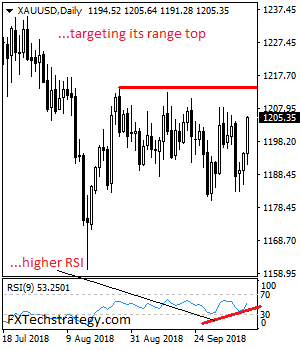
GOLD bull pressure eyes range top located at the 1,214.28 area. On the downside, support comes in at the 1,200.00 level where a break will turn attention to the 1,190.00 level. Further down, a cut through here will open the door for a move lower towards the 1,180.00 level. Below here if seen could trigger further downside pressure targeting the 1,170.00 level. On the upside, resistance comes in at the 1,214.00 level where a break will clear the way for move towards the 1,220.00 level. A turn above here will expose the 1,210.00 level. Further out, resistance stands at the 1,230.00 level. Its daily RSI is bullish and pointing higher suggesting further strength. All in all, GOLD looks to strengthen further with eyes on its range top.
AUD/USD Analysis: Stranded Between SMAs
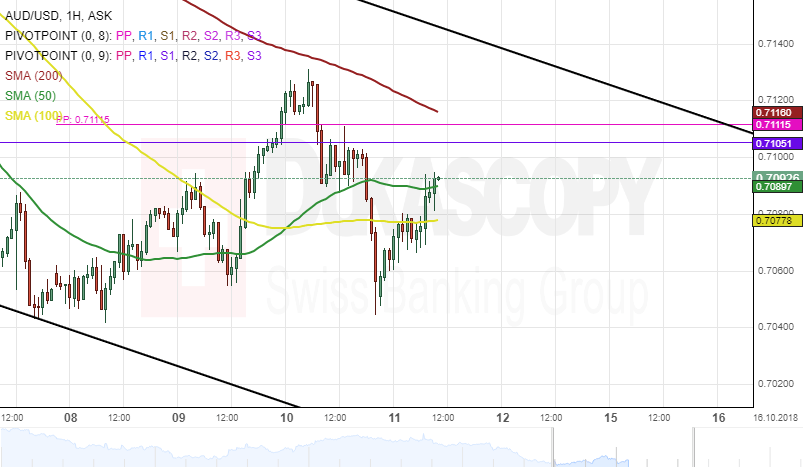
Downside risks dominated the AUD/USD currency pair on Wednesday. The Australian Dollar declined about 86 base points against the US Dollar during the end of yesterday's trading session.
Currently, the exchange rate is stranded between SMAs. The 50-hour simple moving average was providing resistance at 0.7088, while the 100-hour moving average was providing support for the rate at 0.7077.
Everything being equal, it is likely that the currency exchange rate continues its downside momentum during the following trading session. Technical indicators suggest a target of 0.70 could be a possibility during the coming hours.