Sample Category Title
Sunset Market Commentary
Markets
Wind died down on global core bond markets today after US Treasuries jumped higher at the last hours of yesterday’s session. The German Bund caught up with US Treasuries at European openings, moving substantially higher, but paired those gains through the day. Both the Bund as the US Treasuries are hovering near yesterday’s closings. Noise around Italian budget discussions didn’t change tone as EU warns Italy for long-term repercussions of current budget proposal. BTP’s moved south throughout the day. US Treasuries lost some ground ahead of the US CPI’s but recovered mostly as inflation numbers were slightly weaker than expected. Headline inflation for September rose 0.1% MoM (2.3% YoY), less than consensus expectation of a 0.2% gain (2.4% YoY). Core inflation (0.1% MoM, 2.2% YoY) remained stable while a small increase was expected. While rising yields kept investors on their toes in previous days, today’s bond trading moves proved to be rather insignificant. The German yield curve bull flattens with yield changes ranging between -1.0 bps (2-yr) and -2.6 bps (30-yr). US yields moved north with changes from +0.3 bps (10-yr) to +0.7 bps (30-yr). Italian 10-yr spread vs Germany widened 11 bps to move back north of 305 bps in total. Greek and Spanish spread over Germany widen both with 6 bps.
After trending higher in early trading hours, EUR/USD lost some of its mojo before edging up again in the run up to the minutes of the September meeting. These revealed increasing worries of the global trade war, in particular on EMU exports. Yet most governors are still convinced of underlying inflation picking up and believe the EMU economy can deal with the scaling back of the APP by the end of this year. As this message is well known to investors, attention soon shifted to US CPI’s. Yesterday’s risk-off triggered a potential repricing of US assets and caused a small dollar “exodus”. Higher (than expected) inflation had the potential to extend this move as this could possibly increase the projected pace of rate rises. However, both headline and core measures disappointed slightly, pushing EUR/USD back higher. The pair tested the 1.16-area but lost momentum soon afterwards. Slower inflation might have soothed investors and provide the dollar some downside protection. At the same time, Italy probably remains an important barrier for the common currency. The pair is currently filling bids at 1.1564. USD/JPY is trading stable around 112.30, holding on to yesterday’s gains.
Pound trading was largely technical in nature as there were no important data to steer markets. Concerning Brexit “there is no breakthrough yet”, but “intensive technical negotiations are continuing”, the spokesman for the European Commission said today in clarifying Michel Barnier’s prudent yet optimistic speech to the European Parliament. So the investors’ quest for clues whether Tuesday’s report suggesting a possible (yet preliminary and partial) deal is feasible, continues. In the meantime, markets are likely to eschew any meaningful sterling positions, especially having in mind the important brexit summit the 17th of October. EUR/GBP traded with a tentative positive bias, recovering part of previous losses, ending a 6-day losing streak for now. Moves remained technically insignificant though. The pair trades at 0.875, up from 0.873. Cable (1.324) is gaining a few ticks.
News Headlines
Swedish September inflation increased more than anticipated. Headline inflation reached 2.5% YoY vs. 2.3% expected, up from 2.2% in August. Core inflation ended up at 1.6% YoY. The data supports the Riksbank’s case for a rate hike rather sooner (December) than later (February 2019). The Swedish krona jumped.
The Northern Irish Democratic Unionist Party, or DUP, has said it would consider supporting a vote of no-confidence if May agrees to EU checks on goods entering the region, which is a red line for the party. PM May is in need of the support of the DUP to back her proposal in government.
GBPUSD Outlook: Sterling Firm after Weaker than Expected US CPI; Ignores Negative News Regarding Brexit
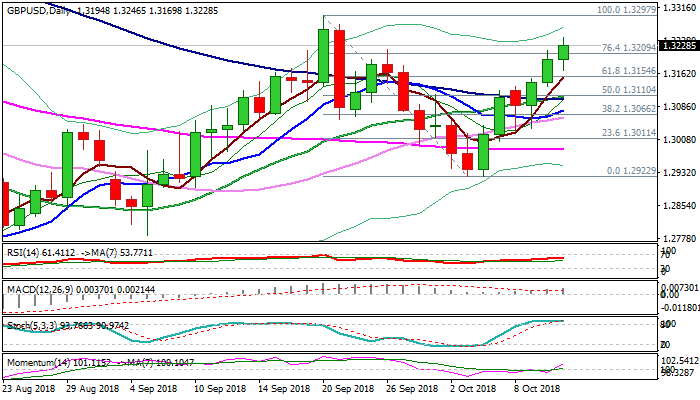
Cable jumped to new three-week high at 1.3246 after US CPI miss on Thursday added to bullish sentiment over Brexit. The pair broke above Fibo barrier at 1.3209 (76.4% of 1.3297/1.2922), opening way towards 1.3300 zone (1.3297 – 20Sep high / round-figure barrier) where strong offers could be expected. Fresh bullish momentum on daily chart underpins, but strongly overbought slow stochastic requires caution. In addition, PM May comes under pressure from parliamentary partner DPU who threatened to withdraw its support in Brexit talks, which would make impossible passing the legislation in the parliament. In addition, former PM Blair said that there is a 50/50 chance of another Brexit referendum if May’s Brexit plan does not pass vote in the parliament. Despite fresh twist in Brexit story, the pound remains firm and driven by weaker dollar and optimistic expectations on final Brexit deal.
Res: 1.3246; 1.3276; 1.3297; 1.3362
Sup: 1.3209; 1.3170; 1.3154; 1.3133
US: Inflation Calm Before the Storm
CPI came in soft in September with headline and core inflation each advancing 0.1%. Nevertheless, inflation pressures are building. With higher oil prices and tariffs, we have raised our outlook for inflation.
CPI Soft, But Not the Start of a Trend
Consumer price inflation came in more tepid than expected, increasing 0.1% in September. Headline inflation was weighed down by a 0.5% drop in energy prices, which largely stemmed from a pullback in costs for electricity and utility gas service. Meanwhile, food costs were flat, as a 0.1% decline in grocery prices was offset by an increase in food away from home.
Core inflation also came in soft in September, printing 0.1% for a second consecutive month. Weakness can be traced to another drop in core goods. A 3.0% reduction in used auto prices led the decline, but with the Manheim used car index increasing in recent months and Hurricanes Florence and Michael likely to generate replacement demand, the pullback should be short-lived. Core services came in at a trend-like 0.24%.
Raising Our Inflation Forecast
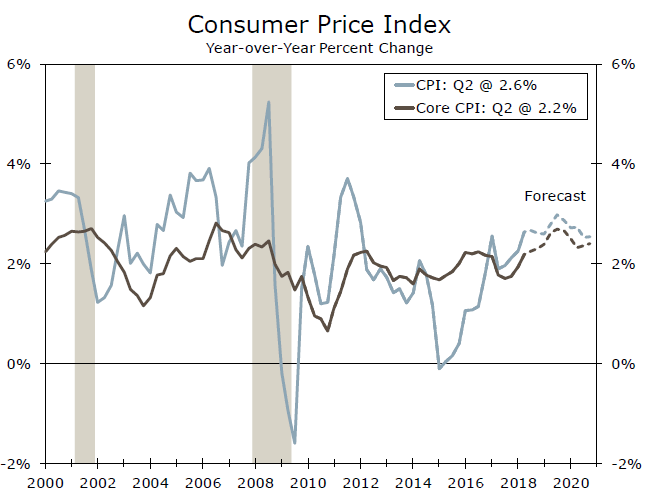
Today's soft readings may temper some concerns about rising price pressures as the economy continues to grow well-above potential. However, we believe inflation will strengthen in the months to come and have upwardly revised our inflation forecast. We look for the Consumer Price Index to rebound to 2.6% year-over-year in the fourth quarter before climbing to 2.8% in 2019 (2.5% previously).
The sources of the lift are two-fold. First, supply/transportation constraints point to higher oil prices through the remainder of this year and into next than we had previously expected. Second, tariffs on U.S. imports have broadened to where we now expect them to have a noticeable impact on the aggregate price level. The initial rounds of tariffs primarily concentrated on intermediate products (e.g., steel and aluminum), but with $200 billion of imports from China now subject to tariffs, finished consumer goods are increasingly in the crosshairs.
Given that many businesses already have price contracts in place or may absorb some of the costs, the impact of tariffs is likely to be drawn out. We expect to see tariffs push up consumer prices in the final months of the year as well as the first few months of 2019. With capacity already tight, some businesses may find it easier to pass on higher input costs to their customers under the guise of tariffs. At the same time, tougher profit comparisons early in 2019 (following the corporate tax cuts) could lead companies to raise prices in order to mitigate a likely slowdown in corporate profits.
While we expect inflation to be stronger in 2019, we have left our fed funds rate call unchanged. We continue to look for the FOMC to raise rates 25 bps per quarter through the third of quarter of 2019. With the lift in inflation stemming from oil and tariffs (which provide a one-time upward level shift in prices), we anticipate the Fed will likely look through the pickup. If, however, inflation expectations break above their ranges of the current expansion, the FOMC's response to higher inflation could change.
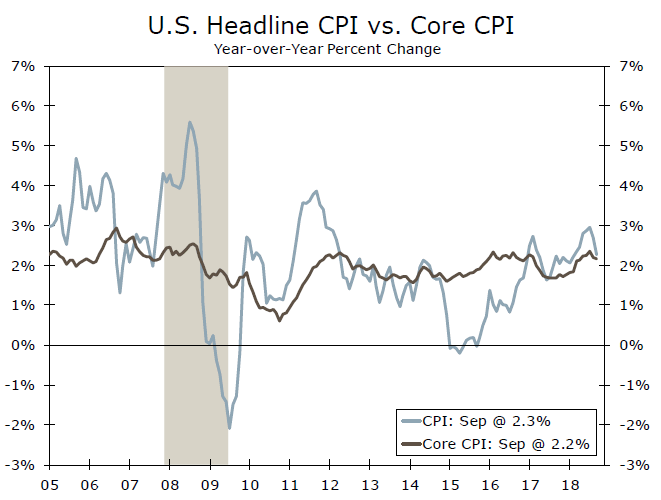
U.S. September CPI Rises Less than Expected
Highlights:
- All items CPI rose a smaller-than-expected 0.1% in September following a 0.2% gain in August.
- With food and energy prices coming in as expected, +0.1% and –0.5%, respectively, the downward surprise was concentrated in a 0.1% gain in core prices which compared to an expected gain of 0.2%.
- The CPI annual increase dropped to 2.3% from 2.7% in August while the core measure held steady at 2.2%.
Our Take:
The September CPI report showed a weaker-than-expected increase of only 0.1% down from the 0.2% increase in August and expectations that today’s report would match the 0.2% gain. Energy prices dropped 0.5% with food and beverage prices rising 0.1%. Those were generally in line with expectations. The downward surprise was concentrated in the core, or ex food and energy, measure which rose 0.1%. That matched August’s monthly gain but was down from the 0.2% expected going into the report. The bounceback in core inflation had been premised on a reversal of some overstated weakness in apparel and medical care services which did occur in the September report. However the recovery in these prices was offset by greater weakness elsewhere led by used car prices plummeting 3.0% in the month.
The modest monthly drop in energy prices was in contrast to an almost 5% monthly increase a year ago. With that sizeable increase dropping out of the year-over-year calculation, the annual increase in inflation dropped to 2.3% in September from August’s rate of 2.7%. The annual increase in core inflation held steady at 2.2% which helped ease concern about the inflationary consequences of an economy operating beyond capacity given the report last week that the September unemployment rate dropped further to 3.7% and thus further away from the Fed’s view of equilibrium unemployment being in a range of 4.3% to 4.6%. Our expectation is that today’s report will not prevent the Fed from tightening further but will keep the pace gradual. Our forecast assumes that the upper end of the Fed’s target range rises from a current 2.25% to 2.50% the end of this year and to 3.50% by the end of 2019.
US: Inflation Pressures Remain Contained in September
Consumer prices were softer than markets had expected in September, both in the headline and the core measures. Headline CPI rose a mild 0.1% on the month, CPI excluding food and energy also rose a modest 0.1%.
The modest gains in September saw headline inflation decelerate on a year-over-year basis to 2.3%. The boost to headline inflation from energy prices has started to wane. Energy prices fell 0.5% in September, and are up 4.8% versus a year ago – a sizeable step down from the 12% pace a couple of months ago. In contrast, food inflation remained quite benign, up only 1.4% year-on-year in September.
The modest monthly gain in core prices left the annual pace of core inflation steady to 2.2%. Core inflation has bounced around between 2.1-2.4% since March.
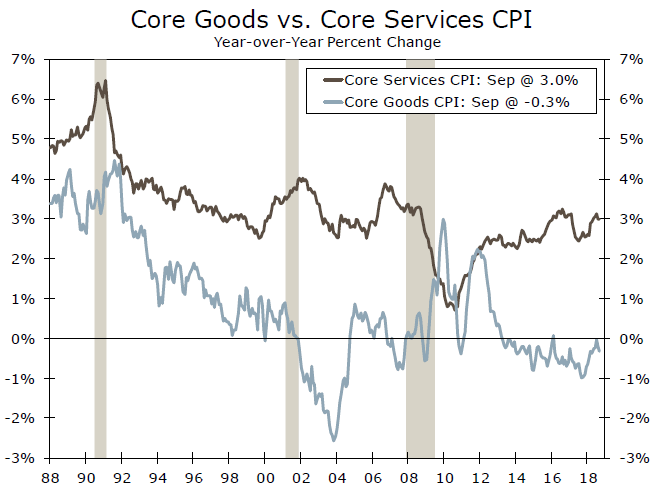
Underneath the hood in core prices, trends remained the same. Core goods prices fell 0.3% on the month. Prices for new (-0.1%) and used (-3.0%) cars and trucks were both notable contributors to the decline in core prices.
Core services prices rose 0.2%, matching August's pace. Price pressures for some key services categories ebbed slightly. For example, the indexes for rent and owners' equivalent rent both rose 0.2% in September, smaller increases than in August. However, services price pressures picked up elsewhere: medical care services (+0.5%), recreation (+0.3%),and airline fares (+1.0%) all saw notable gains.
Key Implications
The September inflation report once again showed that while inflation is simmering away at around a 2% pace, there are few signs that it is starting to boil. Price pressures for core services can best be described as steady. Meanwhile, a strong U.S. dollar and a competitive retail sector are keeping core goods inflation weak. Overall for the third quarter, headline and core inflation came in a tick lower than we had expected in our recent forecast.
We continue to expect inflationary pressures to pick up slightly over the coming quarters. There is little debate that the labor market is tight, and domestic demand is being buoyed by tax cuts and spending. A strong U.S. dollar is helping to keep a lid on price pressures for many imported goods. This well-behaved inflation backdrop supports our expectation for a continued gradual pace of rate increases, with the next move up likely at the December meeting.
Japanese Yen Breaches 112, U.S Consumer Inflation Misses Forecast
After five straight winning sessions, USD/JPY is unchanged on Thursday. In North American trade, the pair is trading at 112.26, down 0.01% on the day. On the release front, Japanese 30-year bonds posted a yield of 0.90%, its highest since February 2017. In the U.S, key indicators disappointed, as CPI and jobless reports missed their estimates. On Friday, the U.S releases a key consumer confidence gauge, UoM Consumer Sentiment.
U.S. consumer inflation numbers were soft in September, as CPI and Core CPI both posted small gains of 0.1%, shy of the estimate of 0.2%. On a year-to-year basis, CPI increased 2.3% in September, down from 2.7% in August. Still, with inflation above the Fed’s 2% inflation target, these readings will not affect the Fed’s plans to raise interest rates in December, which would mark the fourth rate increase this year. The likelihood of a rate hike remains high, with the CME pegging the odds at 76%. On the employment front, unemployment claims climbed to 214 thousand, higher than the estimate of 207 thousand.
As bonds yields continuing to rise, investors have reacted negatively and stock markets continue to spin lower. Risk appetite is considerably lower this week, and nervous investors have snapped up the Japanese yen, a reliable safe haven in times of crisis. The yen has posted five straight winning sessions and has gained 1.9% since Friday. Earlier this week, the IMF released a report in which it lowered its global growth forecasts. The IMF revised its growth forecast downwards to 3.7% for 2018 and 2019, down from 3.9% in April. The IMF took note of the trade war between the U.S and its major trading partners, adding that the downward revisions were most notable in emerging countries such as Turkey and Brazil. However, Japan received a better report card from the IMF, which revised upwards its growth forecast for Japan to 1.1%, compared to 1.0% in April.
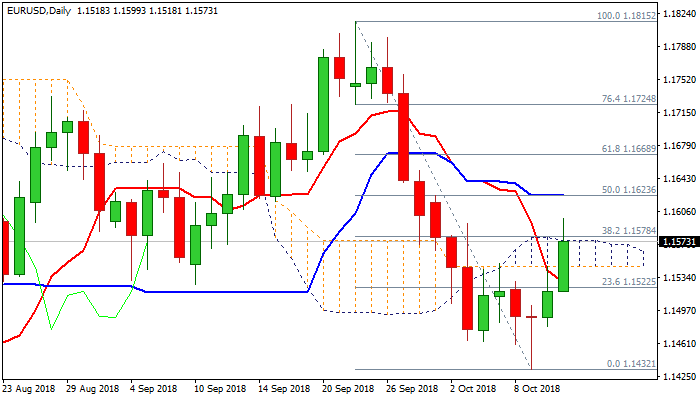
EURUSD Outlook: Euro Jumped on Initial Reaction on US CPI Miss but Daily Cloud is Still Strong Obstacle
The Euro extended higher and broke above pivotal barriers at 1.1574/78 (daily cloud top / Fibo 38.2% of 1.1815/1.1432 descend) as dollar was hit by US CPI miss. US inflation rose less than expected in September and fell below expectations (Sep CPI m/m 0.1% vs 0.2% f/c / y/y 2.3% vs 2.4% f/v and core m/m 0.1% vs 0.2 / core y/y 2.2% vs 2.3% f/c). Despite weaker than expected results, consumer prices remain steady and signal increase in inflation pressure, keeping the Fed on track for gradual rate hikes. Dollar's immediate reaction on weaker than expected data was negative, but markets need to digest results to have clearer picture. Initial positive post-data sentiment exists, however, close above key 1.1574/78 barrier is needed to sustain break above cloud and generate bullish signal for further recovery of 1.1815/1.1432 descend. A cluster of daily MA's (converged 30/20/100SMA's at 1.1616/28 zone), also 50% retracement of 1.1815/1.1432, marks next significant barrier, break of which would confirm reversal. Conversely, failure to sustain break above daily cloud would weaken near-term bulls and keep the downside vulnerable.
Res: 1.1591; 1.1616; 1.1628; 1.1668
Sup: 1.1545; 1.1530; 1.1518; 1.1480
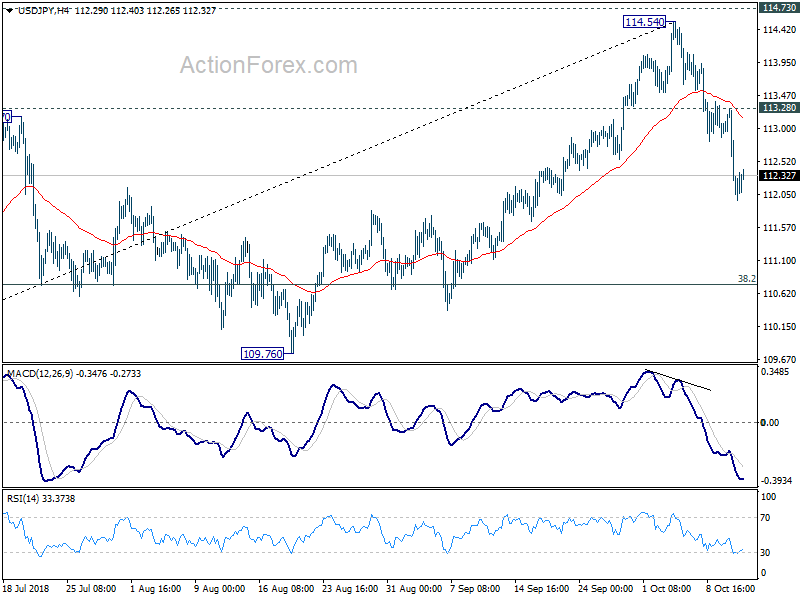
USD/JPY Daily Outlook
Daily Pivots: (S1) 111.92; (P) 112.60; (R1) 112.95; More...
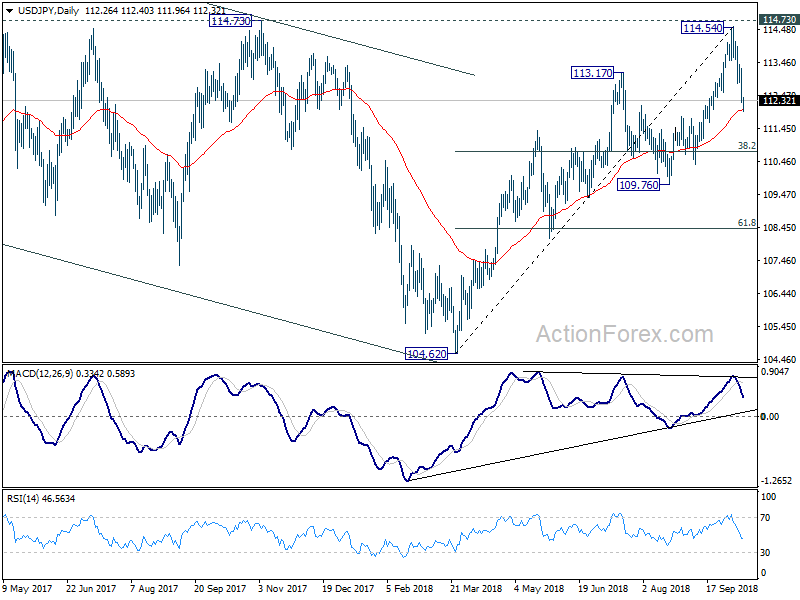
Intraday bias in USD/JPY remains on the downside at this point. Fall from 114.54 could be correcting whole up trend from 104.62, after rejection by 114.73 resistance. Further fall could be seen to 38.2% retracement of 104.62 to 114.54 at 110.75. We'll look for bottoming signal above 109.76 key support. On the upside, break of 113.28 minor resistance is needed to indicate completion of the decline. Otherwise, near term outlook stays mildly bearish even in case of recovery.
In the bigger picture, corrective fall from 118.65 (2016 high) should have completed with three waves down to 104.62. Decisive break of 114.73 resistance will likely resume whole rally from 98.97 (2016 low) to 100% projection of 98.97 to 118.65 from 104.62 at 124.30, which is reasonably close to 125.85 (2015 high). This will stay as the preferred case as long as 109.76 support holds. However, decisive break of 109.76 will dampen this bullish view and turns outlook mixed again.
USD/CHF Mid-Day Outlook
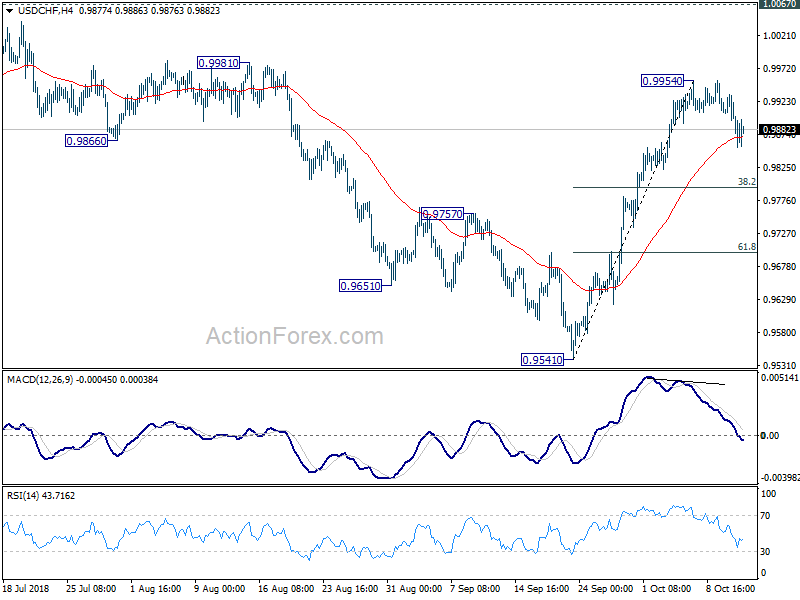
Daily Pivots: (S1) 0.9886; (P) 0.9911; (R1) 0.9925; More...
Intraday bias in USD/CHF is mildly on the downside. Current pull back from 0.9954 could extend to 38.2% retracement of 0.9541 to 0.9954 at 0.9796. But we'd expect strong support from there to bring rebound, and then rise resumption. On the upside, break of 0.9954 will resume the rally from 0.90541 and target 1.0067 resistance next.
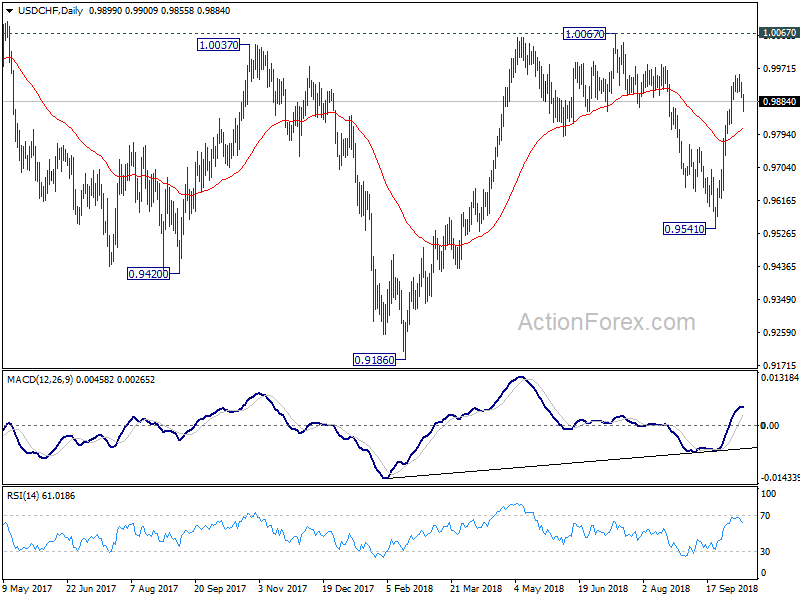
In the bigger picture, the pullback from 1.0067 has completed at 0.9541 already. And rise from 0.9186 is likely resuming. Firm break of 1.0067 will pave the way to retest 1.0342 key resistance. We'd be cautious on strong resistance from there to limit upside to bring another medium term fall to extend long term range trading.
GBP/USD Mid-Day Outlook
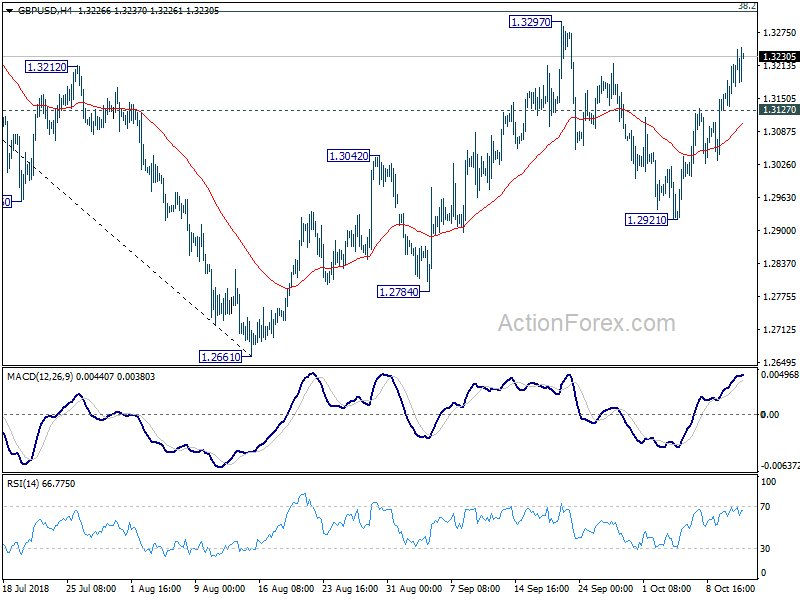
Daily Pivots: (S1) 1.3142; (P) 1.3180; (R1) 1.3228; More...
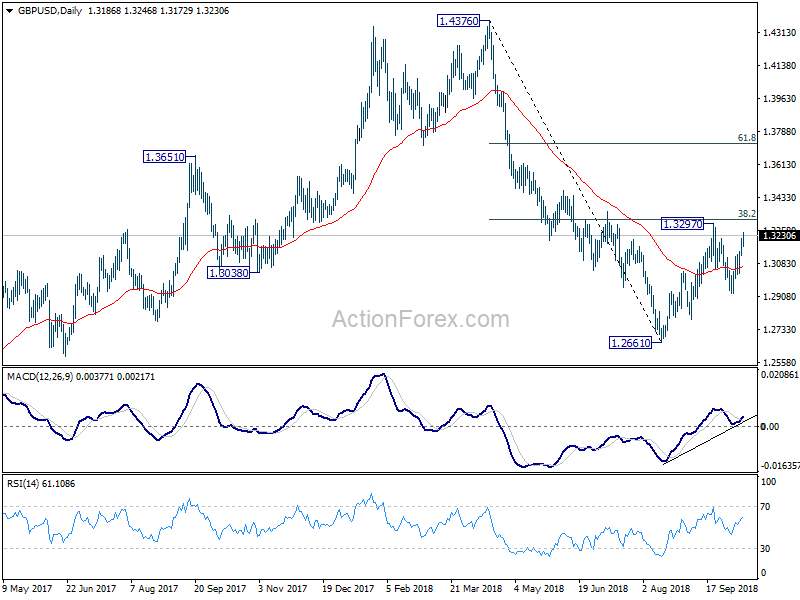
Intraday bias in GBP/USD remains on the upside for 1.3297 resistance. At this point, we'd still expect upside to be limited by 1.3316 key fibonacci level to limit upside to bring down trend resumption eventually. On the downside, below 1.3127 minor support will turn bias back to the downside for 1.2921 first. However, sustained break of 1.3316 would pave the way to next fibonacci level at 1.3721.
In the bigger picture, whole medium term rebound from 1.1946 (2016 low) should have completed at 1.4376 already, after rejection from 55 month EMA (now at 1.4062). The structure and momentum of the fall from 1.4376 argues that it's resuming long term down trend. And this will be the preferred case as long as 38.2% retracement of 1.4376 to 1.2661 at 1.3316 holds. However, firm break of 1.3316 would bring stronger rebound to 61.8% retracement at 1.3721. And, the eventual depth of the fall from 1.4376, and the chance of hitting 1.1946 low, will depend on the strength of the interim corrective rebound from 1.2661.