

Sample Category Title
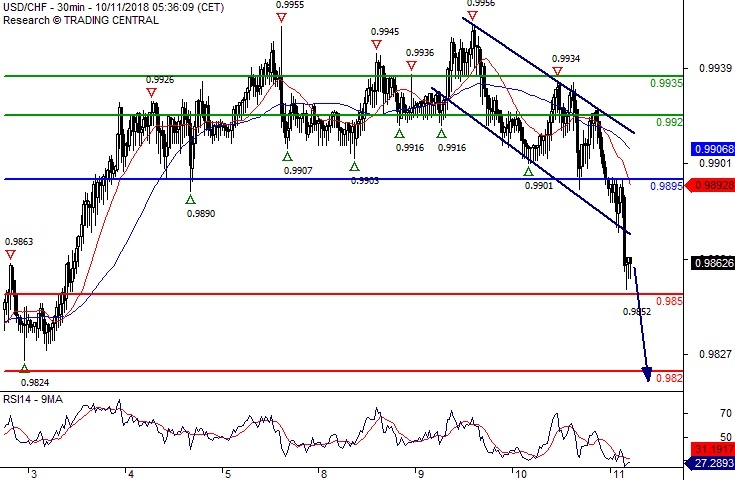
USD/CHF The Downside Prevails
Pivot (invalidation): 0.9895
Our preference Short positions below 0.9895 with targets at 0.9850 & 0.9820 in extension.
Alternative scenario Above 0.9895 look for further upside with 0.9920 & 0.9935 as targets.
Comment The RSI has broken down its 30 level.
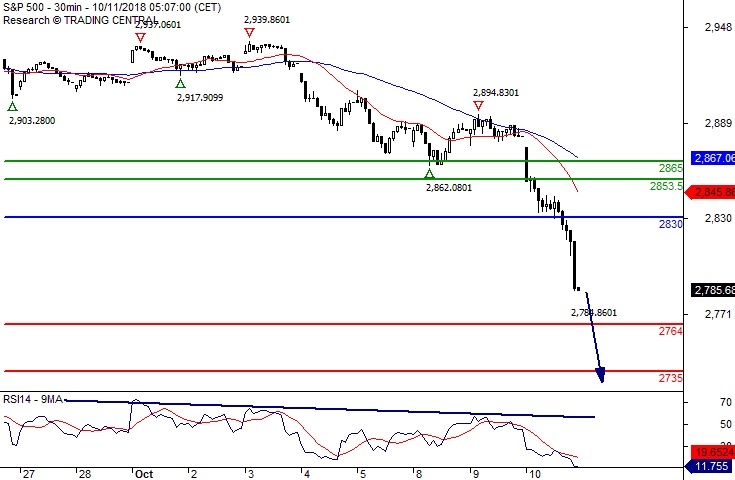
S&P 500 The Downside Prevails
Pivot (invalidation): 2830.00
Our preference Short positions below 2830.00 with targets at 2764.00 & 2735.00 in extension.
Alternative scenario Above 2830.00 look for further upside with 2853.50 & 2865.00 as targets.
Comment The RSI is capped by a bearish trend line.
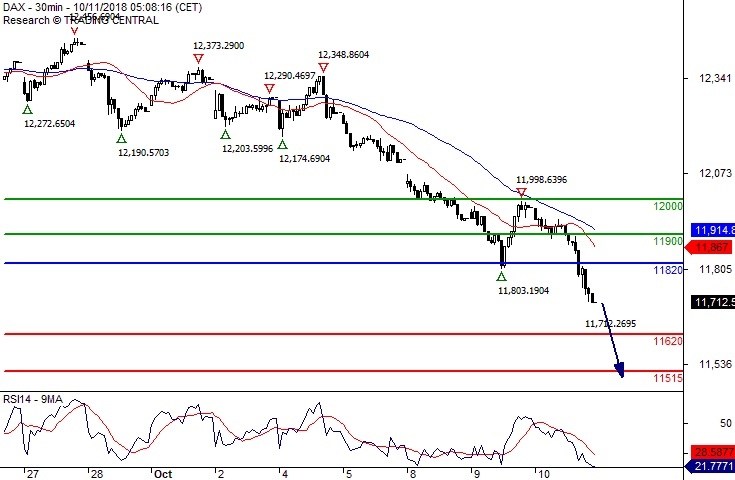
DAX The Downside Prevails
Pivot (invalidation): 11820.00
Our preference Short positions below 11820.00 with targets at 11620.00 & 11515.00 in extension.
Alternative scenario Above 11820.00 look for further upside with 11900.00 & 12000.00 as targets.
Comment The break below the support at 11820.00 triggered a downward acceleration to 11515.00.
Crude Oil The Downside Prevails
Pivot (invalidation): 72.75
Our preference Short positions below 72.75 with targets at 71.25 & 70.65 in extension.
Alternative scenario Above 72.75 look for further upside with 73.60 & 74.20 as targets.
Comment The RSI has broken down its 30 level.
Silver Spot Further Upside
Pivot (invalidation): 14.2200
Our preference Long positions above 14.2200 with targets at 14.4200 & 14.4900 in extension.
Alternative scenario Below 14.2200 look for further downside with 14.1500 & 14.0500 as targets.
Comment The RSI is supported by a rising trend line.
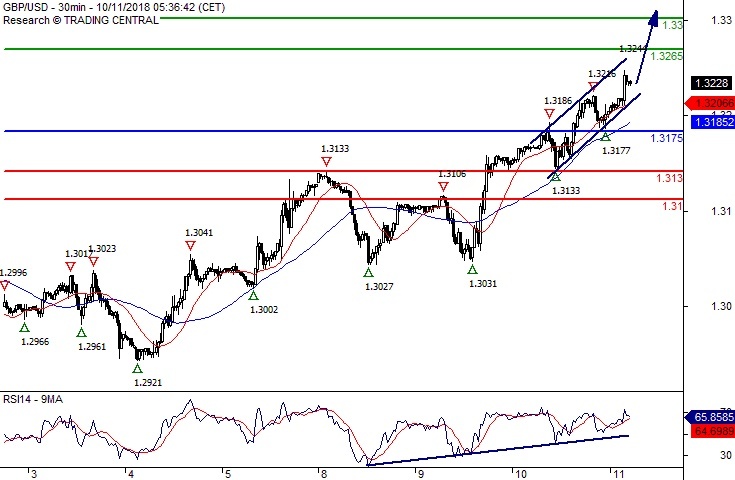
Gold Spot Further Upside
Pivot (invalidation): 1190.00
Our preference Long positions above 1190.00 with targets at 1197.00 & 1200.00 in extension.
Alternative scenario Below 1190.00 look for further downside with 1186.00 & 1183.00 as targets.
Comment The RSI is mixed to bullish.
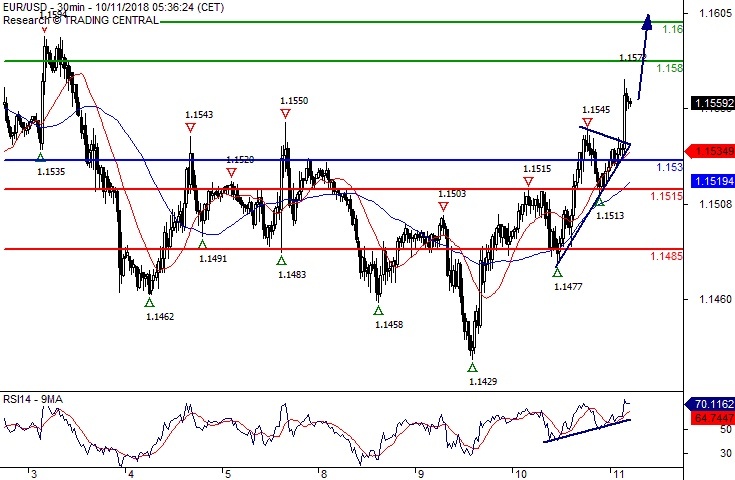
GBPUSD Outlook: Bulls Eye Key 1.3297 Barrier But Consolidation Could Precede
Cable extended above 1.3200/09 barriers (round-figure / Fibo 76.4% of 1.3297/1.2922 descend) and hit new high at 1.3244 (the highest since 21 Sep) on Thursday.
Weaker dollar and bullish sentiment on positive Brexit news, added to bullish outlook, as firm break above 1.32 handle would open way for full retracement of 1.3297/1.2922 bear-leg.
Meanwhile, quick pullback from 1.3244 suggests that bulls may enter consolidative phase before continuing.
Overbought slow stochastic and some dissonant tones about Brexit from media and some politicians, support the notion.
Broken Fibo 61.8% barrier at 1.3154 now acts as solid support which should ideally hold dips and keep bulls intact.
Focus turns towards US CPI data, due later today, which could provide fresh direction signals.
Res: 1.3209, 1.3244, 1.3276, 1.3297
Sup: 1.3170, 1.3154, 1.3133, 1.3106
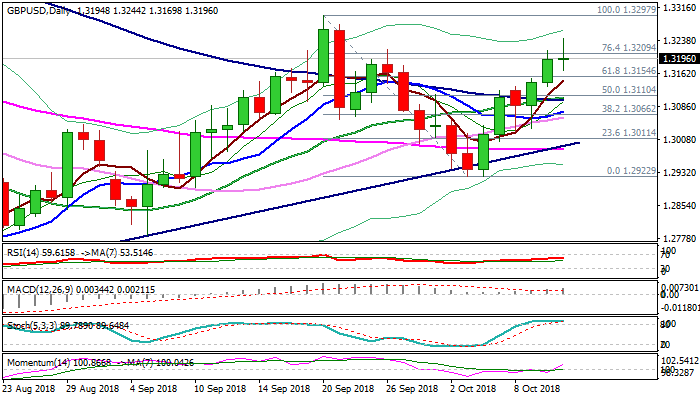
EURUSD Outlook: Risk Of Recovery Stall Would Increase On Failure To Clearly Break Above Daily Cloud
The Euro continues to benefit from weaker dollar, pressured by fall of US stocks which had the worst performance in almost eight months.
Extension of recovery from Tuesday’s spike low at 1.1432 penetrated daily cloud and dented cloud top (1.1572), but without break higher so far.
Key barriers lay at 1.1572 (cloud top) and 1.1578 (Fibo 38.2% of 1.1815/1.1432 fall) and sustained break here is needed to complete reversal pattern on daily chart and signal stronger recovery towards 55SMA (1.1590) and converged 20/30SMA’s (1.1616).
Break above 10SMA (1.1526), north-heading slow stochastic and momentum turning up, are supportive factors, with Tuesday’s long-tailed Doji, which signaled strong downside rejection, underpinning the action.
However, fresh bulls are for now lacking strength for final break higher, which could be seen as initial warning of recovery stall and supporting selling upticks scenario, as concerns over Italian budget persist and keep the single currency under pressure
Repeated close below daily cloud base would add to negative outlook and keep near-term risk skewed lower.
Res: 1.1572, 1.1578, 1.1590, 1.1616
Sup: 1.1526, 1.1512, 1.1480, 1.1463
Trump Comes Out Swinging At The Fed As Markets Tumble
Bloodbath in Markets as Trump Points Finger at the Fed
European stocks are set to become the latest casualty in the global sell-off that has rattled markets over the last 24 hours, as investors worry about the potential for a sharper correction on the back of rising bond yields.
It's been something of a bloodbath overnight, as investors saw what occurred in the US – despite there being no clear catalyst for such a move - and dashed for the exits as fears grow that global risks are mounting and the bill is coming due. While people are naturally pointing to the bond market to explain the sudden panic – most notably Trump who's been laying the groundwork for blaming the Fed for the last couple of months – I wonder whether the underlying risk in the markets for some time has left market primed for a correction and investors have simply fled at the first sign of danger.
Trump was extremely quick to point the finger of blame at the central bank for raising rates too quickly, but as the CPI data is expected to show today, inflation is running above target despite its actions and the absence of more rate hikes could accelerate that. As is to be expected, Trump is not going to want to accept any responsibility himself for huge tax reforms that provided significant stimulus in an already hot economy, forcing the Fed to hike faster than they may have wanted, or for creating risk in the markets by starting a trade war with China, but that is what is playing out here.
There is the potential for this to be nothing more than a brief shock that markets quickly recover from but the proximity to the mid-term elections in the US could make it problematic for Trump if it turns into more. That more than likely explains why Trump has been laying the groundwork in recent months, in preparation for such a scenario so the seed of blame has already been planted, enabling him to quickly come out on the attack as he has.
Oil traders lock in profits as sell-off takes hold
It's not just equities that have suffered the wrath of the bond sell-off, oil bulls also appear to have been run over in the process, with Brent and WTI falling a few percent on Wednesday and extending those losses today. Oil has been scaling long-term highs in recent months and attracting a lot of attention as the US sanctions on Iran prepare to come into effect.
The sell-off on Wednesday and today has prompted some profit taking in oil markets, which should prove temporary as long as the broader sell-off doesn't worsen too dramatically. It will be interesting to see how quickly traders look at the sell-off in oil and seize the opportunity to buy the dips in an asset that was widely seen as being very bullish only a week ago. Of course, if the recent selling is a sign of more worrying weeks and months to come then you would expect oil prices to suffer as well, particularly if the selling is preceding an anticipated slowdown in the global economy which naturally affects demand.
Bitcoin status as "gold 2.0" falters as cryptos caught up in selling
The sell-off also appears to have stretched to more exotic instruments, with bitcoin neither displaying the qualities one would expect of gold 2.0, as it has been touted as by some cryptocurrency enthusiasts, or simply escaping relatively unscathed as a new and relatively uncorrelated asset. This truly is a widespread sell-off and anything perceived as a risky asset has been in the firing line. What will be interesting is whether this will be enough to force bitcoin below $6,000 which has proven to be something of a floor for the crypto on numerous occasions this year.
Stocks Crash As Risk Aversion Reigns, US CPI And ECB Minutes Eyed
Here are the latest developments in global markets:
FOREX: The dollar index was down by almost 0.2% against a basket of six major currencies on Thursday, extending losses from the previous session. The yen was the best performer, advancing against all its major peers as risk aversion took hold, amid sustained worries around the trade outlook and elevated bond yields. Meanwhile, commodity currencies were hammered lower in this environment, with the loonie being caught in the eye of the storm as oil prices tumbled as well.
STOCKS: US markets fell off the cliff on Wednesday, with the benchmark S&P 500 (-3.29%) posting its biggest daily drop since February, and the Dow Jones (-3.15%) falling more than 800 points. Weakness was most evident in the technology sector though, where valuations were the most stretched. The tech-heavy Nasdaq Composite (-4.08%) underperformed amid declines in names like Google-parent Alphabet (-4.63%), Netflix (-8.38%), and Amazon (-6.15%). Futures tracking the Dow, S&P, and Nasdaq 100 are all flashing red, pointing to a negative open today as well. Asia was also a sea of red on Thursday, with Japan’s Nikkei 225 (-3.89%) and Topix (-3.52%) plunging amid a stronger yen, while the Hang Seng in Hong Kong dropped by 3.88%. Likewise, European indices are all set to open significantly lower today, futures suggest.
COMMODITIES: Oil fell on Wednesday alongside energy stocks and the broader market, as risk aversion sapped demand for the precious liquid. WTI fell more than $2 yesterday, and both WTI and Brent are trading lower today as well, at $72.63 and $82.41 per barrel respectively. That said, concerns on the supply side likely limited any greater losses, as Hurricane Michael hit Florida, severely disrupting oil production in the US Gulf of Mexico. In precious metals, gold is down marginally on Thursday (-0.08%) at $1,196 per ounce, continuing to trade sideways and remaining uncharacteristically immune to the broader turbulence in financial markets.
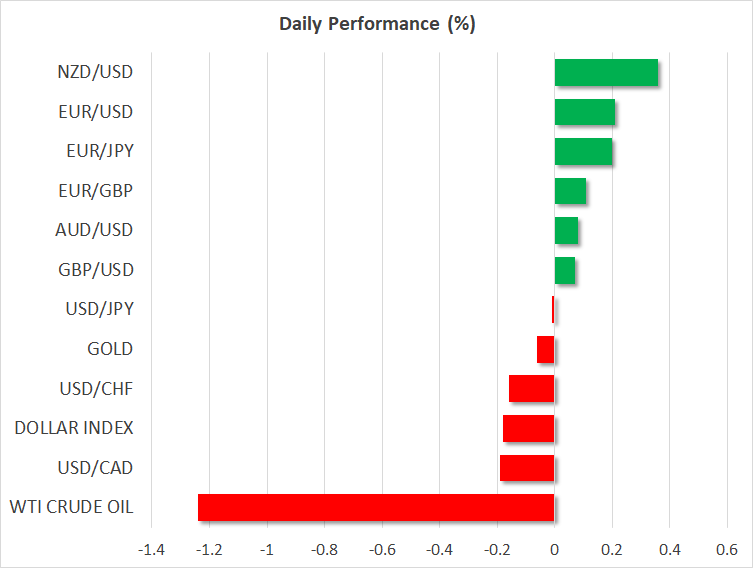
Major movers: Stock selloff turns into bloodbath as risk-off tones dominate
US stock markets came under severe selling pressure on Wednesday, with the benchmark S&P 500 plunging by 3.29%, wiping out several months’ worth of gains in a single session. There was no clear fundamental catalyst to trigger the selloff. It was instead attributed to the 'usual suspects', namely the elevated US bond yields and growing concerns around the impact of a trade war between the world’s two largest superpowers.
In the FX market, currencies moved largely as one would expect amid the risk-averse environment. The Japanese yen, which tends to benefit at times of uncertainty, advanced across the board as investors turned towards defensive assets. Meanwhile, commodity currencies such as the loonie and aussie, both of which are typically correlated with risk sentiment, plunged – with the loonie’s suffering being amplified by a drop in oil prices. As for the dollar, it generally lost some ground as US bond yields pulled back, though the decline was far from dramatic.
President Trump was on the wires following the market selloff, blaming the turbulence entirely on the Fed raising rates too much, saying 'I think the Fed has gone crazy'. He added he 'really disagrees' with hiking rates further, and that they are 'so tight' already. While the Fed and most notably Chair Powell have clearly shown they won’t be swayed by such remarks, it is most interesting that the White House pays this much attention to daily moves in markets. It leads one to question whether a sustained selloff would elicit a policy response directly from Trump aimed at propping up markets, or at least supporting sentiment. In other words, does the US administration measure its success by stock market performance, and if so, is a 'Trump put' on the cards if the picture truly deteriorates?
Turning back to the FX market, today’s moves could largely hinge on the US inflation data. A potential acceleration in inflation could drive US bond yields even higher, enhancing risk aversion and weighing on stocks. Hence, the risks surrounding dollar/yen specifically, may be tilted to the downside today. A weak CPI print would push the pair lower on dollar-weakness, and although a strong figure would drive it higher, that strength may well fade once stocks sell off and the yen starts attracting demand.
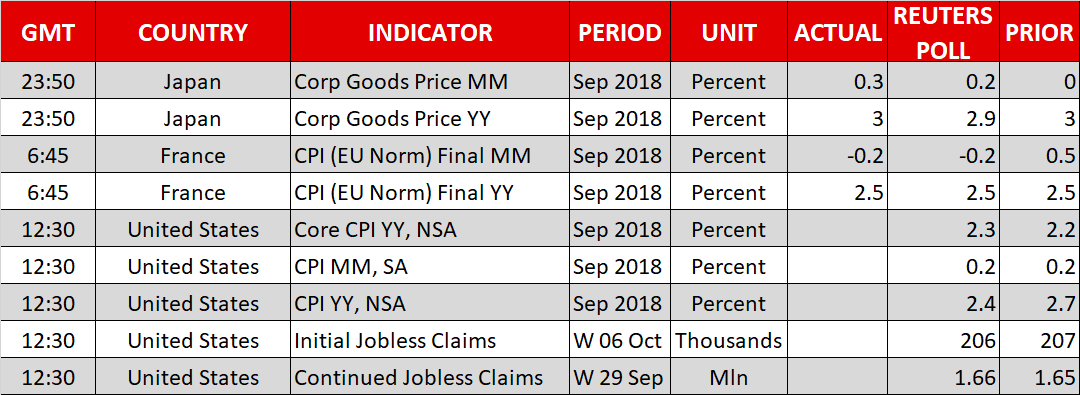
Day ahead: US inflation data in the spotlight; ECB minutes also out
The highlight out of Thursday’s calendar will be US inflation data as gauged by the consumer price index (CPI) due at 1230 GMT, while ECB minutes pertaining to its September meeting will also be made public today. Other themes remaining in the background are Brexit, Italian politics, as well as trade and yield angst that acted as a major drag on US equities during Wednesday’s session.
US headline CPI for September is anticipated to grow by 0.2% on a monthly basis, the same as in August, which would put the annual rate of growth in the measure at 2.4%, matching its lowest since March. Still, this would keep the print at relatively elevated levels. Overall and adding to this the projected rise in core CPI to 2.3% y/y from 2.2%, the annual slowdown in headline CPI is unlikely to be seen as threatening the Federal Reserve’s rate outlook. Core inflation is the reading that excludes volatile food and energy items from its calculations.
Despite the Fed’s preferred indicator of price pressures being the core PCE price index, still consumer price inflation is also closely watched. A beat in the figures is likely to be met with rising odds for a fourth 25bps rate rise in 2018 (73% priced in according to Fed fund futures), which is dollar-supportive in theory. In light of yesterday’s stock rout, it bears mention that stronger-than-projected CPI readings resulting in elevated Treasury yields may trigger another selloff in equities, which could divert funds into the safe-haven yen, thus proving greenback-negative in this particular pair. Lastly, US weekly jobless claims data are also out at 1230 GMT.
On Brexit, the EU’s chief negotiator Barnier saying 80-85% of the withdrawal deal was agreed was sterling-positive. More evidence that the UK and the EU are getting closer to sealing an actual deal is expected to be met with additional long sterling positions by market participants.
Despite the euro recovering somewhat from its lowest in around two months of 1.1429 hit on Tuesday, worries over Italy and a possible clash with EU officials over its spending plans may soon haunt the currency again. Possibly providing some short-term direction to the currency today will be ECB minutes pertaining to the Bank’s latest meeting due at 1130 GMT. ECB chief Draghi recently describing the pick-up in underlying inflation as 'relatively vigorous' led to a jump in the common currency. Any signs of policymakers overall becoming more confident about the euro area’s inflation outlook are expected to support the euro.
Bank of England policymaker Vlieghe will be talking on 'Global and domestic challenges for UK monetary policy' at 1045 GMT. Elsewhere, ECB President Draghi and Board Member Coeure will be among those attending the IMF and World Bank’s annual meetings.
In equities, Delta Airlines will be among companies releasing quarterly earnings today; the corporation will be reporting its results before the opening bell on Wall Street. Beyond earnings, fears over worsening Sino-US trade relationships and rising yields are still in place, though yesterday’s selloff may also provide a 'buy-the-dip' opportunity.
In energy markets, EIA data on US crude stocks are due at 1500 GMT. An inventory buildup of around 2.6 million barrels is forecast for the week ending October 5, following a rise by around 8.0m during the previously tracked week.
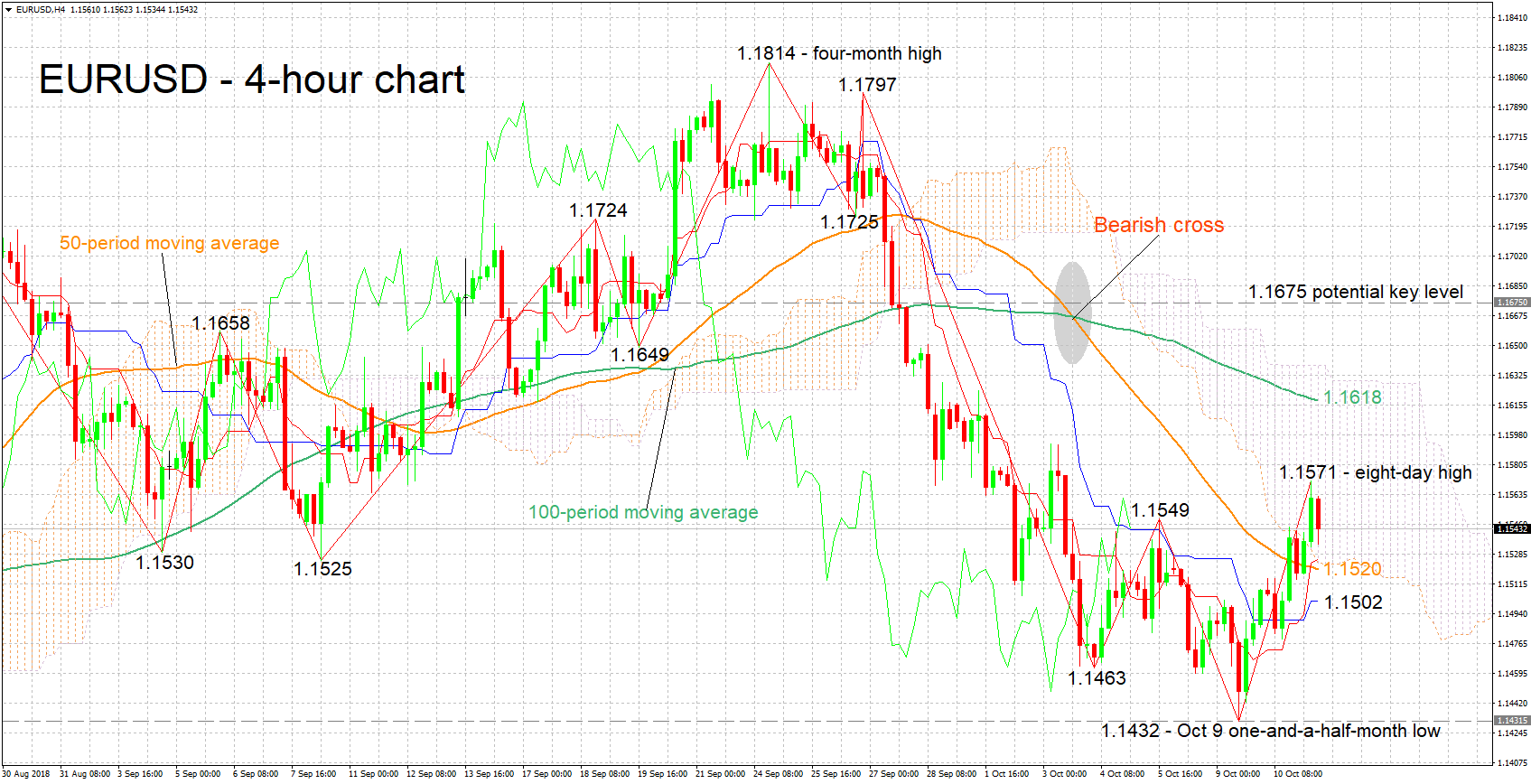
Technical Analysis: EURUSD hit 8-day high in sign momentum turned positive
EURUSD touched an eight-day high of 1.1571 earlier on Thursday, extending its recovery from Tuesday’s one-and-a-half-month low of 1.1432. The Tenkan-sen climbed above the Kijun-sen, suggesting that the bias in the short-term has turned positive.
A relatively hawkish ECB as evidenced by today’s meeting minutes or disappointing US CPI numbers are likely to boost the pair. Immediate resistance may occur around the earlier hit high of 1.1571. The area around the current level of the 100-period moving average at 1.1618 that also includes the Ichimoku cloud top at 1.1639 would be eyed in case of stronger bullish movement. Higher, the previously congested region around 1.1675 would come into focus.
On the downside and in case of a dovish ECB or stronger-than-projected inflation numbers out of the US, support may come around the 50-period MA at 1.1520; the Tenkan-sen and Ichimoku cloud bottom roughly coincide with this point, while the Kijun-sen lies not far below at 1.1502. Lower still, October 9’s one-and-a-half-month low of 1.1432 would increasingly come into scope.
Developments in Italy can also move the pair.