Sample Category Title
British Pound Punches Past 1.30 as Greenback Softens
GBP/USD has posted strong gains on Thursday, recovering from losses earlier in the week. In the North American session, the pair is trading at 1.3030, up 0.70% on the day. On the release front, there are no major British events. In the U.S, unemployment claims dropped to 207 thousand, better than the estimate of 214 thousand. On Friday, the focus will be on employment data, as the U.S releases wage growth and official nonfarm payrolls.
Prime Minister May has been fighting off domestic and external adversaries for weeks, so a well-received major speech may have saved her job at 10 Downing Street, at least for now. May addressed an enthusiastic crowd at the Conservative party conference on Wednesday, declaring that she very much wanted a Brexit deal with Europe, but not at any price. May has been unsuccessful in trying to sell her “Chequers” proposal to the EU, and many Conservative party members feel her proposal leaves Brussels in charge of much of Britain’s economic policy. With a March 2019 deadline for Brexit, major gaps remain between the UK and the EU, such as what kind of border arrangements will be put in place between Northern Ireland and Ireland. Europeans leaders such as French President Emmanuel Macron have openly said that Britain must pay a price to leave the club, and there is growing concern that the two sides will be unable to reach an agreement before the March deadline. Such a scenario would be a nightmare for British businesses and could send the pound into a tailspin.
U.S job numbers continue to look sharp, reflective of a red-hot labor market. Unemployment claims dropped from 214 thousand to 207 thousand. This release comes on the heels of ADP nonfarm payrolls, which jumped 230 thousand in September. This marked the strongest increase in private sector jobs since March. Can the labor market keep up its dizzying pace? We could see some soft numbers as early as Friday, based on markets forecasts. Wage growth is expected to drop from 0.4% to 0.3%, while nonfarm payrolls is forecast to fall from 201 thousand to 185 thousand. Traders should be prepared for some movement in the currency markets during Friday’s North American session.
Forex Trading Accounts: What Account to Choose
For effective and profitable trading, it is important to choose the right type of a trading account. The choice depends on the knowledge level of a trader, the preferred style of trading, the amount of capital and the risk level that the investor is ready to assume.
Trading accounts are divided into several types: demo, standard or classic, cent, ECN, swap-free.
Demo
Perhaps, this is the first account the trader gets acquainted with entering the Forex market. Demo accounts are a complete prototype of real accounts, the only difference is virtual money. Features of a demo account:
- it is absolutely free, to open such an account you do not need to deposit it with real money;
- trading is carried out on virtual means, therefore there is no risk of losing real money;
- as usual, there are no limits on time and quantity;
- execution speed and trading conditions on demo accounts are the same as on real ones.
To start trading on the forex demo account with JustForex it is enough to download the MetaTrader 4 trading terminal and to fill in the form on the site. Demo accounts can be opened in any required quantity. The demo account is a good solution for testing trading conditions and choosing the optimal account type.
Not only beginners trade on demo accounts, but also seasoned traders. They usually return to the demo trading to test new trading strategies, tactics and Forex advisors.
Cent
Having acquired the necessary trading skills, you can switch to real accounts. But do not rush to invest large amounts, start with cent accounts. This type of account refers to the real one, although all operations are conducted in cents. The cent account allows trading in the Forex market with minimal costs. Also, you can learn to manage your finances.
Such accounts forex brokers offer customers are very convenient, as you can deposit it with $10, and see 1000 cents on the balance. Beginners get the opportunity to trade with real money, that means that losses and profit are perceived as real ones.
Standard or Classic
The most common type of the real account with classic trading conditions. The standard account can be called the most universal. Features of such accounts are:
- high leverage
- no commissions
- wide range of trading instruments
The standard account is appropriate for newbies and experienced traders, which are aimed at medium-term and long-term trading strategies and do not have large deposits. Standard accounts are opened by traders who prefer trend trading strategies. However, it is not worth using scalping or news trading.
ECN
The ECN account is intended for those traders who trade within a day, opening short-term transactions.
A distinctive feature and the main advantage of these accounts is the absence of intermediaries, as trading is conducted through an electronic system that directly connects the trader with liquidity providers. Brokers, in turn, do not interfere in the trading process.
- Low spreads – spread ranges from 0-0.5. If a trader opens a large number of transactions, low spreads help significantly reduce the costs of trading.
- Market Depth – here you can find information about orders of a certain instrument. The trader can more accurately analyze the current situation on the market.
- Fast execution of orders – orders to buy/sell are executed in a split second.
JustForex offers low spreads from 0 pips. You can view the current values of spreads on ECN accounts in real time on the broker website.
This type of account gives the trader the most accurate execution of orders, a good difference in the spread and a high liquidity.
Swap-free
Swap-free account does not have a commission for transferring open trading positions through the night. Such accounts are often called Islamic. These types of accounts are considered Islamic, since Sharia law prohibits working with accounts where swap is calculated. Due to this Islamic accounts were created.
These are the main types of accounts used for trading on Forex. Each type of an account has its own features. To choose the account, you first need to get acquainted with the basic parameters: range of instruments, spreads, the amount of commission, execution method. Explore the characteristics of each type of the account and make a choice in favor of the most suitable for you.
Tusk: EU offered UK a Canada plus plus plus deal
European Council President Donald Tusk reiterated today that the EU wants a post-Brexit relationship with UK that is "as close and special as possible". And he added "From the very beginning, the EU offer has been not just a Canada deal, but a Canada plus plus plus deal. Much further-reaching on trade, on internal security and on foreign policy cooperation."
But at the same time he also dismissed UK rejection of EU's proposal of keeping Northern Ireland inside EU economic rules. Tusk said "Emotional arguments that stress the issue of dignity sound attractive but they do not facilitate agreement. Every actor in this process has their dignity and confrontation in this field will not lead to anything good." And, "No one can expect that because of Brexit, the EU will give up its fundamental values and key interests."
He urged UK Prime Minister Theresa May to "get down to business" after having concluded the Conservative Party conference.
US 500 Index Flirts With All-Time Highs, But RSI Signaling Pullback
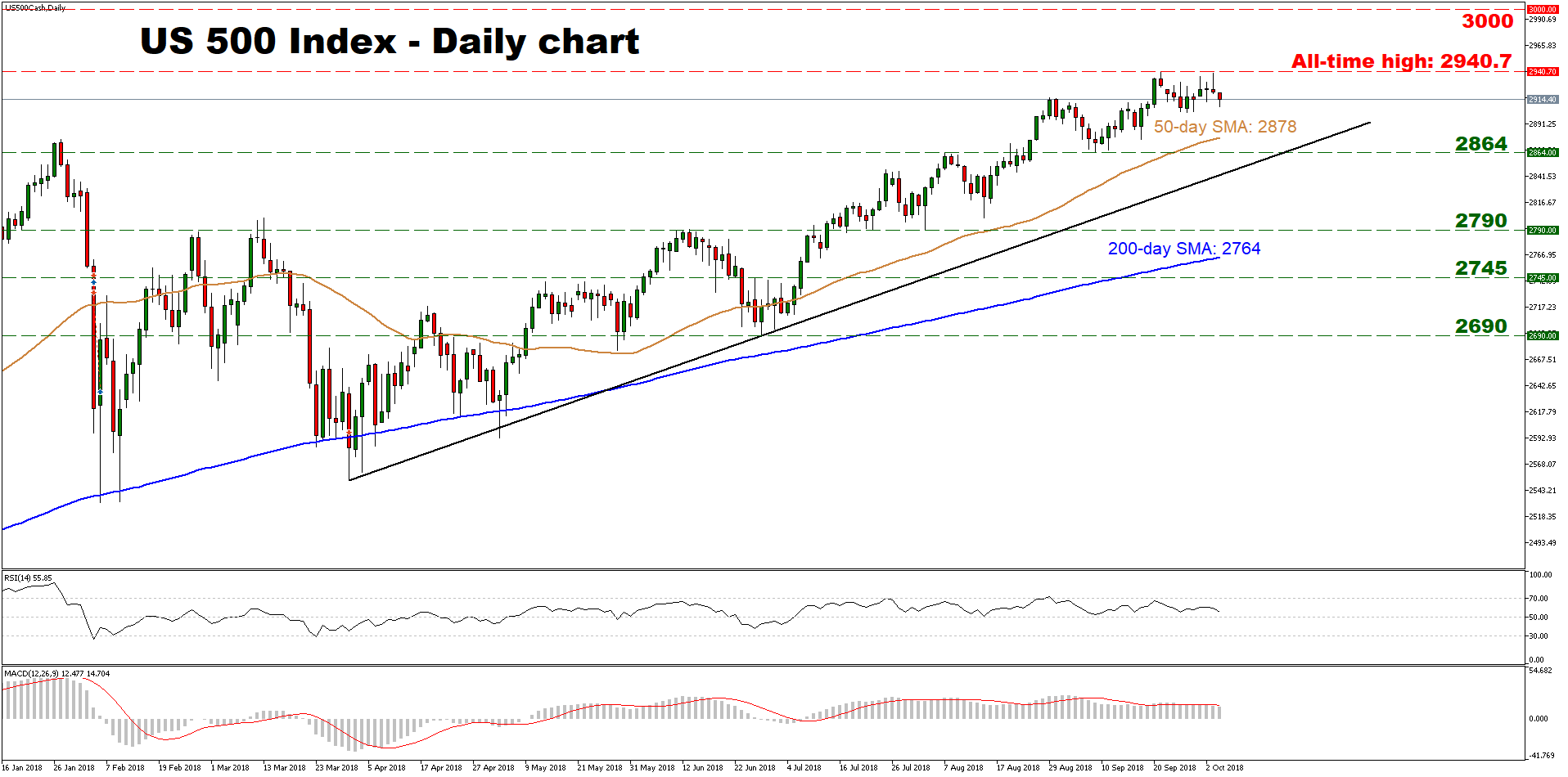
The US 500 index posted considerable gains in recent weeks, trading above a medium-term uptrend line drawn from the lows of April 2, as well as above the 50- and 200-day simple moving averages (SMAs), signaling that the outlook remains positive. The index touched a fresh all-time high of 2940.7 on September 21, and came within breathing distance of that level again on October 3, before pulling back somewhat.
Although the overall picture is still bullish, momentum oscillators suggest that a near-term correction may be on the cards. The RSI – although still above 50 – looks to have topped and is now pointing downwards, signaling that upside momentum is losing steam. Meanwhile the MACD, while safely in positive territory, looks unable to pierce above its red trigger line.
A correction lower in the index could encounter an initial line of support near the crossroads of the aforementioned uptrend line and the 2864 hurdle, marked by the lows of September 7. A drop below this trendline would shift the bullish outlook to a neutral one, potentially opening the way for a test of 2790, the August 2 trough. Even steeper declines would bring into view the 2745 zone, identified by the inside swing high on June 29.
On the flipside, if the bulls stay in control, further advances could stall around the all-time record of 2940.7. A break higher would bring the price into uncharted waters, with the next major resistance barrier likely to be the 3000 handle, which may hold some psychological significance. Similarly, further upside moves could meet barriers at other round figures, such as 3100 and 3200.
Overall, the medium-term outlook remains bullish, though a near-term correction is not to be ruled out.
Elliott Wave Analysis: AUDUSD Eyeing 0.7000/0.6948 Area
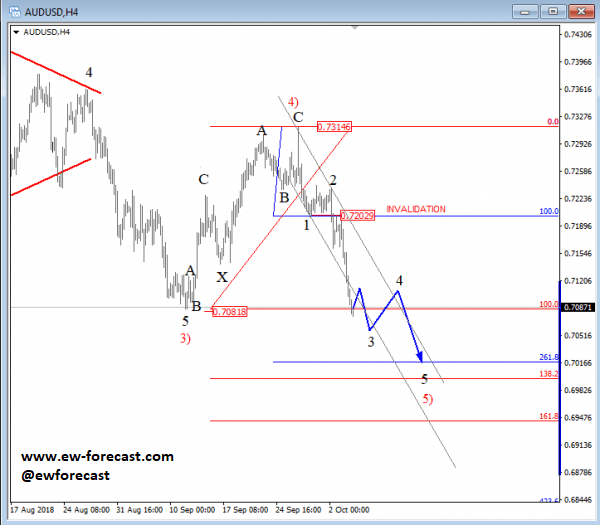
AUDUSD made a recent corrective retracement from the 0.7082 level which we labelled as corrective wave 4) as part of a downtrend. The following decline from the swing high of 0.7315 level, where corrective wave 4) had ended can be observed as wave 5), final leg of a bearish cycle which can extend its drop towards the 0.7000/0.6948 region.
AUDUSD, 4h
Amid Sluggish Growth and Italy Woes, Will the Euro Ever Resume its Uptrend?
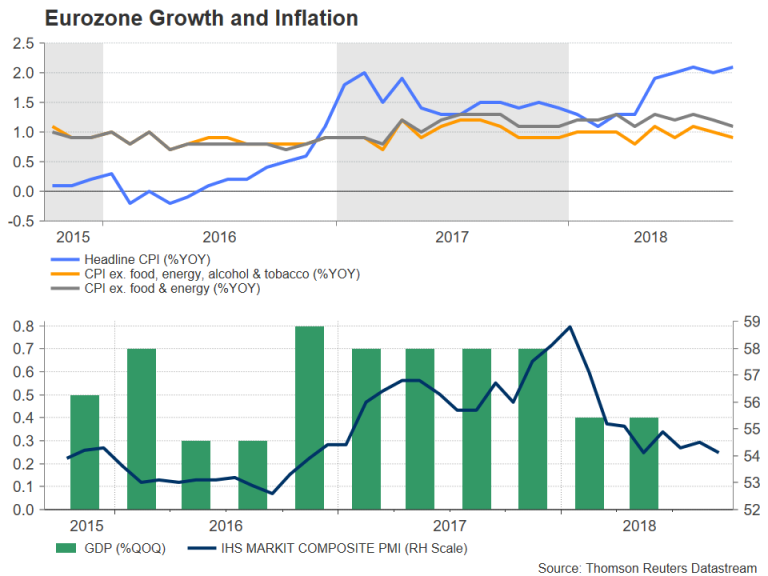
The euro has retreated by about 8% from its three-year peak scaled back in February when it briefly touched $1.2555. At the time, the outlook for the Eurozone economy was looking increasingly positive and political uncertainty appeared to be receding. However, since the spring, economic indicators out of the Eurozone have consistently fallen short of expectations, whereas in the US, they’ve gone from strength to strength. With Eurozone growth struggling to regain momentum and the added risks from global trade tensions and political troubles in Italy, the euro’s recovery is becoming worryingly elusive.
After churning out growth of 0.7% quarter-on-quarter throughout 2017, the pace of economic expansion has almost halved in the first half of 2018 to 0.4%. The slowdown was initially thought to be temporary, but the region’s PMI indicators, which accurately track GDP growth, suggest a rebound is no nearer. Progress on the inflation front has been more evident, at least in the headline rate, which has returned to around 2%, slightly above the ECB’s target of close but below 2%. However, despite some recent hawkish remarks by ECB President Mario Draghi on the underlying price trend, core measures of inflation have been mostly flat over the past year around 1%.
Nevertheless, the European Central Bank is moving ahead with its plans to unwind its asset purchase program be the year-end, with the first rate rise expected to be delivered in the autumn of 2019. The ECB’s long-awaited decision to end its bond buying program was itself negative on the euro as Draghi set out a much more dovish path to normalize policy than the markets had been anticipating.
More recently, the threat of US tariffs on European car imports – which has not completely dissipated as the United States and the European Union have only held preparatory talks on trade so far – and concerns about the effects on global growth from the US-China trade dispute have dampened business confidence in the euro area, particularly in export-dependent Germany.
Adding to the somewhat gloomier outlook for Eurozone businesses is fresh political turmoil in Italy. There was relief at the beginning of May when two of Italy’s populist parties reached a deal to form a coalition government, averting a snap election and further uncertainty. It followed a similar breakthrough in March for Germany’s Angela Merkel when she secured a grand coalition deal to keep her in power and ended months of deadlock.
But as is common in Europe, there’s always a new political or economic headache waiting around the corner and there is a threat that the latest stand-off between Italy and the EU could escalate into a much bigger crisis. While few think that Italy would quit the euro bloc should the European Commission not approve the coalition’s budget deficit plans for 2019-2021, prolonged wrangling between Italy’s outspoken leaders and EU officials could upset the markets further and drive Italian government bond yields even higher.
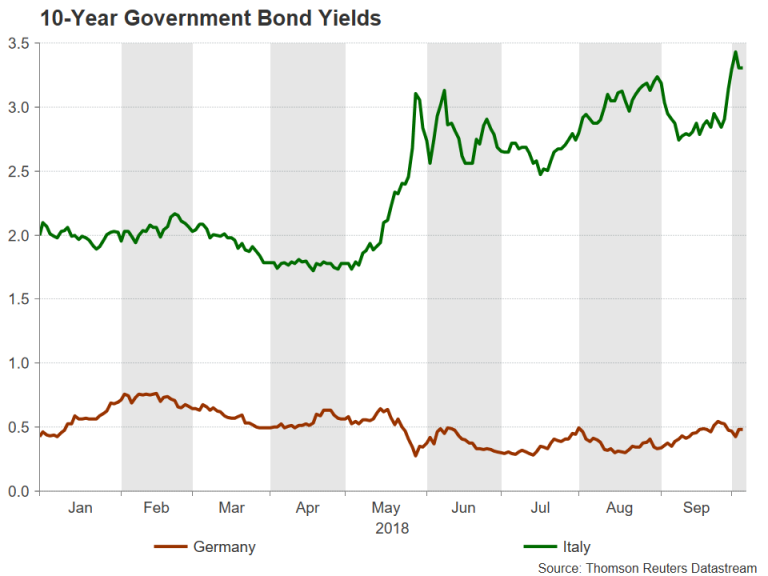
The euro tends to fall whenever periphery bond yields rise sharply above German bund yields and the latest episode with Italy has been no different for the single currency. With the Italian government not looking likely to back down easily over its plans to boost spending in 2019, the euro’s near-term outlook remains tied to the outcome of how the budget saga is resolved.
Should the EU reject Italy’s latest budget proposals, it’s difficult to see the government making further concessions. It’s unclear how the EU would respond to Italy refusing to follow fiscal discipline rules, but such a scenario has the capacity to pull the euro below the yearly low of $1.1297 touched on August 15, which was the weakest in almost 14 months. Before arriving at that bottom though, euro/dollar might seek a more nearby support at around $1.1450, which is the 50% Fibonacci retracement of the January 2017-February 2018 uptrend. Should the pair breach the 2018 trough of $1.1297, attention will fall on the $1.12 handle, as it’s just above the 61.8% Fibonacci retracement and a drop below would signal a deeper bearish phase.
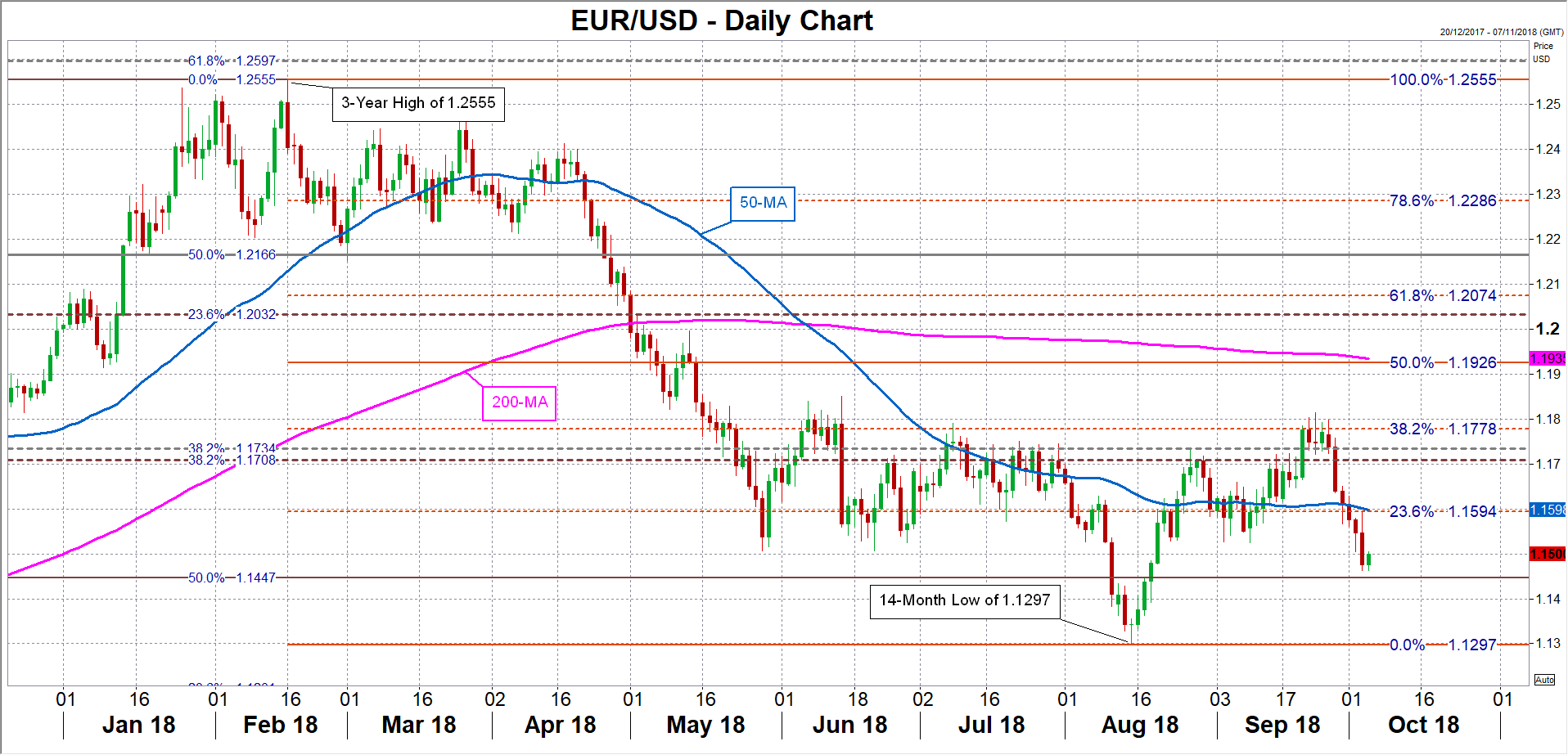
Looking at the more medium- to longer-term prospects for the euro, this would depend not only on whether or not growth in the Eurozone picks up a couple of gears, but also on how the US economy fares in 2019. Assuming the situation in Italy doesn’t develop into a new debt crisis and the tariff war remains confined to US-China, the euro area should continue expanding at a satisfactory pace. Even if growth doesn’t accelerate significantly, inflationary pressures should gradually heat up, as there is already evidence that rising employment levels across the Eurozone are starting to push up wages, and this would enable the ECB to proceed with its rate hike cycle in late 2019.
Until then though, the euro could struggle to make significant headway as the interest rate differential between the US and the Eurozone continues to widen. There is a possibility the Federal Reserve would slow down or pause the pace of rate increases in 2019, with several factors that could potentially cause the US economy to lose steam. These range from the tax cut effects fading out, Trump’s trade war hurting the many US companies closely tied to China, to the cumulative rate hikes since 2015 starting to bite the economy.
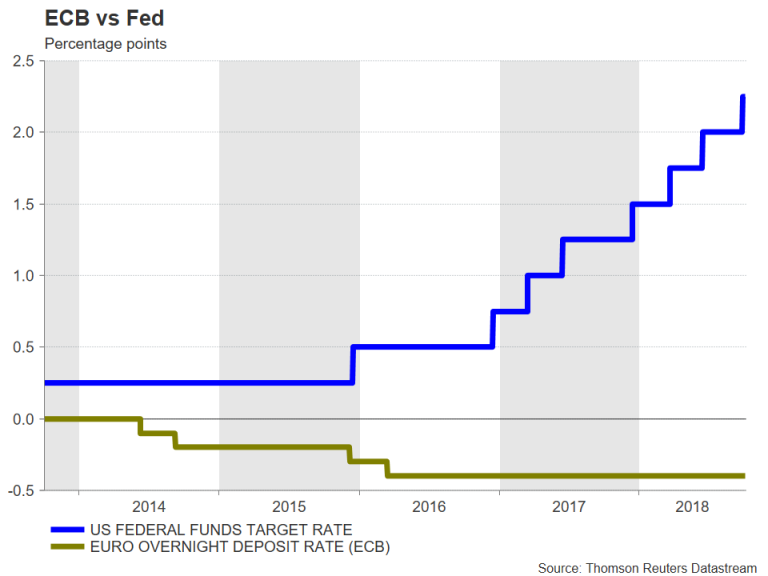
But a US slowdown doesn’t necessarily have to materialise before the ECB begins lifting rates for the euro to advance higher, as any early indication by the Fed that interest rates are nearing the peak of their current cycle would place the dollar on a downward path.
The single currency’s immediate focus on the upside is the $1.17 level, as it’s yet to make a sustained break above it after losing the handle back in May. Higher up, the next major barrier to beat is the $1.1780 area, which is the 38.2% Fibonacci retracement of the February-August down move. This region has been a strong resistance point to overcome and the euro has been unable to close above the $1.18 level since May despite several attempts. A convincing break above $1.18 would open the way to the 50% Fibonacci at $1.1925, which if cleared, would set a more bullish tone in the short term.
However, in the longer run, euro/dollar would need to challenge the three-year top of $1.2555 and make a move for the $1.26 level to confirm a resumption of the 2017 uptrend. It’s worth pointing that the $1.26 handle is just above the 61.8% Fibonacci retracement of the 2014-2016 downtrend, so the pair would need to surpass this level to return to a long-term bullish structure. Such a shift can only occur though, if the monetary policy divergence between the Fed and the ECB comes to an end and the yield differential starts to narrow in favour of the euro.
USDCHF Remarkable Recovery Pushes Pair to 1½-Month High; Outlook Turns Bullish
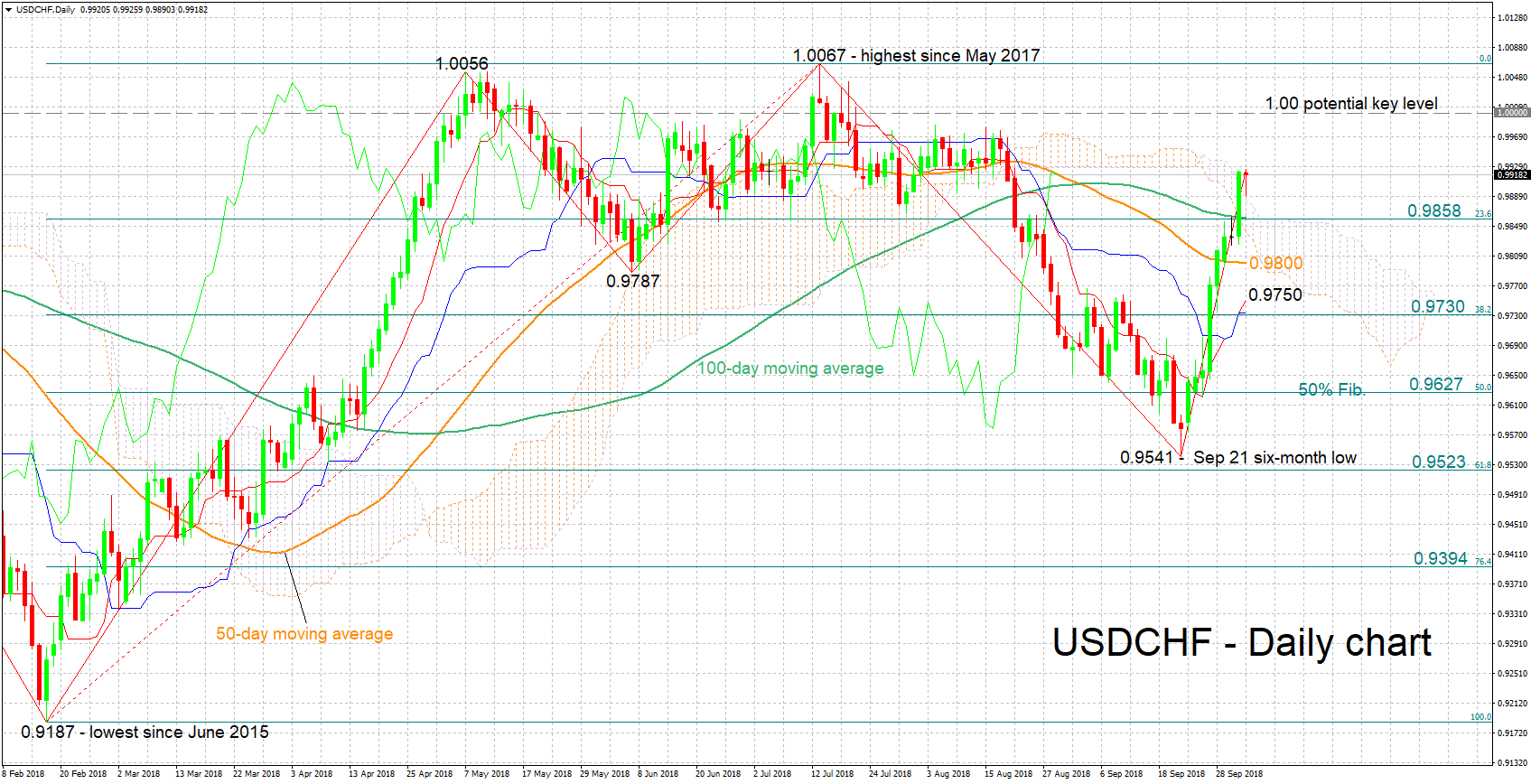
USDCHF staged a remarkable comeback after touching a six-month low of 0.9541 on September 21. In fact, the pair has not experienced a down day ever since, something which amounts to eight straight days of gains, and is currently trading around 400 pips above that nadir. Moreover, it touched a one-and-a-half-month high of 0.9926 earlier on Thursday.
The Tenkan-sen has moved above the Kijun-sen line, which also acts as a testament to the bullish bias in the short-term. However, notice that the Kijun-sen has eased, the implication being that positive momentum may be easing.
Currently at 0.9918, the pair is trading in an area that was congested between mid-June to late August. A conclusive move above may meet resistance around the parity level (1.00) that could hold psychological importance. Further above, 1.0067, the highest since May 2017, would increasingly come within scope.
On the downside, resistance could occur around 0.9858, which is the 23.6% Fibonacci retracement level of the upleg from 0.9187 to 1.0067. The current level of the 100-day (simple) moving average line (0.9861) roughly coincides with this point, while the Ichimoku cloud top (0.9884) and bottom (0.9841) are not far away. Lower still, additional support may come around the 50-day MA at 0.98.
Turning to the medium-term picture, the move above both the 50- and 100-day MAs, as well as above the Ichimoku cloud, has tilted the outlook towards a bullish direction. However, the bullish structure is still fragile given that price action is currently not far above the cloud, with a more conclusive move up needed to solidify the positive view.
Overall, both the short- and medium-term outlooks are looking mostly bullish at the moment.
Yen Rebounds, Investors Eye Japanese Consumer Reports
USD/JPY has posted losses in the Thursday session, after showing strong gains on Wednesday. In North American trade, the pair is trading at 114.02, down 0.45% on the day. On the release front, U.S unemployment claims dropped to 207 thousand, better than the estimate of 214 thousand. Later in the day, Japan releases consumer data. Household Spending is expected to edge lower to 0.0% and Average Cash Earnings is predicted to dip to 1.3%. On Friday, the focus will be on employment data, as the U.S releases wage growth and official nonfarm payrolls.
U.S job numbers continue to look sharp, reflective of a red-hot labor market. Unemployment claims dropped from 214 thousand to 207 thousand. This release comes on the heels of ADP nonfarm payrolls, which jumped 230 thousand in September. This marked the strongest increase in private sector jobs since March. Can the labor market keep up its dizzying pace? We could see some soft numbers as early as Friday, based on markets forecasts. Wage growth is expected to drop from 0.4% to 0.3%, while nonfarm payrolls is forecast to fall from 201 thousand to 185 thousand. Traders should be prepared for some movement in the currency markets during Friday’s North American session.
In Japan, inflation remains well below the Bank of Japan target of close to 2%, and the business sector has lowered its expectations regarding inflation. According to a BoJ survey, companies are projecting inflation at 0.8%, down from 0.9% in July. The BoJ has acknowledged that reaching the target of around 2% has taken longer than expected, and policymakers remain divided on how to deal with the elusive 2% inflation goal. Some members favor taking steps to ensure that the target is reached, but others are concerned about the economic costs of ultra-accommodative policy, such as low bond liquidity in the markets. The BoJ next meets on October 30-31, and it’s a safe bet that the Bank will hold the course, perhaps with some tweaks to monetary policy.
Sunset Market Commentary
Markets
US Treasuries fell hard yesterday on strong US eco data, rising oil prices and positive comments of Fed chairman Powell. The steep decline continued during Asian trading, but lost pace as European markets opened. Core bonds even recovered some of the lost ground throughout the day. German Bunds underperformed, catching up with the US Treasury’s move of late yesterday/overnight. European equities trade in negative territory, apart from the Dax (German markets were closed yesterday). US stock markets opened around 0.25% lower, with Nasdaq underperfroming. Italy’s BTP’s treaded water after the recent turbulence, unmoved by PM Conte’s comments that Italy’s deficit targets will be lowered to 2.4%, 2.1% and 1.8% for 2019, 2020 and 2021 respectively. The news that 5SM leader Di Maio confirmed that Finance Minister Tria will stay on, didn’t support the BTP neither. US weekly jobless claims hovered near multidecade lows and confirmed ongoing strength on the US labour market. Investors shrugged off the move, eying tomorrow’s payrolls. German yields add 1.7 bps (2-yr) to 5 bps (10-yr) today with the belly underperforming the wings. 10-yr spread changes vs Germany marginally decrease with the exception of Greece (+6bps). Differences on the US yield curve range between -0.2 bps (5-yr) and +0.4 bps (2yr).
Tentative dollar strength following yesterday’s yield spike receded at the start of European dealings. This is despite a negative risk climate (emerging markets under pressure as dollar strengthens) that usually triggers some kind of flight to safe havens the greenback is considered to be. Instead, the euro proved quite resilient today and recovered part of yesterday’s losses. The common currency perhaps benefited from narrowing US/EMU-spreads and from some easing of Italian tensions. EUR/USD is trying to regain 1.15-handle, while the trade-weighted dollar (DXY) is losing, slipping back to the 95.7-zone. USD/JPY is struggling to maintain its freshly capped 114-mark as the yen profits more from today’s risk off sentiment.
Lack of meaningful data resulted in some technical trading in sterling today. As May’s keynote speech concluded the Conservative Party conference ended yesterday, attention now shifts back to the UK-EU negotiations. Brexit related news was scant, however. If any, some positive comments from EU sources saying the new British (yet unconfirmed) proposal on a backstop for the Irish border issue, was a “step in the right direction” might have been slightly sterling positive. Under the proposal, the UK would impose a minimum of regulatory checks on goods travelling between Northern Ireland and the mainland in return for a stay in the customs union for the whole of the UK. Although that would dissolve the Irish border issue, it remains yet to be seen if the EU will accept this so called “cherry picking” while Northern Ireland strongly opposes any kind of border with the mainland. Anyway, sterling eked out yesterday’s gains, trading at around 0.885 EUR/GBP, up from 0.887. Cable is currently trying to recover the 1.30-mark.
News Headlines
Greece is rumoured to consider setting up an SPV that would allow banks to off-load some of their huge stock of bad loans. The construction is said to possibly include a government guarantee on some bonds issued to finance the vehicle.
Claims for US unemployment benefits dropped in the week to September 29 to 207 000 from 215.000 in the previous week. A stabilization in the number of claims was expected. This level of claims is holding near the cycle low (202 000, early September) and is close to the lowest since November 1969. The report suggests ongoing strong/tight labour market conditions as markets are looking forward to the BLS September US payrolls report, scheduled for release tomorrow.
NZDUSD Advances after Touching 32-Month Low
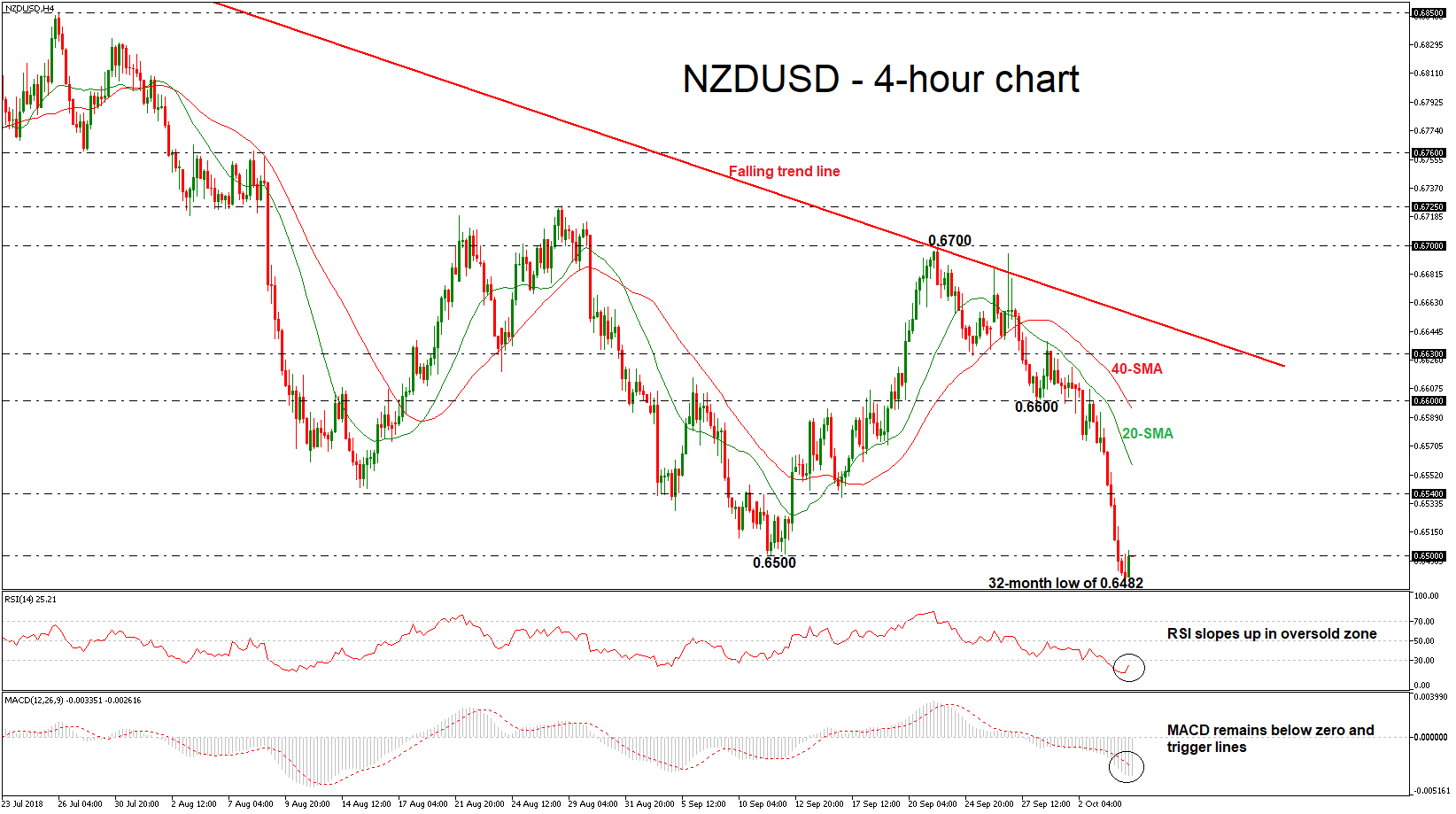
NZDUSD reached a new 32-month low of 0.6482 earlier on Thursday after the aggressive selling interest that started after the slip below the 0.6600 psychological level. Currently, the pair is moving slightly higher, confirming the upside slope from the RSI indicator in the oversold zone. However, the MACD oscillator is strengthening its negative momentum below the trigger and zero lines in the 4-hour chart.
An extension to the downside, the price could drop towards the 0.6345 support level, identified by the low on January 2016. The only major support before this level would be found around the 0.6400 handle.
On the other side, if the pair strengthens and surpasses the 0.6500 key level, it could re-challenge the 0.6540 resistance. Further up, immediate obstacle could be at the 20-simple moving average (SMA) near 0.6564 at the time of writing. Even higher, the 0.6600 could attract greater attention, which coincides with the 40-SMA erasing yesterday’s losses.
Briefly, NZDUSD has been developing within a short-term descending movement since June 6 and posted a new lower low today.