Sample Category Title
USD/JPY Mid-Day Outlook
Daily Pivots: (S1) 113.85; (P) 114.21; (R1) 114.91; More...
USD/JPY lost momentum ahead of 114.73 resistance and intraday bias is turned neutral first. Further rise is expected as long as 113.51 support holds. Decisive break of 114.73 will confirm larger bullish case. Next target will be 118.65 resistance. Nonetheless, break of 113.51 will indicate short term topping and bring lengthier consolidation first.
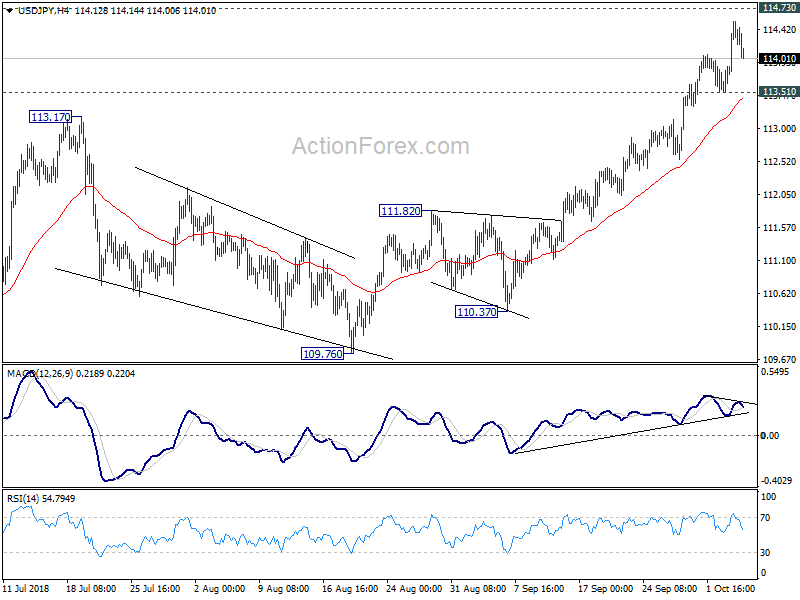
In the bigger picture, corrective fall from 118.65 (2016 high) should have completed with three waves down to 104.62. Decisive break of 114.73 resistance will likely resume whole rally from 98.97 (2016 low) to 100% projection of 98.97 to 118.65 from 104.62 at 124.30, which is reasonably close to 125.85 (2015 high). This will stay as the preferred case as long as 109.76 support holds.
USD/CHF Mid-Day Outlook
Daily Pivots: (S1) 0.0.9863; (P) 0.9894; (R1) 0.9955; More...
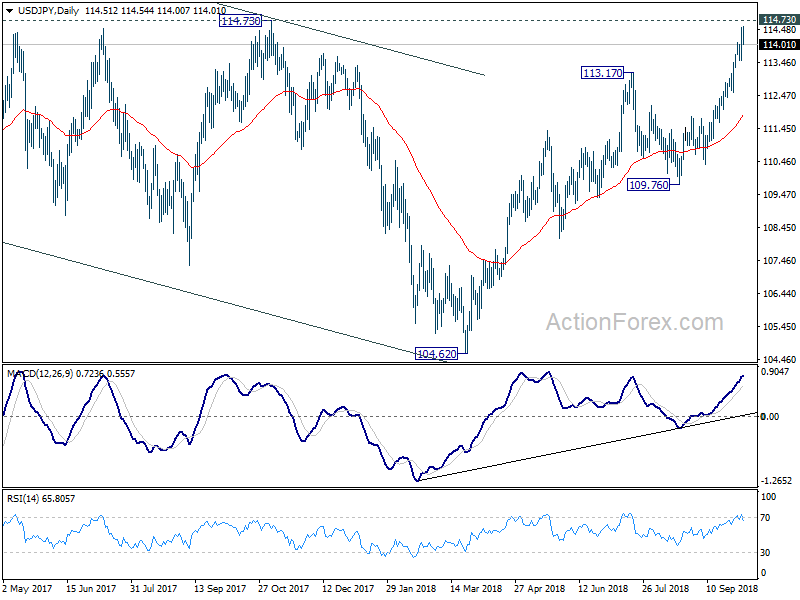
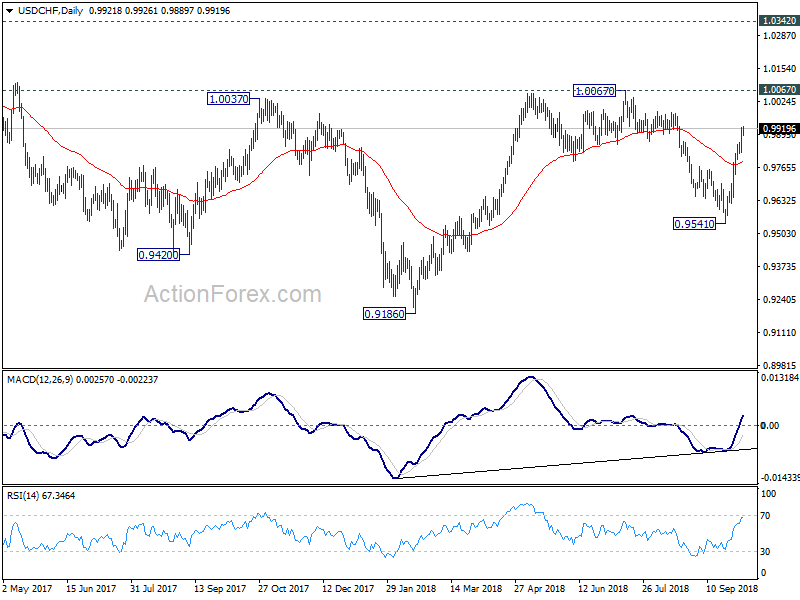
Intraday bias in USD/CHF remains on the upside for the moment. Current rise from 0.9541 should target 1.0067 resistance next. On the downside, break of 0.9822 support is needed to indicate short term topping. Otherwise, near term outlook will remain bullish in case of retreat.
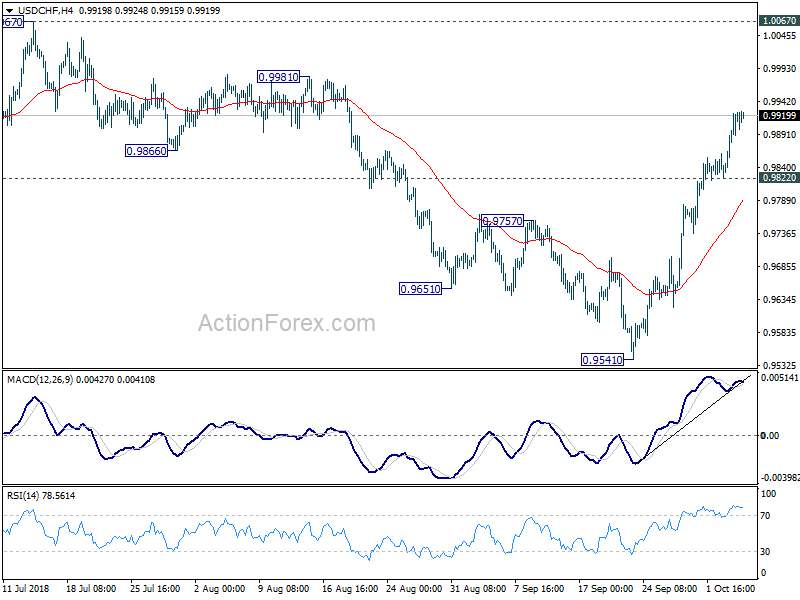
In the bigger picture, the pullback from 1.0067 has completed at 0.9541 already. And rise from 0.9186 is likely resuming. Firm break of 1.0067 will pave the way to retest 1.0342 key resistance. We'd be cautious on strong resistance from there to limit upside to bring another medium term fall to extend long term range trading.
EUR/USD Mid-Day Outlook
Daily Pivots: (S1) 1.1430; (P) 1.1513; (R1) 1.1562; More.....
A temporary low is formed at 1.1463 with today's recovery and intraday bias in turned neutral first. Some consolidations could be seen but upside should be limited below 1.1623 resistance to bring another decline. On the downside, break of 1.1463 will extend the fall from 1.1814 to retest 1.1300 low.
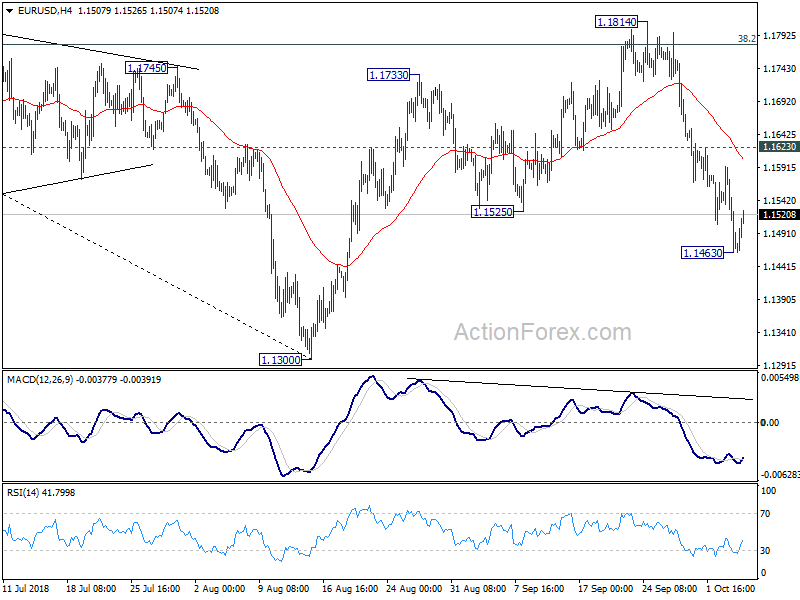
In the bigger picture, a medium term bottom should be in place at 1.1300, on bullish convergence condition in daily MACD and some consolidations would be seen. But still, note that EUR/USD was rejected by 38.2% retracement of 1.6039 (2008 high) to 1.0339 (2017 low) at 1.2516. That carries some long term bearish implications. Thus, we'd expect fall from 1.2555 high to resume after consolidation completes. Below 1.1300 should send EUR/USD through 61.8% retracement of 1.0339 to 1.2555 at 1.1186. And, in that case, EUR/USD would head to retest 1.0339 (2017 low).
USDJPY Outlook: Positioning for Fresh Upside; Weekly 200SMA Marks Key Support
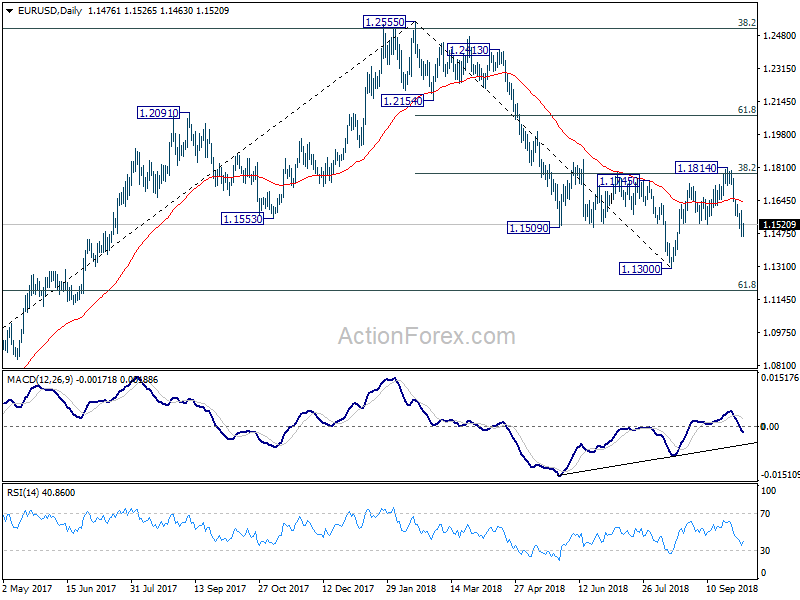
The pair holds in red on Thursday and eases further from new high at 114.64 (the highest since 06 Nov 2017), pressuring initial support at 114.00 (round-figure/rising 5SMA. Deeper pullback cannot be ruled out as slow stochastic is reversing from overbought territory and 14-d momentum turned south after forming bearish divergence and bear-cross on daily chart.
Corrective action is seen as positioning for fresh advance, as overall bullish structure favors dip-buying scenario.
Bulls will remain comfortable while above broken weekly 200SMA (113.18), where extended dips are expected to find ground.
The dollar remains well supported by recent upbeat US data which could push Fed towards more aggressive approach to monetary policy in order to prevent overheating of the US economy.
Also, US and Japan's interest rates are expected to further diverge and widen the gap, which could be another supportive factor to the greenback.
Bull keep in focus next target at 114.73 (06 Nov 2017 high), with extension above psychological 115 barrier and attack at Fibo barrier at 115.35 (76.4% of 118.66/104.63 descend), being in near-term agenda.
Res: 114.54; 114.73; 115.00; 115.35
Sup: 114.00; 113.42; 113.30; 113.18
GBP/USD Mid-Day Outlook
Daily Pivots: (S1) 1.2897; (P) 1.2960; (R1) 1.3001; More...
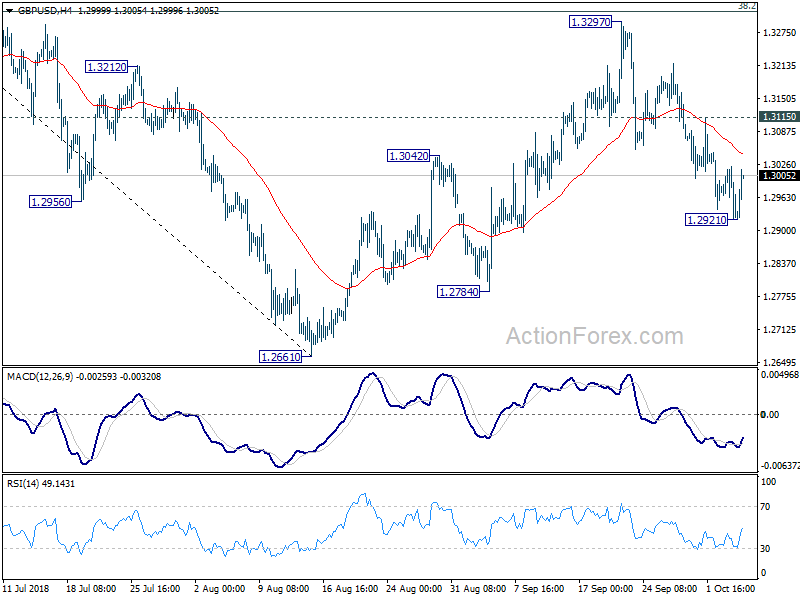
GBP/USD's recovery suggests that a temporary low is formed 1.2921 and intraday bias is turned neutral for consolidations. Upside of recovery should be limited by 1.3115 resistance to bring another decline. We'll holding on to the view that corrective rise from 1.2661 has completed and larger decline from 1.4376 might be resuming. Below 1.2921 will target 1.2784 support next. Nonetheless, break of 1.3115 will dampen our view and turn focus back to 1.3297 resistance instead.
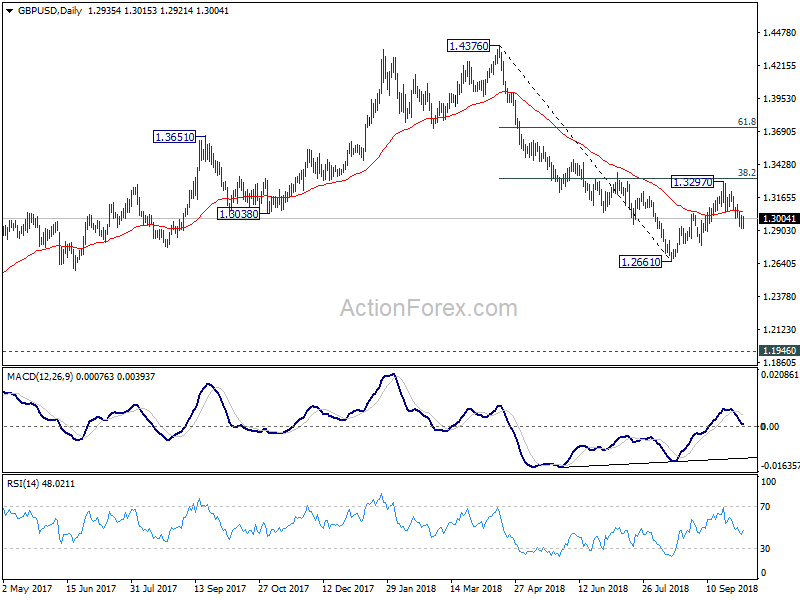
In the bigger picture, whole medium term rebound from 1.1946 (2016 low) should have completed at 1.4376 already, after rejection from 55 month EMA (now at 1.4062). The structure and momentum of the fall from 1.4376 argues that it's resuming long term down trend. And this will be the preferred case as long as 38.2% retracement of 1.4376 to 1.2661 at 1.3316 holds. However, firm break of 1.3316 would bring stronger rebound to 61.8% retracement at 1.3721. And, the eventual depth of the fall from 1.4376, and the chance of hitting 1.1946 low, will depend on the strength of the interim corrective rebound from 1.2661.
Dollar Pares Gains after Strong Rally, Sterling Recovers
Dollar retreats broadly in early US session as this week's rally lost some momentum. The greenback might need some help from tomorrow's non-farm payrolls report if it's to extend the rise. Still, Australian and New Zealand Dollar are the weakest ones on monetary policy divergence and risk aversion. Sterling is so far the strongest one for today on news that Brexit negotiation is making progress. Also, UK's new Irish border solution is hailed as a step to the right direction. But so far there is no details on what progress was made. Yen follows as the second strongest, then Euro.
In other markets, DAX is the relative better performing one as it's trading up 0.08% at the time of writing. FTSE is down -1.0% while CAC is down -1.12%. In Asia, Nikkei closed down -0.56%, Hong Kong HSI down -1.73%, Singapore Strait Times down -1.1%. China is still on holiday. Treasury yields catch a lot attentions globally today. German 10 year bund yield is up 0.043 at 0.519. UK 10 year gilt yield is up 0.0674 at 1.511. Japan 10 year JGB yield closed up 0.178 at 0.159. Eyes will be on whether US yield could extend yesterday's strong rally.
Technically, USD/JPY retreats quite deeply ahead of 114.73 resistance. With 113.51 minor support intact, further rise is still in favor. But break would indicate short term topping and bring lengthier consolidation. Sterling will also be a focus in US session. GBP/USD could have formed a temporary bottom already and stronger recovery might be seen to 1.3022 minor resistance and above. Meanwhile, EUR/GBP's break of 0.8847 low invalidated our view and could be extending the fall from 0.9097.
US initial jobless claims dropped -8k to 207k
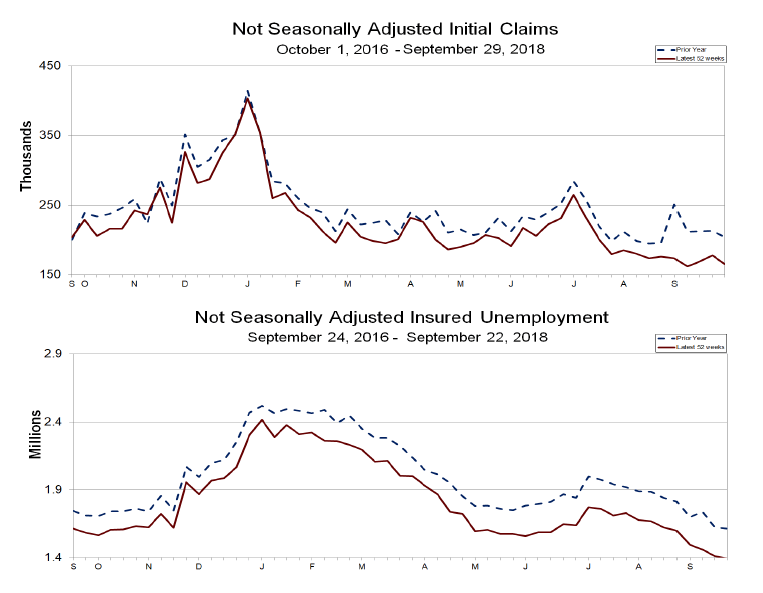
US initial jobless claims dropped -8k to 207k in the week ended September 29, slightly expectation of 206k. Four-week moving average of initial claims rose 0.5k to 207k. Continuing claims dropped -13k to 1.65m in the week ended September 22. Four-week moving average of continuing claims dropped -15.25k to 1.6645m, lowest since October 27, 1973.
ECB Rehn: Market expectations on first hike consistent with ECB statements
ECB Governing Council member Olli Rehn said "financial market expectations concerning the timing of the first interest rate rise are consistent with the Governing Council's statements." That is, ECB said in forward guidance that interest rates will remain at present levels at least through summer of 2019.
Meanwhile, he also added that "the need for extended forward guidance on monetary policy will also diminish, once inflation has reached sufficient progress towards the price stability objective."
Regarding a hot recent topic of Italy, Rehn said ECB's Governing Council "primarily looks at the development of the whole euro zone, and firstly from the mid-term price stability target point of view". And, "monetary policy will be done based on that, not looking at just one member state but the whole euro zone."
IMF: Japan needs reinvigorated policies for reflation, growth and sustainable debt path
IMF said in a report that while Japanese economy continues to "grow above potential", downside risks have increased. It urged that "reinvigorated policies are needed to reflate the economy, boost potential growth, and put public debt on a sustainable path." And, coordinated effort should include (i) a well-specified medium-term fiscal framework; (ii) an ambitious effort toward labor, product market, and corporate reforms; and (iii) a continued accommodative monetary policy accompanied by clear forward guidance.
On monetary policy, IMF hailed that "BoJ's recent emphasis on making the accommodative stance more sustainable is appropriate, and complements its shift to a more patient approach to reaching the inflation target." However, IMF suggested that "the relationship between the forward guidance on the long-term interest rate target and the inflation target could be clarified and the quantitative guidance on JGB purchases could be removed." Also, it suggested BoJ to publish staff baseline forecasts together with underlying policy assumptions to strengthen market communications.
On trade, IMF emphasized that "Continued advancement of multilateralism and bolder domestic policies are needed to mitigate inward spillovers, including from potential trade-war escalation." Though, Japan's leadership in furthering multilateralism can help mitigate the possible effects of trade-war escalation.
World Bank downgrades East Asia and Pacific growth forecasts
The World Bank downgraded East Asia and Pacific growth forecast in 2018 from 6.6% to 6.3%. It also projected growth to further slow to 6.0% in 2019, down graded from 6.1%. For China, growth is projected to slow to 6.5% in 2018, unrevised. But China's growth projection in 2019 was revised lower from 6.3% to 6.2%.
Sudhir Shetty, World Bank chief economist for East Asia and Pacific region, noted that "the main risks to continued robust growth include an escalation in protectionism, heightened financial market turbulence, and their interaction with domestic fiscal and financial vulnerabilities".
And, he added, "in this context of rising risks, developing EAP economies need to utilize the full range of available macroeconomic, prudential, and structural policies to smooth external shocks and raise potential growth rates."
GBP/USD Mid-Day Outlook
Daily Pivots: (S1) 1.2897; (P) 1.2960; (R1) 1.3001; More...
GBP/USD's recovery suggests that a temporary low is formed 1.2921 and intraday bias is turned neutral for consolidations. Upside of recovery should be limited by 1.3115 resistance to bring another decline. We'll holding on to the view that corrective rise from 1.2661 has completed and larger decline from 1.4376 might be resuming. Below 1.2921 will target 1.2784 support next. Nonetheless, break of 1.3115 will dampen our view and turn focus back to 1.3297 resistance instead.
In the bigger picture, whole medium term rebound from 1.1946 (2016 low) should have completed at 1.4376 already, after rejection from 55 month EMA (now at 1.4062). The structure and momentum of the fall from 1.4376 argues that it's resuming long term down trend. And this will be the preferred case as long as 38.2% retracement of 1.4376 to 1.2661 at 1.3316 holds. However, firm break of 1.3316 would bring stronger rebound to 61.8% retracement at 1.3721. And, the eventual depth of the fall from 1.4376, and the chance of hitting 1.1946 low, will depend on the strength of the interim corrective rebound from 1.2661.
Economic Indicators Update
| GMT | Ccy | Events | Actual | Forecast | Previous | Revised |
|---|---|---|---|---|---|---|
| 01:30 | AUD | Trade Balance Aug | 1.60B | 1.45B | 1.55B | |
| 11:30 | USD | Challenger Job Cuts Y/Y Sep | 70.90% | 13.70% | ||
| 12:30 | USD | Initial Jobless Claims (SEP 29) | 207K | 206K | 214K | 215K |
| 14:00 | CAD | Ivey PMI Sep | 61.4 | 61.9 | ||
| 14:00 | USD | Factory Orders Aug | 0.90% | -0.80% | ||
| 14:30 | USD | Natural Gas Storage | 47B | 46B |
US initial jobless claims dropped -8k to 207k
US initial jobless claims dropped -8k to 207k in the week ended September 29, slightly expectation of 206k. Four-week moving average of initial claims rose 0.5k to 207k. Continuing claims dropped -13k to 1.65m in the week ended September 22. Four-week moving average of continuing claims dropped -15.25k to 1.6645m, lowest since October 27, 1973.
Dollar Holds above 114 vs Yen as US Bond Yields Soar; US Factory Orders Pending
Here are the latest developments in global markets:
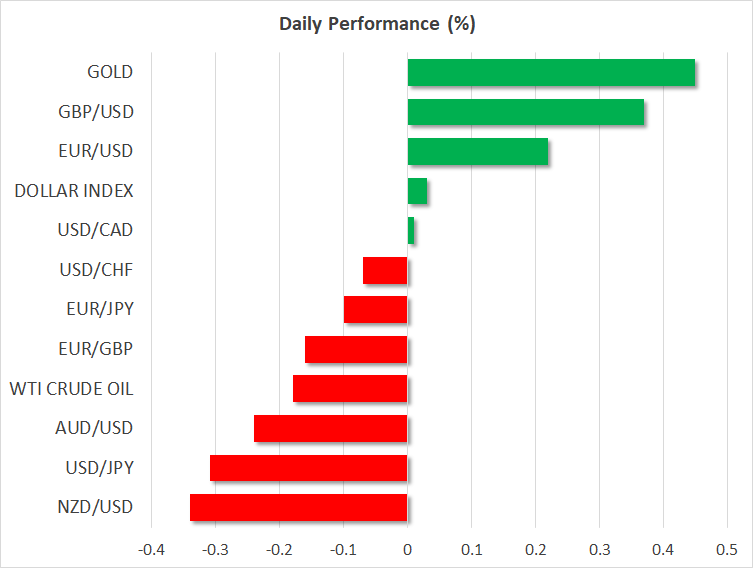
- FOREX: The US dollar retreated by 0.33% to 114.16 against the Japanese yen on Thursday after topping at 114.54 on Wednesday, the highest in 11 months. Following yesterday’s positive US data and hawkish comments from Federal Reserve Chairman Jerome Powell, US 10-year government bond yields spiked as high as 3.23% today, a level never seen since June 2011. Powell said that interest rates still have a long way to go to reach neutral levels, flagging that additional rate hikes are coming. The dollar index inched up to 95.81 (+0.06%). Euro/dollar was trying to pare some losses (+0.23%) which drove the pair to a six-week low of 1.1462 today. Pound/dollar regained some ground to trade at 1.2986, rising by 0.37%. In antipodean currencies, aussie/dollar and kiwi/dollar reached fresh 32-month lows at 0.7063 and 0.6481 respectively, losing more than 0.30% in the day, even with the dollar being on the back foot itself. Dollar/loonie struggled near its opening level, trading around 1.2867. In emerging market currencies, the Turkish lira plummeted by 1.70% versus the greenback, after the nation’s inflation rate soared to 25.5% in annual terms, data showed yesterday.
- STOCKS: Shares in Europe felt the pain from ascending global yields as Japanese and German government bond yields picked up speed as well. The pan-European STOXX 600 was down by 0.67% with all sectors apart financials in the red, while the blue-chip Euro STOXX 50 declined by 0.51% at 1200 GMT. The German DAX 30 and the Spanish IBEX 35 were steady, the French CAC 40 plunged by 0.90% and UK’s FTSE 100 plummeted by 0.86%. The Italian FTSE MIB lost 0.19%. Futures tracking US stock indices were all in the red, pointing to a negative open today despite the Dow Jones touching a fresh all-time high of 26951 yesterday.
- COMMODITIES: Oil prices remained slightly below Wednesday’s 4-year highs supported by forthcoming losses in Iranian supply as a new round of US sanctions is set to kick in by early November. WTI crude oil headed lower by 0.24% to $76.23/barrel, while London-based Brent fell by 0.22% around $86.00/barrel. Gold prices were flirting with the $1,200/ounce level (+0.54%).
Day Ahead: US Factory orders eyed for further dollar rally; Brexit and Italian budget to remain in the spotlight
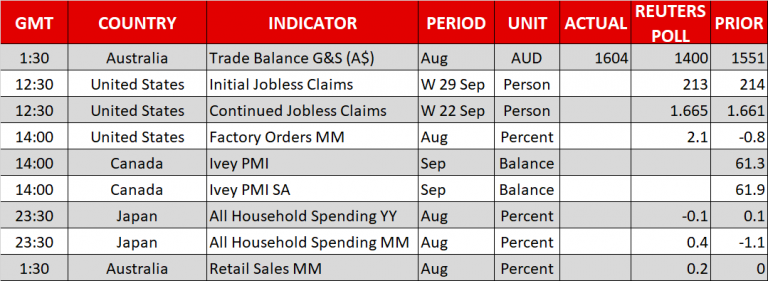
Upbeat data releases out of the US combined with hawkish comments delivered by the Fed chairman Jerome Powell on Wednesday were enough to enhance hopes for further rate hikes in the future and thus boost the dollar. On Thursday, while a few data releases are pending in the remainder of the day, investors will keep a close eye on US factory orders due at 1500 GMT. According to analysts, new purchase orders placed with manufacturers are expected to have expanded by 2.1% month-on-month (m/m) in August, posting a spectacular recovery after decreasing by 0.8% in July. Should the measure print stronger growth than expected, the dollar could unlock fresh highs, while US government bond yields will be in focus as well, as the 10-year bond yields are currently at their highest since 2011. Emerging market currencies might come under pressure once again if the dollar continues to gain ground.
Earlier at 1230 GTM, initial jobless claims for the week ending September 29 may come under review as well, though the market reaction on the data is typically limited.
In neighboring Canada, where trade fears substantially receded after the US, Canada and Mexico managed to reach a new trilateral agreement, attention will turn to the Ivey PMI readings for the month of September later in the day (1400 GMT). Yet the numbers could have a minimal impact on the loonie as investors may be more interested about Friday’s employment figures out of Canada and the US. Fluctuations in oil prices may also affect the commodity-linked loonie.
Elsewhere, Japan is scheduled to publish September’s household spending figures at 2330 GMT. Forecasts are for consumption to have eased to -0.1% on a yearly basis. In July the measure marked a soft increase of 0.1%. Meanwhile the International Monetary Fund judged that downside risks to the Japanese economy have increased in the past year due to trade barriers which threaten to pressure demand for Japanese exports. Moreover, the IMF sees rises in sales taxes planned for next year weighing on growth momentum too, messaging that monetary policy should stay accommodative for now.
Early on Friday, Australian retail sales could move the aussie at 0130 GMT. Analysts believe that retail sales in August increased by 0.2% m/m after showing no growth in the preceding month.
Brexit will remain under the spotlight as markets eagerly await the UK to unveil new proposals on the Irish border before EU summit on October 17-18.
In the Eurozone, Italy’s fiscal policy will continue to limit upside movements in the euro. On Wednesday, the Italian Prime Minister confirmed that the deficit target for 2019 will be 2.4% of GDP, while the goals for 2020 and 2021 would fall to 2.1% and 1.8% respectively versus the 2.4% reported earlier for both years. Yet the government still needs to send full details of its spending plans to the Italian parliament before it submits a budget draft to the European Commission in mid-October.
Canadian Dollar Quiet, Ivey PMI Next
The Canadian dollar is trading sideways in the Wednesday session. In the North American session, USD/CAD is trading at 1.2875, up 0.06% on the day. On the release front, Canada releases Ivey PMI is expected to rise to 62.3 points. In the U.S, the key event is unemployment claims, which is expected to remain unchanged at 214 thousand. On Friday, employment data will be in the spotlight on both sides of the border. Canadian employment change is expected to rebound with a strong gain of 25.0 thousand. In the U.S, we’ll get a look at wage growth and official nonfarm payrolls.
U.S employment numbers kicked off on a high note, as ADP nonfarm payrolls jumped 230 thousand in September. This marked the strongest increase in private sector jobs since March. The red-hot labor market will have to ease sometime, and the markets are braced for some soft numbers on Friday. Wage growth is expected to drop from 0.4% to 0.3%, while nonfarm payrolls is forecast to fall from 201 thousand to 185 thousand. Traders should be prepared for some movement in the currency markets during Friday’s North American session.
After months of intense negotiations, Canadian and U.S officials have finally hammered out a trade deal, which paves the way for a new trade agreement between Canada, Mexico and the United States. The NAFTA agreement, which was a pillar of the Canadian economy for 24 years, gives way to the USMCA – the U.S-Mexico-Canada Agreement. Canada and the U.S both offered concessions in order to reach a deal. Canada’s auto sector, which is highly dependent on cross-border movement, will be shielded from U.S tariffs. In return, U.S farmers will be granted increased access to Canada’s dairy market, which has been highly protected. The new agreement is expected to be signed in November and must then be ratified by the legislature of all three countries. This means that the provisions of the USMCA are not expected to go into effect before 2020. The agreement boosted the Canadian dollar, which has shown strong gains of late – the currency has jumped 2.4% since mid-September.
EURJPY Analysis: Supported By Weekly And Monthly PP
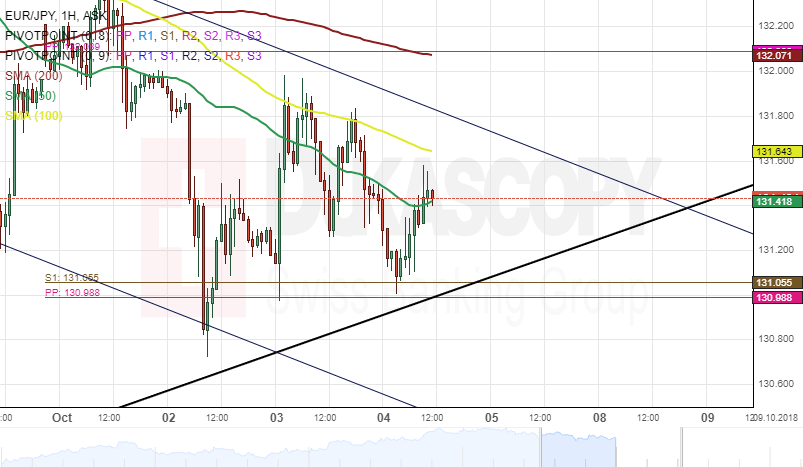
The Eurozone single currency depreciated about 70 base points against the Japanese Yen on Wednesday. The decline was temporary stopped by a support cluster formed by the weekly and the monthly PPs at 131.05.
Everything being equal, the currency pair is likely to move north towards the upper boundary of a descending channel at 131.76 within this session.
However, a resistance level formed by the 50-hour simple moving average at 131.39 might restrict the EUR/JPY currency exchange rate from reaching its target today.
If this resistance level holds, the price will change its direction and most likely aim for a re-test of the support cluster as mentioned above