

Sample Category Title
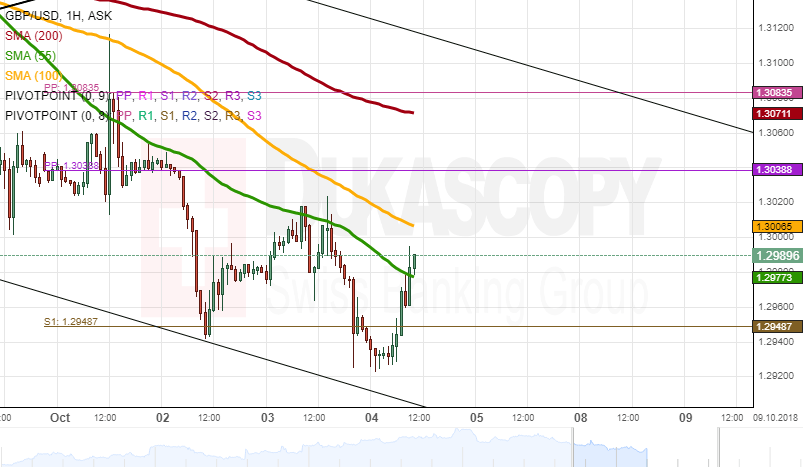
GBPUSD Analysis: Passes 1.30 Mark
The British pound depreciated 0.05 % against the US Dollar since Wednesday's session. On Thursday morning, the rate was passed the weekly S1 to trade at the 1.2961 level.
During Thursday's session, the 55-hour simple moving average will keep trying to resist the British pound to push the rate to trade at lower levels. Most likely, the rate will try to pass the weekly S1 at 1.2948 one more time to trade near the 1.2900 level during the day.
However, the rate might break the 55-hour SMA's resistance to surge upwards to trade at the 1.2980 level.
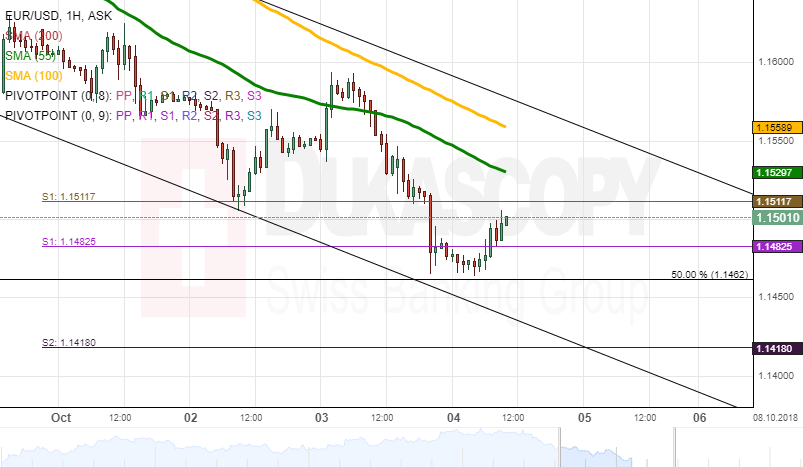
EURUSD Analysis: Will Trade Sideways
The European Single Currency depreciated 0.49% against the US Dollar since Wednesday's session. On Thursday, the rate was located below the monthly S1 at the 1.1485 mark.
During Thursday's session, the European Single Currency will trade sideways due to the resistance of the monthly S1 and the weekly S1, together with the support of the 50.00% Fibo at 1.1460 mark. Most likely, the rate will trade at the 1.1500 mark during the session.
On the other side, the rate might break the weekly S1 at 1.1511 level to trade near the 1.1520 mark during the day.
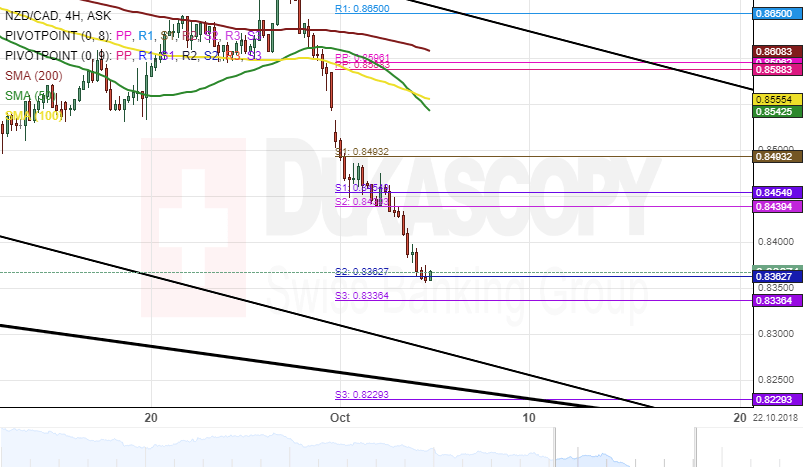
NZD/CAD 4H Chart: Meets Support Level
The New Zealand Dollar has depreciated massively against the Canadian Dollar since the end of September after the currency pair reversed from the upper boundary of a three-month descending channel at 0.8688.
The exchange rate tested the monthly support level at 0.8362 during the morning hours of today's session. From a theoretical point of view, the pair could reverse from that level and aim at a resistance cluster formed by the weekly and the monthly PPs near the 0.8439 mark within this session.
However, if this support line is unable to hold, the currency exchange rate will continue its downside momentum and target the bottom border of the three months descending channel at 0.8250 during the following trading sessions.
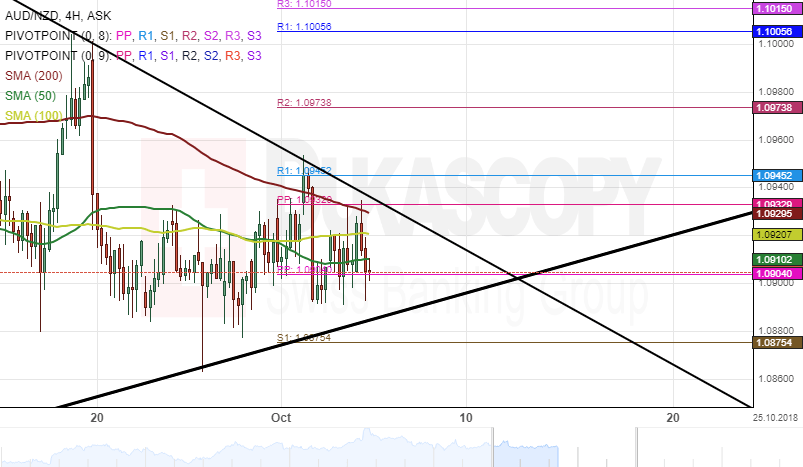
AUD/NZD 4H Chart: Stranded Between SMAs
The Australian Dollar has been trading in a medium-scale triangle pattern against the Swiss Franc. The currency pair tested the upper boundary at 1.1005 on September 19 and breached the lower border at 1.8060 on September 26.
Currently, the exchange rate is stranded between SMAs. The 200-hour simple moving average is providing resistance at 1.0930, while the 50-hour moving average is providing support at 1.0904.
Technical indicators on the 4(H) time frame suggest that the currency exchange rate will move past the resistance level as mentioned earlier.
If this situation occurs, the target for the rate will be at the weekly R2 at 1.0973 during the following trading session.
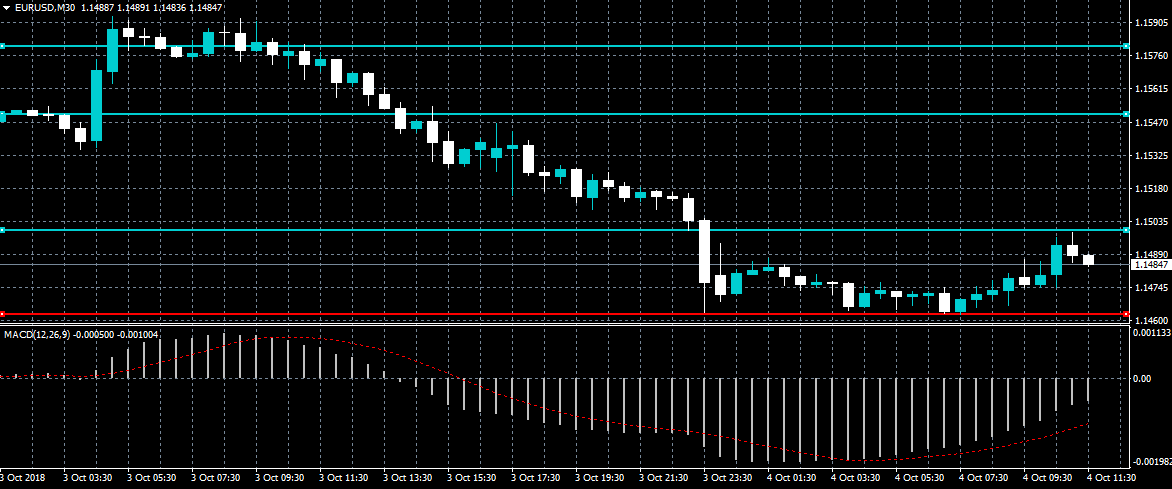
EURUSD Technically Rejected From 1.1500
The euro currency has once again been technically rejected from the 1.1500 resistance level during the European trading session as Italian bond-yields rise and the US dollar index soars higher. EURUSD sellers will look to break the 1.1463 support level and target the 1.1410 level, while buyers need to close the day above the 1.1553 resistance level.
The EURUSD pair is strongly bearish while trading below the 1.1500 level, key support is now found at the 1.1463 and 1.1410 levels.
If the EURUSD pair moves above the 1.1500 level, key technical resistance is located at the 1.1524 and 1.1553 levels.
GBPUSD Remains Weak But Oversold
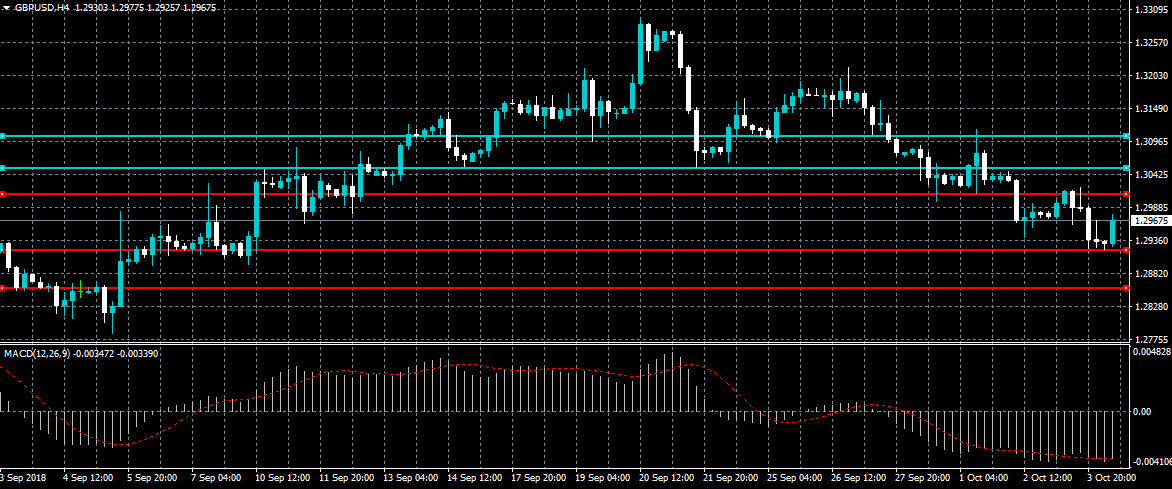
The British pound remains weak against the US dollar after a failed attempt to regain bullish momentum above the 1.3000 level on Wednesday. The GBPUSD pair also risks forming a bearish head and shoulders pattern if price dips below the 1.2800 support level. Sellers will likely aim to break the 1.2900 level, while buyers will look to hold price above the 1.3000 resistance level.
The GBPUSD pair is only bullish while trading above the 1.3000 level, key resistance remains at the 1.3046 and 1.3100 levels.
If the GBPUSD pair trades continues to trade below the 1.3000 level, further intraday losses towards the 1.2930 and 1.2860 levels are expected.
WTI Oil Outlook: Little Impact From Rise Of Crude Stocks / Russia-Saudi Deal
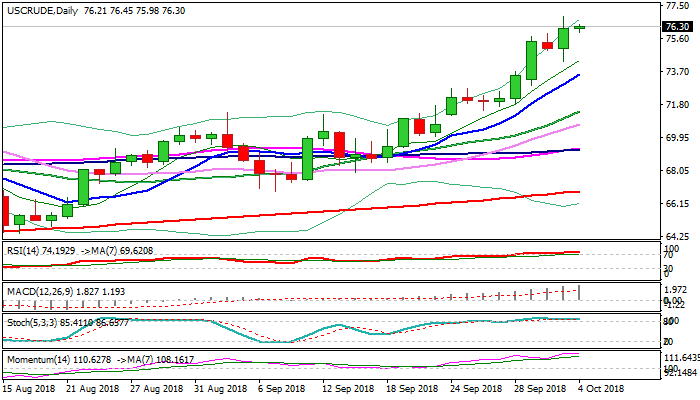
WTI oil consolidates within tight range under new nearly four-year high at $76.88 on Thursday. Strong bullish sentiment remains intact as fears about the impact on global supply on US sanctions on Iran offset much bigger than expected rise in US oil inventories. Also, announcement that Russia and Saudi Arabia made deal to raise oil output, so far had little impact on bulls. Today's break above pivotal barriers at $76.35 (Fibo 61.8% of 107.45/$26.04 fall / Fibo 138.2% expansion of the third wave of five-wave cycle from $64.43) was strong bullish signal which needs confirmation on daily close above these barriers. Fresh bulls would look for test of $77.00 (23 Nov 2014 high) with extension of current wave towards its FE 161.8% at $78.02, not ruled out, as markets already speculates of attack at psychological $100 barrier in coming months. Bullish techs support scenario with overbought conditions being ignored for now, delaying consolidative / corrective action which should be anticipated in coming sessions. Extended dips should find support above rising 10SMA ($73.57) to keep bulls intact.
Res: 76.53, 76.88, 77.00, 78.02
Sup: 78.98, 75.00, 74.30, 73.57
Dollar In The Driving Seat As Yields Spike Higher
- Hawkish Powell the catalyst for higher yields;
- India coming under scrutiny as USD rally and oil prices raise concerns;
- Gold resilient to recent USD gains.
Yields are on the rise on Thursday which may be weighing on stocks ahead of the US open, with the return on 10-year Treasuries at levels not seen since 2011.
Another strong batch of US data on Wednesday combined with some hawkish comments from Federal Reserve Chair Jerome Powell appears to have been the catalyst for a surge in yields, as investors begin to factor in the possibility of higher interest rates and faster hikes. Powell suggested that the Fed remains “a long way from neutral at this point” and that they may go beyond which may go against what investors had in mind.
There appeared to be a belief that in removing the reference to monetary policy being accommodative from the statement last week, that the central bank was near the neutral rate and therefore rate hikes may be more limited but that is clearly not the case. With the economy running hot and headwinds – such as trade wars – not yet weighing, the Fed is clearly very comfortable maintaining the pace of tightening and is willing to go further in order to keep it in check.
The spike in US Treasuries has driven demand for the greenback which is back near last month’s peak, mostly it would appear at the expense of emerging market currencies – again – and the yen. Rising interest rates have coincided with increased focus on emerging markets which has resulted in significant focus on Turkey and Argentina in recent months and is causing concerns for India.
A surging dollar and a relentless rise in oil prices has been particularly troubling for India, with concerns around its current account deficit drawing the spotlight. It would appear this could be the next domino to fall which could continue to put pressure on the rupee and force the central bank to reluctantly raise interest rates in an attempt to bring some order. Scrutiny of the country’s shadow banking industry following government intervention in IL&FS isn’t going to help matters and may worry investors.
Gold has been surprisingly resilient to dollar strength over the last couple of weeks which some have attributed to Italy-related safe haven flows. It has not been the safe haven of choice in recent months though during periods of stress, with Treasuries and therefore the greenback instead being favoured, which has in turn weighed on the yellow metal as it’s priced in dollars. Perhaps, the euro-specific nature of the Italian issues is what’s driven support for Gold during these periods but even if that’s the case, if we continue to see the dollar perform well, it’s going to limit its upside potential.
EUR/USD – Struggling Euro Breaches 1.15
EUR/USD is steady on Thursday, after posting six losing sessions. Currently, the pair is trading at 1.1503, up 0.21% on the day. On the release front, there are no major German or eurozone events on the schedule. In the U.S, the key event is unemployment claims, which is expected to remain unchanged at 214 thousand. On Friday, Germany releases Factory Orders and PPI. In the U.S, the focus will be on key employment data, with the release of nonfarm payrolls, wage growth and the unemployment rate.
The euro continues to struggle, having declined 2.2% since September 26. A key factor in the current slide is the Italian budget, which the populist government tabled last week. The budget increases spending, lowers taxes and sets the budget deficit at 2.4% of GDP for 2019. Italy has a massive debt, and the European Union doesn’t want Rome to expand the current deficit, which stands at 1.6% of GDP. The populist Italian government appeared to backtrack on Wednesday, and has now said that the budget deficit could be lowered in 2020 and 2021. Still, the budget remains a sore point for the EU, and the euro could lose ground if the EU and Italy remain at loggerheads over Italy’s fiscal policy. The budget must first be approved by Italy’s parliament and then by the European Commission, so this saga is likely to continue for some time.
U.S employment numbers kicked off on a high note, as ADP nonfarm payrolls jumped 230 thousand in September. This marked the strongest increase in private sector jobs since March. The red-hot labor market will have to ease sometime, and the markets are braced for some soft numbers on Friday. Wage growth is expected to drop from 0.4% to 0.3%, while nonfarm payrolls is forecast to fall from 201 thousand to 185 thousand. Traders should be prepared for some movement in the currency markets during Friday’s North American session.
Dollar Up On Strong Economy
Dollar up on strong economy
Strong economic data sent US yields higher across the board. 10-year treasuries surged to 3.225%, adding 0.12% overnight. USD bulls charged, bidding up the greenback versus developed and developing currencies alike. Worries of a slowdown trade tensions were nowhere to be found. Markets now expect a steeper rate curve in 2019 with additional rate hikes. Federal Reserve Chairman Jerome Powell boosted the sell-off, saying he is “very happy” with the “remarkably positive” economy, adding that the expansion might “continue for quite some time”.
Fed policymakers continue to signal that gradual rate hikes are starting to reprice the yield curve, especially in its longer end. Emerging currencies are under extreme scrutiny, as higher US yields will further draw out capital. INR and IDR, with heavy USD funding and reliance on imported oil, have come under heavy selling. With US drillers coming offline, distillates below historical average and supply disruptions expected in Iran and Venezuela, crude prices continue to trade higher. We are sidelined: expectations for USD weakness have not appeared and scheduled events for USD selling are far off.
Turkish lira in trouble
Inflation in Turkey blew out expectations, with the core reading up to 24.5% and producer prices hitting 46%. Oddly, TRY is stable, which must mean markets are confident the Central Bank of Turkey will fix it. So the CBT must hike. However, we have a hard time seeing the bank has freedom to hike enough. Food tabs rose 27.7%, energy inflation 27.03%: core inflation is likely to head higher. The CBT should raise at least 1.5% to keep real interest from going negative. But a 25.5% interest rate would be a killer - President Erdogan is unlikely to allow it. Give the macro environment, we look for the lira to weaken.