Sample Category Title
U.S. Non-Manufacturing Activity Activity Heats Up in September
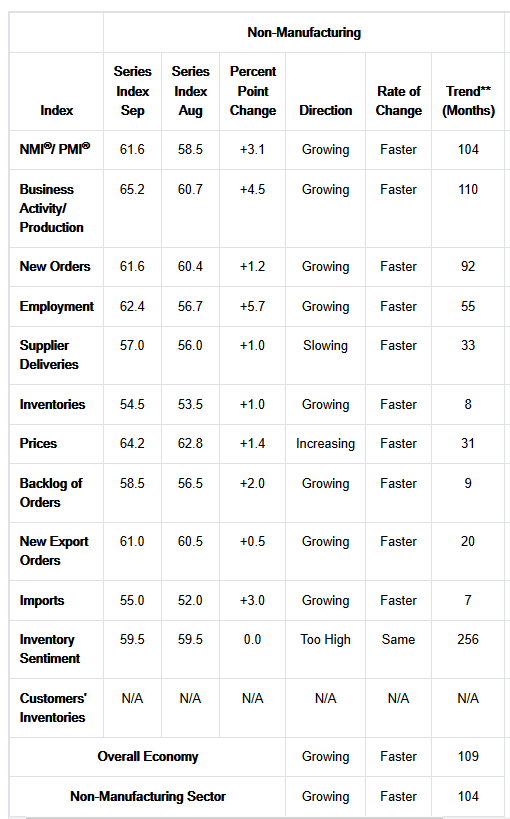
Following a large gain in August, the Institute for Supply Management's (ISM) non-manufacturing index came in strong again in September, rising by 3.1 points to 61.5 – an all-time high. The print surprised on the upside, with markets expecting the index to moderate to 58.0.
Looking beneath the headline, the details of the report were also bright, with all of the index's ten subcomponents rising or remaining unchanged on the month. Similarly, all seventeen industries covered by the survey reported growth in September.
The largest gain was seen in employment subcomponent, which surged by 5.7 to 62.4. Business activity has also picked up significantly, rising by 4.5 points to 65.2. Gains were more moderate elsewhere: new orders rose by 1.2 points to 61.6 indicating stronger demand, price pressures also intensified in tandem, with prices paid subcomponent rising by 1.4 points to 64.2.
There was also a rise in backlog new orders and supplier delivery times, indicating that firms were having more difficulty meeting demand.
Trade-related subcomponents improved. New export orders edged higher (+0.5 to 61.0), while imports picked up (+3.0 to 55.0).
Survey respondents expressed high levels of optimism about the domestic economy and demand, but continued to indicate capacity constraints due to shortage of labor, higher prices and logistical difficulties. Worries about tariffs continued to show up, particularly in retail trade, while respondents from the construction industry stated that higher prices on materials were having a negative impact on earnings.
Key Implications
In a rare divergence from its manufacturing counterpart, the ISM non-manufacturing index continued to move higher in September. Broad-based expansion across the entire swath of non-manufacturing industries alongside positive comments from survey respondents suggest that the U.S. services sector remains healthy.
While, non-manufacturing industries are less exposed to international trade than their manufacturing counterparts, they are not immune to tariffs, as evidenced by concerns in retail and construction industries. While the newly minted USMCA deal with Canada and Mexico signed this week has helped to dissuade some trade-related fears, the battle with China looks likely to escalate further in the coming months. This could lead to further increases in input costs, possible disruptions in supply chains and lower business sentiment and output.
Summing it up, strong domestic demand will continue to provide a solid base for service-sector industries. That being said, non-manufacturing firms are increasingly facing capacity constraints, such as labor shortages and rising input prices.
British Pound Pushes to 1.30 as Services PMI Maintains Expansion
GBP/USD has posted slight gains on Wednesday, recovering some of the losses seen on Tuesday. In the North American session, the pair is trading at 1.2991, up 0.09% on the day. On the release front, British Services PMI dropped to 53.9, close to the estimate of 54.0 points. In the U.S, ADP nonfarm payrolls jumped 230 thousand, crushing the estimate of 185 thousand. This marked the strongest increase in private sector jobs since March. There was more positive news from the services sector, as ISM Non-Manufacturing PMI climbed to 61.6, above the forecast of 58.0 points. On Thursday, the U.S releases unemployment claims.
British PMIs, which are highly regarded gauges of economic activity, all showed expansion in September. Services PMI slipped to 53.9, but was within expectations. Manufacturing PMI improved to 53.8, above the estimate of 52.6 points. Construction PMI dropped sharply from 52.9 to 52.1, missing the estimate of 52.8 points. Even though the PMIs continue to show growth in key economic sectors, there are signs of concern. The construction release was the weakest in six months, and the survey found that some construction firms were concerned that soft economic conditions were having a negative impact on their growth. Brexit remains a constant worry in the business sector, as the uncertainty as to whether a deal will be reached between the UK and the European Union continues to dampen sentiment over the British economy.
Prime Minister May finds herself in a difficult position, as she tries to convince her Conservative party and European leaders to accept her “Chequers” proposal regarding the UK exit from the European Union in March 2019. At the Conservative party conference on Wednesday, May said she wanted a deal with Europe, but not at any price. With Europeans leaders openly stating that Britain must be seen as paying a cost for leaving Europe, it’s an open a question whether Britain and the EU will be able to hammer out an agreement.
Strong US Numbers Push Japanese Yen to 11-Month Low
USD/JPY has posted gains in the Wednesday session. In North American trade, the pair is trading at 114.12, up 0.36% on the day. Earlier in the day, the yen dropped to its lowest level since early November 2017. On the release front, there are no Japanese events. In the U.S, ADP nonfarm payrolls jumped 230 thousand, crushing the estimate of 185 thousand. This marked the strongest increase in private sector jobs since March. There was more positive news from the services sector, as ISM Non-Manufacturing PMI climbed to 61.6, above the forecast of 58.0 points. On Thursday, the U.S releases unemployment claims.
Japanese companies have lowered their expectations on inflation, according to a Bank of Japan inflation survey released this week. In July, firms projected inflation of 0.9%, but this has dipped to 0.8%. The BoJ has acknowledged that reaching the target of around 2% has taken longer than expected, and policymakers remain divided on how to deal with the elusive 2% goal. Some members favor taking steps to ensure that the target is reached, while others are concerned about the economic costs of ultra-accommodative policy, such as low bond liquidity in the markets. The BoJ next meets on October 30-31, and it’s a safe bet that the Bank will hold the course, perhaps with some tweaks to monetary policy.
With President Trump basking in the glow of trade deals with Canada and Mexico, the White House is confident that it can seal a deal with a crucial trading partner, Japan. The two economic giants have agreed to commence trade talks, which will keep Japan’s auto sector protected from U.S tariffs, at least for the time being. President Trump has vowed to redress the $69 billion trade surplus that Japan has with the U.S., although Japan has balked at signing a free trade deal with the U.S, as it prefers a multilateral trade agreement.
WTI Oil Outlook: Limited Reaction on Downbeat Crude Inventories But Overbought Studies Warn of Pullback
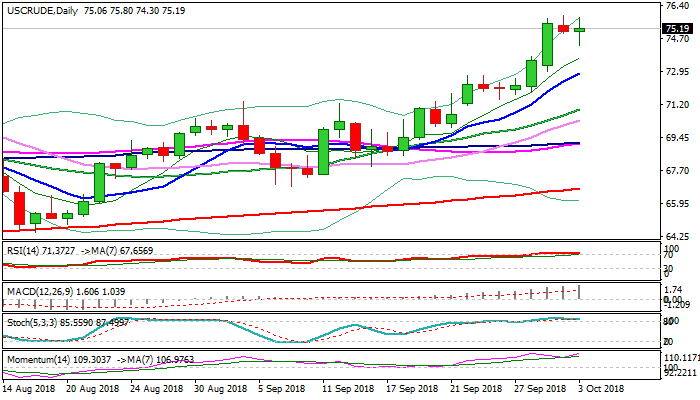
WTI oil price bounced near new four-year high after short-lived spike to session low at $74.30 after US crude inventories rose much above forecast. EIA report showed US crude stocks were up 7.97 million barrels in the past week, strongly overshooting forecast for 1.98 million barrels build and previous week's build of 1.85 million barrels. However, immediate reaction on downbeat data was minor, as oil price bounced back quickly, signaling that bullish sentiment on rising fears over the impact on global supply by US sanctions to Iran, persists. Strong bullish momentum on daily chart suggests further advance, but bulls could be delayed as daily studies are overbought. Indicators (RSI and slow stochastic) are still in overbought zone and lacking firmer signal, however, deeper corrective pullback cannot be ruled out. Rising 10SMA ($72.86) is expected to contain extended dips and prevent stronger correction which would put bulls on hold.
Res: 75.89; 76.35; 77.00; 77.79
Sup: 74.30; 73.63; 72.86; 71.47
NZDUSD Bearish Pressure Eyes 0.6502 Zone
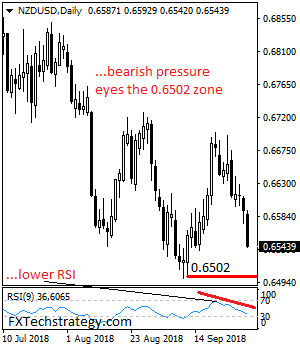
NZDUSD bearish pressure eyes 0.6502 zone as it retains its broader medium term downtrend. This development leaves it vulnerable beyond the above support. Support lies at the 0.6450 level. Further down, the 0.6400 level comes in as the next downside target. Its daily RSI is bearish and pointing lower suggesting further weakness. On the upside, resistance resides at the 0.6600 level where a break will turn attention to the 0.6650 level. A break of here will have to occur to create scope for a move towards the 0.6700 level. Further out, resistance stands at the 0.6750 level. All in all, NZDUSD faces further downside pressure medium term.
ISM Non-Man: Let the Good Times Roll
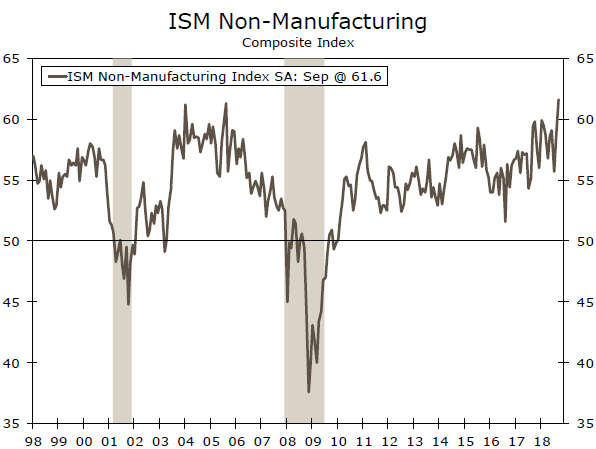
Economic activity strengthened in September with the ISM non-manufacturing index rising to a 21-year high. Fueling the gain was a record-high employment index. We have raised our estimate for payrolls to 210,000.
"Every Day Is a Bit Better Than the Last"
The ISM non-manufacturing index hit a 21-year high in September, leaping 3.1 points to 61.6. Current activity, new orders and supplier deliveries all increased. Backlogs continue to rise, helped in part by elevated levels of export orders.
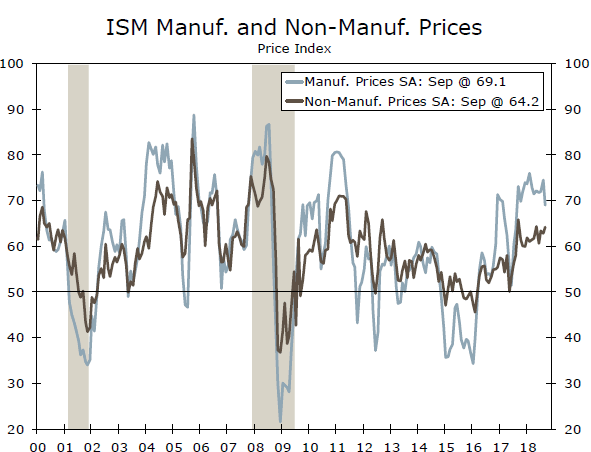
While price growth for manufacturing inputs has cooled from the torrid pace this spring, input prices for the rest of the economy show few signs of easing.
 "Cautious Due to Limitations in Available Manpower"
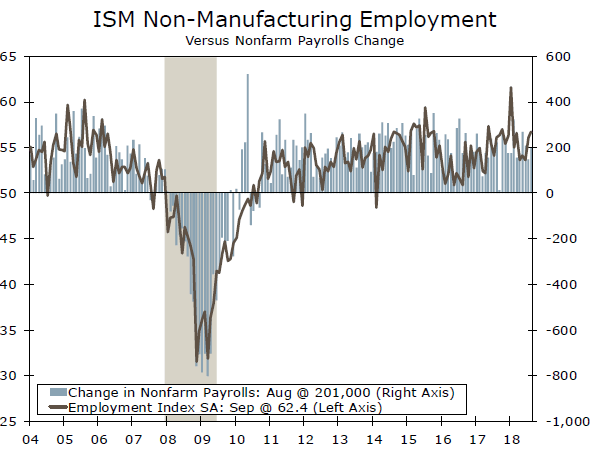
The employment index jumped to an all-time high of 62.4. We have subsequently raised our September nonfarm payroll forecast to 210,000 from 185,000. Respondents noted, however, that labor shortages are beginning to weigh on growth and earnings.
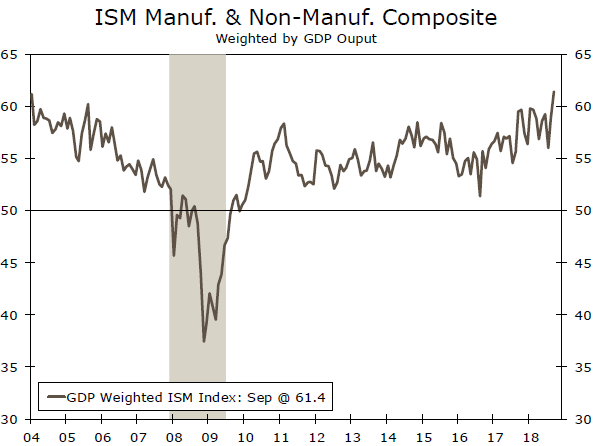
On an economy-weighted basis, the ISM indices rose to 61.4. The fresh cycle-high supports our call for GDP growth to remain solid as we head into the fourth quarter.
EURJPY Loses Ground in Ascending Sloping Channel
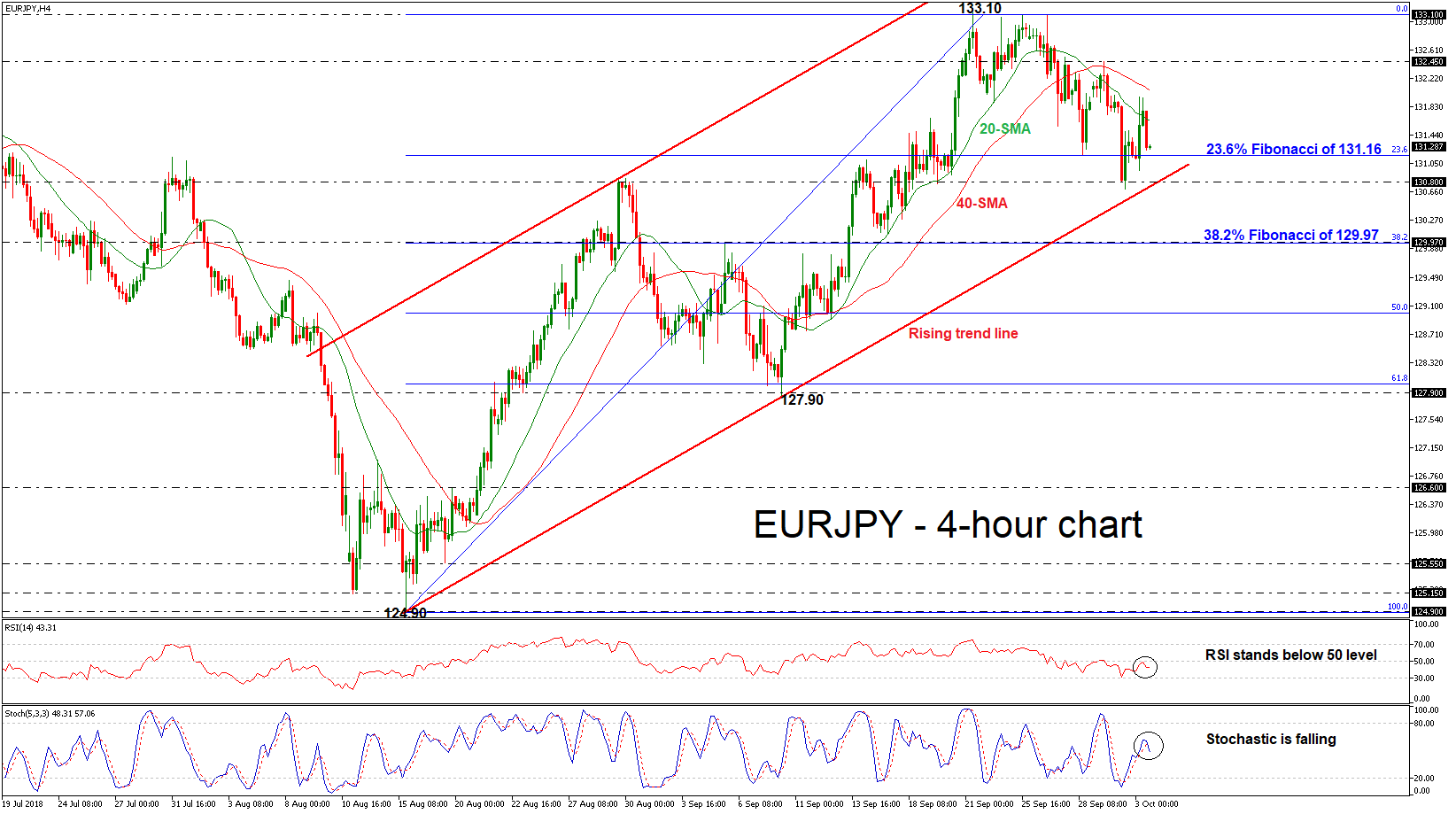
EURJPY edges lower over the last couple of hours, sliding below the 20- and 40-simple moving averages’ (SMAs) bearish crossover. The upside momentum appears to have run out of steam as prices have been attempting and failing to close above the 133.10 high in the previous days. The negative bias is further supported by the RSI, which has flattened in the negative zone, while the stochastic oscillator is moving lower.
If prices are able to break below the 23.6% Fibonacci retracement level of the upleg from 124.90 to 133.10, around 131.16 and the uptrend line of the short-term ascending channel, the risk would shift to the downside, with the 130.80 once again coming into focus. A drop below this level would push the pair until the 38.2% Fibonacci of 129.97.
On the other side, if the price tries to gain some ground, it would challenge the 40-SMA near 132.05. The next resistance level is coming from the 132.45 resistance level, taken from the latest highs. Above this level, the next target stands near the 133.10 barrier, identified by the peak on September 26.
Looking at the near-term picture, EURJPY has been trading within an upward sloping channel since August 15, after the pullback on the 124.90 obstacle.
Sunset Market Commentary
Markets
Global core bonds lost ground today. Overall risk sentiment improved on reports that Italy will lower its proposed budget deficit for 2020 to 2.2% and 2021 to 2.0%, both coming from 2.4%. The Italian BTP future rallied higher at the European opening bell while the German Bund turned south. Both movements didn’t carry through as investors were not convinced that the proposed budget deficit cuts would smooth differences with the EU. The final EMU services PMI (September) and August EMU retail sales were close to forecasts and had no influence on trading. Italy’s FM Tria commented around noon that Italy will seek an accelerated debt reduction in the coming years, committing to cut debt toward EU objectives. This initiated a fresh push for Italian BTP’s, bringing them back to opening levels. US Treasuries were steady today throughout European trading hours. US eco data proved stronger than expected with ADP saying US firms adding 230k jobs in September (est.: 184k). Speeches of Fed members had little impact. The US T-Note lost little ground. German yields add 1.5 bps (2-yr) to 2.5 bps (10-yr) today with the belly underperforming. 10-yr spread changes vs Germany are decreasing with Italy (-17 bps) outperforming. The US yield curve shifts 1.6 bps (2-yr) to 1.9 bps (10-yr) higher.
EUR/USD spiked higher early this morning, driven by an Italian “concession” to limit the budget deficit at 2% in 2021 instead of the 2.4% in the original plan, ‘informally’ rejected by the EU. The pair slowly but steadily lost the initial gain in today’s lower volume setting (Germany closed) as markets ponder whether Italy’s new proposal will withstand EU scrutiny. Mixed EMU data (slightly softer final PMI, August retail sales) were no help for the common currency. US eco data, on the other hand, might have been USD supportive. According to the ADP, the US created 230 000 additional jobs in September vs. 184 000 expected, suggesting yet another strong (official) payrolls report due this Friday. So, a soft euro vs. a firm dollar pushed the pair lower throughout the day. EUR/USD is currently trading at the 1.1530-zone. USD/JPY also edges higher today. The 114-mark is again on the radar.
Sterling witnessed some swing trading today. After losing ground after Boris Jonhson’s speech at the Tory party conference yesterday, Italy laid the foundation for this morning’s first upleg in EUR/GBP. The pair soon lost ground as Italian question marks persisted weighing on the euro. UK PMI’s were mixed-to-better, providing some limited support for sterling. However, the move reversed as PM May’s keynote speech to conclude the party conference, approached. May’s parley was much ado about nothing from a markets point of view. She barely touched upon Brexit and mainly reiterated (implicitly) her wish for the Chequers proposal to be accepted. EUR/GBP followed EUR/USD lower. The pair trades near 0.8875. In cable, sterling outweighs dollar, trading slightly higher near 1.30.
News Headlines
Turkish inflation numbers spiraled out of control in September following this Summer’s collapse of the Turkish currency. Headline, core and producer price inflation all surged more than expected, respectively by 24.52% Y/Y, 24.05% Y/Y and 46.15% Y/Y. EUR/TRY briefly returned above 7 on the release.
The UK services PMI declined slightly more than forecast in September, from 54.3 to 53.9. The final EMU services PMI was confirmed at 54.7. The US non-manufacturing ISM printed again very strong at 61.6 from 58.5 (vs 58.0 expected). ADP data showed that hiring occurred at the fastest pace in 7 months in an already tight US labour market. Private payrolls increased by 230k (vs 184k expected) from an upwardly revised 168k.
Saudi Energy Minister Al-Falih said that the Kingdom is currently pumping about 10.7 million barrels a day, just shy of November 2016 record output. Oil prices remain near cycle tops though (Brent crude >$84.5/barrel) as the output increase isn’t expected to match the decline in Iranian output.
ISM non-manufacturing jumped to 61.6, all time high since 2008
ISM non-manufacturing composite rose to 61.6 in September, up from 58.5 and beat expectation of 58.3. That's also an all-time high since inception of the composite index in 2008. Employment index jumped notably by 5.7 to 62.4. ISM also noted in the release that "17 non-manufacturing industries reported growth" and, "respondents remain positive about business conditions and the current and future economy."
Euro Hits Session Low after Upbeat US Jobs Data Boosted Dollar
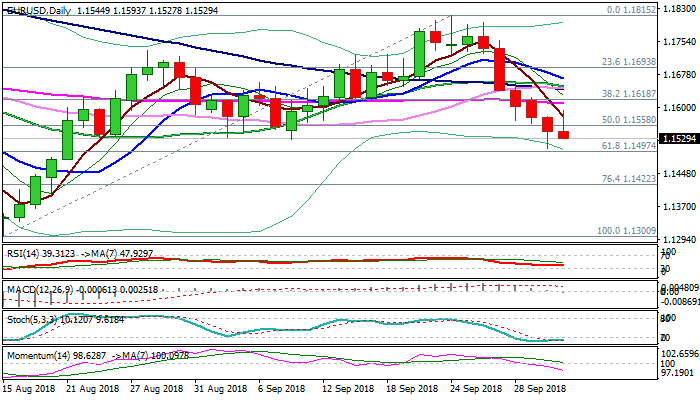
The Euro stands at the back foot in early American session and hit new low 1.1527, after better than expected US jobs data boosted dollar. ADP report showed that US private sector added 230K jobs in September, beating forecast for 187K new jobs and previous month’s upward-revised 168K figure. Initial boost to the single currency after Italy revised its budget plan faded and stronger greenback added to Euro’s existing strong bearish stance. Short-lived advance stalled on approach to 1.16 barrier, with subsequent weakness signaling strong upside rejection.
Fresh bears pressure daily cloud base, break of which would expose pivotal support at 1.1500 zone (Fibo 61.8% of 1.1300/1.1815), looking for bearish signal on close below.
Growing bearish momentum on daily chart supports negative scenario and offsets for now signals from oversold slow stochastic.
Sustained break below 1.15 pivot would open support at 1.1422 (Fibo 76.4%).
Broken Fibo 50% level marks initial resistance at 1.1558, while stronger upticks are expected to hold below 55SMA (1.1610) to keep bears intact.
Res: 1.1558; 1.1593; 1.1610; 1.1650
Sup: 1.1527; 1.1497; 1.1480; 1.1422