

Sample Category Title
RBNZ kept OCR unchanged at 1.75%, full statement
OCR unchanged at 1.75 percent
Statement by Reserve Bank Governor Adrian Orr:
The Official Cash Rate (OCR) remains at 1.75 percent.
We expect to keep the OCR at this level through 2019 and into 2020. The direction of our next OCR move could be up or down.
Employment is around its sustainable level and consumer price inflation remains below the 2 percent mid-point of our target, necessitating continued supportive monetary policy. Our outlook for the OCR assumes the pace of growth will pick up over the coming year, assisting inflation to return to the target mid-point.
Our projection for the New Zealand economy, as detailed in the August Monetary Policy Statement, is little changed. While GDP growth in the June quarter was stronger than we had anticipated, downside risks to the growth outlook remain.
Robust global economic growth and a lower New Zealand dollar exchange rate is expected to support demand for our exports. Global inflationary pressure is expected to rise, but remain modest. Trade tensions remain in some major economies, increasing the risk that ongoing increases in trade barriers could undermine global growth. Domestically, ongoing spending and investment, by both households and government, is expected to support growth.
There are welcome early signs of core inflation rising towards the mid-point of the target. Higher fuel prices are likely to boost inflation in the near term, but we will look through this volatility as appropriate. Consumer price inflation is expected to gradually rise to our 2 percent annual target as capacity pressures bite.
We will keep the OCR at an expansionary level for a considerable period to contribute to maximising sustainable employment, and maintaining low and stable inflation.
Meitaki, thanks.
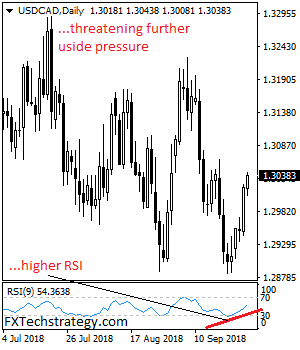
USDCAD – Retains Bull Pressure, Price Extension Eyes 1.3064/99 Region
USDCAD - retains bull pressure as it looks for further corrective recovery. Support lies at the 1.3000 level where a break will aim at the 1.2950 level. Further down, support comes in at the 1.2900 level where a turn lower may occur. But if further weakness occurs support comes in at the 1.2850 level. On the upside, resistance lies at the 1.3100 level where a violation will target the 1.3`50 level. Further up, resistance resides at the 1.3200 level and then the 1.3250 level. Its daily RSI is bullish and pointing higher suggesting further strength. All in all, USDCAD looks to strengthen further on correction.
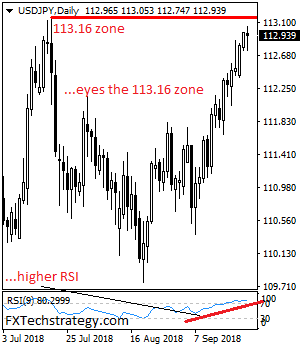
USDJPY – Bullish, Closes In On The 113.16 Resistance Zone
USDJPY - remains biased to the upside as it looks to recover further higher with eyes on its key resistance located at 113.16 level. Above here, resistance resides at the 113.50 level. Further out, we envisage a possible move towards the 114.00 level. Further out, resistance resides at the 114.50 level with a turn above here aiming at the 115.00 level. Its daily RSI is bullish and pointing higher suggesting further strength. On the downside, support lies at the 112.50 level where a break if seen will aim at the 112.00 level. A cut through here will turn focus to the 111.50 level and possibly lower towards the 111.00 level. On the whole, USDJPY faces further upside pressure.
FOMC Review: Gradual Fed Hikes Are Set To Continue
Fed is on autopilot and the destination is neutral
The Fed meeting turned out pretty much in line with what we wrote in our FOMC preview: Destination neutral , as the Fed raised the target range by 25bp to 2.00-2.25% and did not send any new important signals to the markets, supporting our view that the Fed is on autopilot and neutral is the destination. We expect hikes in December, March and June are quite likely , which would take the Fed funds rate to 3.00%, which is the Fed's long-run estimate of where monetary policy is neither expansionary nor contractionary (increased from 2.875% in the June projections, also not a big surprise).
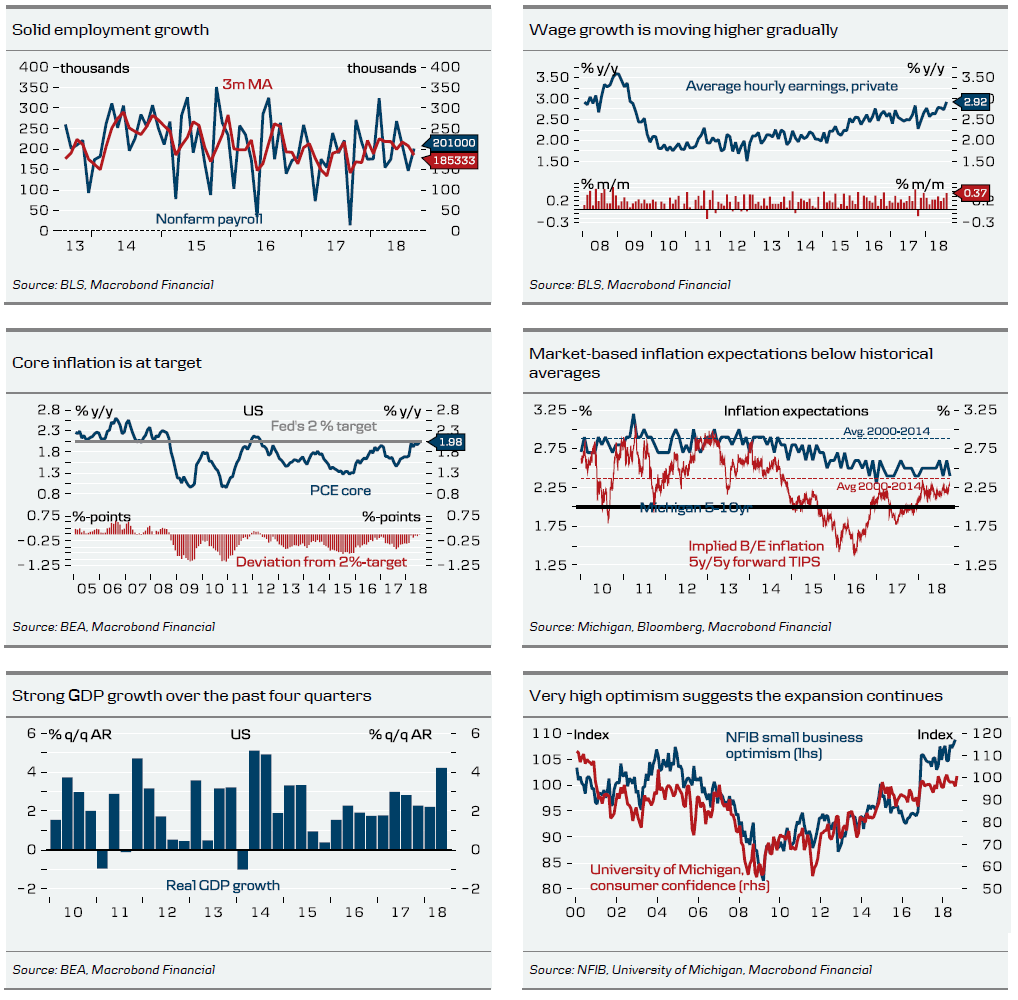
The Fed chose to remove the sentence that "monetary policy is accommodative" from the statement, but in our view it does not matter much, as it just reflects reality, as the hiking cycle has been underway now for some time. The real economy is in good shape and is stronger than when the Fed started its tightening cycle : growth is strong, employment continues to rise, wage growth is increasing, PCE core inflation is 2% and optimism is high. The trade war has not had a material impact on the US economy so far, partly because the US economy is quite closed and partly because the substantial fiscal boost is offsetting the negative impact from trade.
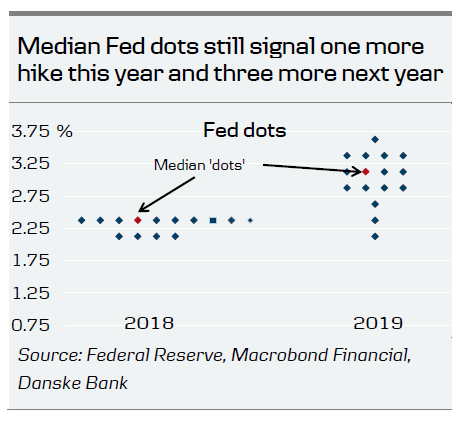
As we argued in our preview, it is more 'stop and go' for the Fed when neutral is reached, as further hikes depend on how the economy is doing and how markets are reacting to monetary tightening. The median Fed dot signals that the Fed thinks it is appropriate to continue hiking and the upper end of the target range is set to peak at 3.50% in 2020. Seven FOMC members think that it is necessary to hike once more in 2020, which is one hawkish takeaway from the meeting.
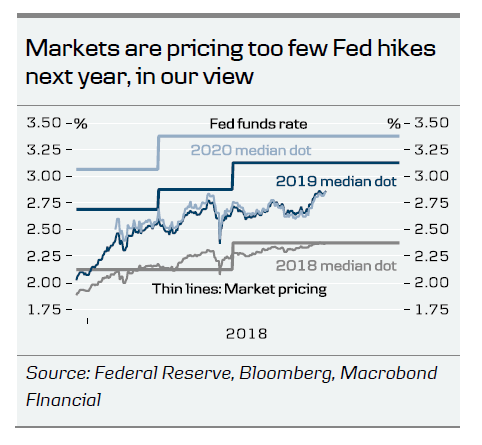
We still believe that the Fed will hike four times from now until year-end 2019 (in December, in March, in June and one time in H2 19), which would bring the upper end of the target range to 3.125% by year-end 2019.
As expected, the market reaction was limited. We still see a case for both 2yr and 10yr US Treasury yields . The short-end is pushed higher, as our Fed rate path is not priced in the money market curve. The long-end is pushed higher by a modest increase in the US term premium and higher supply from the more expansive US fiscal policy, which boosts US bond supply. We forecast US 10yr yields in 12M at 3.25%. For more, see the latest issue of Yield Outlook , 17 September.
With the Fed set to stay on autopilot for now, US rates are set to stay a source of USD support. This should help cement the status of the dollar as a carry currency both in terms of the level of, and the change in, short-end yields. With the Fed still keen to continue the process of moving rates back towards 'neutral', it remains too early in our view for the FX market to price the Fed going on hold. This should help EUR/USD revisit the 1.15 area again during the course of the autumn . But, as the ECB is set to signal a first hike coming up at a time where the Fed could be looking to go on hold, a EUR/USD uptick should start to materialise.Indeed, it is when easing stops - rather than when hikes occur - that currency appreciation is seen, and vice versa.
Picking Up The Pieces Post FOMC
US President Trump said to suggest he is going to call China President Xi tomorrow, which should be soothing news for a lot of cross assets none more so than Chinese equity markets. Keeping an eye on this one.!
US Markets
US stocks ended the day lower as the Fed is expected to stay the dot plot course for the foreseeable future, but nothing too unusual from what usually happens to equity markets every time there is a US interest rate hike. The modest wobble suggests little more than profit taking as there is nothing in the Feds policy statement to raise a red flag about US economic growth. Investors will be sponging up these dips even more so if the US-China trade tensions de-escalate. Of course, back channels were always open, but with the President offering to reach out to XI, this is indeed a very positive sign and likely in response to China very measured approach to the US tariffs. Notably, in keeping the Yuan as stable as can be.
Oil Markets
The DOE data for last week largely confirmed the silhouette offered up by Tuesday's American Petroleum Institute survey, with unexpected builds of 1.9 million barrels in US commercial crude stocks including 0.5 million barrels at the Cushing, Oklahoma delivery WTI hub while refinery crude runs dropped 901,0000 bpd. But one bullish surprise in the broader data set was that distillate inventories fell 2.2 million barrels last week on a drop-in refinery production.
But oil markets rebounded after Rick Perry quashed any notion of tapping SPR, suggesting that selling of strategic reserves would” have a fairly minor and short-term impact' Frankly, using this emergency response tool as a means of controlling oil prices was a bit of a stretch, given the storied history when the SPR's were released in the past.
History of the SPR releases
Not to mention the sale would probably end up doing little more than widening Brent -Crude spreads since the SPR sales would effectively make US oil cheaper and not necessarily the rest of the words supply.
Without sounding like a broken record, Oil prices remain in the Bulls domain amid concern that US sanctions on Iranian crude oil exports will result in much tighter physical market conditions once they take effect in November. While the US oil inventory data counts, the fact that the markets could still be underestimating the supply crunch from Iran sanction has many Oil investors running with the bulls.
Gold Markets
Gold prices fell after the US Federal Board raised interest rates despite the nonplussed initial reaction from G-10 currency traders. There was way too much hand-wringing leading up this FOMC that much of the key focal points were somehow lost in translation.
What should have been an easy exercise based on the fact US economy is firing on all cylinders suggesting the Fed's need to stay the course on interest rates, however in the absence of inflation there is no need to nudge the yield curve higher.
But for Gold prices, the song remains the same, with no haven demand, Gold ETF inflow stagnant and no real shift in investment allocation portfolios, most Gold dealers and market speculators are left watching the US dollar for direction. Until something breaks on the big dollar look for $1190-$1210 range trade to persist
Currency Markets
My currency colleagues in NY left the office with a migraine after getting whipsawed on FOMC double talk.
Canadian dollar
Not everyone is happy on the trade war front as the Loonie has slipped CAD is slipping to 1.3038 as US President Trump makes it clear he is unhappy with Canada. Holding little back, the president was quoted *TRUMP: IF CANADA DOESN'T makes a deal with the US, WE'RE TAXING CARS.
Trade of fade? I still expect a deal to go through but with the crowded trade mentality kicking in as traders find themselves long CAD at the much lower level, there some position trimming likely on stop losses weighing on the CAD sentiment this morning.
New Zealand dollar
The birds the word, as expected the RBNZ kept everything on hold today, given minimal expectation was going into this meeting the KIWI has traded neutral. Other than the usual RBNZ OCR “gap trap” at 5 AM due to the lack of liquidity over the' date change,” the Kiwi is trading flat so far.
Japanese Yen
There was a bit of a wobble into the NY close. Long USDJPY is a very subscribed trade, and signs the yield curve was flattening, traders were more apt to book profits towards the end of the overnight trading session. But with important support level holding firm and the FED painting a slightly rosy outlook for the US economy, it appears the markets continue to favour USDJPY higher over the short term.
Euro
I keep looking for some Italian budget concerns that are frankly not there as the risk of a Euro collapse on the back of the Italian budget is almost entirely priced out. Back to the basics on this trade.
EM Asia
Malaysian Ringgit
The MYR is struggling on the back of equity outflows as the Ringgit continues gravitating towards the top of the near-term range 4.12-4.15 despite Oil prices recovering. Again, volumes are very low as traders are looking for some spark
Indonesian Rupiah
The Bank Indonesia is likely to hike, but in context of consecutive trade deficits in July and August, the IDR remain in currency speculators weakest links in the chain.
Philippine Peso
The BSP will hike by 50bps, in line with consensus expectations. The BSP is likely to keep its hawkish tone even after the September rate hike to ward off inflation.
Another Exercise In FOMC Verbal Gymnastics
Another exercise in FOMC verbal gymnastics
When it comes to the FOMC initial uptake, appearances can be deceiving if not flat out confusing as traders are tasked to respond quickly to what is often little more a series of FOMC verbal gymnastics implied in the accompanying statement only to have to have some clarity delivered at the press conference. Even more so this morning when the Fed removed the term 'accommodative' from their FOMC statement.
Fact:
The Feds Leal Brainard and Charles Evans explicitly talked about hiking beyond neutral last week, so the removal of the term 'accommodative' should have been clear as a bell as the FOMC doves were detouring in a hawkish direction over their rate outlook. Dropping the word 'accommodative' should not have had any material impact on the future path of US monetary policy. It's clear as day a majority of the Committee think that it will be appropriate to continue raising the federal funds rate as graphically illustrated in the dots that spell out the Fed rate hike intentions over the next few years.
View:
Indeed, a bearish dollar overreaction to the initial uptake on the statement, but Chair Powell in his introductory statement to the press conference, he clarified what dropping accommodative means, and succinctly, these two @terminal headlines spell it out nicely
*POWELL: DROPPING ACCOMMODATIVE DOESN'T SIGNAL RATE-PATH CHANGE
*POWELL: OVERALL FINANCIAL CONDITIONS REMAIN ACCOMMODATIVE
In a beautiful example of FED verbal gymnastics:
'It wasn't because the policy is not accommodative. It is still accommodative.'
Fact:
But this clarification was not convincing enough to support US bond yields, especially after Chair Powell told reporters during his post-FOMC new conference 'The main thing where we might need to move along a little bit quicker if inflation surprises to the upside. We don't see that' So while the US economy is firing on all cylinders, in the absence of inflation its the FOMC are unlikely to nudge future rate hike forecasts higher, a position the Feds have held since forever.
View:
But, the fall in US bond yields should not be interpreted as a dovish lean from the FOMC but rather that the Bond markets see future Fed hikes are more reasonably priced into the equation while taking back short bond positions that we're hedges against possible hawkish tail risk. Which has triggered flattening across the curve providing a headwind USDJPY which has moved down to test near-term support while the DXY Index is partially unchanged suggesting the FOMC was, as we anticipated, a non-event for g-10 currency markets.
However high beta currencies continue to trade favourably, and with the Feds holding the dot plot curve steady as she goes, the lack of hawkish follow through should be comforting to Asia EM currencies.
Summation:
Far too much ink was spilt on this event as ultimately what counts for currency markets is US economic growth, data and lots of it, such as next weeks payrolls number and the significant wage growth component. The FOMC is entirely data dependant, and a definite uptick in inflation will ultimately change the Feds view.
Eco Data 9/27/18
[php_everywhere instance="1"]
Fed Raises Rates and No Longer Considers its Policy “Accommodative”
As expected, the Federal Open Market Committee (FOMC) raised its federal funds target rate range by 25 basis points to between 2 percent and 2 ¼ percent.
The statement's characterization of the economy was completely unchanged from their previous statement. "The labor market has continued to strengthen and…economic activity has been rising at a strong rate."
Besides the new interest rate, the only change to the statement was the removal of the sentence noting that: "the stance of monetary policy remains accommodative..."
Near-term economic forecasts were marked to market (reflecting recent strong momentum), but were otherwise largely unchanged relative to the previous Summary of Economic Projections in June:
- The median projection for real GDP growth in 2018 rose to 3.1% (from 2.8%), and to 2.5% in 2019 (from 2.4% previously). The forecast for 2020 was unchanged (at 2.0%), while the newly added 2021 came in at 1.8%, the same as the "longer run" projection.
- The median unemployment rate forecast edged up to 3.7% in 2018 (from 3.6% previously), but was unchanged thereafter at 3.5% for 2019 and 2020. Interestingly, the projection for 2020 is for unemployment to move to 3.7%, still significantly below the longer run estimate of 4.5%.
- On inflation, the median estimate for core PCE was unchanged at 2.1% in 2018, but edged down to 2.0% for 2019 and unchanged for 2020 at 2.1%.
- The median expectation for the federal funds rate was unchanged throughout the projection horizon, with three hikes anticipated in 2019 (bringing median dot to 3.1% by year end), and at least one more in 2020 (median dot at 3.4%). Notably, the median projection for the federal funds rate is anticipated to remain above the longer-run neutral level through 2021.
Key Implications
The most notable thing about this statement was not what it contained but what it left unsaid and what it removed. The statement contained no mention of trade risks and removed the characterization of monetary policy as "accommodative."
Financial markets may treat the removal of "accommodative" as dovish, but FOMC members are sticking to their guns in expecting further rate hikes. Members have cemented their expectations for at least one more hike this year and continue to see three more hikes in 2019. In a new twist, policy will remain above "neutral" through 2021.
The overshoot of the federal funds rate relative to FOMC members' longer run assumption is necessary to square the circle between an unemployment rate that remains well under its longer run rate and inflation that barely budges from 2.0%. Risks to the inflation outlook from higher tariffs appear not to be incorporated into SEP projections, but neither are the potentially deleterious impacts on economic growth.
Fed chair Powell’s press conference live stream
https://www.youtube.com/watch?v=ZEfZNWE8laY
Another look at Fed funds rate projections, doves become less dovish
Here's another dig at the fed funds rate projections. The central tendency is pretty much unchanged. However, overall, the projections argue that the doves in FOMC are getting less dovish. And that should be Dollar supportive. We might see the greenback quickly regains growth after initial spike lower.
Firstly, let's clarify that median means middle projection. Central tendency excludes the three highest and the three lowest. Range includes everyone's projections.
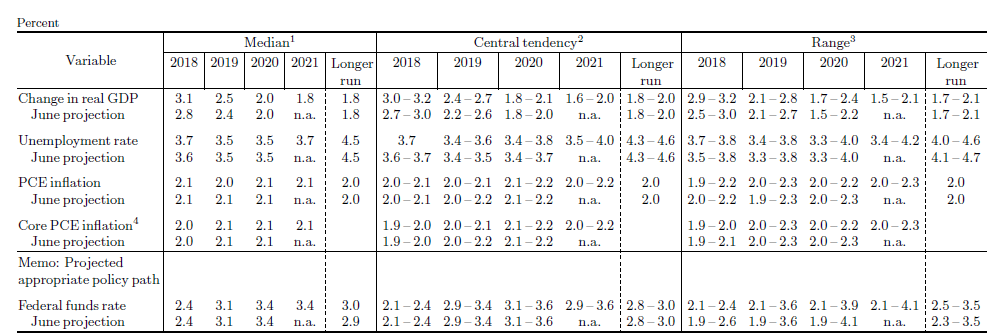
Now, the central tendency projections are pretty much unchanged. Except that it's lowered from 3.1-3.6 in 2020 to 2.9-3.6 in 2021. That is, some might expect a cut in 2021? That's possibly for the expectation of deeper slow down in GDP growth to 1.6% and faster rise in unemployment rate to 4.0%.
The "range" projections are more interesting. For 2018, it's changed from 1.9-2.6 to 2.1-2.4. That is normal given that it's already September and expectations converged.
For 2019, range changed from 1.9 - 3.6 to 2.1 - 3.6. That means, doves are in some ways conceding ground but hawks stayed the same. Fed should be more "firm" on its path for another three hikes next year.
For 2020, range changed from 1.9-4.1 to 2.1 - 3.9. That means doves become less dovish and hawks become less hawkish too!
For 2021, range is at 2.1 - 4.1, suggesting some might have pushed back another hike in 2020 to 2021.
Long run range was changed from 2.3 - 3.5 to 2.5 - 3.5. That suggests doves also agree to a rise in neutral rate estimate. Another sign that they're less dovish.