

Sample Category Title
Gold stays in range after FOMC volatility
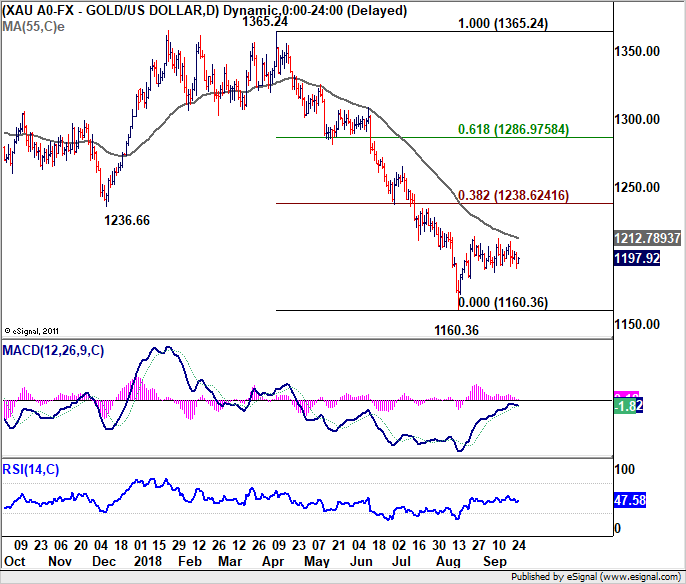
Gold is still bounded in range of 1187.58/1214.30 after FOMC triggered volatility. Outlook remains unchanged for now. While more consolidation could be seen, another rise is in favor as long as 1187.58 support holds. Break of 1214.30 will extend the rebound from 1160.36 and target 38.2% retracement of 1365.24 to 1160.36 at 1238.62.
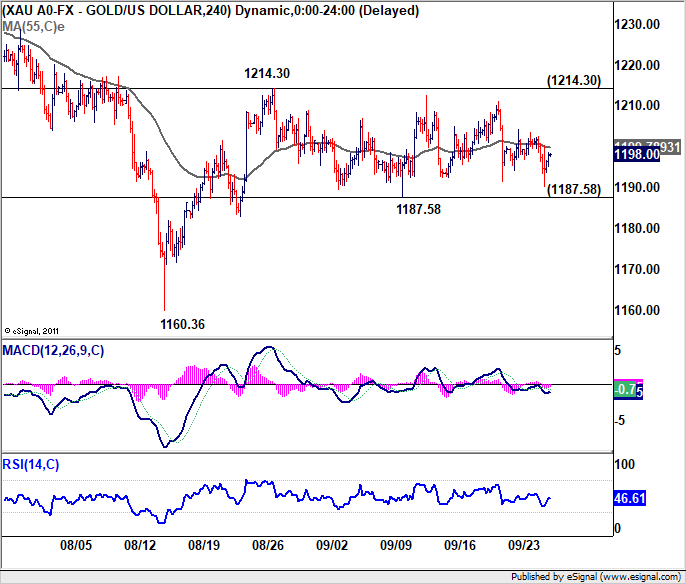
However, as such rebound is seen as a corrective move, we'd expect strong resistance from 1238.62 to limit upside. On the downside, break of 1187.58 will suggest that the rebound is completed and bring retest of 1160.36 low.
Crude Oil Price Remains In Uptrend Above $71.30
Key Highlights
- Crude oil price is trading with a bullish bias above the $71.00 support against the US dollar.
- There is a key ascending channel in place with support at $71.40 on the 4-hours chart of XTI/USD.
- The Fed increased interest rates from 2.00% to 2.25%.
- The US GDP for Q2 2018 will be released today, which is forecasted to grow 4.2%.
Crude Oil Price Technical Analysis
There was a solid support base formed near $68.40 in crude oil price against the US Dollar. The price started an upward move and traded above the $70.00 and $71.00 resistances.
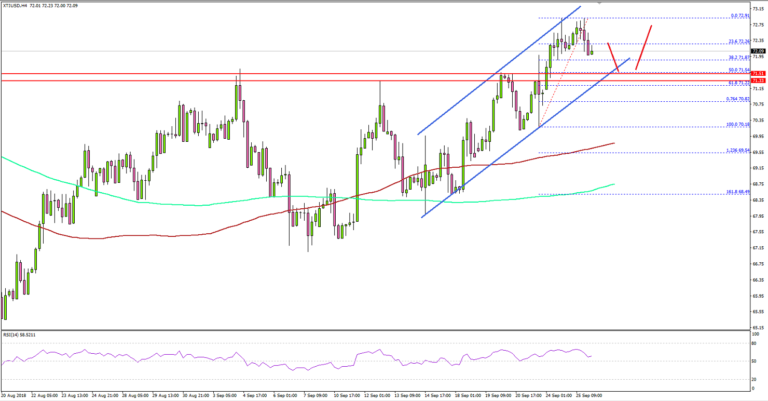
Looking at the 4-hours chart of XTI/USD, the price remained in an uptrend and settled above the $71.00 support and the 100 (red) simple moving average (4-hours). The price traded as high as $72.91 recently and it is currently correcting lower.
It broke the 23.6% Fib retracement level of the last wave from the $70.18 low to $72.91 high. The current price action suggests that there could be more gains above the $72.00 level.
On the downside, there is a major support formed near $71.40-50. There is also a key ascending channel in place with support at $71.40 on the 4-hours chart of XTI/USD.
The channel support is close to the 50% Fib retracement level of the last wave from the $70.18 low to $72.91 high. Therefore, as long as the price is above the $71.40 support, there could be more gains towards $73.00 in the short term.
If there is a break below $71.40, the price may perhaps test the next major support at $71.00.
Economic Releases to Watch Today
- German Consumer Price Index for Sep 2018 (YoY) (Preliminary) – Forecast +2%, versus +2% previous.
- German Consumer Price Index for Sep 2018 (MoM) (Preliminary) – Forecast +0.1%, versus +0.1% previous.
- US Gross Domestic Product Q2 2018 – Forecast 4.2% versus previous 4.2%.
- US Durable Goods Orders for August 2018 – Forecast +2.0% versus -1.7% previous.
Market Morning Briefing: FED Raised Interest Rates By A Quarter Percent From 2.0% To 2.25%
STOCKS
FED raised interest rates by a quarter percent from 2.0% to 2.25%, with plans of further tightening the policy. Median forecasts indicate another hike this year followed by 3 hikes in 2019 and one in 2020, in line with the previous expectations. No mention of trade worries was seen in the post meeting talks but the Fed could be attempting to lower the impact of higher trade tariffs for both inflation and growth figures.
Dow (26385.28, -0.40%) came off a bit after the FED meeting. But while above 26250, upmove in the medium term looks possible. Even if a break below 26250 is seen, lower support near 26000 may hold in the longer run. We do not look at a fall below 26000 in the medium term.
Dax (12385.89, +0.091%) could dip towards 12300-12200 as mentioned yesterday while the daily resistance near 12500 holds. On the weekly chart, there is scope for an eventual rise towards 12700 in the longer run.
Nikkei (24047.43, +0.054%) has resistance on the daily candle chart near 24200 and while that holds, a short corrective dip is possible from 24200. For the next 2-sessions a rise towards 24200 is possible.
Shanghai (2807.51, +0.051%) has immediate resistance near 2850 and that needs to break on the upside to keep the index moving higher in the medium term. A short dip from 2850 could be seen before resuming a rise towards 2900 or higher.
Nifty (11053.80, -0.12%) came off from levels below 11200 yesterday. While below 11300-11200, Nifty could trade lower or remain ranged in the 10800-11200 region. Weekly chart suggests that the support at 10800 may holds and eventually take the index higher in the medium term.
COMMODITIES
Crude prices trade higher after comments from Trump stated that he expects full compliance by US allies. Focus remains on the impact of Iran sanctions. Some analysts think that the US administration may consider releasing oil from the Strategic Petroleum Reserve given Trump's stance on the Iran sanctions and his concern over rising oil prices.
Brent (82.25) has risen and could move up towards 84-85 in the near term.. WTI (72.47) is also trading higher and could test 74 in the coming sessions. Overall crude prices look bullish in the near term.
There is no progress in the Gold (1201.40) price movements and the sideways consolidation continues for now. As mentioned earlier 1190-1220 remains the region of trade in the near term.
Copper (2.8170) is trading below resistance near 2.85. As mentioned earlier, we could see the current dip to extend to 2.75 before again bouncing back to move higher. Near term is likely to remain stable.
FOREX
The FOMC couldn't move the Dollar Index much. However watch out for resistance @ 94.5 on the Dollar Index and support near 1.17 on Euro. The Rupee could strengthen slightly today.
Dollar Index (94.31): Even though the Fed dropped the term ‘accommodative' while describing its policy stance (a dovish step), it still indicated stronger possibility of a rate hike in Dec '18 and 3 more hikes in 2019. This has prevented any weakening in the Dollar Index. Immediate resistance near 94.5 needs to be watched – a break above this level would be bullish. A week close below the 21 weeks MA (94.57) would be bearish for the Dollar Index in the near term.
Euro (1.1749): The Fed's balanced policy outlook has had little effect on Euro. The support near 1.1725-1.1700 continues to be important – a break below it would be bearish. We could see some more ranging between 1.1800-1.1725 in the next couple of sessions – watch out for the release of the US GDP figures later today – a higher than expected growth figure could be bearish for the Euro.
Dollar Yen (112.78): As expected, Dollar Yen tested levels near 113.14 yesterday (close to its July '18 high of 113.18) and has come off from there. While it stays above 112.5-112.3, it could again rise and break above the 113.18 resistance in the coming 1-2 weeks. However, a break below 112.3 might make it bearish towards 111.5 in the next couple of weeks.
Euro Yen (132.49) has been facing resistance near 133 in the last 4-5 sessions. There are chances of some interim correction towards 131 if the Euro tests support near 1.1725 and Dollar Yen dips to 112.5. However, bias for the coming couple of weeks remains bullish towards levels of 134-135.
Pound (1.3150) has some support near 1.315-1.310, from where it could rise towards 1.325-1.330 in the coming week. A week close above the 21 weeks MA (1.3148) would be bullish.
Aussie (0.7262) breached resistance near 0.73 yesterday but is again trading below it. While it stays above support near 0.725, a rise towards higher resistance near 0.735 on daily candles looks likely in the next week.
Dollar Rupee (72.61) Dollar-Rupee likely to remain in the 72.50-72.75 region with some chances of testing 72.40/20 in the near term.
INTEREST RATES
The US Fed raised the federal funds rate by 25 bps to 2.25% as expected. A significant change in the policy statement was the dropping of the term 'accomodative' as a description of the current policy stance - this is being regarded as an acknowledgement by the Fed that interest rates are closer to the neutral rate now. Inspite of this dovish element, the Fed dot-plot remained largely the same as it was in the June '18 meeting - a December rate hike is now favoured by 12 out of 16 Fed members while a majority of the members are expecting 3 rate hikes in 2019.
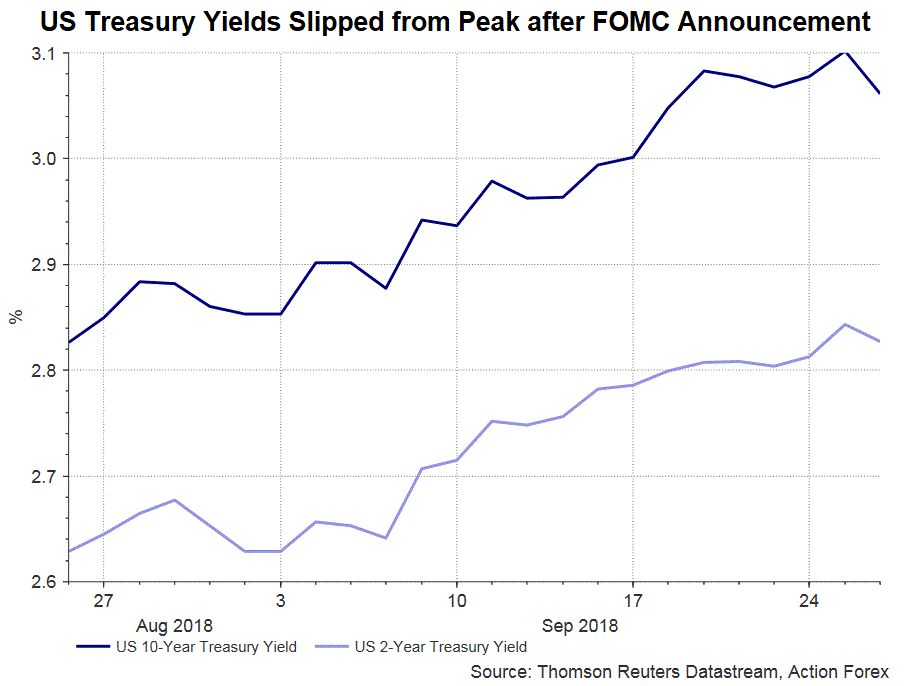
The dovish aspect of the policy has ensured a dip in US Yields. The US 10 Year (3.05%) has come off from levels near 3.10% - while it stays below 3.10%, there are chances of it going back below 3% in the near term.
The 10 Year German-US spread (-2.52%) seems to be breaking above trendline resistance on medium term chart and could now target -2.45% in the near term. This would be further supportive of a dip in the US 10 Year yield.
The German 10 year yield (0.53%) might face trendline resistance near 0.54% on medium term chart - this is lower than the resistance @ 0.6% which we have been mentioning previously.
A rise towards -2.45% on the German-US 10 year spread coupled with the German 10 Year yield staying below 0.54% raises possibility of a dip in the US 10 Year below 3%.
If the above happens, our earlier forecast of 3.100%-3.125% being the year's top for the US 10 Year yield would be proven correct.
The Japanese 30-10 spread (0.78%) could have some resistance near 0.80% - for the resistance to hold, either the 30 year yield's (0.89%) upside could be restricted till 0.93%, or else, the 10 year yield (0.11%) might break the 0.13% resistance. In either case, a rise above 0.80% on the 30-10 differential would be an important event and potentially bullish for yields globally.
NZD/USD range bound after non-eventful RBNZ rate decision
NZD/USD trades steadily in range after RBNZ kept OCR unchanged at 1.75% as widely expected and delivered no surprise to the markets. Governor Adrian Orr reiterated in the statement that "we expect to keep the OCR at this level through 2019 and into 2020." He also kept the options open and indicated the next move could be "up or down". Economic projections are "little changed" from the August MPS. Even though Q2 GDP was stronger than anticipated, Orr noted "downside risks to the growth outlook remain". He concluded the statement by repeating "we will keep the OCR at an expansionary level for a considerable period to contribute to maximising sustainable employment, and maintaining low and stable inflation."
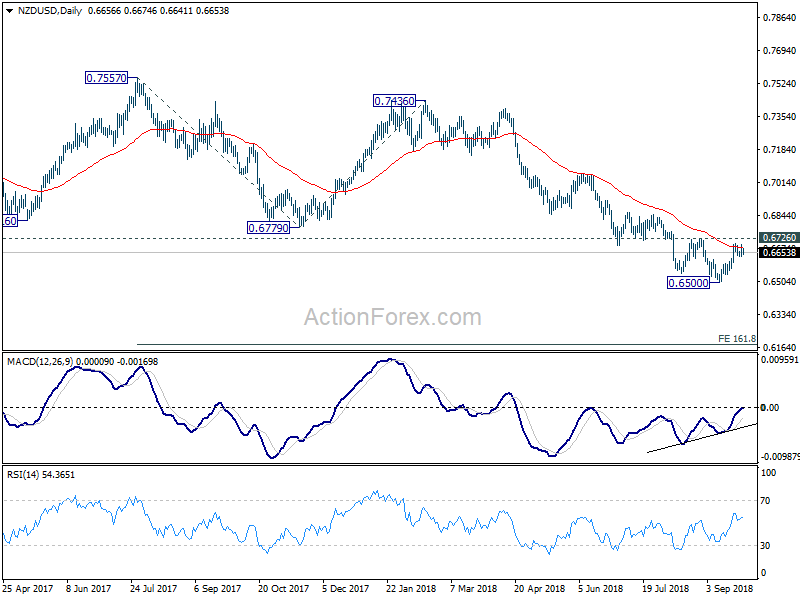
NZD/USD's rebound from 0.6500 lost momentum after hitting 0.6698 and turned sideway. While further rise still be seen, we'd expect strong resistance from 0.6726 to limit upside to complete the corrective rebound. On the downside, break of 0.6607 will bring retest of 0.6500 low.
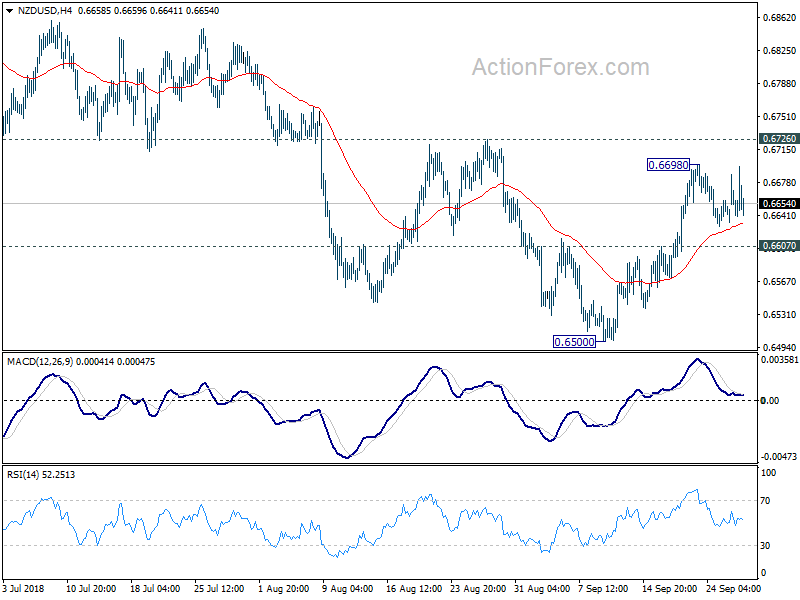
In the bigger picture, with 0.6726 resistance in tact, outlook in NZD/USD stays bearish. Medium term down trend from 0.7436 is still in progress to 161.8% projection of 0.7557 to 0.6779 from 0.7436 at 0.6177. Nonetheless, considering bullish convergence condition in daily MACD, sustained break of 0.6726 will indicate medium term bottoming and bring stronger rebound.
Japan PM Abe agreed bilateral talks with US only on goods
Japan and the US agreed to start bilateral trade talks after meeting of Prime Minister Shinzo Abe and Trump. But after the meeting, Abe emphasized that the new framework would only be a Trade Agreement on Goods. It's not a full Free Trade Agreement that includes investments and services. Both countries pledged in a joint statement to "respect positions of the other government."
However, US Trade Representative Robert Lighthizer ignored the position of Japan. He told reporters he's aiming for a full free trade deal requiring approval by Congress under the "fast track" trade negotiating authority law. Lighthizer added the talks will be handled in two "tranches" targeting an "early harvest" on reducing tariffs and non-tariffs barriers in goods.
In the joint statement, it's noted that:
- For the United States, market access outcomes in the motor vehicle sector will be designed to increase production and jobs in the United States in the motor vehicle industries; and
- For Japan, with regard to agricultural, forestry, and fishery products, outcomes related to market access as reflected in Japan's previous economic partnership agreements constitute the maximum level.
FOMC Hiked Rate and Removed “Accommodative” Policy Reference
FOMC raised the Fed funds rate, by +25 bps, to 2-2.25% in September. While the accompanying statement was largely dubbed from the previous meeting, the market has viewed the removal of the “accommodative” policy language has slightly dovish. This is evidenced in the instant drop of Treasury yields and US dollar’s weakness against the euro. We are not surprised by the removal of the reference. Indeed, the members have, over previous meetings, called for an adjustment in the statement language. They believe that, after a number of interest rate increases since December 2015, describing the current policy as “accommodative” is no longer appropriate.
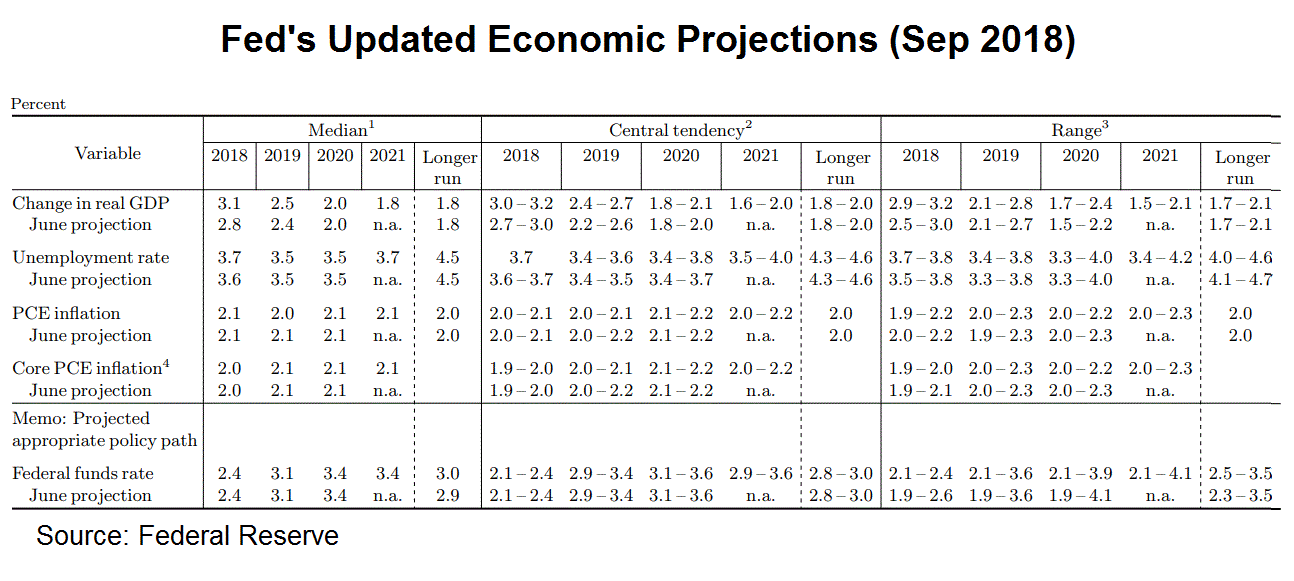
 The staff economic projections and the updated median dot plot appear more optimistic that in the previous meeting, though. The median projections for real GDP growth were upgraded to +3.1% (from +2.8%) in 2018, and to +2.5% (from +2.4%) in 2019. The forecast for 2020 was unchanged at +2%. The Fed introduced the projection for 2021, which is +1.8% and the same as the "longer run" projection.
The median unemployment rate forecast was revised slightly higher to 3.7% (from 3.6% previously) in 2018, but stayed unchanged at 3.5% for 2019 and 2020. The unemployment rate is expected to increase to 3.7% in 2021 and to 4.5% in the longer run.
The median estimate for core PCE was is expected to reach +2.0% (unchanged) in 2018, and then rise to 2.1% and stay there still 2021.
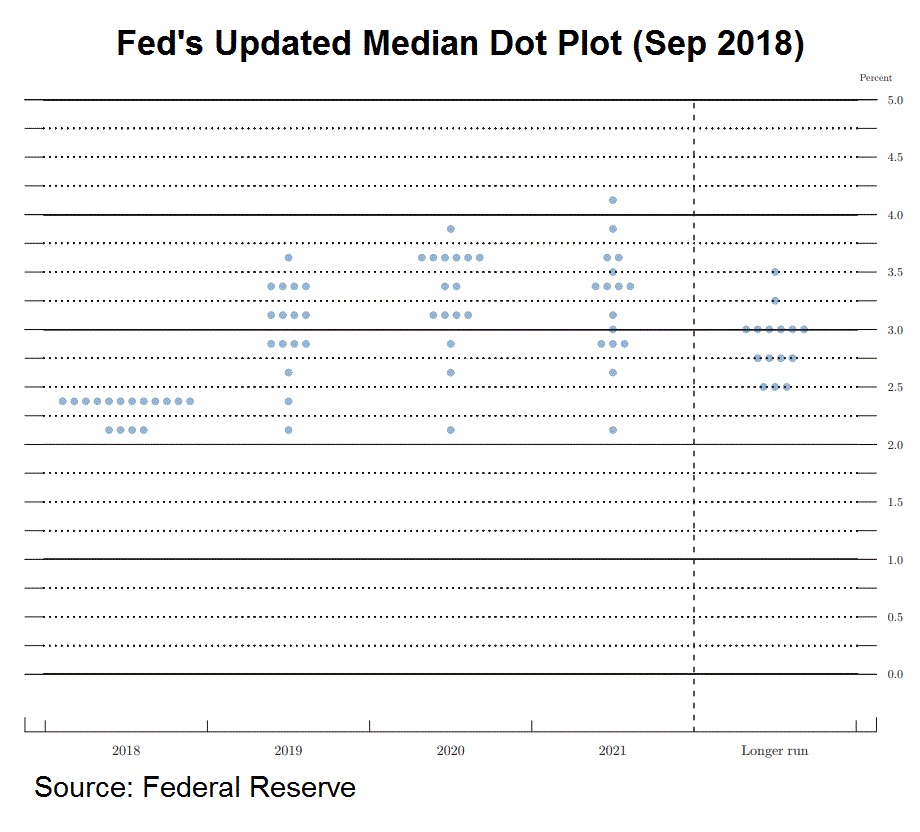
On the policy rate outlook, the median expectation for the Fed funds rate was unchanged throughout the projection horizon, with one more hike this year, followed by 3 hikes in 2019 and 1 in 2020. That is, median dot for the policy rate is 3.1% by end of 2019 and 3.4% by end- 2020. The longer-run neutral rate is projected to be 3.0%. There appears to be some upside risk to hikes in 2020, as 7 members expect more than one hike next year.
The policy statement was largely the same as the previous one with one major change – removal of the reference that “The stance of monetary policy remains accommodative, thereby supporting strong labor market conditions and a sustained return to +2% inflation”. The market views this as slightly dovish – as Fed sees the policy as less accommodative, it might be approaching the end of the rate hike cycle. However, Powell assured that the adjustment does not imply a change in Fed’s gradual monetary policy path. We do not find the adjustment surprising at all. Indeed, the members have, over past meetings, called for an adjustment in the statement language. They believe that, after a number of interest rate increases since December 2015, describing the current policy as “accommodative” is no longer appropriate.
Trump rejected non-existent meeting request of Trudeau, launched fresh personal attacks
Trump "claimed" he rejected one-on-one meeting with Canadian Prime Minister Justin Trudeau on trade. Additionally, Trump launched fresh personal attacks on both Trudeau and the Canadian team. In response, Trudeau shouldered it and pledged to continue work for a good deal for Canada, but be prepared to walk away.
Trump said he turned out the meeting request because "his tariffs are too high, and he doesn't seem to want to move", referring to Trudeau apparently. Trump repeated his threat and said "forget about it and frankly we're just thinking about just taxing cars coming in from Canada". He stepped up further and said "that's the motherlode, that's the big one."
Additionally, Trump added that "We're very unhappy with the negotiations and the negotiating style of Canada. We don't like their representative very much. That's another personal attack on apparently on Canadian Foreign Minister Chrystia Freeland.
Trudeau spokeswoman Chantal Gagnon said: "No meeting was requested. We don't have any comment beyond that." Trudeau himself reiterated "we will keep working as long as it takes to get to the right deal for Canada." He also emphasized Canada would need to feel confident "about the path forward as we move forward - if we do - on a NAFTA 2.0."
It's now clearly more likely then not the Canada-US NAFTA negotiation will slip the US imposed deadline of October 1. It's reported that the US could publish the text of the agreement with Mexico on Thursday or Friday and move on with the process, without Canada.
Is the Fed Funds Rate Now in “Neutral” Territory?
As widely expected, the FOMC hiked rates 25 bps today. Interestingly, the committee removed its reference to "accommodative" policy, which suggests that rates may have entered "neutral" territory.
FOMC Removes Reference to "Accommodative" Policy
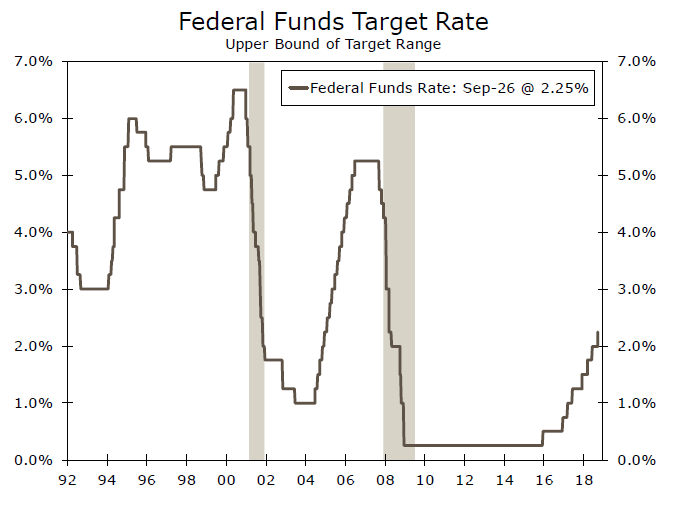
As widely expected, the Federal Open Market Committee (FOMC) decided by unanimous vote today to raise its target range for the fed funds rate 25 bps. The range now spans 2.00% to 2.25%. Since the Fed began its tightening cycle in late 2015, it has raised its target range 200 bps (top chart).
In our view, the most interesting aspect of the policy statement that the Fed released at the end of today's meeting was its characterization of the current state of monetary policy. In previous statements, the FOMC said that "the stance of monetary policy remains accommodative." That is, short-term interest rates were still low enough that they were boosting the pace of economic activity. Notably, the FOMC dropped its reference to accommodative policy in today's statement.
In recent public announcements, some Fed policymakers have expressed their opinion that the fed funds rate would soon enter "neutral" territory. That is, monetary policy would not be boosting, nor would it yet be restraining, the pace of economic activity. By removing the reference to accommodative policy, the committee is implicitly acknowledging that the fed funds rate has moved into neutral territory.
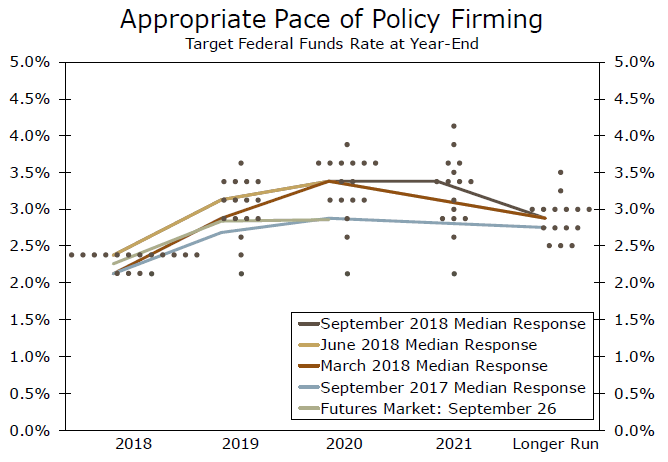
That is not to say that rates will not rise further from here. The neutral fed funds rate is not precisely measured and its range could be broad. Indeed, the so-called "dot plot" shows that the vast majority of FOMC members believe that another 25 bps rate hike by the end of the year would be appropriate (middle chart). Moreover, the median projection of FOMC members looks for 75 bps of further rate hikes in 2019 and 25 bps of additional tightening in 2020. Our own forecast is more or less in line with the Fed's projections. That is, we look for another 25 bps of tightening in December and three rate hikes of 25 bps each in 2019, before the Fed remains on hold for roughly a year.
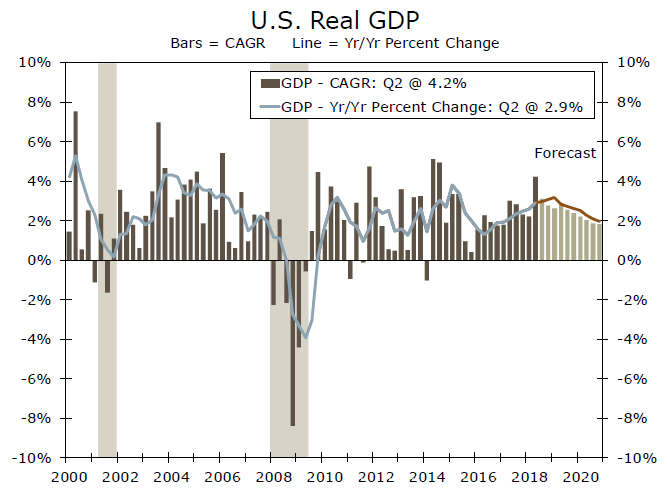
In its statement today, the FOMC said that "economic activity has been rising at a strong rate." We forecast that growth will generally remain solid in coming quarters, but that it will slow somewhat from the 4.2% annualized rate that was registered in Q2-2018, as fiscal stimulus fades and as previous monetary tightening exerts some headwinds on the economy (bottom chart). Looking into 2020, we believe that growth will slow enough to lead the Fed to reverse itself by cutting rates 25 bps at the end of 2020. Admittedly, the end of 2020 is a long time from now and our visibility two years ahead is undoubtedly cloudy. In the meantime, it seems likely that the FOMC will continue to hike rates at a gradual pace. The end of this tightening cycle has not yet arrived. But by removing its reference to accommodative monetary policy today, the FOMC may be signaling (in the words of Sir Winston Churchill) "the end of the beginning" of the current tightening cycle.
Fed Raises Rates as Expected; More to Come this Year and Next
Highlights:
- The target range for the fed funds rate was raised another 25 basis points to 2.00-2.25%. Today’s move was widely expected and fully priced into markets.
- With the real policy rate now above zero (a more ‘normal’ policy stance) and nearing some estimates of the neutral rate, the statement no longer indicated monetary policy “remains accommodative.”
- The ‘dot plot’ medians were unchanged, continuing to show another rate hike this year and three moves in 2019.
- 2021 was added to the dot plot though the fed funds median is flat at 2020’s 3.25-3.50% range, indicating the central bank expects to raise rates only modestly above the assumed ‘neutral’ policy rate.
- The 2018 GDP growth forecast was revised up to 3.1% from 2.8% previously and next year’s projection was also nudged higher. Inflation and unemployment rate projections saw only slight revisions.
Our Take:
Today’s rate increase was widely expected and fully priced into markets. The closest thing to a surprise came from the policy statement, which no longer indicated “monetary policy remains accommodative.” Chair Powell noted that language has “run its useful life,” and while policy remains somewhat accommodative it is now close to the Fed’s range of estimates of the longer run ‘neutral’ rate (2.5-3.5%). So removing that phrase seems to be more of a milestone in the normalization process than an indication of where policy is heading from here. On that score, the ‘dot plot’ showed little shift in the Committee’s expected rate path, with another increase seen later this year and three hikes in 2019. That remains slightly ahead of what markets have priced in but below the four hikes we expect next year. We continue to see little reason for the Fed to slow their tightening process amid late-cycle fiscal stimulus. Upward revisions to the Committee’s growth forecasts are a testament to the US economy’s momentum, and we think upside risks to inflation argue for further rate hikes and an eventual shift to somewhat restrictive monetary policy.
(RBNZ) Official Cash Rate unchanged at 1.75 percent
Statement by Reserve Bank Governor Adrian Orr:
The Official Cash Rate (OCR) remains at 1.75 percent.
We expect to keep the OCR at this level through 2019 and into 2020. The direction of our next OCR move could be up or down.
Employment is around its sustainable level and consumer price inflation remains below the 2 percent mid-point of our target, necessitating continued supportive monetary policy. Our outlook for the OCR assumes the pace of growth will pick up over the coming year, assisting inflation to return to the target mid-point.
Our projection for the New Zealand economy, as detailed in the August Monetary Policy Statement, is little changed. While GDP growth in the June quarter was stronger than we had anticipated, downside risks to the growth outlook remain.
Robust global economic growth and a lower New Zealand dollar exchange rate is expected to support demand for our exports. Global inflationary pressure is expected to rise, but remain modest. Trade tensions remain in some major economies, increasing the risk that ongoing increases in trade barriers could undermine global growth. Domestically, ongoing spending and investment, by both households and government, is expected to support growth.
There are welcome early signs of core inflation rising towards the mid-point of the target. Higher fuel prices are likely to boost inflation in the near term, but we will look through this volatility as appropriate. Consumer price inflation is expected to gradually rise to our 2 percent annual target as capacity pressures bite.
We will keep the OCR at an expansionary level for a considerable period to contribute to maximising sustainable employment, and maintaining low and stable inflation.
Meitaki, thanks.