

Sample Category Title
Fed raised federal funds rate to 2.00-2.25%, full statement
Fed raised federal funds rate to 2.00-2.25%, on unanimous vote. Full statement below.
Federal Reserve issues FOMC statement
Information received since the Federal Open Market Committee met in August indicates that the labor market has continued to strengthen and that economic activity has been rising at a strong rate. Job gains have been strong, on average, in recent months, and the unemployment rate has stayed low. Household spending and business fixed investment have grown strongly. On a 12-month basis, both overall inflation and inflation for items other than food and energy remain near 2 percent. Indicators of longer-term inflation expectations are little changed, on balance.
Consistent with its statutory mandate, the Committee seeks to foster maximum employment and price stability. The Committee expects that further gradual increases in the target range for the federal funds rate will be consistent with sustained expansion of economic activity, strong labor market conditions, and inflation near the Committee's symmetric 2 percent objective over the medium term. Risks to the economic outlook appear roughly balanced.
In view of realized and expected labor market conditions and inflation, the Committee decided to raise the target range for the federal funds rate to 2 to 2-1/4 percent.
In determining the timing and size of future adjustments to the target range for the federal funds rate, the Committee will assess realized and expected economic conditions relative to its maximum employment objective and its symmetric 2 percent inflation objective. This assessment will take into account a wide range of information, including measures of labor market conditions, indicators of inflation pressures and inflation expectations, and readings on financial and international developments.
Voting for the FOMC monetary policy action were: Jerome H. Powell, Chairman; John C. Williams, Vice Chairman; Thomas I. Barkin; Raphael W. Bostic; Lael Brainard; Richard H. Clarida; Esther L. George; Loretta J. Mester; and Randal K. Quarles.
Japanese Yen Unchanged as Japanese Core CPI Within Expectations
USD/JPY is unchanged in the Wednesday session. In North American trade, the pair is trading at 112.98, up 0.01% on the day. In economic news, the BoJ Core CPI posted a gain of 0.5% for a second straight month, just shy of the estimate of 0.6%. This indicator is closely watched, as it is the BoJ’s preferred gauge for measuring consumer inflation. In the U.S, he focus is on the Federal Reserve, which is virtually certain to raise the benchmark rate to a range between 2.00% and 2.25%. On Thursday, the U.S will publish Final GDP and durable goods orders. Japan will release Tokyo Core CPI and retail sales.
The markets are keeping a close eye on the Federal Reserve, which is widely expected to raise rates by 25 basis points at the conclusion of its policy meeting on Wednesday. Investors will be poring over the rate statement, in which policymakers will weigh in on the strength of the economy and perhaps on future rate policy. What will be the tone of the statement? The U.S economy is in excellent shape, with GDP for Q2 expected at 4.2%, unemployment hovering below 4 percent and inflation moving closer to the Fed target of 2 percent. However, the escalating global trade war has raised concerns that it could cool down global economic growth and hurt the U.S economy as well. Still, another rate hike in December is pegged at 78% according to the CME, and some experts are predicting up to four rate hikes in 2019.
On Monday, the BoJ released the minutes of last week’s policy meeting. The BoJ is showing no signs of altering its ultra-accommodative policy. but the minutes indicated that some policymakers are concerned about the impact of the policy on the banking system. With inflation still below the Bank’s target of around 2 percent, the BoJ is unlikely to take anything more than tweak current policy. At the policy meeting, the Bank held its short-term interest rate target at -0.1 percent and a pledge to guide 10-year government bond yields around zero percent. The BoJ also maintained a pledge to keep interest rates extremely low for an extended period.
Gold Slips Below $1200 as Fed Poised to Raise Rates
Gold has posted considerable losses in the Wednesday session. In North American trade, the spot price for one ounce of gold is $1195.52, down 0.46% on the day. On the release front, New Home Sales edged up to 629 thousand, just shy of the estimate of 630 thousand. In the U.S, the focus is on the Federal Reserve, which is virtually certain to raise the benchmark rate to a range between 2.00% and 2.25%. On Thursday, the U.S will publish Final GDP and durable goods orders.
Gold prices are sensitive to interest rate moves, so traders can expect some movement from gold during the North American session. Even though a rate hike has been priced in by the markets, investors are awaiting the rate statement, as policymakers weigh in on the strength of the economy and perhaps on future rate policy. What will be the tone of the rate statement? The U.S economy is in excellent shape, with GDP for Q2 expected at 4.2%, unemployment hovering below 4 percent and inflation moving closer to the Fed target of 2 percent. However, the escalating global trade war has raised concerns that it could cool down global economic growth and hurt the U.S economy as well. Still, another rate hike in December is pegged at 78% according to the CME, and some experts are predicting up to four rate hikes in 2019. If the Fed message to the markets is one of optimism, risk appetite will increase and gold prices could continue to move lower.
Eurozone Headline Flash Inflation Expected to Climb in September
The Eurozone is scheduled to publish initial inflation estimates for the month of September on Friday at 0900 GMT and analysts believe that consumer prices picked up steam after a small pullback in August. The stats however are not likely to have any near-term impact on monetary policy as the ECB has already guided markets about both the path of interest rates and its quantitative easing program.
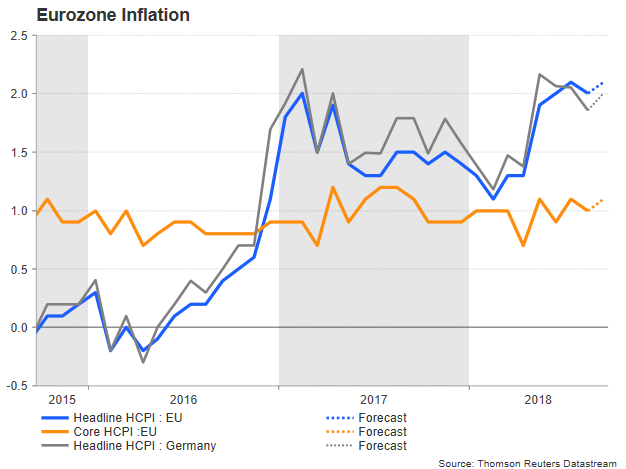
In August, Eurostat reported that the Eurozone Harmonized Consumer Price Index (HICP) eased to 2.0% on a yearly basis from 2.1% a month earlier, though increases in energy, food and alcohol kept the gauge above the ECB’s “below but close to 2.0%” price target. In September, headline inflation is projected to recover back to 2.1% as oil prices maintained positive momentum, while in the absence of volatile items such as food and fuel, core CPI is also anticipated to rebound by 0.1 percentage points to 1.1%.
The core measure, which the central bank uses as an indication for long-term inflation pressures, proves that price growth above the target could be a temporary story. Therefore monetary policy may need to stay accommodative in the Eurozone for some time, with central bankers adopting a wait-and-see approach for now before removing a layer of stimulus. The ECB chief, Mario Draghi, though, speaking at the Economic and Monetary Affairs of the European Parliament on Monday said that core inflation is expected to improve further in the coming months as the tightening labor market is driving wage growth higher. Indeed, hourly labor costs in the eurozone grew by 2.2% y/y in the second quarter, printing the fastest expansion since the third quarter of 2012. Specifically, costs of wages and salaries increased by 1.9% y/y compared to 1.8% in the preceding quarter. That was the third consecutive month of gains for the EU employees. Latvia and Lithuania led the rise in overall labour costs.
Yet while EU employees might be enjoying better payments, preliminary estimates on consumer confidence found that consumers outlook on future economic activities in the bloc has deteriorated to a one-year low of -2.9 in September. That could be evidence that consumers are not planning to spend more on goods and services in the months ahead, restricting any inflation spikes. On the supply side, business leaders looked less confident as well about the Eurozone’s economic outlook in the next six months according to the Sentix Investor Confidence Index which declined by 1.3 points to 12. Initial Markit Manufacturing PMIs out of the bloc added further doubt as the figure slipped to 53.3 in September, the lowest since October 2016.
Given the above, the central bank has no reason to call off its forward guidance by hiking rates earlier than summer 2019, especially now when risks from US trade protectionism are boiling and emerging markets are facing economic headwinds. Not to mention the Italian fiscal puzzle, which threatens to breach the EU’s budget limits, exposing the bloc to potential shocks.
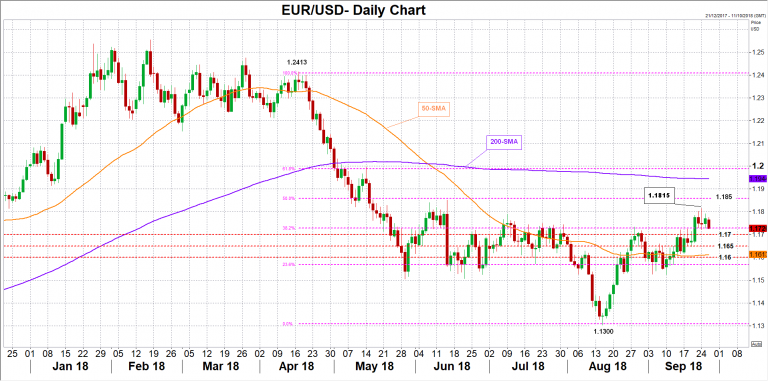
Turning to FX markets, the euro is set to finish the month in the green against the US dollar, gaining 1.6% so far in September. That could have weighed on inflation too as an appreciating currency makes imports cheaper in the domestic market. In the wake of stronger HCPI figures, euro/dollar could crawl back above Thursday’s peak of 1.1815 with scope to reach 1.1850, the 50% Fibonacci of the downleg from 1.2412 to 1.1300. Steeper increases may meet the 1.1900 key level as well ahead of the 200-day simple moving average currently at 1.1940.
Alternatively, a miss in data, could send the pair down to the 1.1700 round level, while even lower the 1.1650-1.600 area may provide support too, as it did in the recent past.
Before the Eurostat inflation report, however, investors could look at the German preliminary inflation figures due on Thursday for direction given the strong correlation between the Eurozone and German HCPI (see the above chart). Forecasts suggest that the headline HICP in the biggest EU economy inched up by 0.1 percentage points both in monthly and yearly terms to 0.1% and 2.0% correspondingly. Should the German figures surpass projections, investors could project similar results in the Eurozone inflation report.
EURGBP Moves Back into Cloud; Reverts to Neutral Mode
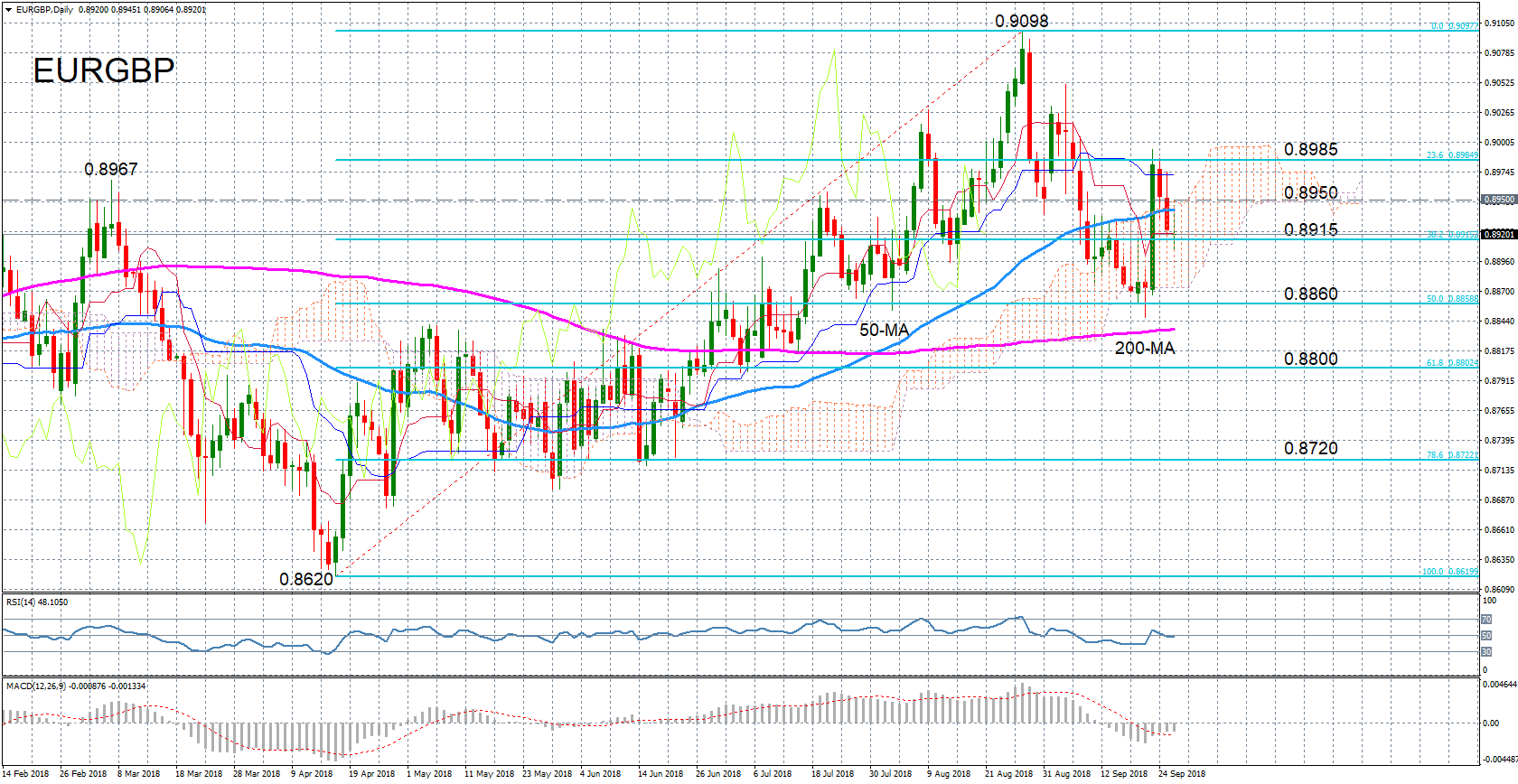
EURGBP has retreated significantly from the more than one-year high of 0.9098 touched at the end of August and appears once again to be struggling for direction. Prices have been drifting inside the Ichimoku cloud during the past couple of weeks and a brief overshoot following the rebound on the 50% Fibonacci retracement of the upleg from 0.8620 to 0.9098 proved unsustainable.
A continuation of the sideways movement risks eroding the bullish medium-term structure and restoring the neutral outlook that had prevailed until July/August. In the more near-term, technical indicators point to a neutral bias. The RSI has flatlined near 50, while the MACD histogram is also moving sideways. However, with both in negative territory, the short-term risk is to the downside.
Immediate support is being provided by the 38.2% Fibonacci retracement at around 0.8915, which is just below the Tenkan-sen line. A break below this level would push prices back towards the key 50% Fibonacci, near 0.8860. A drop below the 50% Fibonacci would deepen the bearish pressure and bring the 61.8% Fibonacci level into focus at the 0.88 handle.
However, should support at the 38.2% Fibonacci hold, an upside reversal would see the top of the Ichimoku cloud around 0.8950 acting as immediate resistance. A break above the cloud could lead to a retest of the 23.6% Fibonacci barrier at 0.8985, which capped last Friday’s strong rebound. A successful climb above this level would open the way to August’s 11½-month top of 0.9098.
Sunset Market Commentary
Markets
Core bonds slightly gained ground as investors took a cautious approach going into today’s only but potentially market moving event: the Fed-meeting. As a 25bp rate hike is largely (if not completely) anticipated, markets are likely to focus on Powell’s press conference and the new dot plot. US Treasuries edged higher during European dealings, triggering some modest bull flattening with yields decreasing up to 1.5 bp at the longer end of the curve. After opening higher, the German Bund hovered around opening levels. The yield curve exhibits a pattern similar to the US as yield drop 1 bp (10yr) to 2 bps (30yr). Across the EMU-spectrum Italy outperformed. BTP’s opened lower on Di Maio threatening not to support the budget proposal but rallied after Finance minister Tria expressed government commitment to reduce the country’s troubling debt ratio. Peripheral yield spreads vs. Germany narrow by 1 bp (Greece) to 5 bps (Italy).
Over the previous days, the dollar developed a rather lackluster trading pattern even as US yields were on an upward trajectory and as the Fed was/is widely expected to continue its path of gradual tightening in the foreseeable future. Today, FX traders understandably settled in a wait-and-see modus. The eco calendar was thin and the focus was on this evening’s Fed decision. Even so, the dollar was in a (slightly) better shape than during previous days. EUR/USD drifted back south in the 1.17 big figure (currently 1.1730 area). Positive headlines from Italy this time didn’t help the euro. USD/JPY is again testing recent top in the 113 area. We don’t make too much out of this thin, pre-Fed trading. Or is it a harbinger of more USD gains if the Fed maintains a positive view on the economy and if it doesn’t call an end to its rate hike cycle yet? At least our base scenario assumes the Fed to keep a positive assessment this evening.
Sterling showed a mixed to fairly constructive picture today. The UK currency held stable against the dollar but gained further ground against the euro. For now, it looks that the bad news from last week’s EU summit has been digested and that enough bad news is discounted. CBI September retail data also indicated that sales momentum remained reasonably strong. EUR/GBP is further reversing Friday’s jump. The pair is trading in the 0.8920 area. Cable (1.3160) is losing a few ticks but the dollar is trading with an overall positive bias.
News Headlines
According to the ECB, an escalation of a global trade war between the US and its major trading partners would hurt the US most. It results in lower US net export, US firms would invest less and unemployment would increase. On the contrary, China would gain by exporting more to the countries where US goods are subject to tariffs.
The Czech central bank (CNB) has, as expected, increased its policy rate with 25bps to 1.50%. The Czech economy is performing strongly, with 2.4% GDP growth, a record low unemployment rate (3.1%) and an inflation rate of 2.5% in August. Governor Rusnok indicated that another rate hike can’t be ruled out but he remained vague on the timing. This uncertainty is weighing on the koruna.
French consumer confidence dropped this month to its lowest point since April 2016. The number printed 94 today, while consensus expected a stabilization of the 97 August number. French citizens remain worried over their financial stability and standard of living, keeping the indicator below its long-term average of 100.
USD/JPY Mid-Day Outlook
Daily Pivots: (S1) 112.81; (P) 112.89; (R1) 113.06; More...
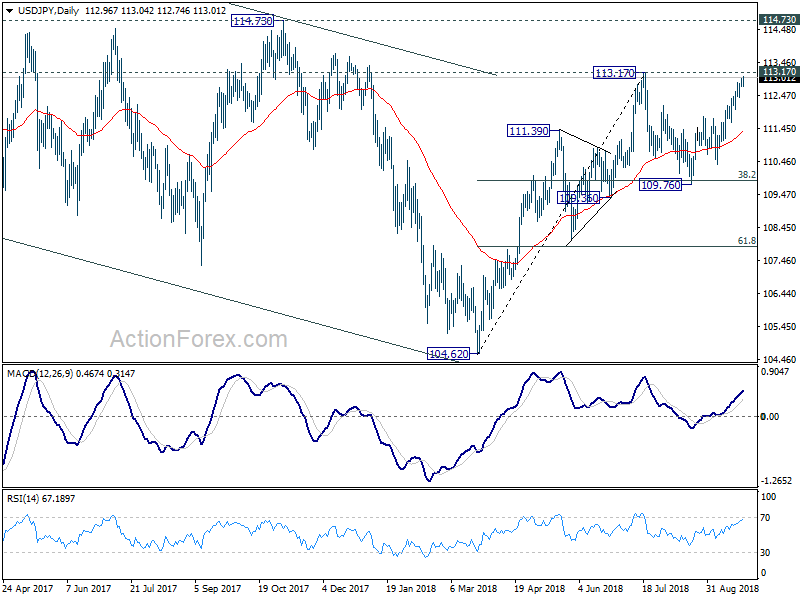
USD/JPY's rally is still in progress and intraday bias remains on the upside for 113.17 resistance first. Decisive break there will resume whole rally from 104.62 and target 114.73 resistance next. On the downside, below 112.39 minor support will turn intraday bias neutral again. But near term outlook will remain cautiously bullish as long as 111.82 resistance turned support holds.
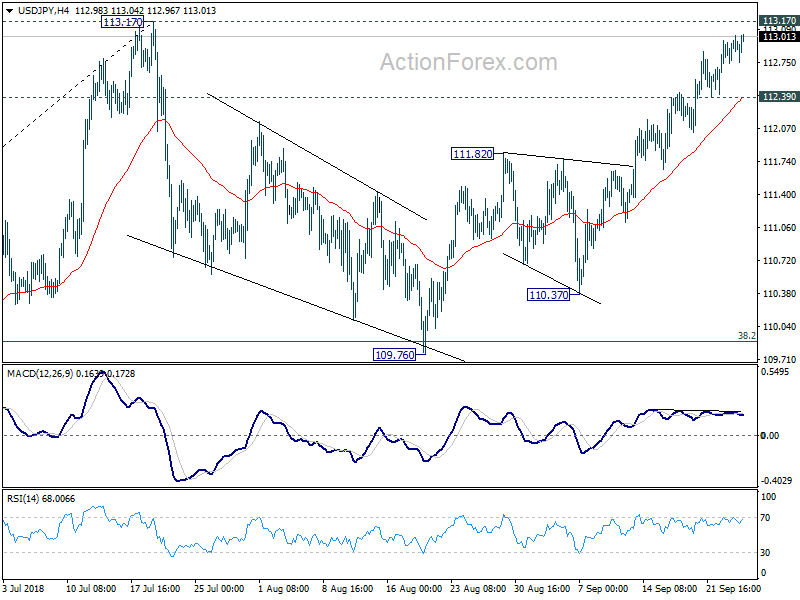
In the bigger picture, corrective fall from 118.65 (2016 high) should have completed with three waves down to 104.62. Decisive break of 114.73 resistance will likely resume whole rally from 98.97 (2016 low) to 100% projection of 98.97 to 118.65 from 104.62 at 124.30, which is reasonably close to 125.85 (2015 high). This will stay as the preferred case as long as 109.36 support holds. However, decisive break of 109.36 will mix up the outlook again. And deeper fall should be seen back to 61.8% retracement of 104.62 to 113.17 at 107.88 and below.
USD/CHF Mid-Day Outlook
Daily Pivots: (S1) 0.9629; (P) 0.9651; (R1) 0.9672; More...
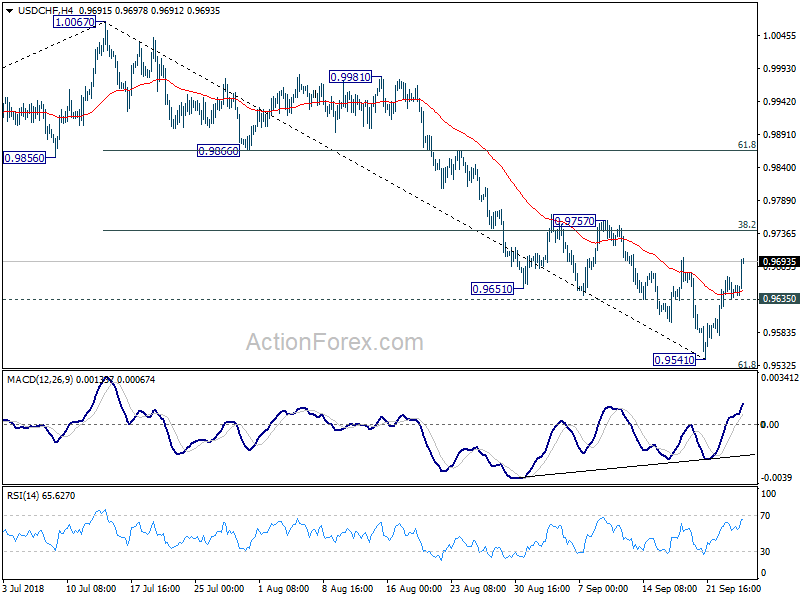
Intraday bias in USD/CHF remains on the upside as rebound from 0.9541 extends today. Further rise should be seen to 0.9757 resistance first. Firm break there will target 0.9866 key resistance level, 61.8% retracement of 1.0067 to 0.9541 at 0.9866. On the downside, below 0.9635 minor support will turn bias back to the downside for 0.9541 low instead.
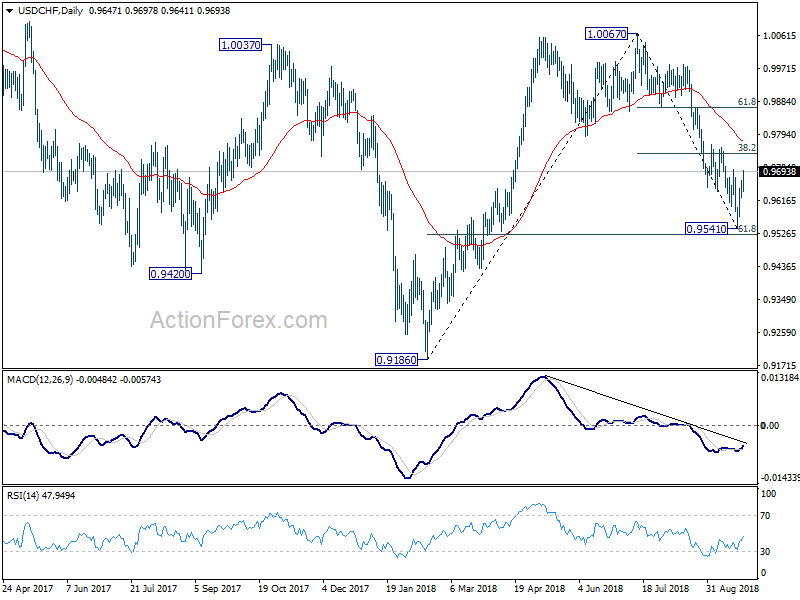
In the bigger picture, rise from 0.9186 low has completed at 1.0067, after failing to sustain above 1.0037 resistance. Fall from 1.0067 could extend to 61.8% retracement of 0.9816 to 1.0067 at 0.9523 and possibly below. But for now, we don't expect a break of 0.9186 low. On the upside, firm break of 0.9866 support turned resistance will suggest that fall from 1.0067 has completed and rise from 0.9186 is resuming.
GBP/USD Mid-Day Outlook
Daily Pivots: (S1) 1.3119; (P) 1.3157; (R1) 1.3219; More...
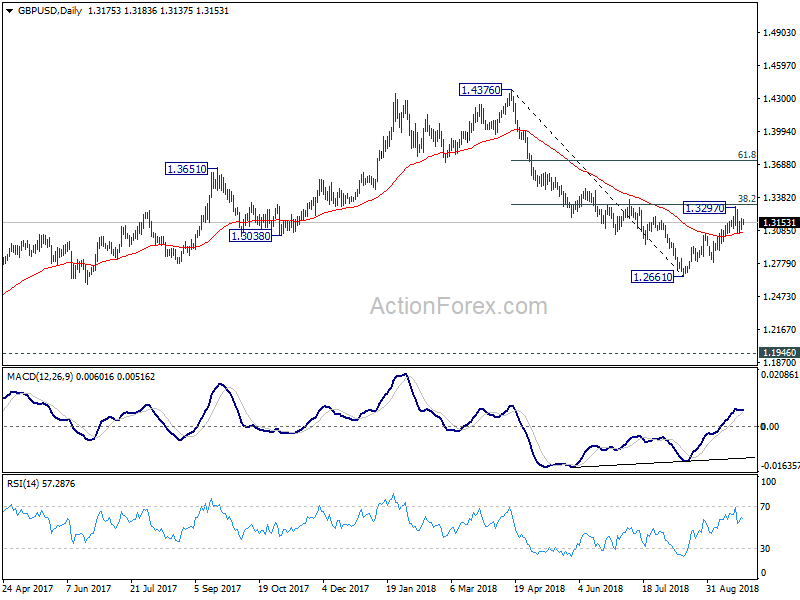
Intraday bias in GBP/USD remains neutral at this point. As noted before, corrective rise from 1.2661 could have completed at 1.3297, ahead of 1.3316 key fibonacci level. Hence, risk will stay on the downside as long as 1.3297 resistance holds. On the downside, break of 1.3042 resistance turned support will bring deeper fall to 1.2784. Break there will argue that larger down trend from 1.4376 is resuming for a new low below 1.2661.
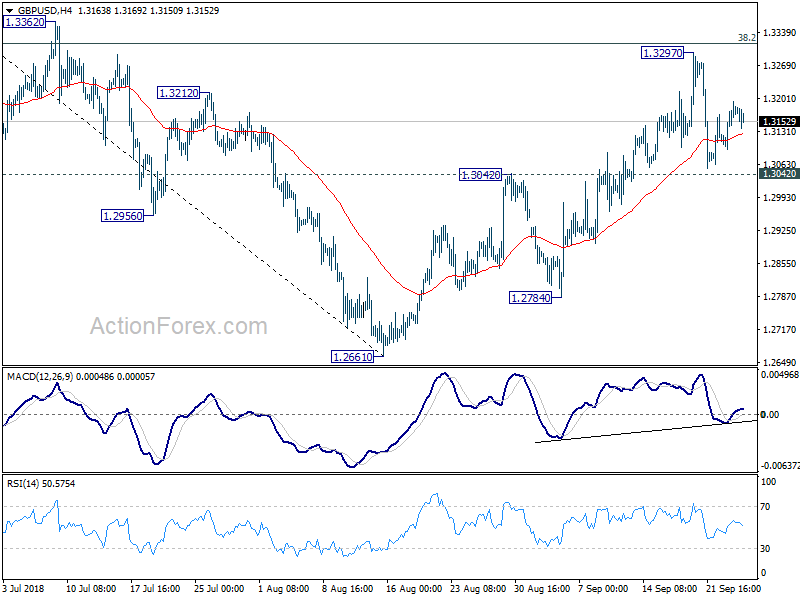
In the bigger picture, whole medium term rebound from 1.1946 (2016 low) should have completed at 1.4376 already, after rejection from 55 month EMA (now at 1.4062). The structure and momentum of the fall from 1.4376 argues that it's resuming long term down trend. And this will be the preferred case as long as 38.2% retracement of 1.4376 to 1.2661 at 1.3316 holds. However, firm break of 1.3316 would bring stronger rebound to 61.8% retracement at 1.3721. And, the eventual depth of the fall from 1.4376, and the chance of hitting 1.1946 low, will depend on the strength of the interim corrective rebound from 1.2661.
British Pound Ticks Lower, Markets Eye Federal Reserve, US GDP
GBP/USD has posted small losses on Wednesday, after recording gains in the past two sessions. Currently, the pair is trading at 1.3169, down 0.10% on the day. In the U.K, a CBI survey showed that retail sales volume dropped to 23, but still beat the estimate of 18 points. In the U.S, the spotlight is on the Federal Reserve, which is virtually certain to raise the benchmark rate to a range between 2.00% and 2.25%. On Thursday, the U.S will publish Final GDP and durable goods orders. The U.K. releases GfK consumer confidence.
All eyes are on the Federal Reserve, which is widely expected to raise rates by 25 basis points at the conclusion of its policy meeting on Wednesday. What will be the tone of the rate statement? The U.S economy is in excellent shape, with GDP for Q2 expected at 4.2%, and unemployment hovering below 4 percent. However, the escalating global trade war has raised concerns that it could cool down global economic growth and hurt the U.S economy as well. Still, another rate hike in December is pegged at 78% according to the CME, and some experts are predicting up to four rate hikes in 2019.
With EU leaders rebuffing the latest proposals from British Prime Minister May on Brexit, negotiations over the UK leaving the EU remain deadlocked. Both sides are making preparations in the event that no deal is reached by the March deadline. European leaders reacted with alarm on Wednesday to a leaked document that Labor leader Jeremy Corbyn had instructed Labor MPs to vote against any deal May brings home, in order to trigger new elections. Corbyn has declared that Labor will vote against any deal that does not provide the same benefits as membership in the single market, and Labor could join up with rebel Conservative MKs to torpedo a deal. Growing uncertainty as to whether a deal can be reached by March has alarmed the business sector and could weigh on the British pound.