

Sample Category Title
Gold: Yellow Metal Reverses Its Losses In The Morning Session
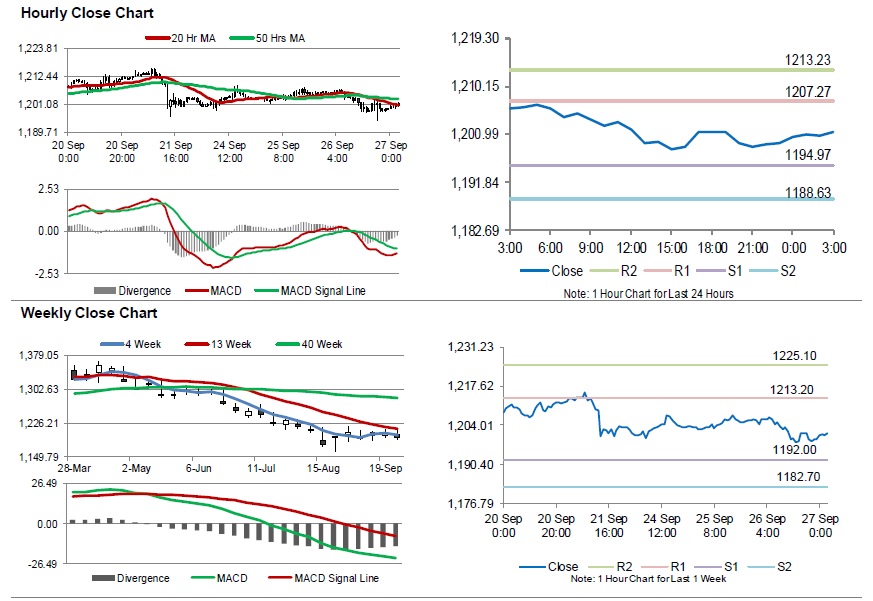
For the 24 hours to 23:00 GMT, Gold declined 0.60% against the USD and closed at USD1199.00 per ounce, after the Federal Reserve hiked its key interest rates.
In the Asian session, at GMT0300, the pair is trading at 1201.30, with gold trading 0.19% higher against the USD from yesterday’s close.
The pair is expected to find support at 1194.97, and a fall through could take it to the next support level of 1188.63. The pair is expected to find its first resistance at 1207.27, and a rise through could take it to the next resistance level of 1213.23.
The yellow metal is showing convergence with its 20 Hr moving average and trading below its 50 Hr moving average.
GBP/USD Daily Outlook
Daily Pivots: (S1) 1.3131; (P) 1.3174; (R1) 1.3211; More...
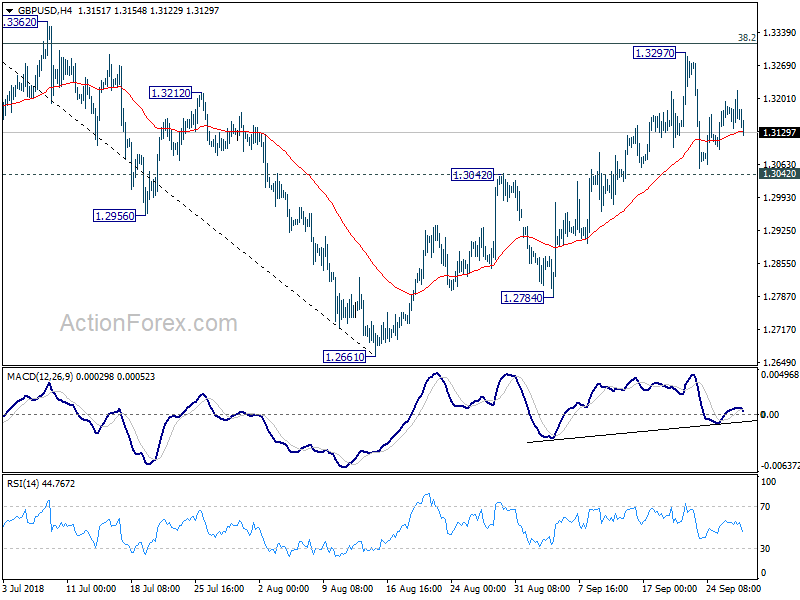
GBP/USD is staying in range of 1.3042/3297 and intraday bias remains neutral. Outlook is unchanged. Corrective rise from 1.2661 could have completed at 1.3297, ahead of 1.3316 key fibonacci level. Hence, risk will stay on the downside as long as 1.3297 resistance holds. On the downside, break of 1.3042 resistance turned support will bring deeper fall to 1.2784. Break there will argue that larger down trend from 1.4376 is resuming for a new low below 1.2661.
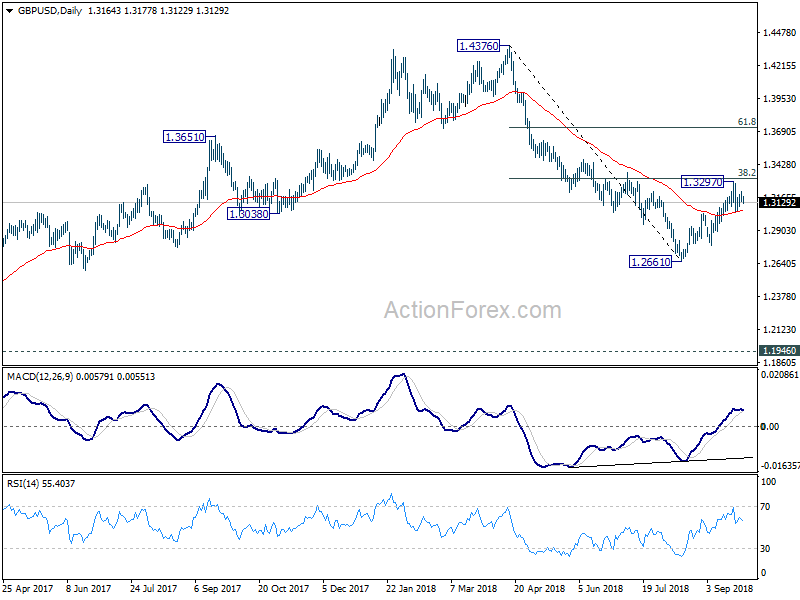
In the bigger picture, whole medium term rebound from 1.1946 (2016 low) should have completed at 1.4376 already, after rejection from 55 month EMA (now at 1.4062). The structure and momentum of the fall from 1.4376 argues that it's resuming long term down trend. And this will be the preferred case as long as 38.2% retracement of 1.4376 to 1.2661 at 1.3316 holds. However, firm break of 1.3316 would bring stronger rebound to 61.8% retracement at 1.3721. And, the eventual depth of the fall from 1.4376, and the chance of hitting 1.1946 low, will depend on the strength of the interim corrective rebound from 1.2661.
Silver: White Metal Trading On A Stronger Footing This Morning
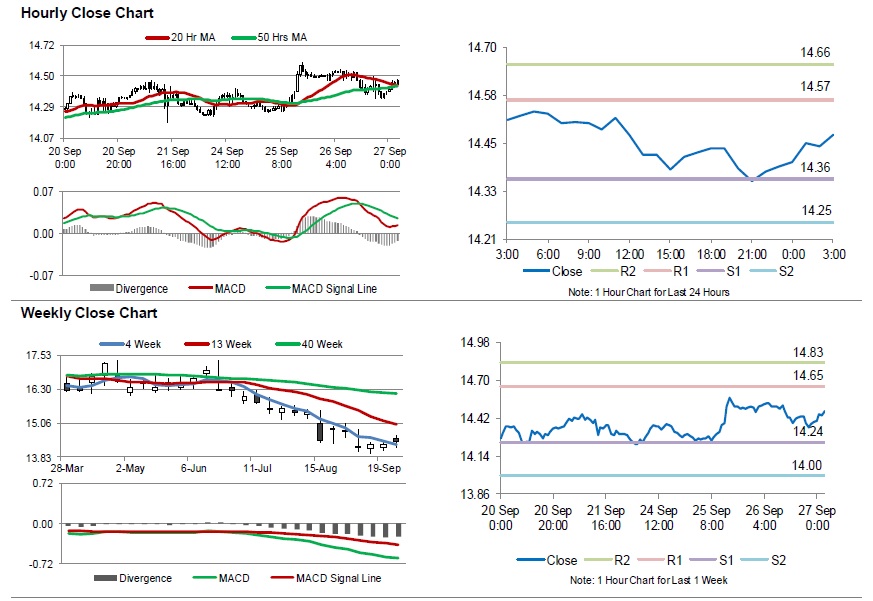
For the 24 hours to 23:00 GMT, Silver declined 0.76% against the USD and closed at USD14.40 per ounce, tracking losses in gold prices.
In the Asian session, at GMT0300, the pair is trading at 14.48, with silver trading 0.56% higher against the USD from yesterday’s close.
The pair is expected to find support at 14.36, and a fall through could take it to the next support level of 14.25. The pair is expected to find its first resistance at 14.57, and a rise through could take it to the next resistance level of 14.66.
The white metal is showing convergence with its 20 Hr and 50 Hr moving averages.
Crude Oil: Oil Extends Its Gains In The Asian Sesssion
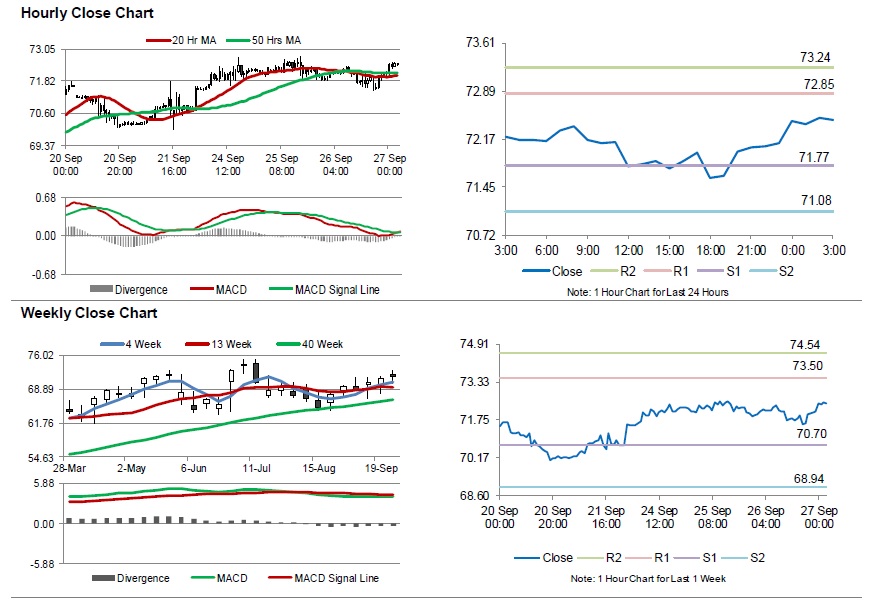
For the 24 hours to 23:00 GMT, Crude Oil rose 0.26% against the USD and closed at USD 72.11 per barrel.
The Energy Information Administration (EIA) report indicated that US crude oil stockpiles advanced 1.9 million barrels to 396.0 million in the week ended 21 September.
In the Asian session, at GMT0300, the pair is trading at 72.46, with oil trading 0.49% higher against the USD from yesterday’s close.
The pair is expected to find support at 71.77, and a fall through could take it to the next support level of 71.08. The pair is expected to find its first resistance at 72.85, and a rise through could take it to the next resistance level of 73.24.
Crude oil is trading above its 20 Hr and 50 Hr moving averages.
Fed: No Longer Accommodative, At Least On Paper
- Fed hikes policy rate by 25 bps to 2%-2.25%
- New dot plot aligns 2021 median with 2020 at 3.25%-3.50%
- Growth and inflation assessment broadly unchanged
- Committee drops reference to accommodative policy
- Muted reaction; markets remain more dovish than FOMC forecasts
The Fed hiked its policy rate as widely anticipated by 25 bps from 1.75%-2% to 2%-2.25%. The decision was unanimous. The median rate projections for the 2018-2020 period remained unchanged from June, hinting at one additional rate hike this year (2.25%-2.50%), followed by three rate hikes next year (3%-3.25%) and another (final) one in 2020 (3.25%-3.50%). The median of the first projections for policy rates in 2021 suggests a stabilization (3.25%-3.50%), but the dispersion of forecasts is rather large. Freshly sworn in vice chair Clarida had a decisive vote to determine the median of the neutral rate forecast and tilted the balance from 2.875% to 3%. The balance sheet run-off ($50bn/month from Q4 2018 onwards) goes according to plan. The balance sheet by and large declined from $4.5tn to $4.2bn since Q4 2017.
Policy no longer 'accommodative'
The FOMC statement was a copy of the August one apart from the Committee dropping a reference to the 'accommodative' character of the policy stance. Fed chair Powell stressed that this doesn’t mean that the Fed will be more reluctant to hike rates going forward. He referred to the lower bound of the Committee’s projections for the neutral rate which is 2.5%. Monetary policy actually remains stimulative for the US economy even if the Fed no longer spells it out. Cutting the sentence is more a way to move away from from providing overly precise estimates of inherently uncertain settings. It fits in Powell’s no-nonse style of limiting guidance on monetary policy. He’s more of a rearview mirror looking FOMC president who looks at the current state of the economy and reacts to it by means of the Fed’s monetary policy. The decision also adds evidence to June’s decision to do press conferences after every policy meeting instead of on a quarterly basis (more room to manoever). Is getting rid of the FOMC dot plot what Powell’s got next in mind? On a sidenote, it’s interesting to see the Fed dropping the accommodative language in lockstep with the real Fed Funds target rate turning (marginally) positive for the first time in a decade.
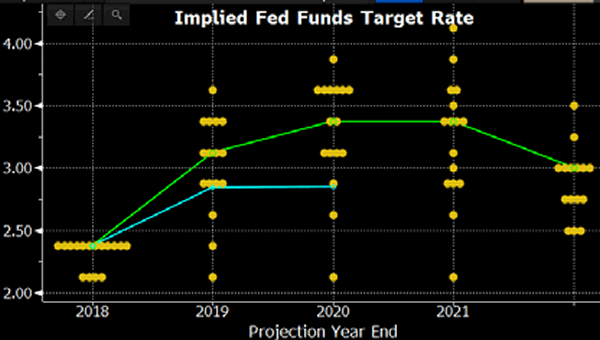 New Fed dot plot (green) and Fed Funds future curve (blue): unchanged in 2018-2020. Increase neutral rate projection. Source: Bloomberg
Returning to the statement, the Fed says, as it did in August, that the labor market has continued to strengthen, economic activity has been rising at a strong rate and the unemployment rate has stayed low. (Core) inflation is expected to remain close to the 2% target on a 12-month basis. This setting warrants a continuation of the gradual rate hike cycle, especially as risks to the economic outlook still appear to be roughly balanced. There’s no reference whatsoever to the escalated trade tensions with the US’s main trading partners.
Crunching the new economic and inflationary forecasts brings no new insights. GDP projections for this year and next showed an upward revision, adapting to current US eco strength. The Fed expects growth to hit 3.1% in 2018 (up from 2.8%) and 2.5% in 2019 (up from 2.4%). The 2020 forecast is unchanged at 2%, with the Fed pencilling in a further gradual slowdown of the economy to 1.8% in 2021, in line with longer run trend growth forecast. The FOMC predicts an unemployment rate below NAIRU (4.5%) throughout the 2018-2021 period (3.5%-3.7%). Both headline and core inflation hover slightly above the Fed’s 2% target throughout the forecasting period.
Returning one final time to the new Fed dot plot, we find (very) small evidence that FOMC governors expect 2020 to be the turning point in the economic/Fed cycle. The median FOMC forecast in 2020 was unchanged from June at 3.375%, but the average prediction fell from 3.31% to 3.24%. Second, the median September rate forecast is both 3.375% in 2020 and 2021, but the average declines from 3.24% to 3.17%. We know it’s just splitting hairs and as Fed Chair Powell at his press conference said himself '2021 is still a long way from here'. However, we’ll keep monitoring these developments closely in December.
Muted market reaction
The FOMC meeting went more or less in line with market expectations. The US yield curve increased rather significantly in the run-up to the meeting, explaining the buy-the-rumour, sell-the-fact reaction. US yields declined by 2.4 bps (2-yr) to 5.1 bps (7-yr). The decisions don’t stroke with our scenario of a technical break beyond 3.12% resistance of the US 10-yr yield in Q4 2018. The dollar showed some volatitlity around Powell’s press conference, but eventually closed unchanged. The trade-weighted greenback ended 0.11% above Tuesday’s close. EUR/USD closed at 1.1739, down from 1.1767. We maintain our positive bias for the US currency as well. US stock markets gave away intraday gains, to be down 0.2% to 0.4% at the bell, perhaps shaken by the prospect of positive real yields.
The market implied probability of a December rate hike increased only marginally to 77.5% even if 12 out of 16 governors indicated that scenario as preferential. The probability of three more consecutive rate hikes between now and June 2018, our preferred scenario, stands at 26%. We think that the Fed might at that stage (neutral rate) reevaluate its options, though we strongly feel for a continuation of the tightening cycle in H2 2019 as well. Markets remain more dovish than the Fed, attaching a stronger change to 2 additional hikes between now and June next year (42%). The market implied probability of 1 additional hike over that period amounts to 24%.
USD/CHF Daily Outlook
Daily Pivots: (S1) 0.9620; (P) 0.9661; (R1) 0.9699; More...
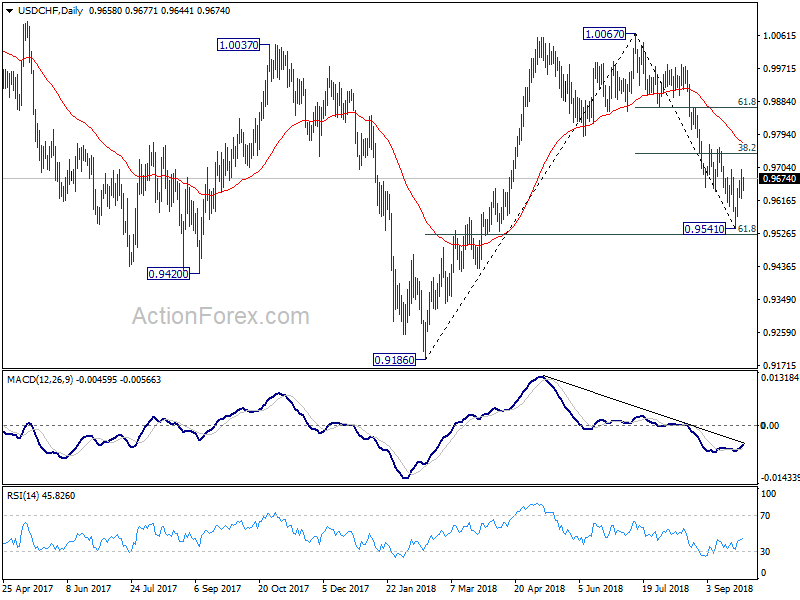
USD/CHF dipped notably after hitting 0.9700 but quickly recovered. Intraday bias is turned neutral first. On the upside, above 0.9700 will resume the rebound from 0.9541 and target 0.9757 resistance first. Firm break there will target 0.9866 key resistance level, 61.8% retracement of 1.0067 to 0.9541 at 0.9866. In case of another fall, we'd expect strong support above 0.9541 low to bring rebound.
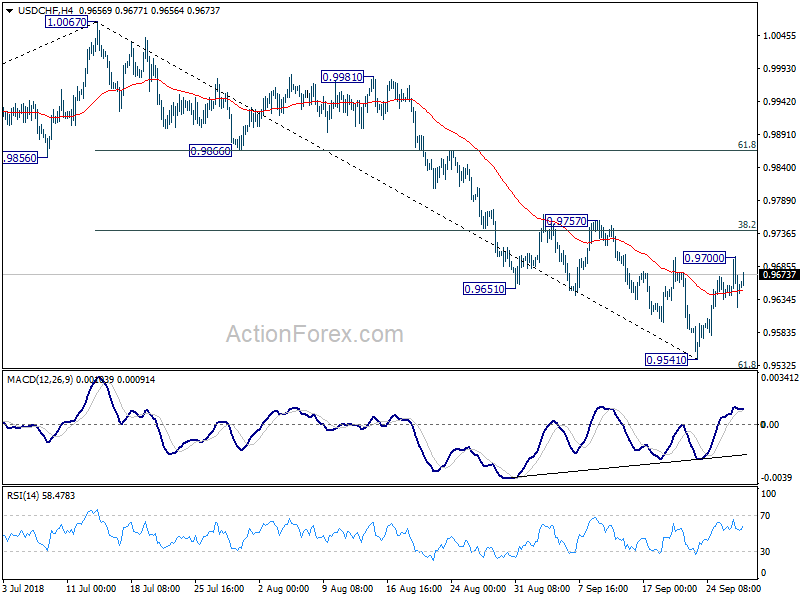
In the bigger picture, rise from 0.9186 low has completed at 1.0067, after failing to sustain above 1.0037 resistance. Fall from 1.0067 could extend to 61.8% retracement of 0.9816 to 1.0067 at 0.9523 and possibly below. But for now, we don't expect a break of 0.9186 low. On the upside, firm break of 0.9866 support turned resistance will suggest that fall from 1.0067 has completed and rise from 0.9186 is resuming.
USD/JPY Daily Outlook
Daily Pivots: (S1) 112.54; (P) 112.83; (R1) 113.04; More...
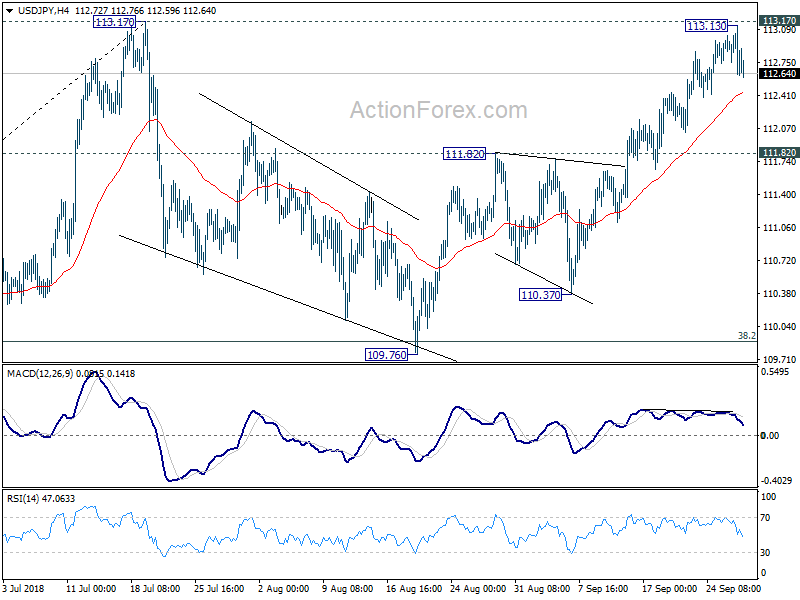
USD/JPY lost momentum ahead of 113.17 key near term resistance. A temporary top is in place at 113.13 and intraday bias is turned neutral. Some consolidations would now be seen. But further rally is expected as long as 111.82 resistance turned support holds. Decisive break of 113.17 will resume whole rally from 104.62 and target 114.73 resistance next. Nonetheless, break of 111.82 will extend the consolidation pattern from 113.17 with another decline.
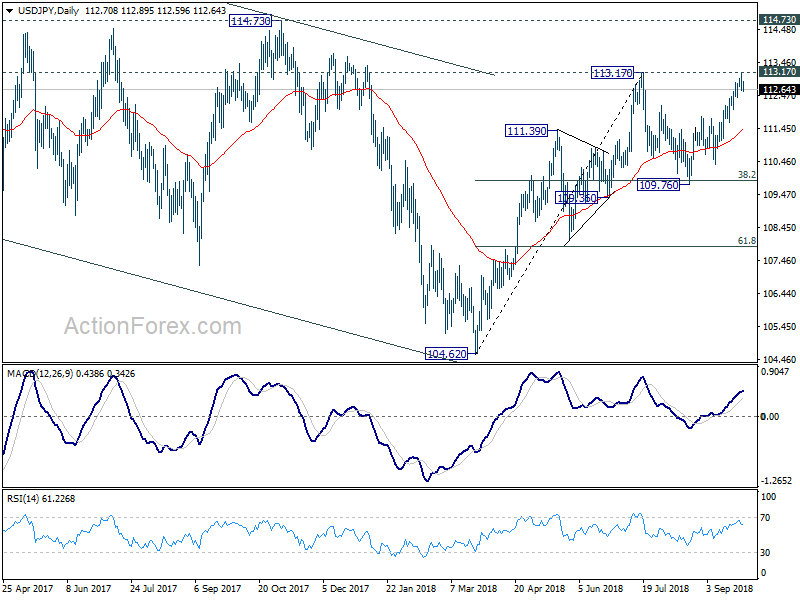
In the bigger picture, corrective fall from 118.65 (2016 high) should have completed with three waves down to 104.62. Decisive break of 114.73 resistance will likely resume whole rally from 98.97 (2016 low) to 100% projection of 98.97 to 118.65 from 104.62 at 124.30, which is reasonably close to 125.85 (2015 high). This will stay as the preferred case as long as 109.36 support holds. However, decisive break of 109.36 will mix up the outlook again. And deeper fall should be seen back to 61.8% retracement of 104.62 to 113.17 at 107.88 and below.
AUD/USD Daily Outlook
Daily Pivots: (S1) 0.7227; (P) 0.7270; (R1) 0.7301; More...
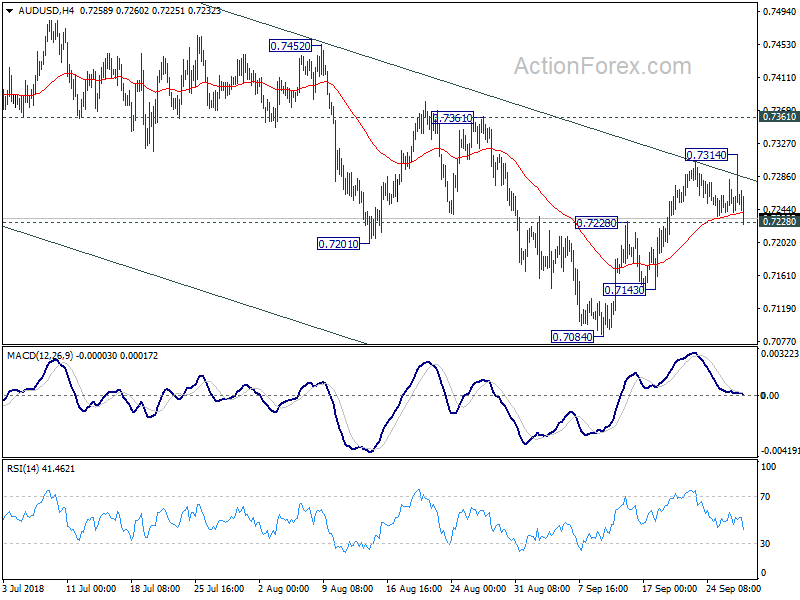
Despite spiking to 0.7314, AUD/USD quickly reversed from there. Subsequent breach of 0.7228 support turned resistance suggests that whole corrective rebound from 0.7084 has completed. Intraday bias is turned back to the downside for 0.7143 support first. Break there will likely resume larger fall from 0.8135 through 0.7084 low. On the upside, in case of another rise, upside should be limited below 0.7361 resistance to complete the correction and bring down trend resumption.
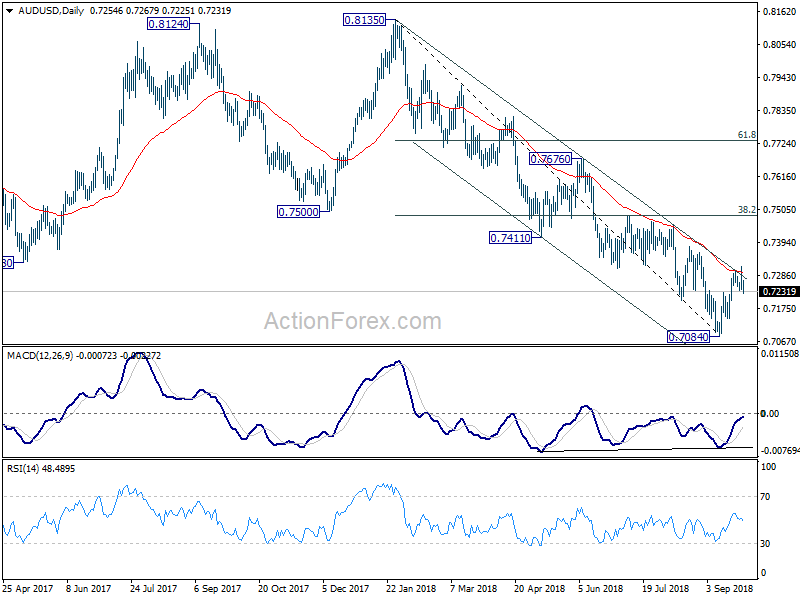
In the bigger picture, rebound from 0.6826 (2016 low) is seen as a corrective move that should be completed at 0.8135. Fall from there would extend to have a test on 0.6826. There is prospect of resuming long term down trend from 1.1079 (2011 high). Current downside momentum as seen in weekly MACD support this bearish case. Firm break of 0.6826 will target 0.6008 key support next (2008 low). On the upside, break of 0.7361 resistance, however, argues that a medium term bottom is possibly in place, and stronger rebound could follow. We'll assess the medium term outlook later if this happens.
USD/CAD Daily Outlook
Daily Pivots: (S1) 1.2969; (P) 1.2997; (R1) 1.3050; More...
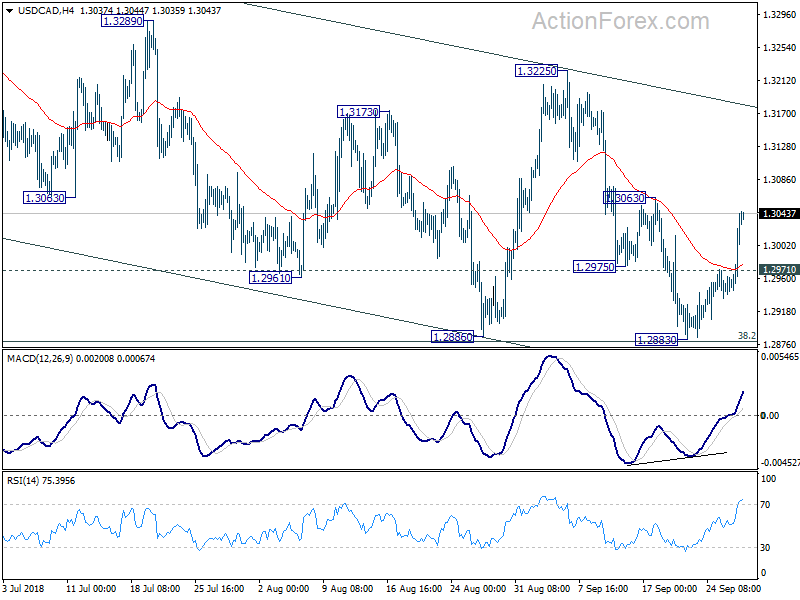
USD/CAD's strong rebound and break of 1.2975 support turned resistance suggests that fall from 1.3225 has completed at 1.2883 already. Also, 1.2879 key fibonacci level remains intact and thus, we're staying bullish in the pair. That is, larger rise from 1.2061 is expected to resume after consolidation from 1.3385 completes. Intraday bias is back on the upside for 1.3063 resistance first. Break will target 1.3225 key near term resistance. On the downside, however, break of 1.2971 minor support will turn focus back on 1.2879 fibonacci level.
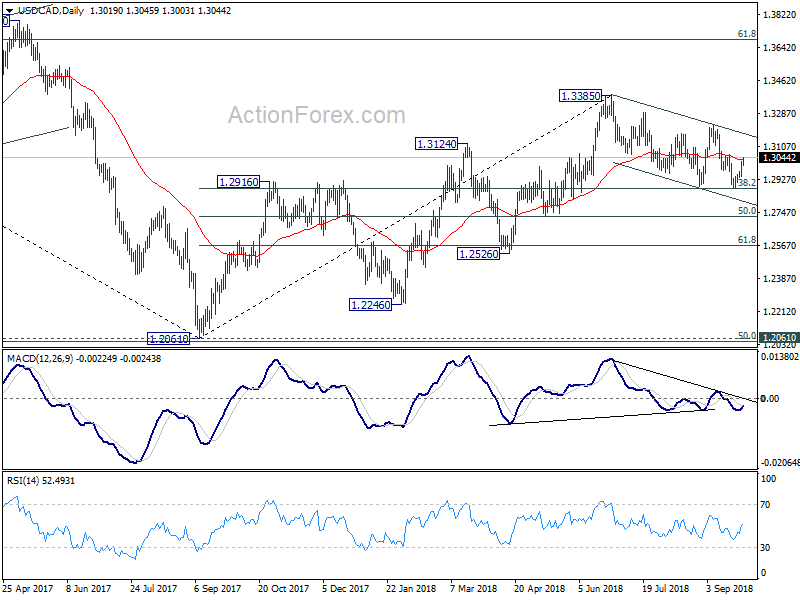
In the bigger picture, focus is back on 38.2% retracement of 1.2061 to 1.3385 at 1.2879 key fibonacci level. As long as it holds, rise from 2017 low at 1.2061 is still in progress. Break of 1.3384 should target 61.8% retracement of 1.4689 (2015 high) to 1.2061 (2017 low) at 1.3685. However, sustained break of 1.2879 will dampen his bullish view and turn focus back to 61.8% retracement at 1.2567, which is close to 1.2526 support.
Dollar Rebounded from Knee-Jerk Selloff as Fed is More Hawkish than Initial Perceived
Dollar suffered a brief knee-jerk selloff after Fed raised interest rate as widely expected but stopped calling monetary policy as accommodative. But the greenback recovered as the overall announcement wasn't dovish at all. There were indeed more hawkish elements in the details of the new economic projections. For now, the greenback is the second strongest one for the week after Sterling. For today, the overall markets are rather mixed, except that Canadian Dollar is clearly suffering due to deadlock in NAFTA negotiations. Sterling also turned softer. Euro and Yen are trading as the strongest ones in Asia.
In other markets, DOW closed down -0.40% after last hour selling. S&P 500 lost -0.33% and NASDAQ dropped -0.21%. Treasury yields dropped quite notably with 10 year yield down -0.041 at 3.061. 30 year yield was down -0.042 at 3.191. Both were rejected quite heavily by 3.115 and 3.255 key resistance levels respectively. In Asian, Nikkei is trading down -0.65%, Hong Kong HSI down -0.45% and China Shanghai SSE down -0.39%. Singapore Strait Times bucks the trend and is up 0.49%. Gold continues to gyrate in range of 1187.58/1214.30.
Technically, the most notable development is USD/CAD's strong break of 1.2975 resistance yesterday. Key fibonacci level at 1.2879 was defended. Immediate focus in on 1.3063 and break will pave the way to 1.3225 resistance next. Yen is a currency to watch today as USD/JPY lost much momentum after failing to hit 113.17 key near term resistance. Break of 112.39 minor support will bring deeper pull back in USD/JPY and could drag down other Yen crosses. Meanwhile, Dollar is staying in range against Euro, Sterling and Australian Dollar. 1.1723 minor support in EUR/USD, 1.3042 in GBP/USD and 0.7228 in AUD/USD need to be broken to prove Dollar's bullish momentum.
More hawkish elements in Fed's projections than not
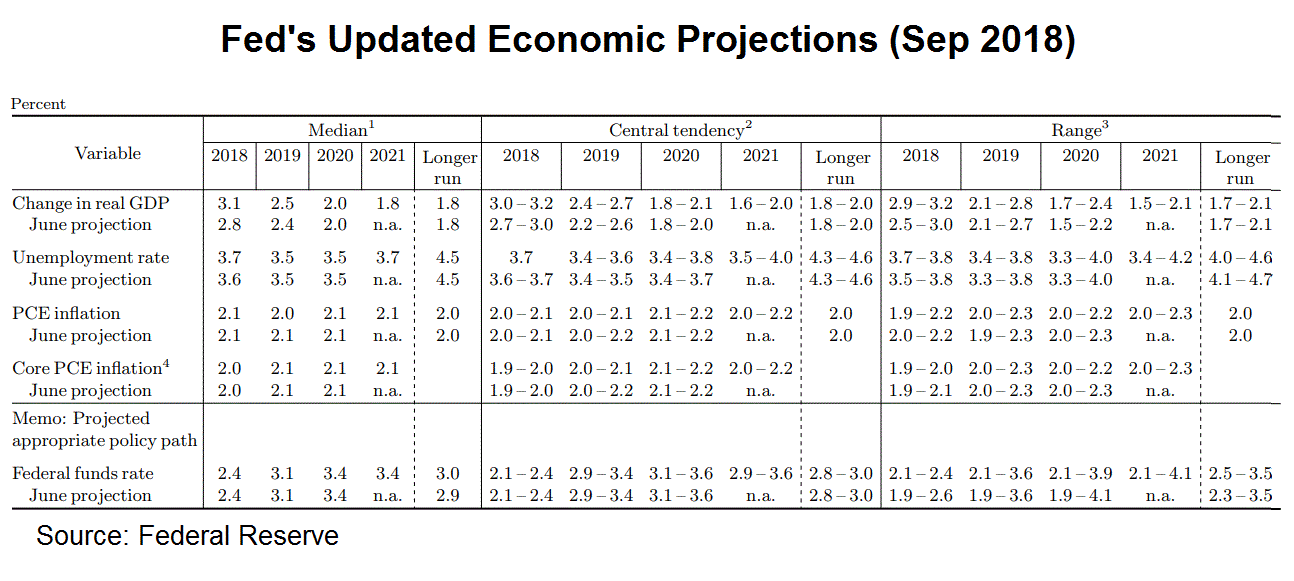
Fed raised federal funds rate by 25bps to 2.00-2.25% overnight as widely expected, by unanimous vote. The accompanying statement was largely dubbed from the previous meeting. But Fed no longer mentioned policy as "accommodative" and that's a factor triggering knee jerk selloff in Dollar. Adding to that, based on the new economic projections, the median federate fund rates projection in 2021 is at 3.4%, unchanged from 2020. That is, Fed could stop the rate hike cycle after 2020. This could be a result of forecast of slowdown in GDP growth from 2.0% in 2020 to 1.8% in 2021. Plus, unemployment rate is also projected to rise from 3.5% in 2020 to 3.7% in 2021.
However, the overall new projects do contain more hawkish elements than not. Firstly, the longer run federal funds rate was raised from 2.9 to 3.0. That is, the neutral rate was somewhat lifted. Secondly, for 2019, range of projections changed from 1.9 - 3.6 to 2.1- 3.6. That means, doves are in some ways conceding ground but hawks stayed the same. Fed should be more "firm" on its path for another three hikes next year. Thirdly, range changed from 1.9-4.1 to 2.1 – 3.9. That means doves become less dovish and hawks become less hawkish too. But 3.9 is still way higher (2 more hikes) then median projection of 3.4. Fourthly, long run range was changed from 2.3 – 3.5 to 2.5 – 3.5. That suggests doves also agree to a rise in neutral rate estimate. Another sign that they're less dovish.
So all in all, Fed's announcement overnight should be Dollar supportive. And that's why after initial spike, the greenback quickly recovered. Though, Fed's message is not strong enough to trigger a sustainable rebound in Dollar yet.
Suggested readings on FOMC:
- Another look at Fed funds rate projections, doves become less dovish
- Fed's projects to end rate hike after 2020, but long run...
- FOMC Hiked Rate and Removed "Accommodative" Policy Reference
- Is the Fed Funds Rate Now in "Neutral" Territory?
- Fed Raises Rates as Expected; More to Come this Year and Next
- FOMC Review: Gradual Fed Hikes Are Set To Continue
- Fed Recap: Accommodative No More
- Another Exercise In FOMC Verbal Gymnastics
- Fed Raises Rates and No Longer Considers its Policy "Accommodative"
Trump rejected non-existent meeting request of Trudeau, launched fresh personal attacks
Trump "claimed" he rejected one-on-one meeting with Canadian Prime Minister Justin Trudeau on trade. Additionally, Trump launched fresh personal attacks on both Trudeau and the Canadian team. In response, Trudeau shouldered it and pledged to continue work for a good deal for Canada, but be prepared to walk away.
Trump said he turned out the meeting request because "his tariffs are too high, and he doesn't seem to want to move", referring to Trudeau apparently. Trump repeated his threat and said "forget about it and frankly we're just thinking about just taxing cars coming in from Canada". He stepped up further and said "that's the motherlode, that's the big one."
Additionally, Trump added that "We're very unhappy with the negotiations and the negotiating style of Canada. We don't like their representative very much. That's another personal attack on apparently on Canadian Foreign Minister Chrystia Freeland.
Trudeau spokeswoman Chantal Gagnon said: "No meeting was requested. We don't have any comment beyond that." Trudeau himself reiterated "we will keep working as long as it takes to get to the right deal for Canada." He also emphasized Canada would need to feel confident "about the path forward as we move forward - if we do - on a NAFTA 2.0."
It's now clearly more likely then not the Canada-US NAFTA negotiation will slip the US imposed deadline of October 1. It's reported that the US could publish the text of the agreement with Mexico on Thursday or Friday and move on with the process, without Canada.
Japan PM Abe agreed bilateral talks with US only on goods
Japan and the US agreed to start bilateral trade talks after meeting of Prime Minister Shinzo Abe and Trump. But after the meeting, Abe emphasized that the new framework would only be a Trade Agreement on Goods. It's not a full Free Trade Agreement that includes investments and services. Both countries pledged in a joint statement to " respect positions of the other government."
However, US Trade Representative Robert Lighthizer ignored the position of Japan. He told reporters he's aiming for a full free trade deal requiring approval by Congress under the "fast track" trade negotiating authority law. Lighthizer added the talks will be handled in two "tranches" targeting an "early harvest" on reducing tariffs and non-tariffs barriers in goods.
In the joint statement, it's noted that:
- For the United States, market access outcomes in the motor vehicle sector will be designed to increase production and jobs in the United States in the motor vehicle industries; and
- For Japan, with regard to agricultural, forestry, and fishery products, outcomes related to market access as reflected in Japan's previous economic partnership agreements constitute the maximum level.
NZD/USD range bound after non-eventful RBNZ rate decision
NZD/USD trades steadily in range after RBNZ kept OCR unchanged at 1.75% as widely expected and delivered no surprise to the markets. Governor Adrian Orr reiterated in the statement that "we expect to keep the OCR at this level through 2019 and into 2020." He also kept the options open and indicated the next move could be "up or down". Economic projections are "little changed" from the August MPS. Even though Q2 GDP was stronger than anticipated, Orr noted "downside risks to the growth outlook remain". He concluded the statement by repeating "we will keep the OCR at an expansionary level for a considerable period to contribute to maximising sustainable employment, and maintaining low and stable inflation."
Looking ahead
The economic calendar is rather busy today. German Gfk consumer sentiment and CPI will be featured in European session. Eurozone will release confidence indicators and M3. ECB will release economic bulletin. Later in the day, US will release trade balance, wholesale inventories, durable goods, jobless claims, pending home sales and Q12 GDP final.
USD/CAD Daily Outlook
Daily Pivots: (S1) 1.2969; (P) 1.2997; (R1) 1.3050; More...
USD/CAD's strong rebound and break of 1.2975 support turned resistance suggests that fall from 1.3225 has completed at 1.2883 already. Also, 1.2879 key fibonacci level remains intact and thus, we're staying bullish in the pair. That is, larger rise from 1.2061 is expected to resume after consolidation from 1.3385 completes. Intraday bias is back on the upside for 1.3063 resistance first. Break will target 1.3225 key near term resistance. On the downside, however, break of 1.2971 minor support will turn focus back on 1.2879 fibonacci level.
In the bigger picture, focus is back on 38.2% retracement of 1.2061 to 1.3385 at 1.2879 key fibonacci level. As long as it holds, rise from 2017 low at 1.2061 is still in progress. Break of 1.3384 should target 61.8% retracement of 1.4689 (2015 high) to 1.2061 (2017 low) at 1.3685. However, sustained break of 1.2879 will dampen his bullish view and turn focus back to 61.8% retracement at 1.2567, which is close to 1.2526 support.
Economic Indicators Update
| GMT | Ccy | Events | Actual | Forecast | Previous | Revised |
|---|---|---|---|---|---|---|
| 21:00 | NZD | RBNZ Official Cash Rate | 1.75% | 1.75% | 1.75% | |
| 06:00 | EUR | German GfK Consumer Confidence Oct | 10.6 | 10.5 | ||
| 08:00 | EUR | Eurozone M3 Money Supply Y/Y Aug | 3.80% | 4.00% | ||
| 08:00 | EUR | ECB Economic Bulletin | ||||
| 09:00 | EUR | Eurozone Business Climate Indicator Sep | 1.39 | 1.22 | ||
| 09:00 | EUR | Eurozone Economic Confidence Sep | 111.5 | 111.6 | ||
| 09:00 | EUR | Eurozone Industrial Confidence Sep | 5.2 | 5.5 | ||
| 09:00 | EUR | Eurozone Services Confidence Sep | 15.3 | 14.7 | ||
| 09:00 | EUR | Eurozone Consumer Confidence Sep F | -2.5 | -2.9 | ||
| 12:00 | EUR | German CPI M/M Sep P | 0.20% | 0.10% | ||
| 12:00 | EUR | German CPI Y/Y Sep P | 2.00% | 2.00% | ||
| 12:30 | USD | Advance Goods Trade Balance (USD) Aug | -70.6B | -72.0B | ||
| 12:30 | USD | Wholesale Inventories M/M Aug P | 0.30% | 0.60% | ||
| 12:30 | USD | GDP Annualized Q2 T | 4.20% | 4.20% | ||
| 12:30 | USD | GDP Price Index Q2 T | 3.00% | 3.00% | ||
| 12:30 | USD | Durable Goods Orders Aug P | 1.50% | -1.70% | ||
| 12:30 | USD | Durables Ex Transportation Aug P | 0.30% | 0.10% | ||
| 12:30 | USD | Initial Jobless Claims (SEP 22) | 208K | 201K | ||
| 14:00 | USD | Pending Home Sales M/M Aug | -0.20% | -0.70% | ||
| 14:30 | USD | Natural Gas Storage | 64B | 86B |