

Sample Category Title
AUD/USD Could Trade Higher Above 0.7300
Key Highlights
- The Aussie Dollar started a decent upward move from the 0.7144 low against the US Dollar.
- There was a break above a major bearish trend line with resistance at 0.7198 on the 4-hours chart of AUD/USD.
- The US S&P/Case-Shiller Home Price Indices increased 5.9%, less than the forecast of 6.2%.
- Today, the Fed interest rate decision is scheduled and the central bank is forecasted to increase rates from 2.0% to 2.25%.
AUDUSD Technical Analysis
The Aussie Dollar formed a good support base near the 0.7140-0.7150 zone against the US Dollar. The AUD/USD pair started an upward move and traded above the 0.7200 barrier.
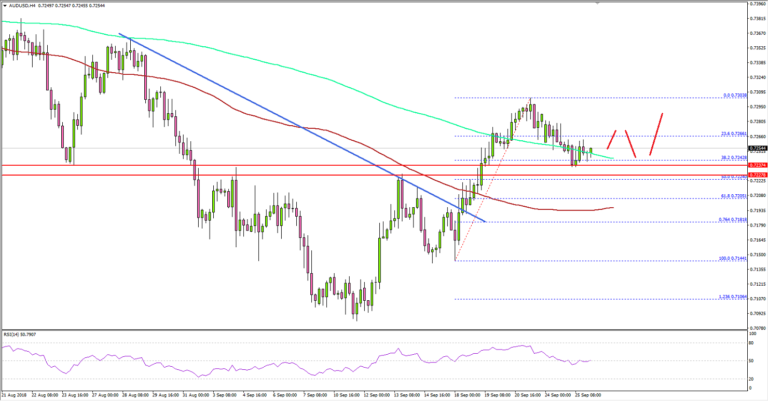
Looking at the 4-hours chart, the pair climbed above the 0.7250 level and even traded above the 200 simple moving average (green, 4-hours). However, the upside move was capped by the 0.7300-0.7305 zone.
The pair started a downside correction and declined below 0.7265 and the 200 SMA. There was also a break below the 23.6% Fib retracement level of the last wave from the 0.7144 low to 0.7303 high.
On the downside, there is a strong support aligned near the 0.7220 level and the 50% Fib retracement level of the last wave from the 0.7144 low to 0.7303 high.
As long as the pair is above 0.7220 and 0.7200 levels, it could bounce back above the 0.7280 and 0.7300 levels. The next major resistance is near the 0.7330 level.
Other major pairs like EUR/USD remained supported above the 1.1720 level. GBP/USD is also trading nicely above the 1.3060 level.
Economic Releases to Watch Today
- US New Home Sales for August 2018 (MoM) – Forecast +0.5%, versus -1.7% previous.
- Fed Interest Rate Decision – Forecast 2.25%, versus 2.00% previous.
Decision Day: The FOMC Looms
US markets
Major U.S. indexes closed mostly lower Tuesday ahead of the Federal Reserve Board rate decision, as airlines, transportation and shipping companies are feeling the squeeze from higher oil prices. But higher energy prices are stoking the inflationary fires, and that pass-through effect is pushing US bond yields higher, which tends to lessen investors appeal for stocks.
FOMC
The market has completely priced in today's Federal Reserve Board rate hike so that the focus will fall on the Fed's forward guidance and Fed Chair Jay Powell's press conference. Over the past few weeks, we've seen some interesting quantified arguments from traditional Fed doves suggesting the Feds will need to move off neutral to a more restrictive monetary policy. So, I expect the real focus of the meeting will be on the “neutral rate” with comments from Brainard and Evans indicating that the Fed may continue hiking into a restrictive territory.
On the flip side, elements of the markets remain policy pessimists concerned about adverse effects of the trade war and preaching fiscal fatigue as we enter mid-2019, and as such are looking for a Fed pause in 2019. As I told my Trading desk,
I'm hawkish, but only 51 % is implying I have no idea what to expect from this newly minted sitting Fed. But this red-hot US economy does suggest the Feds will continue to drain the punch bowl, but if the Chair Powell shows any support for hiking into the restrictive territory, the dollar will surge immediately.
While everything remains little more than a crystal ball hypothesis when it comes to this FOMC, but one thing we can be sure of is that Fed Chair Powell will stay as far away from politically charged topics such as China Trade and the President's constant meddling in Fed policy.
Through the looking glass
Trump's address to the UN was the highlight of the overnight session while not the overly market is impacting, as everyone had pretty much expected his comments to be tinged with Trump “Through the looking glass “, as predictably his most prominent ” wrath of Trump targets were China, for its trade policies; OPEC for fixing oil prices; Syria for chemical weapons; Venezuela for socialism and corruption.
Oil markets
Trump's UN address did not sway the rally in oil prices one iota, but crude conceded a chunk of yesterday's gains after the American Petroleum Institute reported an unexpected 2.9 million barrels increase in US crude stocks for last week. But indeed, it will be a substantial bearish surprise for the market if the more certain DOE Weekly Petroleum Status Report at 10:30 AM EDT on Wednesday confirms a similar inventory build.
But for the most part, Oil prices remain in the Bulls domain amid concern that US sanctions on Iranian crude oil exports will result in much tighter physical market conditions once they take effect in November. While the US oil inventory data counts, the fact that the markets could still be underestimating the supply crunch from Iran sanction has many Oil investors running with the bulls.
Gold Markets
The precious complex is marginally higher with gold consolidating either side of the $1200 level. But with Gold ETF inflow stagnant and no or a real shift in investment allocation portfolios, most Gold dealers and market speculators are left watching the US dollar for direction. And since even the most astute G-10 traders are struggling for dollar direction, gold remains mired in no man's land, smack dab in the middle of the well worn $1190-$1210 range.
Currency Markets
Japanese Yen
With the 112.75-65 near-term support channel holding up overnight USDJPY looks well positioned to move higher. But everyone will be watching the wires today as the FOMC will deliver a rate hike. I'm expecting entirely no shift in forwarding guidance but listening carefully for any bullish inference on the “neutral rate” with comments from Brainard and Evans indicating that the Fed may continue hiking into a restrictive territory.
Malaysian Ringgit
Market remain focused on the FOMC where a hawkish tail risk could weigh negatively on the Ringgit. Despite surging oil prices, one glance at The US 10y is trading up at 3.10 % should be convincing enough to tread gingerly, not only in the Ringgit but EM Asia in general but expect USDASIA, and the MYR to consolidate into the FOMC. Support comes in at 4.12 resistance 4.15
Eco Data 9/26/18
[php_everywhere instance="1"]
British Pound Edges Higher Despite Sharp US Data
GBP/USD has posted gains in the Tuesday session, continuing the trend seen on Monday. In the North American session, the pair is trading at 1.3162, up 0.34% on the day. On the release front, British CBI Industrial Order Expectations came in at -1, well off the estimate of 5 points. In the U.S, CB Consumer Confidence, jumped to 138.4, crushing the estimate of 132.2 points. On Wednesday, the spotlight will be on the Federal Reserve, which is likely to maintain interest rates at a range between 2.00% and 2.25%.
The Brexit talks continue to sputter, and British Prime Minister May suffered another blow last week, when her proposals on Brexit were rebuffed by European leaders at a summit in Salzburg. Investors and the business sector remain jittery about the British economy, and the concerns are becoming compounded as the days tick closer to Brexit Day next March. The week started off poorly, as CBI manufacturing order expectations came in at -5, compared to an estimate of +1 point.
The U.S and China fired more trade salvos at each other this week, and that could spell bad news for the Japanese yen. On Monday, the U.S imposed tariffs on some $200 billion worth of Chinese goods, while China responded with tariffs of $60 billion on U.S products. There may be more headwinds ahead, as China sharply attacked the U.S, saying it had plunged “a knife to China’s neck” with the new tariffs. The Chinese have canceled trade talks with the Trump administration, and no new talks are likely to be held until the mood improves between the world’s two largest economies. Previous rounds of tariffs between the two economic giants have boosted the U.S dollar, but so far, investors have reacted calmly and have not snapped up the U.S dollar at the expense of other currencies.
USD/CAD Canadian Dollar Sensitive to NAFTA Headlines
The Canadian dollar fell after US Trade Representative Lightizer said that time is running out with Canada on NAFTA talks. The US has pressured Canada to join the US-Mexico trade agreement but various deadlines have come and gone with no results.
The US wants to get this negotiation wrapped up as soon s possible to be able to present a trilateral deal to congress ahead of the mid-term elections.
Gaps remains between the two sides, with the most visible ones are access to the Canadian dairy market and the dispute resolution mechanism.
Elections in the province of Quebec, where a large number of dairy farmers are located, complicates matter as Canada realistically could not make big concessions until after the election.
The Canadian dollar is stuck in a tight range on Tuesday. Earlier in the session it was gaining on the US dollar, but the words from Lightizer put the loonie in a back foot, despite the rise in oil prices supporting the currency.
Gold Edges Higher after Repeated Downside Rejection; FOMC in Focus
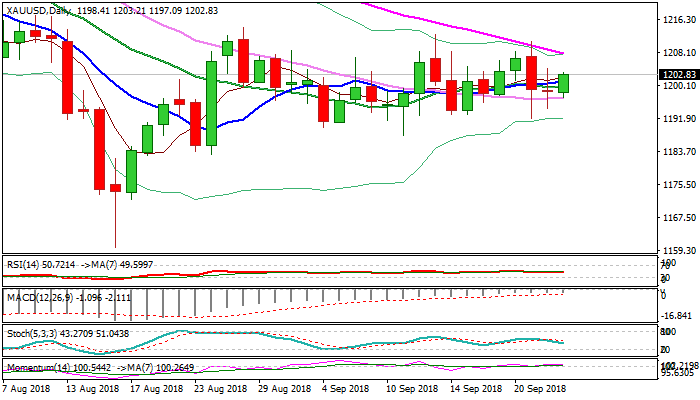
Spot Gold moved higher on Tuesday and probes above $1200 barrier, after the action in two previous days failed to clearly break below base of thick daily cloud ($1195).
The yellow metal price holds within daily cloud for the third straight day, with growing upside prospect after double downside rejection and Monday’s long-legged Doji candle signaling indecision and possible reversal.
Bigger picture shows gold price entrenched within $1187/$1214 range, for the fifth consecutive week, with break out of the range needed to generate stronger direction signal.
Range’s upper boundary is reinforced by Fibo 38.2% of $1309/$1160 bear-leg and sustained break here would signal continuation of recovery from $1160 (16 Aug spike low).
On the other side, initial bearish signal could be expected on break below daily cloud, but extension below range floor would confirm bearish outlook and signal an end of corrective phase from $1160.
Interest rate change-sensitive gold looks for Fed’s rate decision tomorrow, to get clearer direction signal. Fed is widely expected to increase rates, with expectations for another rate hike by the end of the year and hawkish tone of the central bank, expected to boost the greenback and make gold less attractive.
Another important factor is persisting trade conflict between the US and China, which could also affect yellow metal’s price on escalation.
Res: 1204; 1208; 1214; 1217
Sup: 1195; 1191; 1187; 1183
EURUSD Holds Near-Term Bullish Bias But Needs Close above 1.1780/1.1800 to Signal Continuation
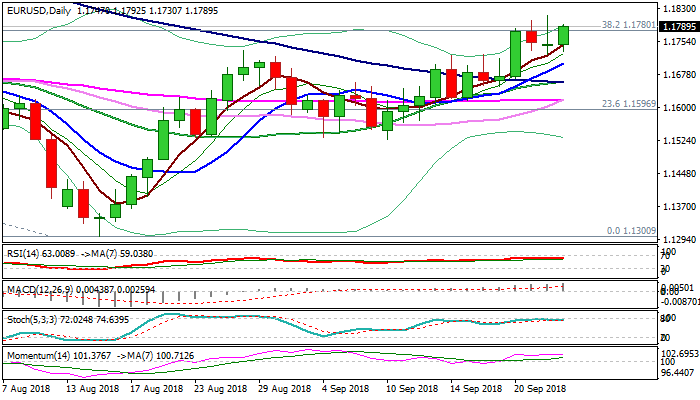
The Euro stands at the front foot in early American session on Tuesday and probes again above cracked Fibo barrier at 1.1780 (38.2% of 1.2555/1.1300). Recent attempts higher registered thre consecutive failures to clearly break this barrier and bulls were strongly rejected on probe above 1.1800 on Monday, but limited dips and subsequent bounce (today) kept near-term bullish bias. Bullish configuration of daily indicators supports but sideways-moving momentum and bear-cross on slow stochastic warns that bulls may run out of steam again. The pair looks for catalyst to break out of congestion which extends into fourth straight day, with FOMC rate decision on Wednesday, expected to provide stronger direction signal. Bullish scenario requires close above 1.1780 and 1.1800 hurdles to generate bullish signal for for attack at.1848 (14 June high) and possible extension towards 1.1928 (50% of 1.2555/1.1300 descend). Conversely, violation of congestion floor at 1.1724 (Monday's low) would be initial negative signal, which requires confirmation on close below rising 10SMA (1.1702).
Res: 1.1800; 1.1815; 1.1848; 1.1900
Sup: 1.1724; 1.1700; 1.1670; 1.1659
Fed ‘Certain’ to Raise Rates, Optimistic Commentary Likely on Tap
The Fed is practically certain to raise interest rates by another quarter-percentage point on Wednesday at 1800 GMT. With such an action being fully priced in already, investors will probably focus more on the updated rate projections, economic forecasts, and Chair Powell’s press conference for fresh guidance. Given a booming US economy, policymakers are likely to appear optimistic overall, potentially providing a modest lift to the dollar.
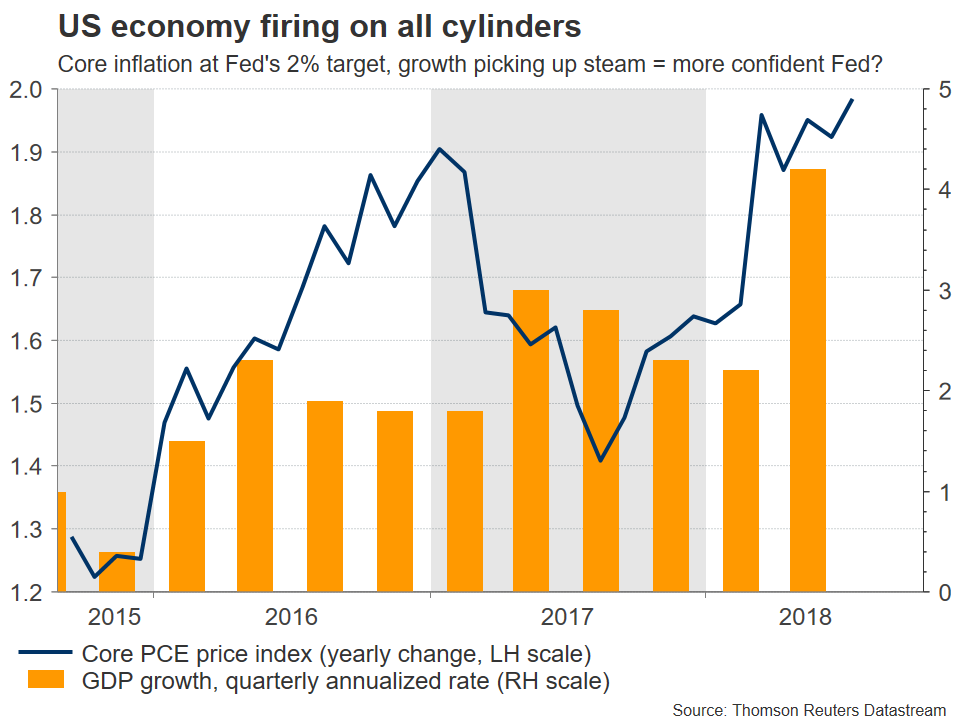
Life is good if you are a Fed policymaker. Or at least, better than it has been for years. The US economy is booming, with fiscal stimulus boosting economic growth to above-trend levels, the unemployment rate hovering near two-decade lows, wage growth accelerating, and inflation as measured by the core PCE price index being exactly in line with the Fed’s 2% objective. Meanwhile, business optimism as gauged by the NFIB hit record highs lately, while consumer morale tracked by the CB survey rests at 18-year highs.
There are risks, of course, with the most notable being uncertainty around trade disputes manifesting itself into lower business confidence, thereby holding back investment plans by US firms and weighing on growth. Alas, nothing like that has shown up in the actual data yet, with the recent tax cuts likely helping to counterbalance the negative impact from trade worries. Moreover, the effect of tariffs has only been felt in a few industries, and given that international trade accounts for a relatively minor fraction of the US economy, many think the negative side-effects won’t be too dire.
 Given this rosy outlook, markets have increasingly priced in more tightening by the Fed over the coming quarters. At the time of writing, a 25bps rate hike at this meeting is completely priced in according to the Fed funds futures, while markets also assign an 80% probability for a second one before year-end. Hence, the focus may fall primarily on any signals regarding the rate outlook beyond 2018, the updated economic forecasts for the US economy, and Chair Powell’s subsequent press conference.
With regards to the rate-path projections, also known as the “dot plot”, the median dot currently suggests two more rate increases this year, in line with market expectations. In 2019, the median “dot” points to three more quarter-point rate hikes. For that to be raised to four hikes, it would require that four policymakers revise their projections higher. While that may be too aggressive of a shift to materialize so early, the risks are still clearly tilted towards more officials revising their “dots” higher, not lower. In other words, although potentially falling short of clearly signaling four hikes for next year, the message would still be that the Committee is growing increasingly more confident.
Now as for the economic forecasts, the risks probably lie towards a more optimistic assessment as well. GDP growth for 2018 was revised up in June, and may well be reviewed higher this time around too, in light of a pristine Q2 print and mounting expectations for a robust Q3 figure. The Atlanta Fed GDPNow model estimates Q3 growth at an annualized pace of 4.4%, even higher than the 4.2% in Q2. While trade tensions would argue the opposite, the Fed typically places more weight on domestic developments, and – as already mentioned – trade uncertainties have yet to show up in US data.
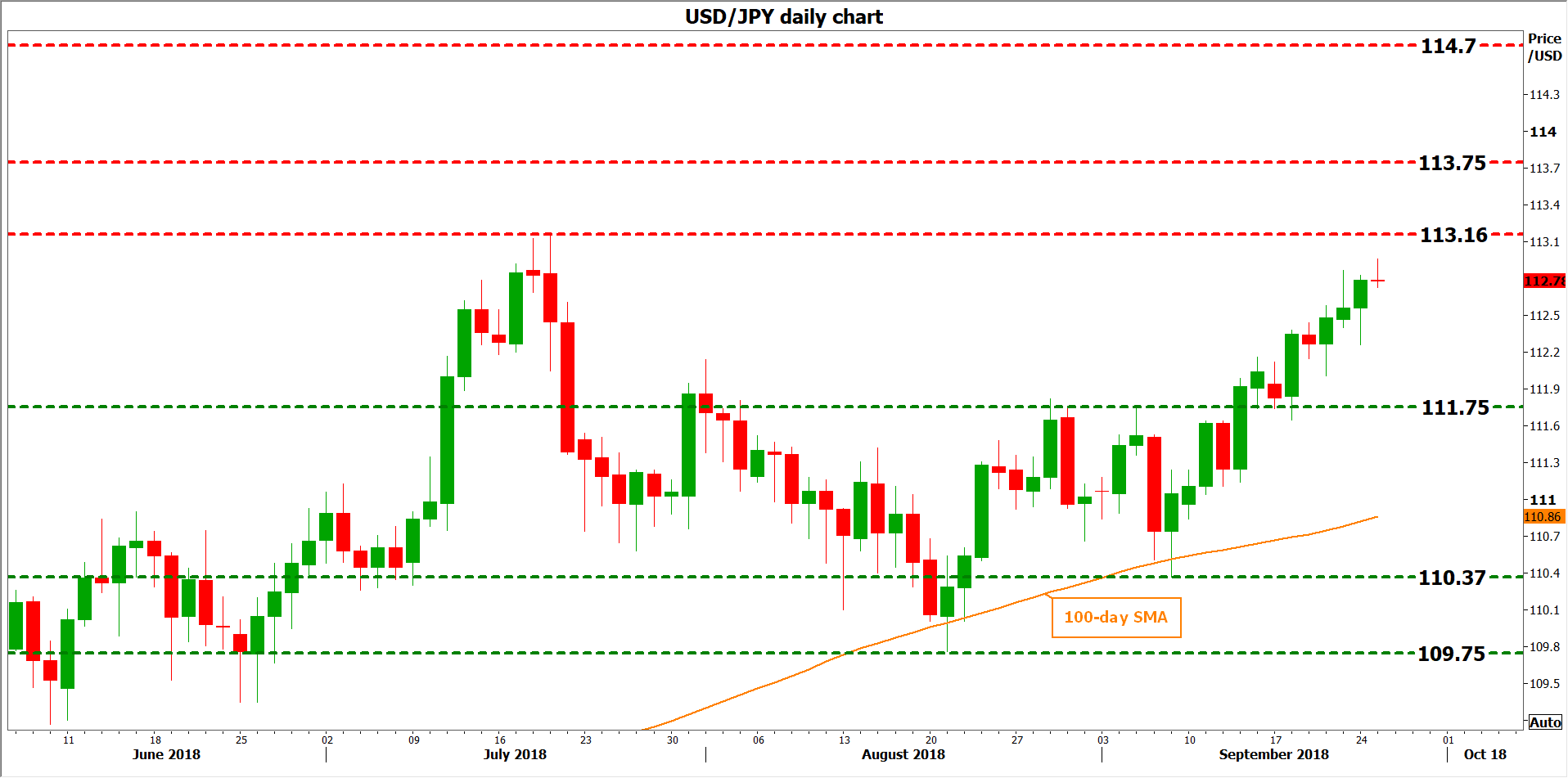
Turning to the market reaction, the combination of a potentially more hawkish “dot plot” and the prospect for slightly higher economic forecasts would likely add the finishing touches to market expectations regarding a December hike, benefiting the dollar. Taking a technical look at dollar/yen, a first wave of resistance to advances may be found near the 9-month high of 113.16, where an upside break could see scope for a test of the 113.75 hurdle, defined by the December 12 peak. Even higher, the 114.70 territory – this being the high of November 6 – would increasingly come into view.
On the flipside, and in case the Fed appears cautious by placing more emphasis on trade risks, the dollar could tumble as a December hike comes into doubt. Declines in dollar/yen could encounter support around 111.75, an area that capped two advances during the last month. If the bears pierce it, attention would turn to 110.37, marked by the September 7 lows, with even steeper declines aiming for the August 21 trough of 109.75.
Finally, it’s worth mentioning this will be the first meeting that the new Fed Vice Chair, Richard Clarida, will attend and vote at. Given that he will hold the second most influential position at the Fed, which also grants him permanent voting rights, investors will be eager to see what his policy leanings are – and where he falls on the dove-hawk spectrum.
US consumer confidence rose to 138.4, 18-year high
US Conference Board Consumer Confidence Index rose to 138.4 in September, up from 133.4 and beat expectation of 130.5. Present Situation Index rose to 173.1, up from 172.8. Expectations Index, on the other hand, further to 115.3, up from 109.3.
Lynn Franco, Director of Economic Indicators at The Conference Board, said in the release "After a considerable improvement in August, Consumer Confidence increased further in September and hovers at an 18-year high." It's also "not far from the all-time high of 144.7 reached in 2000."
Also from US, house price index rose 0.2% mom in July. S&P Case Shiller 20 cities house price rose 5.9% yoy in July.
Sunset Market Commentary
Markets
Global core bonds extended their negative run today. German Bunds underperformed US Treasuries. The main move occurred in the European opening. The Bund downleg lifted the German 10-yr yield above the 0.5% resistance area to its highest level since May. A continuation of the BTP rally after La Stampa reported on a 1.9% 2019 budget deficit commitment and yesterday’s hawkish inflation comments by ECB President Draghi explain the move. Chief economist Praet suggested that markets misinterpreted the chair’s comments, but those same markets bluntly ignored him. Changes on the German yield curve range between -0.1 bp (2-yr) and +2.4 bps (10-yr). Peripheral yield spreads vs Germany narrow by 3 bps (Spain) to 9 bps (Italy). The US yield curve bear flattens marginally in the run-up to tomorrow’s FOMC meeting. Yields increase by 1.4 bps (2-yr) to 1.2 bps (30-yr).
Trading in the major USD cross rates developed as one could typically expect in a session devoid of high profile eco news and just one day before a Fed policy meeting with market moving potential. EUR/USD hovered up and down in the 1.17 big figure. The pair yesterday couldn’t maintain the gains triggered by Draghi’s hawkish inflation comments. The low 1.18 area proved to be a tough resistance. This morning, EUR/USD retried a downside test (1.1740 area) as ECB’s Praet downplayed yesterday’s inflation comments from his boss. However, this move also ran into resistance soon. In technical trading, EUR/USD drifted further north at the start of the US trading session. We didn’t see a clear story/trigger. A rise in the oil price maybe was a slightly USD negative. However, trading still developed within recent ranges. We see it mainly as order-driven trade ahead of tomorrow’s Fed policy meeting. EUR/USD is again trading in the 1.1780 area. USD/JPY is losing a few ticks despite a further rise in US yields. The pair just failed to fill offers at 113 and trades currently in the 112.80 area.
Today, there were no eco data in the UK. In a speech, BoE’s Vlieghe looked forward the process and the potential impact of unwinding QE. In the Q&A he basically confirmed the path of very gradual BoE rate hikes over the policy horizon. Yesterday, sterling already entered calmer waters after a new flaring up of Brexit turmoil after the EU summit last week. Today, sterling kept a wait-and-see bias. Comments on Brexit made at the labour party congress had no clear impact on sterling trading. EUR/GBP hovers in the mid 0.89 area. Cable gained a few ticks intraday at trades again in the 1.3150 area.
News Headlines
ECB’s chief economist Peter Praet downplayed President Draghi’s inflation comments from yesterday. Draghi talked about a relatively vigorous pick-up in underlying inflation, which led investors to speculate on a faster pace of policy normalization. Praet countered today by saying that the ECB’s view didn’t change since the last policy meeting.
Bank of Japan Governor Kuroda said it is the central bank’s desire to achieve the 2% inflation target as soon as possible so that monetary policy normalization can start. He added that it is time not only to acknowledge the benefits of monetary easing, but to look into the side effects of its massive stimulus program as well.
Stefan Lofven, Sweden’s Prime Minister, lost a confidence vote in parliament today. The leader of the Social Democrats remains outgoing PM as long as no new government is formed. Government formation proves to be hard as the populist Sweden Democrats threatens to block any new government unless they are given a say in policy.