Sample Category Title
Gold: Yellow Metal Extends Its Gains In The Morning Session
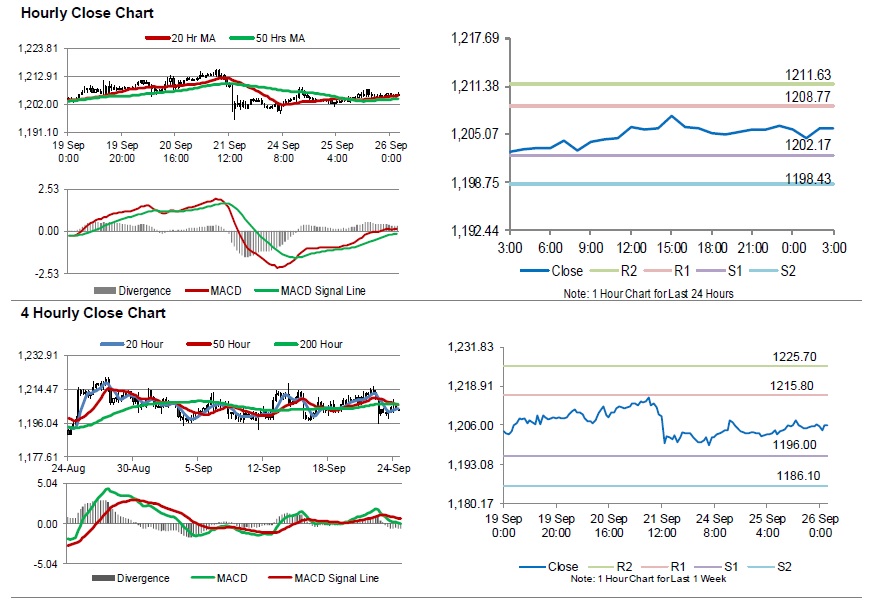
For the 24 hours to 23:00 GMT, Gold rose 0.17% against the USD and closed at USD1205.70 per ounce.
In the Asian session, at GMT0300, the pair is trading at 1205.90, with gold trading slightly higher against the USD from yesterday’s close.
The pair is expected to find support at 1202.17, and a fall through could take it to the next support level of 1198.43. The pair is expected to find its first resistance at 1208.77, and a rise through could take it to the next resistance level of 1211.63.
The yellow metal is showing convergence with its 20 Hr moving average and trading above its 50 Hr moving average.
Silver: White Metal Trading Higher This Morning
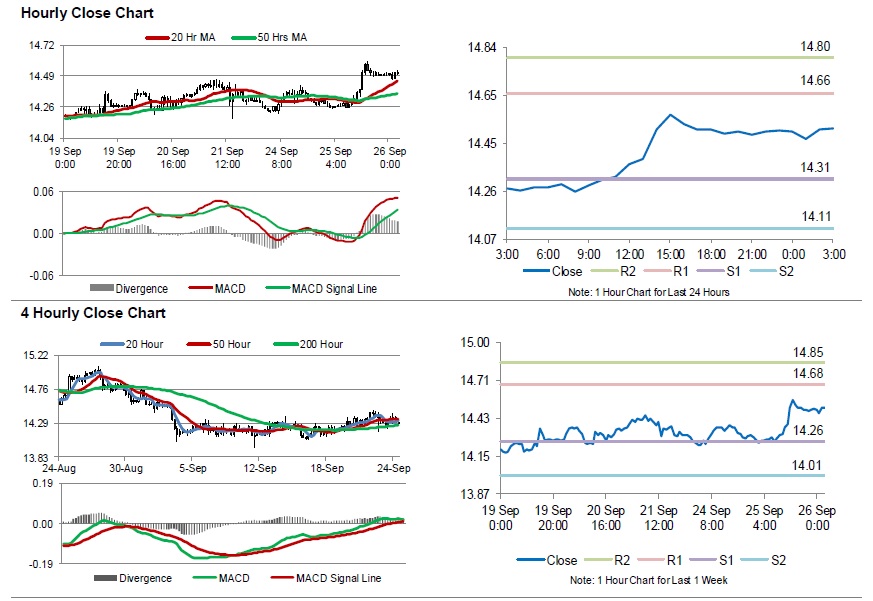
For the 24 hours to 23:00 GMT, Silver rose 1.36% against the USD and closed at USD14.51 per ounce, tracking gains in gold prices.
In the Asian session, at GMT0300, the pair is trading at 14.52, with silver trading 0.07% higher against the USD from yesterday’s close.
The pair is expected to find support at 14.31, and a fall through could take it to the next support level of 14.12. The pair is expected to find its first resistance at 14.66, and a rise through could take it to the next resistance level of 14.79.
The white metal is trading above its 20 Hr and 50 Hr moving averages.
Crude Oil: Oil Trading Higher, Ahead Of EIA’s Weekly Stockpiles Data
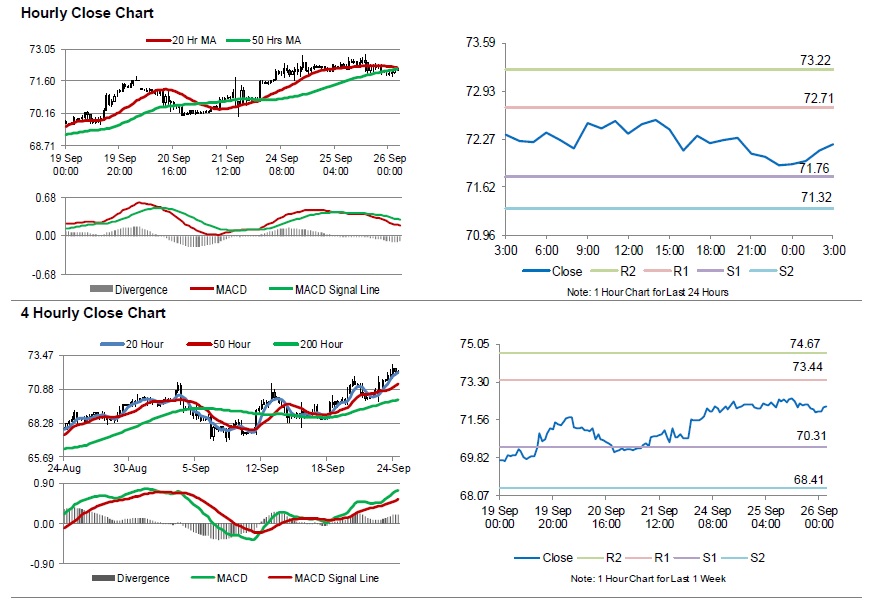
For the 24 hours to 23:00 GMT, Crude Oil declined 0.46% against the USD and closed at USD71.92 per barrel, after the American Petroleum Institute (API) reported that US crude oil inventories rose 2.9 million barrels to 402.4 million barrels in the week ended 21 September.
In the Asian session, at GMT0300, the pair is trading at 72.20, with oil trading 0.39% higher against the USD from yesterday's close.
The pair is expected to find support at 71.76, and a fall through could take it to the next support level of 71.32. The pair is expected to find its first resistance at 72.71, and a rise through could take it to the next resistance level of 73.22.
Crude oil is showing convergence with its 20 Hr and 50 Hr moving averages.
Market Morning Briefing: Euro Yen Hasn’t Yet Been Able To Break Above 133.15
STOCKS
Overall stocks are in a short term corrective mode and could dip a bit in the next few sessions before resuming the upmove.
Dow (26492.21, -0.26%) closed slightly at lower levels. Overall there is support at 26250 which could produce a bounce in the Dow in the near term. For the next 2-3 sessions we will have to allow for a dip to 26250.
Dax (12374.66, +0.19%) is trading just below important resistance on the daily candle chart. While the resistance holds, Dax could see a dip by the end of the week. Although in the longer term, the index looks bullish, we could see a resumption of the uptrend after a short dip towards 12300-12250 levels.
Nikkei (23906.61, -0.14%) is stable for now. The index could face some rejection from 24000-24200 levels in the near term. In the next 3-4 sessions, the index could inch up towards 24200.
Shanghai (2812.13, +1.11%) could see a short term dip while the other indices see a corrective dip globally. But it is likely to remain above 2750to eventually take the index towards 2900 in the medium term.
Nifty (11067.45, +0.91%) saw a decent bounce yesterday. While above 10800, chances of a pickup in rally towards 11200 is on the cards. A break above 11200 is required to negate another possible dip towards 10800.
COMMODITIES
Crude prices move higher after Trump said that the Us will put more sanctions on Iran following the oil sanctions in November. The potential supply shortfall after the Iran sanctions come into effect from 4th November has already been priced into the rising prices.
Brent (81.90) has moved up higher while WTI (72.18) is comparatively stable. Brent has enough room to rise on the upside toward 85 which could be achieved in the near term with some interim dips. WTI also has room on the upside and could test 74-76 levels soon. Overall Crude prices look bullish in the near to medium term with some interim corrective dips.
Gold (1205.90) continues to trade in the small sideways 1220-1190 region. A break on either side could be expected soon preferably on the upside above 1220.
Copper (2.8275) has moved up again today and could spend some time in the 2.75-2.85 region before moving up again. For now some sessions of ranged movement is possible.
FOREX
Unless the Fed appears too hawkish, Dollar Index should break below 93.80 and Euro above 1.180-1.185. An interim dip in USDINR could happen today.
Dollar Index (94.19): Some movement could be expected after the FOMC policy decision today. If it breaks below 93.80, then a near term fall to 93.20 and a fall towards 92 in Oct could be on the cards. Alternatively, a rise above 94.5 would be a bullish indicator, negating the above 'bearish towards 92' view.
Euro (1.1758): From the long term charts, bullishness beyond 1.185 is looking likely in the near term. This would be valid till Euro stays above immediate support near 1.1725-1.1700. Watch out for the FOMC today - the Fed's tone could be the decider on whether the above view turns out to be correct or not.
Dollar Yen (112.95): Chances of medium term bullishness towards 115 are high. On the upside, the first target would be the July ’18 high of 113.18 - after that, there could be some resistance in the 113.18-113.75 zone - which if breached, could lead to 115 ultimately. Only a break below 111.5 would negate the above view.
Euro Yen (132.82) hasn't yet been able to break above 133.15. However given our bullish preference on EURUSD and USDJPY, and also looking at the 3 day and weekly line charts of Euro Yen, our current preference would be for bullishness towards 134-135 in Oct.
Pound (1.3173) continues to stay above 1.305, thereby increasing chances of bullishness towards 1.34. A week close above the 21 and 89 weeks MAs near 1.313-1.318 would be required for further bullishness. Next 1-2 sessions could see some rise towards 1.32.
Aussie (0.7271) rose again after testing a low near 0.7237 yesterday - it has immediate resistance near 0.728 and higher resistance near 0.735-0.738, which could be tested by next week. A breach above 0.738, if it happens in the next 1-2 weeks, could be very bullish.
Dollar Rupee (72.695) Chances of near-term dip towards 72.40, maybe even 72.20 tomorrow.
INTEREST RATES
The Japanese 30 Year yield ( 0.91%), after its breach of resistance near 0.85% on long term chart, is continuing to rise. The Japanese 30-10 spread (0.78%) could have some resistance near 0.80% - for the resistance to hold, either the 30 year's upside could be restricted till 0.93%, or else, the 10 year yield might break the 0.13% resistance.
The Fed meet later today is set to see a hike the federal funds rate by 25 bps - this hike has already been factored in by traders. It will be crucial to see what the Fed indicates regarding future rate hike decisions in Dec '18 and in 2019. Also, any negative comment about trade wars affecting the US economy could also have a dovish effect - yields could again move down.
US 10 Year yield (3.09%) continues to stay below 3.10%. Important upside levels continue to be: 3.10%, 3.125% and 3.16%. Our current preference is for the yield to not breach 3.16% (800 weeks MA).
The 10 Year German-US spread (-2.55%) is currently at resistance on medium term chart. If the resistance holds, it might do so via a rise in the US 10 Year towards 3.16% while the German 10 Year rises to 0.6%.
The German 10 year yield (0.54%), as expected, is rising towards possible resistance near 0.6% - where it might pause for a bit. On the long term chart, there is room for a rise till 0.75% in the coming months.
Hence, a hold of resistance on the German-US spread chart suggests that the US 10 Year might go higher than 3.10% towards 3.16%. After that, there are chances of 3.16% holding - at least in the near term.
Elliott Wave: EURUSD Why Dips Should Remain Supported?
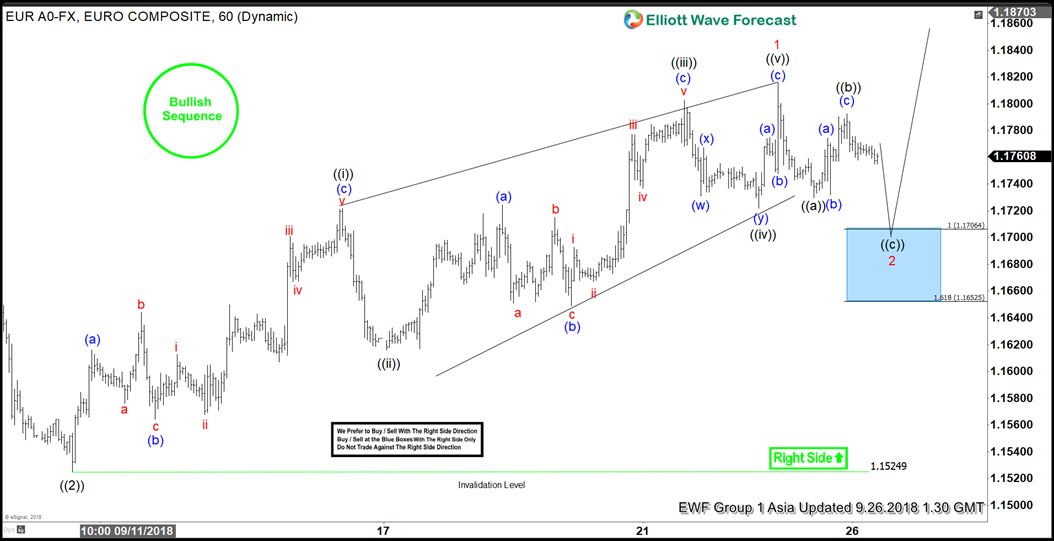
EURUSD short-term Elliott wave view suggests that the decline to 1.1524 low ended Primary wave ((2)) pullback. Above from there, Primary wave ((3)) remain in progress as impulse structure looking for a further extension higher. It’s important to note that the pair is having bullish sequence tag & also the right side tag is calling higher. Therefore, dips are expected to remain supported against 1.1524 low looking for extension higher.
Up from 1.1524 low, the initial rally to 1.1814 high ended lesser degree Minor wave 1 as leading diagonal structure. Where Minute wave ((i)) ended in 3 swings at 1.1720. Down from there, the pullback to 1.1616 low ended Minute wave ((ii)). Then a rally to 1.1801 high ended in 3 swings as zigzag in Minute wave ((iii)). A pullback down from there to 1.1723 low ended Minute wave ((iv)) in 3 swings. Then finally a rally to 1.1814 high ended Minute wave ((v)) & also completed Minor wave 1.
Below from there, the pair is be doing a correction against 1.1524 low in Minor wave 2 pullback in 3, 7 or 11 swings before upside renew. Near-term focus remains towards blue box area at 1.1706-1.1652 100%-161.8% Fibonacci extension area of Minute wave ((a))-((b)) to complete the 3 wave pullback from the peak within Minor wave 2. Afterwards, the pair is expected to resume the upside provided the pivot at 1.1524 low stays intact or should do a 3 wave bounce at least. We don’t like selling it and expect buyers to appear within Minor wave 2 pullback in 3, 7 or 11 swings.
EURUSD 1 Hour Elliott Wave Chart
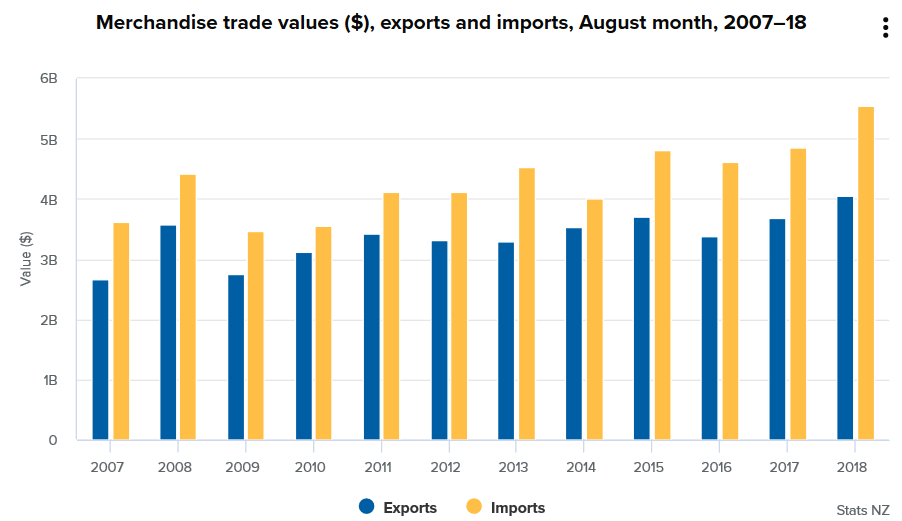
New Zealand recorded highest monthly trade deficit on record
New Zealand trade deficit widened sharply to NZD -1.484m in August versus expectation of NZD -930m. That's also the largest monthly deficit on record.
Exports rose 9.9% yoy to NZD 4.1B. However, imports jumped sharply by 14% yoy to NZD 5.5B, the third highest total on record. It's also the fourth straight month of imports above NZD 5B.
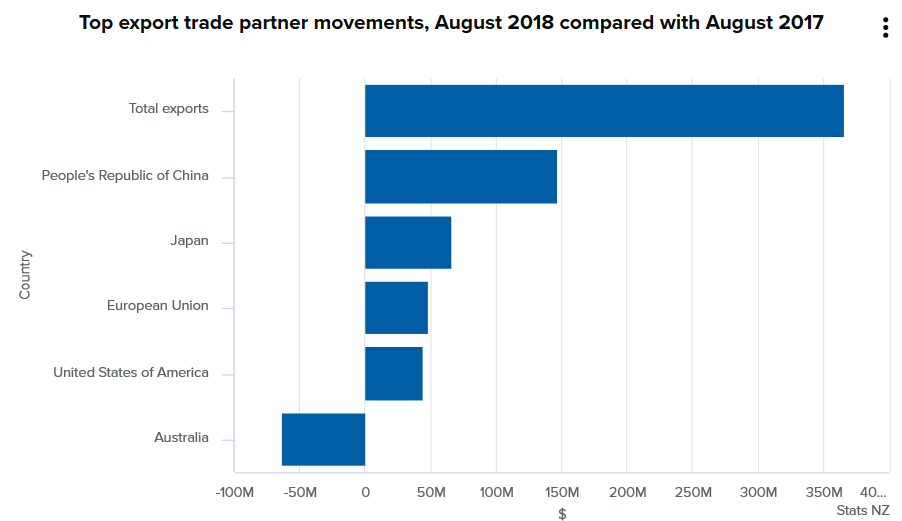
Exports to China rose 20% yoy to NZD 870M, to EU rose 12% to NZD 462M, to USA rose 14% yoy to NZD 371m and to Japan rose 28% yoy to NZD 302m. However, export to Australia was down -7.4% yoy to NZD 791m.
Petroleum and products led the imports rise, up NZD 186m (50%) to NZD 563m.
New Zealand ANZ Business Confidence jumps, but no change in RBNZ’s tune
New Zealand ANZ Business Confidence had a notable bounce by 12 pts to -38 in September. While's it's still a negative reading, it's already the highest level since May. Own activity index also rose 4 pts to 8.
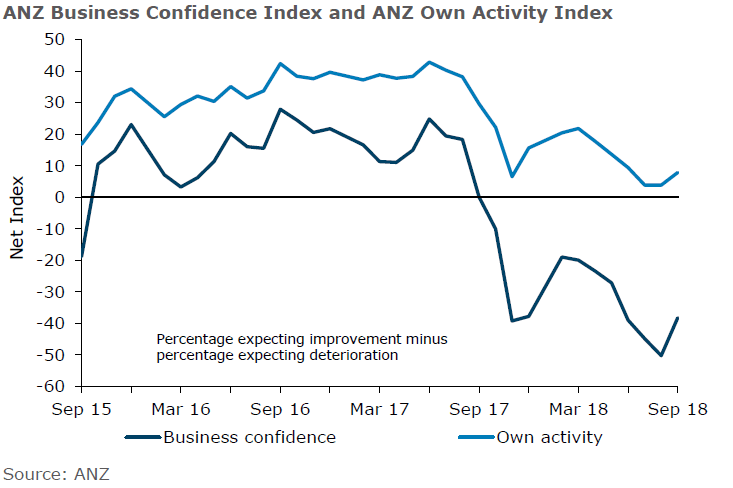
ANZ noted in the release that It is encouraging that nearly all activity indicators out of the ANZ Business Outlook survey rebounded this month, with only investment intentions deteriorating further. The growth signal coming out of the survey remains weak, certainly. But if the indicators continue to rebound, it will increase the odds that while the economy may have hit a pothole, the wheels are not falling off.
On RBNZ, ANZ said the Reserve Bank made it clear in the August Monetary Policy Statement that they believe the economy needs to accelerate to get inflation sustainably back to the target midpoint in an acceptable timeframe. We expect that at the OCR Review this week the message will therefore continue to be that the next move in the Official Cash Rate "could be up or down", despite the stronger-than-expected June quarter GDP outturn.
USTR Lighthizer blames Canada for not making essential concessions
US Trade Representative Robert Lighthizer complained that "Canada is not making concessions in areas where we think they're essential". And, there was "some distance" between the two sides on NAFTA negotiations. Lighthizer added that "We're going to go ahead with Mexico ... If Canada comes along now, that would be the best. If Canada comes along later, then that's what will happen."
Lighthizer also noted "we're sort of running out of time," referring to the US-imposed deadline of October 1.
Canadian Foreign Minister Chrystia Freeland's spokesman Adam Austen reiterated that "Our focus is the substance, not timelines. We will continue to negotiate with a view to getting a deal that is in Canada's national interest."
Asian Development Bank lowered China 2019 growth forecast to 6.3%, 2018 unchanged
The Asian Development Bank lowered China's 2019 growth forecast from 6.4% to 6.3%. For 2018, growth projection was kept unchanged at 6.6%. It cited "slower demand growth and an unfavorable trade environment" as the reasons for the downgrade. On US-China trade conflict, ABD said it could "deflate consumer and investor confidence, severely disrupt supply chains, impede technology transfer and foreign investment, and hit export-oriented industries in the PRC. "
ADB Chief Economist Mr. Yasuyuki Sawada said, "services and consumption will continue lifting the PRC's economy for the rest of 2018 although slower growth is expected next year, as ongoing trade tensions with the United States (US) are expected to affect net exports." He added that "supportive monetary and fiscal policy will help ease the short-run strains" But also urged that "continued reform progress is needed to sustain future growth."
Looking at the details, net exports are expected to hold back GDP growth for the rest of 2018 and 2019 as " trade tensions with the US continue to intensify, coupled with a dimmer outlook on global trade and investment activities." ADB expected current account surplus of China to lower to 0.7% in 2018 and further down to 0.2% in 2019.
For developing Asia as a whole, growth in 2018 is expected meet 6.0% forecast. However, 2019 growth projection was also trimmed by -0.1% to 5.8%. The US-China trade measures implemented by September 24 are expected to lower China GDP by -0.5% and US GDP by -0.1%. And they would have a "negligible effect on the rest of developing Asia". It also noted that "with the trade conflict escalation, the US trade deficit with the PRC would shrink, but the overall US trade deficit would not change much as US imports would be redirected to other countries while US exports to the PRC declined."
Also, ADB warned that "prolonged trade conflict can damage confidence and deter investment. This indirect fallout will be large for many economies in the region and globally, especially if automobiles and other parts become embroiled in the trade conflict."
ADB's press release on China here.
The Asian Development Outlook 2018 update here.
Chinese stocks and AUD surge as MSCI mulls lifting index weighting 4 times
Chinese stocks rise sharply higher today on news that MSCI is considering to increase its A shares in the MSCI indexes.
MSCI noted that the 5% initial inclusion of China A implemented in May and August 2018 got "overwhelming positive feedback from market participants". It's has now launched a consultation on further weight increase. The investment community could provide MSCI with proposals till February 15, 2019 and the decision would be made on or before February 28, 2019.
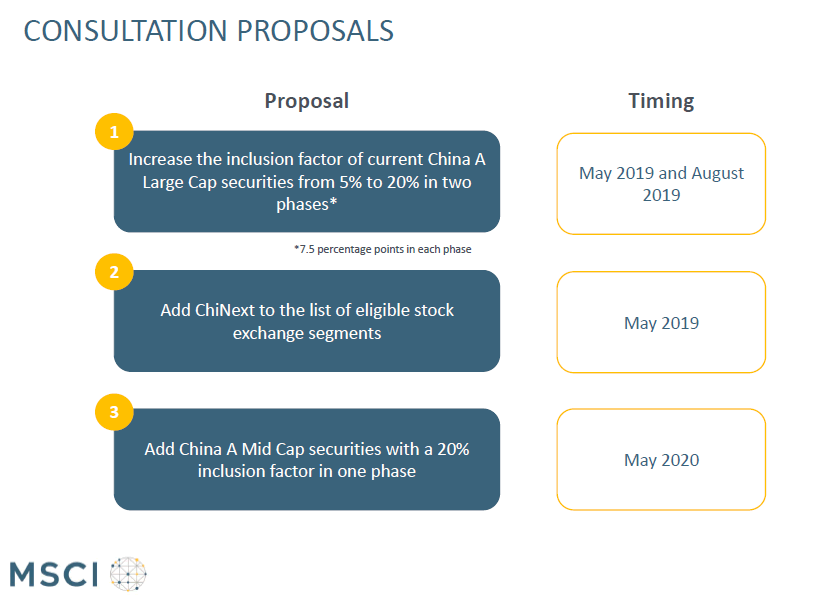
The current proposals including adding the weight of China A Large Cap securities from 5% to 7% in two phases, 7.5% each in May and August 2019. Also ChiNext could be added to the list of eligible stock exchange segments in May 2019. China A Mid-Cap securities with 20% included factor in one phase in May 2020.
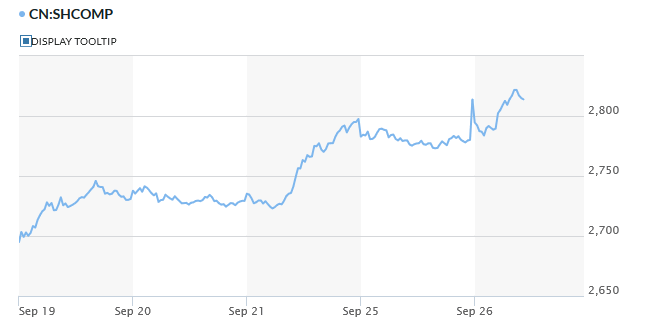
At the time of writing, China Shanghai SSE composite is trading up 1.37% at 2819, finally back above 2800 handle.
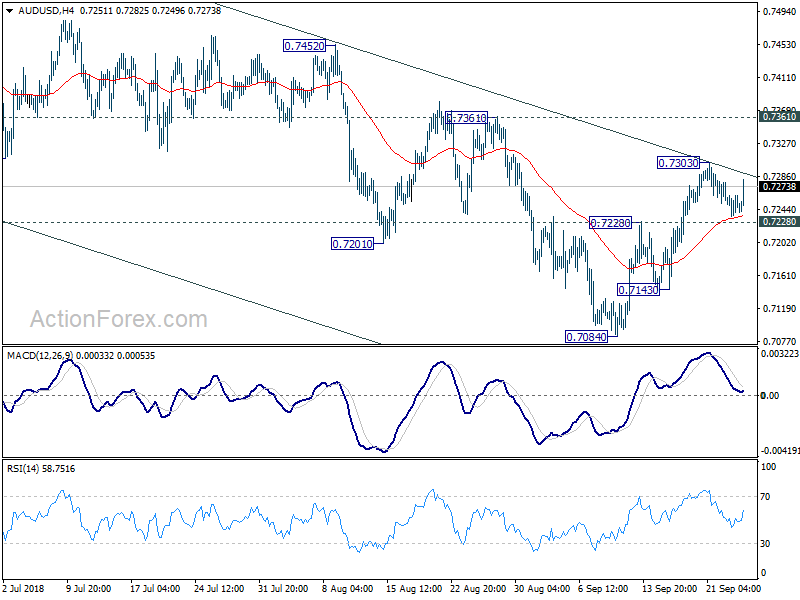
The news has apparently lifted Australian Dollar too. With today's rise and 0.7228 minor support defended, AUD/USD is possibly extending the corrective rebound from 0.7084 through 0.7303 before completing it.
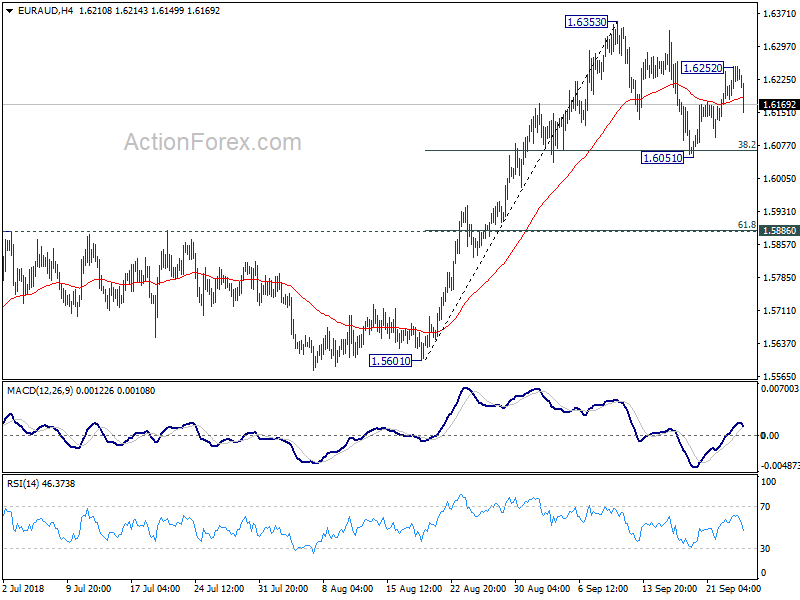
EUR/AUD's rebound from 1.6051 could also be finished at 1.6252. And, the correction from 1.6353 would likely have another take on 1.6051 support before completion.