

Sample Category Title
Japanese Yen at 8-Week Low, U.S Consumer Confidence Next
USD/JPY is showing little movement in the Tuesday session. In North American trade, the pair is trading at 112.86, up 0.05% on the day. In economic news, the BoJ released the minutes of its monetary policy meeting and Japanese SPPI improved to 1.3%, above the estimate of 1.1%. In the U.S, today’s key indicator is CB Consumer Confidence, which is expected to climb to 132.2 points. On Wednesday, the spotlight will be on the Federal Reserve, which is likely to maintain interest rates at a range between 2.00% and 2.25%.
The BoJ released the minutes of last week’s policy meeting. The BoJ is showing no signs of altering its ultra-accommodative policy. but the minutes indicated that some policymakers are concerned about the impact of the policy on the banking system. With inflation still below the Bank’s target of around 2 percent, the BoJ is unlikely to take anything more than tweak current policy. At the policy meeting, the Bank held its short-term interest rate target at -0.1 percent and a pledge to guide 10-year government bond yields around zero percent. The BoJ also maintained a pledge to keep interest rates extremely low for an extended period.
The U.S and China fired more trade salvos at each other this week, and that could spell bad news for the Japanese yen. On Monday, the U.S imposed tariffs on some $200 billion worth of Chinese goods, while China responded with tariffs of $60 billion on U.S products. There may be more headwinds ahead, as China sharply attacked the U.S, saying it had plunged “a knife to China’s neck” with the new tariffs. The Chinese have canceled trade talks with the Trump administration, and no new talks are likely to be held until the mood improves between the world’s two largest economies. Previous rounds of tariffs between the two economic giants have boosted the U.S dollar, but so far, investors have reacted calmly and have not snapped up the U.S dollar at the expense of other currencies.
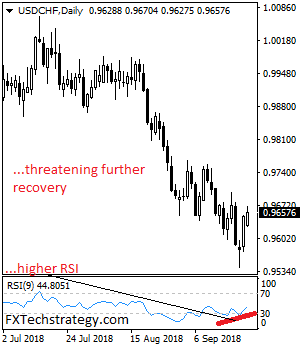
USDCHF: Bullish, Remains On The Offensive On Corrective Recovery
USDCHF: The pair looks to build on its Monday gain with more strength envisaged. On the downside, support lies at the 0.9600 level. A turn below here will open the door for more weakness towards the 0.9550 level and then the 0.9500 level. On the upside, resistance resides at the 0.9700 level where a break will clear the way for more strength to occur towards the 0.9750 level. Further out, resistance comes in at the 0.9800 level. Above here if seen will turn attention to 0.9850. Its daily RSI is bullish and pointing higher suggesting further strength. All in all, USDCHF faces further price strength.
EUR/USD Mid-Day Outlook
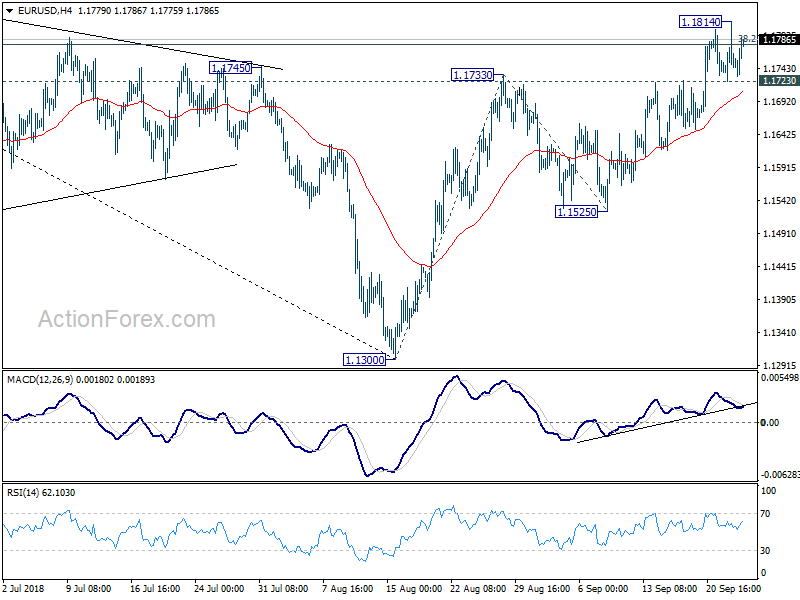
Daily Pivots: (S1) 1.1708; (P) 1.1762; (R1) 1.1800; More.....
Intraday bias in EUR?USD remains neutral with focus on 38.2% retracement of 1.2555 to 1.1300 at 1.1779. Break of 1.1723 minor support will suggest rejection by 1.1779 and would be in line with our original view. In such case, intraday bias will be turned back to the downside for 1.1525 support. However, sustained break of 1.1779 will pave the way to 100% projection of 1.1300 to 1.1733 from 1.1525 at 1.1958.
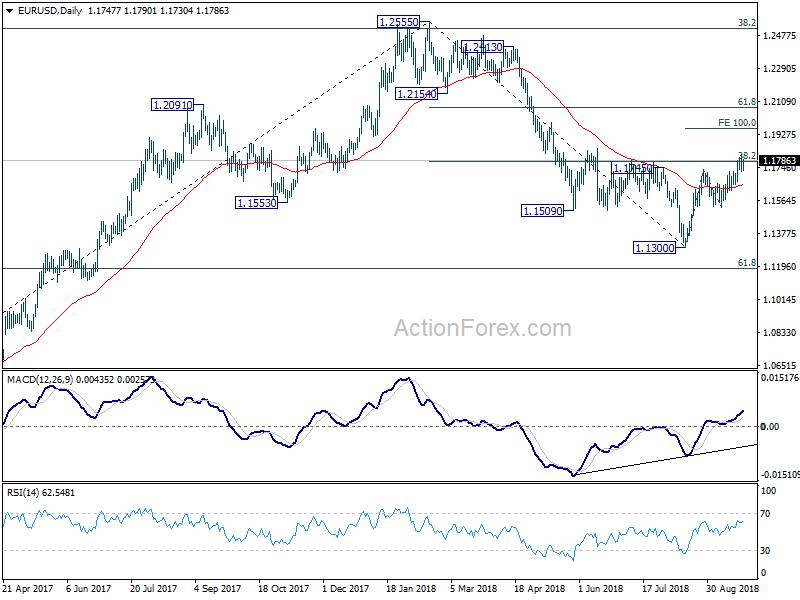
In the bigger picture, a medium term bottom should be in place at 1.1300, on bullish convergence condition in daily MACD and some consolidations would be seen. But still, note that EUR/USD was rejected by 38.2% retracement of 1.6039 (2008 high) to 1.0339 (2017 low) at 1.2516. That carries some long term bearish implications. Thus, we'd expect fall from 1.2555 high to resume after consolidation completes. Below 1.1300 should send EUR/USD through 61.8% retracement of 1.0339 to 1.2555 at 1.1186. And, in that case, EUR/USD would head to retest 1.0339 (2017 low).
GBP/USD Mid-Day Outlook
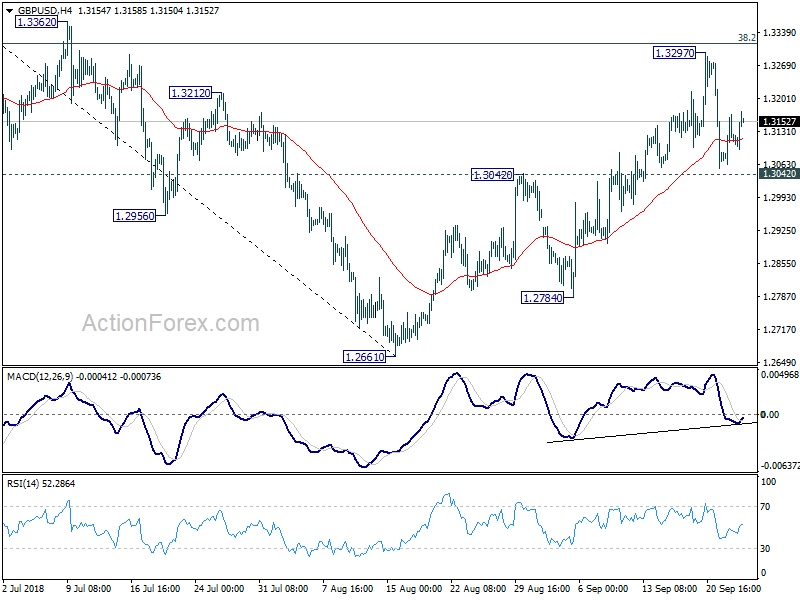
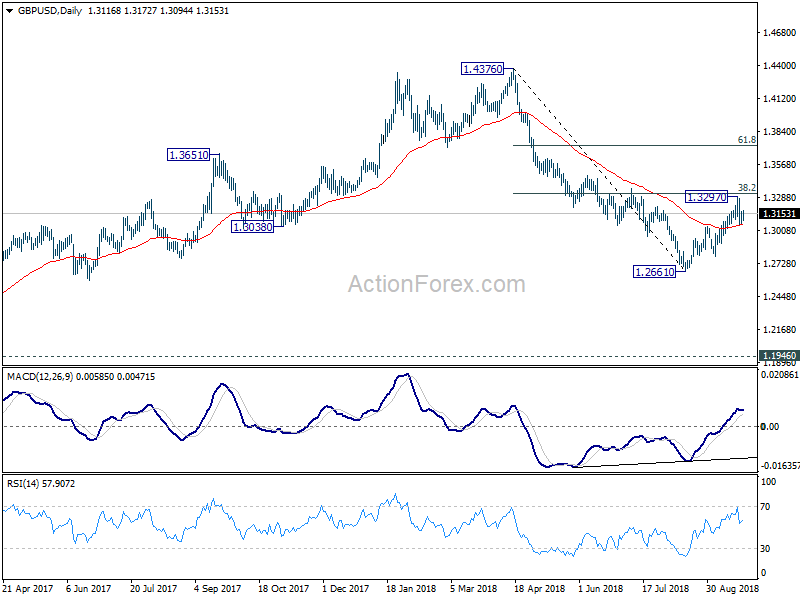
Daily Pivots: (S1) 1.3064; (P) 1.3116; (R1) 1.3168; More...
Outlook in GBP/USD remains unchanged. Intraday bias stays neutral first. Also, with 1.3297 intact, risk remains on the downside. The corrective rise from 1.2661 could have completed at 1.3297, ahead of 1.3316 key fibonacci level. On the downside, break of 1.3042 resistance turned support will bring deeper fall to 1.2784. Break there will argue that larger down trend from 1.4376 is resuming for a new low below 1.2661.
In the bigger picture, whole medium term rebound from 1.1946 (2016 low) should have completed at 1.4376 already, after rejection from 55 month EMA (now at 1.4062). The structure and momentum of the fall from 1.4376 argues that it's resuming long term down trend. And this will be the preferred case as long as 38.2% retracement of 1.4376 to 1.2661 at 1.3316 holds. However, firm break of 1.3316 would bring stronger rebound to 61.8% retracement at 1.3721. And, the eventual depth of the fall from 1.4376, and the chance of hitting 1.1946 low, will depend on the strength of the interim corrective rebound from 1.2661.
USD/CHF Mid-Day Outlook
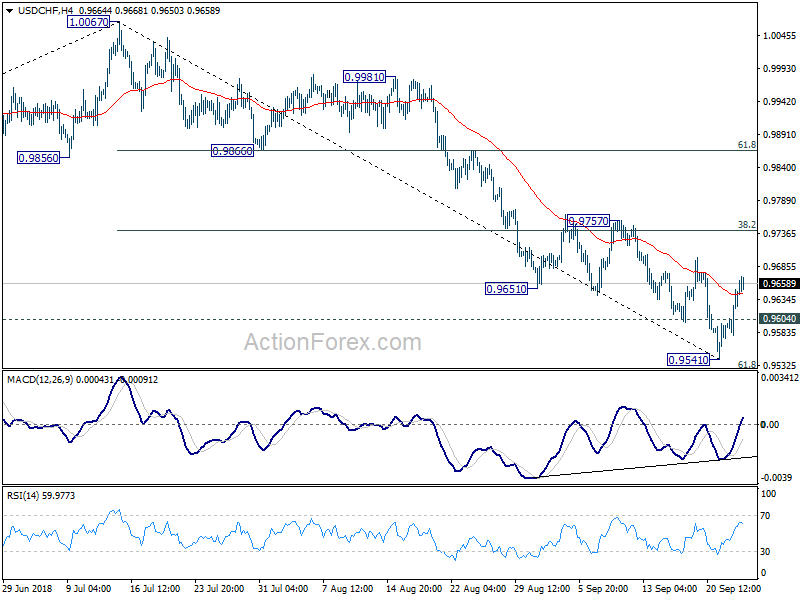
Daily Pivots: (S1) 0.9602; (P) 0.9627; (R1) 0.9674; More...
Intraday bias in USD/CHF remains on the upside at this point. Rebound from 0.9541 short term bottom would target 0.9757 resistance first. Firm break there will target 0.9866 key resistance level, 61.8% retracement of 1.0067 to 0.9541 at 0.9866. On the downside, below 0.9604 will turn bias back to the downside for 0.9541 low instead.
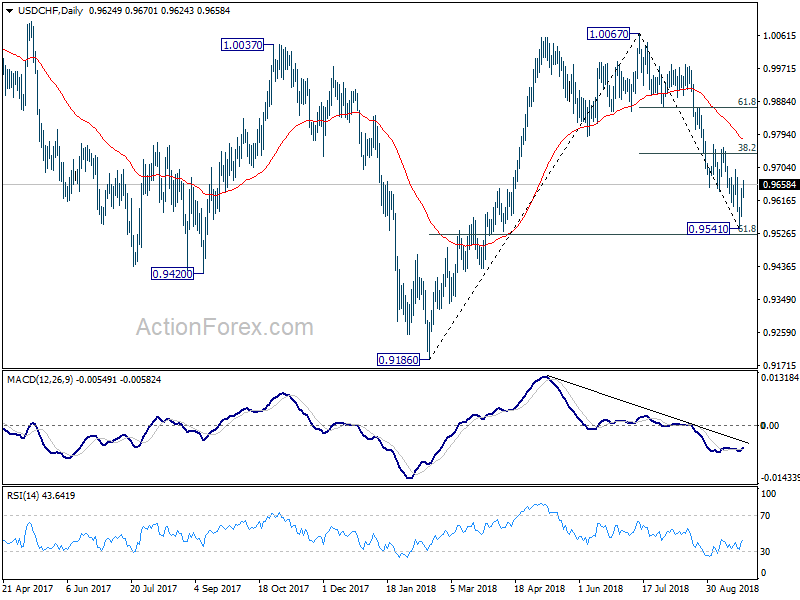
In the bigger picture, rise from 0.9186 low has completed at 1.0067, after failing to sustain above 1.0037 resistance. Fall from 1.0067 could extend to 61.8% retracement of 0.9816 to 1.0067 at 0.9523 and possibly below. But for now, we don't expect a break of 0.9186 low. On the upside, firm break of 0.9866 support turned resistance will suggest that fall from 1.0067 has completed and rise from 0.9186 is resuming.
USD/JPY Mid-Day Outlook
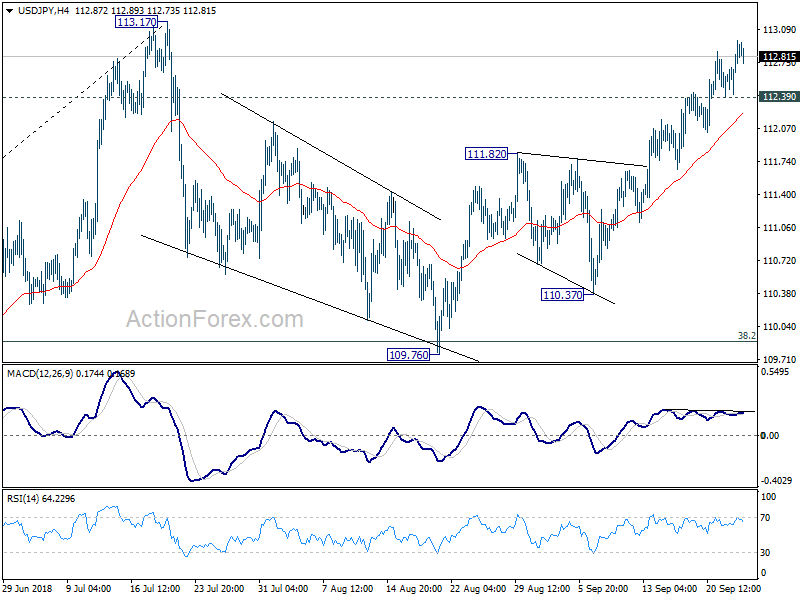
Daily Pivots: (S1) 112.54; (P) 112.68; (R1) 112.96; More...
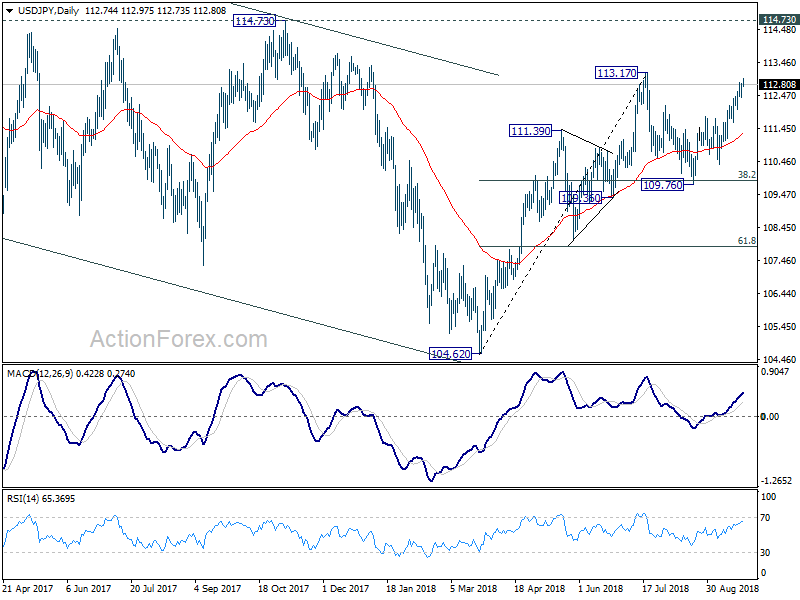
Intraday bias in USD/JPY remains on the upside for 113.17 resistance. Decisive break there will resume whole rally from 104.62 and target 114.73 resistance next. On the downside, below 112.39 minor support will turn intraday bias neutral again. But near term outlook will remain cautiously bullish as long as 111.82 resistance turned support holds.
In the bigger picture, corrective fall from 118.65 (2016 high) should have completed with three waves down to 104.62. Decisive break of 114.73 resistance will likely resume whole rally from 98.97 (2016 low) to 100% projection of 98.97 to 118.65 from 104.62 at 124.30, which is reasonably close to 125.85 (2015 high). This will stay as the preferred case as long as 109.36 support holds. However, decisive break of 109.36 will mix up the outlook again. And deeper fall should be seen back to 61.8% retracement of 104.62 to 113.17 at 107.88 and below.
WTI Crude Oil Futures Trade around 2-month High; Strongly Bullish in Long-Term
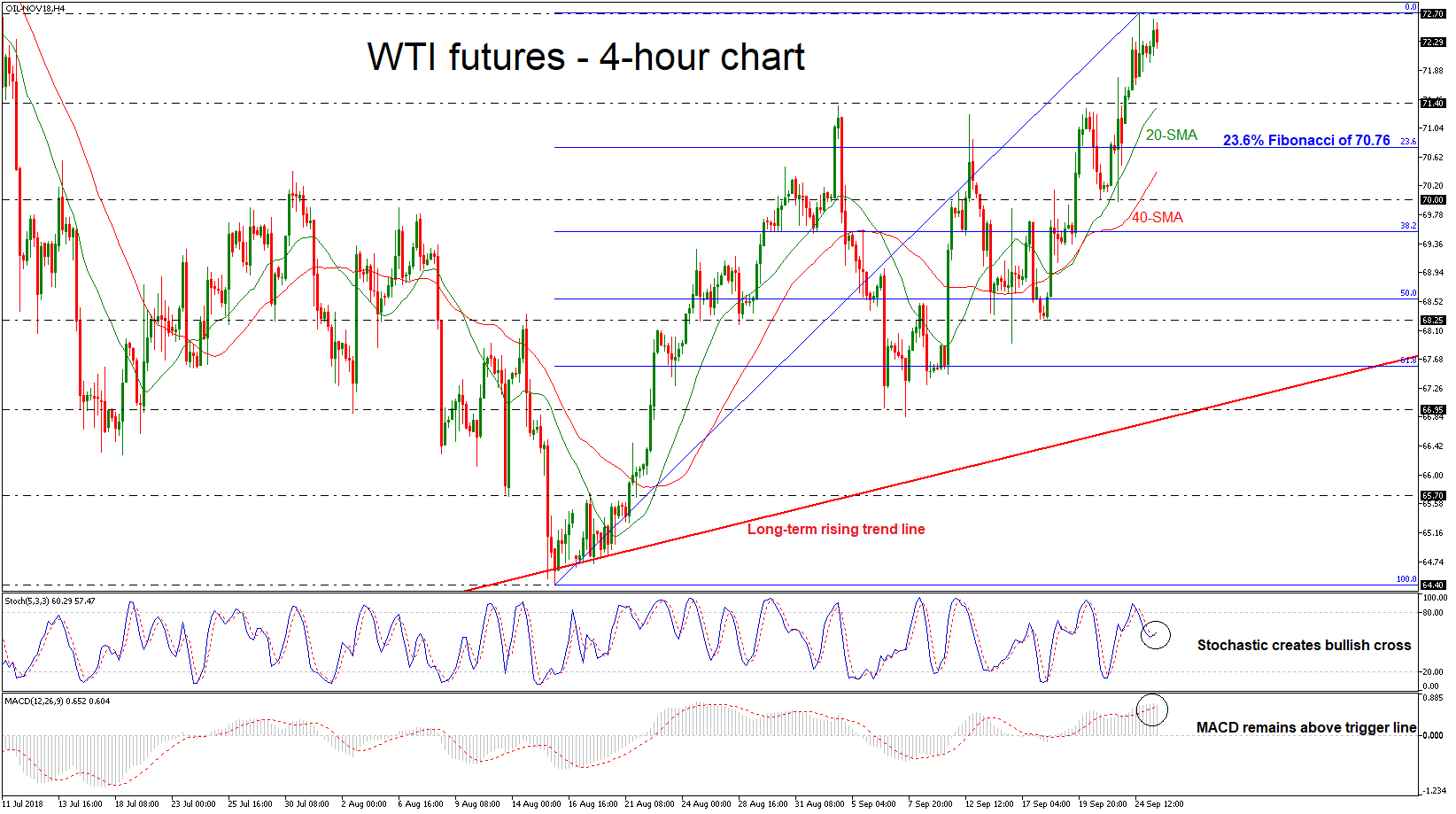
West Texas Intermediate (WTI) futures reached a fresh more than two-month high of 72.70 in Monday’s session. Price action is at the moment taking place not far below this peak, while it is holding well above the simple moving averages (SMAs) in the 4-hour chart.
In the short-term, the MACD oscillator is moving slightly higher in the positive zone, while the blue %K line of the stochastic oscillator posted a bullish cross with the red %D line, signaling upside tendency in the 4-hour chart.
An extension to the upside and above the two-month high (72.70) resistance area could meet the next immediate barrier of 72.94. If there are further advances, resistance could be found at 74.80, identified by the high on July 5.
If the price weakens and slips below the 71.40 support, it could slip until the 23.6% Fibonacci retracement level of the upleg from 64.40 to 72.70, near 70.76. Even lower, the 70.00 strong psychological level could attract greater attention.
To summarize, WTI crude looks bullish in the short-term again, while in the long-term picture, it has been strongly positive since June 2016.
EUR/CHF Mid-Day Outlook
Daily Pivots: (S1) 1.1279; (P) 1.1309; (R1) 1.1364; More...
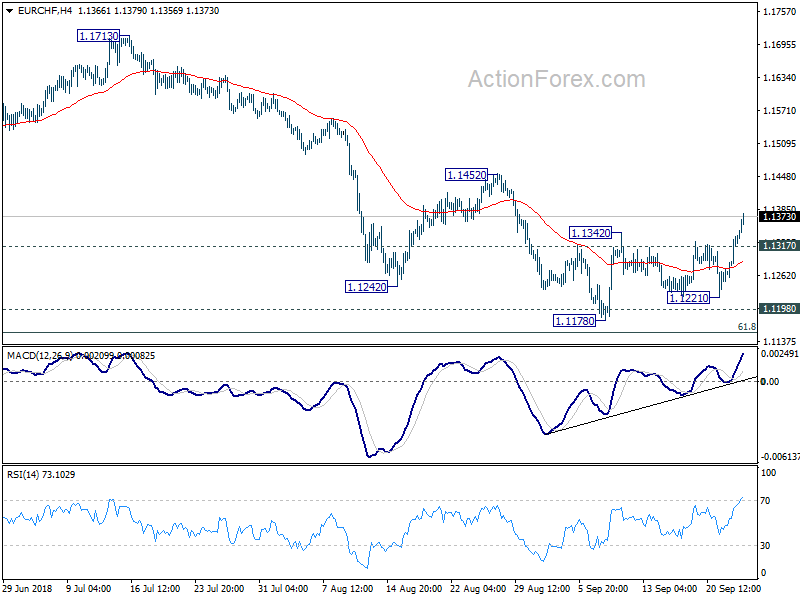
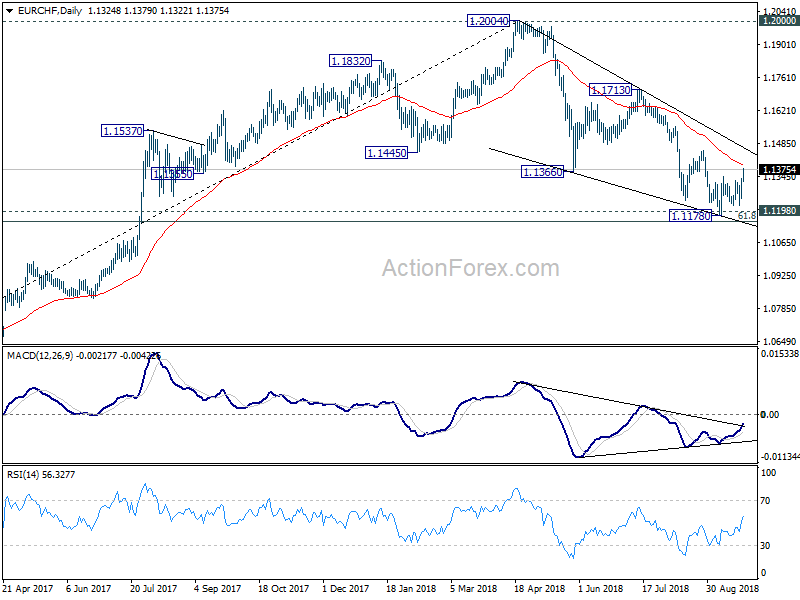
EUR/CHF rises to as high as 1.1379 so far today and intraday bias remains on the upside for 1.1452 resistance. Firm break there should confirm near term reversal. That is, whole correction from 1.2004 has completed at 1.1178 after hitting 1.1154/98 key support zone. In that case, further rise should be seen to 1.1713 resistance next. On the downside, below 1.1317 minor support will dampen this bullish view and turn intraday bias neutral again first.
In the bigger picture, for now, the price actions from 1.2004 medium term top is seen as a correction only. Downside should be contained by support zone of 1.1198 (2016 high) and 61.8% retracement of 1.0629 to 1.2004 at 1.1154 to complete it and bring rebound. This cluster level is in proximity to long term channel support (now at 1.1207) too. A break of 1.2 key resistance is still expected in the medium term long term. However, sustained break of the mentioned support zone will mark reversal of the long term trend. In that case, 1.0629 key support will be back into focus.
Swiss Franc Selloff Extends on Surging German Yield
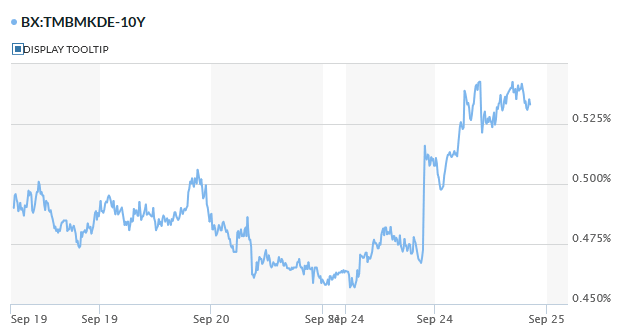
Swiss Franc weakness is the main theme in rather directionless markets today. In particular, EUR/CHF is leading the way higher on expectation of policy divergence between ECB and SNB. Also, the need for safe haven diminished much after situations in Turkey and Italy stabilized for a while. Funds are flowing back from the Franc back to Euro. This could be reflected in the strong rally in German 10 year bund yield too. At the time of writing, German 10 year bund year is rising 0.023 to 0.535.
Both the Pound and Euro are the stronger ones today. But their strength remain unconvincing. EUR/USD, GBP/USD, EUR/JPY and GBP/JPY are bounded in familiar range. For now, it seems traders are refusing to commit ahead of FOMC rate hike and projections tomorrow.
In other markets, major European indices are trading higher today. At the time of writing, DAX is up 0.21%, CAC up 0.18% and FTSE up 0.55%. Earlier in Asia, Nikkei closed up 0.29% and Singapore Strait Times rose 0.53%. China Shanghai SSE dropped -1.62% to close at 27499.39. WTI crude oil continues this week's rally and is up 0.5% at 72.44 for now. Gold is still gyrating in tight range around 1200 handle.
ECB Praet: Price pickup a long process conditioned on very easy monetary conditions
ECB Chief Economist Peter Praet said today that "clearly we see progress in the underlying (prices), what is behind the inflation process." However he emphasized that "it's a long process and conditioned on very easy monetary conditions."
Yesterday, Euro spiked higher on ECB President Mario Draghi's comments that "domestic price pressures are strengthening and broadening". However, Praet talked it down and said there was "nothing new" in Draghi's comments.
Also, Praet added the the biggest risk to price stability is a "growth accident". That is, a sudden stop in the growth cycle. And that could come from from rising protectionism or emerging markets slowdown.
German BDI lowered growth and export forecasts, risks arise with almost every US protectionist measure
The Federation of German Industries (BDI) lowered 2018 GDP growth forecast to 2.0%, down from prior estimate of 2.25%. Also, export growth is expected to be 3.5% in real terms, down from prior forecast of 5%.
BDI president Dieter Kempf urged the country to "prepare for the downturn" in a statement. He noted that "the high phase of the global economic recovery is over, investment activity has flattened." And, for German companies "risks arise with almost every protectionist measure – even if they are directed by the US against China."
Kempf also completed that "the industry is waiting impatiently for economic policy of the Federal Government, especially in the tax, digitization and energy policy."
At the same time, he also emphasized that "in our society, xenophobia has no place." And, "investments by foreign companies and the integration of skilled workers from other countries contribute significantly to prosperity and jobs in Germany."
BoJ Kuroda: Must consider positive and side effects of loose monetary policy in balanced manner
BoJ Governor Haruhiko Kuroda said today that the central bank is now at a stage that the benefits and side-effects of the ultra-loose monetary policy must be considered in a "balanced manner". He pointed to strengthening in the recovery and pickup in wages and prices. But he also echoed the July meeting minutes that it takes more time than expected to achieve the 2% inflation target.
Kuroda added that "under such a fairly complex economic and price situation, monetary policy must take into account various developments in a comprehensive manner". And, "this means that, in continuing with powerful monetary easing, we now need to consider both its positive effects and side-effects in a balanced manner."
Meanwhile, he maintained the pledge that "BOJ will continue to make its utmost efforts to firmly support corporate activity, taking into account economic, price and financial developments."
BoJ July minutes: Sentiments could worsen if US-China trade friction intensifies
The minutes of July 30-31 BoJ meeting showed that the board members expected Japan's economy to grow above potential in fiscal 2018. For 2019 and 2020, growth would likely continue "partly supported by external demand". However, the pace would decelerate "due to a slowdown in domestic demand. On prices, most members agreed that CPI would likely increase increase gradually towards 2% as "firms' stance gradually would shift toward further raising wages and prices". But these members agreed that "it would take more time than expected to achieve 2 percent inflation". Thus, the inflation projection in the July Outlook Report was lowered from April's.
The minutes also noted that the global financial markets had temporarily become unstable through early July, "mainly against the background of uncertainties over trade policy, especially between the United States and China". And, many members warned that "risk sentiment could worsen again if trade friction between the United States and China intensified." Also, one member added that " if the Chinese yuan depreciated further, due mainly to concerns over the possible negative impact on the Chinese economy, there was a risk of this having a negative impact on investors' sentiment regarding emerging markets in Asia."
China to US: No trade talks under threats and pressure
Chinese Vice Commerce Minister Wang Shouwen said at a news conference today that whether trade talk could restart depends on the "will" of the US. But he emphasized that trade meeting will not take place against the backdrop of "threats and pressure" from the US.
He said, "now that the United States has adopted such a huge trade restriction measure … how can the negotiations proceed? It's not an equal negotiation."
Wang also added that "if this continues, it will destroy in an instant the gains of the last four decades of China-U.S. relations."
EUR/CHF Mid-Day Outlook
Daily Pivots: (S1) 1.1279; (P) 1.1309; (R1) 1.1364; More...
EUR/CHF rises to as high as 1.1379 so far today and intraday bias remains on the upside for 1.1452 resistance. Firm break there should confirm near term reversal. That is, whole correction from 1.2004 has completed at 1.1178 after hitting 1.1154/98 key support zone. In that case, further rise should be seen to 1.1713 resistance next. On the downside, below 1.1317 minor support will dampen this bullish view and turn intraday bias neutral again first.
In the bigger picture, for now, the price actions from 1.2004 medium term top is seen as a correction only. Downside should be contained by support zone of 1.1198 (2016 high) and 61.8% retracement of 1.0629 to 1.2004 at 1.1154 to complete it and bring rebound. This cluster level is in proximity to long term channel support (now at 1.1207) too. A break of 1.2 key resistance is still expected in the medium term long term. However, sustained break of the mentioned support zone will mark reversal of the long term trend. In that case, 1.0629 key support will be back into focus.
Economic Indicators Update
| GMT | Ccy | Events | Actual | Forecast | Previous | Revised |
|---|---|---|---|---|---|---|
| 23:50 | JPY | BOJ Minutes | ||||
| 23:50 | JPY | Corporate Service Price Y/Y Aug | 1.30% | 1.10% | 1.10% | |
| 13:00 | USD | House Price Index M/M Jul | 0.20% | 0.20% | ||
| 13:00 | USD | S&P/Case-Shiller Composite-20 Y/Y Jul | 6.20% | 6.30% | ||
| 14:00 | USD | Consumer Confidence Index Sep | 130.5 | 133.4 |
Canadian Dollar Steady, Investors Eye U.S Consumer Confidence
The Canadian dollar is trading sideways in the Tuesday session. Currently, USD/CAD is trading at 1.2961, up 0.05% on the day. On the release front, there are no Canadian releases. In the U.S, today’s key indicator is CB Consumer Confidence, which is expected to climb to 132.2 points. On Wednesday, the spotlight will be on the Federal Reserve, which is likely to maintain interest rates at a range between 2.00% and 2.25%.
It was another strong week for the Canadian dollar, which posted gains close to 0.1 percent. USD/CAD dropped to 1.2885 on Thursday, its lowest level since mid-June. The Canadian currency held its own on Friday, despite mixed consumer data. CPI dipped from 3.0% to 2.8% in August, a rare decline. Even with the rare decline, inflation remains well above the BoC target of 2.0%. Retail Sales rebounded with a strong gain of 0.9%, above the estimate of 0.6%. The strong consumer numbers have strengthened the likelihood of a rate hike when the BoC meets next in October.
Trade tensions have escalated this week, with the U.S and China slapping tariffs on each other. On Monday, the U.S imposed tariffs on some $200 billion worth of Chinese goods, while China responded with tariffs of $60 billion on U.S products. There may be more headwinds ahead, as China sharply attacked the U.S, saying it had plunged “a knife to China’s neck” with the new tariffs. The Chinese have canceled trade talks with the Trump administration, and no new talks are likely to be held until the mood improves between the world’s two largest economies. Previous rounds of tariffs between the two economic giants have boosted the U.S dollar, but so far, investors have reacted calmly and have not snapped up the U.S dollar at the expense of other currencies.