Sample Category Title
Crude Beating Its Own Records
The most interesting events are now taking place in the commodity market. The Brent crude continues making new highs for over a few years and is still downtrending. On Tue Sep 25, Brent is trading around $81.89 and is unlikely to stop there.
The energy commodities hype has a few reasons, one of them being the weak US dollar, which is logical, as the crude is a dollar denominated asset which rises when the greenback falls, and vice versa. Another reason are the results of the OPEC+ meeting last weekend, where the members and non-members talked the possibility of rising the oil production by 500k barrels per day, or even more, although no decisions have been taken, as OPEC+ decided to postpone this discussing to the next meeting that will take place in November.
Another important thing are the OPEC+ comments on continuing oil production regulation in case the inventories are too high, which helped the bulls a lot.
The most popular question in the markets now is how much higher crude oil may climb, with some saying $85 or even $100 is possible before the end of the year. The point is however that Brent crude has already added 20% to its value since early 2018, and reaching $100 will require the black gold to add 25% more, which is way too much, especially given the continuous growth over the last few weeks.
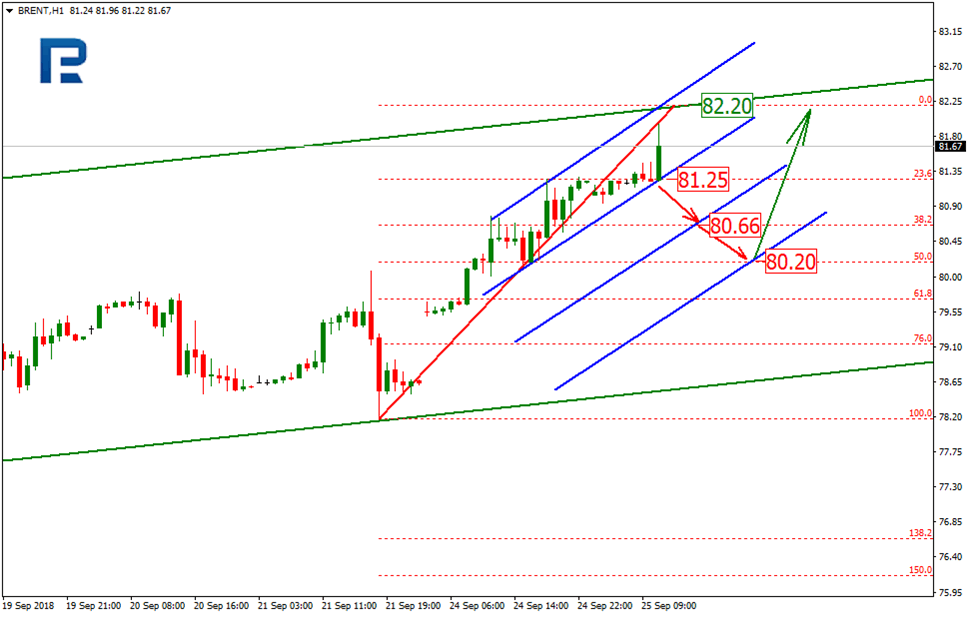
Meanwhile, the new ascending impulse broke out the significant highs and is now heading towards the new ones. The current trend is somewhat stable, as the price is moving inside a uniform channel. The impulse is approaching the upper major channel boundary at $82.20. After testing the resistance area, the price may pull back to the 50.00% Fibo retracement at $80.20. A correctional downtrend is going to start while the short term ascending channel line gets broken out near $81.25. The correction targets are at $80.66 and $80.20, while afterwards the price may start rising towards new highs.
Into US session: Swiss Franc and Canadian Dollar weakest
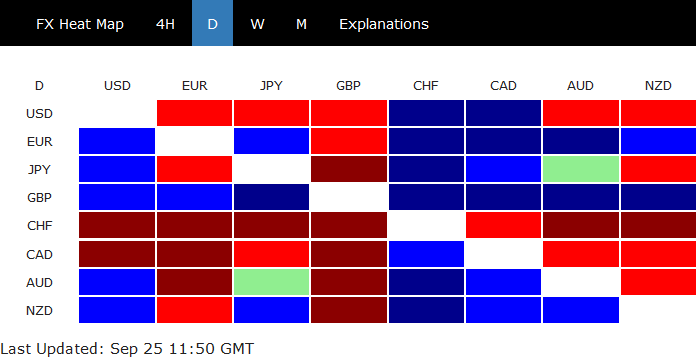
Canadian Dollar and Swiss Franc are the clearly weaker ones in a slow day, in terms of price actions. Sterling and Euro are the strongest but their strength is far from being convincing. For now, EUR/USD, GBP/USD, EUR/JPY and GBP/JPY are staying in familiar range. While Australian Dollar and Canadian Dollar fall against the greenback, both are held above near term support level at 0.7728 and 1.2975 respectively. It looks like Dollar traders are refusing to commit ahead of tomorrow's FOMC rate hike and economic projections.
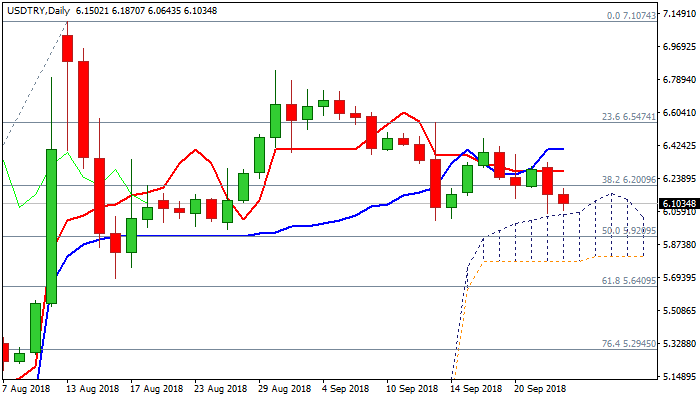
In other markets, European stock indices are slightly higher today with DAX up 0.17% and CAC up 0.21% at the time of writing. FTSE is displaying some strength as it opened lower and dripped to 7455.22 but it's now back pressing 7500 handle, up 0.55%. Earlier in Asia, Nikkei closed up 0.29% and Singapore Strait Times rose 0.53%. China Shanghai SSE dropped -1.62% to close at 27499.39. WTI crude oil continues this week's rally and is up 0.5% at 72.44 for now. Gold is still gyrating in tight range around 1200 handle.
Kiwi May Post Gains If RBNZ Strikes Upbeat Tone, Rates Predicted To Hold Steady
The Reserve of Bank of New Zealand (RBNZ) will be deciding on interest rates on Wednesday at 2100 GMT. The central bank is expected to hold rates steady at 1.75% and the meeting will be accompanied by a press conference by Governor Adrian Orr, and thus the focus will be on the statement for any updates.
In the previous meeting on August 8, the RBNZ left again its official rate unchanged at the record low of 1.75%, saying that economic growth has moderated while inflation is likely to increase in the near term due to higher fuel prices and a lower exchange rate. Moreover, policymakers mentioned that rates will remain at the same level through 2019 and into 2020. The central bank last moved its key rate in November 2016. At the press conference following the decision, Governor Orr said that if growth slows further below its potential rate, then officials would have to cut rates.
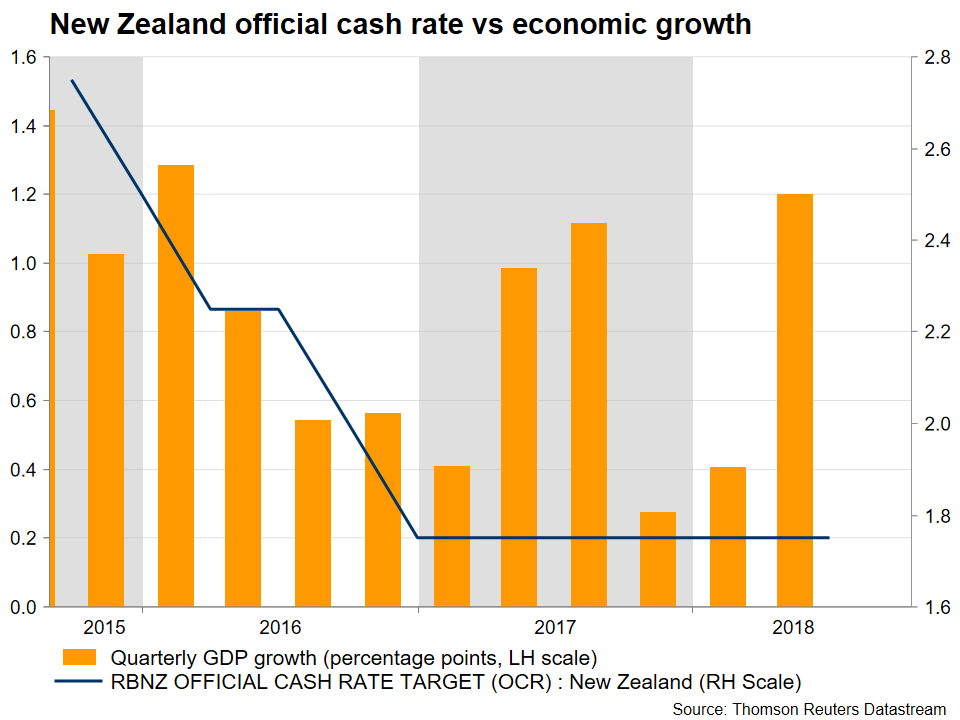
Last week’s GDP figures have helped to relieve concerns that the economy is heading into a slump. The New Zealand economy advanced by 1% on quarterly basis in the second quarter of this year, accelerating from 0.5% previously and beating market expectations of 0.7%. It was the largest quarterly rise in two years. Meanwhile, consumer prices were the second slowest in the last six quarters during April-June, increasing by 1.5% in yearly terms versus a 1.1% increase in the prior quarter.
However, despite the pickup in growth, the RBNZ remains concerned about persistently weak business confidence as it dropped to 10-year low in August. The dire business sentiment readings have raised fears that firms are holding off on investment decisions and this may reduce economic growth in the coming quarters, which would drive the kiwi lower. Governor Orr recently cited this as the biggest downside risk, warning that “people talk themselves into not investing”.
Ahead of the RBNZ policy decision and any updates on global trade between the US and China, as well as countries/blocks that were traditionally considered as US allies, such as the EU and Canada, will also be closely watched by market participants.
Antipodean currencies, such as the kiwi and the aussie, have been suffering lately on the back of trade jitters instigated by President Trump’s trade rhetoric. In this respect, comments on trade in the RBNZ’s statement will be of particular interest.
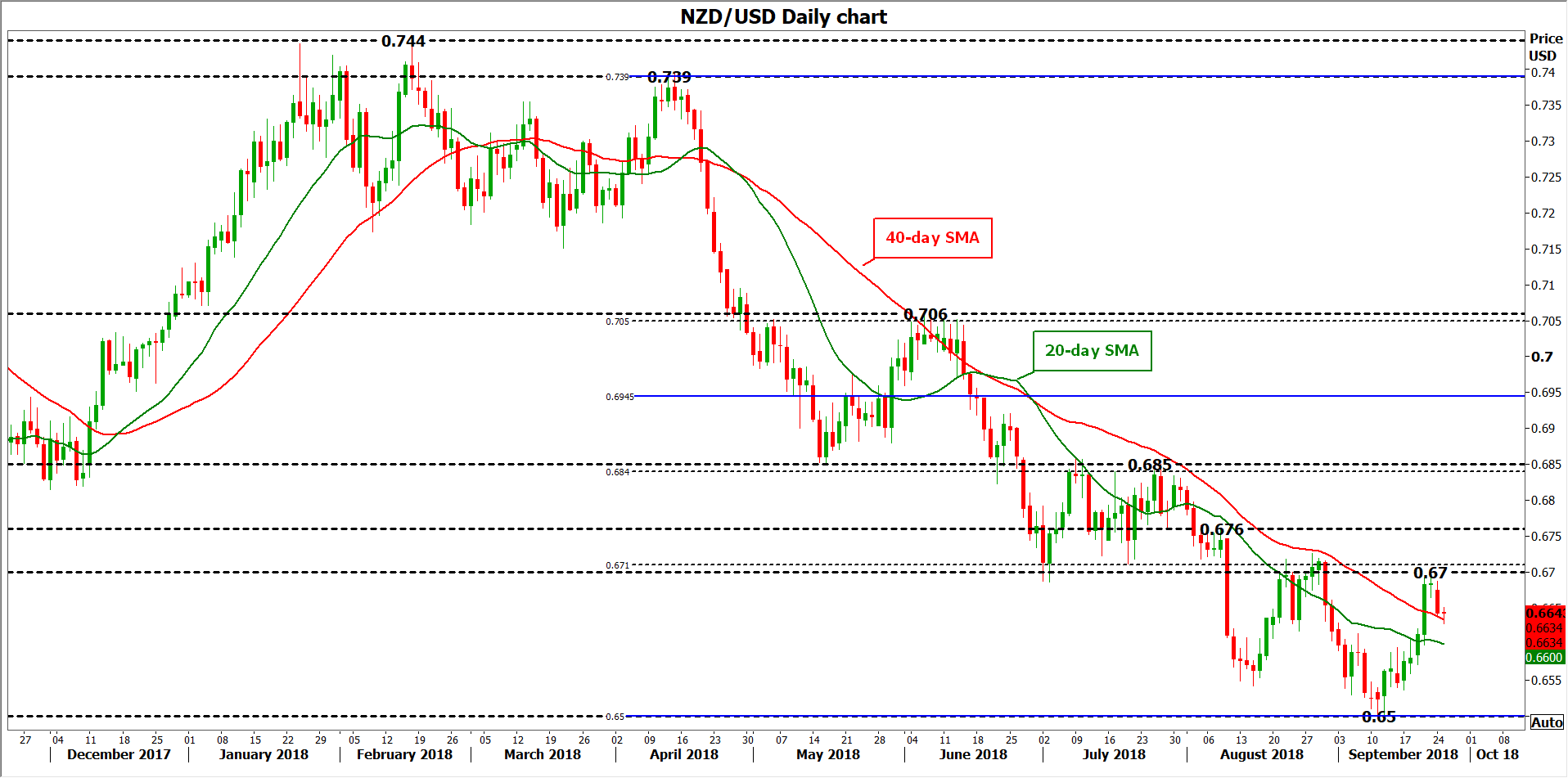
An upbeat take on the economic outlook is likely to boost NZDUSD, with resistance to advances possibly coming around the 0.6700 handle and the 23.6% Fibonacci retracement level of the downleg from April 13 to September 12 of 0.6710. More bullish movement would turn the attention to the 0.6760 barrier, identified by the peak on August 8, before heading towards the 38.2% Fibonacci of 0.6840.
On the downside, and in case of a cautious RBNZ that expresses concerns about the growth outlook, kiwi/dollar is expected to lose more ground. Initial support to declines could come from the zone around the 40- and then the 20-day simple moving averages (SMAs) at 0.6630 and 0.6600 respectively. The two-and-a-half-year low of 0.6500 from September 11 lies not far below and would be eyed in case of steeper declines.
Pound Best Performer On MPC Vlieghe’s Rate Forecasts
Here are the latest developments in global markets:
FOREX: The Japanese yen remained under pressure versus the US dollar as the 10-year US government bond yields reached fresh 4 ½-year highs at 3.10%. Dollar/yen returned to 112.88 (+0.08%) after peaking as high as 112.96 early today, the highest since July 19, while the dollar index stood flat at 94.16. Following somewhat dovish comments by the ECB chief economist Peter Praet, euro/dollar dropped to a low of 1.1731 before crawling up to 1.1762 (+0.12%). Praet offset hawkish remarks by the ECB chief Mario Draghi made yesterday, saying today that inflation needs further accommodation before reaching the 2% ECB price target. Note that the eurozone headline CPI arrived at 2.0% y/y in August, though the core equivalent appeared at 1.0%. Flash CPI readings for September are scheduled to come out on Friday. Euro/yen topped at 132.96 before slipping to 132.75 (+0.18%). The pound outperformed its major counterparts, trading higher at 1.3144 (+0.19%) against the dollar and at 148.37 (+0.29%) versus the yen. Against the euro, the pound was also in a better position gaining 0.08%. The upside in the British currency strengthened even further today after the BoE MPC member, Gerjan Vlieghe recommended one or two rate hikes a year assuming that productivity growth and thus wages improve. Still, his view is not much different from the BoE's gradual rate hike approach. In antipodean currencies, the trade-sensitive aussie/dollar and kiwi/dollar were struggling to recover as escalated trade tensions and particularly China's refusal to resume trade talks with the US, kept investors cautious in the market. The former was last seen lower at 0.7246 (-0.08%), while the latter hovered around 0.6643 (-0.02%). Dollar/loonie was moving sideways at 1.2952. In emerging markets, dollar/lira changed hands lower at 6.11 (-0.41%). The Turkish lira recouped part of earlier losses in the wake of news that US and Turkish officials will meet this week to discuss the fate of a US pastor on trial in Turkey.
STOCKS: European stocks were in the green at 1050 GMT, with the pan-European STOXX 600 and the blue-chip Euro STOXX 50 trading higher by 0.52% and 0.38% respectively, led by energy and technology. The German DAX 30 rose by 0.34%, the French CAC 40 climbed by 0.36%, and the British FTSE 100 was up by 0.43%. The Italian FTSE MIB was the best performer, gaining 1.35%. In Asia, equities closed mixed, with Japanese indices finishing the session higher and Chinese and South Korean stocks finishing lower. In the US, futures tracking S&P 500, Nasdaq 100 were heading up, pointing to a positive open.
COMMODITIES: Oil prices were in bullish mode for the third consecutive day as OPEC and Russia seemed so far to be rejecting calls from the US to raise output in order to offset supply shortages in Iran, the third largest OPEC producer. Meanwhile, the OPEC Secretary General, Mohammad Barkindo, said during an event in Madrid organized by the Spanish oil and gas company Cepsa that global demand for energy is projected to increase by 33% to 2040. WTI crude surged by 0.60% to $72.51/barrel but stood below the 2 ½ -month high of 72.74 reached yesterday. Brent crude rallied by 1.0% to a 4-year high of 82.20. In precious metals, gold edged up to $1,199.6/ounce (+0.12%), remaining within the range it has traded in sinceAugust 23.
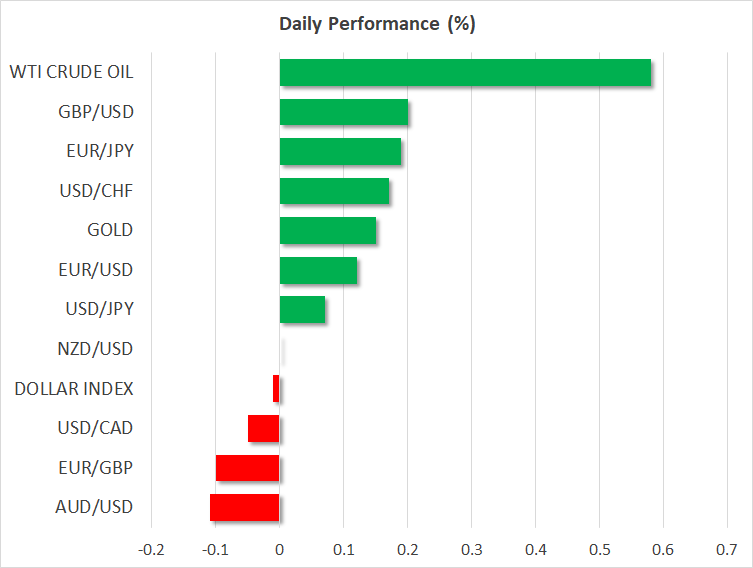
Day Ahead: US consumer confidence the major release ahead of a quiet day; trade negotiations eyed
In a relatively quiet day in terms of data releases, the US CaseShiller house price index and the Conference board consumer confidence index will come under the spotlight. Yet any potential trade headlines could prove of more importance as investors are eagerly waiting to see how far the US and China can stretch their trade dispute. Regarding NAFTA, reports suggest that informal discussions between Canada and the US will take place during the UN meeting in New York on Tuesday. Also, in New York, US President Donald Trump will be having a meeting with Japanese PM Shinzo Abe to discuss trade. Note that Trump considers Japan as his next trade war target.
Out of the US, at 1300 GMT, the CaseShiller indices gauging house prices during the month of July will be made public, while data on consumer confidence for the month of September will be released at 1400 GMT. The consumer confidence index is expected to rise to 132.2 from 133.4 before. Furthermore, the US Federal Reserve's Federal Open Market Committee (FOMC) starts its two-day meeting on interest rates today, due to make its rate announcement on Wednesday.
In energy markets, investors will be waiting for the API weekly report to show changes in US crude oil inventories at 2030 GMT.
In addition, later in the day, New Zealand trade balance for December is scheduled for release at 2245 GMT.
In terms of public appearances, at 14:40 ECB Board Member Benoit Coeure will be participating at the 3rd ECB Annual Research Conference in Frankfurt.
USDTRY Moves Further Down On Easing US/Turkey Political Tensions
Turkish lira is regaining traction on hopes of solution of current political dispute between Turkey and the US over imprisoned US pastor.
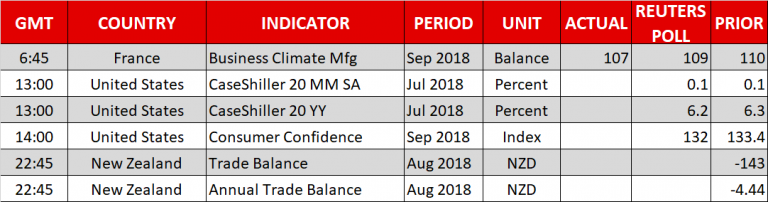
The USDTRY pair holds in red for the second straight day and pressures important support at 6.0420 (daily cloud top) which guards another pivotal support at 6.0093 (post rate hike low).
Lira's sentiment improved after bigger than expected rate hike by CBRT, as well as government's new economic growth program.
Solution of political issue would further ease pressure on lira, additionally boosted by US sanctions to Turkey and open way for further recovery.
Break below 6.0093 is needed to spark further strength of lira and open next key supports at 5.8097 (daily cloud base) and 5.6875 (16 Aug low of sharp pullback from new historical high of USDTRY pair).
Bearish setup of 10/20/30SMA's and strengthening bearish momentum support scenario.
Res: 6.1870, 6.2256, 6.2744, 6.3306
Sup: 6.0420, 6.0093, 5.9223, 5.8097
Crude Oil Surges In Anticipation Of Tighter Supply
Crude oil gets political
Tightening supply is pushing oil prices higher. The USA has sanctioned Iranian crude exports, while at home capacity constraints and pipeline bottlenecks are tightening, and inventories have hit their lowest level since 2015. This, despite US crude production reaching an all-time high June. OPEC and exporting countries such as Russia are discussing raising output to counter the falling supply from Iran, but raising 1.3 million extra barrels per day is not easy. Saudi Arabia and Russia recently decided against additional production increases.
They are defying US President Trump's demands for lower prices. Oil-sensitive currencies have firmed as OPEC resists an output rise and Brent crude climbs through $80.66. Traders are forecasting $90 per barrel by years end and $100 by early 2019. We continue to see Brent outperform WTI yet rise, as commodity curves are increasingly bullish. Which in turn will support US energy companies earning outlook. Higher crude oil prices will have a negative effect on consumer discretionary as household spending slows.
Italian budget won't break Euro bank
Budget talks in Rome end on Thursday, and there is risk that it could exceed investors' expectations, putting additional pressure on the Euro. Early September estimates were 1.50% of GDP; recent estimates are 2% - still below the EU's 3% limit. Accordingly, we expect minimal impact on the EUR, as long as the 3% threshold is not breached. A 2% budget will be positive for Italian assets. Trading along 1.1742, EUR/USD is expected to approach the 1.1720 range short-term.
Is the budget realistic? Considering that Italy remains the second largest debt-bearing country (as a % of GDP) after Greece and 24% of its borrowings come from Eurozone states, we expect further opposition from the EU, which will either reject the spending plan or ask for looser fiscal policy, i.e. lower spending. Here's a wild card: Italy's ruling coalition is willing to implement a 15% flat tax and increase welfare for poor across the country.
If In Doubt, Look To The Fed For Direction
Tuesday September 25: Five things the markets are talking about
It's a return to the drawing board for many investors who are now back online beginning their holiday shortened Asian trading week.
Euro equities are trading mixed following a “get back to basics” Asian session as investors ponder the outlook for global trade and U.S politics.
The U.S dollar continues to hang tough, while stateside, Treasury yields consolidate atop of +3.1% while crude oil trades at a four-year high.
In Europe, Italian bonds rally as the country edges closer to delivering a budget.
Topping investors' agenda this week is today's two-day FOMC meeting, along with the Fed's updated forecasts and the chair's quarterly press conference (Sep 25-26).
Note: The market is looking for a third +25 bps rate hike and is pricing in another one for December. Investors await Fed chair Powell's views on trade and tariffs tomorrow.
1. Stocks mixed results
In Japan, the Nikkei rallied for a seventh consecutive session overnight, helped by gains in chip-related stocks that offset weakness in construction equipment manufacturers. The ‘big' dollar trading through ¥112 also helped to support overall sentiment. The index gained +0.3% to hit its highest print in more than eight-months.
Note: Both Hong Kong and South Korea indexes were closed for holidays on Tuesday.
Down-under, Aussie stocks traded flat overnight as an escalation in Sino-U.S trade tensions hit risk sentiment, while energy stocks rallied on a firmer oil prices. The benchmark dipped -0.1% on Monday.
In China, stock fell on Tuesday in their first trading session after fresh U.S tariffs on +$200B worth of Chinese imports began yesterday. At the close, the Shanghai Composite index was down -0.58%, while the blue-chip CSI300 index was down -1%.
In Europe, in early trade, regional bourses are being supported by stronger commodity prices and optimism over the Italian budget.
U.S stocks are set to open in the ‘black' (+0.1%).
Indices: Stoxx50 +0.3% at 3,419, FTSE +0.3% at 7,482, DAX +0.2% at 12,373, CAC-40 +0.2% at 5,486, IBEX-35 +0.4% at 9,550, FTSE MIB +0.5% at 21,450, SMI +0.3% at 8,972, S&P 500 Futures +0.1%
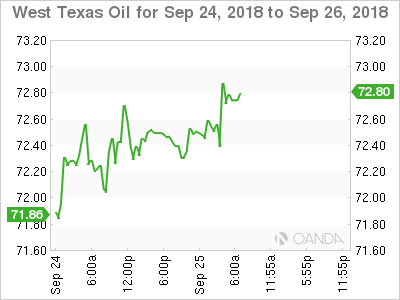
2. Oil hits new four-year highs as OPEC resists output rise, gold steady
Crude oil prices remain better bid after Brent hit a fresh four-year high amid looming U.S sanctions against Iran and an apparent reluctance by OPEC and Russia to raise output to offset the expected hit to supply.
With OPEC and Russia having ignored Trump's twitter pleas to increase production, coupled with U.S sanctions to hit Iran exports in November, should again provide support for oil ‘bulls' to seek higher price prints.
Brent crude futures are up +30c, or +0.4% from Monday's close at +$81.69 a barrel, a level not seen since November 2014. U.S West Texas Intermediate (WTI) crude futures are at +$72.28 a barrel, up +20c or +0.3% from yesterday's close.
The U.S from Nov. 4 will target Iran's oil exports with sanctions, and Trump continues to put pressure on governments and companies around the world to fall in line and cut purchases from Tehran.
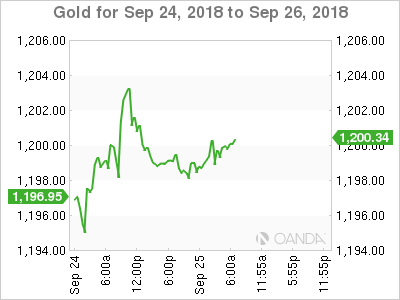
Ahead of the U.S open, gold prices trade steady as the market remains somewhat cautious ahead of today's two-day U.S Fed meeting, which could offer direction on future interest rate hikes. Spot gold is little changed at +$1,199.06 an ounce. U.S gold futures are also steady at +$1,203.70 an ounce.
Note: Gold has fallen -12% since hitting a peak in April against a backdrop of trade disputes and rising U.S interest rates.
3. Italian yields' fall on budget hopes, Bund yields rally
Italian borrowing costs rally, narrowing the gap with its German counterparts, on signs that Italy's coalition is likely to reach a compromise over next years budget. The ruling coalition is willing to keep the budget deficit below +2% of GDP.
In contrast, Germany's Bund yields continue to back-up, trading atop of their four-month highs, a day after ECB chief Mario Draghi pointed to a “vigorous” pick-up in underlying inflation.
In early trade, Italy's 10-year BTP yield has fallen -9 bps to +2.86%, narrowing the spread over the benchmark German Bund yield to around +232 bps, from around +245 bps late yesterday.
In Germany, the 10-year bund yields has rallied to a four-month high at +0.54%, a day after posting their biggest one-day jump since June.
Elsewhere, the yield on 10-year Treasuries has advanced +1 bps to +3.09%, its highest yield in almost 19-weeks. In the U.K, the 10-year Gilt yield has climbed +1 bps to +1.624%, , the highest in more than seven months.
4. Bitcoin's pullback quickens
In early trade, BTC has slid to new intraday lows, falling nearly -4% to +$6,400 in the overnight session, moving the cryptocurrency back toward this month's lows. The BTC ‘bears' continue to eye the +$6,000 region.
TRY has rallied +6% in the past 24-hrs to $6.1374 on reports that Turkish authorities are sending signals that an American pastor facing terrorism charges could be released next month.
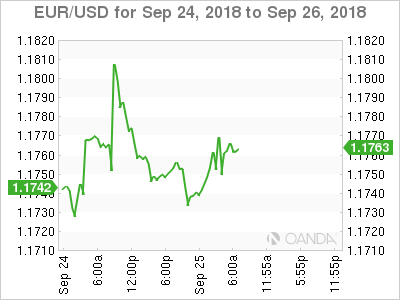
EUR/USD (€1.1762) softened slightly after comments from ECB's Praet noting that comments from Draghi yesterday were nothing new. The pair fell -30 pips to a low of €1.7133 following the comments.
Note: The ‘single unit' found support yesterday after ECB President Draghi said there has been a relatively vigorous pick-up in inflation.
5. Swedish PM Lofven ousted in no-confidence vote
Earlier this morning, Swedish PM Stefan Lofven lost a no-confidence vote in parliament and will step down after four-years in power, but with neither major political bloc holding a majority it remained unclear who will form the next government.
Note: Voters delivered a hung parliament in the Sept. 9 election with Lofven's center-left bloc garnering 144 seats, one more than the center-right opposition Alliance.
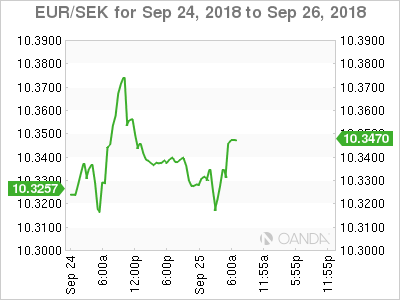
SEK is down -0.18% at €10.3374.
DAX Gains Ground As Investors Ignore New US-China Trade Tariffs
The DAX index has edged upwards in the Tuesday session, erasing the losses seen on Monday. Currently, the index is at 12,365, up 0.12% on the day. On the release front, German Wholesale Price Index jumped 0.3%, edging above the estimate of 0.2%. On Wednesday, the spotlight will be on the Federal Reserve, which is likely to maintain interest rates at a range between 2.00% and 2.25%.
The DAX was red-hot last week, posting gains of 3.1 percent. On Friday, the DAX touched 12,458, its highest level in September. However, risk appetite will be tested this week, as the U.S and China have upped the ante and imposed new tariffs on each other. On Monday, the U.S imposed tariffs on some $200 billion worth of Chinese goods, while China responded with tariffs of $60 billion on U.S products. There may be more headwinds ahead, as China sharply attacked the U.S, saying it had plunged “a knife to China’s neck” with the new tariffs. The Chinese have canceled trade talks with the Trump administration, and no new talks are likely to be held until the mood improves between the world’s two largest economies. Previous rounds of tariffs between the two economic giants have boosted the U.S dollar, but so far this week, equity markets are steady.
The normally cautious Mario Draghi had a hawkish message on Monday. Draghi was testifying before the European Parliament Economic and Monetary Affairs Committee. He said there had been a “relatively vigorous pick-up in underlying inflation”. With regard to the ECB’s forward guidance, Draghi said that the ‘”through the summer of 2019″ was a timeline in which conditions warrant a first rate increase. This means that the September meeting will be a live meeting, with many analysts predicting a rate hike in December.
EUR/USD – Euro Steady As German Inflation Within Expectations
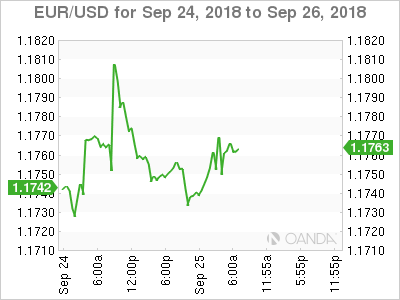
EUR/USD is drifting in the Tuesday session. Currently, the pair is trading at 1.1761, up 0.12% on the day. On the release front, German Wholesale Price Index jumped 0.3%, edging above the estimate of 0.2%. In the U.S, today's key indicator is CB Consumer Confidence, which is expected to climb to 132.2 points. On Wednesday, the spotlight will be on the Federal Reserve, which is likely to maintain interest rates at a range between 2.00% and 2.25%.
The euro punched past the 1.18 line on Monday. This followed hawkish remarks from ECB President Mario Draghi, who was testifying before the European Parliament Economic and Monetary Affairs Committee. Draghi said there had been a “relatively vigorous pick-up in underlying inflation”. With regard to the ECB's forward guidance, Draghi said that the ‘”through the summer of 2019″ was a timeline in which conditions warrant a first rate increase. This means that the September meeting will be a live meeting, with many analysts predicting a rate hike in December.
Trade tensions have escalated this week, with the U.S and China slapping tariffs on each other. On Monday, the U.S imposed tariffs on some $200 billion worth of Chinese goods, while China responded with tariffs of $60 billion on U.S products. There may be more headwinds ahead, as China sharply attacked the U.S, saying it had plunged “a knife to China's neck” with the new tariffs. The Chinese have canceled trade talks with the Trump administration, and no new talks are likely to be held until the mood improves between the world's two largest economies. Previous rounds of tariffs between the two economic giants have boosted the U.S dollar, but so far, investors have reacted calmly and have not dumped their euro assets in favor of the greenback.
USDJPY Looking To Challenge July High
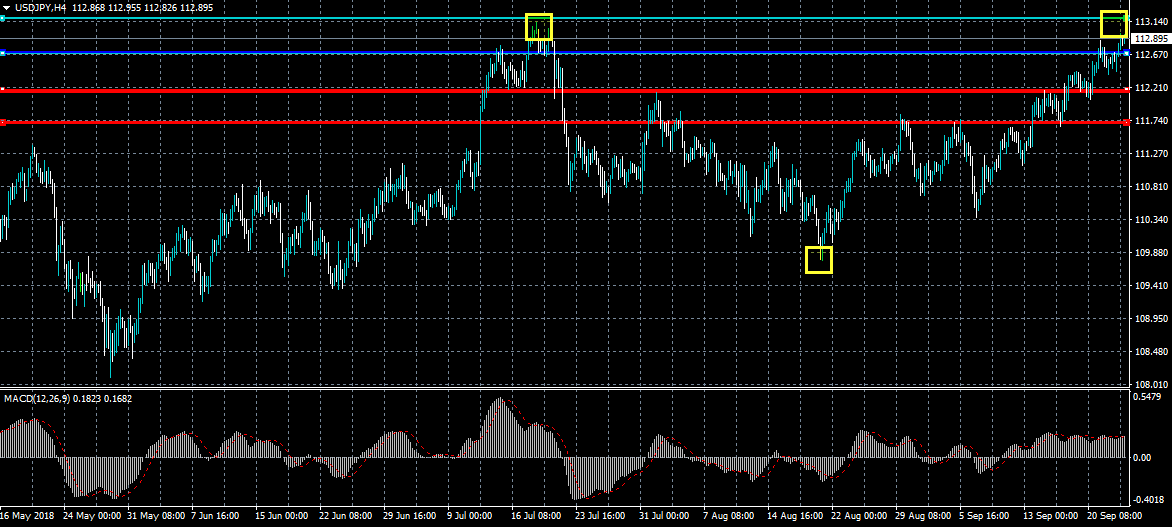
The US dollar has moved to a fresh monthly trading high against the Japanese yen on Tuesday, with price moving within touching distance of the 113.00 resistance level. Overall, the USDJPY pair remains bullish in the short and medium-term and looks to challenge the July 2018 trading high, at 113.17. A much larger bullish inverted head and shoulders pattern will be triggered if price moves above the 113.17 level.
The USDJPY pair is strongly bullish while trading above the 112.70 level, key resistance is now found at the 113.17 and 113.80 levels.
If the USDJPY pair moves below the 112.70 level, key support is found at the 112.20 and 111.80 levels.